• About

Sacred Cow Chips

Sacred Cow Chips

Tag Archives: Medicaid

Hillary’s “Fix”: Obamacare Squared

26 Wednesday Oct 2016

Posted by Nuetzel in Obamacare

≈ Leave a comment

Tags

Avik Roy, Bill Clinton, Block Grants, Christopher Jacobs, competition, Health Insurer Bailouts, Hillary Clinton, John C. Goodman, Marketplace Regulation, Medicaid, monopoly, Obamacare Exchanges, Obamacare Fixes, Pharmaceutical Patents, Public Option, Reimbursement Rates, Risk corridors, Sally Pipes, Single-Payer System, Wikileaks

hillarys-health-problem

One of Hillary Clinton’s “public positions” is that Obamacare needs a few “fixes”, a considerable understatement. Meanwhile, Wikileaks has revealed that she has “privately” rooted for the failure of Obamacare. For that reason, Bill Clinton’s recent slip-up, in which he portrayed Obamacare as a “crazy” system, had a certain Freudian quality. Indeed, Obamacare looks crazier every year, especially in the middle of premium-hike season.

One of Hillary’s so-called “fixes” is the creation of a “public option”, or health insurance offered by the government to compete on exchanges with private insurance. Private health insurers, with the expiration of the so-called “risk corridors”, do not have continuing access to the public purse to cover their losses; going forward, they must price coverage at rates covering the cost of their respective risk pools. The government, on the other hand, is likely to have pricing flexibility. If exercised, there will be little hope for private insurers to “compete” without bailout money. Health insurance coverage, then, is likely to devolve into a single-payer monopoly, and control over health care delivery will be increasingly monopolized as well.

Sally Pipes says the “public option” is a politically attractive way to make a single-payer system inevitable:

“But progressives face the same problem pushing single-payer they always have — the public won’t stand for it. So they’re dusting off an old idea that will get them to single-payer without using those words.“

So the path from Obamacare to a single-payer system is likely to involve a public option in one form or another. John C. Goodman points out that expanding Medicaid is one way to create a broad public option. Medicaid reimbursement rates are low, however, which is why many doctors refuse to accept patients with Medicaid coverage. Such might be the quality of future coverage under an “affordable” public option. And if Medicaid is enhanced so as to appeal to middle class families, it will be correspondingly more expensive. But for whom? More than likely, the tab will be paid by a combination of insureds and taxpayers. And more than likely, the number of competing Medicaid plans (most of which are now privately offered and managed (e.g., Centene Corporation)) will dwindle.

Christopher Jacobs says that when Obamacare became law, health insurers had every expectation that they’d be bailed out by the government indefinitely. Continuing reimbursement for losses was never guaranteed, however. The pressure to backstop the insurers’ profitability will be stronger as the debate over “fixing” Obamacare advances. But as Jacobs warns, ongoing bailouts mean that these insurers are essentially controlled by the government. The private insurers would essentially become heavily-regulated entities managing the operational details of a de facto single-payer system.

So, there are three distinct possibilities under a Hillary Clinton presidency, assuming she can get any of them though Congress: 1) a public option with no private bailouts; 2) a public option with ongoing bailouts; and 3) no public option with ongoing bailouts. Ultimately, all of these scenarios are likely to devolve toward a de facto single-payer system. So we will have monopoly, central control of health care, and/or bailouts. Who was it that said government is the way we wreck things together?

Hillary has some other “fixes” in mind. Some of these involve more regulation of coverage and pricing, such as mandatory provision of three free “sick” visits with a provider each year and in-network pricing for emergency procedures. These steps will add to the cost burden on private insurers.

Regulating drug companies more heavily is another favorite Hillary Clinton theme, but regulation is perhaps the primary reason why the drug development process is so lengthy and costly. The theory that government will be more effective at negotiating drug prices than insurers is suspect. Outright price regulation is likely to mean reduced availability of various medicines. Patent reform and an expedited drug approval process would be a more effective approach to reducing drug prices.

Clinton has also proposed a tax credit for out-of-pocket health care costs exceeding 5% of income. We’ll need higher tax rates, lower deductions and credits elsewhere, or higher deficits to pay for this one.

Finally, Hillary wants to expand eligibility for Medicare to anyone 55 and older, but as Goodman explains, the kind of Medicare Advantage plans that would be made available to “near seniors” under this proposal are similar to those already offered by private insurers, and at lower cost, and premia for these plans are often payable with pre-tax dollars, or the buyers may be eligible for tax subsidies. This proposal might sound appealing, but it is unlikely to accomplish anything except to create more administrative overhead, regulation and diminish existing offerings.

Obamacare has injected a high degree of central planning into the health care system with disastrous results. It has fallen far short of its own objectives for reducing the number of uninsured, “bending the cost curve” downward, and avoiding disruptions to existing coverage and patient-doctor relationships. Choices have narrowed in terms of coverage options and within networks. Obamacare has imposed unnecessary costs on providers and encouraged a monopolization of health care delivery, hardly a prescription for affordability. And Obamacare has proven to be a budget buster, contrary to the advance hype from its proponents.

I remember standing in a pharmacy shortly after Obamacare was enacted, and I heard a sharp-voiced leftist telling a clerk that Obamacare was just a bridge to single-payer health care. I tried to mind my own business, thinking it unproductive to engage such an individual in public. This fellow was quite pleased with the clever deception that was Obamacare. It was never a secret that the progressive left hoped single-payer would be the ultimate outcome, but it’s interesting to witness their discomfort with the way things are unfolding. Surely they must have known that if “fixes” were necessary, something would have to be broken. Perhaps they thought the politics would get simpler, but the shortcomings of the health care law have inflicted too much pain and shame.

I’m tempted to say that the health care system can be improved only by doing precisely the opposite of everything Clinton has proposed. There’s some truth in that, but it’s not quite that simple. The path to better and more affordable health care is to end the dominant role of third-party payers, placing responsibility on price-sensitive consumers, allowing a variety of choices in coverage, ending tax preferences, reducing regulation and encouraging real competition in the markets for coverage and medical care. Reform of the patent system could introduce more competition to markets for pharmaceuticals. The Medicaid system will have to be relied upon to cover those who otherwise can’t be insured at affordable rates. Proposals for federal funding of Medicaid through block grants to the states is an avenue for achieving greater efficiency and better health care outcomes.

Hillary Clinton’s “fixes” are all likely to exacerbate the worst failings of Obamacare for consumer-patients and taxpayers. More federal spending commitments will not solve the structural problems embedded in the health care law. It will magnify them. The hope among the progressive left remains that single-payer health care will evolve out of the Obamacare system once it is “fixed”. And what will we get? More complete monopolies in coverage and care, higher prices, central regulation, narrowed choice, waiting lists, denial of care, and some combination of higher taxes and deficits. In other words, a more radical version of Obamacare.

Medicaid and Value Mislaid

12 Friday Jun 2015

Posted by Nuetzel in Obamacare

≈ 1 Comment

Tags

Amy Finkelstein, Earned Income Tax Credit, Erzo F.P. Luttmer, Implicit insurance, Marginal Revolution, Medicaid, Megan McArdle, Moral Hazard, Nathaniel Hendren, Obamacare, Oregon Health Insurance Experiment, Redistribution, Relative Value Units, Uncompensated care, Welfare value

Medicaid-Agency-Cartoon

A new paper on the MIT Econ department web site finds that the “welfare benefit to recipients from Medicaid per dollar of government spending range from $0.2 to $0.4, depending on the framework ….” Those estimates are from “The Value of Medicaid: Interpreting Results from the Oregon Health Insurance Experiment” by Amy Finkelstein, Nathaniel Hendren, and Erzo F.P. Luttmer (Hat Tips: Marginal Revolution, John Crawford). A major share of the increase in the number of insured individuals under Obamacare stems from Medicaid enrollments, so the efficacy of the program is of great interest as the nation considers possible changes to the health care law.

The value of Medicaid to recipients is low in part because the coverage is incremental to the uncompensated medical care they would have received without coverage. So perhaps it’s not too surprising that if “… Medicaid recipients had to pay the government’s average cost of Medicaid, they would rather be uninsured.” That’s why I think some of the commentary on this result is a little unfair, such as the way it’s presented by Megan McArdle. There are clearly other reasons why Medicaid receives a low valuation by recipients, however. For example, the authors find that the program entails substantial costs of moral hazard, which may mean that recipients are in poor health relative to reimbursement levels, take risks that they would avoid in the absence of coverage, or simply over-utilize services for which they would be unwilling to pay, even if the cash were made directly available. While it doesn’t receive much focus from the authors, low reimbursement rates discourage providers from accepting Medicaid patients. That would certainly reduce one’s willingness to pay for the coverage.

Finkelstein, Hendren and Luttmer estimate that 40% to 80% of Medicaid’s welfare value derives from “a transfer component, as opposed to its ability to move resources across states of the world.” The transfers go to providers who, in the absence of Medicaid coverage, would offer “implicit insurance” in the form of uncompensated care. As noted above, that’s a good thing. Providers should be compensated rather than relied upon as a charities, though there are strong indications that compensation is inadequate.

The authors also estimate the value of Medicaid as a “redistribution tool” relative to the earned income tax credit (EITC). At best, they find that recipients would slightly prefer Medicaid cuts to equivalent reductions in the EITC (though the comparison suffers from some conceptual shortcomings). Unsurprisingly, the outcome depends upon how highly the “transfers” to health care providers are valued by enrollees. So the program seems to do poorly in the eyes of recipients, who would likely prefer outright transfers of cash. I would speculate that many recipients would prefer a voucher with which they could purchase coverage levels of their choice, retaining any excess not spent.

The “Value of Medicaid” study suggests that the program is unsuccessful in delivering value to recipients and taxpayers. Obamacare reform should include fundamental changes to the Medicaid program, measures that restore individual choice and the private market for health coverage, and provisions to increase competition in the health care and insurance markets. Eliminating prohibitions on the sale of health insurance across state lines would be a good start. Reforms should also combat excessive regulation of health care providers, such as eliminating the electronic health records mandate and reforming the inflexible system of compensation based on relative value units. Market-oriented reforms and competition can reduce costs and make health care more affordable, aiding in the delivery of greater benefits to all segments of society.

Obamacare’s Verity Disparity

26 Wednesday Nov 2014

Posted by Nuetzel in Uncategorized

≈ Leave a comment

Tags

ACA, Clive Crook, deceit, Jonah Goldberg, Jonathan Gruber, King vs. Burwell, Medicaid, medical device tax, Obamacare, Scott Atlas, Timothy Carney

156570_600

Increase demand for health care and reduce the cost of care… that was the the major thrust of the Obamacare sales job. It didn’t take an MIT economist to realize that the promise would be unattainable without major steps to enhance the supply of medical care. Unfortunately, nearly everything in the ACA and its implementation ensured the opposite, from the medical device tax to compliance burdens on providers and low reimbursement rates. Given the supply constraints, it should be no surprise that access to care among the newly insured is limited. Scott Atlas notes that Obamacare placed an emphasis on general care rather than specialist care, despite the growing need for specialists to serve the needs of an increasingly elderly population:

“Virtually all patients with serious diseases today are managed by specialists and with advanced technology. For seniors, visits to specialists have increased from 37% of visits two decades ago to 55% today. And that’s appropriate, because those are the doctors who have necessary training and expertise to use the complex diagnostic tests and devices, state-of-the-art procedures, and novel drugs of modern medicine. … Fittingly, Americans unambiguously prioritize the latest medical technology.”

Atlas also points out that most of the newly insured obtained their coverage via Medicaid:

“Medicaid is already refused by more than half of doctors across America, according to 2013 data from a 2014 Merritt Hawkins survey. Likewise, more than 20% of primary care doctors already accept no new Medicare patients, five times the percentage who refuse new privately insured patients.

In 2012 alone, CMS reported that almost 10,000 doctors opted out of Medicare, tripling from 2009. And, counter to the administration’s demonization of private insurers, it is Medicare that consistently ranks at the top of the charts for the highest rates of claim refusals….”

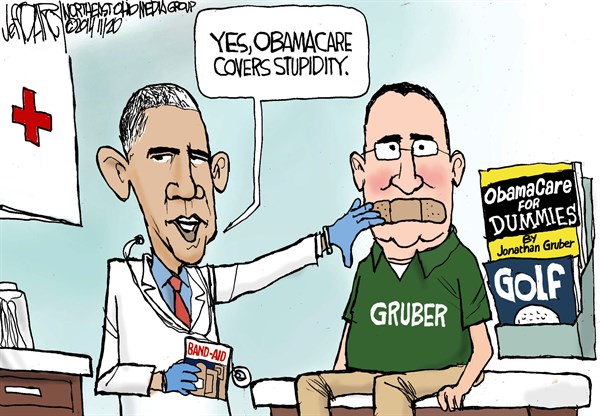
In describing the campaign to make Obamacare law, the pejorative “sales job” never seemed more appropriate in light of the recent revelations provided by the Jonathan Gruber videos. He is the aforementioned MIT economist, and his statements indicate that the law’s team of elite architects knew full well that selling it would require deceit. Here are links to two perspectives on this crew’s dishonesty and contempt for voters: first, Clive Crook provides a Democrat voter’s perspective on certain tendencies in the party that he finds regrettable:

“This syndrome of Democratic disdain, I think, has two main parts. First, liberals have an exaggerated respect for intellectual authority and technical expertise. Second, they have an unduly narrow conception of the values that are implicated in political choices. These things come together in the conviction that if you disagree with Democrats on universal health insurance or almost anything else, it can only be because you’re stupid.

Voters recognize this as insufferable arrogance and, oddly enough, they resent it. Democrats who might be asking where they went wrong in the mid-term elections — not that many of them are — ought to give this some thought. The conviction that voters are stupid, however, isn’t just bad tactics. It’s also substantively wrong.”

Jonah Goldberg offers a view of the Obamacare deceit from the right:

“Speaking of transparency, the Washington Examiner’s Timothy Carney notes that Obama frequently attacked the ‘special interests’ opposed to the bill even though the very same interests supported the bill thanks to the generous bribes — er, ‘subsidies’ — included therein. From the Rose Garden in 2009, Obama attacked drug companies for opposing the bill, even though he knew the drug lobby helped craft it. (Carney notes, ‘Behind closed doors, the White House apologized to drugmakers for that line, blaming a ‘young speechwriter.’’)”

Here is an earlier SCC post on the Gruber videos, including the damage wrought by Gruber to the government’s argument in the upcoming King v. Burwell case to be heard by the Supreme Court next year.

Obamacare Shills Try Heroic Measures

01 Saturday Nov 2014

Posted by Nuetzel in Uncategorized

≈ 1 Comment

Tags

ACA, Business Week, CHIP, Cronyism, Death Spiral, Employer Sponsored Plans, Forbes, Government Failure, Health Care Exchanges, Mandates, Medicaid, Obamacare, USA Today, Welfare Programs

obama-health-care

Die-hard Obamacare supporters are in full denial over the lousy results of the health care plan in its first year. They’re tone deaf, living a delusion. This piece from Forbes.com notes that the Affordable Care Act (ACA) has been an abject failure thus far on six of seven major counts, and even the one “success” is terribly blemished. Close to 90% of the increase in the number of insured is due to expansion in the Medicaid and state Children’s Health Insurance Program roles. Both of those welfare programs predate the ACA and certainly could have been expanded without Obamacare and its collateral damage to existing health plans and the health care industry. In fact, according to Business Week, less than half of physicians now accept Medicaid, so it’s not always easy for those “newly insured” individuals to gain access to actual care.

In fact, Medicaid patients are not the only ones with access problems. This USA Today article linked by Forbes notes that physicians are limiting the number of Obamacare exchange-covered patients they’ll accept. After the disastrous unraveling of the “if-you-like-your-plan-you-can-keep-it” fiction, it was revealed that many of the policies foisted upon the “previously-insured-but-no-longer” group through Obamacare exchanges offered severely limited provider networks. If you liked your doctor, you might well have lost your doctor.

For the majority who do not qualify for taxpayer subsidies under Obamacare, the health insurance premia on policies acquired on the exchanges have risen drastically. This problem is covered in the Forbes article. Far less expensive short-term plans are being offered by insurers as an alternative to Obamacare, but they are only renewable if the insured remains healthy. It is precisely these kinds of circumstances that might devolve into a death spiral for Obamacare: an increasingly sick risk pool and universal rating may lead to accelerating premium hikes for the exchange policies.

So, prospects for improvement under the ACA are quite bleak. We’ve seen a botched rollout of the Obamacare website, the chief enrollment vehicle, which is still problematic; a wrecked individual market with policies cancelled and replaced by coverage with limited provider networks; a medical device industry battered by new taxes; a negative impact on full-time employment as firms reduce hours to avoid coverage requirements; expanded welfare programs with a concomitant burden on taxpayers; increased emergency room utilization; physicians opting out due to inadequate reimbursement and high compliance costs; healthy individuals opting out and sick individuals opting in; higher premia with more increases on the way and the prospect of an insurance death spiral; and we’ve seen arbitrary exemptions carved out for various cronies of the Obama administration all along the way. Oh, and we’ve seen lies, delays, and every effort to back-load costs and front-load benefits, an implementation governed by political considerations rather than improving health care. The next shoe to drop is likely to be widespread cancellation of employer-sponsored coverage as the ACA coverage mandate hits employers in 2015.

Desperate propaganda continues to flow, but that can’t change the fact that Obamacare is terrible policy with results to prove it. Here is government failure.

Newer posts →
Follow Sacred Cow Chips on WordPress.com

Recent Posts

  • The Case Against Interest On Reserves
  • Immigration and Merit As Fiscal Propositions
  • Tariff “Dividend” From An Indigent State
  • Almost Looks Like the Fed Has a 3% Inflation Target
  • Government Malpractice Breeds Health Care Havoc

Archives

  • January 2026
  • December 2025
  • November 2025
  • October 2025
  • September 2025
  • August 2025
  • July 2025
  • June 2025
  • May 2025
  • April 2025
  • March 2025
  • February 2025
  • January 2025
  • December 2024
  • November 2024
  • October 2024
  • September 2024
  • August 2024
  • July 2024
  • June 2024
  • May 2024
  • April 2024
  • March 2024
  • February 2024
  • January 2024
  • December 2023
  • November 2023
  • August 2023
  • July 2023
  • June 2023
  • May 2023
  • April 2023
  • March 2023
  • February 2023
  • January 2023
  • December 2022
  • November 2022
  • October 2022
  • September 2022
  • August 2022
  • July 2022
  • June 2022
  • May 2022
  • April 2022
  • March 2022
  • February 2022
  • January 2022
  • December 2021
  • November 2021
  • October 2021
  • September 2021
  • August 2021
  • July 2021
  • June 2021
  • May 2021
  • April 2021
  • March 2021
  • February 2021
  • January 2021
  • December 2020
  • November 2020
  • October 2020
  • September 2020
  • August 2020
  • July 2020
  • June 2020
  • May 2020
  • April 2020
  • March 2020
  • February 2020
  • January 2020
  • December 2019
  • November 2019
  • October 2019
  • September 2019
  • August 2019
  • July 2019
  • June 2019
  • May 2019
  • April 2019
  • March 2019
  • February 2019
  • January 2019
  • December 2018
  • November 2018
  • October 2018
  • September 2018
  • August 2018
  • July 2018
  • June 2018
  • May 2018
  • April 2018
  • March 2018
  • February 2018
  • January 2018
  • December 2017
  • November 2017
  • October 2017
  • September 2017
  • August 2017
  • July 2017
  • June 2017
  • May 2017
  • April 2017
  • March 2017
  • February 2017
  • January 2017
  • December 2016
  • November 2016
  • October 2016
  • September 2016
  • August 2016
  • July 2016
  • June 2016
  • May 2016
  • April 2016
  • March 2016
  • February 2016
  • January 2016
  • December 2015
  • November 2015
  • October 2015
  • September 2015
  • August 2015
  • July 2015
  • June 2015
  • May 2015
  • April 2015
  • March 2015
  • February 2015
  • January 2015
  • December 2014
  • November 2014
  • October 2014
  • September 2014
  • August 2014
  • July 2014
  • June 2014
  • May 2014
  • April 2014
  • March 2014

Blogs I Follow

  • Passive Income Kickstart
  • OnlyFinance.net
  • TLC Cholesterol
  • Nintil
  • kendunning.net
  • DCWhispers.com
  • Hoong-Wai in the UK
  • Marginal REVOLUTION
  • Stlouis
  • Watts Up With That?
  • Aussie Nationalist Blog
  • American Elephants
  • The View from Alexandria
  • The Gymnasium
  • A Force for Good
  • Notes On Liberty
  • troymo
  • SUNDAY BLOG Stephanie Sievers
  • Miss Lou Acquiring Lore
  • Your Well Wisher Program
  • Objectivism In Depth
  • RobotEnomics
  • Orderstatistic
  • Paradigm Library
  • Scattered Showers and Quicksand

Blog at WordPress.com.

Passive Income Kickstart

OnlyFinance.net

TLC Cholesterol

Nintil

To estimate, compare, distinguish, discuss, and trace to its principal sources everything

kendunning.net

The Future is Ours to Create

DCWhispers.com

Hoong-Wai in the UK

A Commonwealth immigrant's perspective on the UK's public arena.

Marginal REVOLUTION

Small Steps Toward A Much Better World

Stlouis

Watts Up With That?

The world's most viewed site on global warming and climate change

Aussie Nationalist Blog

Commentary from a Paleoconservative and Nationalist perspective

American Elephants

Defending Life, Liberty and the Pursuit of Happiness

The View from Alexandria

In advanced civilizations the period loosely called Alexandrian is usually associated with flexible morals, perfunctory religion, populist standards and cosmopolitan tastes, feminism, exotic cults, and the rapid turnover of high and low fads---in short, a falling away (which is all that decadence means) from the strictness of traditional rules, embodied in character and inforced from within. -- Jacques Barzun

The Gymnasium

A place for reason, politics, economics, and faith steeped in the classical liberal tradition

A Force for Good

How economics, morality, and markets combine

Notes On Liberty

Spontaneous thoughts on a humble creed

troymo

SUNDAY BLOG Stephanie Sievers

Escaping the everyday life with photographs from my travels

Miss Lou Acquiring Lore

Gallery of Life...

Your Well Wisher Program

Attempt to solve commonly known problems…

Objectivism In Depth

Exploring Ayn Rand's revolutionary philosophy.

RobotEnomics

(A)n (I)ntelligent Future

Orderstatistic

Economics, chess and anything else on my mind.

Paradigm Library

OODA Looping

Scattered Showers and Quicksand

Musings on science, investing, finance, economics, politics, and probably fly fishing.

  • Subscribe Subscribed
    • Sacred Cow Chips
    • Join 128 other subscribers
    • Already have a WordPress.com account? Log in now.
    • Sacred Cow Chips
    • Subscribe Subscribed
    • Sign up
    • Log in
    • Report this content
    • View site in Reader
    • Manage subscriptions
    • Collapse this bar
 

Loading Comments...