• About

Sacred Cow Chips

Sacred Cow Chips

Tag Archives: National Endowment for the Arts

State Aesthetics: Taxes for Art and Dogma

07 Tuesday Jan 2025

Posted by Nuetzel in Art & Politics, Subsidies

≈ Leave a comment

Tags

Agitprop, Americans for the Arts, Arts Education, Arts Funding, Corporation for Public Broadcasting, crowding out, DOGE, Exclusivity, Externalities, National Endowment for the Arts, Propaganda, Public goods, Public Radio, Samuel Andreyev, Subsidies, Thomas Jefferson
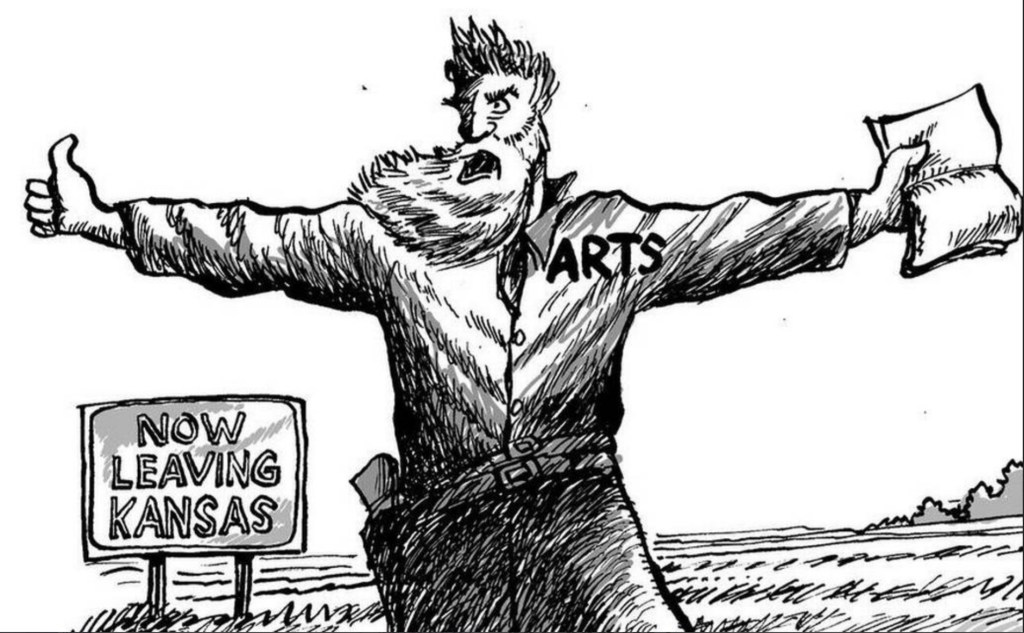
In a post a few years ago entitled “The National Endowment for Rich Farts”, I discussed a point that should be rather obvious: federal funding of the arts too often subsidizes the upper class, catering to their artistic tastes and underwriting a means through which they conduct social and professional networking. The topic is back in the news, with reports that the incoming Trump Administration, at the recommendation of the Department of Government Efficiency (DOGE), will attempt to eliminate funding for the Corporation for Public Broadcasting.

Great Big Stuff and Crowding Out

To opponents of federal arts funding, public radio is probably the bête noire of arts organizations due to its left-wing political orientation and the general affluence of its subscriber base. However, public arts funding goes way beyond subsidies for public radio.

Large nonprofits receive the bulk of government arts funding. Despite claims to the contrary, these organizations won’t go broke without the gravy provided by public funding. The federal government contributes about 3% of the revenue taken in by non-profit arts organizations, according to Americans For the Arts. These organizations are already heavily subsidized: their surpluses are tax exempt and private contributions are tax deductible. Tax deductions are worth more to those in high income-tax brackets, and involvement in such visible organizations is highly prized by elites.

Furthermore, there is no evidence that additional government funding “multiplies” private giving. If anything, increases in public funding reduce private giving (and see here).

Public Funds for Private Gain

It’s often argued that government should subsidize the arts because art has the qualities of a public good, but that’s a false premise. A good can be classified as “public” only when its consumption is non-exclusive and non-rivalrous. Can individuals be excluded from enjoying music? Of course. Can they be excluded from viewing a theatrical performance, a film, or any other piece of visual art? Generally yes, and art exhibitions and artistic performances are nearly always subject to paid and limited attendance.

In some contexts art is, or can be made, less excludable. Architecture can be admired (or detested) by anyone on the street. So can public monuments and street art. A concert or play can be performed free of charge, perhaps at a large, outdoor venue. Amplification and large video monitors can make a big difference in terms of non-exclusion. Museums can offer admission to the general public at no charge. And we can broaden the definition of a work to include copies or reproductions that might be available via public display or broadcast (on NPR!).

All these steps will help increase exposure to the arts. But you can’t make it mandatory. People will always self-exclude because they can. So, in which cases should taxpayers bear the costs of art, and of making it less exclusive? On the spectrum of legitimate functions of government, it’s hard to rank this sort of activity highly.

A claim less absurd than the public goods argument is that art has some positive spillover effects, or externalities. It should therefore be subsidized or underwritten with public funds lest it be underprovided. Unfortunately, the spillover effects of a piece of art (where relevant) are not always positive. After all, tastes vary considerably. One man’s art can be another man’s annoyance or provocation. This undermines the case for public funding, at least for art that is controversial in nature.

Perhaps a better interpretation of art externalities is that exposure to the arts has positive spillover effects. Thus, additional art confers benefits to society above and beyond the edification of those exposed to it. Perhaps it makes us nicer and more interesting, but that’s a highly speculative rationale for public funding.

Less questionably, more art and more exposure to the arts does enrich society in ways that have nothing to do with external benefits. Culture and arts are by-products of normal social interactions between private individuals. The benefits of art exposure (and art education) are largely accrued privately. When artistic knowledge is shared to nourish or broaden one’s network, the benefits flow from private social interactions that arise naturally, rather than as a consequence of phantom external benefits.

Public Funding and Agitprop

The selection of recipients and projects for government grants or subsidies is especially prone to influence by entrenched political interests. That is indeed the case when it comes to federal agencies that offer grants for the arts.

The same danger looms when government provides a venue or manages aspects of a presentation of art, including curation of content. It’s an avenue through which art can become politicized. The problem, however, is not so much that a particular work might have political implications. As Samuel Andreyev, a Canadian composer says:

“Like any other subject, it is possible for political subjects to be handled sensitively by an artist, provided there is a strong enough element of abstraction and symbolism so that the work does not become merely journalistic.”

Andreyev makes a good point, but government funding and direction can create incentives to politicize art, encouraging more blatant expressions of political viewpoints at the expense of taxpayers.

I’ve certainly admired art despite subtle political implications with which I differed. One can hardly imagine a treatment of the human condition that would not invite tangential political commentary. Still, politicization of art should always be left as a private exercise, not one over which the government of a free society wields influence.

Do Markets Undervalue Art?

What about the artists themselves? The premise that artists deserve subsidies relies on the questionable presumption that the value of their work exceeds its commercial or market value. Thus, taxpayers are asked to pay handsomely for art that is not valued as highly by private buyers.

Artists who benefit from government arts funding are often well established professionally. Less fortunate artists scrape by, finding what market they can while working side gigs. In fact, many less celebrated artists work at their craft on a part-time basis while earning most of their income from day jobs. Should the government support these artists, or artists having few opportunities to promote their work?

It’s not clear that public funding should override the private market’s basis of valuation for established or unestablished artists. However, some government funding finds its way into less celebrated corners of the art world. This report uses data at the census tract level to show that arts organizations located in low income tracts, while receiving less, still get a disproportionate share of federal grant dollars relative to their share of the population. This finding should be viewed cautiously, as data at this level of aggregation has limitations. The findings do not imply that “starving artists” receive a disproportionate share of those dollars. Nor do they prove that federal grants benefit low-income individuals disproportionately via improved access to the arts. Again, the findings are based on the location of organizations. And again, large organizations receive the bulk of these grants.

Drawing the Line

So where do we draw the line on taxpayer subsidies for the arts? The standard, public-goods justification is false. While externalities may exist, they are not always positive, and it is hardly the state’s proper role to fund art that “challenges” notions about good and bad art. In that vein, just as law tends to be ineffective when it lacks consensus, public arts funding breeds dissent when the art is controversial.

The legitimacy of public arts funding ultimately depends on whether the art itself has a true public purpose. To varying degrees, this might include the architecture and interior design of public buildings, landscaping of parks, as well as certain monuments and statuary. Even within these disciplines, the selection of form, content, and the artists who will execute the work can be controversial. That might be unavoidable, though controversy will be minimized when the content of publicly-funded art remains within cultural norms.

Beyond those limited purposes, funding art at the federal level is difficult to justify. That role simply does not fall within the constitutionally-enumerated powers of the federal government. The tenuous rationale for subsidies implies that art is undervalued, despite the existence of a vibrant private ecosystem for art, including private support foundations and markets. To the extent that public subsidies line the pockets of elites or support art that would otherwise fail a market test, they represent a wasteful misallocation of resources.

Funding art might seem less troublesome at lower levels of government, where elected representatives and policymakers are in more intimate contact with voters and taxpayers. Still, the same economic reservations apply. At local levels, institutions like community orchestras and concerts series might be broadly supported. Publicly-funded museums, theatrical venues, and other facilities might be accepted by voters as well. If parents have educational choices and expect schools to teach art, it should be funded at public schools, so long as the content stays within cultural norms and is age-appropriate. Of course, all of these matters are up to local voters.

The greatest danger of public funding for the arts is that it tends to be utilized as a tool of political propaganda. Having the state select winners and losers in the arts invites politicization, undermining freedom and our system of government. On that point, Thomas Jefferson once made this observation:

“To compel a man to furnish contributions of money for the propagations of opinions which he disbelieves and abhors, is sinful and tyrannical.“

National Endowment for Rich Farts

08 Wednesday Mar 2017

Posted by Nuetzel in Big Government, Charity, Subsidies

≈ Leave a comment

Tags

Cliches of Progressivism, Constitutional convention, Grant Multiplier, Heritage Foundation, Identity Politics, Jeff Jacoby, Lawrence Reed, National Bureau of Economic Research, National Endowment for the Arts, National Public Radio, Politicized Art, Public Arts Funding, Stuart Butler

Wailing has begun over the possible defunding and demise of the National Endowment for the Arts (NEA). How could those cretins propose to eliminate an institution so very critical to promoting artistic expression? If that’s your reaction, you haven’t thought much about the main beneficiaries of federal sinkholes like the NEA. Granted, at $146 million annually, it is not a major federal budget item, but I’d rather not stoop to defend a lousy program because it’s small. So what’s my beef with the NEA, you ask? Read on.

First, any implication that the NEA is the lifeblood of the arts is laughable. No, the arts won’t die if federal funding is denied. Jeff Jacoby quotes figures suggesting that grants from the NEA represented less than 1% of all support for the arts and culture in the U.S. in 2015. Great art was created prior to the establishment of the NEA in 1965. Without the NEA, such bungles as “Piss Christ” would have met with less acclaim. As such a minor funding vehicle, eliminating the NEA won’t make much difference to artists, but it will end a subsidy for wealthy patrons, who can and do provide support for worthy projects, but also derive essentially private benefits from the federal arts spigot.

A large share of NEA grant money goes to non-profit organizations that are already subsidized to the extent that they are not taxed. (Let’s face it: the term “non-profit” itself is often a term of art.) Large arts organizations, which receive a significant share of NEA grants, often have highly-paid administrators and sumptuous facilities. Contributions to those organizations are tax-deductible for the donors. And few of those organizations provide art to the public for free or at a discount. Indeed, as noted at the last link, they often charge significant prices for attendance, and their audiences include a disproportionate percentage of high-income patrons.

Lawrence Reed argues persuasively that government need not subsidize the arts in an article in his series on the Cliches of Progressivism. Here are the highlights:

  • “Government funding of the arts… carries with it all the downsides of dependence on politics.
  • Claims that arts spending is magically “multiplied” are specious and usually self-serving, and never look at alternative uses of the same money.
  • Culture arises naturally and spontaneously among people who chose to interact with each other. Art is part of that, but it also competes with all sorts of other things people choose to do with their time and money.
  • If art is truly important, then the last thing we should want to do is politicize it or divert it toward those things that people with power think we should see or hear.”

Reed’s comment regarding “multipliers” might need some explanation in this context. The NEA’s defenders often claim that each dollar of NEA grant money results in multiple additional grants from other sources, but there is absolutely no evidence to support this claim except for a requirement that NEA grants be matched at the state level (not to mention a requirement for a state-level arts agency). Obviously, that represents another cost to taxpayers. It is quite possible, in fact, that the NEA and matching state grants act as substitutes for, and depress, private arts giving. See this piece in Forbes for more background. This NBER research utilized a large panel data set on individual charities and found only mixed support for the proposition that government grants encourage private contributions. In fact, the estimated effect was ambiguous for individual categories of charitable giving (which did not explicitly address the arts as a category). In any case, a positive cross-sectional effect of government grants on private giving for individual charities is consistent with a negative effect on other charities that do not receive public grants.

In a 20-year-old report from the Heritage Foundation, Stuart Butler offered a list of reasons to defund the NEA, which have held up well. Here, I provide eight that seem relevant:

  1. The arts will have more than enough support without the NEA: See above.
  2. Welfare for cultural elitists: See above. NEA grants fund a number of big and very elite organizations, but they would have you believe that it’s a veritable welfare program for the arts. That is a huge distortion. There is no question that the distribution of patrons of these organizations skews to the wealthy.
  3. Discourages charitable gifts to the arts: See above. Is the award of an NEA grant the equivalent of establishing a credit record to an arts organization? This might hold up for a few small organizations with projects the NEA has funded, but again, the support for this proposition is anecdotal and self-serving, and the numbers are small. And is there an implied stain on the legitimacy of any organization unable to win such a grant?
  4. Lowers the quality of American art: Committee decisions and central planning are not conducive to the spirit of creativity. Public institutions are often guided by political agendas, and government-sanctioned art stands in sharp contradiction to the ideal of free expression. Butler quotes Ralph Waldo Emerson: “Beauty will not come at the call of the legislature…. It will come, as always, unannounced, and spring up between the feet of brave and earnest men.”
  5. Funds pornography: this is not my hot button… it’s an issue only to the extent that public funds should not be used for purposes only flimsily in the public interest that many taxpayers find morally repugnant.
  6. Promotes politically correct art: See #4 above. The merits are then judged on the basis of criteria like race, ethnicity, and gender identity, not the quality of the art itself.
  7. Wastes resources: Butler offers a few examples of the waste at the NEA, a shortcoming common to all bureaucracies. The NEA funds organizations that behave as non-profit cronyists, engaging in lobbying efforts for more support. Butler also cites evidence that recipients of government grants in the UK hire more administrative staff than non-recipients, and tend not to reduce ticket prices.
  8. Funding the NEA disturbs the U.S. tradition of limited government: I suppose this goes without saying….

The federal government in the U.S. was granted a set of enumerated powers in the Constitution, and promoting the arts was not one of them. It wasn’t as if the subject didn’t come up at the Constitutional Convention. It did, and it was voted down. Today, entrenched interests at organizations like the NEA and National Public Radio distort the character of the constituencies they serve. In reality, those constituencies  are heavily concentrated among the cultural and economic elite. The NEA and NPR also promote the fiction that they are all that stand between access to the arts and culture and a bleak, artless dystopia. Give them credit for creating a fantasy about which the political left readily suspends disbelief.

Follow Sacred Cow Chips on WordPress.com

Recent Posts

  • Immigration and Merit As Fiscal Propositions
  • Tariff “Dividend” From An Indigent State
  • Almost Looks Like the Fed Has a 3% Inflation Target
  • Government Malpractice Breeds Health Care Havoc
  • A Tax On Imports Takes a Toll on Exports

Archives

  • December 2025
  • November 2025
  • October 2025
  • September 2025
  • August 2025
  • July 2025
  • June 2025
  • May 2025
  • April 2025
  • March 2025
  • February 2025
  • January 2025
  • December 2024
  • November 2024
  • October 2024
  • September 2024
  • August 2024
  • July 2024
  • June 2024
  • May 2024
  • April 2024
  • March 2024
  • February 2024
  • January 2024
  • December 2023
  • November 2023
  • August 2023
  • July 2023
  • June 2023
  • May 2023
  • April 2023
  • March 2023
  • February 2023
  • January 2023
  • December 2022
  • November 2022
  • October 2022
  • September 2022
  • August 2022
  • July 2022
  • June 2022
  • May 2022
  • April 2022
  • March 2022
  • February 2022
  • January 2022
  • December 2021
  • November 2021
  • October 2021
  • September 2021
  • August 2021
  • July 2021
  • June 2021
  • May 2021
  • April 2021
  • March 2021
  • February 2021
  • January 2021
  • December 2020
  • November 2020
  • October 2020
  • September 2020
  • August 2020
  • July 2020
  • June 2020
  • May 2020
  • April 2020
  • March 2020
  • February 2020
  • January 2020
  • December 2019
  • November 2019
  • October 2019
  • September 2019
  • August 2019
  • July 2019
  • June 2019
  • May 2019
  • April 2019
  • March 2019
  • February 2019
  • January 2019
  • December 2018
  • November 2018
  • October 2018
  • September 2018
  • August 2018
  • July 2018
  • June 2018
  • May 2018
  • April 2018
  • March 2018
  • February 2018
  • January 2018
  • December 2017
  • November 2017
  • October 2017
  • September 2017
  • August 2017
  • July 2017
  • June 2017
  • May 2017
  • April 2017
  • March 2017
  • February 2017
  • January 2017
  • December 2016
  • November 2016
  • October 2016
  • September 2016
  • August 2016
  • July 2016
  • June 2016
  • May 2016
  • April 2016
  • March 2016
  • February 2016
  • January 2016
  • December 2015
  • November 2015
  • October 2015
  • September 2015
  • August 2015
  • July 2015
  • June 2015
  • May 2015
  • April 2015
  • March 2015
  • February 2015
  • January 2015
  • December 2014
  • November 2014
  • October 2014
  • September 2014
  • August 2014
  • July 2014
  • June 2014
  • May 2014
  • April 2014
  • March 2014

Blogs I Follow

  • Passive Income Kickstart
  • OnlyFinance.net
  • TLC Cholesterol
  • Nintil
  • kendunning.net
  • DCWhispers.com
  • Hoong-Wai in the UK
  • Marginal REVOLUTION
  • Stlouis
  • Watts Up With That?
  • Aussie Nationalist Blog
  • American Elephants
  • The View from Alexandria
  • The Gymnasium
  • A Force for Good
  • Notes On Liberty
  • troymo
  • SUNDAY BLOG Stephanie Sievers
  • Miss Lou Acquiring Lore
  • Your Well Wisher Program
  • Objectivism In Depth
  • RobotEnomics
  • Orderstatistic
  • Paradigm Library
  • Scattered Showers and Quicksand

Blog at WordPress.com.

Passive Income Kickstart

OnlyFinance.net

TLC Cholesterol

Nintil

To estimate, compare, distinguish, discuss, and trace to its principal sources everything

kendunning.net

The Future is Ours to Create

DCWhispers.com

Hoong-Wai in the UK

A Commonwealth immigrant's perspective on the UK's public arena.

Marginal REVOLUTION

Small Steps Toward A Much Better World

Stlouis

Watts Up With That?

The world's most viewed site on global warming and climate change

Aussie Nationalist Blog

Commentary from a Paleoconservative and Nationalist perspective

American Elephants

Defending Life, Liberty and the Pursuit of Happiness

The View from Alexandria

In advanced civilizations the period loosely called Alexandrian is usually associated with flexible morals, perfunctory religion, populist standards and cosmopolitan tastes, feminism, exotic cults, and the rapid turnover of high and low fads---in short, a falling away (which is all that decadence means) from the strictness of traditional rules, embodied in character and inforced from within. -- Jacques Barzun

The Gymnasium

A place for reason, politics, economics, and faith steeped in the classical liberal tradition

A Force for Good

How economics, morality, and markets combine

Notes On Liberty

Spontaneous thoughts on a humble creed

troymo

SUNDAY BLOG Stephanie Sievers

Escaping the everyday life with photographs from my travels

Miss Lou Acquiring Lore

Gallery of Life...

Your Well Wisher Program

Attempt to solve commonly known problems…

Objectivism In Depth

Exploring Ayn Rand's revolutionary philosophy.

RobotEnomics

(A)n (I)ntelligent Future

Orderstatistic

Economics, chess and anything else on my mind.

Paradigm Library

OODA Looping

Scattered Showers and Quicksand

Musings on science, investing, finance, economics, politics, and probably fly fishing.

  • Subscribe Subscribed
    • Sacred Cow Chips
    • Join 128 other subscribers
    • Already have a WordPress.com account? Log in now.
    • Sacred Cow Chips
    • Subscribe Subscribed
    • Sign up
    • Log in
    • Report this content
    • View site in Reader
    • Manage subscriptions
    • Collapse this bar
 

Loading Comments...