• About

Sacred Cow Chips

Sacred Cow Chips

Tag Archives: Ocean Acidification

Is “Global Temperature” a Fiction?

01 Friday May 2026

Posted by Nuetzel in Climate science, Global Warming

≈ Leave a comment

Tags

ARGO Buoys, Atmospheric CO2, Christopher Essex, Extensive Measure, Global Temperature, GMST, Intensive Measure, IPCC, Jack Salmon, Jonathan Cohler, NOAH, Ocean Acidification, PH, Price Level, Satellite Temperatures, Sea Surface Temperatures, Temperature Averaging, Urban Heat Island Effect, Weather Station Siting
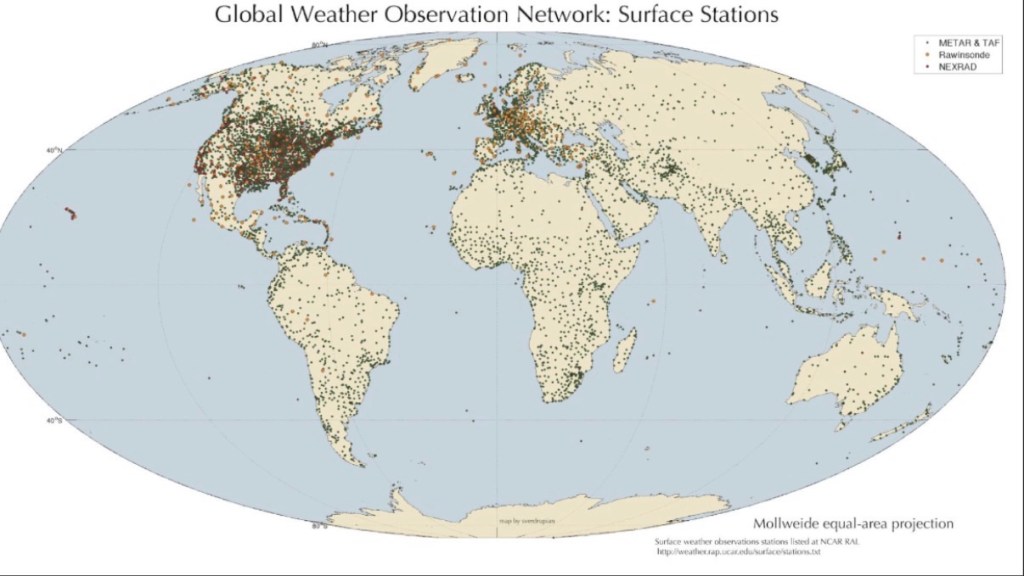
At the heart of the climate crisis narrative lies a huge weakness regarding a thing its believers take for granted: whether our measures of global temperature are meaningful, let alone reliable. The problems are both at the level of individual weather stations, their siting, their geographical distribution, and perhaps even more critically, their aggregation into the so-called Global Mean Surface Temperature (GMST).

The Weather Station Network

In the U.S. and worldwide we have about one weather station for every one thousand square miles. However, the geographic distribution of weather stations is highly uneven (see the map of land-based stations above) and is more sparse in rural areas than in urban environments. It’s also very sparse in highly remote and extreme environments.

At best, a temperature reading at a particular weather station might be approximately representative of its surrounding area at that moment. However, temperatures from place-to-place are influenced by many varying features of local geography. That includes altitude, the presence of waterways and bodies of water, other surface features such as rock and greenery, and human land use. Thus, conditions at a given weather station might not be at all descriptive of the surrounding area.

Moreover, there are no well-defined geographic “zones” to which weather stations are assigned. Attempts to do so involve arbitrary and irregular boundaries and drastic variations in size. “Averaging” temperatures across such zones requires a crude attempt to assign weights based on distances and ultimately yields mongrelized statistics. Furthermore, daily temperature averages are based on averages of high and low temperatures at each station. Such an average might only describe the actual temperature at a station for an instant, but regardless of duration, the timing is likely to differ across any two stations. Not only that, but many weather stations do not record “daily” temperatures based on normal calendar days. Thus, temperature averages across stations are calculated across locations, extremes only, and time. And again, inputs of temperatures from the individual stations are not representative of their respective zones.

Deterioration in the quality of weather station sites has been the subject of sharp criticism over the years. There are now a large number of poorly-sited stations, often located in close proximity to paved surfaces, concrete, metals, or exhaust fans. These kinds of features impart an upward bias to the local temperature record. Individually, these are small examples of the well-known urban heat island effect. In the aggregate, it creates a substantial exaggeration in temperatures, accounting for about 50% of the estimated warming trend for the U.S.

According to this study, the upward bias is more severe for poorly-sited stations, and the quality of siting often deteriorates over time as urban growth encroaches on outlying communities. Urban sites tend to warm the most, followed by semi-urban sites, followed by rural sites. Even worse, the study found that the NOAH temperature adjustment process creates a contagion of the warming bias, passing biases from poor sites along to better stations as an artifact. That is, the process adjusts temperatures upward for well-sited stations to more closely match poor sites!

Ocean temperatures present their own challenges. Several different techniques have been used over the years, but the most consistent and reliable ocean temperatures are from so-called ARGO buoys, which have been available only since 2003. Before that, ocean temperatures were taken using buckets dipped into the water from the sides of ships, and from engine water intakes. Unfortunately, error rates on reported observations from ARGO buoys (which involve several factors besides the accuracy of the thermometers themselves, such as transmission errors) are unknown, but they appear to be far outside acceptable limits. Thus, reasonably good sea surface records have only recently contributed to global temperature coverage, and even those are subject to great uncertainty. (Satellite temperature measurements, by the way, are really indirect estimates of temperatures based on radiance and subsequent calibrations.)

Thus, historical temperature records are an amalgam of different measurement instruments at different locations at different times of the day, adding layers of inconsistency to the calculation of temperature averages.

Physically Untethered

I was prompted to write this post after reading a mathematical analysis of the impossibility of aggregating temperature readings across multiple weather stations in any meaningful way. The analysis, by Jonathan Cohler, is a damning indictment of GMST as a concept. It relies on a series of calculations and transformations that are arbitrarily chosen from many unsuitable alternatives. Cohler says that such an “average temperature” calculation is necessarily “untethered” from the various states of nature it attempts to summarize.

Temperature itself is a so-called intensive quantity. That means it is independent of the size of the system it characterizes. If you combine it with an identical twin system, the temperature of the combined whole doesn’t double, unlike measures like mass or volume. The latter are examples of extensive quantities.

Temperatures vary from one spot to another within a given system while in disequilibrium, and of course they vary over the course of any day. However, the validity of a temperature measurement at a particular location and time requires a local state of equilibrium in the immediate vicinity of the measuring instrument. Otherwise, a temperature measurement is would not be a valid descriptor of the condition of the (very local) system.

Faulty Aggregations

With that in mind, imagine the many arbitrary ways we can devise to aggregate temperatures across weather stations for which conditions differ drastically. These are all attempts to calculate a single temperature for a large and geographically uneven system in a continuing state of disequilibrium. And every combination of weather station temperatures represents an artificially combined “system” in a state of disequilibrium. That’s true of any two adjacent weather stations or of all the weather stations on the globe. No one method of doing so can claim validity as a measure of system-wide temperature. This contrasts with extensive quantities, for which well-defined rules of aggregation exist (e.g., summation) regardless of a system’s dynamic condition.

Over time, the temperature records involve a changing number of stations, local environmental conditions, accuracy, and a varying mix of seawater bucket measurements, ship engine water intake measurements, and ARGO floats. These disparities reinforce the impossibility of measuring wide-ranging “average” trends in temperature.

As Cohler demonstrates mathematically, these temperature averages are physically meaningless. He offers a crazy-sounding example of blending two intensive measurements: averaging the PH of your morning coffee with the PH of seawater at a nearby coast. This is very much of a kind with averaging temperatures across weather stations under disparate conditions. Furthermore, as noted above, the steps employed to arrive at the temperature to be used for each station, and the weight each station is assigned in the average, is hardly a unique set of calculations. There is an infinite number of equally invalid aggregations of the same data.

Grand Ambiguity

Cohler is not the first to point out that the concept of a global temperature average is physically meaningless. In 2007, a paper by Christopher Essex, et al was entitled, “Does a Global Temperature Exist?” The abstract states (my brackets):

“Distinct and equally valid [or invalid] statistical rules can and do show opposite trends when applied to the results of computations from physical models and real data in the atmosphere. A given temperature field can be interpreted as both ‘warming’ and ‘cooling’ simultaneously, making the concept of warming in the context of the issue of global warming physically ill-posed.”

This is all the more salient in a world with warming biases at poorly sited weather stations and a strong urban heat island effect.

My Glass House?

Of course, there are other areas in which similar statistical “sins” are common, some of which are also used repeatedly by climate alarmists: ocean water PH, which Cohler explains cannot be averaged across “parcels”. The result is meaningless. If that isn’t enough for you to harbor doubts about the ocean acidification narrative, just read the first few paragraphs of the tweet linked above!

Similar examples occur in the world of economic data. For example, prices are intensive measures, but economists often refer to an aggregate “price level”. Can such a thing truly exist? Simply averaging prices of all goods and services creates a meaningless figure. Each price can be weighted in a variety of ways (e.g., by shares of a fixed or varying “market basket”). There are several prominent alternatives, all of which have strengths and weaknesses, but none has a claim as an accurate measure of “the price level.”

In fact, though economists talk about it constantly, it can be said that “the price level” does not exist as an objective reality, just as there is no “global temperature.” The difference is that economists readily acknowledge this fundamental ambiguity surrounding price aggregation. Some even insist, for example, that only nominal aggregates (e.g., total spending = prices x quantities), rather than inflation in “the price level”, be considered in certain policy domains, though there is more than one reason for that preference. In contrast, climate officialdom, within the likes of such organizations as the IPCC and NOAH, are loath to acknowledge weaknesses in GMST.

Conclusion

There are many reasons to question the climate orthodoxy, which holds that human emissions of carbon dioxide, a trace gas, produce a warming global temperature trend. An issue that’s been largely taken for granted is the integrity of the so-called global temperature, most commonly the GMST. The reality is that it’s impossible to identify a unique method of calculating a global temperature. It’s possible to specify many different aggregations of local temperature readings, but there is no “true” way of measuring global temperature. Another way of putting this is that it’s impossible to define a single global temperature as a physical reality. There is no such thing.

Nevertheless, global temperature is a critical pillar on which climate alarmism rests, and Cohler has published equally damning critiques of several other climate measurements (also see here), such as mean ocean PH, ocean heat content, and human contribution to atmospheric CO2. Climate authorities should acknowledge the inherent weakness of relying on temperature aggregations, and especially any one aggregation. Perhaps they could define several alternatives, as economists have with price indices, acknowledging the impossibility of pinning down a true global temperature.

The real lesson here is that we should approach climate statistics both with skepticism and humility. Even if you must pretend that it exists, any measure of a so-called global temperature and its trend is of highly of uncertain value. This is critical when it comes to assessing climate policy. As Jack Salmon says in a somewhat broader context:

“One of the most striking features of modern climate economics is not consensus, it’s dispersion. Depending on which paper, model, or administration you consult, the economic damages from climate change range from modest to catastrophic.“

Deceits of the Climate Claimants

23 Monday Jul 2018

Posted by Nuetzel in Global Warming

≈ 1 Comment

Tags

Al Gore, Alpine Tree Lines, Armadillos, Desertification, Global Greening, global warming, Ocean Acidification, Polar Bears, Social Cost of Carbon, Steven Hayward

Well-meaning souls innocently parrot the global warming narrative but generally know little of the controversies surrounding its validation, or lack thereof. That includes much of the mainstream media. Every warm day is evidence of global warming. Every cold day is evidence of extreme volatility brought on by climate change. Every big storm, every forest fire, and every endangered species is attributed to warming. The poles are melting, the sea is rising, the sky is falling, and it is mostly bullshit. But in the meantime, the mythology of global warming has become an all-purpose cudgel for state oversight and “redistributive justice”, primarily to the benefit of the “climate change industrial complex. The myths are repeated so frequently that many accept them as facts. Here, I list a few of these myths along with information that should give pause to anyone tempted to take them too seriously.

The science is settled: There are a number of great scientists who dispute the global warming narrative (and see here). But a few studies have claimed incredibly widespread consensus (97%) among scientists that mankind drives climate change. These studies are generally plagued by biased samples of scientists (sometimes including non-scientists), faulty selection and classification of paper abstracts, and direct involvement of climate activists in the research process. These studies tend to present the “consensus” as one side of a stark dichotomy, with no nuance or middle ground for those subscribing to anything less than the inevitability of a warming catastrophe.

Record high temperatures: The temperatures that are almost always reported are surface temperatures that are subject to extreme bias. The most drastic bias is caused by increasing urbanization. Urban weather instruments are often sited in areas with an increasing amount of impervious ground cover, which absorbs sunlight and heat, leading to the so-called “urban heat-island effect”. This has imparted an upward trend in urban temperature readings. Moreover, urban temperature readings tend to be over-sampled in estimates of global surface temperatures, reinforcing the distortions in measured warming.

Melting poles: Arctic sea ice extent has been in modest retreat since 1980, when satellite measurement began to allow more accurate readings. The Antarctic, however, has shown a trend in the other direction, as shown in this piece by Judith Curry. In the same article, Curry shows that specific Arctic locations had less sea ice 6,000 to 8,000 years ago than today. For more complete information on satellite-era trends in sea ice extent, see this informative reference page (scroll way down for Antarctic information). Looks like Al Gore’s dire prediction that the poles would melt by 2007 was just a little off target.

Polar bear extinction: We are constantly seeing warnings of polar bear extinction on social media. Memes feature desperate-looking bears stranded on ice floes, drifting away from their cubs. Perhaps you aren’t supposed to know that polar bears are extremely strong swimmers. Or that the polar bear population is been thriving, increasing by an estimated 10-20% since 2001. So whether or not the past few decades have seen a decline in sea ice, the bears seem be doing just fine.

Rising sea levels: The rate of increase in sea levels over the past 8,000 years has been vey slow relative to the 10,000 years prior to that, when they rose at rates of up to 5.5 meters per century. That compares to recent rates of about one foot per century. Predictions that islands in the Pacific would be swallowed by the seas have not come to pass. In fact, satellite images show that more of the world’s sandy shorelines accreted than receded between 1984 and 2016, This does not appear to be a crisis by any means.

Increasing storms: No, the frequency and intensity of tropical cyclone activity has decreased since 1900, a trend that has continued unabated over the past 20 years. I know of at least one study suggesting otherwise, but it is based purely on modeled relationships, not hard data, and not tested against data. The frequency and intensity of droughts and floods has been flat to declining as well. And while more weak tornadoes are detected today than in the past, the frequency of moderate to strong tornadoes has decreased over the past 45 years.

Desertification: Increases in carbon concentration have not been associated with desertification, as the media seem to have concluded. As noted above, the frequency of drought has been steady to declining. In fact, precipitation data suggests that patterns of variability in rainfall do not square with the predictions of climate models. In fact, the world has seen an increase in green vegetation since 1985, even in arid regions.

Ocean acidification: The reported declines in ocean pH levels over the past few centuries are actually smaller than the normal seasonal variation in pH levels. The presumed negative impact on sea life appears, after all, to be minimal to nonexistent (see the same link).

Higher alpine tree lines: We’ve been waiting. It hasn’t happened, but that hasn’t stopped some activists from stating it as established fact.

Armadillo northward migration: I’ve heard this cited as “proof” of global warming. The range of armadillos extended as far north as southern Missouri and Kansas in the early 1970s, so this isn’t new. In fact, armadillos began their migration northward into the U.S. before the mid-1800s. Some biologists have attributed the migration to warming but acknowledge many other reasons, including more forested habitat in the north and factors such as movement of cattle by rail. Armadillos burrow and are able to keep warm underground in the winter. Of course, a series of warm winters can bring them further north along with other species, but a few cold winters can take a toll on the population and push them south again.

U.S. carbon criminality: U.S. CO2 emissions have been in almost steady decline on a per capita basis for at least seven decades, long before the carbon freak-out began. The declines have resulted largely from the normal market process of competitive efficiency in production. China leads the world in total annual CO2 emissions by a wide margin, about 80% ahead of the U.S. in 2017. Total U.S. emissions actually declined in 2017 for the third straight year, while emissions in China, the EU, and for the world all increased. In fact, China was actually in compliance with its pledge under the Paris Accord despite the increase, so the pledge was not especially ambitious.

High social cost of carbon: The estimates used by the Environmental Protection Agency are plagued by poor methodology and are subject to great uncertainty. Some studies rely on a series of tenuous causal links, such as CO2 emissions to global temperatures to ice melt to sea level to real dollars of coastal damage many years hence, all without considering variances at each stage, and assuming zero effort to adapt or mitigate damages over long time frames. A shortcut approach relies on historical correlations between temperatures and such measures as heat-related deaths, labor productivity and real output. These estimates extrapolate old relationships to the distant future and ignore the very real human tendency to adapt. The underlying assumptions are undercut by such basic facts as ongoing migration to warmer regions. The estimates also fail to account for the likelihood that warmer weather will improve agricultural productivity.

The public’s interest in climate change has waned, and no wonder: sensible people do not buy hype and demands for sacrifice in the face of contradictory evidence. Revelations of statistical fraud have led to even more skepticism. And when your “proof” is founded on model extrapolation, often theoretically-based rather than empirically-based, you’re skating on thin scientific ice. At this link, Steven Hayward has an interesting take on the public’s increasingly jaundiced view of global warming activism:

“Scientists who are genuinely worried about the potential for catastrophic climate change ought to be the most outraged at how the left politicized the issue and how the international policy community narrowed the range of acceptable responses. Treating climate change as a planet-scale problem that could be solved only by an international regulatory scheme transformed the issue into a political creed for committed believers. Causes that live by politics, die by politics.”

Follow Sacred Cow Chips on WordPress.com

Recent Posts

  • Is “Global Temperature” a Fiction?
  • ESG Contortions: Virtue, Returns, and Politics
  • Grading Trump II, So Far
  • A Warsh Policy Scenario At the Federal Reserve
  • The Coexistence of Labor and AI-Augmented Capital

Archives

  • May 2026
  • April 2026
  • March 2026
  • February 2026
  • January 2026
  • December 2025
  • November 2025
  • October 2025
  • September 2025
  • August 2025
  • July 2025
  • June 2025
  • May 2025
  • April 2025
  • March 2025
  • February 2025
  • January 2025
  • December 2024
  • November 2024
  • October 2024
  • September 2024
  • August 2024
  • July 2024
  • June 2024
  • May 2024
  • April 2024
  • March 2024
  • February 2024
  • January 2024
  • December 2023
  • November 2023
  • August 2023
  • July 2023
  • June 2023
  • May 2023
  • April 2023
  • March 2023
  • February 2023
  • January 2023
  • December 2022
  • November 2022
  • October 2022
  • September 2022
  • August 2022
  • July 2022
  • June 2022
  • May 2022
  • April 2022
  • March 2022
  • February 2022
  • January 2022
  • December 2021
  • November 2021
  • October 2021
  • September 2021
  • August 2021
  • July 2021
  • June 2021
  • May 2021
  • April 2021
  • March 2021
  • February 2021
  • January 2021
  • December 2020
  • November 2020
  • October 2020
  • September 2020
  • August 2020
  • July 2020
  • June 2020
  • May 2020
  • April 2020
  • March 2020
  • February 2020
  • January 2020
  • December 2019
  • November 2019
  • October 2019
  • September 2019
  • August 2019
  • July 2019
  • June 2019
  • May 2019
  • April 2019
  • March 2019
  • February 2019
  • January 2019
  • December 2018
  • November 2018
  • October 2018
  • September 2018
  • August 2018
  • July 2018
  • June 2018
  • May 2018
  • April 2018
  • March 2018
  • February 2018
  • January 2018
  • December 2017
  • November 2017
  • October 2017
  • September 2017
  • August 2017
  • July 2017
  • June 2017
  • May 2017
  • April 2017
  • March 2017
  • February 2017
  • January 2017
  • December 2016
  • November 2016
  • October 2016
  • September 2016
  • August 2016
  • July 2016
  • June 2016
  • May 2016
  • April 2016
  • March 2016
  • February 2016
  • January 2016
  • December 2015
  • November 2015
  • October 2015
  • September 2015
  • August 2015
  • July 2015
  • June 2015
  • May 2015
  • April 2015
  • March 2015
  • February 2015
  • January 2015
  • December 2014
  • November 2014
  • October 2014
  • September 2014
  • August 2014
  • July 2014
  • June 2014
  • May 2014
  • April 2014
  • March 2014

Blogs I Follow

  • Passive Income Kickstart
  • OnlyFinance.net
  • TLC Cholesterol
  • Nintil
  • kendunning.net
  • DCWhispers.com
  • Hoong-Wai in the UK
  • Marginal REVOLUTION
  • Stlouis
  • Watts Up With That?
  • American Elephants
  • The View from Alexandria
  • The Gymnasium
  • A Force for Good
  • Notes On Liberty
  • troymo
  • SUNDAY BLOG Stephanie Sievers
  • Miss Lou Acquiring Lore
  • Your Well Wisher Program
  • Objectivism In Depth
  • RobotEnomics
  • Orderstatistic
  • Paradigm Library
  • Scattered Showers and Quicksand
  • Jam Review

Blog at WordPress.com.

Passive Income Kickstart

OnlyFinance.net

TLC Cholesterol

Nintil

To estimate, compare, distinguish, discuss, and trace to its principal sources everything

kendunning.net

The Future is Ours to Create

DCWhispers.com

Hoong-Wai in the UK

A Commonwealth immigrant's perspective on the UK's public arena.

Marginal REVOLUTION

Small Steps Toward A Much Better World

Stlouis

Watts Up With That?

The world's most viewed site on global warming and climate change

American Elephants

Defending Life, Liberty and the Pursuit of Happiness

The View from Alexandria

In advanced civilizations the period loosely called Alexandrian is usually associated with flexible morals, perfunctory religion, populist standards and cosmopolitan tastes, feminism, exotic cults, and the rapid turnover of high and low fads---in short, a falling away (which is all that decadence means) from the strictness of traditional rules, embodied in character and inforced from within. -- Jacques Barzun

The Gymnasium

A place for reason, politics, economics, and faith steeped in the classical liberal tradition

A Force for Good

How economics, morality, and markets combine

Notes On Liberty

Spontaneous thoughts on a humble creed

troymo

SUNDAY BLOG Stephanie Sievers

Escaping the everyday life with photographs from my travels

Miss Lou Acquiring Lore

Gallery of Life...

Your Well Wisher Program

Attempt to solve commonly known problems…

Objectivism In Depth

Exploring Ayn Rand's revolutionary philosophy.

RobotEnomics

(A)n (I)ntelligent Future

Orderstatistic

Economics, chess and anything else on my mind.

Paradigm Library

OODA Looping

Scattered Showers and Quicksand

Musings on science, investing, finance, economics, politics, and probably fly fishing.

Jam Review

"If you get confused, listen to the music play."

  • Subscribe Subscribed
    • Sacred Cow Chips
    • Join 128 other subscribers
    • Already have a WordPress.com account? Log in now.
    • Sacred Cow Chips
    • Subscribe Subscribed
    • Sign up
    • Log in
    • Report this content
    • View site in Reader
    • Manage subscriptions
    • Collapse this bar

Loading Comments...