• About

Sacred Cow Chips

Sacred Cow Chips

Tag Archives: PATRIOT Act

Cap Rates and You’ll Kill Low-Income Credit Cards

19 Wednesday Feb 2025

Posted by Nuetzel in Lending, Price Controls

≈ Leave a comment

Tags

BBVA Research, Bernie Sanders, Credit Card Lending, Credit Limits, Credit Report, Dodd-Frank, Donald Trump, Federal Reserve, Interest Rate Caps, J.D. Tuccille, Josh Hawley, Late Fees, Loan Sharks, Minimum Payments, Or, PATRIOT Act, Pawn Shops, Payday Loans, Purchase Limits, Relationship Requirements, Revolving Balances, Thin Files, Title Loans, Usury Laws

If you want to induce a shortage, a price ceiling is a reliable way to do it. Usury laws are no exception to this rule. Private credit can be supplied plentifully to borrowers only when lenders are able to charge rates commensurate with other uses of their funds. Importantly, the rate charged must include a premium for the perceived risk of nonpayment. That’s critical when extending credit to financially-challenged applicants, who are often deserving but may be less stable or unproven.

No doubt certain lenders will seek to exploit vulnerable borrowers, but those borrowers are made less vulnerable when formal, mainstream sources of credit are available. A legal ceiling on the price of credit short-circuits this mechanism by restricting the supply to low-income borrowers, many of whom rely on credit cards as a source of emergency funds.

A couple of odd bedfellows, Senators Josh Hawley (R-MO) and Bernie Sanders (D-CT), are cosponsoring a bill to impose a cap of 10% on credit card interest rates. Sanders is an economic illiterate, so his involvement is no surprise. Hawley is otherwise a small government conservative, but in this effort he reveals a deep ignorance. Unfortunately, President Trump would be happy to sign their bill into law if it gets through Congress, having made a similar promise last fall during the campaign. Unfortunately, this is a typically populist stance for Trump; as a businessman he should know better.

Many consumers in the low-income segment of the market for credit have thin credit reports, a few delinquencies, or even defaults. Most of these potential borrowers struggle with expenses but generally meet their obligations. But even a few with the best intentions and work ethic will be unable to pay their debts. The segment is risky for lenders.

Card issuers might be able to compensate along a variety of margins. These include high minimum payments, stiff fees for late payments, tight credit limits (on lines, individual purchases, or revolving balances), deep relationship requirements, and limits on rewards. However, the most straightforward option for covering the risk of default is to charge a higher interest rate on revolving balances.

The total return on assets of credit-card issuing banks in 2023 was 3.33%, more than twice the 1.35% earned at non-issuing banks, as reported by the Federal Reserve. But that difference in profitability is well aligned with the incremental risk of unsecured credit card lending. According to BBVA Research:

“… studies confirm that higher interest rates on credit cards are not related to limited market competition but to greater levels of risk relative to other banking activities backed or secured by collateral. … In fact, an investigation into the risk-adjusted returns of credit cards banks versus all commercial banks suggests that over the long term, credit cards banks do not enjoy a significant advantage. … the market is characterized by participants that operate a high-risk business that requires elevated risk premiums.”

So card issuers are not monopolists. They face competition from other banks, often on the basis of non-rate product features, as well as “down-market” lenders who “specialize” in serving high-risk borrowers. These include payday lenders, pawn shop operators, vehicle title lenders, refund anticipation lenders, and informal loan sharks, all of whom tend to demand stringent terms. People turn to these alternatives and other informal sources when they lack better options. Hawley, Sanders, and Trump would unwittingly throw more credit-challenged consumers into this tough corner of the credit market if the proposed legislation becomes law.

Much of this was discussed recently by J.D. Tuccille, who writes that many consumers:

“… find banks, credit card companies, and other mainstream institutions rigid, uninterested in their business, and too closely aligned with snoopy government officials. Often, the costs and requirements imposed by government regulations make doing business with higher-risk, lower-income customers unattractive to mainstream finance.

‘The regulators are causing the opposite of the desired effect by making it so dangerous now to serve a lower-income segment,’ JoAnn Barefoot, a former federal official, including a stint as deputy controller of the currency, told the book’s author. She emphasized red tape that makes serving many potential customers a legal minefield“

Tuccille offers a revealing quote attributed to a bank official from a 2015 article in the Albuquerque Journal:

“‘Banking regulations stemming from the Dodd-Frank Wall Street Reform and Consumer Protection Act of 2010 and the Patriot Act of 2001 have created an almost adversarial credit environment for people whose finances are in cash.‘“

In other words, for some time the government has been doing its damnedest to choke off bank-supplied credit to low-income and risky borrowers, many of whom are deserving. It’s tempting to say this was well-intentioned, but the truth might be more sinister. Onerous regulation of lending practices at mainstream financial institutions, including caps on credit card interest rates, is political gold for politicians hoping to exploit populist sentiment. “Good” politics often hold sway over predictable but unintended consequences, which later can be blamed on the very same financial institutions.

Fix TikTok? Or Nix It? The Authoritarian RESTRICT Act

08 Saturday Apr 2023

Posted by Nuetzel in anti-Semitism, Big Government, Liberty, Technology

≈ 1 Comment

Tags

AI, Artificial Intelligence, Attention Span, ByteDance, CATO Institute, Caveat Emptor, ChatGPT, Community Standards, Data Privacy, Elon Musk, First Amendment, Free Speech, Hate Speech, L. Frank Baum, Munger Test, National Security, Open Source, PATRIOT Act, People’s Republic of China, Philip Hamburger, Protectionism, RESTRICT Act, Scott Lincicome, Separation of Powers, The Land of Oz, TikTok, Twitter

There’s justifiable controversy surrounding TikTok, the social media app. I find much to dislike about TikTok but also much to dislike about the solutions some have proposed, such as a complete ban on the app in the United States. Such proposals would grant the federal executive branch powers that most of us wouldn’t grant to our worst enemy (i.e., they fail the “Munger test”).

Congressional Activity

The proposed RESTRICT Act (Restricting the Emergence of Security Threats that Risk Information and Communications Technology) is a bipartisan effort to eliminate the perceived threats to national security posed by technologies like TikTok. That would include a ban on the app. Proponents of a ban go further than national security concerns, arguing that TikTok represents a threat to the health and productivity of users. However, an outright ban on the app would be a drastic abridgment of free speech rights, and it would limit Americans’ access to a popular platform for creativity and entertainment. In addition, the proposed legislation would authorize intrusions into the privacy of Americans and extend new executive authority into the private sphere, such as tampering with trade and commerce in ways that could facilitate protectionist actions. In fact, so intrusive is the RESTRICT Act that it’s been called a “Patriot Act for the digital age.” From Scott Lincicome and several coauthors at CATO:

“… the proposal—at least as currently written—raises troubling and far‐reaching concerns for the First Amendment, international commerce, technology, privacy, and separation of powers.”

Bad Company

TikTok is owned by a Chinese company, ByteDance, and there is understandable concern about the app’s data collection practices and the potential for the Chinese government to access user data for nefarious purposes. The Trump administration cited these concerns when it attempted to ban TikTok in 2020, and while the ban was ultimately blocked by a federal judge, the Biden administration has also expressed concerns about the app’s data security.

TikTok has also been accused of promoting harmful content, including hate speech, misinformation, and sexually explicit material. Critics argue that the app’s algorithm rewards provocative and controversial content, which can lead to the spread of harmful messages and the normalization of inappropriate behavior. Of course, those are largely value judgements, including labels like “provocative”, “inappropriate”, and many interpretations of content as “hate speech”. With narrow exceptions, such content is protected under the First Amendment.

Unlike L. Frank Baum’s Tik-Tok machine in the land of Oz, the TikTok app might not always qualify as a “faithful servant”. There are some well-founded health and performance concerns related to TikTok, however. Some experts have expressed reservations about the effects of the app on attention span. The short-form videos typical of TikTok, and endless scrolling, suggest that the app is designed to be addictive, though I’m not aware of studies that purport to prove its “addictive nature. Of course, it can easily become a time sink for users, but so can almost all social media platforms. Nevertheless, some experts contend that heavy use of TikTok may lead to a decrease in attention span and an increase in distraction, which can have negative implications for productivity, learning, and mental health.

Bad Government

The RESTRICT Act, or a ban on TikTok, would drastically violate free speech rights and limit Americans’ access to a popular platform for creativity and self-expression. TikTok has become a cultural phenomenon, with millions of users creating and sharing content on the app every day. This is particularly true of more youthful individuals, who are less likely to be persuaded by their elders’ claims that the content available on TikTok is “inappropriate”. And they’re right! At the very least, “appropriateness” depends on an individual’s age, and it is generally not an area over which government should have censorship authority, “community standards” arguments notwithstanding. Furthermore, allowing access for children is a responsibility best left in the hands of parents, not government.

Likewise, businesses should be free to operate without undue interference from government. The RESTRICT Act would violate these principles, as it would limit individual choice and potentially harm innovation within the U.S. tech industry.

A less compelling argument against banning TikTok is that it could harm U.S.-China relations and have broader economic consequences. China has already warned that a TikTok ban could prompt retaliation, and such a move could escalate tensions between the two countries. That’s all true to one degree or another, but China has already demonstrated a willingness and intention to harm U.S.-China relations. As for economic repercussions, do business with China at your own risk. According to this piece, U.S. investment in the PRC’s tech industry has fallen by almost 80% since 2018, so the private sector is already taking strong steps to reduce that risk.

Like it or not, however, many software companies are subject to at least partial Chinese jurisdiction. The means the RESTRICT Act would do far more than simply banning TikTok in the U.S. First, it would subject on-line activity to much greater scrutiny. Second, it would threaten users of a variety of information or communications products and services with severe penalties for speech deemed to be “unsafe”. According to Columbia Law Professor Philip Hamburger:

“Under the proposed statute, the commerce secretary could therefore take ‘any mitigation measure to address any risk’ arising from the use of the relevant communications products or services, if the secretary determines there is an ‘undue or unacceptable risk to the national security of the United States or the safety of United States persons.’

We live in an era in which dissenting speech is said to be violence. In recent years, the Federal Bureau of Investigation has classified concerned parents and conservative Catholics as violent extremists. So when the TikTok bill authorizes the commerce secretary to mitigate communications risks to ‘national security’ or ‘safety,’ that means she can demand censorship.”

A Lighter Touch

The RESTRICT Act is unreasonably broad and intrusive and an outright ban of TikTok is unnecessarily extreme. There are less draconian alternatives, though all may involve some degree of intrusion. For example, TikTok could be compelled to allow users to opt out of certain types of data collection, and to allow independent audits of its data handling practices. TikTok could also be required to store user data within the U.S. or in other countries that have strong data privacy laws. While this option would represent stronger regulation of TikTok, it could also be construed as strengthening the property rights of users.

To address concerns about TikTok’s ownership by a Chinese company, its U.S. operations could be required to partner with a U.S. company. Perhaps this could satisfied by allowing a U.S. company to acquire a stake in TikTok, or by having TikTok spin off its U.S. operations into a separate company that is majority-owned by a U.S. entity.

Finally, perhaps political or regulatory pressure could persuade TikTok to switch to using open-source software, as Elon Musk has done with Twitter. Then, independent developers would have the ability to audit code and identify security vulnerabilities or suspicious data handling practices. From there, it’s a matter of caveat emptor.

Restrain the Restrictive Impulse

The TikTok debate raises important questions about the role of government in regulating technology and free speech. Rather than impulsively harsh legislation like the RESTRICT Act or an outright ban on TikTok, an enlightened approach would encourage transparency and competition in the tech industry. That, in turn, could help address concerns about data security and promote innovation. Additionally, individuals should take personal responsibility for their use of technology by being mindful of the content they consume and what they reveal about themselves on social media. That includes parental responsibility and supervision of the use of social media by children. Ultimately, the TikTok debate highlights tensions between national security, technological innovation, and individual liberty. and it’s important to find a balance that protects all three.

Note: The first draft of this post was written by ChatGPT, based on an initial prompt and sequential follow-ups. It was intended as an experiment in preparation for a future post on artificial intelligence (AI). While several vestiges of the first draft remain, what appears above bears little resemblance to what ChatGPT produced. There were many deletions, rewrites, and supplements in arriving at the final draft.

My first impression of the ChatGPT output was favorable. It delineated a few of the major issues surrounding a TikTok ban, but later I was struck by its repetition of bland generalities and its lack of information on more recent developments like the RESTRICT Act. The latter shortfall was probably due to my use of ChatGPT 3.5 rather than 4.0. On the whole, the exercise was fascinating, but I will limit my use of AI tools like ChatGPT to investigation of background on certain questions.

Voting Rights Doublespeak

18 Tuesday Jan 2022

Posted by Nuetzel in Voter Fraud, Voting Rights

≈ Leave a comment

Tags

Absentee Voting, Antifa, Armed Resistance, Ballot Harvesting, Ballot Security, BLM, Capitol Riot, Domestic Terror, Donald Trump, Early Voting, FBI, filibuster, Freedom To Vote Act, George Wallace, Glenn Reynolds, Insurrection, Joe Biden, Joseph M. Hanneman, LARP, Legal Insurrection, Mail-In Voting, Marco Rubio, NASA, Oathkeepers, Patrick Eddington, PATRIOT Act, Proud Boys, Ray Epps, Robert Byrd, Russian Collusion, Sedition, Transfer of Power, Voter ID, Voter Suppression, Voting Rights Act

The so-called insurrection that took place on January 6, 2021 (J6) has obsessed Democrats seeking to ram through a “voting rights” bill that they hope will advantage them in future elections. Oh, and to legitimize proposed new powers for agencies in the fight against “domestic terror”, and to somehow disqualify Donald Trump from holding the presidency again. We can thank a couple of moderate Democrats for shutting down the election bill, at least for the time being, by refusing to eliminate the filibuster.

The Real Threat to Voting Rights

If your real aim is to undermine ballot security and make it easier to cheat, you’d have to work hard to beat the election bill pushed by the Biden Administration: the Freedom To Vote Act (FVA). In their fashion, however, the Left prefers to stake-out phony rhetorical high-ground, replete with spurious charges against the opposition alleging racism and subversive, anti-democratic intent. Joe Biden demonstrated this vividly during his ill-advised speech in Georgia last week.

Here is a fairly thorough summary of the FVA, including an earlier version passed by the House last March. The overarching thrust of the bill is to substitute federal for state authority over the election process. States would not be permitted to demand that voters produce photo IDs. The bill would also require automatic voter registration at the department of motor vehicles and other government agencies, on-line registration, same-day registration, more days of early voting, excuse-free, notary-free, and witness-free absentee ballots, and extended counting of late-arriving ballots.

Democrats in the House of Representatives have now used a NASA funding bill as a shell for all these federally-prescribed protocols. Reportedly, this bill would legalize ballot harvesting nationwide, but that does not appear to be the case. Nevertheless, it includes all of the other provisions cited above, and many others.

While Congress certainly has the power to regulate elections, states were given the primary authority for conducting elections under the Constitution:

“The Times, Places and Manner of holding Elections for Senators and Representatives, shall be prescribed in each State by the Legislature thereof; but the Congress may at any time by Law make or alter such Regulations, except as to the Places of chusing Senators.”

The Voting Rights Act of 1965 helped secure minority voting rights that plainly exist under the Constitution, and it prescribed federal review of certain changes in state voting procedures (some aspects of which were struck down by the Supreme Court). However, never before has such sweeping federal authority been proposed as to the range of mechanics involved in casting and counting ballots. Ballot security would be compromised by several provisions of the legislation.

While voter registration should be relatively painless, it should not be so painless that non-citizens find it easy to register. That is likely to be the case under automatic voter registration. Surely many non-citizens have much to recommend them, but they have not yet demonstrated their commitment to the nation through earned citizenship. The right to vote is a benefit of citizenship; it serves as an inducement to learn about our system of government through the naturalization process. These individuals might not be interested in going to the trouble, however, or they might be loyal to a foreign power. Do we really want such individuals to have a vote? And to the extent that their interest is focused on public benefits, they surely do not have an equal claim to natural-born but similarly-situated Americans.

Voter ID is a safeguard against voter fraud, and a huge majority of Americans support it, including majorities of minorities. The very idea that a photo ID requirement would “suppress” the legitimate votes of minorities is based on the presumption that those voters might have difficulty obtaining identification such as a drivers license or other government ID. Oh really? We can safely file that contention under “the bigotry of low expectations”.

Extensive use of absentee ballots was intended to facilitate voting during pandemic restrictions that were expected to reduce the safety and efficiency of polling places. However, most developed countries ban “mail-in voting”, regarding it as a prescription for voter fraud. That threat seems all too real given the lax standards proposed in the FVA.

The Threat to Political Opposition

The House investigative committee looking into the January 6th melee may recommend new intelligence powers for the federal government. Those powers aren’t needed to investigate the Capitol riot: the FBI has been in possession of teams of video evidence, and it has broad powers under the PATRIOT Act and other measures. Here’s Patrick Eddington from the link above:

“… the FBI already has unbelievably sweeping authority to surveil individual Americans or domestic groups without ever having to go before a judge to get a warrant.

Under an investigative category known as an assessment, FBI agents can search commercial and government databases (including databases containing classified information), run confidential informants, and conduct physical surveillance, all without a court order.”

The simple truth is that certain congressional Democrats and the Biden Administration are attempting to use the Capitol riot as an excuse to turn federal law enforcement against their political enemies. The claim by Biden, the guy who bragged of being mentored by Klansman Robert Byrd, and the same man who praised George Wallace on several occasions, is that his opponents are “domestic terrorists” and/or “white supremacists”. We’ve seen quite enough of this chicanery already. Having suffered through a lengthy “Russian collision” charade, a willingness to completely ignore massive riots and property destruction by BLM and Antifa activists in 2020, and an orchestrated attempt to treat concerned parents of schoolchildren as “domestic terrorists”, we’re expected to believe that these stooges need more power?

The J6 Fiasco

And that brings us back to the Capitol riot. It was, as Glenn Reynolds has said, a clownshow and a mess. But speaking of insurrection, let’s hope the FBI is keeping its eye on violent leftists as well, who perpetrated some unquestionably treasonous escapades in the not very distant past. From Legal Insurrection:

“…leftist rioters … attempted to stop the peaceful transition of power during President Trump’s inauguration. … did anti-Trump leftists riot, attack and injure police, set cars and buildings on fire… …

… the multi-day May, 2020 assault on the White House that left at least 60 Secret Service agents wounded and forced President Trump to be whisked away to a bunker for his personal safety.”

Even more dangerous leftist attacks on the Capitol building have been perpetrated, such as bombings by the Weather Underground in 1971 and the Armed Resistance in 1983.

Many people were hurt in the J6 riot through no real fault of their own, including Ashli Babbitt, who was shot and killed by a Capitol police officer shortly after she attempted to stop attackers from smashing windows. Nevertheless, those who breached the Capitol building were mostly a bunch of hapless goofballs encouraged to run amuck by certain instigators. Among those were the Oathkeepers, a gang who marched around in stack formation wearing gear that looked vaguely militaristic. They brought no weapons to the Capitol (though they had some stashed in the VA suburbs). Apparently, one of them did assist a crowd in barging through a door to the Capitol. Their activities on J6 have been described by one pundit as LARP — live action role playing. Nevertheless, there was much talk among them of interfering with the transfer of power to “the usurper”, as they called Joe Biden. And now, eleven of them have been charged with insurrection and sedition. Members of the Proud Boys were also at the Capitol, some of whom fought with police.

But what really happened to make things go off the rails on January 6th? This article by Joseph M. Hanneman offers an excellent discussion of the events of that afternoon, and the subsequent investigation. He notes the mysterious absence of a number of individuals involved in the breach of the Capitol and grounds from the FBI’s “Seeking Information” list of over 1,500 photos. That includes one Ray Epps, whose incitement was otherwise fairly well-documented. Some suspect certain parties with no interest in seeing Donald Trump remain in office actually encouraged the rioters, up to and including the FBI. Would that surprise anyone after the Whitmer kidnapping operation or the Russian collusion hoax?

The vast majority of the crowd on J6 came to the Capitol grounds to conduct a peaceful protest in the vain hope for congressional action to put a hold on the counting of electors pending state election audits, investigations, and court challenges. Many of those arrested were denied due process, and were held for months with no charges filed.

As for the “threat to the nation” posed by the crowd on J6, I found this Marco Rubio quote to be apropos:

“I don’t care how many candlelight vigils and musical performances you have from the cast of Hamilton, you’re not going to convince most normal and sane people that our government last year was almost overthrown by a guy wearing a Viking hat and speedos.”

Conclusion

Democrats still hope to vote to eliminate the Senate filibuster and then pass the FVA. That is a pipe dream at this point, but they would come to regret eliminating the filibuster in due course. They have used it themselves to defeat legislation hundreds of times in the recent past. The filibuster has its shortcomings, particularly its inability to restrain executive power. Nevertheless, it has never been more critical as protection against a tyrannical (and slim) majority in Congress.

The Freedom To Vote Act is doomed to failure. Still, no one should forget the mendacious rhetoric employed by Joe Biden and the leftist Democrat leadership in Congress on the issue of election integrity. Nor should anyone forget their dishonorable, anti-democratic intent to devalue legitimate voting rights.

The Court and Kavanaugh

08 Monday Oct 2018

Posted by Nuetzel in Supreme Court

≈ Leave a comment

Tags

Anthony Kennedy, Brett Kavanaugh, Due Process, Glenn Reynolds, Metadata Collection, National Security, PATRIOT Act, Privacy, Roev. Wade, Second Amendment, Supreme Court

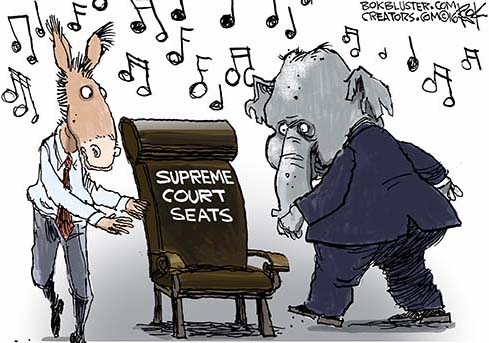
There are both great and hysterically negative expectations for Brett Kavanaugh’s seating on the Supreme Court, depending on one’s perspective. The changes are likely to be much less dramatic than many think, however, according to Glenn Reynolds in his Sunday column. As he says, most cases before the Supreme Court are decided by easy majorities, and that won’t change. On split decisions, Kavanaugh will be less of a “swing vote” than Anthony Kennedy, no doubt, and he will have influence over the choice of cases to be heard by the Court because the selection of a case requires only four justices.

Reynolds thinks Kavanaugh is not as conservative as partisans hope or fear. For example, Reynolds believes he is unlikely to vote to overturn Roe vs. Wade, when and if that question comes before the Court. There may be shifts on narrower questions, such as an earlier definition of fetal viability (in recognition of improved medical technology) and greater protection against arrangements that facilitate illegal funding of abortions by federal taxpayers. Reynolds acknowledges, however, that Kavanaugh is a stronger advocate of Second Amendment rights than Kennedy, so those protections are less likely to be eroded.

Reynolds’ also notes a shift that is likely to take place in legal academia:

“Strange new respect for judicial minimalism. As Harvard Law professor Adrian Vermeule remarked, ‘Law review editors: brace for a tidal wave of legal academic theories supporting judicial minimalism, Thayerianism, and strong — very strong — theories of precedent. Above all: the Court must do nothing without bipartisan agreement, otherwise it is illegitimate.’ The past half-century’s enthusiasm for judicial activism will vanish, as legal academia turns on a dime to promote theories that will constrain the court until a left-leaning majority returns, at which point they’ll turn on a dime again.”

That is all too likely. My liberal friends insist that the four justices on the left are free of political bias. Don’t laugh! I’ll be happy if Kavanaugh, as a justice, sticks to his traditional originalist philosophy on constitutional interpretation. I’m under no illusion that the left side of the bench takes the original meaning of the Constitution seriously.

My own concerns about Kavanaugh have to do with his earlier work in the Bush White House on issues related to national security, including work on the PATRIOT Act. In fairness, that work took place at a time when the horrors of 9/11 were still fresh in our minds. However, years later he wrote a favorable judicial opinion on metadata collection by the government. It’s disturbing that Kavanaugh has ever shown a willingness to relinquish the rights to privacy and due process as a routine matter of national security. The founders’ intent was to protect individual rights from the threat of tyranny, so they expressly limited the power of government through the Constitution. Those who would claim that threats to national security are so compelling as to supersede individual rights are perhaps the very tyrants the Constitution was meant to foil. Nevertheless, my hope is that Kavanaugh, having come face-to-face with those who would prefer to deny privacy and due process rights when it suits them, has gained additional respect for these protections.

Follow Sacred Cow Chips on WordPress.com

Recent Posts

  • Immigration and Merit As Fiscal Propositions
  • Tariff “Dividend” From An Indigent State
  • Almost Looks Like the Fed Has a 3% Inflation Target
  • Government Malpractice Breeds Health Care Havoc
  • A Tax On Imports Takes a Toll on Exports

Archives

  • December 2025
  • November 2025
  • October 2025
  • September 2025
  • August 2025
  • July 2025
  • June 2025
  • May 2025
  • April 2025
  • March 2025
  • February 2025
  • January 2025
  • December 2024
  • November 2024
  • October 2024
  • September 2024
  • August 2024
  • July 2024
  • June 2024
  • May 2024
  • April 2024
  • March 2024
  • February 2024
  • January 2024
  • December 2023
  • November 2023
  • August 2023
  • July 2023
  • June 2023
  • May 2023
  • April 2023
  • March 2023
  • February 2023
  • January 2023
  • December 2022
  • November 2022
  • October 2022
  • September 2022
  • August 2022
  • July 2022
  • June 2022
  • May 2022
  • April 2022
  • March 2022
  • February 2022
  • January 2022
  • December 2021
  • November 2021
  • October 2021
  • September 2021
  • August 2021
  • July 2021
  • June 2021
  • May 2021
  • April 2021
  • March 2021
  • February 2021
  • January 2021
  • December 2020
  • November 2020
  • October 2020
  • September 2020
  • August 2020
  • July 2020
  • June 2020
  • May 2020
  • April 2020
  • March 2020
  • February 2020
  • January 2020
  • December 2019
  • November 2019
  • October 2019
  • September 2019
  • August 2019
  • July 2019
  • June 2019
  • May 2019
  • April 2019
  • March 2019
  • February 2019
  • January 2019
  • December 2018
  • November 2018
  • October 2018
  • September 2018
  • August 2018
  • July 2018
  • June 2018
  • May 2018
  • April 2018
  • March 2018
  • February 2018
  • January 2018
  • December 2017
  • November 2017
  • October 2017
  • September 2017
  • August 2017
  • July 2017
  • June 2017
  • May 2017
  • April 2017
  • March 2017
  • February 2017
  • January 2017
  • December 2016
  • November 2016
  • October 2016
  • September 2016
  • August 2016
  • July 2016
  • June 2016
  • May 2016
  • April 2016
  • March 2016
  • February 2016
  • January 2016
  • December 2015
  • November 2015
  • October 2015
  • September 2015
  • August 2015
  • July 2015
  • June 2015
  • May 2015
  • April 2015
  • March 2015
  • February 2015
  • January 2015
  • December 2014
  • November 2014
  • October 2014
  • September 2014
  • August 2014
  • July 2014
  • June 2014
  • May 2014
  • April 2014
  • March 2014

Blogs I Follow

  • Passive Income Kickstart
  • OnlyFinance.net
  • TLC Cholesterol
  • Nintil
  • kendunning.net
  • DCWhispers.com
  • Hoong-Wai in the UK
  • Marginal REVOLUTION
  • Stlouis
  • Watts Up With That?
  • Aussie Nationalist Blog
  • American Elephants
  • The View from Alexandria
  • The Gymnasium
  • A Force for Good
  • Notes On Liberty
  • troymo
  • SUNDAY BLOG Stephanie Sievers
  • Miss Lou Acquiring Lore
  • Your Well Wisher Program
  • Objectivism In Depth
  • RobotEnomics
  • Orderstatistic
  • Paradigm Library
  • Scattered Showers and Quicksand

Blog at WordPress.com.

Passive Income Kickstart

OnlyFinance.net

TLC Cholesterol

Nintil

To estimate, compare, distinguish, discuss, and trace to its principal sources everything

kendunning.net

The Future is Ours to Create

DCWhispers.com

Hoong-Wai in the UK

A Commonwealth immigrant's perspective on the UK's public arena.

Marginal REVOLUTION

Small Steps Toward A Much Better World

Stlouis

Watts Up With That?

The world's most viewed site on global warming and climate change

Aussie Nationalist Blog

Commentary from a Paleoconservative and Nationalist perspective

American Elephants

Defending Life, Liberty and the Pursuit of Happiness

The View from Alexandria

In advanced civilizations the period loosely called Alexandrian is usually associated with flexible morals, perfunctory religion, populist standards and cosmopolitan tastes, feminism, exotic cults, and the rapid turnover of high and low fads---in short, a falling away (which is all that decadence means) from the strictness of traditional rules, embodied in character and inforced from within. -- Jacques Barzun

The Gymnasium

A place for reason, politics, economics, and faith steeped in the classical liberal tradition

A Force for Good

How economics, morality, and markets combine

Notes On Liberty

Spontaneous thoughts on a humble creed

troymo

SUNDAY BLOG Stephanie Sievers

Escaping the everyday life with photographs from my travels

Miss Lou Acquiring Lore

Gallery of Life...

Your Well Wisher Program

Attempt to solve commonly known problems…

Objectivism In Depth

Exploring Ayn Rand's revolutionary philosophy.

RobotEnomics

(A)n (I)ntelligent Future

Orderstatistic

Economics, chess and anything else on my mind.

Paradigm Library

OODA Looping

Scattered Showers and Quicksand

Musings on science, investing, finance, economics, politics, and probably fly fishing.

  • Subscribe Subscribed
    • Sacred Cow Chips
    • Join 128 other subscribers
    • Already have a WordPress.com account? Log in now.
    • Sacred Cow Chips
    • Subscribe Subscribed
    • Sign up
    • Log in
    • Report this content
    • View site in Reader
    • Manage subscriptions
    • Collapse this bar
 

Loading Comments...