• About

Sacred Cow Chips

Sacred Cow Chips

Tag Archives: Recession

So When Can We Expect That Hard Landing, Hmmm?

13 Wednesday Dec 2023

Posted by Nuetzel in Economic Outlook, Monetary Policy

≈ Leave a comment

Tags

Consumer Sentiment, Core PCE, Federal Funds Rate Target, Federal Open Market Committee, Hard Landing, Inflation, Jamie Diamond, Labor Market, Leading Indicators, Long and Variable Lags, Milton Friedman, Money Growth, Neutral Real Rate, Quantitative Tightening, Real Interest Rates, Real Wages, Recession, Scott Sumner, Soft Landing, Tight Money

The joke’s on me, but my “out” on the question above is “long and variable lags” in the impact of monetary policy, a description that goes back to the work of Milton Friedman. If you call me out on my earlier forebodings of a hard landing or recession, I’ll plead that I repeatedly quoted Friedman on this point as a caveat! That is, the economic impact of a monetary tightening will be lagged by anywhere from 9 to 24 months. So maybe we’re just not there yet.

Of course, maybe I’m wrong and we won’t have to get “there”: the rate of inflation has indeed tapered over the past year. A soft landing now seems like a more realistic possibility. Still, there’s a ways to go, and as Scott Sumner says, when it comes to squeezing inflation out of the system, “It’s the final percentage point that’s the toughest.” One might say the Federal Reserve is hedging its bets, avoiding further increases in its target federal funds rate absent evidence of resurging price pressures.

Strong Growth or Mirage?

Economic growth is still strong. Real GDP in the third quarter grew at an astonishing 5.2% annual rate. A bulge in inventories accounted for about a quarter of the gain, which might lead to some retrenchment in production plans. Government spending also accounted for roughly a quarter, which corresponds to a literal liability as much as a dubious gain in real output. Unfortunately, fiscal policy is working at cross purposes to the current thrust of monetary policy. Profligate spending and burgeoning budget deficits might artificially prop up the economy for a time, but it adds to risks going forward, not to mention uncertainty surrounding the strength and timing in the effects of tight money.
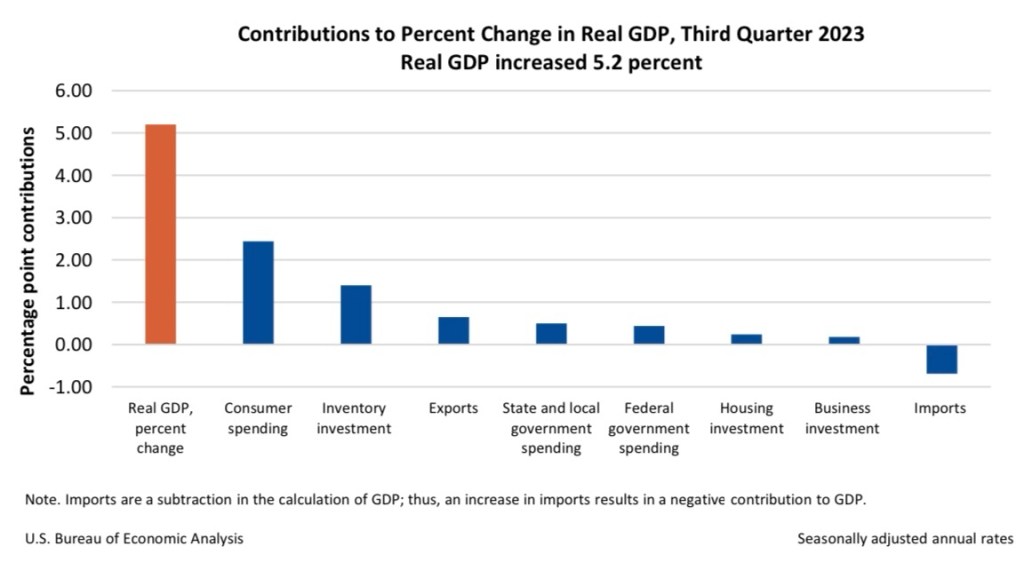
Consumers accounted for almost half of the third quarter growth despite a slim 0.1% increase in real personal disposable income. That reinforces the argument that consumers are depleting their pandemic savings and becoming more deeply indebted heading into the holidays.

The economy continues to produce jobs at a respectable pace. The November employment report was slightly better than expected, but it was buttressed by the return of striking workers, and retail and manufacturing jobs declined. Still, the unemployment rate fell slightly, so the labor market has remained stronger than expected by most economists.

Consumer sentiment had been in the dumps until the University of Michigan report for December, which erased four months of declines. The expectations index is one component of the leading economic indicators, which has been at levels strongly suggesting a recession ahead for well over a year now. See the chart below:
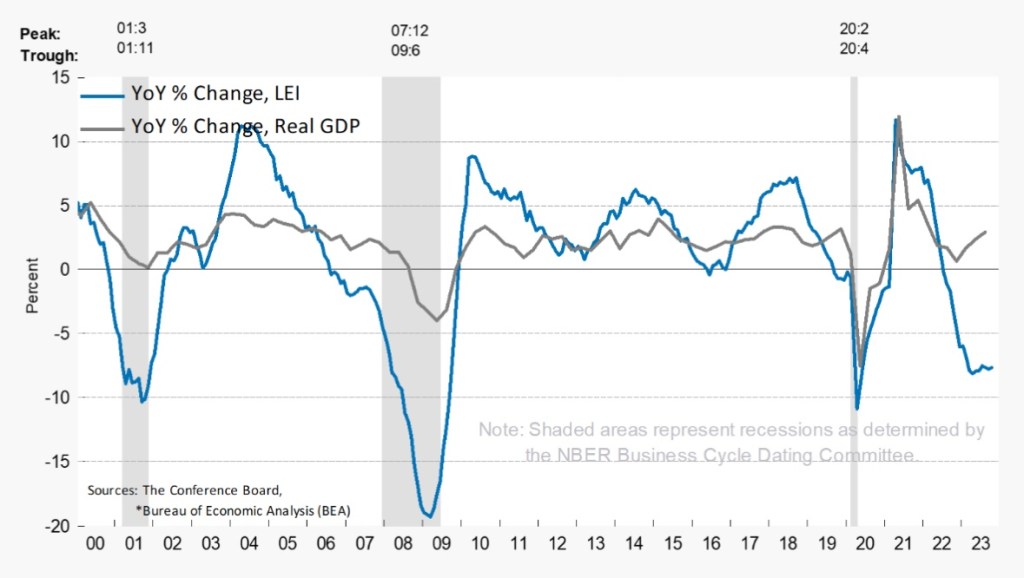
But expectations improved sharply in November, and that included a decline in inflation expectations.

Another component of the LEI is the slope of the yield curve (measured by the difference between the 10-year Treasury bond yield and the federal funds rate). This spread has been a reliable predictor of recessions historically. The 10-year bond yield has declined by over 90 basis points since mid-October, a sign that bond investors think the inflation threat is subsiding. However, that drop steepened the negative slope of the yield curve, meaning that the recession signal has strengthened.

Disinflation, But Still Inflation

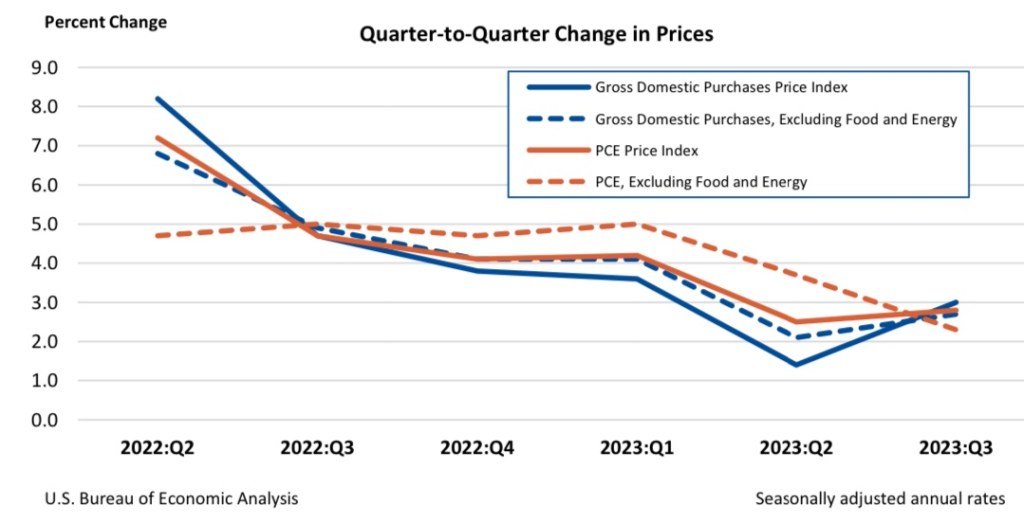
Inflation measures have been slowing, and the Fed’s “target” inflation rate of 2% appears within reach. In the Fed’s view, the most important inflation gauge is the personal consumption expenditures deflator excluding food and energy prices (the “core” PCE). The next chart shows the extent to which it has tapered over the past two quarters. While it’s encouraging that inflation has edged closer to the Fed’s target, it does not mean the inflation fight is over. Still, the decision taken at the December meeting of the Fed’s Open Market Committee (FOMC) to leave its interest rate target unchanged is probably wise.
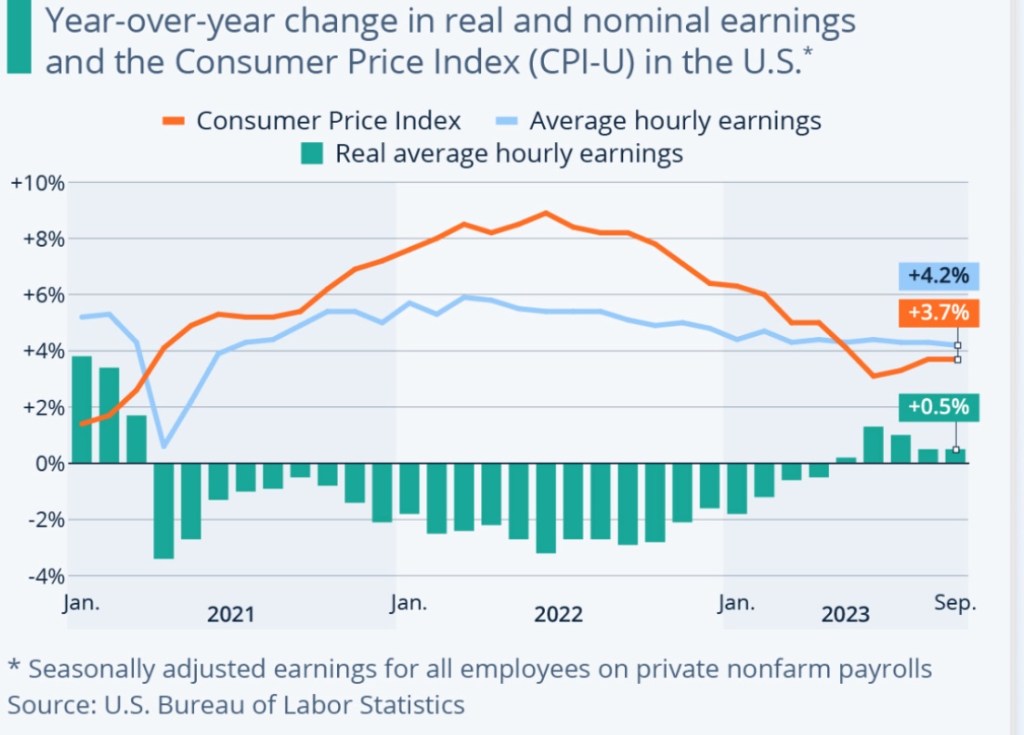
Real wages declined during most of the past three years with the surge in price inflation (see next chart). Some small gains occurred over the past few months, but the earlier declines reinforce the view that consumers need to tighten their belts to maintain savings or avoid excessive debt.
Has Policy Really Been “Tight“?

The prospect of a hard landing presupposes that policy is “tight” and has been tight for some months, but there is disagreement over whether that is, in fact, the case. Scott Sumner, at the link above in the second paragraph, is skeptical that policy is “tight” even now. That’s despite the fact that the Fed hiked its federal funds rate target 11 times between March 2022 and July 2023 (by a total of 5.25%). The Fed waited too long to get started on its upward rate moves, which helps explain the continuing strength of the economy right now.

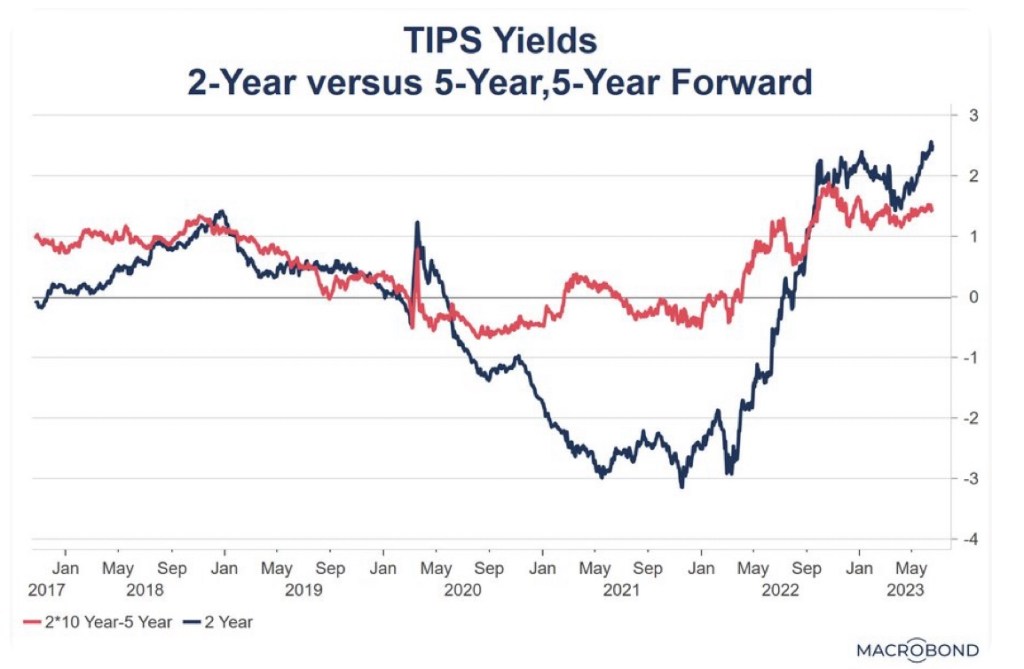
The real fed funds rate turned positive (arguably) as early as last winter as the rate rose and as expected inflation began to decline. There is also solid evidence that real interest rates on the short-end of the maturity spectrum are higher than “neutral” real rates and have been for well over a year (see chart below). If the Fed leaves its rate target unchanged over the next few months, assuming expected inflation continues to taper, the real rate will rise passively and the Fed’s policy stance will have tightened further.
Another view is that the Fed’s policy became “tight” when the monetary aggregates began to decrease (April 2022 for M2). A few months later the Fed began so-called “quantitative tightening” (QT—selling securities to reduce its balance sheet). Thus far, QT has reversed only a portion of the vast liquidity provided by the Fed during the pandemic. However, markets do grow accustomed to generous ongoing flows of liquidity. Cutting them off creates financial tensions that have real economic effects. No doubt the Fed’s commitment to QT established some credibility that a real policy shift was underway. So it’s probably fair to say that policy became “tight” as this realization took hold, which might place the date demarcating “tight” policy around 15 – 18 months ago.

Back to the Lags

Again, changes in monetary policy have a discernible impact only with a lag. The broad range of timing discussed among monetary experts (again, going back to Milton Friedman) is 9 – 24 months. We’re right in there now, which adds to the conviction among many forecasters that the onset of recession is likely during the first half of 2024. That’s my position, and while the tapering of inflation we’ve witnessed thus far is quite encouraging, it might take sustained monetary restraint before we’re at or below the Fed’s 2% target. That also increases the risk that we’ll ultimately suffer through a hard landing. In fact, there are prominent voices like hedge fund boss Bill Ackman who predict the Fed must begin to cut the funds rate soon to avoid a hard landing. Jamie Diamond, CEO of JP Morgan, says the U.S. is headed for a hard landing in 2024.

Looking Forward

If new data over the next few months is consistent with a “soft landing” (and it would take much more than a few months to be conclusive), or especially if the data more strongly indicate an incipient recession, the Fed certainly won’t raise its target rate again. The Fed is likely to begin to cut the funds rate sometime next year, and sooner if a recession seems imminent. Otherwise, my guess is the Fed waits at least until well into the second quarter. The average of FOMC member forecasts at the December meeting works out to three quarter-point rate cuts by year-end 2024. When the Fed does cut its target rate, I hope it won’t at the same time abandon QT, the continuing sales of securities from its currently outsized portfolio. Reducing the Fed’s holdings of securities will restrain money growth and give the central bank more flexibility over future policy actions. QT will also put pressure on Congress and the President to reduce budget deficits.
“Hard Landing” Is Often Cost of Fixing Inflationary Policy Mistakes

05 Wednesday Oct 2022

Posted by Nuetzel in Inflation, Monetary Policy

≈ Leave a comment

Tags

Ample Reserves, Budget Deficit, Core CPI, Demand-Side Inflation, Energy Policy, Expected Inflation, Hard Landing, Inflation, Inflation Targeting, Inverted Yield Curve, Jeremy Siegel, John Cochrane, M2, Median CPI, Median PCE, Monetary Base, Monetary policy, PCE Deflator, Price Signals, Recession, Scott Sumner, Soft Landing, Supply-Side Inflation, Trimmed CPI

The debate over the Federal Reserve’s policy stance has undergone an interesting but understandable shift, though I disagree with the “new” sentiment. For the better part of this year, the consensus was that the Fed waited too long and was too dovish about tightening monetary policy, and I agree. Inflation ran at rates far in excess of the Fed’s target, but the necessary correction was delayed and weak at the start. This violated the necessary symmetry of a legitimate inflation-targeting regime under which the Fed claims to operate, and it fostered demand-side pressure on prices while risking embedded expectations of higher prices. The Fed was said to be “behind the curve”.

Punch Bowl Resentment

The past few weeks have seen equity markets tank amid rising interest rates and growing fears of recession. This brought forth a chorus of panicked analysts. Bloomberg has a pretty good take on the shift. Hopes from some economists for a “soft landing” notwithstanding, no one should have imagined that tighter monetary policy would be without risk of an economic downturn. At least the Fed has committed to a more aggressive policy with respect to price stability, which is one of its key mandates. To be clear, however, it would be better if we could always avoid “hard landings”, but the best way to do that is to minimize over-stimulation by following stable policy rules.

Price Trends

Some of the new criticism of the Fed’s tightening is related to a perceived change in inflation signals, and there is obvious logic to that point of view. But have prices really peaked or started to reverse? Economist Jeremy Siegel thinks signs point to lower inflation and believes the Fed is being too aggressive. He cites a series of recent inflation indicators that have been lower in the past month. Certainly a number of commodity prices are generally lower than in the spring, but commodity indices remain well above their year-ago levels and there are new worries about the direction of oil prices, given OPEC’s decision this week to cut production.

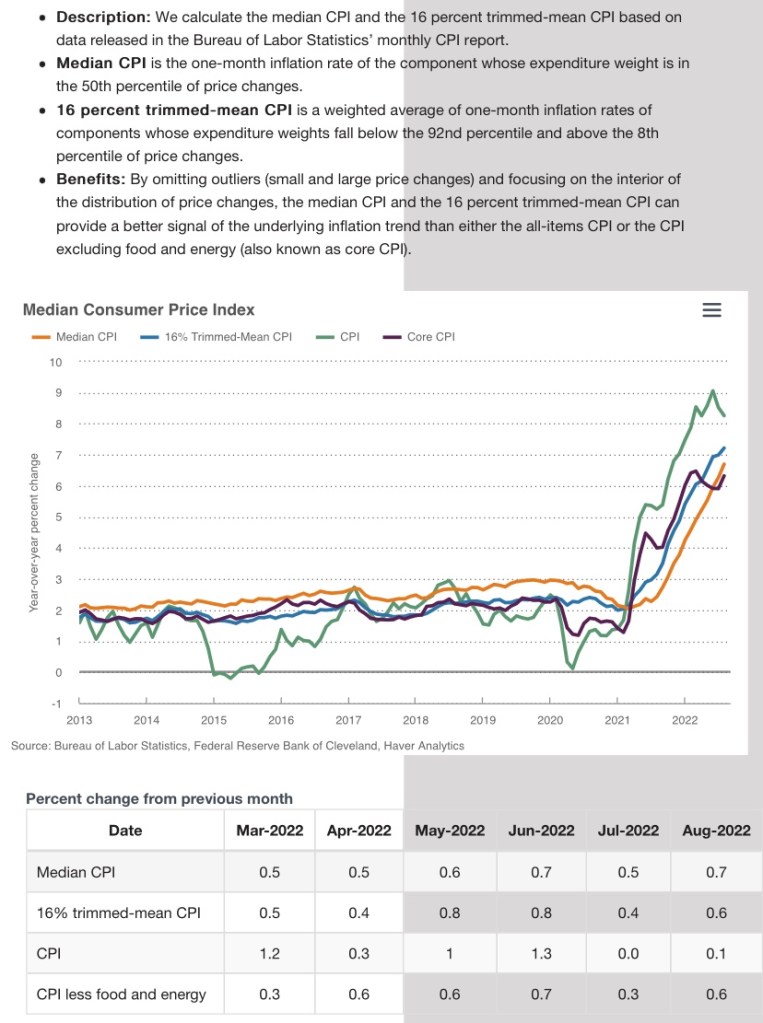
Central trends in consumer prices show that there is a threat of inflation that may be fairly resistant to economic weakness and Fed actions, as the following chart demonstrates:

Overall CPI growth stopped accelerating after June, and it wasn’t just moderation in oil prices that held it back (and that moderation might soon reverse). Growth of the Core CPI, which excludes food and energy prices, stopped accelerating a bit earlier, but growth in the CPI and the Core CPI are still running above 8% and 6%, respectively. More worrisome is the continued upward trend in more central measures of CPI growth. Growth in the median component of the CPI continues to accelerate, as has the so-called “Trimmed CPI”, which excludes the most extreme sets of high and low growth components. The response of those central measures lagged behind the overall CPI, but it means there is still inflationary momentum in the economy. There is a substantial risk that expectations of a more permanent inflation are becoming embedded in expectations, and therefore in price and wage setting, including long-term contracts.

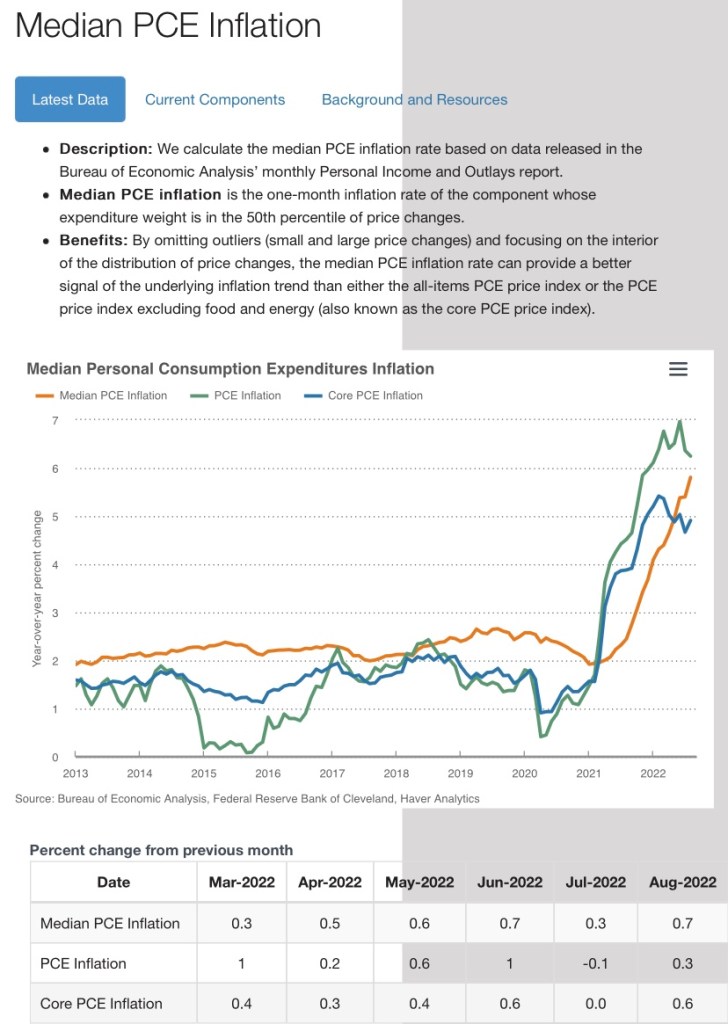
The Fed pays more attention to a measure of prices called the Personal Consumption Expenditures (PCE) deflator. Unlike the CPI, the PCE deflator accounts for changes in the composition of a typical “basket” of goods and services. In particular, the Fed focuses most closely on the Core PCE deflator, which excludes food and energy prices. Inflation in the PCE deflator is lower than the CPI, in large part because consumers actively substitute away from products with larger price increases. However, the recent story is similar for these two indices:

Both overall PCE inflation and Core PCE inflation stopped accelerating a few months ago, but growth in the median PCE component has continued to increase. This central measure of inflation still has upward momentum. Again, this raises the prospect that inflationary forces remain strong, and that higher and more widespread expected inflation might make the trend more difficult for the Fed to rein in.

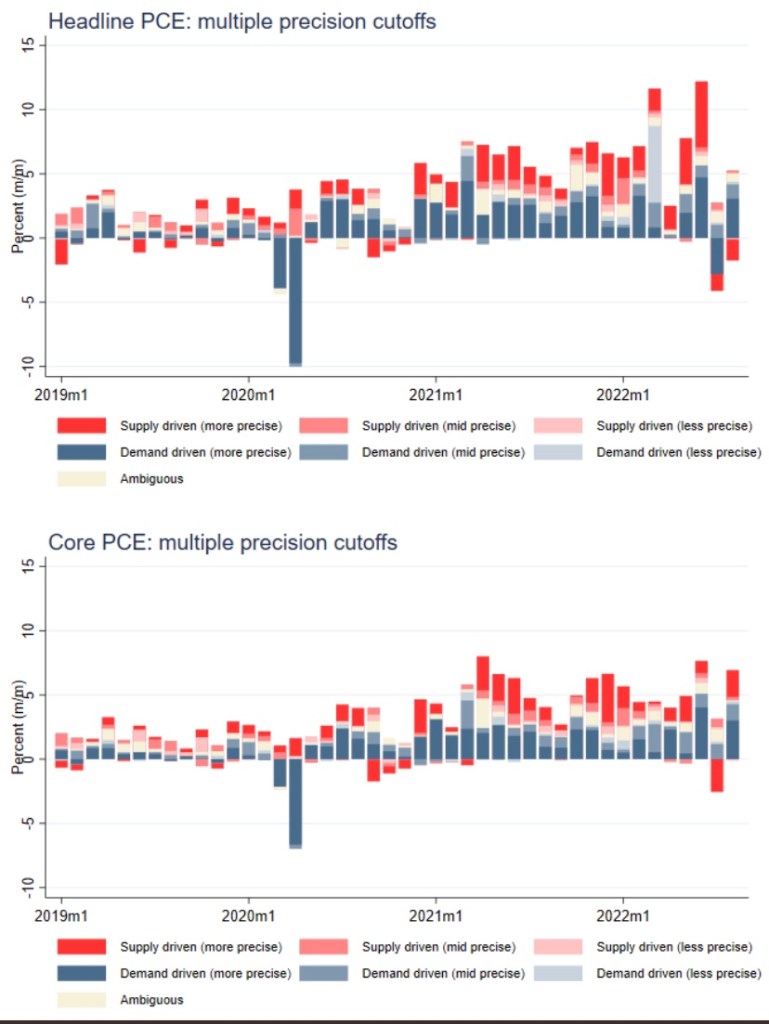
That leaves the Fed little choice if it hopes to bring inflation back down to its target level. It’s really a only a choice of whether to do it faster or slower. One big qualification is that the Fed can’t do much about supply shortfalls, which have been a source of price pressure since the start of the rebound from the pandemic. However, demand pressures have been present since the acceleration in price growth began in earnest in early 2021. At this point, it appears that they are driving the larger part of inflation.

The following chart shows share decompositions for growth in both the “headline” PCE deflator and the Core PCE deflator. Actual inflation rates are NOT shown in these charts. Focus only on the bolder colored bars. (The lighter bars represent estimates having less precision.) Red represents “supply-side” factors contributing to changes in the PCE deflator, while blue summarizes “demand-side” factors. This division is based on a number of assumptions (methodological source at the link), but there is no question that demand has contributed strongly to price pressures. At least that gives a sense about how much of the inflation can be addressed by actions the Fed might take.

I mentioned the role of expectations in laying the groundwork for more permanent inflation. Expected inflation not only becomes embedded in pricing decisions: it also leads to accelerated buying. So expectations of inflation become a self-fulfilling prophesy that manifests on both the supply side and the demand-side. Firms are planning to raise prices in 2023 because input prices are expected to continue rising. In terms of the charts above, however, I suspect this phenomenon is likely to appear in the “ambiguous” category, as it’s not clear that the counting method can discern the impacts of expectations.

What’s a Central Bank To Do?

Has the Fed become too hawkish as inflation accelerated this year while proving to be more persistent than expected? One way to look at that question is to ask whether real interest rates are still conducive to excessive rate-sensitive demand. With PCE inflation running at 6 – 7% and Treasury yields below 4%, real returns are still negative. That’s hardly seems like a prescription for taming inflation, or “hawkish”. Rate increases, however, are not the most reliable guide to the tenor of monetary policy. As both John Cochrane and Scott Sumner point out, interest rate increases are NOT always accompanied by slower money growth or slowing inflation!

However, Cochrane has demonstrated elsewhere that it’s possible the Fed was on the right track with its earlier dovish response, and that price pressures might abate without aggressive action. I’m skeptical to say the least, and continuing fiscal profligacy won’t help in that regard.

The Policy Instrument That Matters

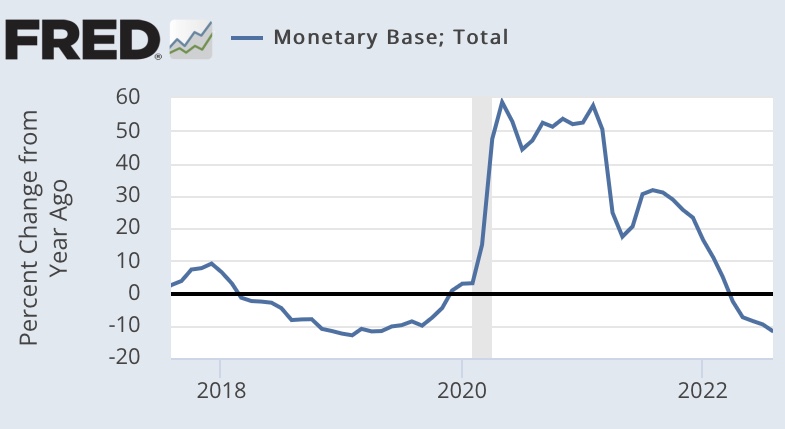
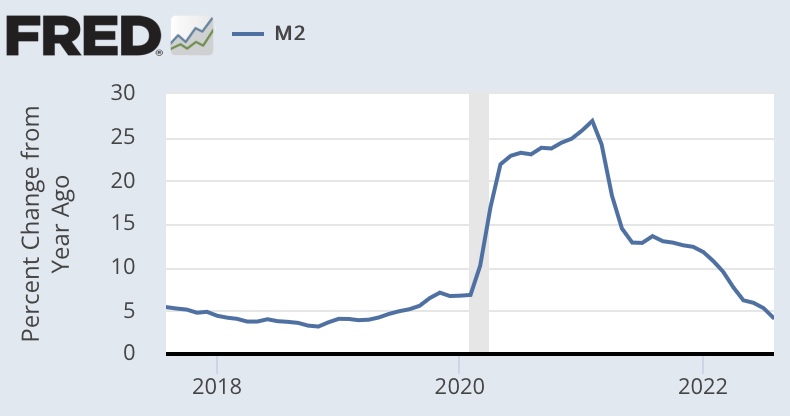
Ultimately, the best indicator that policy has tightened is the dramatic slowdown (and declines) in the growth of the monetary aggregates. The three charts below show five years of year-over-year growth in two monetary measures: the monetary base (bank reserves plus currency in circulation), and M2 (checking, saving, money market accounts plus currency).

Growth of these aggregates slowed sharply in 2021 after the Fed’s aggressive moves to ease liquidity during the first year of the pandemic. The monetary base and M2 growth have slowed much more in 2022 as the realization took hold that inflation was not transitory, as had been hoped. Changes in the growth of the money stock takes time to influence economic activity and inflation, but perhaps the effects have already begun, or probably will in earnest during the first half of 2023.

The Protuberant Balance Sheet

Since June, the Fed has also taken steps to reduce the size of its bloated balance sheet. In other words, it is allowing its large holdings of U.S. Treasuries and Agency Mortgage-Backed Securities to shrink. These securities were acquired during rounds of so-called quantitative easing (QE), which were a major contributor to the money growth in 2020 that left us where we are today. The securities holdings were about $8.5 trillion in May and now stand at roughly $8.2 trillion. Allowing the portfolio to run-off reduces bank reserves and liquidity. The process was accelerated in September, but there is increasing tension among analysts that this quantitative tightening will cause disruptions in financial markets and ultimately the real economy, There is no question that reducing the size of the balance sheet is contractionary, but that is another necessary step toward reducing the rate of inflation.

The Federal Spigot

The federal government is not making the Fed’s job any easier. The energy shortages now afflicting markets are largely the fault of misguided federal policy restricting supplies, with an assist from Russian aggression. Importantly, however, heavy borrowing by the U.S. Treasury continues with no end in sight. This puts even more pressure on financial markets, especially when such ongoing profligacy leaves little question that the debt won’t ever be repaid out of future budget surpluses. The only way the government’s long-term budget constraint can be preserved is if the real value of that debt is bid downward. That’s where the so-called inflation tax comes in, and however implicit, it is indeed a tax on the public.

Don’t Dismiss the Real Costs of Inflation

Inflation is a costly process, especially when it erodes real wages. It takes its greatest toll on the poor. It penalizes holders of nominal assets, like cash, savings accounts, and non-indexed debt. It creates a high degree of uncertainty in interpreting price signals, which ordinarily carry information to which resource flows respond. That means it confounds the efficient allocation of resources, costing all of us in our roles as consumers and producers. The longer it continues, the more it erodes our economy’s ability to enhance well being, not to mention the instability it creates in the political environment.

Imminent Recession?

So far there are only limited signs of a recession. Granted, real GDP declined in both the first and second quarters of this year, but many reject that standard as overly broad for calling a recession. Moreover, consumer spending held up fairly well. Employment statistics have remained solid, though we’ll get an update on those this Friday. Nevertheless, payroll gains have held up and the unemployment rate edged up to a still-low 3.7% in August.

Those are backward-looking signs, however. The financial markets have been signaling recession via the inverted yield curve, which is a pretty reliable guide. The weak stock market has taken a bite out of wealth, which is likely to mean weaker demand for goods. In addition to energy-supply shocks, the strong dollar makes many internationally-traded commodities very costly overseas, which places the global economy at risk. Moreover, consumers have run-down their savings to some extent, corporate earnings estimates have been trimmed, and the housing market has weakened considerably with higher mortgage rates. Another recent sign of weakness was a soft report on manufacturing growth in September.

Deliver the Medicine

The Fed must remain on course. At least it has pretensions of regaining credibility for its inflation targeting regime, and ultimately it must act in a symmetric way when inflation overshoots its target, and it has. It’s not clear how far the Fed will have to go to squeeze demand-side inflation down to a modest level. It should also be noted that as long as supply-side pressures remain, it might be impossible for the Fed to engineer a reduction of inflation to as low as its 2% target. Therefore, it must always bear supply factors in mind to avoid over-contraction.

As to raising the short-term interest rates the Fed controls, we can hope we’re well beyond the halfway point. Reductions in the Fed’s balance sheet will continue in an effort to tighten liquidity and to provide more long-term flexibility in conducting operations, and until bank reserves threaten to fall below the Fed’s so-called “ample reserves” criterion, which is intended to give banks the wherewithal to absorb small shocks. Signs that inflationary pressures are abating is a minimum requirement for laying off the brakes. Clear signs of recession would also lead to more gradual moves or possibly a reversal. But again, demand-side inflation is not likely to ease very much without at least a mild recession.

Follow Sacred Cow Chips on WordPress.com

Recent Posts

  • Immigration and Merit As Fiscal Propositions
  • Tariff “Dividend” From An Indigent State
  • Almost Looks Like the Fed Has a 3% Inflation Target
  • Government Malpractice Breeds Health Care Havoc
  • A Tax On Imports Takes a Toll on Exports

Archives

  • December 2025
  • November 2025
  • October 2025
  • September 2025
  • August 2025
  • July 2025
  • June 2025
  • May 2025
  • April 2025
  • March 2025
  • February 2025
  • January 2025
  • December 2024
  • November 2024
  • October 2024
  • September 2024
  • August 2024
  • July 2024
  • June 2024
  • May 2024
  • April 2024
  • March 2024
  • February 2024
  • January 2024
  • December 2023
  • November 2023
  • August 2023
  • July 2023
  • June 2023
  • May 2023
  • April 2023
  • March 2023
  • February 2023
  • January 2023
  • December 2022
  • November 2022
  • October 2022
  • September 2022
  • August 2022
  • July 2022
  • June 2022
  • May 2022
  • April 2022
  • March 2022
  • February 2022
  • January 2022
  • December 2021
  • November 2021
  • October 2021
  • September 2021
  • August 2021
  • July 2021
  • June 2021
  • May 2021
  • April 2021
  • March 2021
  • February 2021
  • January 2021
  • December 2020
  • November 2020
  • October 2020
  • September 2020
  • August 2020
  • July 2020
  • June 2020
  • May 2020
  • April 2020
  • March 2020
  • February 2020
  • January 2020
  • December 2019
  • November 2019
  • October 2019
  • September 2019
  • August 2019
  • July 2019
  • June 2019
  • May 2019
  • April 2019
  • March 2019
  • February 2019
  • January 2019
  • December 2018
  • November 2018
  • October 2018
  • September 2018
  • August 2018
  • July 2018
  • June 2018
  • May 2018
  • April 2018
  • March 2018
  • February 2018
  • January 2018
  • December 2017
  • November 2017
  • October 2017
  • September 2017
  • August 2017
  • July 2017
  • June 2017
  • May 2017
  • April 2017
  • March 2017
  • February 2017
  • January 2017
  • December 2016
  • November 2016
  • October 2016
  • September 2016
  • August 2016
  • July 2016
  • June 2016
  • May 2016
  • April 2016
  • March 2016
  • February 2016
  • January 2016
  • December 2015
  • November 2015
  • October 2015
  • September 2015
  • August 2015
  • July 2015
  • June 2015
  • May 2015
  • April 2015
  • March 2015
  • February 2015
  • January 2015
  • December 2014
  • November 2014
  • October 2014
  • September 2014
  • August 2014
  • July 2014
  • June 2014
  • May 2014
  • April 2014
  • March 2014

Blogs I Follow

  • Passive Income Kickstart
  • OnlyFinance.net
  • TLC Cholesterol
  • Nintil
  • kendunning.net
  • DCWhispers.com
  • Hoong-Wai in the UK
  • Marginal REVOLUTION
  • Stlouis
  • Watts Up With That?
  • Aussie Nationalist Blog
  • American Elephants
  • The View from Alexandria
  • The Gymnasium
  • A Force for Good
  • Notes On Liberty
  • troymo
  • SUNDAY BLOG Stephanie Sievers
  • Miss Lou Acquiring Lore
  • Your Well Wisher Program
  • Objectivism In Depth
  • RobotEnomics
  • Orderstatistic
  • Paradigm Library
  • Scattered Showers and Quicksand

Blog at WordPress.com.

Passive Income Kickstart

OnlyFinance.net

TLC Cholesterol

Nintil

To estimate, compare, distinguish, discuss, and trace to its principal sources everything

kendunning.net

The Future is Ours to Create

DCWhispers.com

Hoong-Wai in the UK

A Commonwealth immigrant's perspective on the UK's public arena.

Marginal REVOLUTION

Small Steps Toward A Much Better World

Stlouis

Watts Up With That?

The world's most viewed site on global warming and climate change

Aussie Nationalist Blog

Commentary from a Paleoconservative and Nationalist perspective

American Elephants

Defending Life, Liberty and the Pursuit of Happiness

The View from Alexandria

In advanced civilizations the period loosely called Alexandrian is usually associated with flexible morals, perfunctory religion, populist standards and cosmopolitan tastes, feminism, exotic cults, and the rapid turnover of high and low fads---in short, a falling away (which is all that decadence means) from the strictness of traditional rules, embodied in character and inforced from within. -- Jacques Barzun

The Gymnasium

A place for reason, politics, economics, and faith steeped in the classical liberal tradition

A Force for Good

How economics, morality, and markets combine

Notes On Liberty

Spontaneous thoughts on a humble creed

troymo

SUNDAY BLOG Stephanie Sievers

Escaping the everyday life with photographs from my travels

Miss Lou Acquiring Lore

Gallery of Life...

Your Well Wisher Program

Attempt to solve commonly known problems…

Objectivism In Depth

Exploring Ayn Rand's revolutionary philosophy.

RobotEnomics

(A)n (I)ntelligent Future

Orderstatistic

Economics, chess and anything else on my mind.

Paradigm Library

OODA Looping

Scattered Showers and Quicksand

Musings on science, investing, finance, economics, politics, and probably fly fishing.

  • Subscribe Subscribed
    • Sacred Cow Chips
    • Join 128 other subscribers
    • Already have a WordPress.com account? Log in now.
    • Sacred Cow Chips
    • Subscribe Subscribed
    • Sign up
    • Log in
    • Report this content
    • View site in Reader
    • Manage subscriptions
    • Collapse this bar
 

Loading Comments...