
Tags
Edward Glaeser, Externalities, Home ownership, Jesse Shapiro, Medical Expense Deduction, Mortgage Interest Deduction, NBER, SALT, State & Local Tax Deduction, Student Loan Interest Deduction, Tax Deductions, Tax Foundation, Tax Reform
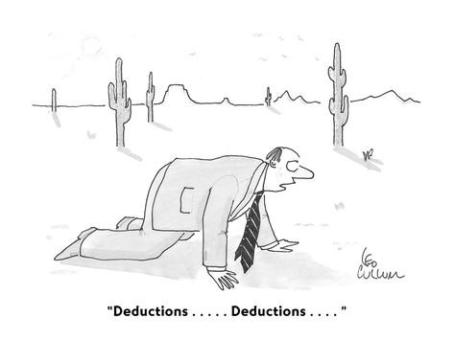
The rat’s nest that is the federal income tax code is a testament to the counter-productive nature of central economic planning. Not only does the tax code force citizens to waste time and other resources on compliance activities. It also encourages us to direct resources into uses that would not be worthwhile in the absence of tax incentives, uses that are not worthwhile in a societal context.
A general rationale for many provisions of the tax code is that they serve some “worthwhile” public purpose. A special tax provision is created to subsidize activities contributing to that purpose. Since that reduces the flow of revenue, tax rates must increase as an offset. However, high tax rates are damaging to economic health in and of themselves. They blunt incentives and drive wedges between the values and rewards that guide all economic decisions.
The competing tax plans under debate in the House and Senate would eliminate or pare back deductions to varying degrees, enabling a reduction in tax rates. I applaud steps in that direction, though a consequence of doing so piecemeal is to invite later tinkering of the sort that got us into this mess in the first place. Both the House and Senate bills are piecemeal. Here is a run-down of some of the deductions that are under review in the GOP plans:
State and Local Tax (SALT) Deductions: this deduction prevents the imposition of federal “taxes on taxes”, which is a worthwhile consideration. However, SALT also gives lower levels of government a “discount” on tax burdens they impose on their citizens, thereby forcing that burden to be shared by members of other jurisdictions. According to the Tax Foundation:
“The deduction favors high-income, high-tax states like California and New York, which together receive nearly one-third of the deduction’s total value nationwide. Six states—California, New York, New Jersey, Illinois, Texas, and Pennsylvania—claim more than half of the value of the deduction.“
Defenders of this deduction note peremptorily that it is used by taxpayers in all fifty states, as if that should come as a surprise. Well of course it is! And those who are taxed most heavily benefit the most from this deduction, and those benefits are most concentrated in high-tax states. The House GOP bill would limit the SALT deduction to $10,000, while the Senate version would eliminate it entirely.
Mortgage Interest (MI) Deduction: Long ago, the idea took hold that ownership of a home was of greater inherent value than mere occupancy. It’s obviously true that owners have greater rights than renters over use of a property. Those benefits are internalized, and owner-occupants might well be more inclined than renters to take pride in, care for, and improve a property. That suggests a social or external benefit from home ownership, one that at least benefits others in the vicinity of a given property.
The MI deduction creates an incentive for debt-financed home ownership, but only for the minority of taxpayers who can benefit from itemizing deductions. It therefore tends to subsidize the housing choices of those at higher levels of income and those with larger homes. It has contributed little, if anything, to the homeownership rate. Here are Edward Glaeser and Jesse Shapiro describing the findings of their NBER Working Paper:
“Externalities from living around homeowners are far too small to justify the deduction. … the home mortgage interest deduction is a particularly poor instrument for encouraging homeownership since it is targeted at the wealthy, who are almost always homeowners. The irrelevance of the deduction is supported by the time series which shows that the ownership subsidy moves with inflation and has changed significantly between 1960 and today, but the homeownership rate has been essentially constant.“
This deduction has fostered a massive over-investment in housing relative to other assets and forms of consumption. The House tax bill would allow a deduction on interest payments for up to $500,000 of mortgage debt, but this limit would apply only to new mortgages. The Senate bill would not alter the deduction in any way. These steps are severely limited in their reform ambitions.
Medical Expense Deduction: To take this deduction, you must 1) be an itemizer; and 2) have eligible medical expenses exceeding 10% of adjusted gross income (AGI). Then, you can deduct only the excess above 10%. A relatively small percentage of taxpayers actually take this deduction, mostly wealthy, older individuals or couples. It can be argued that the deduction encourages overuse of medical resources in some cases, but there are certainly others in which it provides relief from the hardship of an illness requiring expensive care. On the other hand, the deduction might serve to discourage the purchase of supplemental Medicare coverage by individuals who can afford it but are willing to bet that they won’t need it. Part of that bet is covered by the deduction.
The House bill would repeal this deduction in its entirety. The Senate bill would leave it untouched.
Student Loan Interest Deduction: Currently, up to $2,500 of student loan interest can be deducted “above the line” by non-itemizers, but only if their AGI is within certain limits. Higher education is often claimed to have social (external) benefits. To some extent, the student loan interest deduction helps bring the cost of an eduction to within reach of a broader swath of the citizenry. These considerations provide the rationale for public subsidies for funding tuition and other costs with debt. The tax deduction is only one of many forms of education subsidies. Another is provided by the below-market rates at which students are able to borrow from the federal government.
The social benefits of higher education are strongly associated with the value it adds for the individual. It can be argued that as a society, we may have pushed college education well beyond that point. A large number of indebted students decide, too late, that continued enrollment has little value, so they drop out and often default on their federally-subsidized debt. Moreover, these loan subsidies stimulate the demand for college education, which leads to a certain amount of escalation in tuition and fees. These ill effects make elimination of this deduction a tempting way to broaden the income-tax base, enabling a reduction in tax rates.
The House bill eliminates the deduction for student loan interest, but the Senate bill leaves it intact.
Conclusion: There are plenty of shortcomings in both the House and Senate versions of tax reform. Three liberalizing goals of reform are tax simplification, elimination of provisions that benefit special interests, and of course lower rates. Most of the complexities in the tax code benefit special interests in one way or another. The deductions discussed above fall into that category and necessitate higher tax rates on personal income. That in turn makes the deductions more valuable to those who claim them. In terms of the liberalizing goals of reform, the House tax bill is wider ranging than the Senate version, though the Senate bill’s complete elimination of the SALT deduction is better.
 Sacred Cow Chips