• About

Sacred Cow Chips

Sacred Cow Chips

Tag Archives: Systemic Racism

The Anti-CRT Revolt: Banning a Racist Curriculum

16 Wednesday Jun 2021

Posted by Nuetzel in Critical Race Theory, Education, racism, Uncategorized

≈ Leave a comment

Tags

1619 Project, Black Lives Matter, Critical Race Theory, Disparate impact, Food Deserts, Jim Crow, Living Wage, New York Times, racism, Systemic Racism, Unconscious Bias, Zinn Education Project

Suddenly it’s dawned on many people of good faith that our educational, business, and other institutions have been commandeered by adherents to critical race theory (CRT), which teaches that all social interactions and outcomes must be viewed through the lens of racial identity and exploitation. In fact, it teaches that racism is endemic, whether conscious or unconscious, among people deemed to have privilege. They are labeled as oppressors, especially anyone with white skin. Furthermore, CRT holds that racism is systemic, and therefore the “system”, meaning all of our institutions and social arrangements, must be radically transformed. Some or all of these tenets are taught to our children in public and private schools, and they are embedded in anti-bias and diversity training delivered to employees of government, non-profits, and private companies.

Standing Up To It

It’s easy to see why many have come to view CRT as a racist philosophy in its own right. Teaching children that they are either “oppressors” or “victims” based on the color of their skin, is a deeply flawed and dangerous practice. The revelation of CRT’s cultural inroads has prompted an angry counter-revolution by parents who hope to purge CRT from the curricula in their children’s schools… schools that they PAY FOR as taxpayers. Many other fair-minded people are offended by the sweeping racism and identity politics inherent in CRT. And yet its proponents continue in attempts to gaslight the public. More on that below.

The groundswell of opposition to CRT is evident in explosive meetings of school boards across the country, as well as recent school board elections in which slates of candidates opposed to the teaching of CRT have been victorious (see here, here, and here).

In addition, we’ve seen a number of recent legislative or administrative initiatives at the state level. There are now, or recently have been, efforts in 22 states to ban or restrict the instruction of CRT. In some cases, institutions found to be in violation of the new laws are subject to deadlines to remedy the situation. Otherwise, funding dispersed by their state’s Department of Education may be cut by ten percent, for example.

But It’s Speech

As happy as I am to witness the pushback, it’s fair to ask whether the most severe restrictions are reasonable from an educational point of view. For example, as a social philosophy, and as wrong-headed as I believe it to be, there is no reason CRT can’t be discussed alongside other social philosophies, failed and otherwise, without endorsement. For that matter, we should not insist that schools shield children from the fact that racism exists, and CRT certainly has its place along the spectrum of racism.

For my own part, I believe elective classes covering CRT as one philosophical position among others should be defended, as should instruction in the history of American slavery and Jim Crow laws, for example. However, mandatory training in CRT is unacceptable and, to the extent that students or employees are required to accept its tenets, it constitutes compelled speech. To the extent that certain groups of students are identified as inherently biased, it is a form of defamation and a personal attack. 

Legislation

Some states are attempting to ban CRT outright. Others have imposed strictures on certain messages arising from the CRT curriculum. The Florida Department of Education just passed an extremely brief rule stating: 

“Instruction on the required topics must be factual and objective, and may not suppress or distort significant historical events, such as the Holocaust, and may not define American history as something other than the creation of a new nation based largely on universal principles stated in the Declaration of Independence.”

The Florida rule prohibits teaching the 1619 Project as part of the history curriculum. This revised “history” of our nation’s founding was sponsored by the New York Times. It insists that the Revolutionary War was fought to preserve American slavery, an assertion that has been condemned as false by many historians (see here and here), though the Left still desperately clings to it. I have no problem with a prohibition on false histories, though again, it’s important for students to learn that slavery was the subject of much debate at the nation’s founding and that it persisted beyond that time. No one kept those facts from us when I was a child. And they didn’t brand white students as oppressors.

While a rulemaking by a state Department of Education is better than nothing, it’s a far cry from an actual piece of legislation. A bill signed into law in Idaho in late March contained substantially the same provisions as the rule promulgated in Florida, but it didn’t proscribe the 1619 Project. The same is true of the bill signed into law in Oklahoma in early May. 

In Texas, the state senate passed a bill in May that would ban instruction in any public school or state agency of any of the following:

“… one race or sex is inherently superior to another race or sex

an individual, by virtue of his or her race or sex, is inherently racist, sexist, or oppressive, whether consciously or unconsciously;

an individual, by virtue of his or her race or sex, bears responsibility for actions committed in the past by other members of the same race or sex;

meritocracy or traits such as a hard work ethic are racist or sexist, or were created by … members of a particular race to oppress members of another race.”

A new law in Iowa and abill signed by the governor of Tennessee in late May contained similar provisions, essentially banning instruction of some highly objectionable tenets of CRT. However, the Iowa and Tennessee laws are careful to spell out what the law should not be construed to do. For example, these laws do not:

“—Inhibit or violate the first amendment rights of students or faculty, or undermine a school district’s duty to protect to the fullest degree intellectual freedom and free expression.
—Prohibit discussing specific defined concepts as part of a larger course of academic instruction.
—Prohibit the use of curriculum that teaches the topics of sexism, slavery, racial oppression, racial segregation, or racial discrimination, including topics relating to the enactment and enforcement of laws resulting in sexism, racial oppression, segregation, and discrimination.
“

A bill in the Missouri House mentions a few such protections. However, the Missouri bill is general in the sense that it explicitly bans the instruction of CRT by name, rather than simply blocking a few unsavory messages of CRT, as detailed by Texas and a few other states. Utah’s legislation, which is awaiting the governor’s signature, is also quite brief and explicit in its prohibition of CRT. I greatly prefer the Texas approach, however, as it makes clear that discussions of CRT in the classroom are not precluded, as might be inferred from the language of the Missouri bill. 

But, But… You Just Don’t Get It!

PProtests against these legislative actions have shown a certain tone-deaf belligerence. According to an organization called Black Lives Matter at School and the Zinn Education Project, all the protesters want is a curriculum that illuminates:

“… full and accurate U.S. history and current events … rais[ing] awareness of the dangers of lying to students about systemic racism and other forms of oppression.”

One advocate says they must be free to teach the “truth” of our nation’s foundational and ongoing structural racism. The Missouri bill, they say, “fails to note ‘a single lesson’ which is ‘inaccurate’ or ‘misleads’ students.” It’s not as if it’s necessary for legislation to provide a series of examples, but be that as it may, these CRT advocates know exactly what many find objectionable. Essentially, their response is, “You don’t understand CRT! WE are the experts on systemic, institutional racism.” What they believe is somehow, every negative outcome is actuated by racism of one kind or another, past or present.

Divining the “Fault” Line

Are you below the poverty line? Earning less than a “living wage”? Are you unemployed? Is your credit score lousy? Do you live in a high crime area? In a “food desert”? Are you a single parent? Did you receive a failing grade? Is your rent going up? Did someone fail to defer to you? Did they “disrespect” you, whatever your definition? Were you scolded for being late? 

Of course, none of those “outcomes” is exclusive to people of color or minorities. But wait! Someone else is earning a decent income. They got good grades. They have a high credit score. They drive a nice car. They have skills. 

Does any of that make them guilty of oppression? Does this have something to do with YOU?

Well, you see, CRT teaches us that every unequal outcome must be the consequence of unjust, “disparate impacts” inherent to the social and economic order. To be clear, outcomes are a legitimate subject of policy debate, and we should aim for improved well-being across the board. The point that defenders of CRT miss is that unequal outcomes are seldom diabolic in and of themselves. Real indications of injustice, past or present, do not imply that any one class of individuals is inherently racist or behaves in a discriminatory manner.

Critical Theory Is a Fraud

Critical race “theory” is nothing but blame in fraudulent “search” of perpetrators. It is fraudulent because the perps are already identified in advance. It is “critical” because someone or something deserves blame. The real exercise is to spin a tale of misused privilege and biased conduct by the privileged perps against a set of oppressed victims.

CRT is not just one theory, but a whole slew of theories of blame. The very attitudes of the purveyors of CRT show they do not believe their “theories” are falsifiable. And indeed, allegations of unconscious bias are impossible to falsify. Thus, CRT is not a theory, as such. It amounts to a polemic, and it should only be discussed as such. It certainly shouldn’t be taught as “truth” to children, university students, or employees. More states should jump on-board to restrict the CRT putsch to propagandize.
BLM’s Trail of Homicide

20 Tuesday Apr 2021

Posted by Nuetzel in law enforcement, Police Bias

≈ Leave a comment

Tags

Alex Tabarrok, Black Lives Matter, BLM, BLM Protests, Defund the Police, Freddie Gray, George Floyd, Lethal Force, Marxism, Police Homicides, Property Crime, Systemic Racism, Travis Campbell, Vox

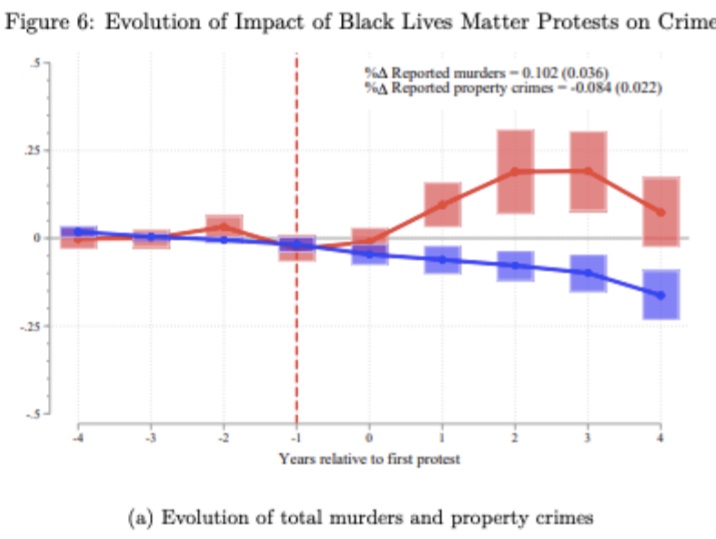
Check out this Vox article on the impact of Black Lives Matter (BLM) protests on police homicides, other homicides, and property crime within the communities where protests occurred. It cites a study by Travis Campbell, a Ph.D. candidate in economics at UMass-Amherst with the following major findings for the period 2014-2019:

1) Police homicides in census areas where BLM protests took place were 10% – 15% less than if those deaths had followed the trend where BLM protests did not take place, after controlling for confounding factors like the local unemployment rate. That’s about 300 fewer uses of lethal force by police, or one less for every 4,000 BLM protestors. So far, so good, one might guess.

2) Other homicides increased by roughly 10% using the same basis of comparison, or somewhere between 1,000 and 6,000. This estimate is less precise for a number of reasons, and it was not the main focus of Campbell’s research. Still, using a value near the mid-point, say 3,000, yields one extra murder for every 400 BLM protestors! The effect seems to taper off after about four years.

3) Reported property crimes decreased by 8.4% in areas that had BLM protests, but the share of those crimes solved declined by 5.5%. Campbell interprets the latter as an indication of reduced policing intensity. Reports of crime might decline if confidence in the police declines post protest, but reduced effort by the police is also consistent with less reported property crime, less police engagement, and more homicide.

As Alex Tabarrok says:

“The explanation is consistent with what happened in Baltimore after the Freddie Gray protests and riots, namely arrests went down and murders went up.”

The research did not include data on the 2020 protests and riots following the death of George Floyd due to lags in reporting homicides and crime.

One of BLM’s primary objectives is to end “systemic racism” in policing, a problem that has no real empirical basis. Nevertheless, a reduction in deadly confrontations between police and blacks would seem to be a win (though the study doesn’t address the racial makeup of police homicides). But if that means less police engagement and a substantial increase in homicides in the community, the cost is obviously too high. Areas suffering from high homicide rates need more policing, not less. But yes, it must be good policing in partnership with citizens, and there are real reforms that could help.

BLM’s continued calls to “defund the police” are more about signaling lofty intent than about solving real problems. After all, that’s the perverse charm of the Marxism espoused by BLM, Antifa, and gentry leftists having class immunity to unintended (but predictable) consequences. You don’t really have to solve problems. You can just make them for others and take credit for trying!

The Critical Race Dialectic

07 Sunday Feb 2021

Posted by Nuetzel in Critical Race Theory, Social Justice

≈ Leave a comment

Tags

1619 Project, Critical Race Theory, Critical Theory, criticalrace.org, Equality Under the Law, Immanuel Kant, Jonah Goldberg, Mark Robinson, newdiscourses.com, Overt Discrimination, Privilege, racism, Reparations, Revolutionary War, S.G. Cheah, Social Justice, Systemic Racism, Victimhood

The very notion of impartiality requires decisions that are independent of race, ethnicity, religion, gender, sexual preference, gender identity, or any other component of identity. The great irony of identity politics is its insistence on using characteristics of identity as the key drivers in a broad range of human decisions. It does so in an effort to redress injustices, often in the distant past. This necessarily penalizes individuals bearing no responsibility for the original injustices, and of course those penalties are also assessed on the basis of identity.

That would seem to limit the political viability of reparations for injustices of the distant past, but identity politics seeks to foster a sense of contemporary and immediate relevance to claims of compensable injustice. That’s one way to rationalize the kind of massive redistribution contemplated by this movement. Those who would stand to benefit must be convinced of their ongoing victimhood, and those who would pay must be convinced of their guilt: despite all good intentions, they practice unconscious bias in all of their actions, words, and thoughts. If successful, the possibilities for transfers of wealth and power in all matters are limited only by the negative-sum reality of this scam.

The kind of propaganda referenced above is the province of Critical Race Theory (CRT). S.G.Cheah explains:

“Critical Theory originated from Immanuel Kant’s Critical Philosophy. Critical Philosophy states that ‘proper inquiry is not about what is out there in reality, but rather about the character and foundations of experience itself.’”

For a more detailed analysis of Kant’s “Critiques” of pure reason, practical reason, and judgement, see here. His primary focus was theology, but the adherents obviously found much broader application. The brief explanation quoted above is pretty accurate, and probably offers all the intellectual underpinnings critical race theorists require to push their agenda.

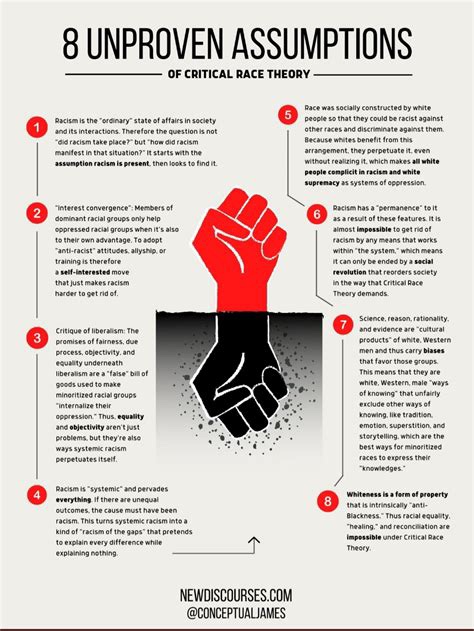
If one’s “experience” is the only evidence that matters, then the ravings of any lunatic must be taken at face value, and as truth. A concession to objective reality is tolerated only when and if it confirms an individual’s mood affiliation. And what defines one’s experience if not one’s inner feelings about events? Thus, regardless of facts, CRT would have us bow to mere feelings, perceptions, and assertions of harm said to be inflicted by the so-called “privileged”.

If I believe I’ve experienced racism, then CRT supports the conclusion that I have experienced racism. It is not confined to situations of overt discrimination. It goes for any conflict I might have with someone of a different race; any transaction in which I might feel disadvantaged; any life circumstance that I experience as “unfair”; or any judgement against me in a court of law. Racism is reality if I “experience” the world as racist (or sexist or homophobic or transphobic, for that matter.) These charges are conveniently leveled against those who have enjoyed any differential success in the world, irrespective of race, but primarily against whites and often Asians regardless of success.

Apparently, under CRT, one’s “experience” may extend to perceptions that today’s culture and institutions are evolved from any version of history one might choose to conjure. A prominent case are the lies promoted by the New York Times’ 1619 Project that the Revolutionary War was fought to preserve slavery. Jonah Goldberg’s thoughts on that topic are worth reading.

CRT has spawned some incredibly bad research. Here’s a review of two academic papers on the connection between the use of the “N-word” in LLP Google searches and 1) gun purchases “motivated by white racial animus”, and 2) “anti-black voting patterns”. The authors of those papers drew behavioral conclusions from mere coincidental events, based more upon their personal biases than objective evidence. They undoubtedly were aware of the weaknesses of using Google trends to gauge attitudes, but they willfully ignored that evidence.

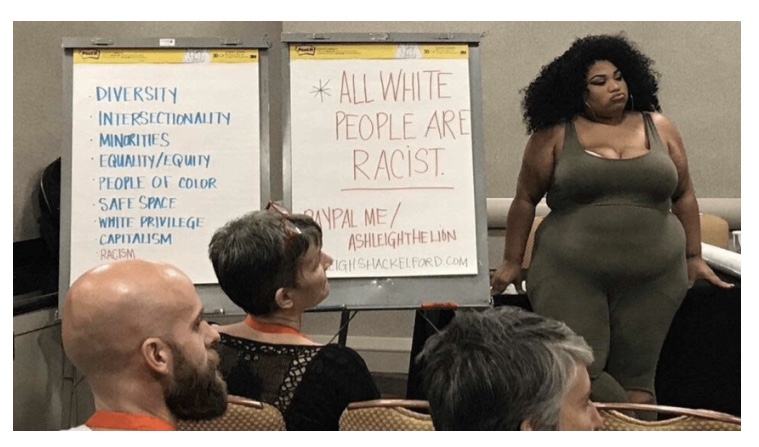
CRT is being taught to our children in public schools and probably in some private schools. This is nothing short of an indoctrination campaign. Of course, CRT made much earlier inroads in higher education. A new web site, criticalrace.org, includes a searchable database on CRT training at U.S. universities, as well as links to a variety of articles on CRT. Many private corporations have been eager to jump on board with CRT. Take a look at the instructor’s notes on the poster boards at the racial struggle session shown below. Here is a longer description.

This is literally a propaganda putsch, and it is meeting with far more success than I would have thought possible. I’ve apparently misjudged the ability of my countrymen to think independently, or to think at all. Here are examples of the success of CRT advocates in convincing whites of their individual and collective guilt. There are individuals now so convinced of the guilt of all white people that they can’t help but make complete fools of themselves:

“We will only achieve tolerance and unity once white people accept that they are evil, repugnant, worthless trash whose very existence is a vomit stain on the fabric of society.”

Speak for yourself! I have to conclude that this poor woman recognizes something quite damning within herself, and she feels it necessary to project her innermost racism onto others who happen to share her skin color.

Now here’s a man to admire: Lt. Governor Mark Robinson of North Carolina. He isn’t having any of the CRT crap, and he knows how to give it back to the petty stringers in the media as well as anyone.

CRT is a lie, or many lies. Racists certainly walk among us, but to condemn all whites of racism, or to allege racism by any class with presumed privilege, is a gross violation of ethics. Guilt of recompensable racism cannot be established by mere claims about anyone else’s “experience” without impartial adjudication. The thoughts and actions of decent people are not dominated by racial animus or repugnance, and any presumption to the contrary must be rejected in the absence of objective proof. Everyone matters, and we must insist on equality under the law. That does not mean equality of outcome, and it is not an excuse for blaming negative outcomes on anyone skilled and/or fortunate enough to have enjoyed more positive outcomes. If the fact that blacks have not achieved average economic parity with whites is evidence of “systemic racism”, I would suggest it has more to do with short-sighted public policy efforts to engineer social outcomes than with racism. More on that in a later post.

Note: the graphic at the top is from New Discourses.

Equal *Mattering* Under Ethics, Law and Community

04 Saturday Jul 2020

Posted by Nuetzel in Identity Politics, racism, Uncategorized

≈ 1 Comment

Tags

Black Lives Matter, Civil Rights, Conflict Theory, Equal Protection, Family Unit, Great Society, Identity Politics, Jim Crow, Lyndon Johnson, Marxism, Moral Dilemma, Original Sin, racism, Self-Driving Cars, Slavery, Systemic Racism, Thomas Sowell, Tribalism, Walter Williams, Welfare State

How many white lives is a single black life worth? It seems so easy to pin that down, but if you think it’s okay to say “black lives matter”, but not to say “all lives matter”, the implication is that one black life is worth more than one white life. Anyone who insists on that should take the following litmus test. 

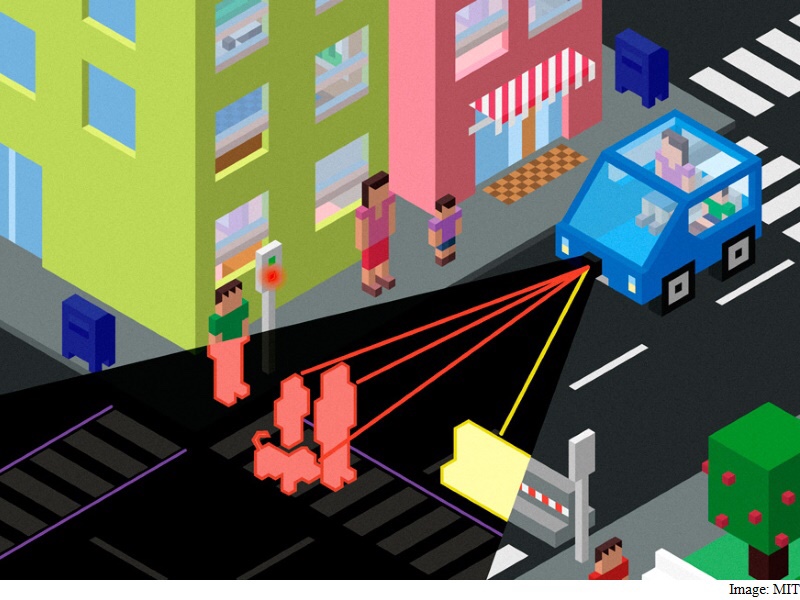
A classic dilemma discussed by ethicists involves situations of mortal danger in which a life or lives might be sacrificed in order to save other lives. Variants of it come up again and again in the effort to tune software for autonomous vehicles. It’s also a simple tool for challenging assertions about the values of different lives, or whether different lives “matter”.

Suppose that two pedestrians step into the path of your vehicle. You can save them only by swerving, killing a single pedestrian standing at the curb. Most would agree the car should swerve, but the answer might change under certain circumstances. Forget about the argument that the two in your path weren’t careful, so they “deserve” die. We just don’t know what caused them to proceed, or what might have distracted them.

What if the two in your path are elderly, using walkers and dragging oxygen tanks, while the pedestrian at the curb is a healthy child. Does that matter? Do we weigh the sacrifice of many potential life-years as well as a higher quality of life? People might feel less certain about that choice.

Now let’s suppose that all three pedestrians are healthy, young adults. Does it matter that any of the pedestrians are black? The one on the the curb, or the two in your path? Of course not! The truly “colorblind” answer is to swerve regardless of race. You are an obvious racist if you think otherwise. The sacrifice of one white life is certainly worth saving two black lives; the sacrifice of one black life is certainly worth saving two white lives. Black lives and white lives matter equally. 

Our Constitution and ethical standards dictate that lives are equal, that we are equal before the law, that we that we have equal rights to speak, worship, and enjoy the fruits of our labors, including the unchallenged right to property we might acquire. Under the law, and in all of our social interactions, we must be accorded equal consideration regardless of extraneous characteristics such as race. All of us have the same promise of life and opportunities to pursue happiness, and to make of our lives what we can or will. However, none of this entitles us to equal happiness, romance, and material well being.

Now, detractors will say all that misses the point. The value of black lives has been discounted for centuries, they say, as evidenced in disparate treatment by police, prosecutors, juries, employers, neighbors, social clubs, and places of business. Of course it’s true that racism has a long history throughout the world, and at one time or other it has been turned against virtually every race or religion in existence. If you think in this day and age that racism doesn’t exist elsewhere, think again.

Slavery was a tragic reality in the U.S. until 155 years ago, but it was certainly not unique to the U.S. Jim Crow laws that prevented blacks from participating equally in many aspects of life were finally ended more than 50 years ago through a series of legislative actions and Supreme Court decisions. Slavery and Jim Crowism were the acts of long-dead ancestors of almost anyone living today. The presumption that all whites should assume guilt for some kind original sin against blacks is sheer nonsense, and one many of us will simply never accept.

Nevertheless, the legacy of degraded personhood under those long-defunct laws created a heavy burden for blacks in terms of upward mobility, and certainly vestiges of racism survive even today. However, we have adopted many standards and programs intended to rectify this unfortunate legacy, including the civil rights legislation of the 1960s and beyond, the Great Society programs of Lyndon Johnson, and many other enlargements of the social safety net since then. These programs have represented a massive redistribution of resources to the impoverished via education, housing, and direct transfers. One estimate put cumulative federal spending on anti-poverty programs alone at $13 trillion between 1963 and 2010. In addition, a variety of programs have been a source of preferential treatment for various minorities in an effort to ensure equal opportunities across many aspects of life.

The success of these programs is subject to great doubt (more on that below), and in fact the motives of Johnson and other proponents of this expansion in the role of government were perhaps less than pure. Nevertheless, the entirety of the package of civil rights and welfare state programs over the years was supported by most of the black community. In fact, one could say that these measures were hardly the actions of a racist society, at least in ostensible intent.

And yet we are told today that we do not sufficiently appreciate that black lives matter! There is no question that racism lives in the hearts and minds of certain individuals, but those individuals aren’t all white. More importantly, the blanket condemnation of whites as racist lacks any basis in reality.

When Black Lives Matter activists talk of “systemic racism”, you can translate as follows: blacks have not met with the ex post economic and social success to which these activists believe blacks are entitled. As it pertains to law enforcement, they mean that blacks are met with more violent police actions than blacks should suffer.

As to law enforcement, it is an awful thing that crime perpetrated by blacks, and particularly crime by blacks against blacks, is disproportionally heavy. As I argued recently, it is difficult to accept the hypothesis of systemic racism in law enforcement in the presence of rampant “systemic crime” in the black community. But crime, in turn, is tied closely to economic success, or the lack thereof.

Median black income has grown relative to median white income since 1970 (also see here). Unfortunately, many blacks have not shared in that growth and remain mired in poverty and on public aid. Sadly, many aid programs have pernicious effects because they impose extremely high marginal tax rates on earned income. The solution lays the groundwork for continued dependency. That qualifies as systemic racism, or at least classism.

Two well-known black economists, Thomas Sowell and Walter Williams, have both decried the welfare state’s destructive impact on the black family unit. That’s one reason why Williams calls white liberals the “worst enemy of black people“. (Also see what Williams has to say about expectations for black students, and about black crime.)

Ultimately, the uproar over racism alleged to be so widespread and “systemic” is divisive. It is an application of Marxist “conflict theory” lying at the very heart of identity politics. Such tribal philosophies creat huge obstacles to peaceful and productive coexistence among diverse peoples. Meanwhile, there’s a simple truth: a widespread consensus exists that all lives are of equal value, that all lives deserve respect and equal treatment under the law, that the goodwill of one’s fellows is a birthright, and that racism is fundamentally evil. If society is to provide fertile ground for the equal cultivation of all lives, it must reject the strictures and resentment bred by identity politics in favor of individual liberty, personal responsibility, and compassion for those unable to care for themselves.

Brave Cops and Foolish Subversives

25 Thursday Jun 2020

Posted by Nuetzel in Police Bias, racism

≈ 2 Comments

Tags

Alexandra Phillips, Antifa, Barry Latzer, Black Lives Matter, Criminal Justice Reform, George Floyd, Lethal Force, Marxism, No-Knock Raids, Non-Lethal Force, Patrice Cullors, Police Brutality, Qualified Immunity, Rayshard Brooks, Roland Fryer, Systemic Racism, Walter Williams, War on Drugs, Welfare State

It’s difficult to put oneself in the shoes of a cop, but it seems clear that many partisans lack an appreciation for the intensity and danger of police work, which is fundamentally about protecting the public from threats to life and property. Confrontation is an unavoidable part of the job, whether it involves a domestic disturbance, drunk and disorderly conduct, property crime, or a shooting. Situations are adversarial and officers often face significant mortal risk. These are very brave people.

It would be impossible to do a cop’s job without legal authorization and occasional use force, but it can be very hard to judge when that’s necessary. A cop’s beat can feel like a war zone. There’s not much time to think. Things happen fast. Bad things happen really fast. Calm is restored in the best of circumstances, but arrests may be necessary, and sometimes a situation escalates or is already so fraught that it ends in tragedy. Sound procedures help police do their jobs better, but outcomes are capricious, and it is all too easy to make harsh judgements about split-second decisions in hindsight. Like any other accused, when a police matter ends badly, the cop is entitled to due process. Depending on circumstances and evidence, that means cops deserve a fair margin of error in the conduct of their duties.

To take a recent example, the police shooting of Rayshard Brooks in Atlanta occurred after Brooks wrestled with officers when they attempted to put him in handcuffs. Brooks broke free and snatched one of their tasers. As he ran, an officer pursued him at fairly close range. Brooks turned and fired the taser at the officer, shooting too high as it turned out. But the officer returned fire within an instant, three shots, striking Brooks in the back twice. Was that justified or reckless? The videos shown on the networks are in slow motion, but decisions like that can’t be made in slow-mo. The taser might have struck and disabled the officer, or in rare circumstances even killed him. And some tasers fire more than once; if one or both officers were disabled, their guns were potentially up for grabs. Either way, the use of his firearm seems to have been within Georgia law and Atlanta Police Department guidelines. No one should pretend there was time for careful deliberation. However, none of that dissuaded the Fulton County DA from filing immediate murder charges in a politically charged atmosphere. That’s hardly due process.

Of course there are bad cops and racist cops, but they comprise a distinct minority. Certain reforms might help to keep them from abusing their power, get them off the force, or convict them, depending on the nature of the offense. Qualified immunity gives excessive cover to bad cops and has protected far too many from prosecution. It’s regrettable that Senate Republicans have refused to consider modifications to qualified immunity, but perhaps they are holding it back as a negotiating ploy. Monitoring the conduct of officers is obviously important, and anonymous peer review within departments would be an excellent mechanism for identifying problem officers. Some reform proposals would certainly reduce the likelihood that police actions will be unjust, regardless of individual attitudes: ending no-knock raids and decriminalizing drugs would be major steps forward on that front.

The brutal murder of George Floyd has brought much more radical calls for changes in policing — even defunding or dismantling entire departments. These are based on widespread assertions that police are biased against blacks and that unjust police violence is directed at blacks. There is conflicting evidence on that point, however. Harvard Professor Roland Fryer concludes that while there is no evidence of racial bias in the use of lethal force by police, there is some evidence of bias in the use of non-lethal force. Other facts make the latter conclusion seem dubious, however. Consider the patterns of criminal activity described at the last link by Barry Latzer, CUNY Professor of Criminal Justice:

“The latest police data collected by the FBI indicates that blacks comprised 58 percent of all murder arrests and 40 percent of those apprehended for all violent crimes. This disproportional involvement of African Americans in violent crime turns out to be the most significant factor of all in explaining the use of force against blacks by police.

It will be no surprise that violent criminals in the United States are commonly armed and dangerous. For assaults, for instance, 71 percent of arrested persons carried firearms. Among suspected murderers, 58 percent had guns, as did 42 percent of apprehended robbery suspects. This tally doesn’t include the knives or blunt instruments recovered from violent offenders, including over 48,000 cutting instruments possessed by those arrested for assault alone.”

Latzer cites a number of studies of lethal force by police. One of these studies found:

“… after controlling for numerous factors, that blacks were 27.4 percent less likely than non-Hispanic whites to be fatally shot by police.”

Other researchers have noted:

“… the absence of any correlation between the race of the officer and that of the victim. That is, after controlling for other factors, white police officers were no more likely than black officers to fatally shoot black civilians. In fact, the more black officers on a police force, the more African Americans were fatally shot.” 

Another finding by the same study:

“[O]fficer race, sex, or experience did not predict the race of a person fatally shot beyond relationships explained by county demographics. On the other hand, race-specific violent crime strongly predicted the race of a civilian fatally shot by police, explaining over 40% of the variance in civilian race. These results bolster claims to take into account violent crime rates when examining fatal police shootings.”

The most tragic aspect of all this is that the vast majority of black crime victims are victimized by other blacks. Here are 2018 statistics for homicides. While blacks account for about 13.5% of the U.S. population, black offenders accounted for nearly 45% of homicides in 2018, and black-on-black homicide accounted for nearly 40% of all homicides.

Crime in the black community, and its economic costs, are inflicted almost exclusively on other blacks. If there was ever a need for good policing, this is it. The reasons for disproportionate crime and violence in the black community are complex. The notion that there is “systemic racism” at play here might be correct, but again, the evidence suggests it is not the fault of police. The welfare state plays a major role, as Walter Williams has long asserted. There are many more children living without fathers in the black community, a product of misdirected social policy that awards greater benefits to single-parents households. High rates of male incarceration obviously compound this problem. Blame can also be ascribed to a dysfunctional system of public education, and our nation’s continuing insistent on prosecuting the War on Drugs is highly destructive.

The campaign against police is promoted by a number of leftist organizations, the most prominent of which are Black Lives Matter and Antifa. Other well-meaning leftists do not question the rhetoric of police racism, and they also tend to fall for the illusion of collectivist virtue. Don’t accept this bullshit! It won’t help blacks as a class. We’ve known for some time that BLM is a Marxist organization, as is Antifa. Lawrence Person quotes BLM co-founder Patrice Cullors: “We are trained Marxists.”

According to Alexandra Phillips:

“BLM happily self-identifies as a neo-Marxist movement with various far left objectives, including defunding the police (an evolution of the [Black] Panther position of public open-carry to control the police), to dismantling capitalism and the patriarchal system, disrupting the Western-prescribed nuclear family structure, seeking reparations from slavery to redistribute wealth and via various offshoot appeals, to raise money to bail black prisoners awaiting trial. The notion of seizing control of the apportionment of capital, dismantling the frameworks of society and neutralising and undermining law enforcement are not just Marxist, but anarchic.”

Identity politics provides a rich trove of grievance, guilt projection, and intimidation. But it won’t end there. They will use any and all means to subvert civil society in order to gain power, and there will be a high cost in terms of freedom, lives and human well being. These people are ruthless morons. One doesn’t have to look far to learn that the histories of Marxist revolution and attempts at governance are uniform in their failure and bloody mayhem.

Too many “nice people”, media, businesses, and other institutions are all too willing to accept BLM and Antifa propaganda unquestioningly, including their stupefying lies about disproportionate police violence against blacks. Yes, there are black victims of police brutality, and there are many white victims as well — criminal justice and police reform is not to be dismissed. Unfortunately, there is a large disproportion of violent crime committed by blacks against blacks. Many in the black community know all too well that good policing is desperately needed. Quite simply: no cops, no peace, no justice.

Leftist Ad Hominid Species Screams “White Racists!”

03 Wednesday Feb 2016

Posted by Nuetzel in Discrimination, Equality, racism

≈ Leave a comment

Tags

A Taste For Discrimination, Assimilation, Celebrating Diversity, Cultural Sorting, Davis Bacon Act, discrimination, Economics of Discrimination, Jim Crow Laws, Minimum Wage, Racial Quotas, racism, Rent Controls, Social Mobility, Systemic Racism, Unintended Consequences, Virtue Signaling, Voluntary Sorting, War on Drugs


Lately I hear that all white people are racists, and I feel compelled to examine the intellectual grounding of such an inflamatory claim. Consciousness of race is not racism, as some would suggest. Indeed, solutions to racial division offered by activists usually require that we bear race in mind as a primary differentiator. Insofar as one must consider the worth of another person in any context, people of good faith simply do not care about a person’s race. Rather, they care about traits that count, such as honesty, skills, work ethic and perhaps affability. Should they somehow care more? What would vindicate them?

Inflammatory Claims

There are probably several motives for the charge of universal white racism. On one level, it represents political agitation. Posts carrying the charge on social media always involve a measure of “virtue signaling” to like-minded friends, or perhaps before the Gods. (I’m sure the posters will be forgiven.) Such posts might represent acts of social contrition to allay deep-seated feelings of guilt. The posters might fancy that they are raising the consciousness of others, proudly imagining the important lesson they are teaching. The bad news for them is that most people of good faith are rightly skeptical of proselytization like this. In fact, the agitation probably does more to breed skepticism than anything else.

Voluntary Sorting Behavior

What some view as racial division is often an innocent consequence of voluntary sorting based upon the shared subcultures most compelling to individuals at a given time. There are many subcultures into which a person might fit: work, school, profession, sports, music, religion, politics, hobbies, geography, ancestry, ethnicity and race. And there are micro-cultures within all of these categories. These cultural segments differ in many respects, and they may overlap in many cases. The extent of sub-cultural overlap may be viewed as a gauge of assimilation.

In any given context, people tend to voluntarily sort themselves into the sub-culture they find most compelling. This voluntary sorting does not yield a fixed social distribution of individuals across groups. Individuals can choose to associate with different sub-cultures to which they belong on a day-to-day basis.

There is a pronounced tendency for sorting to occur within larger “populations”, such as cafeteria-goers in a large office or in a large school. People from particular work groups might sit together: there is some sorting by age, by gender, and by race. African-Americans often sit together. There is mixing of members of these subgroups as well. People are brought together by work or school, but the shared work or school culture is frequently less compelling to individuals in their choice of a lunch table than other sub-cultures to which they belong.

Isolation or Assimilation

Assimilation does not mean that cultural differences must disappear, but it does mean that subcultures must at least be tolerant of others. A key question is whether one subgroup would welcome a member of another subgroup to join them. There might be reasons to refuse in some circumstances, such as a group of accountants who wish to avoid economists. Lol. However, a group of Caucasians who prefer to remain exclusive, making African Americans feel unwelcome, are guilty of racism, and vice-versa. As for the converse, an African American individual who prefers not to join a group of Caucasians, and vice versa, there is usually a good rationale for presuming the individual to be innocent of racism: they are simply choosing a more compelling sub-culture.

Certain sub-cultures may be especially amenable to selection from across sub-groups. For example, team sports often foster racial mixing, as do music and various professions. Religion and economic stratum can be powerful shared sub-cultures, drawing members across racial groups. In other words, mixing of sub-cultures will occur when a compelling sub-culture is shared. That is a form of successful assimilation.

When voluntary sorting takes place, the parties seek commonalities. That’s a form of discrimination that may be quite healthy and not racist in any way. On the other hand, accepting diversity implies respect for other cultures and subcultures. Voluntary sorting allows those cultures to function, but it does not necessarily imply exclusion of others who might be curious and wish to learn and take part in a culture’s traditions, or who might even wish to become a part of a different community.

Counterproductive Compulsion

The insistence that racism is widespread is often an expression of support for compelled remedies or paying reparations of some kind to alleged victims. In a free society, the kind of voluntary sorting discussed above will always be a reality; any attempt to prevent it would require extreme coercion. Reparations for historical injustices, legal or economic, raise ethical questions about the treatment of those who must bear the costs. They also carry high administrative costs and tend to breed resentment and division. There are well-known downsides to quotas in hiring and in school admissions. Not only do quotas lead to reverse discrimination, they also can place the intended beneficiaries into situations of vulnerability to failure.

Markets Are Not Racist

Then there is the allegation that private markets are a source of “systemic racism”, having “disparate impacts” on certain minorities. However, it should be noted that the market mechanism tends to penalize racism. A consumer who chooses to avoid sellers of a different race will tend to pay a higher price for the privilege. An employer with a “taste for discrimination” must choose from a smaller labor pool and may lose the opportunity to hire the best talent. In other words, racists must pay for their preference. They also forego the creative benefits that diverse organizations tend to enjoy.

Certain minorities have struggled to achieve success in the private economy, but there are much better explanations for that difficulty than market forces, which provide the best opportunity for growth and assimilation. There is no question that institutional obstacles have had extremely harsh effects on groups starting from lower rungs of the socioeconomic ladder. A few examples: the failed public education has been especially burdensome for urban and rural minorities; various public policies have effectively excluded minorities from markets, including Jim Crow laws, the minimum wage and the Davis-Bacon Act; the so-called social safety net is rife with features that penalize work and reward fragmentation of families, making it as much a trap as a net; the drug war creates illicit market opportunities which present catastrophic but unappreciated risks for both the participants and their families; rent controls, zoning laws and restrictions on new construction limit the stock of affordable housing; heavy regulation makes starting a business difficult for those without the financial and legal resources to deal with it; and the ugly tradition of cronyism tends to reduce social mobility by entrenching privilege rather than rewarding economic value. The deck is stacked in many ways against economic mobility by public policy, and racial minirities have borne much of the burden.

Immigration Hotspot

Another controversy is whether racism is manifest in the negative views of many Americans toward immigrants. These claims allege ethnic and religious discrimination, including the hatred of Muslims. No doubt there are Americans who harbor racist attitudes toward immigrants. Some of this is grounded in unreasonable economic fears. There are also fears that terrorists may be among new immigrant populations, especially refugees, but that fear is hardly unreasonable given the recent experience of Europe and the difficulty of establishing reliable background information on some of these individuals.

Sharing Freedom

Racism still exists and it will never go away entirely. However, our dedication to freedom compels us to protect speech as long as it is not threatening. Racial discrimination by participants in markets can be difficult to detect, but racists must pay an economic price imposed by the market mechanism, and there are often legal remedies if racial discrimination in markets can be proven. Fortunately, racism today is not as widespread as the agitators would have you believe. The best policy for assimilation and acceptance is to promote a shared culture of freedom and economic opportunity.

Follow Sacred Cow Chips on WordPress.com

Recent Posts

  • The Case Against Interest On Reserves
  • Immigration and Merit As Fiscal Propositions
  • Tariff “Dividend” From An Indigent State
  • Almost Looks Like the Fed Has a 3% Inflation Target
  • Government Malpractice Breeds Health Care Havoc

Archives

  • January 2026
  • December 2025
  • November 2025
  • October 2025
  • September 2025
  • August 2025
  • July 2025
  • June 2025
  • May 2025
  • April 2025
  • March 2025
  • February 2025
  • January 2025
  • December 2024
  • November 2024
  • October 2024
  • September 2024
  • August 2024
  • July 2024
  • June 2024
  • May 2024
  • April 2024
  • March 2024
  • February 2024
  • January 2024
  • December 2023
  • November 2023
  • August 2023
  • July 2023
  • June 2023
  • May 2023
  • April 2023
  • March 2023
  • February 2023
  • January 2023
  • December 2022
  • November 2022
  • October 2022
  • September 2022
  • August 2022
  • July 2022
  • June 2022
  • May 2022
  • April 2022
  • March 2022
  • February 2022
  • January 2022
  • December 2021
  • November 2021
  • October 2021
  • September 2021
  • August 2021
  • July 2021
  • June 2021
  • May 2021
  • April 2021
  • March 2021
  • February 2021
  • January 2021
  • December 2020
  • November 2020
  • October 2020
  • September 2020
  • August 2020
  • July 2020
  • June 2020
  • May 2020
  • April 2020
  • March 2020
  • February 2020
  • January 2020
  • December 2019
  • November 2019
  • October 2019
  • September 2019
  • August 2019
  • July 2019
  • June 2019
  • May 2019
  • April 2019
  • March 2019
  • February 2019
  • January 2019
  • December 2018
  • November 2018
  • October 2018
  • September 2018
  • August 2018
  • July 2018
  • June 2018
  • May 2018
  • April 2018
  • March 2018
  • February 2018
  • January 2018
  • December 2017
  • November 2017
  • October 2017
  • September 2017
  • August 2017
  • July 2017
  • June 2017
  • May 2017
  • April 2017
  • March 2017
  • February 2017
  • January 2017
  • December 2016
  • November 2016
  • October 2016
  • September 2016
  • August 2016
  • July 2016
  • June 2016
  • May 2016
  • April 2016
  • March 2016
  • February 2016
  • January 2016
  • December 2015
  • November 2015
  • October 2015
  • September 2015
  • August 2015
  • July 2015
  • June 2015
  • May 2015
  • April 2015
  • March 2015
  • February 2015
  • January 2015
  • December 2014
  • November 2014
  • October 2014
  • September 2014
  • August 2014
  • July 2014
  • June 2014
  • May 2014
  • April 2014
  • March 2014

Blogs I Follow

  • Passive Income Kickstart
  • OnlyFinance.net
  • TLC Cholesterol
  • Nintil
  • kendunning.net
  • DCWhispers.com
  • Hoong-Wai in the UK
  • Marginal REVOLUTION
  • Stlouis
  • Watts Up With That?
  • Aussie Nationalist Blog
  • American Elephants
  • The View from Alexandria
  • The Gymnasium
  • A Force for Good
  • Notes On Liberty
  • troymo
  • SUNDAY BLOG Stephanie Sievers
  • Miss Lou Acquiring Lore
  • Your Well Wisher Program
  • Objectivism In Depth
  • RobotEnomics
  • Orderstatistic
  • Paradigm Library
  • Scattered Showers and Quicksand

Blog at WordPress.com.

Passive Income Kickstart

OnlyFinance.net

TLC Cholesterol

Nintil

To estimate, compare, distinguish, discuss, and trace to its principal sources everything

kendunning.net

The Future is Ours to Create

DCWhispers.com

Hoong-Wai in the UK

A Commonwealth immigrant's perspective on the UK's public arena.

Marginal REVOLUTION

Small Steps Toward A Much Better World

Stlouis

Watts Up With That?

The world's most viewed site on global warming and climate change

Aussie Nationalist Blog

Commentary from a Paleoconservative and Nationalist perspective

American Elephants

Defending Life, Liberty and the Pursuit of Happiness

The View from Alexandria

In advanced civilizations the period loosely called Alexandrian is usually associated with flexible morals, perfunctory religion, populist standards and cosmopolitan tastes, feminism, exotic cults, and the rapid turnover of high and low fads---in short, a falling away (which is all that decadence means) from the strictness of traditional rules, embodied in character and inforced from within. -- Jacques Barzun

The Gymnasium

A place for reason, politics, economics, and faith steeped in the classical liberal tradition

A Force for Good

How economics, morality, and markets combine

Notes On Liberty

Spontaneous thoughts on a humble creed

troymo

SUNDAY BLOG Stephanie Sievers

Escaping the everyday life with photographs from my travels

Miss Lou Acquiring Lore

Gallery of Life...

Your Well Wisher Program

Attempt to solve commonly known problems…

Objectivism In Depth

Exploring Ayn Rand's revolutionary philosophy.

RobotEnomics

(A)n (I)ntelligent Future

Orderstatistic

Economics, chess and anything else on my mind.

Paradigm Library

OODA Looping

Scattered Showers and Quicksand

Musings on science, investing, finance, economics, politics, and probably fly fishing.

  • Subscribe Subscribed
    • Sacred Cow Chips
    • Join 128 other subscribers
    • Already have a WordPress.com account? Log in now.
    • Sacred Cow Chips
    • Subscribe Subscribed
    • Sign up
    • Log in
    • Report this content
    • View site in Reader
    • Manage subscriptions
    • Collapse this bar
 

Loading Comments...