• About

Sacred Cow Chips

Sacred Cow Chips

Tag Archives: The Economist

Success In The Enlightened West

08 Wednesday Aug 2018

Posted by Nuetzel in Free markets, Liberalism, Liberty

≈ Leave a comment

Tags

Constitution, Enlightenment, Individual Rights, Joe Lonsdale, Liberalism, Patriarchy, The Cicero Institute, The Economist, Western Civilization
The Left is engaged in a full attack on true liberalism and it is an attack on the rights of the individual: life, liberty, property, speech, due process of law, and other enumerated and unenumerated rights enshrined in the U.S. Constitution. These rights are themselves the very underpinnings of Western civilization and are together an unambiguous force for good in the world. Joe Lonsdale has written a declaration regarding the powerful legal, political, and economic philosophies that have served as the bases of Western civilization and its successes and which have, as a consequence, been adopted around the globe. Lonsdale, in his mid-30s, is an “American entrepreneur and technology investor” and founder of The Cicero Institute, an organization dedicated to encouraging “public-sector entrepreneurship to address America’s most pressing problems.”

I love Lonsdale’s full-throated advocacy for Western principles. Their articulation over three centuries ago by an enlightened “patriarchy” (as today’s social justice warriors might call them) managed to upset an entrenched and rapacious oligarchy, over time lifting whole populations out of subjugation and penury. Ultimately, this upheaval made possible the legal recognition of the same rights for all individuals, regardless of race and gender. Lonsdale’s insistence on the appropriate use of the word “liberal” is refreshing. It should (but won’t) serve as a corrective to the towering ignorance of those who accept “liberalism” when used as a cover for statism.

I’m going to quote “liberally” from Lonsdale’s piece because it speaks so well for itself, but if you’ve made it this far then you should read Lonsdale’s essay in its entirety.

“[John] Locke’s moral insight is ‘liberalism’, a principle of mutual restraint inspired by the inviolable rights of others to design their own lives. Freedom is life in accordance with reason; reason compels us to respect the freedoms of others. By respecting the rights of others, we guarantee our own.

This Enlightenment thinking was put into practice in the Glorious Revolution in 1688 in Britain, and especially in the founding of America, where Locke’s liberalism formed the backbone of the new republic. To be sure, in practice there were deep contradictions—the founders were simultaneously freedom fighters and slave-owners—but the institutional architecture was in place. The West’s new framework of property rights and political freedoms unleashed a surge of creative energy, enabling a three-century miracle of growth, prosperity and unimaginable wonders of innovation.

It didn’t have to happen that way. The natural order of things is for life to be ‘solitary, poor, nasty, brutish and short’ (in the words of Thomas Hobbes, a contemporary of Locke). Western civilisation is a great artifice: a liberal framework that enshrines property rights, allowing us to restrain most forms of tribalism, participate in free markets and prosper by serving others regardless of their identities.

These political rights of treating people equally and letting them get on with their business had a hugely beneficial effect on society and the economy. Consider that historically speaking, it is actually unnatural for the best ideas to dominate and spread, thus allowing entrepreneurs to displace incumbent, vested interests. More common is for force or hierarchy, not the meritocracy of ideas, to win. However, the West established a cultural and legal environment where a competition of clever ideas and activities could flourish. 

Lonsdale offers several examples of the malignant effects of forsaking these Western ideals. The hallmark of all these failures is an abandonment of the individual as the true and natural rights-holder and productive force. Here are Lonsdale’s  closing paragraphs:

“As pre-Enlightenment modes of value-signaling, tribalism and power-politics come to the fore on campus and social media, we must reaffirm our commitment to Western liberal values by actually putting them into practice. Only a rational order which enshrines individual rights to person and property, and expands opportunities for all, will create the stability and economic progress necessary to quell populist discontent.  

Unsurprisingly the anti-liberal, top-down parts of our society are experiencing cost-disease and decay. The West enabled a market order where the best ideas win, no matter whose idea it was. We need to remind ourselves of how unusual the miracle of our political economy is and enact its lessons. Only then can we save the concept of ‘Western civilisation’ and spread its benefits of freedom and prosperity—not just for people in the West, but for everyone.”
Unequal Pay For Unequal Work

25 Thursday Feb 2016

Posted by Nuetzel in Labor Markets

≈ Leave a comment

Tags

BLS, Claudia Golden, DOL, FiveThirtyEight, Gender Discrimination, Gender Gap, High-Risk Occupations, Job Flexibility, Mark Perry, Millennial Pay Gap, Mutually Beneficial Trade, Non-Wage Compensation, Obama Discrimination Data Mandate, Occupational Choice, Pay Differentials, Risk Aversion, STEM, The Economist, Tyler Cowen

equal-pay-cartoon

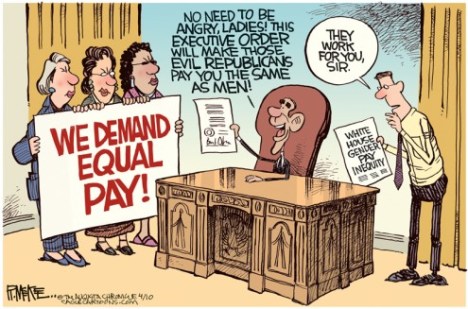
Debates on social issues are often plagued by facile comparisons that distort the underlying facts. The alleged gender pay gap involves such comparisons. The Obama Administration proposed new rules last month intended to address a difference in median earnings between men and women, demanding data reports on various demographics from firms with 100+ employees. Mark Perry points out that the pay gap in the Obama White House is about the same as the national difference. Can there be any reasonable explanation for these disparities?

One key to understanding the debate is that the difference in aggregate pay between men and women (17% in 2014, according to the Bureau of Labor Statistics) is not a divergence in pay for equal work! However, that is the gist of the fraudulent narrative so often heard from the White House and elsewhere. The truth: 17% is the difference in the medians of two large distributions of working adults, one for men, one for women, covering all occupational categories. The discrepancy, which has declined sharply over the past 35 years, is explained today by fewer hours worked among women and “differences in educational attainment, work experience, and occupational choice.” These differences are well known, but gender-gap warriors conveniently overlook the following facts, as established by the Department of Labor:

  • There is more part-time work among women;
  • Women lose more experience to childbirth, child care and elder care;
  • Women demand more job flexibility and non-wage benefits (and that costs);
  • Women are disproportionately under-represented in dangerous occupations;
  • Women are disproportionately under-represented in STEM fields (Science, Technology, Engineering, Math);

Interestingly, the last point may have more to do with a broader range of talents possessed by females who are skilled at math, relative to men, which leads to a greater variety of career options. An implication: non-STEM occupational choices by women are often voluntary and not the result of discrimination. And those choices are often driven by considerations other than cash remuneration.

As to the risk of physical danger, in 2010, men were almost 12 times as likely as women to suffer fatal injuries on the job. There is no question that high-risk occupations have higher wages. Apparently, women choose not to pursue opportunities in these occupations. An earlier study found that single parents, male and female, were the most risk averse in their choice of occupation, and that married women with children are more risk averse than married men with children. Of course, it is possible that some employers have requirements in terms of physical strength that favor men. Either way, the job-risk gap almost certainly contributes to the measured-wage gender gap, but it has little to do with gender discrimination per se.

Earnings are sensitive to factors such as full-time / part-time status, continuous job tenure, and the likelihood of extended leaves of absence. This is supported by a research finding cited in The Economist, that partners in lesbian relationships tend to out-earn married straight females. The division of responsibilities in the home is surely part of the story: lesbian couples tend to split chores more equally than straight couples. Millennial couples (ages 25-34) are also more likely to split household chores equally; the gender pay gap for millennials is much narrower than for older age cohorts, and it is nonexistent for childless millennials. Millennial women have more than closed the education gap as well.

When gender differences in hours, tenure, absences, education, and job hazards are considered, as well as the full menu of compensating non-wage benefits available, the wage gap is essentially nonexistent. Yet President Obama’s proposed data mandate would carry high compliance costs and likely cost jobs as well. The purpose of the regulation is to make it easier for various groups to sue employers on the basis of wage discrimination. But observation of such a gap, wherever it might exist, is not prime facie evidence of discrimination; it is more than likely to be the result of private, voluntary agreement.

Is it possible that certain attitudes or behavioral characteristics of women generalize to poorer outcomes, relative to men, in negotiations? Tyler Cowan reports on research that suggests as much, based on “laboratory” experiments in which participants played repeated games involving actual rewards. In one experiment, the rewards depended on the acceptance of an offer to share a pot, and both men and women made lower offers to female partners than to males. However, when the partner was a woman, females were markedly stingier in their offers than males. Those women are tough! But seldom are real-world “deals” so one-dimensional, and controlling for all considerations of value is often impossible. In any case, trades rarely take place when the parties don’t find them to be mutually beneficial.

Fortunately, in labor markets, when differentials in skills and experience matter, discrimination is practiced only under a self-inflicted penalty on the discriminator. In the case of wage-based gender discrimination, the employer will tend to overpay for equivalently-skilled male help. Discrimination of this sort impairs a firm’s ability to attract the best employees and harms its competitive position. Nevertheless, the extent to which the market’s self-regulation confers benefits on individual participants depends upon their vigilance: buyer beware (caveat emptor) and seller beware (caveat venditor) are keys to real economic freedom. Most importantly, in all things, beware government edicts. Markets are the best regulator.

Sidebar: I was referred to an article on FiveThirtyEight by my friend John Crawford. The main subject matter of the article is off-topic and its conclusions are incorrect (I might post on it soon), but many of the charts are interesting; the third chart is really fascinating! It shows that women, by age 30, tend to belong to households that are higher in the income distribution than men who come from the same point in the distribution of household-income in childhood. This is true at every point in the childhood household-income distribution! Are there advantage(s) for women that can account for this? A few guesses: a lower rate of incarceration of women by age 30; women have higher marriage rates by age 30; women “marry up” more than men, both in terms of the ages and incomes of their spouses; women who don’t marry live with their parents more than men do (?). There could be other explanations, and the relationship may not hold at later ages. Still, it’s noteworthy that such a reverse “gender gap” exists in the data.

I close with a quote from Harvard’s Claudia Golden, from “A Grand Gender Convergence: Its Last Chapter” (HT: Marginal Revolution):

“The gap is much lower than it had once been and the decline has been largely due to an increase in the productive human capital of women relative to men. Education at all levels increased for women relative to men and the fields that women pursue in college and beyond shifted to the more remunerative and career-oriented ones. Job experience of women also expanded with increased labor force participation. The portion of the difference in earnings by gender that was once due to differences in productive characteristics has largely been eliminated. 

What, then, is the cause of the remaining pay gap? Quite simply the gap exists because hours of work in many occupations are worth more when given at particular moments and when the hours are more continuous. That is, in many occupations earnings have a nonlinear relationship with respect to hours. A flexible schedule comes at a high price, particularly in the corporate, finance and legal worlds.“

Subsidized Waste: The Renewable Irony

12 Tuesday May 2015

Posted by Nuetzel in Renewable Energy

≈ Leave a comment

Tags

Charles Frank, Christopher Helman, Elon Musk, Energy Matters, Energy storage, Energy subsidies, Lobos Motl, Renewable energy, Tesla Powerwall battery, The Brookings Institution, The Economist, Viv Forbes, Wind and solar

wind damage

The new Tesla “Powerwall” home battery is probably most noteworthy for the breathless hype it has generated. The $3,500 cost for the 10 kWh version is not cheap, and the installed price is probably closer to $7,000. The battery has a limited number of charge cycles, though Tesla has not fully disclosed all of the specifications. People of considerable expertise in this area (not me!) do not believe that Tesla’s new battery is the least bit innovative as an energy storage technology. See this post by Lobos Motl, or this one by Christopher Helman. This is not to say that Tesla has not made contributions to battery technology, only that this variation is not new, except for the marketing.

How can it pay for itself? The promise is not so much for back-up power during outages. Instead, it is an arbitrage play allowing consumers to store power during off-peak hours and avoid usage during peak-price hours. But the application (and hope) that has excited the media and well-meaning greens is efficient storage of power generated by intermittent, renewable sources. Tesla’s marketing effort certainly fostered such hopes; those with home solar panels may have Tesla sugar plums dancing in their heads.

Advocates of renewable energy can rightly claim that the costs of energy storage (and some forms of renewable power generation) have been declining. But there is still a mismatch between expectations and reality: the Tesla battery is not new technology, and it is not really cheap in terms cost per unit of energy stored and later delivered. The economic viability of intermittent sources of power obviously depends on the combined cost of storage, transmission and the power generated by a renewable source relative to other fuels, including the initial capital outlays. This is reviewed at the Energy Matters blog in “The High Cost of Renewables“, which is largely based on this paper from The Brookings Institution by Charles Frank.

It’s relevant to compare renewables such as wind and solar to nuclear energy and natural gas as replacements for “base-load” coal plants. Nuclear and gas power are often touted as viable, reduced or no-carbon solutions to providing for the energy needs. Two issues make renewables more costly than nuclear and gas in terms of installed cost per kilowatt, despite the huge up-front installation costs of nuclear. The first is the intermittency of wind and solar power generation. According to Frank’s calculations at the link above, this factor alone causes solar to be nearly four times as costly as nuclear energy, and wind to be more than 25% more costly. The second issue is that wind and solar installations have short useful lives relative to nuclear. This adds to the wind and solar cost disadvantages, but the practice of dividing costs by the number of years of useful life probably distorts the comparisons. The shorter-lived installations can be expected to involve lower costs at replacement, which should be averaged into a comparison with a longer-lived asset. Still, there is no question that renewables are more costly than gas and nuclear power.

Critics took Frank to task over certain assumptions following the publication of his paper. He offered rebuttals here, here and here in which he revised his calculations in ways that tested his critics’ assertions. Frank’s conclusions are the same:

“Taking all changes into account, my main conclusions are strengthened. Wind continues to rank number four and, by a large margin, solar number five. Gas combined cycle continues to rank number one by a large margin, although nuclear drops from two to three [behind hydroelectric power].”

This article in The Economist also emphasizes the problem of intermittency:

“… countries which have a lot of renewable generation must still pay to maintain traditional kinds of power stations ready to fire up when demand peaks. And energy from these stations also becomes more expensive because they may not run at full-blast.“

“Firing-up” a power station repeatedly consumes fuel at a greater than proportionate rate. If fossil fuels are involved, this process eats into the presumed benefits of using renewables. Of course, there are other factors that make large-scale renewable energy  “farming” undesirable, such as massive land requirements and danger to birds and even marine life. Here is another piece offering a reality check on the true costs of wind power.

Certain forms of renewable energy and energy storage technologies will continue to advance and their costs will decline over time. However, solar and wind power are currently more costly than other alternatives. The benefits of these technologies to society are highly speculative, since models of carbon-forced climate change do a poor job of explaining the actual climate. In any case, climate change, should it occur, is not unambiguously costly. In the absence of more convincing evidence, the costs of renewable energy supplies should be fully internalized by rational actors (who may have personal preferences for renewables) in private, arms-length transactions. Unfortunately, to date, the growth in the share of renewable energy production in most countries has been abetted by government subsidies, so even the aforementioned private actors are collecting rents at the expense of the rest of society. The extra costs imposed on society represent a waste of resources.

In the absence of compelling evidence of pure public benefits, new technologies should be subject to true market tests, not forced upon the public by mandates or encouraged via artificial self-interest created by subsidies. In “Green Energy Policy: ‘Nothing That Works’“, Viv Forbes discusses the real goals of the extreme green lobby, quoting several environmental radicals. Here is the “money” quote:

“… Amory Lovins of the Rocky Mountains Institute, said: ‘It would be little short of disastrous for us to discover a source of clean, cheap, abundant energy, because of what we might do with it.’“

There are a few countries that have attempted to adopt aggressive policies of renewable energy mandates. Here is a discussion of the German “Green Energy Debacle”. Australia has had its share of problems as well. And here is a warning about the implications of green policy and the imposition of “energy poverty on poor countries“.

ZIRP: Zero Interest Retirement Poverty

22 Wednesday Apr 2015

Posted by Nuetzel in Macroeconomics

≈ 2 Comments

Tags

Austrian Economics, Barron's, Ben Bernanke, EconoMonitor, Federal Reserve, Income effect, Keynesianism, Phoenix Capital Management, Randall Forsyth, rate of time preference, saving behavior, Substitution effect, The Economist, Thorsten Polliet, Trust Your Instincts, ZIRP

seniors

Far be it from me to make a Keynesian economic argument, but I will play devil’s advocate and do so at the risk of alienating any Austrian friends in the audience. They might or might not appreciate the point before I’m done. Writing in Barron’s, Randall Forsyth argues that a zero or negative real interest rate, or specifically a zero interest rate policy (ZIRP), will backfire on central banks precisely because low rates add to the pressure on consumers to save. If that is the case, in the Keynesian paradigm, the policy would undermine consumer demand and lead to weaker growth.

I find it plausible that savers might react to extremely low interest rates by increasing saving. With an aging population and baby boomers fast approaching their retirement years, low interest rates mean diminished opportunities to build on existing assets. The only way to bring more assets into retirement safely is to save more. There has been much said about the impact of quantitative easing and ZIRP on asset values, and the tendency of investors to “reach” for higher, but risker, returns. However, a decent, safe return is hard to come by.

This kind of saving behavior is easy enough to demonstrate for a consumer who must choose between present and future consumption. Present consumption is limited by what the consumer can earn now. Future consumption is limited by what the consumer saves now (does not consume) and the real return or interest rate that can be earned on that saving. The consumer maximizes well being by choosing the most-preferred “bundle” of present consumption and future consumption attainable. But when the interest rate falls to zero, for example, the consumer must reallocate the bundle.

First, the “effective price” of present consumption has declined, since less future consumption must be sacrificed in order to to consume now. So there is a tendency to reallocate the bundle toward more present consumption as a pure “substitution effect”. However, the consumer’s lifetime income has declined precisely because the real rate at which present saving can be transformed into future consumption has decreased. The bundles available for the consumer to choose from are now unambiguously less preferred than the original bundle. Faced with this worsened constraint, the consumer may choose to divide the sacrifice between present consumption and future consumption. The negative income effect on present consumption may well outweigh the substitution effect.

This is standard economics, but relatively little has been said about the possibility. Instead, it is widely assumed that ZIRP must reduce saving, but there have been a few writers making the argument that saving may increase. In 2010, the Buttonwood column in The Economist made this argument in a piece entitled “Another Paradox of Thrift“. In 2012, the Trust Your Instincts blog ran this interesting piece on ZIRP and saving behavior in which the possibility is discussed. For the same reason, Phoenix Capital Management asserted that “QE and ZIRP Are Deflationary“, And the same thing is mentioned in EconoMonitor.

Continuing to indulge Forsyth’s possibility, it does not imply that increased saving from ZIRP will be channeled into productive investment. That’s because governments continue to absorb private saving by running historically large deficits. But I must note that the possibility of increased saving in response to ZIRP may contradict a couple of points made in an earlier post on Sacred Cow Chips: “Taking The Air Out of the Deflation Scare“. That post quotes Thorsten Polliet in support of the notion that the rate of time preference underlying consumer behavior cannot be zero or negative. Does that conclusion change when consumers order bundles rationally with a budget constraint that implies a negative return? In fact, the macroeconomic concept of a time preference “parameter” appears to be inconsistent with the normal micro theory of consumer utility maximization.

Increased saving from ZIRP leads to a second apparent contradiction of Polliet, who says:

“Should a central bank really succeed in making all market interest rates negative in real terms, savings and investment would come to a shrieking halt: as time preference and the originary interest rate are always positive, “capitalistic saving” — the accumulation of goods designed for improving the production process — would come to an end.”

But again, the possibility that saving may increase does not imply that capital investment will increase as well, as long as the government is absorbing the increased saving. In fact, the adoption of ZIRP policies around the developed world seems in large part intended to accommodate large government deficits by keeping interest costs low.

The evidence that ZIRP encourages saving is mixed. Japanese saving rates tended to edge up over the country’s many years of ZIRP (since 1999). More recent experience in the EU seems mixed. In the U.S., saving rates increased during the financial crisis even before ZIRP began, moved down during the recovery, but have since returned to relatively high levels. The Federal Reserve claims that consumers continue to unwind the excessive leverage that built up prior to the recession, and of course that is saving. Paying down debt certainly carries a higher and safer return than many other options. ZIRP cannot be counted upon to encourage consumer spending, and it may well do the opposite.

There Is No Nordic Nirvana

17 Wednesday Sep 2014

Posted by Nuetzel in Uncategorized

≈ 1 Comment

Tags

Denmark, Finland, Iceland, John Fund, McCleans, Michael Booth, Nordic MIracle, Nordic Utopia, Norway, Privatization, Sweden, Tax Competitiveness, The Conversation, The Economist, Welfare State

'Remember, what goes on in Valhalla stays in Valhalla.'

Perhaps the Nordic utopia is not all it’s cracked up to be! Here’s a glimpse behind the facade from Michael Booth in The Guardian, with some blistering (and humorous) country-by-country commentary on a few of the cultural and economic failings of these darlings of the American Left. Here is The Conversation‘s rather cautious response. And here’s a comment from McLean‘s.

Apparently, the meme-niks of the Left are unaware that the more recent trend in Nordic countries has been away from government domination of the economy and high taxes. In fact, to his likely demerit, Booth even bemoans the widespread privatization of services that has taken place. This week’s Swedish election results were expected to herald a shift in direction, however, back toward the kind of welfare statism from which the country has turned away. Here’s The Economist‘s pre-election take on the situation. It includes some detail on the dismantling of the vaunted Swedish welfare state. But the outcome was not quite what The Economist expected. John Fund discusses the results, which included the advance of hard-line nationalists. Support for the welfare state seems to have eroded in tandem with the influx of immigrants. The hard-liners aside, this shift could simply indicate that support for the state from taxpayers is contingent upon the expectation of a return in the form of services, which may be diminished by redistribution to newcomers. However, some of the articles linked above imply a rising degree of racism toward non-Nordic immigrant populations.

As a further indication of the extent to which the Nordic countries have evolved, take a peak at the rank given to Sweden, Finland, Norway, Denmark and Iceland in this survey of international tax competitiveness. They are all ahead of the U.S. (which ranks 32nd out of 34 OECD countries) on the overall score and on most individual categories of tax competitiveness and neutrality.

Follow Sacred Cow Chips on WordPress.com

Recent Posts

  • Immigration and Merit As Fiscal Propositions
  • Tariff “Dividend” From An Indigent State
  • Almost Looks Like the Fed Has a 3% Inflation Target
  • Government Malpractice Breeds Health Care Havoc
  • A Tax On Imports Takes a Toll on Exports

Archives

  • December 2025
  • November 2025
  • October 2025
  • September 2025
  • August 2025
  • July 2025
  • June 2025
  • May 2025
  • April 2025
  • March 2025
  • February 2025
  • January 2025
  • December 2024
  • November 2024
  • October 2024
  • September 2024
  • August 2024
  • July 2024
  • June 2024
  • May 2024
  • April 2024
  • March 2024
  • February 2024
  • January 2024
  • December 2023
  • November 2023
  • August 2023
  • July 2023
  • June 2023
  • May 2023
  • April 2023
  • March 2023
  • February 2023
  • January 2023
  • December 2022
  • November 2022
  • October 2022
  • September 2022
  • August 2022
  • July 2022
  • June 2022
  • May 2022
  • April 2022
  • March 2022
  • February 2022
  • January 2022
  • December 2021
  • November 2021
  • October 2021
  • September 2021
  • August 2021
  • July 2021
  • June 2021
  • May 2021
  • April 2021
  • March 2021
  • February 2021
  • January 2021
  • December 2020
  • November 2020
  • October 2020
  • September 2020
  • August 2020
  • July 2020
  • June 2020
  • May 2020
  • April 2020
  • March 2020
  • February 2020
  • January 2020
  • December 2019
  • November 2019
  • October 2019
  • September 2019
  • August 2019
  • July 2019
  • June 2019
  • May 2019
  • April 2019
  • March 2019
  • February 2019
  • January 2019
  • December 2018
  • November 2018
  • October 2018
  • September 2018
  • August 2018
  • July 2018
  • June 2018
  • May 2018
  • April 2018
  • March 2018
  • February 2018
  • January 2018
  • December 2017
  • November 2017
  • October 2017
  • September 2017
  • August 2017
  • July 2017
  • June 2017
  • May 2017
  • April 2017
  • March 2017
  • February 2017
  • January 2017
  • December 2016
  • November 2016
  • October 2016
  • September 2016
  • August 2016
  • July 2016
  • June 2016
  • May 2016
  • April 2016
  • March 2016
  • February 2016
  • January 2016
  • December 2015
  • November 2015
  • October 2015
  • September 2015
  • August 2015
  • July 2015
  • June 2015
  • May 2015
  • April 2015
  • March 2015
  • February 2015
  • January 2015
  • December 2014
  • November 2014
  • October 2014
  • September 2014
  • August 2014
  • July 2014
  • June 2014
  • May 2014
  • April 2014
  • March 2014

Blogs I Follow

  • Passive Income Kickstart
  • OnlyFinance.net
  • TLC Cholesterol
  • Nintil
  • kendunning.net
  • DCWhispers.com
  • Hoong-Wai in the UK
  • Marginal REVOLUTION
  • Stlouis
  • Watts Up With That?
  • Aussie Nationalist Blog
  • American Elephants
  • The View from Alexandria
  • The Gymnasium
  • A Force for Good
  • Notes On Liberty
  • troymo
  • SUNDAY BLOG Stephanie Sievers
  • Miss Lou Acquiring Lore
  • Your Well Wisher Program
  • Objectivism In Depth
  • RobotEnomics
  • Orderstatistic
  • Paradigm Library
  • Scattered Showers and Quicksand

Blog at WordPress.com.

Passive Income Kickstart

OnlyFinance.net

TLC Cholesterol

Nintil

To estimate, compare, distinguish, discuss, and trace to its principal sources everything

kendunning.net

The Future is Ours to Create

DCWhispers.com

Hoong-Wai in the UK

A Commonwealth immigrant's perspective on the UK's public arena.

Marginal REVOLUTION

Small Steps Toward A Much Better World

Stlouis

Watts Up With That?

The world's most viewed site on global warming and climate change

Aussie Nationalist Blog

Commentary from a Paleoconservative and Nationalist perspective

American Elephants

Defending Life, Liberty and the Pursuit of Happiness

The View from Alexandria

In advanced civilizations the period loosely called Alexandrian is usually associated with flexible morals, perfunctory religion, populist standards and cosmopolitan tastes, feminism, exotic cults, and the rapid turnover of high and low fads---in short, a falling away (which is all that decadence means) from the strictness of traditional rules, embodied in character and inforced from within. -- Jacques Barzun

The Gymnasium

A place for reason, politics, economics, and faith steeped in the classical liberal tradition

A Force for Good

How economics, morality, and markets combine

Notes On Liberty

Spontaneous thoughts on a humble creed

troymo

SUNDAY BLOG Stephanie Sievers

Escaping the everyday life with photographs from my travels

Miss Lou Acquiring Lore

Gallery of Life...

Your Well Wisher Program

Attempt to solve commonly known problems…

Objectivism In Depth

Exploring Ayn Rand's revolutionary philosophy.

RobotEnomics

(A)n (I)ntelligent Future

Orderstatistic

Economics, chess and anything else on my mind.

Paradigm Library

OODA Looping

Scattered Showers and Quicksand

Musings on science, investing, finance, economics, politics, and probably fly fishing.

  • Subscribe Subscribed
    • Sacred Cow Chips
    • Join 128 other subscribers
    • Already have a WordPress.com account? Log in now.
    • Sacred Cow Chips
    • Subscribe Subscribed
    • Sign up
    • Log in
    • Report this content
    • View site in Reader
    • Manage subscriptions
    • Collapse this bar
 

Loading Comments...