• About

Sacred Cow Chips

Sacred Cow Chips

Tag Archives: Transparency

The Dirt On the Corporate Income Tax

23 Tuesday Mar 2021

Posted by Nuetzel in Fiscal policy, Tax Incidence

≈ 2 Comments

Tags

Alan D. Viard, Biden Administration, Compliance Costs, corporate income tax, Edward Lane, Investment Incentives, Joseph Sullivan, L. Randall Wray, Milton Friedman, Off-Shoring, Peggy Musgrave, Physical Capital, Pricing Power, Regressive Tax, Richard Musgrave, Shifting the Burden, Tax Avoidance, Tax Foundation, Transfer Pricing, Transparency
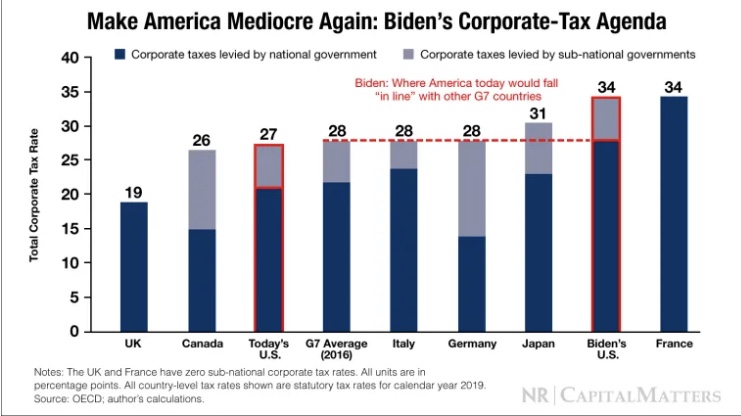
The Biden Administration is proposing a substantial increase in the corporate income tax rate from 21% to 28%. This is another case of a self-destructive policy that serves as a virtue signal to the progressive Left. See? We’re taxing the rich and their powerful corporations! What none of them realize is that the tax on corporate income is actually a regressive tax on consumers and workers; it is a disincentive to the formation of productive capital; and it is a highly wasteful tax due to compliance costs and the impact of avoidance. And the Biden proposal would make the U.S. less competitive internationally, as the chart above from Joseph Sullivan demonstrates. Maybe some of the proponents realize it, but they still like it because it sounds so good to their base!

It’s not as if all these unhealthy characteristics of the corporate tax are new findings. Milton Friedman explained some of the basics in 1971 when he said:

“The elementary fact is that ‘business’ does not and cannot pay taxes. Only people can pay taxes. Corporate officials may sign the check, but the money that they forward to Internal Revenue comes from the corporation’s employees, customers or stockholders. A corporation is a pure intermediary through which its employees, customers and stockholders cooperate for their mutual benefit.”

In 1984, two giants of public finance economics, Richard and Peggy Musgrave, investigated how the corporate tax was shifted to households. Here’s a description of their findings from a recent paper by Edward Lane and L. Randall Wray:

“… the bottom quintile pays 4.6–5.5 percent of its income toward the corporate profits tax, the top decile pays 2.5–3.7 percent of its income, and the ninth decile pays 2.4–2.9 percent of its income. They conclude that the corporate profits tax is largely regressive while the federal personal income tax is progressive.”

The incidence of the corporate tax rate falls primarily on workers in the form of lower wages and lost jobs, and on consumers in the form of higher prices. Lane and Wray cite several influential studies over the years showing a substantial negative association between corporate taxes and wages. As the authors note, major corporations often have pricing power in both product and labor markets, at least relative to their power in capital markets where they must raise capital. Capital markets are highly competitive, so they don’t provide much opportunity for shifting the burden of the tax to owners of equity and debt. There are limits on a firm’s ability to pass the tax along to customers and workers as well, of course, but shareholders are relatively well-insulated from the burden of the tax.

There are still other reasons to avoid increasing the corporate income tax rate. It currently raises about $200 billion annually for the U.S. Treasury, or about 7% of estimated federal tax revenue for the 2021 fiscal year. It also has extremely high compliance costs. Lane and Wray quote a 2016 Tax Foundation estimate that U.S. businesses face tax compliance costs on the order of $193 billion a year. Not all of that figure applies to corporations, and not all of it is for federal tax compliance, but a great deal of it is. There are also a number of ways the tax can be avoided, such as off-shoring operations and using overstated transfer prices of inputs obtained from units overseas. This is not an economically efficient way to generate tax revenue.

Moreover, the corporate income tax creates perverse incentives. When new investment in productive, physical capital is penalized at the margin, you can expect less capital investment, lower wages, and fewer jobs. Alan D. Viard explains that the dynamics of this mechanism take time to play out, but the longer-run decay in the capital stock is perhaps the most damaging aspect of a high corporate tax rate. And indeed, while there are probably short-run effects, the reduction in the incentive to invest is the real mechanism linking a higher corporate tax to reduced wages and higher prices, not to mention reduced economic growth.

Finally, there is a pernicious political-economic aspect of the corporate income tax owing to the difficulty for the general public in identifying its true incidence. This was also discussed by Milton Friedman:

“… Indirect effects make it difficult to know who ‘really’ pays any tax. But this difficulty is greatest for taxes levied on business. That fact is at one and the same time the chief political appeal of the corporation income tax, and its chief political defect. The politician can levy taxes, as it appears, on no one, yet obtain revenue. The result is political irresponsibility. Levying most taxes directly on individuals would make it far clearer who pays for government programs.

If the government intends to tax the owners of corporate wealth (a significant share of which is held in retirement savings accounts), it should be honest about doing so. That would mean taxing capital income in a more consolidated way, as Lane and Wray put it, at the individual level. That kind of transparency might be too much to hope for because the politics of doing so are much less favorable.

Meanwhile, the Biden Administration wants to have it all: higher corporate taxes and higher taxes on relatively high-earning individuals. But a significant burden of the corporate tax increase ultimately is shifted to individual workers and consumers. It is a regressive tax, and it is an inefficient tax with outrageously high compliance costs. It is a destructive tax because it undermines the economy’s growth in productive capacity. And it offers tax revenue to politicians who have little budgetary resolve, and with little political consequence.
The Incredible Glibness of Being Gruber

16 Tuesday Dec 2014

Posted by Nuetzel in Uncategorized

≈ Leave a comment

Tags

ACA, Darrell Issa, federal subsidies, House Oversight Committee, Jonathan Gruber, King vs. Burwell, Obamacare, Peter Suderman, Reason, Transparency

Gruber Comic

Jonathan Gruber is apparently a man of contradictions. He told a congressional committee last week that he “did not write any part of the Affordable Care Act.” He was asked at the hearing why he had claimed in 2012 that he did write part of the law. According to Peter Suderman, writing in Reason, Gruber replied “that it was ‘an effort to seem more important than I was,’ and that he was ‘speaking glibly.’” Video evidence of Gruber’s glibbery keeps stacking up in the wake of his sworn testimony.  He made the same “glib” claim at least twice in 2010 and again in 2012. In those videos, Gruber seemed pleased to issue disclaimers to his econ classes at MIT and other audiences that he “helped write” the ACA (Obamacare). From Suderman:

“There is no way to reconcile his multiple past statements with the statements he made this week while under oath. Either Gruber spent two years lying about his role in writing the law, or he was lying this week in his sworn congressional testimony.”

Now, Gruber has been subpoenaed again by the House Oversight Committee, this time in relation to his work and the income he earned as an Obamacare advisor. However, the subpoena covers all documents and exchanges with government employees, including work product, the results of economic model simulations, and any communications related to contracts and the funding of his research. Poor Gruber is in hot water. Lying to Congress, if that charge were pressed, could earn him up to five years in prison.

Of greater importance is that he very likely furnished the administration, as the law was being drafted, with economic projections showing that some existing private health plans would be cancelled. In his testimony last week, he admitted that his model simulations showed as much. Of course, President Obama was quite glib in his repeated assertions that “if you like your health plan, you can keep your health plan.” From Reason:

“Shouldn’t that mean that Gruber knew that administration’s repeated promises that those who like their health plans could keep their plans under the law weren’t true? 

Gruber was asked about the promise…. ‘I interpreted the administration’s comments as saying that for the vast majority of Americans the law would not affect the productive health insurance arrangements that they have,’ he said. ‘I did not see a problem with the administration’s statement.’

Of course he didn’t. Gruber is, after all, someone who argued that ‘lack of transparency’ was key to passing the health law.”

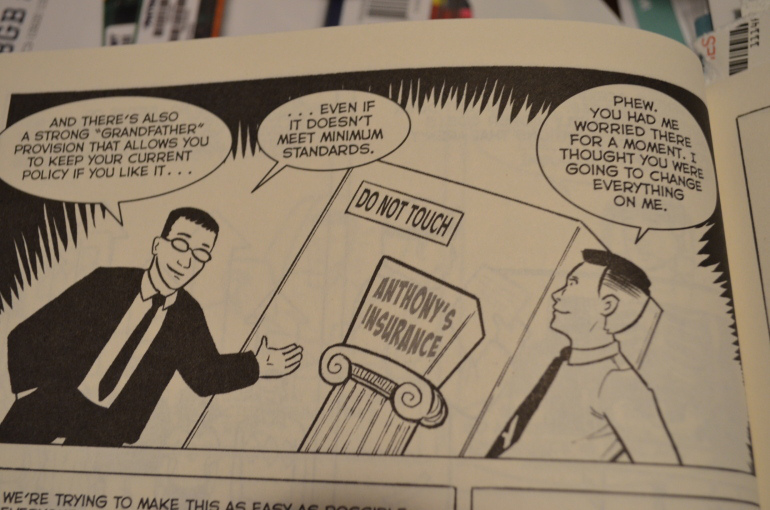
In fact, on the question of lost coverage, Gruber’s own comic book on the ACA made the same assurances as the Administration. See the frame at the top of this post! More contradiction.

Another crucial point is that Gruber claimed to have written the part of the ACA related to state health insurance exchanges. He stated on multiple occasions (captured on video) that the federal health insurance subsidies created by the ACA were intended as incentives for states to create their own exchanges. The “plain language of the law” is consistent with that claim; it is explicit in providing for subsidies only when a policy is purchased through a state exchange, not a federal exchange. Next year, the Supreme Court will hear the case King vs. Burwell, which turns upon whether the law itself disqualifies ACA insurance buyers in 36 states from collecting federal subsidies. Gruber’s videos appear to be quite damaging to the government’s case.

Follow Sacred Cow Chips on WordPress.com

Recent Posts

  • The Case Against Interest On Reserves
  • Immigration and Merit As Fiscal Propositions
  • Tariff “Dividend” From An Indigent State
  • Almost Looks Like the Fed Has a 3% Inflation Target
  • Government Malpractice Breeds Health Care Havoc

Archives

  • January 2026
  • December 2025
  • November 2025
  • October 2025
  • September 2025
  • August 2025
  • July 2025
  • June 2025
  • May 2025
  • April 2025
  • March 2025
  • February 2025
  • January 2025
  • December 2024
  • November 2024
  • October 2024
  • September 2024
  • August 2024
  • July 2024
  • June 2024
  • May 2024
  • April 2024
  • March 2024
  • February 2024
  • January 2024
  • December 2023
  • November 2023
  • August 2023
  • July 2023
  • June 2023
  • May 2023
  • April 2023
  • March 2023
  • February 2023
  • January 2023
  • December 2022
  • November 2022
  • October 2022
  • September 2022
  • August 2022
  • July 2022
  • June 2022
  • May 2022
  • April 2022
  • March 2022
  • February 2022
  • January 2022
  • December 2021
  • November 2021
  • October 2021
  • September 2021
  • August 2021
  • July 2021
  • June 2021
  • May 2021
  • April 2021
  • March 2021
  • February 2021
  • January 2021
  • December 2020
  • November 2020
  • October 2020
  • September 2020
  • August 2020
  • July 2020
  • June 2020
  • May 2020
  • April 2020
  • March 2020
  • February 2020
  • January 2020
  • December 2019
  • November 2019
  • October 2019
  • September 2019
  • August 2019
  • July 2019
  • June 2019
  • May 2019
  • April 2019
  • March 2019
  • February 2019
  • January 2019
  • December 2018
  • November 2018
  • October 2018
  • September 2018
  • August 2018
  • July 2018
  • June 2018
  • May 2018
  • April 2018
  • March 2018
  • February 2018
  • January 2018
  • December 2017
  • November 2017
  • October 2017
  • September 2017
  • August 2017
  • July 2017
  • June 2017
  • May 2017
  • April 2017
  • March 2017
  • February 2017
  • January 2017
  • December 2016
  • November 2016
  • October 2016
  • September 2016
  • August 2016
  • July 2016
  • June 2016
  • May 2016
  • April 2016
  • March 2016
  • February 2016
  • January 2016
  • December 2015
  • November 2015
  • October 2015
  • September 2015
  • August 2015
  • July 2015
  • June 2015
  • May 2015
  • April 2015
  • March 2015
  • February 2015
  • January 2015
  • December 2014
  • November 2014
  • October 2014
  • September 2014
  • August 2014
  • July 2014
  • June 2014
  • May 2014
  • April 2014
  • March 2014

Blogs I Follow

  • Passive Income Kickstart
  • OnlyFinance.net
  • TLC Cholesterol
  • Nintil
  • kendunning.net
  • DCWhispers.com
  • Hoong-Wai in the UK
  • Marginal REVOLUTION
  • Stlouis
  • Watts Up With That?
  • Aussie Nationalist Blog
  • American Elephants
  • The View from Alexandria
  • The Gymnasium
  • A Force for Good
  • Notes On Liberty
  • troymo
  • SUNDAY BLOG Stephanie Sievers
  • Miss Lou Acquiring Lore
  • Your Well Wisher Program
  • Objectivism In Depth
  • RobotEnomics
  • Orderstatistic
  • Paradigm Library
  • Scattered Showers and Quicksand

Blog at WordPress.com.

Passive Income Kickstart

OnlyFinance.net

TLC Cholesterol

Nintil

To estimate, compare, distinguish, discuss, and trace to its principal sources everything

kendunning.net

The Future is Ours to Create

DCWhispers.com

Hoong-Wai in the UK

A Commonwealth immigrant's perspective on the UK's public arena.

Marginal REVOLUTION

Small Steps Toward A Much Better World

Stlouis

Watts Up With That?

The world's most viewed site on global warming and climate change

Aussie Nationalist Blog

Commentary from a Paleoconservative and Nationalist perspective

American Elephants

Defending Life, Liberty and the Pursuit of Happiness

The View from Alexandria

In advanced civilizations the period loosely called Alexandrian is usually associated with flexible morals, perfunctory religion, populist standards and cosmopolitan tastes, feminism, exotic cults, and the rapid turnover of high and low fads---in short, a falling away (which is all that decadence means) from the strictness of traditional rules, embodied in character and inforced from within. -- Jacques Barzun

The Gymnasium

A place for reason, politics, economics, and faith steeped in the classical liberal tradition

A Force for Good

How economics, morality, and markets combine

Notes On Liberty

Spontaneous thoughts on a humble creed

troymo

SUNDAY BLOG Stephanie Sievers

Escaping the everyday life with photographs from my travels

Miss Lou Acquiring Lore

Gallery of Life...

Your Well Wisher Program

Attempt to solve commonly known problems…

Objectivism In Depth

Exploring Ayn Rand's revolutionary philosophy.

RobotEnomics

(A)n (I)ntelligent Future

Orderstatistic

Economics, chess and anything else on my mind.

Paradigm Library

OODA Looping

Scattered Showers and Quicksand

Musings on science, investing, finance, economics, politics, and probably fly fishing.

  • Subscribe Subscribed
    • Sacred Cow Chips
    • Join 128 other subscribers
    • Already have a WordPress.com account? Log in now.
    • Sacred Cow Chips
    • Subscribe Subscribed
    • Sign up
    • Log in
    • Report this content
    • View site in Reader
    • Manage subscriptions
    • Collapse this bar
 

Loading Comments...