• About

Sacred Cow Chips

Sacred Cow Chips

Tag Archives: Water Vapor

Carbon Credits Are Still Largely Fake

06 Wednesday Mar 2024

Posted by Nuetzel in Climate, Renewable Energy

≈ 4 Comments

Tags

Carbon Credits, Carbon Offsets, CO2, Credible CO2 Offsets, Deforestation, Double Counting of Offsets, ESG Variance, Excess Power, Global Greening, Greenhouse Gases, Inelastic Power Demand, Intermitancy, Net Zero, Paul Mueller, Renewable energy, Renewables Utilization, Taylor Swift, Water Vapor
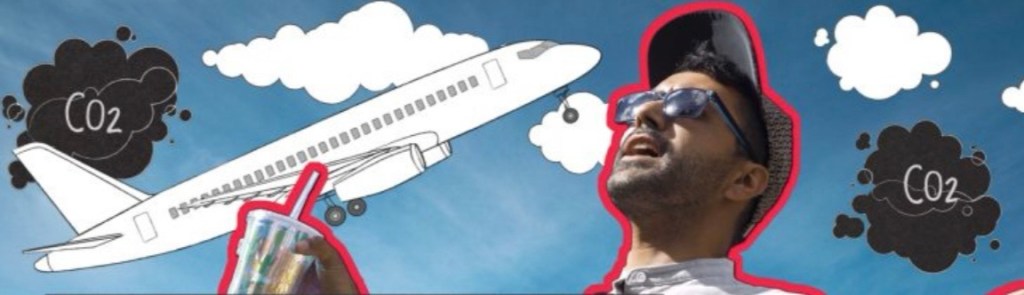
About a year ago I wrote about the sketchy nature of carbon credits (or “offsets”), which are purchased by people or entities whose actions generate CO2 emissions they’d like to offset. Those actions would include Taylor Swift’s private air travel, electric power generation, and many other activities whose participants wish to have “greenwashed”.

One short digression before I get started: see those black clouds of CO2 in the image above? Well, carbon dioxide doesn’t really look like that. In fact, CO2 is transparent. Trees breathe it! Visually, it’s less obvious than the greenhouse gas known as water vapor in those puffy white clouds, but virtually every image you’ll ever see on-line depicting CO2 emissions shows dark, roiling smoke. I just hate to spoil the scary effect, but there it is.

Back to carbon credits, which help fund projects that offset CO2 emissions (at least theoretically), such as planting new forest acreage (which would absorb CO2 … someday) or preventing deforestation. Other types of offset activities include investment in renewable energy projects and carbon capture technology. So, for example, if a utility’s power generation emits CO2, the creation or preservation of some amount of forested acreage can serve as a carbon sink adequate to offset the utility’s emissions. Net zero! Or so the utility might claim.

If only it were that simple! Paul Mueller explains that the incentive structure of these arrangements is perverse. What if credits are sold on the basis of supposed efforts to preserve forests that were never at risk to begin with? In fact, the promise of revenue from the sale of credits may be a powerful incentive to falsely present forested lands as targets for development. For that matter, cutting forestland for lumber makes more sense if it can be replanted immediately in exchange for revenue from the sale of carbon credits. And newly planted acreage won’t lead to absorption of much CO2 for many years, until the trees begin to mature. Then there are the risks of forest fires or disease that could compromise a forest’s ultimate value as a carbon sink.

Whether through fraud, calamity, or mismanagement, the sad truth is that projects serving as a basis for credits have done far less to reduce deforestation than promised. On top of that, another issue plaguing carbon markets for some time has been double counting of offsets, which can occur under several circumstances. Ultimately, CO2 emissions themselves may have done more to promote the growth of forests than purchases of carbon credits, because CO2 gives life to vegetation!

Obviously, the purchase of offsets raises the incremental cost of any project having CO2 emissions. The incidence of this added cost is borne to a large extent by consumers, especially because power demand is fairly inelastic. The craziness of offset logic may even dictate the purchase of offsets when a plant emitting more CO2 (e.g., coal) is replaced by a plant emitting less (natural gas), because the replacement would still emit carbon!

Some carbon offsets help pay for the construction of renewable power facilities like wind and solar farms. These renewable power facilities contribute to the power supply, of course, but wind turbines and solar farms typically operate at a small fraction of nameplate capacity due to the intermittency of wind and sunshine. Thus, these offsets are far less than complete. And from that low rate of renewable utilization we can deduct another fraction: periods of actual utilization often occur when no one wants the power, and while utilities can sell that excess power into the grid, it doesn’t replace other power at those times and it therefore doesn’t contribute to reductions in CO2 emissions.

Claims of achieving net zero are very much in vogue in the corporate world, and for a few related reasons. One is that they help keep activists and protesters away from the gates. There are, however, plenty of activists serving on corporate boards, in the executive suite, and among regulators.

The purchase of carbon offsets by “socially responsible corporations” might put stakeholder pressure on competitors who are “insufficiently green”. That would help to compensate for the higher costs imposed by offsets. After all, carbon credits are not cheap. In fact, smaller competitors might struggle to fund additional outlays for the credits.

Finally, claims of carbon neutrality also help with another constituency: “woke” investors. “Achieving” net zero boosts a firm’s so-called ESG score, presumed to reflect soundness in terms of environmental (E) and social (S) responsibility, as well as the quality of internal governance (G). With firms jockeying for ESG improvements, they help keep the offset charade going.

There is no common standard for calculating ESG, and there is considerable variance in ESG scores across rating firms. This should be cause for great skepticism, but too many investors are vulnerable to suggestions that screening on ESGs can enable both social responsibility and better returns. Sadly, they are sometimes paying higher fees for the privilege. The ESG fad among these investors might have helped fulfill hopes of greater returns for a while, but the imagined ESG advantage may have faded.

Carbon credits or offsets are plagued by bad incentives that often lead to wasteful outlays if not outright fraud. At present, they generally fail to reduce atmospheric CO2 as promised and they contribute to higher costs, which are passed on to consumers. They also serve as an unworthy basis for higher ESG scores, which are something of a sham in any case.

There have been efforts underway to improve the quality and legitimacy of carbon offsets. Some of this is voluntary due diligence on the part of purchasers. The effort also includes various NGOs and regulators. Ultimately, the push for quality is likely to push the price of offsets upward dramatically. Perhaps offsets will become more credible, but they won’t come cheap. The cost of achieving net zero targets will largely come out of consumers’ pockets, and those net zeros will still be nominal at best.
Tis the Season of Peak Climate Propaganda

09 Wednesday Aug 2023

Posted by Nuetzel in Climate

≈ 1 Comment

Tags

Björn Lomberg, Climate Change, Cooling the Past, Dust Bowl, El Nino, EPA, global warming, Heat Wave Index, Heat Waves, Hunga Tonga, Lancet, NASA, PBS News Hour, Satellite Temperatures, Thermometer Sitings, Urban Heat Island Effect, Water Temperatures, Water Vapor, Wildfires

It happens every summer! It’s been hot, and the news media and professional grifters in the anti-carbon climate-change establishment want us to panic about it. Granted, the weather really was quite hot for several weeks in July across parts of the U.S., Europe, and elsewhere, but it’s cooled off considerably since then, especially in my neck of the woods.

July is typically the warmest month of the year, and July 2023 was the warmest July for the troposphere on the satellite record. (The troposphere is the lowest 13 km of the atmosphere, but that’s an average — it’s thicker toward equatorial latitudes, thinner toward the poles.) However, attribution of this summer’s heat waves to carbon-induced climate change is misplaced. What follows are a few considerations in evaluating this claim, and the lengths to which climate activists go to distort weather data and reporting.

The Biggest Greenhouse Gas

One speculative explanation for the recent heat wave has gained some traction: the eruption of the Hunga Tonga-Hunga Ha’apai volcano in the South Pacific on Jan. 15, 2022 (and see here). This underwater eruption spewed massive quantities of water vapor into the stratosphere, which encircled the globe in fairly short order. Water vapor acts as a greenhouse gas, and it is by far the most important greenhouse gas. This plume of vapor may have affected the climate with a delay, and it is not expected to dissipate for at least a couple of years. However, there are theories that the eruption might have led to some offsetting effects due to the reflective properties of water and ice in the stratosphere. See here for an interesting debate on the estimated effects of this “shock” to the atmosphere.

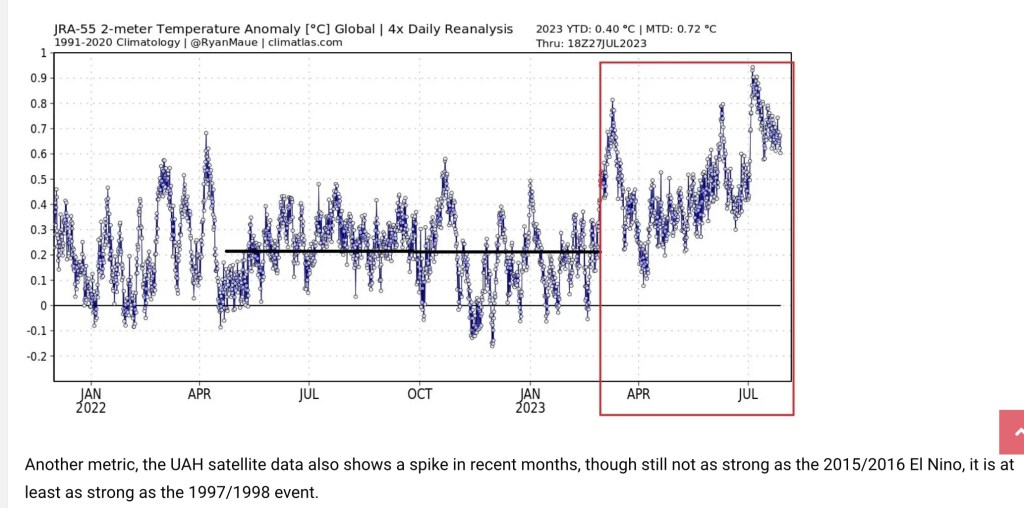
NASA has estimated that the Hunga Tonga eruption resulted in a 10% increase in atmospheric water vapor, while the European Space Agency puts the increase at 13%. Now, in addition to this added water vapor, we have the early effects of an El Niño event in the Pacific, which may elevate temperatures over the next couple of years.

However, the temperatures in July simply don’t justify the claim that we’re experiencing “unprecedented” warmth. The satellite records go back only to 1979, which is an especially narrow window on climatological scales. The longer record of temperatures shows earlier periods of higher temperatures, For example, U.S. surface temperature records indicate that the 1930s had periods warmer than this July. Moreover, while estimates of paleo-climate data are a matter of great dispute, there is no question that the globe has experienced warmer temperatures in the past, with an ice-free Arctic.

So, was July 3 really the hottest day in history? No way, and the worst part of this warm spell wasn’t even the warmth. Rather, it was the attempts to make weather a political matter, as if public policymakers possess some kind of control knob over weather phenomena, or as if we should bestow upon them dictatorial powers to act on their fantasy.

Longer Trends

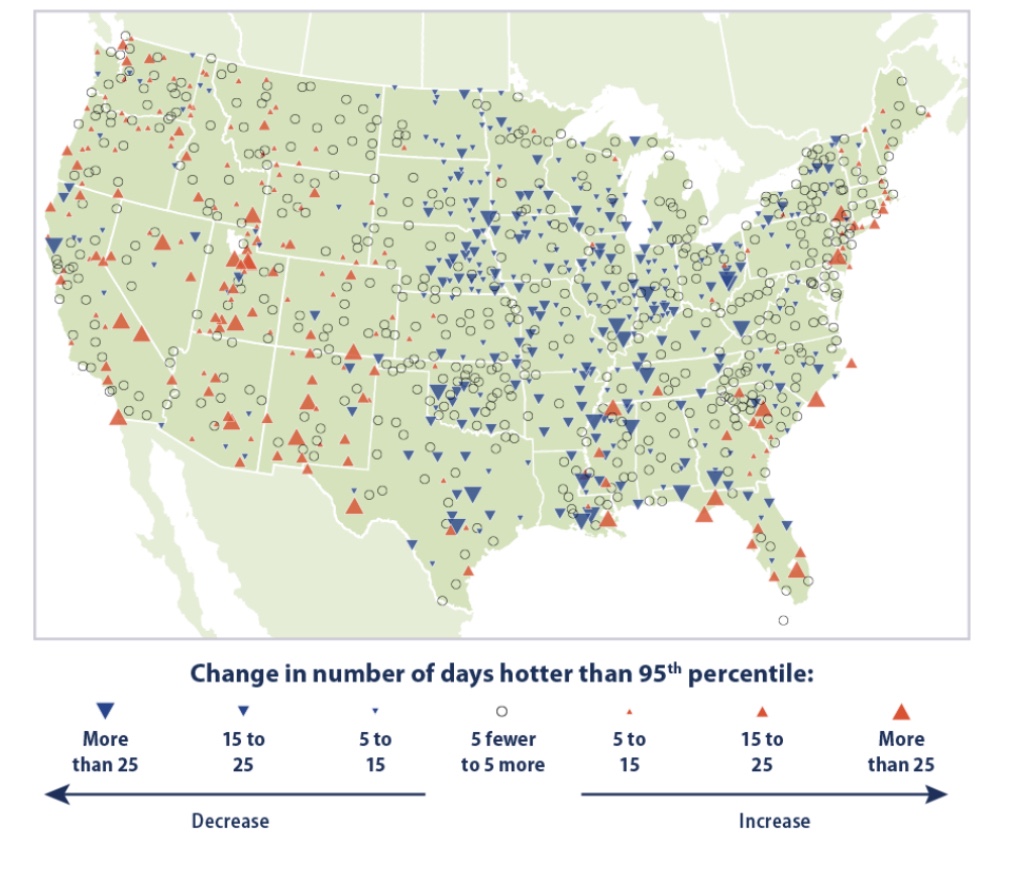
There’s plenty of other evidence running contrary to the “hotter-than-any-time in-history” foolishness. Take a look at trends in hot and cool weather from individual U.S. weather stations over a somewhat longer time span than the satellite record. The red symbols shown on the map below mark stations reporting increases in the number of unusually hot days (heat in the 95th percentile) between 1948 – 2020, with larger symbols corresponding to greater increases in extremely hot days. The blue symbols mark stations reporting increases in the number of unusually cool days (in the 5th percentile) over the same period. The data in this chart is published by the EPA, and it is definitely not alarming.

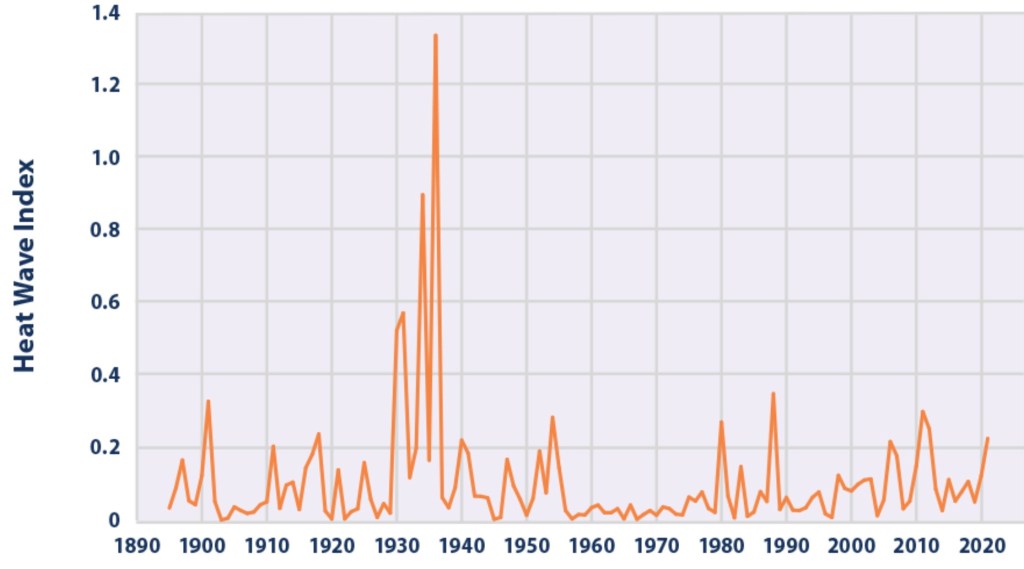
The next chart shows the so-called Heat Wave Index produced by the EPA. Recent spikes in the index are muted relative to the Dust Bowl days of the 1930s.

Journalism or Exaggeration?

Reports of hot weather in Europe have been distorted as well, often placing more emphasis on forecasts of high temperatures than on the temperatures themselves. It’s almost as if authorities, with the aid of the news media and naive weather reporters, are determined to raise an exaggerated sense of alarm among the citizenry. Almost?

Cold 10x Deadlier Than Heat

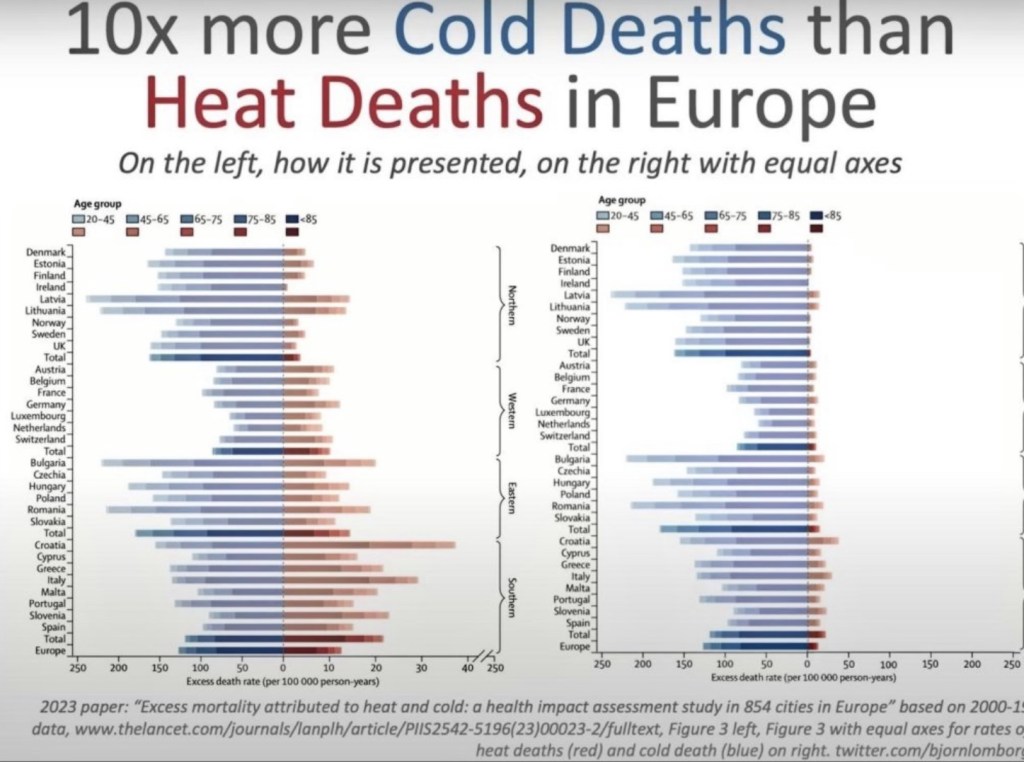
The next chart vividly illustrates an attempt to propagandize climate misinformation. Take a look at the left side of this illustration, which appeared in the medical journal Lancet. Note the difference in the horizontal scale for heat deaths vs. cold deaths. The chart on the right side uses equivalent scales for heat vs. cold deaths. This should qualify the journal for some kind of award for mendacity, or perhaps sheer stupidity. It’s the cold that really kills, not the heat! I’m moving south!

Finding Hot Water

And here’s a take-down of some incredible water temperature propaganda. A PBS News Hour reporter has pushed claims that South Florida water temperatures reached 101 degrees this summer. The emphasis on a single reading was taken from a buoy not subject to the cooling effects of deep water circulation, and it is located where fresh water often overlays salt water, which traps heat. Data from other buoys not far away showed much lower temperatures.

Spreads Like Wildfire

Another fallacious claim we hear too often is that global warming is literally causing the world to go up in flames. The facts run contrary to these scare stories. Björn Lomborg notes the following:

“For more than two decades, satellites have recorded fires across the planet’s surface. The data are unequivocal: Since the early 2000s, when 3% of the world’s land caught fire, the area burned annually has trended downward.

“In 2022, the last year for which there are complete data, the world hit a new record-low of 2.2% burned area. Yet you’ll struggle to find that reported anywhere.”

The heavy focus by the media on this year’s wild fires in North America offers a perfect example of the media’s tendency to “cherry pick for clicks”. Africa and Europe have had little burning this year, and in North America, arson has played a conspicuous role (and see here) in the wildfires.

Distorted Measurements

Personally, I have trouble accepting claims that temperatures are any warmer now than they were in my youth, at least where I grew up. My subjective and local assessment aside, there are strong reasons to doubt the reliability and significance of trends in official temperature records. The urban heat-island effect has distorted temperatures by ever greater magnitudes, as growing metropolitan areas absorb heat readily compared to rural green space.

Furthermore, poor siting of weather stations and temperature gauges has become all too common. This includes equipment located at airports and other areas in close proximity to asphalt or concrete. This contributes to an upward bias in more recent temperature data. It’s also worth noting in this context that satellite temperature readings must be calibrated periodically to surface temperatures. If the latter are corrupted in any way, the satellite readings may be corrupted as well.

“Adjusting” the Past

Official historical records also include a variety of “adjustments” to temperature data that raise concerns. Ostensibly, these adjustments are justified by an interest in maintaining a consistent historical record. Changes in equipment or it’s exact location can create discontinuities, for example. Unfortunately, the adjustments appear to have had a systematic tendency to “cool the past” relative to more recent data. This reinforcement of the warming trend over the past few decades is suspicious, to say the least. It does very little to build confidence in the agencies responsible for these records.

Conclusion

The hot temperatures in July brought the usual deluge of propaganda, including distortions in the reporting of weather phenomena. And we hear increasing calls to force transition to EVs (which are powered mostly by fossil-fuel electric plants), subsidize intermittent renewable power sources, and to end the use of air conditioning and gas stoves. Yet these coercive measures would do nothing to prevent summer heat or climate change generally. Water vapor represents 95% of greenhouse gases, and the huge vapor shock from the Hunga Tonga eruption might well make us prone to warmer temperatures for at least some months to come, mixed with signals from the Pacific El Niño pattern. But these are not evidence of a man-made crisis, despite perverse cheers from those rooting for more draconian state intrusions and an end to growth, or indeed, a reversal in gains to human well being.

The Oceans and Global Temperatures

18 Saturday Feb 2023

Posted by Nuetzel in Climate science, Ocean Temperatures

≈ Leave a comment

Tags

Acidification, Alkaline, Anthony WAtts, ARGO Floats, Buffering, Carbon Dioxide, Carbon Sink, Cloud Formation, Cosmic Ray Flux, El Nino, Energy Budget, Evaporation, Geothermal Heat, Greenhouse Gases, Gulf Stream, Heat Storage, Henrik Svensmark, Indian Ocean, Isoprene, Jim Steele, Ocean Circulation, Ocean Temperatures, Paul Homewood, pH Levels, Rud István, Sea Life, Solar Irradiation, Water Vapor, Willis Eschenbach

Despite evidence to the contrary, there’s one thing climate change alarmists seem to consider a clincher. Well… their stylized account has the seas absorbing heat from our warming atmosphere as human activity forces carbon emissions into the air. That notion seems to be reinforced, at least in the popular imagination, by the fact that the sea is a “carbon sink”, but that is a matter of carbon sequestration and not a mechanism of ocean warming. While ocean temperatures have warmed slightly over the past few decades, it is almost entirely coincidental, rather than a result of slightly warmer air temperatures.

Heat and the Hydrosphere

There is no doubt that the oceans store heat very efficiently, but that heat comes primarily from solar radiation and geothermal sources underseas. In fact, water stores heat far more efficiently than the atmosphere. According to Paul Homewood, a given cross section of sea water to a depth of just 2.6 meters is capable of holding as much heat as a column of air of the same width extending from the ocean surface to the outermost layers of the atmosphere! (See here for an earlier reference.) However, that does not imply that the oceans are very effective at drawing heat from warmer air or particularly carbon back-radiation. Both the air and water draw heat from solar radiation, and how much in any given location depends on the Sun’s angle in the sky.

A solid guide is that air temperatures are heavily influenced by water temperatures, but not as much vice versa. When temperatures in the upper layers of the ocean rise from natural forces, including reduced upward circulation from greater depths, evaporation causes this heat to radiate into the atmosphere along with evaporation of water vapor. Homewood notes that El Niño patterns make the influence of the Pacific Ocean waters on climate pretty obvious. The impact of the Gulf Stream on European climates is also instructive.

The Indian Ocean accounted for about half of the sea warming that occurred within the globe’s top 700 meters of waters over the years 2000 – 2019, though the Indian Ocean represents only about 20% of the world’s sea surface. The authors of that research found that the warming was not caused by trends in surface forcing of any kind, including warmer air temperatures. They said the ocean warming:

“… has been driven by significant changes in oceanic fluxes and not by surface forcing. … the ocean has been driving a rapid increase in Indian Ocean heat content.”

This was consistent with an earlier study of global sea temperatures covering the period 1984 – 2006 that found:

“… diminished ocean cooling due to vertical ocean processes … A conclusion is that natural variability, rather than long-term climate change, dominates the SST [sea surface temperature] and heat flux changes over this 23-yr period.”

It’s a Water World

Heat released by the oceans tends to dominate variations in global temperatures. A 2018 study found that evaporative heat transfer to the atmosphere from the oceans was closely associated with variations in air temperatures:

“When the atmosphere gets extra warm it receives more heat from the ocean, when it is extra cool it receives less heat from the ocean, making it clear that the ocean is the driving force behind these variations. …

The changes in solar radiation received at the Earth’s surface are clearly a trigger for these variations in global mean temperature, but the mechanisms by which these changes occur are a bit more complex and depend on the time-scale of the changes.”

Measurement

Willis Eschenbach reviewed a prominent study of ocean temperature changes and noted that the authors’ estimate of total warming of the oceans was quite small:

“… over the last sixty years, the ocean has warmed a little over a tenth of one measly degree … now you can understand why they put it in zettajoules—it’s far more alarming that way.”

Eschenbach goes on to discuss the massive uncertainty underlying measurements of ocean temperatures, particularly below a depth of 2,000 meters, but even well above that depth given the extremely wide spacing of so-called ARGO floats. However, the relative stability of the point estimates over 60 years is noteworthy, not to mention the “cold water” doused on alarmist claims about ocean overheating.

Sun Engine

Ocean warmth begins with energy from the Sun and from the deep interior of the Earth. The force of solar energy is greatest in the tropics, where sunlight is perpendicular to the surface of the Earth and is least dispersed by the thickness of the atmosphere. The sun’s radiative force is smallest in the polar regions, where the angle of its light is acute. As Anthony Watts says:

“All elements of Earth’s weather, storm fronts, hurricanes, the jet stream, and even ocean currents, are driven to redistribute energy from the tropics to the poles.”

Both land and sea absorb heat from the Sun and from volcanic activity, though the heat is moderated by the sea. That moderation is especially impactful in the Southern Hemisphere, which has far less land area, greater exposure of sea surface to the Sun, and about half of the average ocean temperature variation experienced in the North.

Ultimately, the importance of natural sunlight on air and sea temperatures can’t be overemphasized. Henrik Svensmark and some co-authors have estimated that a cosmic ray flux of 15% from a coronal mass ejection leads to a reduction in cloud cover within roughly 9 – 12 days. The ultimate increase in the Earth’s “energy budget” over about a week’s time is about the same size as a doubling of CO2, which certainly puts things in perspective. However, the oceans, and hence cloud cover, moderate the impact of the Sun, with or without the presence of additional greenhouse gases forced by human activity.

Vapors

The importance of evaporation from bodies of water also deserves great emphasis. No one doubts the massive influence of greenhouse gases (GHGs) on the climate. Water vapor accounts for about 90% of GHGs, and it originates predominantly from oceans. Meanwhile, carbon dioxide accounts for less than 4% of GHGs, and it appears that only a small part is from anthropogenic sources (and see here and below).

The impact of changing levels of water vapor dominates GHG levels. They are also a critical input to cloud formation, a phenomenon that climate models are generally ill-equipped to explain. Clouds reflect solar radiation back into space, reducing the Sun’s net contribution to the Earth’s energy budget. On the other hand, clouds can trap heat in the lower layers of the atmosphere. The globe has an average of 60 – 70% cloud cover, and most of that is over the oceans. Increased cloud cover generally leads to declines in temperature.

A 2015 study identified a process through which the sea surface has an unexpectedly large impact on climate. This was from the formation of isoprene, a film on the ocean surface, which leads to more cloud formation. In addition to biological sources, isoprene was found to originate, surprisingly, from the effect of sunlight.

The Big Sink

Man-made emissions of CO2 constitute only about 5% of naturally discharged CO2, which is roughly matched by natural removal. CO2 is absorbed, dissolved, or transformed in a variety of ways on both land and sea, but the oceans collectively represent the world’s largest carbon sink. They hold about 50 times more CO2 than the atmosphere. Carbon is stored in sea water at great depths, and it enhances undersea vegetation just as it does on land. It is sequestered in a variety of sea organisms as calcium carbonate and is locked in sediments as well. A longstanding question is whether there is some limit on the capacity of the oceans and other sinks to store carbon, but apparently the uptake over time has remained roughly constant at just under 50% of all natural and man-made CO2 emissions (also see here). So far, we don’t appear to be approaching any sort of “saturation point”.

One claim about the rising carbon stored undersea is that it will drive down the oceans’ pH levels. In other words, it will lead to “ocean acidification” and harm a variety of marine life. Rud István has ridiculed that term (quite rightly) because slightly less alkaline sea water does not make it “acidic”. More substantively, he notes the huge natural variations in ocean pH levels across different marine environments, the exaggeration inherent in some estimates of pH changes that do not account for physical buffering, and the fact that the impact on many organisms is inconsistent with the presumed harms of reduced pH. In fact, errors in some of the research pointing to those harms has been acknowledged. In addition, the much feared “coral crisis” seems to have been a myth.

Conclusion

The upper layers of the oceans have warmed somewhat over the past 60 years, but the warming had natural causes. Heat transfer from the atmosphere to the hydrosphere is relatively minor compared to the absorption of heat by oceans via solar forcings. It is also minor compared to the transfer of temperature from oceans to surface air. As Jim Steele has explained it:

“Greenhouse longwave energy penetrates only a few microns into the ocean surface and even less into most soils, but the sun’s shortwave energy passes much more deeply into the ocean.”

It’s reasonable to concede that warmer air temperatures via man-made GHGs might be a minor reinforcement to natural sources of ocean warming, or it might slightly moderate ocean cooling. However, measuring that contribution would be difficult against the massive background of natural forcings on ocean temperatures.

Oceans are dominant in terms of heat storage from natural forcings and in terms of carbon sequestration. In fact, the oceans have thoroughly outperformed alarmist projections as a carbon sink. Dire prognostications of the effect of carbon dioxide on marine life have been drastically over-emphasized as well.

Follow Sacred Cow Chips on WordPress.com

Recent Posts

  • The Case Against Interest On Reserves
  • Immigration and Merit As Fiscal Propositions
  • Tariff “Dividend” From An Indigent State
  • Almost Looks Like the Fed Has a 3% Inflation Target
  • Government Malpractice Breeds Health Care Havoc

Archives

  • January 2026
  • December 2025
  • November 2025
  • October 2025
  • September 2025
  • August 2025
  • July 2025
  • June 2025
  • May 2025
  • April 2025
  • March 2025
  • February 2025
  • January 2025
  • December 2024
  • November 2024
  • October 2024
  • September 2024
  • August 2024
  • July 2024
  • June 2024
  • May 2024
  • April 2024
  • March 2024
  • February 2024
  • January 2024
  • December 2023
  • November 2023
  • August 2023
  • July 2023
  • June 2023
  • May 2023
  • April 2023
  • March 2023
  • February 2023
  • January 2023
  • December 2022
  • November 2022
  • October 2022
  • September 2022
  • August 2022
  • July 2022
  • June 2022
  • May 2022
  • April 2022
  • March 2022
  • February 2022
  • January 2022
  • December 2021
  • November 2021
  • October 2021
  • September 2021
  • August 2021
  • July 2021
  • June 2021
  • May 2021
  • April 2021
  • March 2021
  • February 2021
  • January 2021
  • December 2020
  • November 2020
  • October 2020
  • September 2020
  • August 2020
  • July 2020
  • June 2020
  • May 2020
  • April 2020
  • March 2020
  • February 2020
  • January 2020
  • December 2019
  • November 2019
  • October 2019
  • September 2019
  • August 2019
  • July 2019
  • June 2019
  • May 2019
  • April 2019
  • March 2019
  • February 2019
  • January 2019
  • December 2018
  • November 2018
  • October 2018
  • September 2018
  • August 2018
  • July 2018
  • June 2018
  • May 2018
  • April 2018
  • March 2018
  • February 2018
  • January 2018
  • December 2017
  • November 2017
  • October 2017
  • September 2017
  • August 2017
  • July 2017
  • June 2017
  • May 2017
  • April 2017
  • March 2017
  • February 2017
  • January 2017
  • December 2016
  • November 2016
  • October 2016
  • September 2016
  • August 2016
  • July 2016
  • June 2016
  • May 2016
  • April 2016
  • March 2016
  • February 2016
  • January 2016
  • December 2015
  • November 2015
  • October 2015
  • September 2015
  • August 2015
  • July 2015
  • June 2015
  • May 2015
  • April 2015
  • March 2015
  • February 2015
  • January 2015
  • December 2014
  • November 2014
  • October 2014
  • September 2014
  • August 2014
  • July 2014
  • June 2014
  • May 2014
  • April 2014
  • March 2014

Blogs I Follow

  • Passive Income Kickstart
  • OnlyFinance.net
  • TLC Cholesterol
  • Nintil
  • kendunning.net
  • DCWhispers.com
  • Hoong-Wai in the UK
  • Marginal REVOLUTION
  • Stlouis
  • Watts Up With That?
  • Aussie Nationalist Blog
  • American Elephants
  • The View from Alexandria
  • The Gymnasium
  • A Force for Good
  • Notes On Liberty
  • troymo
  • SUNDAY BLOG Stephanie Sievers
  • Miss Lou Acquiring Lore
  • Your Well Wisher Program
  • Objectivism In Depth
  • RobotEnomics
  • Orderstatistic
  • Paradigm Library
  • Scattered Showers and Quicksand

Blog at WordPress.com.

Passive Income Kickstart

OnlyFinance.net

TLC Cholesterol

Nintil

To estimate, compare, distinguish, discuss, and trace to its principal sources everything

kendunning.net

The Future is Ours to Create

DCWhispers.com

Hoong-Wai in the UK

A Commonwealth immigrant's perspective on the UK's public arena.

Marginal REVOLUTION

Small Steps Toward A Much Better World

Stlouis

Watts Up With That?

The world's most viewed site on global warming and climate change

Aussie Nationalist Blog

Commentary from a Paleoconservative and Nationalist perspective

American Elephants

Defending Life, Liberty and the Pursuit of Happiness

The View from Alexandria

In advanced civilizations the period loosely called Alexandrian is usually associated with flexible morals, perfunctory religion, populist standards and cosmopolitan tastes, feminism, exotic cults, and the rapid turnover of high and low fads---in short, a falling away (which is all that decadence means) from the strictness of traditional rules, embodied in character and inforced from within. -- Jacques Barzun

The Gymnasium

A place for reason, politics, economics, and faith steeped in the classical liberal tradition

A Force for Good

How economics, morality, and markets combine

Notes On Liberty

Spontaneous thoughts on a humble creed

troymo

SUNDAY BLOG Stephanie Sievers

Escaping the everyday life with photographs from my travels

Miss Lou Acquiring Lore

Gallery of Life...

Your Well Wisher Program

Attempt to solve commonly known problems…

Objectivism In Depth

Exploring Ayn Rand's revolutionary philosophy.

RobotEnomics

(A)n (I)ntelligent Future

Orderstatistic

Economics, chess and anything else on my mind.

Paradigm Library

OODA Looping

Scattered Showers and Quicksand

Musings on science, investing, finance, economics, politics, and probably fly fishing.

  • Subscribe Subscribed
    • Sacred Cow Chips
    • Join 128 other subscribers
    • Already have a WordPress.com account? Log in now.
    • Sacred Cow Chips
    • Subscribe Subscribed
    • Sign up
    • Log in
    • Report this content
    • View site in Reader
    • Manage subscriptions
    • Collapse this bar
 

Loading Comments...