• About

Sacred Cow Chips

Sacred Cow Chips

Tag Archives: Welfare State

Universal Pre-K Dumb-Down

30 Friday Oct 2015

Posted by Nuetzel in Education, Welfare State

≈ 1 Comment

Tags

Bernie Sanders, Child Development, Cradle to Grave Socialism, Ezra Klein, Federal funding, Fertility Decisions, Head Start, Hillary Clinton, Negative Incentives, Pre-Kindergarten Education, Pre-School For All, Socialization, Subsidies, Tennessee Pre-K Study, Universal Pre-K, Vox, Welfare State

big_government-school

Can the middle class be sold on federal pre-kindergarten dependency? Is pre-K always beneficial to children? All children? One of many issues agitating the “government-must-do-something” crowd is universal pre-kindergarten. It’s a favorite topic of the Socialist-Democrat Bernie Sanders and, more recently, it became a campaign promise from the Democrat-Socialist Hillary Clinton. It’s typical of the freebies these two presidential candidates are compelled to promise their base. While federal funding of universal pre-K is often billed as way to assist low-income working families, the subsidies proposed are not well-targeted: Clinton’s proposal calls for pre-K subsidies for middle-class families as well. A “Pre-School For All” proposal by President Obama in 2013 required $75 billion in funding. These kinds of broad-based transfer payments aren’t cheap.

In addition to the expense, it’s not clear that pre-K schooling is beneficial to all children. In Vox, Ezra Klein describes a recent study on the efficacy of a pre-K program in Tennessee (hat tip: John Crawford). The selection of children for the pre-K and control groups was randomized by virtue of a “lottery” for admission in regions experiencing excess demand. Here is Klein’s description of the results:

“At the end of pre-K, the results look pretty much as you would expect: Teachers rates [sic] the children who went through pre-K as ‘being better prepared for kindergarten work, as having better behaviors related to learning in the classroom and as having more positive peer relations.’

The problem is those results dissipate by the end of kindergarten — by then, the group that attended pre-K is no better off than the group that didn’t — and then begin to reverse by the end of first grade. By the end of second grade, the children who attended the pre-K program are scoring lower on both behavioral and academic measures than the children who didn’t.“

Klein cites two other “high-quality” studies (one by Head Start) that are consistent with the findings in Tennessee. He also notes some weaknesses of earlier studies suggesting that pre-K provides developmental benefits.

Some prominent advocates of pre-K insist that there are long-term benefits that the recent studies fail to capture. If so, it is hard to square that belief with such negative results after three years. I suspect that there are significant developmental rewards for children who spend their days with family members or even family friends, and I am skeptical that improved socialization can be gained from full-time attendance at a public facility. Perhaps some children benefit, but clearly not all.

None of this is to suggest that low-income parents would not benefit economically from additional subsidies for early education. To the extent that the parents are able to earn more income, the entire household will benefit and perhaps even society will benefit. But this is a social safety net issue at its base, not a broad-based social need. Ideally, one’s prospects for income should have a strong bearing on fertility decisions. Individual families should not expect others to bear the costs. And as for the safety net, let’s face it, great parts of it would be unnecessary in the absence of the negative work and family incentives inherent in many transfer programs. Neutralizing the costs of raising children compounds the bad incentives.

Like so many other statist misadventures, the populist appeal of universal pre-K is a desire for a freebie at the expense of others. The politicians Sanders, Clinton and Obama understand that, and they recognize it as another pillar of support for the great federal highway of cradle-to-grave serfdom.

Government Supplies a Cliff; Would you Jump?

14 Friday Aug 2015

Posted by Nuetzel in Big Government, Welfare State

≈ Leave a comment

Tags

Benefits Cliff, Dan Mitchell, dependency, Earned Income Tax Credit, EITC, Federalism, Fight Club, Illinois Policy Institute, Labor Force Participation, LiberalForum, Marginal tax rate, National Bureau of Economic Research, NBER, Obamacare incentives, Pennsylvania welfare cliff, Tyler Durden, War on Drugs, Welfare Cliff, Welfare State, Work Disincentives, Work Effort, Zero Hedge

welfare cliff

People respond to incentives. That does not, in and of itself, make some people “energetic” and others “lazy”. To the contrary, it really means they are responsive and capable of calculating rewards. Critics of the welfare state are sometimes accused of labeling welfare recipients as “lazy”, which is absurd and a cop-out response to serious questions about the size, effectiveness, and even the fairness of means-tested benefits. The structure of welfare benefits in the U.S. often penalizes work effort and market earnings. That being the case, who can blame a recipient for minimizing work effort? From their perspective, that is what society wants them to do. Note that this has nothing to do with the provision of a social safety net for those who are unable to help themselves.

The welfare incentive phenomenon is explored by Zero Hedge under the Fight Club nom de guerre Tyler Durden in “When Work Is Punished: The Ongoing Tragedy Of America’s Welfare State“:

“At issue is the so-called “welfare cliff” beyond which families will literally become poorer the higher their wages, as the drop off in entitlements more than offsets the increase in earnings.“

The cliff looks different in different states and even differs by county. The chart at the top of this post is for Pennsylvania, from the state’s Secretary of Public Welfare, though I saw it on this post from LiberalForum. (Go to the link if the image is not clear). The Zero Hedge post linked above includes a dramatic illustration for Cook County in Illinois. Not many welfare recipients participate in all of the programs shown in the charts, but the point is that many of the programs create nasty incentives that tend to “trap” families at low income levels. Often, these workers and their families would be better off in the long-run if they were to suffer the consequences of the cliff in order to gain more work experience. Unfortunately, few have the resources to ride out a period of lower total income precipitated by the cliff. Another obvious implication is that increases in the minimum wage would actually harm some families by pushing them over the cliff.

Welfare cliffs differ by the recipients’ family structure (one- versus two-parent households, number of children) and do not apply to every welfare program. For example, the Earned Income Tax Credit (EITC) is very well-behaved in the sense that additional work and/or wage income flows through as a net gain the household. While most welfare programs involve a benefits cliff, incentives are undermined even before that point. A flattening in the level of total income as earned income rises indicates that the recipient faces an increasing marginal tax rate. The chart above shows that total income is relatively flat over a range of earned income below the income at which they’d encounter the cliff. This flat range starts at an earned income of $15,000 to $20,000 and extends up to the severe cliff at almost $30,000.

Zero Hedge quotes a report from the Illinois Policy Institute:

“We realize that this is a painful topic in a country in which the issue of welfare benefits and cutting (or not) the spending side of the fiscal cliff have become the two most sensitive social topics. Alas, none of that changes the matrix of incentives for Americans who find themselves facing a comparable dilemma: either remain on the left side of minimum US wage and rely on benefits, or move to the right side at far greater personal investment of work, and energy, and… have the same (or much lower) disposable income at the end of the day.“

Another interesting take on this issue is offered by Dan Mitchell, who cites a recent National Bureau of Economic Research (NBER) paper, which finds:

“…the decline in desire to work since the mid-90s lowered the unemployment rate by about 0.5 ppt and the participation rate by 1.75 ppt. This is a large effect…“

The findings suggest that the welfare reforms of the 1990s actually had positive effects on work effort, though even the EITC creates some incentive problems for second earners. Worst of all is the incentive impact of expanded disability benefits, which have undone some of the gains from reform. Newer programs like Mortgage Assistance and now, Obamacare, have added to the work disincentives. Mitchell cites other research that reinforce these conclusions.

The welfare cliff harms economic efficiency by distorting the offer price of labor, by increasing costs to taxpayers, and by reducing the availability of productive resources. It is grossly unfair because it consigns its intended beneficiaries to a life of dependency. What a waste! Here is Mitchell’s prescription:

“Regarding the broader issue of redistribution and dependency, I argue that federalism is the best approach, both because states will face competitive pressure to avoid excessively generous benefits and because states will learn from each other about the best ways to help the truly needy while minimizing the negative impact of handouts on incentives for productive behavior.“

A side effect of negative welfare incentives is that they increase the relative benefits of participating in illegal income-earning activity. The “War on Drugs” exacerbates this effect by driving up drug prices. Of course, this activity is untaxed, and because it is unreported, it does not push the recipient toward the benefits cliff. This is another example of different government policies working at cross purposes, which is all too common.

Government and Perpetual Poverty

07 Thursday May 2015

Posted by Nuetzel in Welfare State

≈ 1 Comment

Tags

Alex Tabarrok, Anti-Poverty Programs, Baltimore City Schools, dependency, Disincentives, Jon Stewart, Ross Dothan, Thomas Sowell, War on Drugs, Welfare State

welfare-state

The welfare state has 1) reduced measured poverty, but it has 2) failed to provide sufficient opportunity and economic mobility. In “Two Premises on Poverty and Culture“, Ross Douthat writes that it should be easy for Left and Right to agree on these points. #1 is a fairly well-established empirical fact, while #2 leaves plenty of room to debate what went wrong and how to fix it. The Left might well call for more resources to be plowed into the effort; the right believes that the welfare state has fostered dependency and subverted social institutions. The best that can be said is that the modern welfare state leaves the poor “running in place”, but that concedes far too much to programs rife with disincentives for legal, market work effort. I wrote about this topic just over a month ago, in “Poverty Maintenance Is Not a Win“. While Douthat’s short essay sought common ground upon which Right and Left can debate reforms, he notes that anti-poverty programs:

“... raise incomes but also increase dependency, encourage idleness, crowd out the basic institutions of civil society, and so on through the libertarian critique.“

This is not to diminish the waste inherent in other areas of government largess, such as corporate subsidies, defense spending, and over-regulation. Virtually any government program can be called out on waste and unintended consequences. Tonight, however, we’re featuring the dismal results of the welfare state. Thomas Sowell, a well-known African American economist, is uncompromising in his condemnation of the welfare state in connection with recent protests by blacks against perceived injustices in “The Inconvenient Truth about Ghetto Communities“:

“Anyone who is serious about evidence need only compare black communities as they evolved in the first 100 years after slavery with black communities as they evolved in the first 50 years after the explosive growth of the welfare state, beginning in the 1960s. …

We are told that such riots are a result of black poverty and white racism. But in fact — for those who still have some respect for facts — black poverty was far worse, and white racism was far worse, prior to 1960. But violent crime within black ghettos was far less.

There is no doubt that the behavioral dysfunctions induced by welfare state incentives have been compounded by the war on drugs. Like all prohibitions, it offers black market “opportunities” to the poor and unskilled while promoting violence and a high risk of arrest and imprisonment, contributing to the destruction of families and communities. But the welfare state itself effectively subsidizes the drug-war pathway to perdition:

You cannot take any people, of any color, and exempt them from the requirements of civilization — including work, behavioral standards, personal responsibility, and all the other basic things that the clever intelligentsia disdain — without ruinous consequences to them and to society at large.

Non-judgmental subsidies of counterproductive lifestyles are treating people as if they were livestock, to be fed and tended by others in a welfare state — and yet expecting them to develop as human beings have developed when facing the challenges of life themselves.“

The usual trope promoted by the Left is that more resources are required to end the cycle of dependency. That is dubious in light of the dramatic increases in U.S. welfare spending over the past 50 years. Those increases have been fairly steady, yet significant decreases in the incidence of poverty came to an end before 1970:

“Today, government spends 16 times more, adjusting for inflation, on means-tested welfare or anti-poverty programs than it did when the War on Poverty started. But as welfare spending soared, the decline in poverty came to a grinding halt.“

Finally, here is a little object lesson in the way Leftists typically misperceive facts surrounding the actual allocation of budgetary resources and the concomitant results. On April 28th, Jon Stewart said:

“If we are spending a trillion dollars to rebuild Afghanistan’s schools, we can’t, you know, put a little taste Baltimore’s way. It’s crazy.“

Alex Tabarrok castigates Stewart for this gross misrepresentation of the foreign aid budget and the complete distortion of the facts surrounding school funding in Baltimore. Actually, per-student funding for the Baltimore city public schools is over 26% greater (a difference of more than $3,500 per year) than for the schools in Fairfax County, VA. The latter is considered one of the best school districts in the country. The funding of Baltimore schools is dominated by state contributions, but federal funding there exceeds local funding.

There Is No Nordic Nirvana

17 Wednesday Sep 2014

Posted by Nuetzel in Uncategorized

≈ 1 Comment

Tags

Denmark, Finland, Iceland, John Fund, McCleans, Michael Booth, Nordic MIracle, Nordic Utopia, Norway, Privatization, Sweden, Tax Competitiveness, The Conversation, The Economist, Welfare State

'Remember, what goes on in Valhalla stays in Valhalla.'

Perhaps the Nordic utopia is not all it’s cracked up to be! Here’s a glimpse behind the facade from Michael Booth in The Guardian, with some blistering (and humorous) country-by-country commentary on a few of the cultural and economic failings of these darlings of the American Left. Here is The Conversation‘s rather cautious response. And here’s a comment from McLean‘s.

Apparently, the meme-niks of the Left are unaware that the more recent trend in Nordic countries has been away from government domination of the economy and high taxes. In fact, to his likely demerit, Booth even bemoans the widespread privatization of services that has taken place. This week’s Swedish election results were expected to herald a shift in direction, however, back toward the kind of welfare statism from which the country has turned away. Here’s The Economist‘s pre-election take on the situation. It includes some detail on the dismantling of the vaunted Swedish welfare state. But the outcome was not quite what The Economist expected. John Fund discusses the results, which included the advance of hard-line nationalists. Support for the welfare state seems to have eroded in tandem with the influx of immigrants. The hard-liners aside, this shift could simply indicate that support for the state from taxpayers is contingent upon the expectation of a return in the form of services, which may be diminished by redistribution to newcomers. However, some of the articles linked above imply a rising degree of racism toward non-Nordic immigrant populations.

As a further indication of the extent to which the Nordic countries have evolved, take a peak at the rank given to Sweden, Finland, Norway, Denmark and Iceland in this survey of international tax competitiveness. They are all ahead of the U.S. (which ranks 32nd out of 34 OECD countries) on the overall score and on most individual categories of tax competitiveness and neutrality.

Not Undead, But Ruling From The Grave

24 Thursday Jul 2014

Posted by Nuetzel in Uncategorized

≈ 1 Comment

Tags

Eugene Steuerle, Keynes, Nondiscretionary Spending, Richard Rahn, Welfare State, Zombie Governance

david-dees-uncle-sam

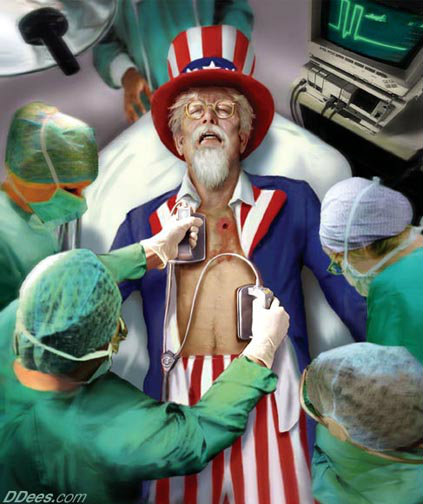
Richard Rahn explains How Congress Lost Control of Government Spending. Programs enacted decades ago have grown dramatically and keep growing, often beyond their original purpose, claiming ever-larger shares of tax revenue, leaving little flexibility to undertake discretionary spending of any kind. Rahn quotes Eugene Steuerle of The Urban Institute, author of a new book “Dead Men Ruling”:

In recent decades, both parties have conspired to create and expand a series of public programs that automatically grow so fast that they claim every dollar of additional tax revenue that the government generates each year. … Unlike reaching the moon, rejuvenating the economy, winning a war, or curing a disease, none of these permanent programs are designed to achieve goals or solve problems once and for all. Almost all of them simply maintain, and often perpetually increase, subsidies for some pattern of consumption….

John Maynard Keynes’ spoke of the lasting influence of defunct thinkers:

Practical men, who believe themselves to be quite exempt from any intellectual influence, are usually the slaves of some defunct economist. Madmen in authority, who hear voices in the air, are distilling their frenzy from some academic scribbler of a few years back. 

Add to this the budgetary strictures imposed by metastasizing government consumption programs and we get what amounts to zombie governance.

Redistributing a “Progressively” Smaller Pie

03 Thursday Jul 2014

Posted by Nuetzel in Uncategorized

≈ Leave a comment

Tags

bailout, Casey Mulligan, Disincentives, Redistribution, Welfare State

Dilbert Layoffs

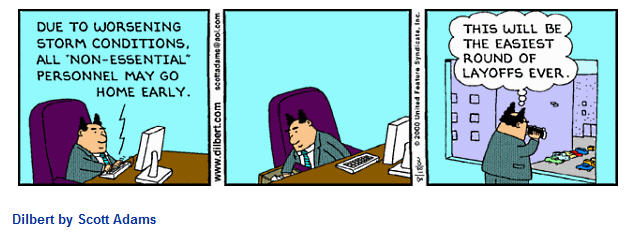
“A Recovery Stymied By Redistribution” contains excerpts from a recent speech by Casey Mulligan of the University of Chicago. It’s about the destructive power of bad incentives, and it reeks of common sense. It’s long been recognized that efforts to soften economic blows can have damaging incentive effects. Today, those well-intentioned efforts have been expanded beyond the point at which they become counterproductive, and the negative effects are being compounded by new programs that can act as taxes on work effort.

I’ve witnessed some of the phenomena Mulligan describes first-hand. There is no question that some people can be tempted to accept benefits in exchange for a less than vigorous job-search effort, sometimes for no search effort at all, and sometimes fraudulently when they already have gainful employment. Mulligan quotes a job recruiter who, during the recession, “ran into a hurdle he hadn’t seen before. People would apply for jobs not with the intention of accepting it, but to demonstrate to the unemployment office that they were looking for work.” Mulligan also describes ways in which employers have seen reductions in their incentives to retain marginal workers.

Some programs are better than others at minimizing disincentives created by assistance. But here is what Ben Franklin thought:

I am for doing good to the poor, but I differ in opinion of the means. I think the best way of doing good to the poor, is not making them easy in poverty, but leading or driving them out of it. In my youth I traveled much, and I observed in different countries, that the more public provisions were made for the poor, the less they provided for themselves, and of course became poorer. And, on the contrary, the less was done for them, the more they did for themselves, and became richer.

— On the Price of Corn and Management of the Poor, November 1766

Damaging disincentives are also created by efforts to ease economic blows to businesses. Corporate bailouts, for example, create perverse, one-sided “win-can’t lose” sets of outcomes, leading to taxpayer subsidies and excessive risk-taking.


Video

A Socialist Wreckoning

16 Sunday Mar 2014

Posted by Nuetzel in Uncategorized

≈ Leave a comment

Tags

Welfare State

Airfrance

http://cbn.com/tv/3254023064001

France’s Reckoning: Rich, Young Flee Welfare State

Newer posts →
Follow Sacred Cow Chips on WordPress.com

Recent Posts

  • The Case Against Interest On Reserves
  • Immigration and Merit As Fiscal Propositions
  • Tariff “Dividend” From An Indigent State
  • Almost Looks Like the Fed Has a 3% Inflation Target
  • Government Malpractice Breeds Health Care Havoc

Archives

  • January 2026
  • December 2025
  • November 2025
  • October 2025
  • September 2025
  • August 2025
  • July 2025
  • June 2025
  • May 2025
  • April 2025
  • March 2025
  • February 2025
  • January 2025
  • December 2024
  • November 2024
  • October 2024
  • September 2024
  • August 2024
  • July 2024
  • June 2024
  • May 2024
  • April 2024
  • March 2024
  • February 2024
  • January 2024
  • December 2023
  • November 2023
  • August 2023
  • July 2023
  • June 2023
  • May 2023
  • April 2023
  • March 2023
  • February 2023
  • January 2023
  • December 2022
  • November 2022
  • October 2022
  • September 2022
  • August 2022
  • July 2022
  • June 2022
  • May 2022
  • April 2022
  • March 2022
  • February 2022
  • January 2022
  • December 2021
  • November 2021
  • October 2021
  • September 2021
  • August 2021
  • July 2021
  • June 2021
  • May 2021
  • April 2021
  • March 2021
  • February 2021
  • January 2021
  • December 2020
  • November 2020
  • October 2020
  • September 2020
  • August 2020
  • July 2020
  • June 2020
  • May 2020
  • April 2020
  • March 2020
  • February 2020
  • January 2020
  • December 2019
  • November 2019
  • October 2019
  • September 2019
  • August 2019
  • July 2019
  • June 2019
  • May 2019
  • April 2019
  • March 2019
  • February 2019
  • January 2019
  • December 2018
  • November 2018
  • October 2018
  • September 2018
  • August 2018
  • July 2018
  • June 2018
  • May 2018
  • April 2018
  • March 2018
  • February 2018
  • January 2018
  • December 2017
  • November 2017
  • October 2017
  • September 2017
  • August 2017
  • July 2017
  • June 2017
  • May 2017
  • April 2017
  • March 2017
  • February 2017
  • January 2017
  • December 2016
  • November 2016
  • October 2016
  • September 2016
  • August 2016
  • July 2016
  • June 2016
  • May 2016
  • April 2016
  • March 2016
  • February 2016
  • January 2016
  • December 2015
  • November 2015
  • October 2015
  • September 2015
  • August 2015
  • July 2015
  • June 2015
  • May 2015
  • April 2015
  • March 2015
  • February 2015
  • January 2015
  • December 2014
  • November 2014
  • October 2014
  • September 2014
  • August 2014
  • July 2014
  • June 2014
  • May 2014
  • April 2014
  • March 2014

Blogs I Follow

  • Passive Income Kickstart
  • OnlyFinance.net
  • TLC Cholesterol
  • Nintil
  • kendunning.net
  • DCWhispers.com
  • Hoong-Wai in the UK
  • Marginal REVOLUTION
  • Stlouis
  • Watts Up With That?
  • Aussie Nationalist Blog
  • American Elephants
  • The View from Alexandria
  • The Gymnasium
  • A Force for Good
  • Notes On Liberty
  • troymo
  • SUNDAY BLOG Stephanie Sievers
  • Miss Lou Acquiring Lore
  • Your Well Wisher Program
  • Objectivism In Depth
  • RobotEnomics
  • Orderstatistic
  • Paradigm Library
  • Scattered Showers and Quicksand

Blog at WordPress.com.

Passive Income Kickstart

OnlyFinance.net

TLC Cholesterol

Nintil

To estimate, compare, distinguish, discuss, and trace to its principal sources everything

kendunning.net

The Future is Ours to Create

DCWhispers.com

Hoong-Wai in the UK

A Commonwealth immigrant's perspective on the UK's public arena.

Marginal REVOLUTION

Small Steps Toward A Much Better World

Stlouis

Watts Up With That?

The world's most viewed site on global warming and climate change

Aussie Nationalist Blog

Commentary from a Paleoconservative and Nationalist perspective

American Elephants

Defending Life, Liberty and the Pursuit of Happiness

The View from Alexandria

In advanced civilizations the period loosely called Alexandrian is usually associated with flexible morals, perfunctory religion, populist standards and cosmopolitan tastes, feminism, exotic cults, and the rapid turnover of high and low fads---in short, a falling away (which is all that decadence means) from the strictness of traditional rules, embodied in character and inforced from within. -- Jacques Barzun

The Gymnasium

A place for reason, politics, economics, and faith steeped in the classical liberal tradition

A Force for Good

How economics, morality, and markets combine

Notes On Liberty

Spontaneous thoughts on a humble creed

troymo

SUNDAY BLOG Stephanie Sievers

Escaping the everyday life with photographs from my travels

Miss Lou Acquiring Lore

Gallery of Life...

Your Well Wisher Program

Attempt to solve commonly known problems…

Objectivism In Depth

Exploring Ayn Rand's revolutionary philosophy.

RobotEnomics

(A)n (I)ntelligent Future

Orderstatistic

Economics, chess and anything else on my mind.

Paradigm Library

OODA Looping

Scattered Showers and Quicksand

Musings on science, investing, finance, economics, politics, and probably fly fishing.

  • Subscribe Subscribed
    • Sacred Cow Chips
    • Join 128 other subscribers
    • Already have a WordPress.com account? Log in now.
    • Sacred Cow Chips
    • Subscribe Subscribed
    • Sign up
    • Log in
    • Report this content
    • View site in Reader
    • Manage subscriptions
    • Collapse this bar
 

Loading Comments...