Collectivists Need Police Power To Tread On You

Tags

, , , , , ,

Dissent

Most people have no trouble understanding that increasing government control imperils individual freedoms, including freedom of expression. Sandy Ikeda discusses this linkage in “Dissent Under Socialism,” which inevitably means suppression and oppression.

First, to the degree that the State undertakes central planning of the resources it controls it can’t allow any person to interfere with or oppose the plan. Or, as Hayek puts it, “If the state is precisely to foresee the incidence of its actions, it means that it can leave those affected no choice.”

Second, the more resources the State controls, the wider the scope and more detailed its planning necessarily becomes so that delay in any part of the system becomes intolerable. There is little room for unresponsiveness, let alone dissent.

Statists and radical egalitarians harbor a naive belief that their goals for society, and for “social justice,” can be achieved by collective action. That belief is naive on several levels. In practical terms, government is incapable of achieving complex social goals, and it will botch the effort. Even more ominous is that police power must always stand behind the effort. That police power will be brought to bear on a wider range of issues seems to surprise collectivists, as illustrated by the following quote used by Ikeda:

“Fascist states stop people demonstrating against wars—it is beyond belief that French Socialists are following their example.”

Really not too surprising.

Worthy Profits Are The Rule

Tags

, , , , , ,

philosophers-on-strike

Subverting language seems to be a preoccupation on the Left, as amply illustrated by the misappropriation of the word “liberal” itself (see here).  Another distortion is in the Left’s use of the word “profit,” but with no direct change in its meaning as the excess of business revenue over costs. Rather, there is a peculiar innuendo often attached to “profit” by Leftists. This point is developed more fully in “Liberals Make Profit a Dirty Word.” Too often, profit is characterized as undeserved, motivated by ill-will, evil. The author, Stephen Carter, notes that so many of those opposed to the Supreme Court’s recent Hobby Lobby decision, which struck down certain forms of mandated contraception benefits, were aggrieved by the fact that Hobby Lobby is a “for-profit” enterprise. Could anything be less relevant to the decision? And yet…

So far, the number of e-mails accurately describing the decision is, as my physics professors used to say, arbitrarily close to zero. But there’s one underlying fact they all get right: the justices ruled in favor of a “for-profit” employer. This little hyphenated term appears in e-mail after e-mail, suggesting that it’s the for-profitness that creates the perniciousness.

Profit is simply what a business earns as a return to its capital and entrepreneurship. It is a reward for risks taken, and it actually measures gains from voluntary exchange corresponding to benefits derived by customers. As Carter points out, profits provide a signal directing resources to flow toward their highest-valued uses, a social function that central planners can never replicate. Casting aspersions at “profits” or an enterprise’s for-profit status is no more righteous than a generalization that wages are wicked. Some qualification is needed for either sort of condemnation to have pertinence.

Not Undead, But Ruling From The Grave

Tags

, , , , ,

david-dees-uncle-sam

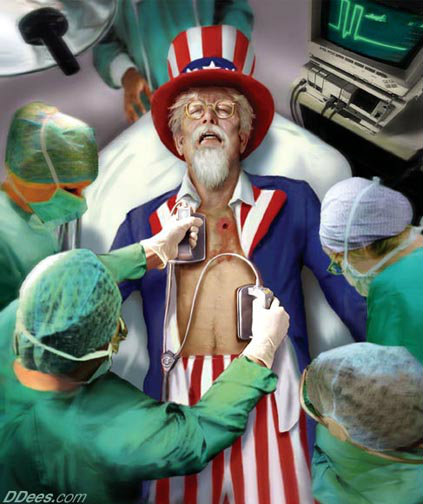
Richard Rahn explains How Congress Lost Control of Government Spending. Programs enacted decades ago have grown dramatically and keep growing, often beyond their original purpose, claiming ever-larger shares of tax revenue, leaving little flexibility to undertake discretionary spending of any kind. Rahn quotes Eugene Steuerle of The Urban Institute, author of a new book “Dead Men Ruling”:

In recent decades, both parties have conspired to create and expand a series of public programs that automatically grow so fast that they claim every dollar of additional tax revenue that the government generates each year. … Unlike reaching the moon, rejuvenating the economy, winning a war, or curing a disease, none of these permanent programs are designed to achieve goals or solve problems once and for all. Almost all of them simply maintain, and often perpetually increase, subsidies for some pattern of consumption….

John Maynard Keynes’ spoke of the lasting influence of defunct thinkers:

Practical men, who believe themselves to be quite exempt from any intellectual influence, are usually the slaves of some defunct economist. Madmen in authority, who hear voices in the air, are distilling their frenzy from some academic scribbler of a few years back. 

Add to this the budgetary strictures imposed by metastasizing government consumption programs and we get what amounts to zombie governance.

Markets Foster Peace With Vampires

Tags

, , , , ,

EconomicsOfTheUndead

The prospect of vampire re-ensoulment prompts some entertaining thoughts about economic philosophy in this post at the Volokh Conspiracy. Here is a sample:

Why presume that having more humans or human-like beings on the planet is even a problem at all? The ecological concern seems to borrow from the perspective of doomsayers like Paul Ehrlich, who have been beating the population-bomb drum for decades. And for decades, the doomsayers have been proven wrong.

And here is a classic closing sentence:

By establishing a legal market in human blood, as suggested by Enrique Guerra-Pujol in Chapter 12, we could go a long way toward creating an incentive for vampires (especially re-ensouled ones) to eschew violence in favor of remunerative work in the combined vampire-human economy, to the benefit of both the living and the dead.


Statists Opposed To Legal Immigration AND Legal Drugs

Tags

, , , , ,

Open-border-cartoon

Views on U.S. immigration policy are often shaped by fears and misconceptions about the economic impact of immigration, such as competition for jobs and strains on the welfare state and the education system. While there is some basis for suspecting that heavy inflows of immigrants will cause economic dislocations in the short term, an even stronger case can be made that immigration is good for the economy, on balance. Policy should allow at least enough legal immigration to meet private labor demands across all skill levels, to keep families united, and for legitimate humanitarian purposes. Job opportunities in the U.S. should attract workers; blocking their entry is not in our economic interest. The desire to do so represents a pernicious form of statism.

Limits on the number of legal immigrants to the U.S. has inflamed the current immigration debate in part because it has led to a spillover of illegal immigrants. It is possible to seal the borders completely only at great expense, an expense that is not worthwhile. These illegal residents must be dealt with under any reform proposal. Costly deportation of large numbers of illegals is not a viable option. Many are gainfully employed and are thus contributing to the U.S. economy, and many have other family members in the U.S. Some long-term path to citizenship should be made available. Some illegals (and legals) either are or will be dependent on public assistance, but it is hard to justify deportation based on that fact. Some may be criminals, in which case deportation may be an option.

Recently, Major General John Kelly of the Marine Corps blamed the unfortunate surge in child migrants on the “insatiable U.S. demand for drugs.” In fact, the demand for drugs would have no role whatsoever were it not for the ill-advised U.S. war on drugs. The CATO Institute makes this case very well in a recent commentary. Of course, the war on drugs is another pernicious form of statism.

One very interesting approach to immigration reform would take a federalist approach to issuing visas, as explained in this CATO Policy Analysis. “A state-based visa program would direct immigration to the states that want it without forcing much additional immigration on those that do not. Unlike existing employment-based visas that tie foreign workers to one firm, state-based visa holders would be free to move between employers within the state….” This program would have economic benefits and political viability, the latter by virtue of allowing a strong degree of control over immigration at the state level.

Devilish Sympathy For Hamas

Tags

, , , , ,

hamas-cartoon Anti-Zionist rhetoric is becoming increasingly shrill as Israel attempts to defend itself against an ongoing barrage of missiles fired by Hamas from residential areas in Gaza. Some of the claims being made about Israel’s maneuvers are implausible and even bizarre, especially given the unpopularity of Hamas among Palestinians, their history of uncooperative dealings, and their recent refusal to accept cease-fire terms brokered by Egypt. “Understanding What Hamas Wants” is a good assessment of the situation and, on a complete reading, provides a balanced viewpoint, offering criticisms of actions of both sides in the conflict. The piece does not question Israeli’s right of self-determination or to defend themselves. An example:

An alternative to this current horrible reality presented itself in 2005, when the Israeli government—after years of foolish and destructive colonization—expelled thousands of Jewish settlers from Gaza and then withdrew its army. The Palestinian leadership could have taken the opportunity created by the Israeli withdrawal to build the nucleus of a state. Instead, Gaza was converted into a rocket-manufacturing and -launching facility. But here’s a bit of good news: The people of Gaza, who suffer from Hamas rule, appear to be tired of it.

It’s unfortunate that so much anti-Zionist rhetoric relies on the genocide lie, as described at the link by Jonah Goldberg. In another good piece, Charles Krauthammer covers the ethics of the actions taken by Hamas and Israel. Yet the propagandized version of events repeated by anti-Zionist parrots ignores the obvious. And they keep repeating the words of certain Israeli hawks as if they are representative of an actual defensive strategy.

Deductible Concept Sprung On Newly Insured

Tags

, , , ,

image

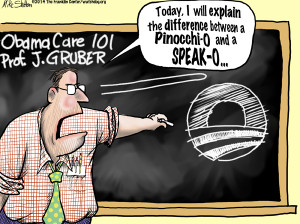
No, the monthly premium on your Obamacare coverage does NOT cover your deductible and copayments. You’re still on the hook for those bills. Apparently, that reality comes as a shock to many of the newly insured. And apparently, that reaction was unexpected by the drafters of the ACA as well as HHS, the state exchanges, and various organizations involved in the implementation of Obamacare. So, many of the previously uninsured, intended as the chief beneficiaries of the ACA, are feeling disillusioned, even jilted, by the terms of their coverage. As if the poor risk profile of enrollees weren’t bad enough, and amid continuing doubts about whether those purchasing coverage under Obamacare are actually paying their premia, the confusion among this constituency is a bad omen for the sustainability of the program.

Roth Plan Advantage Often Ephemeral

Tags

, , , ,

busfare

Roth tax-deferred savings vehicles (IRAs and 401Ks) are frequently touted as superior to traditional IRA or 401K savings for young savers, sometimes for the wrong reasons. Both types of vehicles offer tax advantages for retirement saving. Roth contributions are taxed immediately, but they grow tax-free and are completely tax-free at withdrawal. Traditional IRA and 401k contributions (“traditionals”) are tax-deductible, but the contributions and growth are taxed at withdrawal. The key determinant of which type of plan contribution is best at a given time is the tax rate faced today relative to the years of withdrawal. Based on this consideration, the Roth is better (for today’s contribution) if today’s tax rate is lower. If today’s tax rate is higher than during the withdrawal period, the traditional plan is more advantageous.

Comparing the two types of saving vehicles must be done on a basis that is equivalent in terms of post-tax, post-contribution income. For example, suppose an individual with a current annual income of $50,000 desires to set aside 6% of their income in their employer’s Roth 401k. The individual’s marginal tax rate is 15% federal plus 5% state. Therefore, they must part with pre-tax income of $3,750 to generate a net $3,000 plan contribution (ignoring the FICA tax). The individual has a “disposable” income after taxes and saving of $50,000 – $10,000 (taxes) – $3,000 = $37,000. Instead, if the individual contributed $3,750 to a traditional 401k, their disposable income would be exactly the same. (The contribution is tax deductible, but the extra tax savings from the 401k deduction is invested in the plan.) This equivalence in terms of the current disposable income is crucial, because the extra contribution in the traditional plan made possible by the immediate tax deduction serves to offset the Roth’s later tax advantage. Megan McArdle, for whom I have tremendous respect, overlooks this point in a piece about Roths here. Moreover, the number of years of untaxed growth in a Roth does not matter if the traditional vehicle grows as well, contrary to one popular explanation of the Roth’s advantages.

Some Easy Math: The conclusions stated above can be deduced easily from basic equations for future value (FV – for the time of the last contribution) in the presence of proportional taxes:

Net FV(Roth) = Gross Monthly Contrib x FVfactor x (1 – tax rate @ contrib)

Gross FV(Trad) = Gross Monthly Contrib x FVfactor

Net FV(Trad) = Gross Monthly Contrib x FVfactor x (1 – tax rate @ w/drawal)

where FVfactor is a function of the return on savings (naturally assumed to be common to the plans) and the number of months of contributions. Obviously, the two plans are equivalent if the two tax rates are equal. While these equations assume that the plan values are compared at the time of the last contribution, the results are robust to longer or differing patterns of withdrawals, as long as the same gross returns are available to both plans (this statement ignores certain rules for mandatory distributions, discussed later).

Comparing Future Outcomes: The table below shows comparisons of Roth and traditional contributions under various scenarios (click on the “?” icon to view the table). The withdrawals in these examples are structured as fixed monthly payouts (annuities) over 30 years. Returns during “retirement” (4%) are assumed to be lower than during the years of contributions (7%). The two vehicles yield the same ultimate level of benefits if the tax rates are the same during the years of contribution and withdrawal (the first “panel” of four rows in the table). If the current tax rate is lower, the traditional vehicle benefits more from the immediate tax deduction than the Roth gains later via non-taxable withdrawals (the second and third panels). The opposite is true if the current tax rate is higher than during the years of withdrawal (the fourth panel). The rightmost column of the table shows the aggregate value of the government’s tax revenue on a time-valued basis, carried forward (traditional) or discounted (Roth) to the date at which contributions end. It should come as no surprise that the difference in the net value of the two vehicles to the saver is equal to the difference in the government’s take (but of opposite sign). If you expect your tax rate to be lower in retirement, you lose and the government wins if you elect to be taxed early on retirement saving, i.e., the Roth.

Likely Tax Rates? What tax rate assumptions are realistic for most savers? First, current marginal federal and state tax rates should be applied to gross Roth contributions. However, a strong argument can be made that tax rates during the period of withdrawal (traditional) should be lower than during the years of contribution. There are three resaons for this:

1) Retirement incomes tend to be lower than during working years for most savers, which often implies a lower tax bracket.

2) Just as importantly, withdrawals from accumulated savings may not represent marginal income, because they are often taxed across multiple brackets because they represent a substantial portion of retirement income. An average tax rate may be more appropriate for calculating the net benefit of withdrawals from a traditional plan. To some extent, this depends upon how social security benefits are taxed, since those benefits may represent “base income” for purposes of calculating an average tax rate applicable to plan withdrawals. Regardless, it can be argued that taxable withdrawals should be assessed at lower tax rates than taxable contributions.

3)   Finally, many retirees choose to spend their post-working years in states with lower or no state income taxes, such as Florida and Texas. This would imply an even greater advantage for traditional plans over Roths.

Despite these considerations, there are many young savers laboring in cubicles who are cheerfully anticipating much higher earning years ahead, even for those distant years of retirement from the corner office. For this group, it is possible that contributions to a Roth make sense, but probably not beyond a certain point in their careers, when their marginal tax rate rises above the likely tax rate they will face in retirement. By then, the Roth option will be foreclosed if their incomes exceed the Roth limits on earnings eligibility. Still, the Roth is probably less likely to pan out as the best choice for most workers currently above the 25% federal tax bracket and many at or below it.

Other Roth Advantages: There may be other potential advantages of Roth savings over traditional tax-deferred plans. One is that Roths give the saver more flexibility over the timing of withdrawals simply because the withdrawals are not taxed as ordinary income. (Early Roth withdrawals are subject to the 10% penalty tax (before age 59½, with exceptions.)) Perhaps more importantly, by taking the tax hit immediately on Roth contributions, with no tax liability on future earnings, a Roth has a more certain tax impact than a traditional plan. It may be comforting to think that one’s tax rate is likely to be low in retirement, but who can say how high tax rates will be in the future, given the sorry state of government finances? Then again, the federal government could one day elect to violate its pledge not to tax Roth withdrawals, or it could even impose a wealth tax with broad applicability to all Roth and traditional plan balances. Death and taxes may be certain, but the integrity of government is not.

Finally, there are no mandatory Roth distributions at any age. This flexibility may be useful to some retirees, since complete deferral of taes beyond age 70½ is impossible on traditional plan assets. In terms of estate planning, the final accumulation of assets in a Roth can be passed along to heirs income tax-free. Therefore, an inherited Roth will have more value than a traditional plan if the heirs are in relatively high tax brackets. This argument is often used in favor of Roth conversions from traditional plans, even for individuals of advanced age. Extending the logic, even if traditional plans had no mandatory distributions, Roths would have an estate planning advantage beyond age 70½ if the heirs are in higher tax brackets than their benefactor. In any case, the traditional option is foreclosed for this purpose, given the mandatory distribution requirement on traditional tax-deferred savings.

Trampling On the Right To Have Others Pay

obamacare

“If it weren’t for state power, the Little Sisters of the Poor would be happily not facilitating the birth-control purchases of its employees; the Barack Obama administration has attempted to force them to do otherwise.” That’s from Megan McArdle in a good piece on the Supreme Court’s Hobby Lobby decision. Here’s more:

The interesting question is why people on the other side view ceasing the coercion as itself coercive while arguing that the original law did not, in fact, force anyone to violate their religious beliefs. …while the religious right views religion as a fundamental, and indeed essential, part of the human experience, the secular left views it as something more like a hobby, so for them it’s as if a major administrative rule was struck down because it unduly burdened model-train enthusiasts.

That’s worth an LOL! Oh yes, it’s coercive if we can’t be permitted to coerce you. As a friend recently quipped, your reproductive decisions might not be your employer’s business, but you make it their business when you ask them to pay for your decisions. The economics of the decisions are secondary to First Amendment rights, as buttressed by the Religious Freedom Restoration Act.

The Hobby Lobby decision was not strictly about contraception, but as to the economics of contraception and whether it pays for itself, as many insist, this post offers some interesting perspectives. The economics are not quite as settled as some would have you believe.

What a Joy To Be a Social Scientist With ESSP

Tags

, , ,

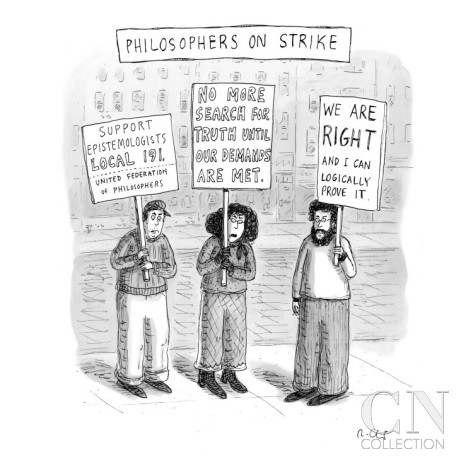
The world of social phenomena is so complex that we should be guarded in accepting appeals to scientism. As Arnold Kling points out, social scientism is insidious because it may appear to comport with “common sense,” yet this frequently involves a fallacy of division. Kling believes we should do our best to exercise “ESSP,” or Epistemological Skepticism about Social Phenomena. The egos of central planners are fed by social scientism of the type described by Kling, but their promises regularly fail to pan out, leading to a kind of societal senescence. But if we all rev up our ESSP, and keep are meddling hands off, we’re likely to enjoy a more creative and prosperous society. Let freedom ring!