Executive Privilege and Constitutional Shrivelage

Tags

, , , , ,

Sue-Me

There is disagreement about the merits and wisdom of a lawsuit filed this week by the House of Representatives against President Obama for his refusal to enforce various provisions of the Affordable Care Act, even among those who have opposed the president’s decisions. David Rivkin and Elizabeth Price Foley, the attorneys who crafted the suit, explain its rationale in “The Case for Suing the President.” (I hope the link remains ungated, but if not, search “rivkin foley wsj” and you might get in.) The subtitle: “Rewriting ObamaCare laws on the fly is a violation of the constitutionally mandated separation of powers.” They explain the duties assigned to the branches of government by the constitution, certain principles underlying the separation of powers, and they review some relevant case law. They say:

… the Supreme Court has come to recognize that preserving the constitutional separation of powers between the branches of government at the federal level, and between the states and the federal government, is among the judiciary’s highest duties.

A separate WSJ editorial  (I hope ungated) notes some of the doubts about the merits of the suit. Courts have ruled that individual lawmakers do not have standing to bring a suit of this kind, but:

…the House is making an institutional challenge to executive abuse. The courts may take such a challenge seriously, in particular because the suit claims that Mr. Obama’s abuses are usurping the institutional power of Congress under the Constitution. [emphasis added]

Some salient points are established in “Top Ten Myths about the House’s Proposed Suit Against Obama.” My favorite is myth #8: “It’s a huge waste of money since the suit is just a political stunt.” Many contend that the suit will be dismissed on the grounds that it is political, but this argument is a straw man. Conflicts between the branches of government will often have a political dimension. The reality of politics does not diminish the importance of the principles at stake. Quite the opposite.

Surprisingly, Judge Andrew Napolitano believes that the lawsuit is frivolous because it is political, despite his strong condemnation of Obama’s many attempts to exploit executive privilege. He explains his view in “Is the President Incompetent or Lawless?.” Napolitano’s solution to this constitutional crisis is the more extreme impeachment route, which is more risky politically for those pressing the case, even with a GOP landslide in this fall’s election. Nevertheless, the judge asserts that impeachment is the correct constitutional remedy.

I view the lawsuit against Obama as politically risky, but I believe it has merit and may well succeed.

More Obamacare Follies

Tags

, , , , , , ,

follies
Disconcerting news regarding the administration of the ACA just keeps on coming. The so-called “risk corridors” represent a bailout for health insurers for whom Obamacare premium revenue proves inadequate. Sure enough, but more interesting is how the Obama administration attempted to manipulate several provisions of the law on reimbursement in order to keep insurers happy after other changes with negative implications for their risk pools. In addition, when insurers expressed alarm about the “budget neutrality” of the corridors, the administration backtracked on that position. “… the administration had a choice: provide a bailout, or face the unpleasant prospect of having insurers price their products honestly.” The unfolding of these events is detailed in Emails Show Cozy Government- Insurer Alliance….

Don’t get too excited about the improvement in Medicare’s finances under the ACA. The chief actuary for the Centers for Medicaid and Medicare Services says that the ACA’s Medicare changes aren’t sustainable. Reimbursement rates under the ACA are inadequate barring “an unprecedented change in health care delivery systems and payment mechanisms.” In other words, an unlikely advance in productivity will be necessary in order to make Medicare’s finances work.

A few days ago, I posted about the Halbig vs. Sebelius District Court decision here, highlighting Jonathan Gruber’s one-time defense of the ACA’s rules that premium subsidies could be paid only on policies purchased on state exchanges. More recently, he claimed that the rule was not the intent of the legislation. Here are some further thoughts from Don Boudreaux on Gruber’s memory lapse, in which he links to a piece by Megan McArdle. Boudreaux:

The very claim that such a simple “mistake” infects the ACA calls into question the competence (or the incentives, or both) of elites, both political and intellectual, who seek ever more power for government.

Faux Peaceniks Celebrate Hamas Barbarism

Tags

, , , , , , , ,

PEACE-NEGOTIATIONS-HAMAS-ROCKET-ISRAEL-CAI-012706

It’s ironic that so many on the Left, who claim to be anti-war and humanitarian, have aligned themselves with Hamas against Israel in the current conflict. Exactly who wants to support an authoritarian, brutally intolerant, aggressively militaristic, misogynistic “government” that practices terror, sacrificing the welfare of its civilians by dedicating resources to unrelenting attacks on a neighboring state, in the process using its own civilians as human shields? Just who are their vocal supporters? And those who denigrate the Israeli effort to defend themselves? They are naive peacenik wanna-bes and, of course, a large contingent of anti-Semites, some of whom pose as peace lovers.

An intellectually honest peace lover will recognize that there is nothing inconsistent about loving peace and making a concerted effort to destroy an aggressive, attacking force. A good government must protect its people.

There were some interesting notes on the Hamas-Israeli conflict from David Bernstein at the Volokh Conspiracy over the weekend. His major points were: the conditions of Secretary of State John Kerry’s proposed cease fire were ridiculous and conflicted with Kerry’s earlier assurances; the casualty figures being reported by the media are coming from sources controlled by Hamas; the “humanitarian” deliveries of concrete to Gaza were diverted to the construction of tunnels for military use.

Here is an illuminating post covering human rights in Gaza under Hamas, from Freedom House. A key quote from the final paragraph.

Under Hamas, personal status law is derived almost entirely from Sharia, which puts women at a stark disadvantage in matters of marriage, divorce, inheritance, and domestic abuse. Rape, domestic abuse, and “honor killings,” in which relatives murder women for perceived sexual or moral transgressions, are common, and these crimes often go unpunished.

Can we call this civilization? Barbarism is more accurate. Warning: 14 Ways Hamas Weaponizes Palestinian Women, Children and Animals Against Israel contains some shocking photos and videos. First, it quotes the first Hamas Charter of 1988, defining the Hamas Mission Against Israel and Jews: “Israel will exist and will continue to exist until Islam will obliterate it.” The charter goes on to quote The Prophet, Allah: “The stones and trees will say O Moslems, O Abdulla, there is a Jew behind me, come and kill him.” The link documents what can only be described as crimes against humanity by Hamas: using children to commit stone attacks, sending women and children on suicide missions, using civilians, women and children as human shields, weaponizing: animals, homes, schools, hospitals, ambulances and mosques.

We can persist in hoping that some middle ground can be found between the Israelis and the Palestinian people, but that is unlikely to happen with Hamas in charge of the Gaza Strip. In Lift the Siege On Gaza, the Israeli author makes an eloquent case that Israel must work toward opening the border with Gaza, but he recognizes that Hamas stands as a major obstacle to real peace.

Local Cops or Local Military?

Tags

, , , , ,

drugs-swat

Violent crime in the U.S. is down by half since 1991. Why have we witnessed a militarization of local police forces? Why do we have 50,000 no-knock SWAT raids each year? Mark Perry asks these questions in a post quoting extensively from a recent John Stossel column on the subject. As Stossel observes:

SWAT raids are dangerous, and things often go wrong. People may shoot at the police if they mistake the cops for ordinary criminals and pick up guns to defend their homes against invasion. Sometimes cops kill the frightened homeowner who raises a gun.

And from Perry:

… people’s homes are often destroyed, infant children have been burned with stun grenades, hundreds of family pet dogs have been shot and killed, and dozens of suspects and some police officers have died in these violent paramilitary operations.

These SWAT raids should be alarming to anyone concerned about civil liberties. The unnecessary and wasteful war on drugs is behind much of this activity. Any physical threats to the public and law enforcement associated with drugs would vanish, much as they did with the repeal of prohibition, if drugs were legalized. The sophisticated weaponry being acquired by local police is often surplus from American wars abroad. The federal government’s provision of these armaments establishes a link and a potential dependence of local law enforcement on federal masters. The public should regard this with great suspicion.

Obamacare Web Weavers Tangled Again

Tags

, , , ,

Speak-O 

Did Congress intend to deny subsidies to those purchasing health insurance on federal exchanges under Obamacare? The DC Circuit Court ruled that it did, based on the “plain language of the law,” in last week’s Halbig v Sebelius decision. Shikha Dalmia writes that the howls of protest from some ACA supporters are disingenuous at best, especially those from health economist Jonathan Gruber, who was a key player in designing the law. In 2012, his standard talking points included assertions about incentives for states built into the law. On at least three occasions, Gruber said that any state would be crazy not to set up its own exchange because that would deny its citizens the right to federal tax credits on premium costs. Obviously, Gruber did not anticipate the backlash against the ACA, as manifested (among other things) by 36 “crazy” states refusing to set up their own exchanges.  

Earlier this week, before proof of Gruber’s earlier statements had surfaced, he insisted to Chris Matthews that the “plain language” on this point in the ACA was something like a typo. Later, when the first Gruber video was revealed, he stated that his comment was mistaken, that it was a “speak-o.” Hahaha! Nice try.

Key legislators certainly knew that the state exchange requirement was built into the ACA, as this video of remarks from Max Baucus at a Senate Finance Committee hearing proves. Of course, many legislators might have missed this point, but the bill never went through a careful mark-up process, and of course some lawmakers, like Nancy Pelosi, felt that they had to “pass the bill to find out what’s in it.” Well, after all, should busy legislators be bothered to read a 1,400 page bill prior to a vote? 

Collectivists Need Police Power To Tread On You

Tags

, , , , , ,

Dissent

Most people have no trouble understanding that increasing government control imperils individual freedoms, including freedom of expression. Sandy Ikeda discusses this linkage in “Dissent Under Socialism,” which inevitably means suppression and oppression.

First, to the degree that the State undertakes central planning of the resources it controls it can’t allow any person to interfere with or oppose the plan. Or, as Hayek puts it, “If the state is precisely to foresee the incidence of its actions, it means that it can leave those affected no choice.”

Second, the more resources the State controls, the wider the scope and more detailed its planning necessarily becomes so that delay in any part of the system becomes intolerable. There is little room for unresponsiveness, let alone dissent.

Statists and radical egalitarians harbor a naive belief that their goals for society, and for “social justice,” can be achieved by collective action. That belief is naive on several levels. In practical terms, government is incapable of achieving complex social goals, and it will botch the effort. Even more ominous is that police power must always stand behind the effort. That police power will be brought to bear on a wider range of issues seems to surprise collectivists, as illustrated by the following quote used by Ikeda:

“Fascist states stop people demonstrating against wars—it is beyond belief that French Socialists are following their example.”

Really not too surprising.

Worthy Profits Are The Rule

Tags

, , , , , ,

philosophers-on-strike

Subverting language seems to be a preoccupation on the Left, as amply illustrated by the misappropriation of the word “liberal” itself (see here).  Another distortion is in the Left’s use of the word “profit,” but with no direct change in its meaning as the excess of business revenue over costs. Rather, there is a peculiar innuendo often attached to “profit” by Leftists. This point is developed more fully in “Liberals Make Profit a Dirty Word.” Too often, profit is characterized as undeserved, motivated by ill-will, evil. The author, Stephen Carter, notes that so many of those opposed to the Supreme Court’s recent Hobby Lobby decision, which struck down certain forms of mandated contraception benefits, were aggrieved by the fact that Hobby Lobby is a “for-profit” enterprise. Could anything be less relevant to the decision? And yet…

So far, the number of e-mails accurately describing the decision is, as my physics professors used to say, arbitrarily close to zero. But there’s one underlying fact they all get right: the justices ruled in favor of a “for-profit” employer. This little hyphenated term appears in e-mail after e-mail, suggesting that it’s the for-profitness that creates the perniciousness.

Profit is simply what a business earns as a return to its capital and entrepreneurship. It is a reward for risks taken, and it actually measures gains from voluntary exchange corresponding to benefits derived by customers. As Carter points out, profits provide a signal directing resources to flow toward their highest-valued uses, a social function that central planners can never replicate. Casting aspersions at “profits” or an enterprise’s for-profit status is no more righteous than a generalization that wages are wicked. Some qualification is needed for either sort of condemnation to have pertinence.

Not Undead, But Ruling From The Grave

Tags

, , , , ,

david-dees-uncle-sam

Richard Rahn explains How Congress Lost Control of Government Spending. Programs enacted decades ago have grown dramatically and keep growing, often beyond their original purpose, claiming ever-larger shares of tax revenue, leaving little flexibility to undertake discretionary spending of any kind. Rahn quotes Eugene Steuerle of The Urban Institute, author of a new book “Dead Men Ruling”:

In recent decades, both parties have conspired to create and expand a series of public programs that automatically grow so fast that they claim every dollar of additional tax revenue that the government generates each year. … Unlike reaching the moon, rejuvenating the economy, winning a war, or curing a disease, none of these permanent programs are designed to achieve goals or solve problems once and for all. Almost all of them simply maintain, and often perpetually increase, subsidies for some pattern of consumption….

John Maynard Keynes’ spoke of the lasting influence of defunct thinkers:

Practical men, who believe themselves to be quite exempt from any intellectual influence, are usually the slaves of some defunct economist. Madmen in authority, who hear voices in the air, are distilling their frenzy from some academic scribbler of a few years back. 

Add to this the budgetary strictures imposed by metastasizing government consumption programs and we get what amounts to zombie governance.

Markets Foster Peace With Vampires

Tags

, , , , ,

EconomicsOfTheUndead

The prospect of vampire re-ensoulment prompts some entertaining thoughts about economic philosophy in this post at the Volokh Conspiracy. Here is a sample:

Why presume that having more humans or human-like beings on the planet is even a problem at all? The ecological concern seems to borrow from the perspective of doomsayers like Paul Ehrlich, who have been beating the population-bomb drum for decades. And for decades, the doomsayers have been proven wrong.

And here is a classic closing sentence:

By establishing a legal market in human blood, as suggested by Enrique Guerra-Pujol in Chapter 12, we could go a long way toward creating an incentive for vampires (especially re-ensouled ones) to eschew violence in favor of remunerative work in the combined vampire-human economy, to the benefit of both the living and the dead.


Statists Opposed To Legal Immigration AND Legal Drugs

Tags

, , , , ,

Open-border-cartoon

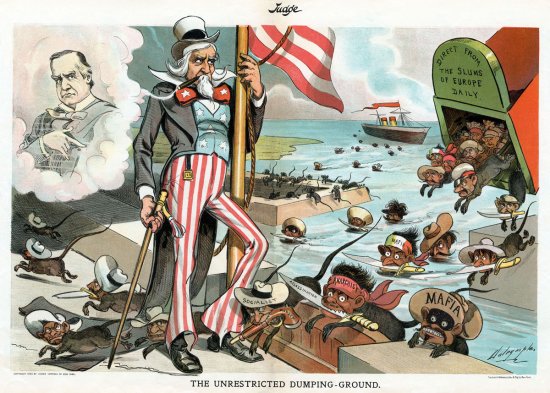
Views on U.S. immigration policy are often shaped by fears and misconceptions about the economic impact of immigration, such as competition for jobs and strains on the welfare state and the education system. While there is some basis for suspecting that heavy inflows of immigrants will cause economic dislocations in the short term, an even stronger case can be made that immigration is good for the economy, on balance. Policy should allow at least enough legal immigration to meet private labor demands across all skill levels, to keep families united, and for legitimate humanitarian purposes. Job opportunities in the U.S. should attract workers; blocking their entry is not in our economic interest. The desire to do so represents a pernicious form of statism.

Limits on the number of legal immigrants to the U.S. has inflamed the current immigration debate in part because it has led to a spillover of illegal immigrants. It is possible to seal the borders completely only at great expense, an expense that is not worthwhile. These illegal residents must be dealt with under any reform proposal. Costly deportation of large numbers of illegals is not a viable option. Many are gainfully employed and are thus contributing to the U.S. economy, and many have other family members in the U.S. Some long-term path to citizenship should be made available. Some illegals (and legals) either are or will be dependent on public assistance, but it is hard to justify deportation based on that fact. Some may be criminals, in which case deportation may be an option.

Recently, Major General John Kelly of the Marine Corps blamed the unfortunate surge in child migrants on the “insatiable U.S. demand for drugs.” In fact, the demand for drugs would have no role whatsoever were it not for the ill-advised U.S. war on drugs. The CATO Institute makes this case very well in a recent commentary. Of course, the war on drugs is another pernicious form of statism.

One very interesting approach to immigration reform would take a federalist approach to issuing visas, as explained in this CATO Policy Analysis. “A state-based visa program would direct immigration to the states that want it without forcing much additional immigration on those that do not. Unlike existing employment-based visas that tie foreign workers to one firm, state-based visa holders would be free to move between employers within the state….” This program would have economic benefits and political viability, the latter by virtue of allowing a strong degree of control over immigration at the state level.