
Tags
Abraham Accords, anti-Semitism, Ashkenazi, David Post, Egypt, Gaza Blockade, Gaza Strip, Genocide, Golan Heights, Hamas, Hezbollah, Houthis, Human Shields, Iran, Israel, Israeli Defence Forces, Jacob Sullum, Jerusalem, Jordan, League of Nations, Levant, Mizrahim, October 7th Massacre, Palestine, Palestinian Authority, Separation Wall, Six-Day War, Syria, Two-State Solution, UN Partition Plan, Volokh Conspiracy, West Bank
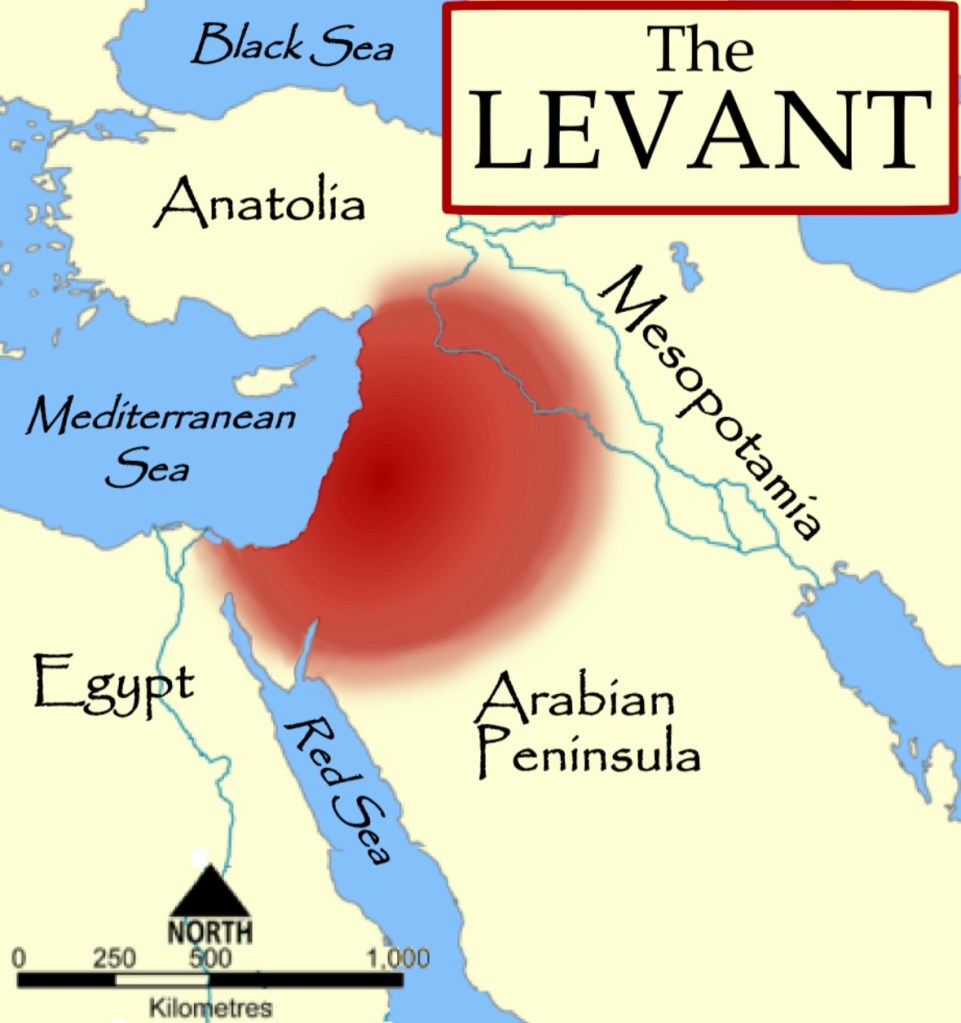
The timing of this post might be awkward given the escalation of threats by Iran and its client militia groups toward Israel. But I’m posting it anyway because this blog is a way for me to get things off my chest. Read on…
In the West there is fairly broad agreement that the Palestinian people should have a sovereign state of their own. There is much less agreement over the geographic boundaries of such a state and the sequence of events that must take place in order for it to be established. Among Palestinians there is some support for a two-state solution, but it is far from a majority.
The UN Partition Plan
The following map might be helpful in what follows. It shows the proposed boundaries of an Israeli state and an Arab state under the Partition Plan adopted by UN Resolution in 1947. The Resolution called for replacing a League of Nations mandate for British administration of the region requiring the establishment of a Jewish homeland. Likewise, the Arab state was intended to accommodate Palestinian nationalists. Together the two states were expected to comprise an economic union.
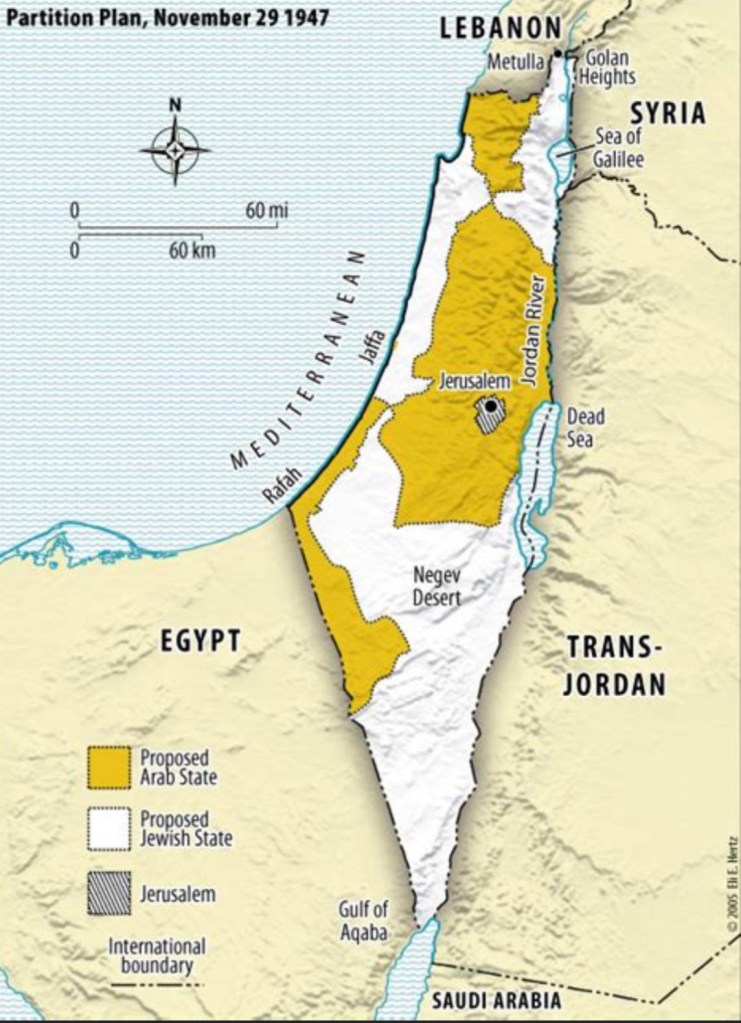
What is striking is the discontinuity of the lands assigned to each state, and this surely contributed to almost immediate border challenges. More on that below.
The Gaza Strip is the region along the shore of the Mediterranean on the lower left, which was designated as Palestinian. The Golan Heights is the Israeli region on the upper right. The West Bank is the Palestinian region in the middle. Jerusalem and its vicinity was designated as an international zone to be administered by the UN.
Border Battles
Today, the geography of a prospective Palestinian state would certainly include the Gaza Strip. There doesn’t seem to be any great dispute there, but the West Bank is another story. In this context, it’s important to remember some key details about the history of this region since 1947. David Post writes at the Volokh Conspiracy that the Palestinian state was obliterated by other Arab states in 1948:
“The State of Palestine was strangled in its infancy, not by the Israelis, who accepted the U.N. partition plan, but by the neighboring Arab States—Egypt, Syria, and Jordan—who did not. The day after the British pulled their forces out, the Arab armies marched in, and the first Arab-Israeli War began.“
The hostilities were formally ended with the signing of three different Armistices in 1949:
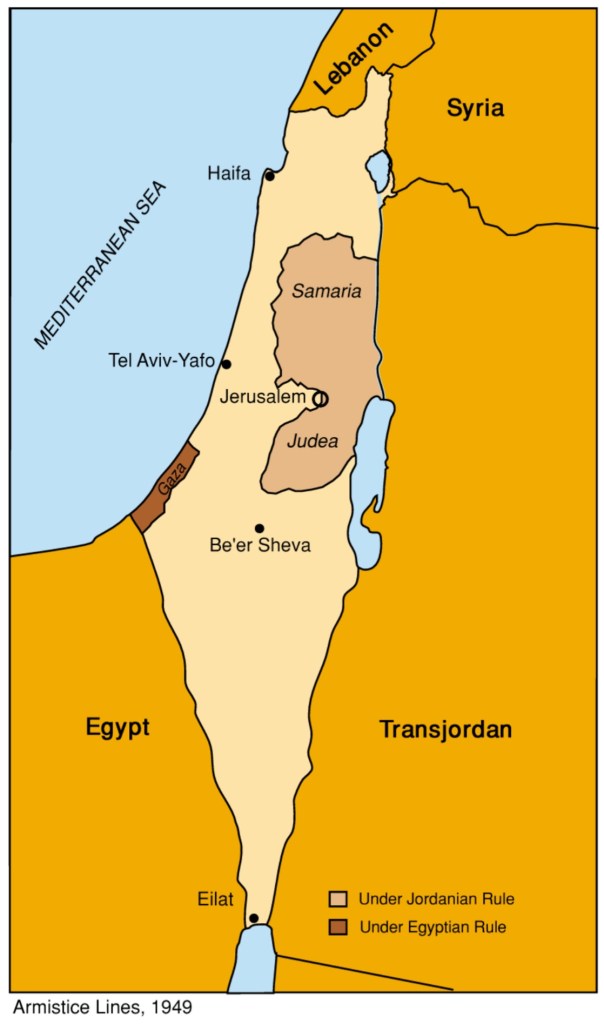
“The boundaries fixed in those agreements gave to each of the four countries involved more-or-less the territory that their armies had managed to control as of the date that ceasefires had been declared. The West Bank became part of Jordan; Gaza became part of Egypt; the Golan Heights became part of Syria. Israel got—or kept—the rest. The Palestinians, who had no army of their own, got nothing.“
Here are the boundaries under the 1949 Armistices:
The three Arab states, which refused to recognize Israel’s right to exist, attacked again in 1967. In a matter of six days and on three fronts, the Israelis drove them back and took Gaza, the West Bank, and retook the Golan Heights. Post asks:
“Why is it that only starting then, now that Israel was in control of these areas, did the world rouse itself to Palestinian grievances, and demand that ‘Palestinian lands’ be given back to the Palestinians?“
It’s worth noting that these conflicts led to the displacement of a great many Palestinians, but Israel did not provoke the attacks.
Indigenous Populations
Enemies of Israel, including those in the West, go so far as to say the Israelis are not entitled to a homeland in the Levant. Even worse, they chant “from the river to the sea”, often ignorant that it is a thinly veiled call for genocide. But Jews have as great a claim to a homeland in the Levant as the Palestinians. Jacob Sullum wrote of this truth last October, in the wake of the Hamas butchery on October 7, 2023. Israeli Jews are characterized by enemies as “colonizers”. This, as Sullum says:
“… is a ‘simplistic morality tale’, that pits white European oppressors against ‘indigenous’ people, eliding Israel’s demographic roots and the ancient Jewish connection to the land. “
Sullum goes on to discuss research on the genetic origins of modern Jewish populations. For example, one paper found that the ancestors of Ashkenazi Jews, who account for almost a third of Jews in Israel, likely descended from a “diverse population in the Middle East.” And Sullum points out that Mizrahim Jews of Middle Eastern and North African origin represent almost 45% of Israeli Jews. Furthermore, another study found that Jews and Arabs in the Middle East both share high percentages of Y chromosomes with a single gene pool, which suggests a common origin. Therefore, both Palestinians and Israeli Jews have legitimate claims to a homeland in the Levant.
Israel and Gaza
Contrary to claims by Hamas supporters, there was no occupation of Gaza by Israel at the time of the October 7th massacre. Israel’s prior occupation of Gaza ended almost 20 years ago, in 2005. However, Israel has restricted the movement of goods in and out of the Gaza Strip since the 1990s. Israel and Egypt tightened the blockade on Gaza in 2007 after Hamas took control there, though it was eased in steps from 2010 – 2013. Given the uncompromising belligerence of Hamas and its proclivity for diverting resources to support aggression against Israel, it’s fair to say the blockade is, and has been, a legitimate instrument of defense, as long as Gaza is “governed” by Hamas.
Last year, less than a week after the October 7th massacre and hostage taking, the Israeli Defense Forces (IDF) began ground operations in Gaza in an effort to root out Hamas fighters, destroy their war-making infrastructure, and rescue hostages held by Hamas in Gaza. Of course, that fight goes on.
Hamas has fought against Israel’s retaliatory action in ways that have propaganda value, especially given the naïveté of much of the Western press. Its fighters are often embedded among civilians within residential areas and facilities like schools and hospitals. The use of human shields is a war crime for which Hamas bears full responsibility, and Hamas has made it clear that their aim is to kill Israelis, civilian and military alike. Hamas has made a practice of exaggerating Palestinian death counts, a distortion that has been more obvious to statisticians than journalists.
The Israeli blockade of the Gaza Strip will be tough to end without a complete surrender by Hamas and release of the hastages. Even then, the current IDF occupation is unlikely to end until efforts are well underway to flesh out the details of a new Palestinian government, if not statehood.
The West Bank
Perhaps even more thorny for an eventual two-state solution is that Israel occupies the West Bank and has established settlements that Palestinians strongly oppose. Jordan might also have designs on retaking West Bank territory, which would once again leave Palestinians as the odd people out. Israel took the land in its own defense during the Six-Day War in 1967 and kept it as a security buffer:
“… Israel insisted that it should not, and would not, simply return to the pre-war situation — the dangerous combination of precarious armistice lines and aggressive neighbors that had prevailed for 19 years. …
The idea that Israeli security depended on continued control over parts of the West Bank was held not only by Israeli officials, but also by the American Joint Chiefs of Staff. … Referring to the West Bank, they argued that Israel required a new boundary that would ‘widen the narrow portion of Israel’ and help protect Tel Aviv.“
Israel splits aspects of governance with the Palestinian Authority in parts of the West Bank, but most of the security apparatus is run by Israel.
The continued West Bank occupation is as fraught with controversy as ever. Today there is bitter resentment over new Israeli settlements and the construction of the “Separation Wall” just inside the western border of the West Bank. The situation is made all the more intractable by Hamas’ presence there amid ongoing attacks against Israeli interests.
Withdrawing from the West Bank would create a huge vulnerability for Israel, so one can hardly expect it to cede control of the entire territory. Yet it is hard to imagine an economically viable Palestinian state confined to the Gaza Strip. In fact, some feel that more than the West Bank should be in play for creating a contiguous corridor to Gaza, which would help promote a new Palestinian state’s economic viability.
Iran
Obviously Hamas is not the only threat to Israel’s security. To the north in Lebanon, Hezbollah is a well-armed adversary. And like Hamas, it receives considerable support from Iran. It’s difficult to imagine that Iran could maintain this support, not to mention its nuclear ambitions, without the flow of oil revenue made possible by U.S. acquiescence. Reaching a peaceful resolution to the conflicts between Israel and its neighbors will be very difficult without somehow neutralizing the Iranian threat. Regime change there would be key to this effort.
What Must Happen
The obstacles to establishing a peaceful, two-state solution for Palestinians and Israelis are so steep that the prospect seems almost unimaginable. A complete defeat of both Hamas and Hezbollah would be critical, and the Palestinian Authority or any other successor regime must be counted on to negotiate in good faith and with the legitimate support of the Palestinian people. Likewise, Israel must be willing to negotiate meaningful concessions, at least in terms of its occupied territories in the West Bank.
For a successful resolution, the role of other Arab states can’t be emphasized enough. These states should apply pressure to Israel’s neighbors like Syria and Jordan to rein-in their own territorial ambitions. In a positive sign, there is now growing pressure on Iran from other Arab states to end its belligerence.
A reconstituted Abraham Accords framework could strengthen diplomatic and economic ties across the region, promoting cross-investment, trade, and cultural exchange. The framework should include a mechanism to encourage aid from the Arab states and Israel to help Palestinians build a new, peaceful, and prosperous state.
Finally, a peaceful two-state solution hinges on continued U.S. support for Israel and a new Palestinian homeland. Unfortunately, in recent years we’ve witnessed a drift toward anti-Zionism (and even anti-Semitism) among Democrats. This sort of foolishness on the far Left knows no bounds. If the anti-Zionist position comes to be accepted by the mainstream of the party, it could severely compromise Israel’s leverage in negotiations.
Summary
A resolution that would ultimately bring peace to the Middle East seems remote in the midst of the current hostilities. It would require a dramatic softening of views among nearly all parties to solve the impasse over nation-state homelands for both Jews and Palestinians. In no particular order, the following are all necessary:
- Israel’s neighboring states must not covet territory originally intended for the Palestinians, or for that matter the state of Israel.
- Iran must butt out one way or another (in the language of high diplomacy), which would do much to neutralize militant factions like Hamas, Hezbollah, and the Houthis.
- Other Arab states must come to the table along with the Israelis to negotiate economic and political accords, including aid to the Palestinian people.
- The U.S. must resist internal calls from the Left to withdraw support for Israel.
- More immediately, Israel must do its best to root out and defeat Hamas, Hezbollah, and the Houthis.
- The Palestinian people must decide they want peace and a prosperous civilization.
- Israel must show a willingness to negotiate concessions to Palestinians in the West Bank, and to aid in the rebuilding of Gaza.
Taken together that’s a very tall order! The U.S. can and should do its part to support Israel and the Palestinian people, penalize Iran, and help to bring all parties to the negotiating table. A refashioning of the Abraham Accords could contribute to peace in the region, including a stable, prosperous, and well-governed Palestinian homeland.




 Sacred Cow Chips