• About

Sacred Cow Chips

Sacred Cow Chips

Tag Archives: MAGA

The Rise of the GOP “Common Good” Socialists

02 Wednesday Sep 2026

Posted by Nuetzel in Capitalism, Socialism

≈ Leave a comment

Tags

central planning, China Shock, Common Good Capitalism, Covenant Capitalism, Data Centers, Democratic Socialists of America, Don Boudreaux, Donald Trump, Financialization, Government Equity Stakes, Industrial Policy, Interventionism, J.D. Vance, Josh Hawley, Lindsay Craig, Living Wage, MAGA, Marco Rubio, National Review Institute, Nationalism, NIMBYism, Oren Cass, Protectionism, Share Buybacks, Stakeholder Capitalism, Veronique de Rugy

Socialism has gained ground among democrats at a feverish pitch, and “mere socialism” and “democratic socialism” do not convey the tenor of the movement. The Democratic Socialists of America (DSA) wants not just bigger government: the majority of its governing board would like to completely dismantle our governing institutions and replace them with a communist state. While the DSA is formally independent, it doesn’t field candidates as a party. Instead, it essentially operates as a faction of the Democrats, who have long given cover to the far left. There are still plenty of moderate democrats who see the DSA as anathema and a threat to their electoral hopes.

New Ground On the Right

While the socialists’ ascendance among democrats is getting all the media coverage, a different trend is more remarkable: the outright embrace of socialist policies by an influential wing of the Republican Party. This despite the GOP’s rhetorical tradition as the party of “small government”, which of course it has failed to live up to. Pay no attention to the House resolution condemning socialism “in all its forms”, which was narrowly passed this week. The bill does put opposing representatives on record as having failed to condemn socialism. Otherwise it’s fairly meaningless, especially in the context of “GOP socialism”, which has gone largely unrecognized as such, or willfully ignored, by most republicans. In any case, the resolution is more focused on calling for the enactment of the SAVE America Act (Voter ID) than on socialism itself.

The government equity stakes launched by the Trump Administration are but one manifestation of this statist philosophical trap into which republicans began to stumble several years ago: “Common Good Capitalism” (CGC). Vice President Marco Rubio is widely credited with coining that name in a 2019 speech at Catholic University. In policy terms, it overlaps with MAGA dogma in several areas, but not all. Oren Cass, who is the “chief economist” of American Compass (and he is not an economist), was probably most instrumental in the development of CGC. It’s not all socialism, of course. Every ideological offshoot has its nuances. While often cited for its compatibility with religious policy motives, it’s nevertheless a mishmash of populist-nationalist, postliberal “DO SOMETHING” ideas that would grant a far greater role for the state in economic and social affairs. There are variations of CGC: Senator Josh Hawley calls his own version “covenant capitalism”, which suggests an even heavier emphasis on themes of family and faith.

Burned At the Equity Stake

Veronique de Rugy calls out GOP hypocrisy regarding socialism and state ownership of the means of production in a recent article “The GOP Is Warning About Socialism While Quietly Embracing It”. Trump’s aggressive effort to acquire equity stakes is now at 30 companies plus a giant Venezuelan oil development interest held by … the Pentagon? (A defense bill pending in the Senate would authorize the Department of War to take equity stakes in key contractors, but this deal seems to have happened without it.) I’m passionately opposed to government equity stakes and a federal sovereign wealth fund. I’ve discussed it on this blog several times (here and here, for example).

De Rugy covers several failings of state ownership in private companies:

  • Concentrated power over economic decisions in the hands of shifting partisan interests. Influence here extends well beyond the government’s share of ownership;
  • Every government policy tool influences the value of its equity stake, creating conflicts of interest between government, private shareholders, and taxpayers;
  • Irresponsible use of public funding in a time of severe fiscal imbalance;
  • Inefficient allocation of capital to politically-favored and often boneheaded uses; efficient uses tend not to require public money;
  • These firms might well be too state-invested and state-controlled to fail, so taxpayer bailouts become a much greater possibility.

Government equity stakes ultimately provide a subsidy to select firms and penalize others based on political considerations. They offer some of the worst shortfalls of central planning. And if there is spare change rattling around at the Treasury, which is unlikely, it would be better deployed in paying down the existing federal debt. That gets you an immediate and ongoing reduction in now burgeoning interest costs, less rate risk as debt rolls over, and it avoids reliance on the tenuous equity returns on shares of companies subject to heavy government control.

Cloaked Collectivism

Trump’s equity stakes fit seamlessly with the policy agenda of CGC. The following is taken from the web site of the Common Good Capitalism Movement:

“Common Good Capitalism is when in a free market economy individuals and organizations freely choose to give priority to the common good and second priority to profit or mission. They can act alone. Or they can join in an association with competitors to reach agreements to voluntarily raise the level labor, environmental, and social playing field beyond what governments have demanded of them while continuing to compete as a secondary priority.”

That sounds so nice! Be very, very good and generous to everyone, at your owners’ expense, and then join hands with your competitors. Then we’ll either buy-in or simply leave you alone. Sure they will!

The GOP is enamored with the vacuous concept of “common good” for electoral purposes. It’s certainly alluring to populist instincts. Thus, many republicans have come to believe in an array of policies that incorporate practices involving more than a small degree of statism. It’s partly based on the myth of a shrinking middle class and that the affordability of the American dream is out of reach for many Americans.

Pieces of a Platform

So let‘s review a few positions and tenets now associated with CGC. These appear in no particular order, but several are intended by their advocates to encourage American self-sufficiency and national security:

  • Industrial policy is promoted by CGC devotees as a tool for achieving the common good. They favor interventions that would favor small businesses, and they believe active industrial policy can promote job growth, national self-reliance, and national security. Equity stakes in private companies fall under this heading, which may include coercive reviews or approvals for certain business activities. Industrial policy is a form of central economic planning, and it often boils down to the picking of winners and losers by the state.
  • Protectionism, including tariffs, presumed to encourage reindustrialization and high-wage job growth, self-sufficiency, and national security. This is the wrong approach, and it too is a form of statist central economic planning. Its proponents don’t seem to realize that Trump’s tariffs represent a huge tax increase on consumers as well as firms that rely on imported inputs.
  • “Stakeholder capitalism“, they say, is necessary to ensure that businesses weigh not only the interests of their owners, but more importantly their workers and “communities”, broadly defined. No one should expect firms pursuing such ends to maximize value, and buyers should not expect them to produce superior products. Codified stakeholder capitalism would represent an abrogation of the property rights of actual shareholders. The identification of “stakeholders” has no limiting principle, so it’s an open invitation to loot.
  • Data center derangement has crept into the talking points made by many republicans and the CGC faithful. This is mostly run-of-the mill anti-development activism, not socialism per se. Plain old NIMBYism can be a visceral response to almost any development, and an honest aesthetic revulsion, but data center developers are more than willing to negotiate compromises that bring massive benefits to communities. Almost everything you hear about the external costs inflicted by data center is fictitious. Should data center opponents prevail in slowing the buildout of information infrastructure, it would be a blow to prospects for U.S. leadership in AI, economic growth, competitiveness, and national security. I think more moderate voices within the CGC movement recognize these dangers.
  • Price controls just might be put to broader use in the hope of serving the “common good”: living wage arguments have been welcomed into the CGC intellectual milieu, despite the unproductive and often destructive results of minimum wage legislation. Trump has been railing against the oil companies for supposedly profiting off American consumers. Probably just jawboning, but price ceilings might not be out of the question. Commodity price ceilings seem to be only a mild flirtation of CGC, so let’s hope Trump doesn’t normalize the idea. However, Trump and Josh Hawley have proposed capping credit card interest rates, a sure path to limiting the availability of credit to the most credit-challenged consumers. You can quibble here, but the revocation of pricing authority is every bit as much a taking as a levy on asset values.
  • CGC is union-friendly, which is unusual for a movement dominated by republicans. It insists that broad-based collective bargaining will promote more prosperous and stable families. I support the right to collective bargaining for all except public employees, and with the qualification that workers should have complete freedom of representation. However, unions raise business costs and introduce rigidities that ultimately make unionized firms less competitive and less innovative, so the hoped-for stability is likely to be short-lived for many workers.
  • Another tenet of CGC is to restrict legal immigration, despite the aging U.S. population, an insolvent pay–as-you-go public retirement system, and birth rates below replacement levels. Imposing sharp limits on immigration is a nationalist position, or even nativist, though some notorious socialists were and are both nativistic and nationalistic. Either way, this is an intrusive, statist position, and it is often xenophobic. But to be clear, I am not arguing for open borders or any form of illegal entry. Rather, I advocate for liberalized legal immigration based on merit.
  • To its credit, CGC is more oriented toward “sound money” and an independent Federal Reserve than is the Trump Administration. Trump almost seems to prefer replacing Fed authority with money printing at the whim of the executive, and in support of a far broader economic role for the state.
  • CGC calls for restrictions on certain private financial decisions, such as outlawing share buybacks and private equity. This would represent another intrusion into private affairs. This is connected to CGC’s disdain for the “financialization” of the American economy. The ban would come on top of Trump’s 1% tax of share repurchases and prohibition of buybacks by defense contractors. However, there is evidence that legalizing share repurchases tends to stimulate corporate investment by redirecting investor funds from “mature firms” to newer, relatively cash-strapped firms having unfunded growth opportunities. An implication is that prohibiting buybacks is more like shooting yourself in the foot. It would be another coercive intrusion into the private sphere, a “taking” of private decision-making authority and a form of social control.
  • The CGC movement would like to use the tax code to achieve social objectives such as family formation. These steps would include higher per-child tax credits, subsidies (family income supports), and private business mandates (e.g., required paid parental leave). I‘m all for family formation, but whether you call this socialist or authoritarian, these incentives should remain private, not subject to the whims of the state.
  • Investment incentives: I’m loath to criticize policies that improve investment incentives, such as immediate expensing of investments of physical capital. On the other hand, were it not for the existence of a distortionary tax system that double-taxes corporate income, business tax breaks would be wholly unnecessary. So let’s start with the root problem by reforming business taxation, not doubling down on distortions. Furthermore, the reliance on so-called tax subsidies represents another avenue through which government manipulates the character of economic activity, with impacts that persist for years. Central planning!
  • Perceptions of the “national interest” are always in flux, shaped by current politics and those holding power. But among CGC adherents, their view of today’s national interest must always take priority over market efficiency. This is used to justify a wide range of policies: tariffs, equity stakes, manufacturing subsidies, often based on claims that a fictitious “China Shock” has hollowed out American manufacturing. Please… this is a weak excuse for state intervention. And though the argument might not be uniquely inspired by socialism, the “national interest” makes a convenient talking point for any socialist.
  • Finally, MAGA and CGC have somewhat divergent views on regulation and intervention. MAGA, despite its embrace of government planning and its apparent rejection of fiscal conservatism, at least continues its efforts to reduce regulatory burdens on the private sector. In some cases, CGC might do that too, but CGC embraces a variety of interventions under a variety of circumstances to change business incentives or safeguard against what they judge to be violations against public welfare. CGC’s approach to managing the business environment might include antitrust actions, efforts to discourage plant or office closures, and restrictions on certain business practices such as H-1B visas and non-compete agreements. This is in addition to items discussed above, like discouraging “financialization”, strict oversight of private equity, enforcing a balanced labor bargaining environment, and fostering representation of stakeholders in corporate decision-making.

But here’s a fundamental truth, courtesy of Don Boudreaux in a 2024 letter to the National Review Institute’s then-President Lindsay Craig, regarding Oren Cass‘ advocacy for CGC:

“… one of the merits of the liberal market order is that it allows each of us to pursue our individual ends absent any need to agree on, or to aim for, anything called the ‘common good.’ …

“… Because of the diversity of individuals’ particular interests, ends, and understandings of ‘the good,’ to impose any specific ‘common good’ goal of the sort that Mr. Cass favors necessarily requires coercing the majority of people to abandon their own ends in order to assist in the pursuit of the particular ends enforced by those who currently hold political power.”

If not socialism, many of the positions listed above are at odds with the ideals of small government, individual liberty, and free market capitalism. But it’s not the least unfair to say many of them veer into socialism. The extent to which the collectivist mindset, often disguised as mere populism, has permeated republican circles is rather astonishing. I should be happy they haven’t proposed anything as socially suicidal as a wealth tax… yet!

Vance and Rubio

In leadership circles, Trump has areas of agreement as well as departures from CGC, but it’s a different story among his most likely successors to the helm of the party and the presidency. Vice President J.D. Vance is an ardent critic of capitalism, and strongly believes that the state must intervene to correct the “failures” of the market economy. I empathize with his outrage over the plant closures and economic decline that have afflicted certain communities. He experienced the effects himself growing up, but his current diagnosis assigns blame to the market order. He does not acknowledge that buyer preferences and high costs made operating those plants unviable in the first place. Market competition can both reward and punish, but it is a process that ultimately improves the general welfare. Government planning is wholly incapable of replacing the market process, and government (and taxpayers) cannot be called upon to preserve former income levels or even a former way of life.

Vance has a beef with the pursuit of measured economic growth. In his view, it comes at the expense of the traditional values he most cherishes. For example, unpaid household work is not counted in official GDP statistics, nor is elder care at home. Therefore, says Vance, the statistics themselves contain a bias against single-income and multi-generational households. Those measurement issues have long been acknowledged by economists, but he goes so far as to suggest that policy should ignore the official statistics. He has slammed holiday shifts for retail workers as exploitive. And he believes that trade deficits represent a threat to the nation (complete nonsense) and strongly supports tariffs on imports of foreign goods.

Marco Rubio is another potential CGC contender for the presidency in 2028, and he’s given credit for bringing CGC into broad discussion within the GOP. His version strikes me as hewing closer to MAGA principles than Vance does. Rubio’s take on GCG is quite focused on national security and Sino-American trade and relations. He is strongly for tight control of immigration. He supports deregulation and free market principles, with qualifications. But he also says free markets must guarantee “dignified work” to all working or job-seeking Americans at decent wages. What exactly does “dignified work” mean? And how does one simply wave away frictions in the job market that will always persist. What does “decent wages” mean? Is Rubio suggesting a mandated living wage?

Rubio statements are riddled with misconceptions about economic and technological issues. For example, his anti-trade arguments are just as moronic as Trump’s; his emphasis on redirecting activity toward production in the “physical economy” is vapid (except perhaps in markets with implications for national security); he supports more industrial policy despite a history of central planning failures; his comparison of stock buybacks to dividend income for shareholders is daft; he holds a childish view of internet development as a social media phenomenon; and far too broadly, he characterizes U.S. innovation as historically driven by defense and public-private partnerships. On the whole, Rubio might seem to have a healthier market orientation than Vance, but he still talks like an interventionist in many respects.

Conclusion

The whole CGC attack on free markets reflects a poor understanding of basic economics. It requires massive value judgements that stand in contrast to the values that emerge from the impersonal, voluntary interactions of many participants in free markets. Just as damning is CGC’s failure to recognize the many opportunities for rent seeking and corruption are enabled by government intervention. But to drive all this home, I’ll close with another quote from Don Boudreaux, which I took from a 2023 post on his blog:

“In reality, the best economic system for promoting the common good is what I, in these discussions, call ‘capitalism unprefixed’ – that is, capitalism as understood and championed by people such as Hayek and Friedman. Not only is there no need for government to interfere with capitalism unprefixed in order to ensure that the common good is served, such interference is far too likely to bestow unearned benefits on politically favored groups, or to satisfy the particular ideological preferences of politically influential intellectuals, all at the larger expense – material and nonmaterial – of the people as a whole.

“If ‘common good capitalism’ means anything other than capitalism unprefixed, its pursuit necessarily requires government to elevate the particular preferences of some individuals over those of other individuals – a move that mocks the meaning of ‘common good’ as understood by true liberals.

“In short, ‘common good capitalism’ implies the ability of ‘common good capitalists’ to determine which particular ends are, and which aren’t, consistent with the common good, and the right of these ‘capitalists’ to commandeer the state to impose their determination on everyone.“


Employee Speech and Its Consequences

18 Thursday Sep 2025

Posted by Nuetzel in Censorship, Free Speech

≈ Leave a comment

Tags

ABC, Charlie Kirk, DEI, Eugene Volokh, First Amendment, Free Speech, Hate Speech, Jimmy Kimmel, Julie Borowsky, MAGA, Pickering v. Bd. of Education, Second Amendment, Trust

I just can’t express any sympathy for those fired from their jobs for publicly endorsing or “celebrating” the assassination of Charlie Kirk. Regardless of how you felt about Charlie Kirk’s words, he was a nonviolent public figure who did everything he could to engage peacefully with those who disagreed with his views. Praising his assassination is morally repugnant.

The fairness and even the legality of these dismissals has been called into question, however. As Eugene Volokh notes, the First Amendment offers protection “against criminal punishment, civil liability” for all speech unless it “is intended to and likely to cause imminent illegal conduct”. It does not protect the speaker from other consequences, however, such as continued employment or social ostracism. It goes without saying that this applies to both sides of any debate.

But job dismissals for expressing controversial opinions should not extend beyond issues likely to threaten the mission of the employing organization, including reputation and the well being of clients and other employees. Even more importantly, prosecution under so-called “hate speech” laws (a flawed construct) should not extend outside the bounds of the First Amendment, and should not be prosecuted selectively on political grounds.

One prominent action with which I’m not comfortable is the “indefinite” cancellation of Jimmy Kimmel, who (like others on the Left) thought it would be clever to make the absurd claim, during his late-night monologue, that Kirk’s assassin was one of the MAGA tribe. Kimmel did not “celebrate” the murder per se, but his statement was enough to get his show pulled, for now. The cancellation was lauded by the Right as a response to the market. That’s plausible: Kimmel’s pronouncement might have damaged ABC’s brand, though it didn’t have far to drop. The Trump Administration seems to have employed some strong-arm tactics in this episode, however, which is awful. In any case, I’d rather keep Kimmel out there making a fool of himself.

Of course, private employers can generally employ whom they want and can often cite agreed-upon codes of conduct as justification for dismissals, if necessary. Who wants an employee announcing to the world that he or she endorses the murder of someone with whom they happen to disagree on public policy or expressions of faith? Or who wants an employee openly stating such a monstrous opinion in the workplace? It’s simply bad business to risk offense to customers, sowing discord in the workplace, or affiliating in any way with an individual willing to demonstrate such depraved values.

Things are a little different for public employees. In his post, Volokh outlined general legal conditions under which a public employee can be disciplined. These are (the full list is a quote):

  1. the speech is said by the employee as part of the employee’s job duties, Garcetti v. Ceballos (2006), or
  2. the speech is not on a matter of public concern, Connick v. Myers (1983), or
  3. the damage caused by the speech to the efficiency of the government agency’s operation outweighs the value of the speech to the employee and the public, Pickering v. Bd. of Ed. (1968).

As Volokh says, strictly speaking, these conditions do not establish categorical grounds for dismissing a public employee for praising violence. He cites case law to support that position. But the third condition listed is critical in many cases. On that point, he notes that the case in question involved a private conversation with the speaker’s co-worker/boyfriend. So that case hardly seems dispositive.

Volokh goes on to say that #3 above, or really the Pickering case, establishes a kind of heckler’s veto for public employers. That is, it:

“… often allows government to fire employees because their speech sufficiently offends coworkers or members of the public. …

“This conclusion by lower courts applying Pickering might, I think, stem from the judgment that employees are hired to do a particular job cost-effectively for the government: If their speech so offends others (especially clients or coworkers) that keeping the employees on means more cost for the government than benefit, the government needn’t continue to pay them for what has proved to be a bad bargain.“

Whether it involves someone in the public or the private sector, concerns about endorsing the murder of an ideological opponent are particularly acute when issued by those in jobs requiring a high level of trust. That covers a broad swath of workers, but especially those in health care, education, and law enforcement. Can you trust a nurse, a surgeon, or any other caregiver who would endorse murder as a proper response to political or ideological differences? Are you willing to allow your child to be instructed by such an individual at any level? For that matter, would you trust a news anchor who spouted that kind of rhetoric?

It’s certainly doesn’t present as “normal” to espouse or praise murder and other violent acts, regardless of ideological passion. In fact, most people would fairly question the stability of anyone cheerleading for murder and the risk they might present to society. Words are cheap, but it might well signal an elevated propensity for acts of violent retaliation for perceived wrongs.

The question of trust really permeates our interactions with the whole of society, so the kind of behavior we’ve witnessed from this quarter is threatening. Will my waitress, overhearing a conversation, befoul or poison the food she serves me? Will my ride share driver deliver me to a torture chamber? Will a neighborhood contact attempt to exact some kind of retribution? It’s not quite there yet, but the encroachment is real. This should be more salient to anyone with an accessible social media profile who wishes to express an honest opinion, particularly on a college campus.

A brief word about some of the Charlie Kirk quotes that have made the rounds. They are often excerpted and divorced from the full context of the argument he was attempting to make. Julie Borowsky on X provides some direct, full quotes of Kirk on several important topics. I happen to think he made valid (if not fully developed) points about the value of the Second Amendment, the divisiveness of DEI, overuse of the word “empathy”, and the downsides of Civil Rights Act. At the same time, I am certain I’d disagree with other positions Kirk held, like his support for tariffs. Still, they were all debating points on policy (or matters of faith), and they did not qualify as “hate speech”, which is a subjective notion and highly resistant to consensus. In any case, his comments could never have justified the insane reaction of Kirk’s assassin or those who cheered his murder.

June Budget Surplus and Wishful Tariff Thinking

21 Monday Jul 2025

Posted by Nuetzel in Deficits, Tariffs

≈ Leave a comment

Tags

Balanced Budget, Budget Surplus, Calendar Adjustments, Donald Trump, Economic Freedom, MAGA, Protectionism, Tariffs

The federal government ran a budget surplus of $27 billion in June, much to the surprise of nearly everyone. The Trump Administration and MAGA-friendly media were eager to credit a big revenue boost from higher tariffs, which… ahem … they have assured us are not really taxes. In any case, to attribute the June surplus to tariffs is flatly ridiculous. The truth is these “non-tax” magic revenue generators made a relatively small contribution to the apparent shift in the government’s fiscal position in June. And I say “apparent” because the surplus itself was something of a mirage.

Yes, tariffs brought in a total of almost $27B during June, which is about the same as the surplus recorded, but that was purely coincidental. It does not imply that tariffs “created” a surplus. Nor does it suggest that tariffs might just be able to balance the federal budget. Not a chance!

Here is one of two other sides of the story: the Treasury reported that the budget balance this June improved from a year ago by a total of $89 billion, from a deficit of $72B in June of 2024 to the aforementioned surplus of $27B in June 2025. Outlays were lower by about $38B this June, accounting for almost 43% of the improvement. Receipts were about $59B higher, with tariffs increasing by $20B relative to June 2024. So tariffs contributed just over a third of the boost in receipts. Altogether then, tariffs accounted for 22.5% of the improvement in the June budget balance between 2024 and 2025. That version of the story, as far as it goes, does not support the contention that tariffs “caused” the budget surplus in June, only that tariff revenue was a contributing factor.

Let’s dig a little deeper, however. Were it not for so-called “calendar adjustments” made by the Treasury, it would have reported a deficit of $70B in June. The reason? The first day of June fell on a Sunday this year, so certain payments were shifted to the last prior business day: Friday, May 30. That reduced June outlays substantially. Moreover, an extra business day in June 2025 added revenue. So the surplus in June was, in essence, an artifact of the calendar and had little to do with tariff revenue.

Incidentally, no one should be surprised by the growth of tariff revenue collected in June. When a tax rate more than triples (from a pre-Trump average of about 3% to 10% plus in June — net of tariff exclusions), one should expect revenue from that tax to increase substantially (and it was probably exaggerated by the extra business day).

Oh wait! Did I say tax?

With time, buyers will adjust and scale back their import purchases, reducing the revenue impact of the tariff hikes. However, we still don’t know how high tariffs will go. That means we could see substantially higher tariff revenue, though the demand response and a likely negative impact on incomes will cut into those gains. Either way, the revenue potential of tariffs is limited. Some estimates put the revenue impact of Trump’s tariffs at less than $250B annually. That seems conservative, but it’s significant revenue if it holds up. Still, it won’t come close to balancing a federal budget that’s almost $2 trillion in the hole. It certainly doesn’t justify a headlong dive into protectionism, which amounts to taking a crap on the economic freedom and prosperity of the American public.

That Word “Liberal” … I Don’t Think That Means What You Think It Means

03 Wednesday Jan 2024

Posted by Nuetzel in Conservatism, Liberalism, Socialism

≈ Leave a comment

Tags

Adam Smith, Capitalism, Classical Liberal, Conservatism, Consumer Sovereignty, Corporatism, Free Markets, Freedom of Speech, Friedrich Hayek, Liberalism, Libertarianism, MAGA, monopoly, Monopsony, Nate Silver, Natural Rights, Non-Aggression Principle, Perfect Competition, Progressivism, Property Rights, Public goods, Religious Freedom, Right to Life, Scott Sumner, social engineering, Socialism, State Capacity, State Religion, statism, The Wealth of Nations

Leftism has taken on new dimensions amid its preoccupation with identity politics, victimhood, and “wokeness”. Traditional socialists are still among us, of course, but “wokeists” and “identitarians” have been on the progressive vanguard of late, rooting for the deranged human butchers of Hamas and the dismantling of liberal institutions. This didn’t happen overnight, of course, and traditional socialists are mostly fine with it.

An older story is the rebranding of leftism that took place in the U.S. during the first half of the 20th century, when the word “liberal” was co-opted by leftists. Before that, a liberal orientation was understood to be antithetical to the collectivist mindset long associated with the Left. Note also that liberalism retains its original meaning even today in much of Europe. Often we hear the term “classical liberal” to denote the “original” meaning of liberalism, but the modifier should be wholly unnecessary.

Liberalism Is Not “In-Betweenism”

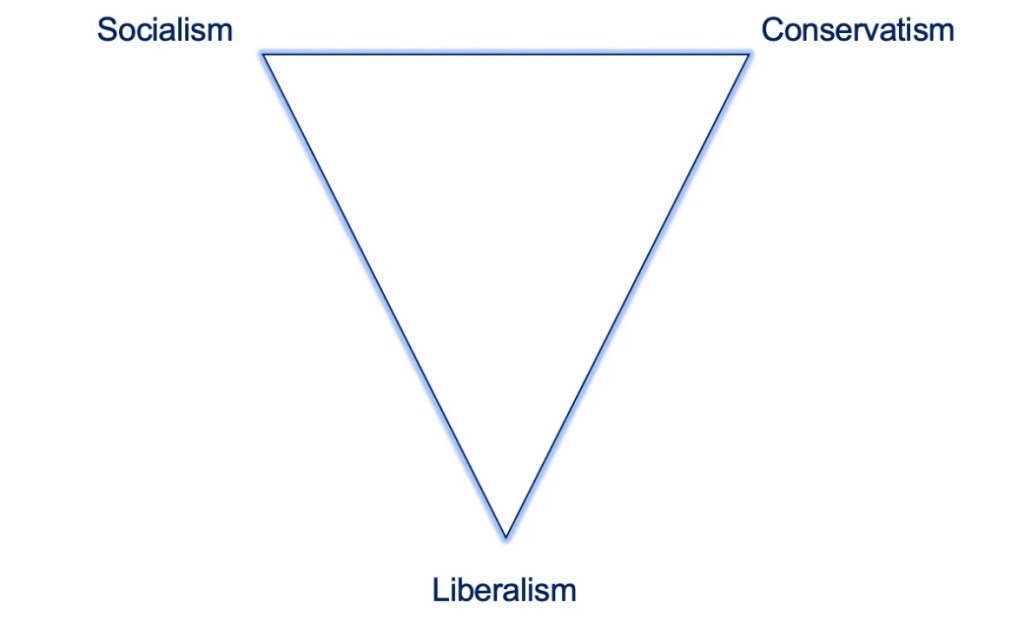
In this vein, Nate Silver presents a basic taxonomy of political orientation in a recent Substack post. It includes the diagram above, which distinguishes between socialism, conservatism, and liberalism. Silver draws on a classic essay written by Friedrich Hayek in 1945, “Why I am Not a Conservative”, in which Hayek discussed the meaning of the word “liberal” (and see here). Liberalism’s true emphasis is a tolerance for individual rights and freedoms, subject to varying articulations of the “nonaggression principle”. That is, “do as you like, but do no harm to others”.

We often see a linear representation distinguishing between so-called progressives on the left and conservatives on the right. Of course, a major hallmark of leftist thinking is extreme interventionism. Leftists or progressives are always keen to detect the slightest whiff of an externality or the slightest departure from the perfectly competitive market ideal. They seem eager to find a role for government in virtually every area of life. While it’s not a limiting case, we can substitute socialism or statism for progressivism on the far left, as Silver does, whereby the state takes primacy in economic and social affairs.

Conservatism, on the other hand, is a deep resistance to change, whether institutional, social, and sometimes economic. Conservatives too often demonstrate a willingness to use the coercive power of the state to prevent change. Hayek noted the willingness of both socialists and conservatives to invoke state power for their own ends.

Similarly, religious conservatives often demand state support beyond that afforded by the freedom to worship in the faith of one’s choice. They might strongly reject certain freedoms held to be fundamental by liberals. Meanwhile, socialists often view mere religious freedom as a threat to the power of the state, or at least they act like it (e.g. see here for an example).

Like conservatives, dedicated statists would doubtless resist change if it meant a loss of their own power. That is, they’d wish to preserve socialist institutions. On this point, witness the vitriol from the Left over what it perceives as threats to the public school monopoly. Witness also the fierce resistance among public employees to reducing the scale of the administrative state, and how advocates of entitlements fiercely resist decreases in the growth rate of those expenditures.

Silver, like Hayek, objects to the traditional, linear framework in which liberals are thought to occupy a range along a line between socialism and conservatism. He objects to that because real liberals value individual liberty as a natural human right, a viewpoint typically abhored by both socialists and conservatives. There is nothing “in between” about it! And of course, conservatives and progressives are equally guilty in their mistaken use of the word “liberal”.

Mapping Political Preferences

Liberty, statism, and conservatism are not exactly orthogonal political dimensions. Larger government almost always means less economic liberty. At a minimum, state dominance implies a social burden associated with public monopoly and monopsony power, as well as tax and welfare-state incentive problems. These features compromise or corrupt the exercise of basic rights. On the other hand, capitalism and its concomitant reliance on consumer sovereignty, individual initiative, free exchange and secure property rights is most in harmony with true liberalism.

For conservatives, resistance to change in support of a traditionally free market economy might offer something of a contradiction. In one sense, it corresponds to upholding market institutions. However, free markets allow new competitors and new technologies to undermine incumbents, who conservatives sometimes wish to defend through regulatory or protectionist measures. And conservatives are almost always too happy to join in the chorus of “price gouging” in response to the healthy operation of the free market in bringing forth supplies.

All that is to say that preferences involving liberty, statism, and traditionalism are not independent of one another. They cannot simply be mapped onto a three-dimensional space. At least the triangular representation gets liberalism out of the middle, but it’s difficult to visualize other ideological positions there. For example, “state religionism” could lie anywhere along the horizontal line at the top or even below it if certain basic liberties are preserved. Facism combines elements of socialism and a deformed version of capitalism that is properly called corporatism, but where would it fall within the triangle?

Big Government Liberalism?

Silver says he leans heavily toward a “big government” version of liberalism, but big government is hard to square with broad liberties. Granted, any well-functioning society must possess a certain level of “state capacity” to defend against private or public violations of individual rights, adjudicate disputes, and provide true public goods. It’s not clear whether Silver’s preferences lie within the bounds of those ambitions. Still, he deserves credit for his recognition that liberalism is wholly different from the progressive, socialist vision. It is the opposite.

The “New” Triangle

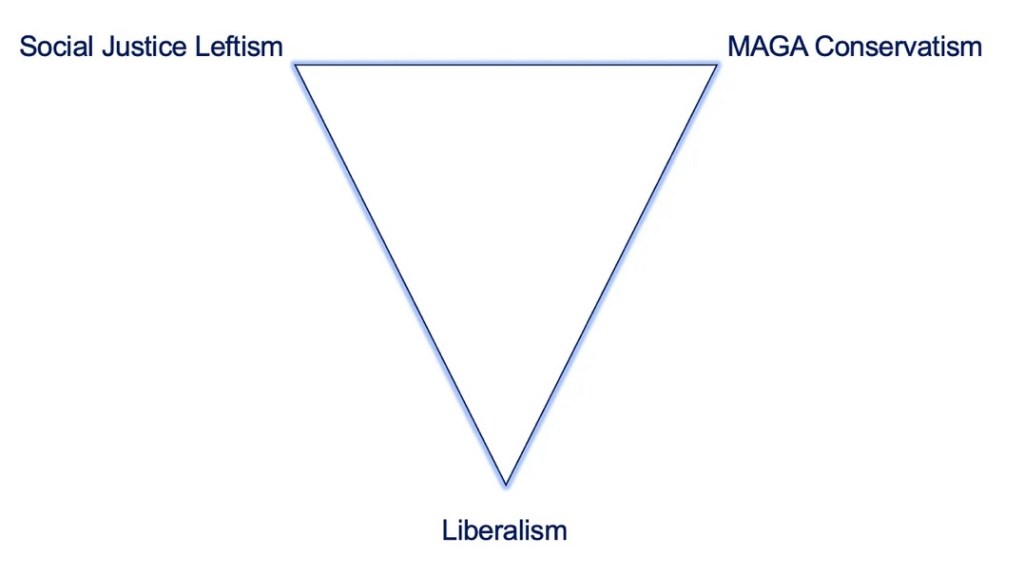
Silver attempts to gives the triangular framework a more contemporary spin by replacing conservatism with “MAGA Conservatism” and socialism with “Social Justice Leftism” (SJL), or “wokeism”. Here, I’m treating MAGA as a “brand”. Nothing below is intended to imply that America should not be a great nation.

The MAGA variant of conservatism emphasizes nationalism, though traditional conservatives have never been short on love of nation. For that matter, as a liberal American, it’s easier to forgive nationalist sentiments than it is the “Death to America” refrain we now hear from some SJLs.

The MAGA brand is also centered around a single individual, Donald Trump, whose rhetoric strikes many as nativistic. And Trump is a populist whose policy proposals are often nakedly political and counterproductive.

SJL shares with socialism an emphasis on various forms of redistribution and social engineering, but with a new focus on victimhood based on classes of identity. Of SJL, Silver says:

“Proponents of SJL usually dislike variations on the term ‘woke’, but the problem is that they dislike almost every other term as well. And we need some term for this ideology, because it encompasses quite a few distinctive features that differentiate it both from liberalism and from traditional, socialist-inflected leftism. In particular, SJL is much less concerned with the material condition of the working class, or with class in general. Instead, it is concerned with identity — especially identity categories involving race, gender and sexuality, but sometimes also many others as part of a sort of intersectional kaleidoscope.”

The gulf between liberals and SJLs couldn’t be wider on issues like free speech and “equity”, and equality of opportunity. MAGAns, on the other hand, have some views on individual rights and responsibility that are largely consistent with liberals, but reflexive populism often leads them to advocate policies protecting rents, corporate welfare, and protectionism.

Divided Liberalism

Liberalism emphasizes limited government, individual autonomy, and free exchange. However, there are issues upon which true liberals are of divided opinion. For example, one such area of controversy is the conflict between a woman’s right to choose and the fetal right to life. Many true liberals disagree over whether the rights of a fetus outweigh its mother’s right to choose, but most would concede that the balance shifts to the fetus at some point well short of birth (putting aside potential dangers to the mother’s life). Open borders is another area that can divide true liberals. On one side, the right to unrestricted mobility is thought to supersede any public interest in enforcing borders and limiting the flow of immigrants. On the other side, questions of national sovereignty, national security, as well as social and state capacity to absorb immigrants take primacy.

Don’t Call Lefties “Liberal”… They’re Not!

True liberalism (including most strains of libertarianism) recognizes various roles that a well-functioning state should play, but it also recognizes the primacy of the individual and individual rights as a social underpinning. As Hayek noted, true liberals are not resistant to change per se, unlike conservatives. But modern progressives demand changes of the worst kind: that the state should intervene to pursue their favored objectives, laying claim to an ever-greater share of private resources. This requires government coercion on a massive scale, the antithesis of liberalism. It’s time to recognize that “progressives” aren’t liberals in any sense of the word. For that matter, they don’t even stand for progress.

I’ll close with a quote from Adam Smith that I cribbed from Scott Sumner. Unfortunately, Sumner does not give the full reference, but I’ll take his word that Smith wrote this 20 years before the publication of The Wealth of Nations:

“Little else is requisite to carry a state to the highest degree of opulence from the lowest barbarism, but peace, easy taxes, and a tolerable administration of justice; all the rest being brought about by the natural course of things. All governments which thwart this natural course, which force things into another channel, or which endeavour to arrest the progress of society at a particular point, are unnatural, and to support themselves are obliged to be oppressive and tyrannical.”

“Othered” By the Left

31 Thursday Jan 2019

Posted by Nuetzel in fascism, Identity Politics, Progressivism

≈ Leave a comment

Tags

#ExposeChristianSchools, anti-Semitism, Antifa, Black Hebrew Israelites, Brett Kavanaugh, Caroline Lewis, Christian Education, Covington Catholic High School, David French, Eliminationist Rhetoric, Glenn Reynolds, Identity Politics, Joel Kotkin, MAGA, Nathan Phillips, Otherism

Progressivism certainly has its discards. The photo showed a trash bin labeled “CATHOLIC DUMPSTER”. Dead bodies were hanging out of the top. A “friend” had posted it on Facebook, ostensibly as humor. I thought it was in poor taste and had the temerity to say so in a comment; naturally I was immediately castigated by a mob for expressing that opinion. The “friend” said that if I really knew him, I’d realize that he loves everyone. That claim was quickly undermined by his partner, who joined the exchange to spew vitriol for Christians. A wiser person on the thread, perhaps detecting a whiff of hypocrisy, noted the likely outrage had the label on the trash bin said “JEWISH DUMPSTER”. Well yes…. Er, maybe. The political Left, it seems, is drifting ever closer to anti-Semitism as well as radical intolerance for Christians. This in addition to outright hostility toward whites, men, or anyone perceived as having “privilege”. The rhetoric is becoming increasingly hateful, vile, and violent.

A recent confrontation in front of the Lincoln Memorial wrapped together several objects of leftist hatred. It involved boys from Covington Catholic High School and left-wing activist Nathan Phillips, an Omaha Indian, as well as a group of black nationalists called the Black Hebrew Israelites. The Covington boys are white, male, Catholic, pro-life, and they wore MAGA caps. They were passive except for chants intended to drown-out shouts of “faggots” from the Black Israelites, but the media almost uniformly portrayed the boys as racist villains in the immediate aftermath, based on incomplete video evidence. It is difficult to ascertain who released the original video, but a longer version proved that the boys were not at fault. Meanwhile, Phillips proved to be a bald-faced liar. He lied about the sequence of events, the behavior of the boys, and about having served in Vietnam. But those lies fueled a media narrative as well as the fertile imaginations of many leftists. The full video reveals that Phillips marched from some distance straight up to one of the teenagers and proceeded to bang a drum in the kid’s face. The boy maintained his composure and kept a calm smile on his face. Later, however, that smile was cited as proof of racism!

A few members of the media retracted the awful things they said about the teenagers and the incident, but others continue to allege that the Covington teenagers were at fault, or that they at least share the blame. Some of the rhetoric is no less hateful than before the full video became available. This is a far cry from the heartfelt entreaties to avoid criticism of any controversial opinions expressed by “the children” in the wake of the Parkland High School shooting. In the present case. the kids have been targeted with a slew of insults and threats to themselves and their families.

Regarding the MAGA caps, I am by no means a Trump enthusiast, but I root for him to do well as our president despite my strong disapproval of some of his policies. You won’t ever catch me in a MAGA cap. However, I do not believe that he and his political base are racist. Trump is an equal opportunity denigrator, but he’s called a racist every time his target happens to be a person of color, as though people of color are always above criticism. Trump is called a racist for his promise to build a wall along the Mexican border to stem illegal crossings, though the same proposal has been offered by many Democrats over the years, including Barack Obama and Check Schumer. Therefore, the very idea that wearing a MAGA cap is a racist signal is transparently political and absurd. That some of the Covington boys wore MAGA caps has reinforced other excuses to target them for vicious criticism.

A further issue is that the Covington boys are privileged, you see, guilty of possessing white, male privilege, even as they defended a black classmate harangued by the Black Israelites. They attend a private school, and so they must be from wealthy families and worthy of progressive hatred. They were in DC for the March for Life, so they are opposed to reproductive choice and must hate women. In fact, it’s been alleged that they were in DC only to oppose the Women’s March. Misogynists!

Hatred for Catholics and for anyone who has attended private schools is always de rigueur on the Left. That was quite clear during the Brett Kavanaugh confirmation hearings. Hatred gushed from the Left not only because they were satisfied of Judge Kavanaugh’s guilt based on unsubstantiated, 11th-hour allegations leveled against him by an SJW, but apparently also because he attended a Catholic boys school! Oh, and he is male. I have another “friend” whose Facebook feed was littered with smears of Kavanaugh, including characterizations of private school kids as “smug little weasels”. As Caroline Lewis said at the time, these “critics” are barbarians. Do you think they don’t want to hurt those they’ve “othered”, or want someone else to hurt them in one way or another? The boundaries of grievance always expand, and will keep expanding until they eat their own.

David French claims that his defense of Christian education prompted an activist to start the #ExposeChristianSchools hashtag. Now, I’m sure everyone who has attended public or private schools can repeat a litany of stories about a few awful teachers they were forced to endure, not to mention the hostile environment that school children often create for one another. But private schools, and religious schools, are often superior options for parents and children. If you don’t like the curriculum, don’t send your kids there. If you don’t think the policies are sufficiently inclusive, or the environment will be unhealthy for your child, then send them elsewhere. But the vilification of an entire segment of the population based on how they choose to educate their children is despicable. They’d ban Christian education if they could… and religion!

Note that the Left’s insistence on state domination is itself a threat of violence. While capitalism and free markets are cooperative in nature, socialism is at its core authoritarian and coercive. If you resist you become an enemy of “the people”, and such enemies will have consequences to pay.

Antifa is unashamedly violent, but it might be only the tip of the iceberg. The rhetoric of the Left has become increasingly hostile toward Christians, Jews, males, whites, Republicans, and of course anyone achieving material success. There is no forgiveness nor genuine love of others in leftist doctrine. Indeed, the “otherism” inherent in leftist identity politics is dangerous and a source of increasing social instability. Their “eliminationist rhetoric” is becoming all too common (scroll down at the link).

For now I’ll continue to engage in the marketplace of ideas. Perhaps it’s becoming a war. Us “others” need to keep voting and never back down. And by all means, be prepared to defend ourselves and our loved ones by any means necessary.


Follow Sacred Cow Chips on WordPress.com

Recent Posts

  • The Rise of the GOP “Common Good” Socialists
  • Trial Lawyers Reveal Preference For Less Safety
  • Funding Private Social Security Accounts
  • Chinese State, CCP, Cronies Exploit Wage Earners
  • Some Dimensions Of the AI/Data Center Freakout

Archives

  • September 2026
  • August 2026
  • July 2026
  • June 2026
  • May 2026
  • April 2026
  • March 2026
  • February 2026
  • January 2026
  • December 2025
  • November 2025
  • October 2025
  • September 2025
  • August 2025
  • July 2025
  • June 2025
  • May 2025
  • April 2025
  • March 2025
  • February 2025
  • January 2025
  • December 2024
  • November 2024
  • October 2024
  • September 2024
  • August 2024
  • July 2024
  • June 2024
  • May 2024
  • April 2024
  • March 2024
  • February 2024
  • January 2024
  • December 2023
  • November 2023
  • August 2023
  • July 2023
  • June 2023
  • May 2023
  • April 2023
  • March 2023
  • February 2023
  • January 2023
  • December 2022
  • November 2022
  • October 2022
  • September 2022
  • August 2022
  • July 2022
  • June 2022
  • May 2022
  • April 2022
  • March 2022
  • February 2022
  • January 2022
  • December 2021
  • November 2021
  • October 2021
  • September 2021
  • August 2021
  • July 2021
  • June 2021
  • May 2021
  • April 2021
  • March 2021
  • February 2021
  • January 2021
  • December 2020
  • November 2020
  • October 2020
  • September 2020
  • August 2020
  • July 2020
  • June 2020
  • May 2020
  • April 2020
  • March 2020
  • February 2020
  • January 2020
  • December 2019
  • November 2019
  • October 2019
  • September 2019
  • August 2019
  • July 2019
  • June 2019
  • May 2019
  • April 2019
  • March 2019
  • February 2019
  • January 2019
  • December 2018
  • November 2018
  • October 2018
  • September 2018
  • August 2018
  • July 2018
  • June 2018
  • May 2018
  • April 2018
  • March 2018
  • February 2018
  • January 2018
  • December 2017
  • November 2017
  • October 2017
  • September 2017
  • August 2017
  • July 2017
  • June 2017
  • May 2017
  • April 2017
  • March 2017
  • February 2017
  • January 2017
  • December 2016
  • November 2016
  • October 2016
  • September 2016
  • August 2016
  • July 2016
  • June 2016
  • May 2016
  • April 2016
  • March 2016
  • February 2016
  • January 2016
  • December 2015
  • November 2015
  • October 2015
  • September 2015
  • August 2015
  • July 2015
  • June 2015
  • May 2015
  • April 2015
  • March 2015
  • February 2015
  • January 2015
  • December 2014
  • November 2014
  • October 2014
  • September 2014
  • August 2014
  • July 2014
  • June 2014
  • May 2014
  • April 2014
  • March 2014

Blogs I Follow

  • Passive Income Kickstart
  • OnlyFinance.net
  • TLC Cholesterol
  • Nintil
  • kendunning.net
  • DCWhispers.com
  • Hoong-Wai in the UK
  • Marginal REVOLUTION
  • Stlouis
  • Watts Up With That?
  • American Elephants
  • The View from Alexandria
  • The Gymnasium
  • A Force for Good
  • Notes On Liberty
  • troymo
  • SUNDAY BLOG Stephanie Sievers
  • Miss Lou Acquiring Lore
  • Your Well Wisher Program
  • Objectivism In Depth
  • RobotEnomics
  • Orderstatistic
  • Paradigm Library
  • Scattered Showers and Quicksand
  • Jam Review

Blog at WordPress.com.

Passive Income Kickstart

OnlyFinance.net

TLC Cholesterol

Nintil

To estimate, compare, distinguish, discuss, and trace to its principal sources everything

kendunning.net

The Future is Ours to Create

DCWhispers.com

Hoong-Wai in the UK

A Commonwealth immigrant's perspective on the UK's public arena.

Marginal REVOLUTION

Small Steps Toward A Much Better World

Stlouis

Watts Up With That?

The world's most viewed site on global warming and climate change

American Elephants

Defending Life, Liberty and the Pursuit of Happiness

The View from Alexandria

In advanced civilizations the period loosely called Alexandrian is usually associated with flexible morals, perfunctory religion, populist standards and cosmopolitan tastes, feminism, exotic cults, and the rapid turnover of high and low fads---in short, a falling away (which is all that decadence means) from the strictness of traditional rules, embodied in character and inforced from within. -- Jacques Barzun

The Gymnasium

A place for reason, politics, economics, and faith steeped in the classical liberal tradition

A Force for Good

How economics, morality, and markets combine

Notes On Liberty

Spontaneous thoughts on a humble creed

troymo

SUNDAY BLOG Stephanie Sievers

Escaping the everyday life with photographs from my travels

Miss Lou Acquiring Lore

Gallery of Life...

Your Well Wisher Program

Attempt to solve commonly known problems…

Objectivism In Depth

Exploring Ayn Rand's revolutionary philosophy.

RobotEnomics

(A)n (I)ntelligent Future

Orderstatistic

Economics, chess and anything else on my mind.

Paradigm Library

OODA Looping

Scattered Showers and Quicksand

Musings on science, investing, finance, economics, politics, and probably fly fishing.

Jam Review

"If you get confused, listen to the music play."

  • Subscribe Subscribed
    • Sacred Cow Chips
    • Join 128 other subscribers
    • Already have a WordPress.com account? Log in now.
    • Sacred Cow Chips
    • Subscribe Subscribed
    • Sign up
    • Log in
    • Report this content
    • View site in Reader
    • Manage subscriptions
    • Collapse this bar
Loading Comments...