• About

Sacred Cow Chips

Sacred Cow Chips

Tag Archives: Australia

Single-Payer: Queue Up and Die Already

19 Sunday Jan 2020

Posted by Nuetzel in Health Care, Health Insurance

≈ 1 Comment

Tags

Australia, Bernie Sanders, Canada, Catastrophic Coverage, Chris Pope, Competitive Payer, Dual Payer, Employer-Paid Coverage, France, Germany, Individual Mandate, Manhattan Institute, Medicaid, Medicare, Netherlands, Out-of-Pocket Costs, Portability, Premium Deductibility, Segmented Payer, Single-Payer, Switzerland, third-party payments, Uncompensated care, United Kingdom, Universal Coverage

I constantly hear this sort of naive remark about health care in “other major countries”, and while Chris Pope’s rejoinder below should chasten the ignorant, they won’t listen (emphasis is mine):

“[Bernie] Sanders recently argued that ‘our idea is to do what every other major country on earth is doing,’ but this claim is … fictitious. In fact, there is not a single country in the world that offers comprehensive coverage with an unlimited choice of providers, fully paid for by taxpayers, without insurer gatekeeping, service rationing, or out-of-pocket payments. In reality, there is a direct trade-off between ease of access to providers and the cost borne by individuals in out-of-pocket expenses.”

Pope’s statement pretty much strips bare the fiction of “universal” coverage, a concept too loosely defined to be of any real use except as a rhetorical device. It also highlights the non-monetary costs inflicted on consumers by non-price rationing of care. The presumption that government must provide universal health care coverage and that all other developed countries actually have that arrangement is incorrect.

Pope has another article at the Manhattan Institute site, written late last year, on the lessons we can learn on health care from experience abroad under various payer systems. This offers a more detailed comparison of the structure of the U.S. payment system versus seven other countries, including Canada, the U.K., Australia, and Germany. Single-payer tends to be the “gold standard” for the Left, but the only systems that “approximate” single-payer are in Canada and the U.K. Here is one blurb about Canada:

“Canadians have easy access to general practitioners, but getting an appointment to see a specialist is more difficult than in all the other nations studied in this report. The Canadian medical system provides the least hospital care, delivers consistently fewer outpatient procedures, and provides much less access to modern diagnostic technology.

Canadians also have limited access to drugs, according to Pope. And out-of-pocket (OOP) spending is about the same as in the U.S. At the first link above, Pope says:

“Canadians spend less on health care than Americans mostly because they are not allowed to use as much — not because they are getting a better deal. … Waiting lists are generally seen as the single-payer budgeter’s friend, as some patients will return to health by themselves, others will be discouraged from seeking treatment, and a large proportion of the most expensive cases will die before any money is due to be spent on them.”

Pope says this about the U.K. at the second link:

“U.K. hospitals often lack cutting-edge technology, and mortality after major emergency hospitalizations compares poorly with that of other nations in this report. Access to specialists is very limited, and the system falls well short of most other nations in the delivery of outpatient surgery.” 

Waiting times in the U.K. tend to be long, but in exchange for all these shortcomings in care, at least OOP costs are low. Relative to other payment systems, single payer seems to be the worst in several respects.

The other systems described by Pope are:

  • “dual payer” in Australia and France, with public entitlements and the choice of some private or supplemental coverage;
  • “competing payer” in Switzerland, Germany, and the Netherlands, whereby subsidies can be used to purchase coverage from private plans (and in Germany some “quasi-public” plans; and
  • “segmented payer” in the U.S., with two public plans for different segments of the population (Medicare for the elderly and Medicaid for the non-elderly poor), employer-sponsored coverage primarily from larger employers, individually-purchased private coverage, and subsidies to providers for “uncompensated care” for the uninsured.

Here is what Pope says about the various “multi-payer” systems:

“Dual-payer and competitive-payer systems blend into each other, according to the extent of the public entitlement in dual-payer countries …

… limitations in access to care are closely tied to the share of the population enrolled in private insurance—with those in Britain and Canada greatly limited, Australians facing moderate restrictions, and those in the other countries studied being more able to get care when they need it. 

The competing-payer model ideally gives insurers the freedom and responsibility to procure health-care services in a way that attracts people to their plans by offering them the best benefits and the lowest medical costs. While all competing-payer systems fall short of this ideal, in practice they consistently offer good access to high-quality medical care with good insurance protection. The competing-payer model is, therefore, best understood as an objective that is sought rather than yet realized—and countries including Germany, the Netherlands, France, and the U.S., which have experienced the most significant health-care reform over recent years, are each moving toward it.”

The U.S. has very high health care costs as a percent of GDP, but OOP costs are roughly in line with the others (except the Swiss, who face very high OOP costs). The U.S. is wealthier than the other countries reviewed by Pope, so a large part of the cost gap can be attributed to demand for health care as a luxury good, especially late in life. Insured U.S. consumers certainly have access to unrivaled technology and high-quality care with minimal delays.

Several countries, including the U.S., are plagued by a lack of competition among hospitals and other providers. Government regulations, hospital subsidies, and pricing rules are at the root of this problem. Third-party payments separate consumers from the pricing consequences of their health-care decisions, which tends to drive up costs. If that weren’t enough, the tax deductibility of employer-paid insurance premiums in the U.S. is an subsidy ironically granted to those best-able to afford coverage, which ultimately heightens demand and inflates prices.

Notably, unlike other countries, there is no longer an individual mandate in the U.S. or any penalty for being uninsured, other than the potential difficulty in qualifying for coverage with pre-existing conditions. Consumers who lack employer-sponsored or individual coverage, but have incomes too high to qualify for Medicaid or premium subsidies, fall into a gap that has been the bane of would-be reformers. There are a few options for an immediate solution: 1) force them to get insured with another go at an individual mandate; 2) offer public subsidies to a broader class; 3) let them rely on emergency-room services (which cannot turn them away) or other forms of uncompensated care; 4) allow them to purchase cheap temporary and/or catastrophic coverage at their own expense; 5) allow portability of coverage for job losers. Recently, the path of least political resistance seems to have been a combination of 3, 4, and 5. But again, the deficient option preferred by many on the Left: single-payer. Again, from Pope:

“Single-payer systems share the common feature of limiting access to care according to what can be raised in taxes. Government revenues consistently lag the growth in demand for medical services resulting from increased affluence, longevity, and technological capacity. As a result, single-payer systems deliver consistently lower quality and access to high-cost specialty care or surgical procedures without reducing overall out-of-pocket costs. Across the countries in this paper, limitations in access to care are closely tied to the share of the population enrolled in private insurance—with those in Britain and Canada greatly limited…”
Feckless Greens Burn Aussie Bush

09 Thursday Jan 2020

Posted by Nuetzel in Forest Fires, Global Warming, Wildfires

≈ 1 Comment

Tags

Arson, Arson Raptors, Australia, Black Kite, CO2 Forcings, David Packham, David Ward, Dead Vegetation, Eucalyptus, Gasoline Trees, Human Ignitions, Invasive Grasses, James Morrow, Jennifer Marohasy, Leslie Eastman, Marc Lallanilla, Massachusetts, Mike Shedlock, Mishtalk, Myron Ebell, New South Wales, Patrick Michaels, Prescribed Burns, Queensland, Roy Spencer, Victoria, Whistling Kite, Willis Eschenbach

The raging Australian bush fires have been expansive and deadly. Country-wide, over 12 million acres have burned over the past few months, an area approaching twice the size of Massachusetts. The burnt areas in some regions rival or exceed individual fires of the past, such as the Black Friday fire of 1939, which burned about 5 million acres. As bad as the recent fires have been, note that various outlets in the U.S. have felt it necessary to exaggerate the size of the burnt area (also see here). And the season’s burnt area has not even approached the total for 1974-1975, when over 250 million acres burned.

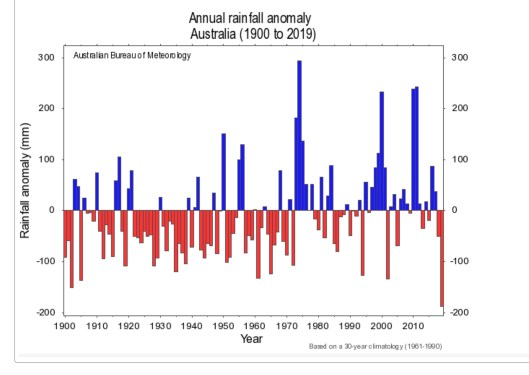
So what causes these bush fires? Dry weather and plenty of fuel from dead vegetation create the hazard, of course. A spark is needed, as from lightning, an accident, an arsonist, or perhaps even a blistering sun, but warm temperatures are unnecessary. Nevertheless, the narrative we hear year-in and year-out is that global warming is to blame for wildfires. My commentary on the climate-change hubbub over the 2018 California fires is here. As for Australia’s fires, there is similarly ample evidence that climate change or warming has nothing to do with it. Rather, as in California, there is a pattern of mismanagement of forests and brush combined with population growth, accidents, and arson, and of course a dry spell. This dry spell has been severe, but the trend in Australia over the past 120 years has been toward more precipitation, not less, and the past 25 years have been relatively rainy. The rain comes with a downside, however: it encourages growth in vegetation, much of which dies every dry season, leaving plenty of fuel for fires. And the fuel has been accumulating.

Mike Shedlock at Mishtalk offers some pertinent observations. First, he quotes James Morrow in the Wall Street Journal:

“Byzantine environmental restrictions prevent landholders from clearing scrub, brush and trees. State governments don’t do their part to reduce the fuel load in parks. Last November a former fire chief in Victoria slammed that state’s ‘minimalist approach’ to hazard-reduction burning in the off-season. That complaint is heard across the country.“

Prescribed burns have been in decline and focused on areas adjacent to suburbs, leaving vast areas of accumulating fuel. This is a product of wrongheaded conservation efforts and resistance to CO2 emissions. These policymakers haven’t done favors for Australia or the world on either count. Shedlock reinforces this point with the following statement from Patrick Michaels and Myron Ebell:

“Australia has been ready to explode for years. David Packham, former head of Australia’s National Rural Fire Research Centre, warned in a 2015 article in the Age that fire fuel levels had climbed to their most dangerous levels in thousands of years. He noted this was the result of ‘misguided green ideology.'”

Eucalyptus trees grow thickly in many fire-prone areas of Australia, and Shedlock says these trees act as a multiplier on the fire hazard. Yet these trees remain a favorite landscape feature for suburbians even in fire-prone areas. He quotes Marc Lallanilla in LiveScience:

“Fallen eucalyptus leaves create dense carpets of flammable material, and the trees’ bark peels off in long streamers that drop to the ground, providing additional fuel that draws ground fires up into the leaves, creating massive, fast-spreading ‘crown fires’ in the upper story of eucalyptus forests. … Additionally, the eucalyptus oil that gives the trees their characteristic spicy fragrance is a flammable oil: This oil, combined with leaf litter and peeling bark during periods of dry, windy weather, can turn a small ground fire into a terrifying, explosive firestorm in a matter of minutes. That’s why eucalyptus trees — especially the blue gums (Eucalyptus globulus) that are common throughout New South Wales — are sometimes referred to wryly as ‘gasoline trees.’“

The introduction of non-native invasive grasses has also been blamed for increasing the fuel load in the bush. And as incredible as it may seem, certain birds native to Australia are spreading bushfires by carrying and dropping burning sticks in grasslands to flush out prey. Birds are indeed tool users! The Whistling Kite and the Black Kite are sometimes called “arson raptors”, according to Leslie Eastman at this link.

The hypothesis that climate warming from CO2 emissions is the cause of the bushfires is undermined by all of the above. Then, of course, there are the arsonists and accidental fires. Over 180 people have been arrested for setting recent brushfires intentionally in New South Wales alone, and 103 others in Queensland. (Also see here.) Jim Steele reports that human ignitions account for 66% of bush fires, while just 11% are caused by lightning. Population growth has brought more people into close proximity with the bush, which increases the exposure of humans to fire danger and might well add to the number of accidents and potential arsonists. Obviously, human and avian arson, and accidents, are not within the line of causation that climate alarmists have in mind.

Roy Spencer addresses some of the inconsistencies in the claimed link between climate warming and the Australian bushfires. First, of course, is the trend in rainfall. Climate models based on CO2 forcings predict no long-term trend in Australia’s rainfall, but again, rainfall has increased in Australia during the era of accelerated forcings. Interestingly, the fires of 1974-75 occurred during a period that was quite rainy, but that rain might have added so much to the annual vegetation cycle that it exacerbated the effect of dry season. Temperatures in Australia were quite warm in 2019, but the climate models cannot account for that variation, especially as Australian temperatures are subject to high variability from year-to-year. It’s been hotter before, though the temperature records in Australia have been subject to some controversial “editing”. Finally, Spencer notes that global wildfire activity has been in decline for many years, despite the mild warming we’ve experienced over the past 50 years (also see here).

Australia has bush fires every year, and this year has been particularly bad, but it might not reach the proportions of the fires in 1974-75. The causes are: poor burn management practices, or sometimes neglect and no burn management at all, allowing dead vegetation to accumulate to dangerous levels; arson, which has been implicated in a large number of fires this year; and 2019 was a very dry year. The contention that global warming or climate change is responsible for these bush fires is a dangerous distraction from reforms that can minimize fire hazards in the future.

For additional reading of interest, see “Australia Fires … and Misfires” by Willis Eschenbach and “The Mathematics of Connectivity and Bush Fires: A Note From David Ward” a post from Jennifer Marohasy’s blog.

Another Flop at the Impeachment Playhouse

04 Friday Oct 2019

Posted by Nuetzel in Impeachment

≈ Leave a comment

Tags

Adam Schiff, Australia, China, Cronyism, Donald Trump, FISA Abuse, House Intelligence Committee, Hunter Biden, Impeachment, Inspector General, Joe Biden, Michael Horowitz, Nancy Pelosi, Obama administration, Presidential Powers, Protectionism, Quid Pro Quo, Russia Investigation, Ukraine, Volodymyr Zelenskiy, Whistleblower

Listen, President Trump drives me crazy. His policy instincts often strike me as dangerous: trade protectionist, inflationist, and cronyist. I’m still suspicious that he might play ball with statists left and right on critical issues, when and if he perceives a political advantage in doing so. And Trump is hopelessly inarticulate and belligerent. Nevertheless, I will almost certainly vote for him in 2020 for several reasons, not least because the feasible alternatives are completely unacceptable. That view is reinforced by the behavior of the Democrat party in their effort to fabricate “high crimes and misdemeanors” on Trump’s part. That effort is not just dishonest, it is foolish, and they have a lot to lose. Their machinations are likely to blow up in their faces.

For one thing, the Democrats don’t seem to have much of a case. This time they are focused on a May 2019 phone conversation that took place between Trump and the recently-elected Ukrainian President Volodymyr Zelenskiy. The Democrats contend that Trump held up military aid in order to pressure Zelenskiy to investigate the Biden family’s activities in the Ukraine, a charge flatly denied by Zelenskiy. In fact, at the time of the call, the Ukrainians has no idea that military aid had been suspended, a fact first reported by The New York Times.

The Trump Administration released a transcript of the Zelenskiy call, which offers no evidence that a quid pro quo was offered by Trump. Even the text messages released this morning fail to support the claim. Joe Biden’s name came up during the call in connection with potential interference by the Ukraine in the 2016 U.S. presidential campaign. That’s reasonable in light of the events reported to have taken place, and it is certainly within the scope of presidential powers, as were Trump’s efforts to discuss election interference with Australia, the U.K., and other countries.

If you don’t know it already, a successful impeachment in the House of Representatives will not remove Trump from office. It will constitute a referral of charges to the Senate, which is controlled by Republicans, and a conviction requires a two-thirds majority. Ain’t gonna happen.

In the meantime, there really is no formal “impeachment” underway, despite what you think you’ve heard. This is a “proceeding” that House Speaker Nancy Pelosi really had no authority to initiate, and there is no set of rules or procedures guiding the spectacle. An impeachment investigation requires a House vote, but Democrats voted to table a resolution calling for such a vote because they really don’t want one, not yet anyway. Why? Because it would force them to go on record before they’re quite sure they want to, but more importantly it would demand due process for the accused. A House vote for an impeachment investigation would give House Republicans subpoena powers, something Democrats don’t want to take a chance on.

Again, the whole effort by the Democrats will ultimately be futile, and the trial proceedings in the Senate might be very ugly for them as well. It is likely to shed light on several matters that offer unflattering context for the impeachment effort and might well lead to criminal charges against prominent Democrats and their operatives:

  • Did members of the Obama Administration, the DNC, and Hillary Clinton’s campaign work with the Ukrainian government to undermine the Trump’s candidacy, hatching the Russian collusion narrative in the process? Politico said so in 2017.
  • Did the Biden family trade on Joe Biden’s position to attract capital from large investors for a venture in the Ukraine?
  • What was exchanged in order for Joe Biden’s son Hunter to land a $50,000/month job with a Ukrainian gas company?
  • Did Joe Biden use the authority of his office to strong-arm the Ukrainians into dropping the prosecution of the company that employed his son? “Son of a B“, Joe said, I threatened to walk away and they dropped the investigation. Son of a Biden?
  • Members of Congress sent a letter to the Ukrainian government in May of 2018 that threatened reductions in aid without Ukrainian cooperation with the Mueller investigation into the Trump campaign.
  • A member of the Obama Administration is known to have approached the Ukrainian Embassy in Washington in 2016 to solicit the Ukraine’s participation in a scheme to interfere with the U.S. election.
  • The Intelligence Community Inspector General’s report stated that the “whistleblower” or operative had a political bias. Well, might that have been a motive in the case?
  • Who authorized the change in requirements for whistleblower referrals from first-hand information to second-hand information, or hearsay? And when? Despite denials from left-wing fact-checkers, the Intelligence Community Inspector General’s narrative here doesn’t quite hang together. They gave the operative the wrong form? It’s been claimed that the operative provided first-hand information after all, but where is it?
  • Did members of Congress know about the operative’s complaint before it was formally referred to Congress? Apparently Adam Schiff, Chairman of the House Intelligence Committee, knew before the complaint was drafted, and he lied about it. Was there collaboration with the operative?
  • What are Adam Schiff’s connections in the Ukraine? Let’s find out!

These are all troubling questions that should be investigated. We may or may not get to the bottom of it before the impeachment vote in the House, if it ever occurs. Senate Republicans will undoubtedly be interested in pursuing many of these areas of inquiry, and Joe Biden will not come out of this unscathed. There is likely considerable evidence to support claims that he used political influence to gain his son Hunter favor in the Ukraine and China. 

This month, DOJ Inspector General Michael Horowitz is expected to release his report on the origins and conduct of the Russia investigation into Trump’s 2016 presidential campaign. including potential corruption of the FISA process. His report will reflect the findings of two U.S. attorneys conducting separate inquiries into various aspects of the matter. These reports are a potential disaster for Democrats. Perhaps the distraction of impeachment theatre seems desirable to them, but the longer they continue the fruitless effort to “get Trump”, which began well before he was elected, the more incompetent they look. They don’t seem to have noticed that the whole spectacle is strengthening Trump’s base of support.

Which brings me back to Trump’s belligerence, which I briefly decried above. And it’s true, I often wince, but then I often laugh out loud as well. His political opponents and the media are constantly aghast at his every unapologetic response to their attacks. I will readily admit that it’s deeply satisfying to witness him hurling the crap right back at them, right on the schnoz. In the case of the impeachment drama, his base of support and many others in the middle know the Dems richly deserve it.


Aside

Can the Carbon Tax

22 Thursday May 2014

Posted by Nuetzel in Uncategorized

≈ Leave a comment

Tags

Australia, Carbon Tax, Climate Sensitvity, Externalities, Pigouvian Taxes, Precautionary Principle

carbon tax footprint

Economists often fall victim to the naive view that government technocrats can measure the external costs or benefits of an activity accurately. Having performed the necessary calculations, the idea is that optimal taxes or subsidies can be promulgated through the political process and applied to an activity in order to correct or “internalize” these kinds of social effluents. In their focus on private market failure, many economists fail to appreciate the extent to which governments usually “fail” in these and many other efforts. At best, one might hope that such intrusions are directionally correct, but even that is fraught with risk.

A particularly good example involves the presumed social costs of carbon emissions. Carbon tax proposals are very much in vogue, but they are not without controversy. The well-meaning assertions of climate alarmists rely on rather fatuous claims about anthropomorphic warming and an overly broad and unwise application of the precautionary principle. There is a vocal minority of climate researchers who do not believe we have sufficient knowledge about climate sensitivities to make judgements about the true social costs and even some likely benefits of a warmer climate, should that be an ultimate consequence. Moreover, accurately measuring the presumed costs is out of the question. Meanwhile, carbon taxes impose costly burdens in the here and now that are difficult to justify.

This response to Irwin Selzer on carbon taxes is worth reading (with a link to Selzer’s article).

Here is a review and further links regarding the disastrous Australian carbon tax.

And here is Robert Murphy on carbon taxes, in which he discusses some prominent estimates of costs and benefits which show the sometimes enormous danger of setting non-optimal carbon taxes (granting the conceit that an optimal tax is positive).

FYI, the unfortunate Julia in the cartoon above refers to Julia Gillard, the former PM of Australia who pushed for the country’s ill-fated carbon tax.

Follow Sacred Cow Chips on WordPress.com

Recent Posts

  • Immigration and Merit As Fiscal Propositions
  • Tariff “Dividend” From An Indigent State
  • Almost Looks Like the Fed Has a 3% Inflation Target
  • Government Malpractice Breeds Health Care Havoc
  • A Tax On Imports Takes a Toll on Exports

Archives

  • December 2025
  • November 2025
  • October 2025
  • September 2025
  • August 2025
  • July 2025
  • June 2025
  • May 2025
  • April 2025
  • March 2025
  • February 2025
  • January 2025
  • December 2024
  • November 2024
  • October 2024
  • September 2024
  • August 2024
  • July 2024
  • June 2024
  • May 2024
  • April 2024
  • March 2024
  • February 2024
  • January 2024
  • December 2023
  • November 2023
  • August 2023
  • July 2023
  • June 2023
  • May 2023
  • April 2023
  • March 2023
  • February 2023
  • January 2023
  • December 2022
  • November 2022
  • October 2022
  • September 2022
  • August 2022
  • July 2022
  • June 2022
  • May 2022
  • April 2022
  • March 2022
  • February 2022
  • January 2022
  • December 2021
  • November 2021
  • October 2021
  • September 2021
  • August 2021
  • July 2021
  • June 2021
  • May 2021
  • April 2021
  • March 2021
  • February 2021
  • January 2021
  • December 2020
  • November 2020
  • October 2020
  • September 2020
  • August 2020
  • July 2020
  • June 2020
  • May 2020
  • April 2020
  • March 2020
  • February 2020
  • January 2020
  • December 2019
  • November 2019
  • October 2019
  • September 2019
  • August 2019
  • July 2019
  • June 2019
  • May 2019
  • April 2019
  • March 2019
  • February 2019
  • January 2019
  • December 2018
  • November 2018
  • October 2018
  • September 2018
  • August 2018
  • July 2018
  • June 2018
  • May 2018
  • April 2018
  • March 2018
  • February 2018
  • January 2018
  • December 2017
  • November 2017
  • October 2017
  • September 2017
  • August 2017
  • July 2017
  • June 2017
  • May 2017
  • April 2017
  • March 2017
  • February 2017
  • January 2017
  • December 2016
  • November 2016
  • October 2016
  • September 2016
  • August 2016
  • July 2016
  • June 2016
  • May 2016
  • April 2016
  • March 2016
  • February 2016
  • January 2016
  • December 2015
  • November 2015
  • October 2015
  • September 2015
  • August 2015
  • July 2015
  • June 2015
  • May 2015
  • April 2015
  • March 2015
  • February 2015
  • January 2015
  • December 2014
  • November 2014
  • October 2014
  • September 2014
  • August 2014
  • July 2014
  • June 2014
  • May 2014
  • April 2014
  • March 2014

Blogs I Follow

  • Passive Income Kickstart
  • OnlyFinance.net
  • TLC Cholesterol
  • Nintil
  • kendunning.net
  • DCWhispers.com
  • Hoong-Wai in the UK
  • Marginal REVOLUTION
  • Stlouis
  • Watts Up With That?
  • Aussie Nationalist Blog
  • American Elephants
  • The View from Alexandria
  • The Gymnasium
  • A Force for Good
  • Notes On Liberty
  • troymo
  • SUNDAY BLOG Stephanie Sievers
  • Miss Lou Acquiring Lore
  • Your Well Wisher Program
  • Objectivism In Depth
  • RobotEnomics
  • Orderstatistic
  • Paradigm Library
  • Scattered Showers and Quicksand

Blog at WordPress.com.

Passive Income Kickstart

OnlyFinance.net

TLC Cholesterol

Nintil

To estimate, compare, distinguish, discuss, and trace to its principal sources everything

kendunning.net

The Future is Ours to Create

DCWhispers.com

Hoong-Wai in the UK

A Commonwealth immigrant's perspective on the UK's public arena.

Marginal REVOLUTION

Small Steps Toward A Much Better World

Stlouis

Watts Up With That?

The world's most viewed site on global warming and climate change

Aussie Nationalist Blog

Commentary from a Paleoconservative and Nationalist perspective

American Elephants

Defending Life, Liberty and the Pursuit of Happiness

The View from Alexandria

In advanced civilizations the period loosely called Alexandrian is usually associated with flexible morals, perfunctory religion, populist standards and cosmopolitan tastes, feminism, exotic cults, and the rapid turnover of high and low fads---in short, a falling away (which is all that decadence means) from the strictness of traditional rules, embodied in character and inforced from within. -- Jacques Barzun

The Gymnasium

A place for reason, politics, economics, and faith steeped in the classical liberal tradition

A Force for Good

How economics, morality, and markets combine

Notes On Liberty

Spontaneous thoughts on a humble creed

troymo

SUNDAY BLOG Stephanie Sievers

Escaping the everyday life with photographs from my travels

Miss Lou Acquiring Lore

Gallery of Life...

Your Well Wisher Program

Attempt to solve commonly known problems…

Objectivism In Depth

Exploring Ayn Rand's revolutionary philosophy.

RobotEnomics

(A)n (I)ntelligent Future

Orderstatistic

Economics, chess and anything else on my mind.

Paradigm Library

OODA Looping

Scattered Showers and Quicksand

Musings on science, investing, finance, economics, politics, and probably fly fishing.

  • Subscribe Subscribed
    • Sacred Cow Chips
    • Join 128 other subscribers
    • Already have a WordPress.com account? Log in now.
    • Sacred Cow Chips
    • Subscribe Subscribed
    • Sign up
    • Log in
    • Report this content
    • View site in Reader
    • Manage subscriptions
    • Collapse this bar
 

Loading Comments...