• About

Sacred Cow Chips

Sacred Cow Chips

Tag Archives: Carbon Mitigation

The Futility and Falsehoods of Climate Heroics

01 Tuesday Jun 2021

Posted by Nuetzel in Climate science, Environmental Fascism, Global Warming, Uncategorized

≈ Leave a comment

Tags

Atmospheric Carbon, Biden Administration, Carbon forcing, Carbon Mitigation, Climate Change, Climate Sensitivity, ExxonMobil, Fossil fuels, global warming, Green Energy, Greenhouse Gas, IPPC, John Kerry, Judith Curry, Natural Gas, Netherlands Climate Act, Nic Lewis, Nuclear power, Putty-Clay Technology, Renewables, Ross McKitrick, Royal Dutch Shell, Social Cost of Carbon, William Nordhaus

The world’s gone far astray in attempts to battle climate change through forced reductions in carbon emissions. Last Wednesday, in an outrageously stupid ruling,a Dutch court ordered Royal Dutch Shell to reduce its emissions by 45% by 2030 relative to 2019 levels. It has nothing to do with Shell’s historical record on the environment. Rather, the Court said Shell’s existing climate action plans did not meet “the company’s own responsibility for achieving a CO2 reduction.” The decision will be appealed, but it appears that “industry agreements” under the Netherlands’ Climate Act of 2019 are in dispute.

Later that same day, a shareholder dissident group supporting corporate action on climate change won at least two ExxonMobil board seats. And then we have the story of John Kerry’s effort to stop major banks from lending to the fossil fuel industry. Together with the Biden Administration’s other actions on energy policy, we are witnessing the greatest attack on conventional power sources in history, and we’ll all pay dearly for it. 

The Central Planner’s Conceit

Technological advance is a great thing, and we’ve seen it in the development of safe nuclear power generation, but the environmental left has successfully placed roadblocks in the way of its deployment. Instead, they favor the mandated adoption of what amount to beta versions of technologies that might never be economic and create extreme environmental hazards of their own (see here, here, here, and here). To private adopters, green energy installations are often subsidized by the government, disguising their underlying inefficiencies. These premature beta versions are then embedded in our base of productive capital and often remain even as they are made obsolete by subsequent advances. The “putty-clay” nature of technology decisions should caution us against premature adoptions of this kind. This is just one of the many curses of central planning.

Not only have our leftist planners forced the deployment of inferior technologies: they are actively seeking to bring more viable alternatives to ruination. I mentioned nuclear power and even natural gas offer a path for reducing carbon emissions, yet climate alarmists wage war against it as much as other fossil fuels. We have Kerry’s plot to deny funding for the fossil fuel industry and even activist “woke” investors, attempting to override management expertise and divert internal resources to green energy. It’s not as if renewable energy sources are not already part of these energy firms’ development portfolios. Allocations of capital and staff to these projects are usually dependent upon a company’s professional and technical expertise, market forces, and (less propitiously) incentives decreed by the government. Yet, the activist investors are there to impose their will.

Placing Faith and Fate In Models

All these attempts to remake our energy complex and the economy are based on the presumed external costs associated with carbon emissions. Those costs, and the potential savings achievable through the mitigation efforts of government and private greenies around the globe, have been wildly exaggerated.

The first thing to understand about the climate “science” relied upon by the environmental left is that it is almost exclusively model-dependent. In other words, it is based on mathematical relationships specified by the researchers. Their projections depend on those specs, the selection of parameter values, and the scenarios to which they are subjected. The models are usually calibrated to be roughly consistent with outcomes over some historical time period, but as modelers in almost any field can attest, that is not hard to do. It’s still possible to produce extreme results out-of-sample. The point is that these models are generally not estimated statistically from a lengthy sample of historical data. Even when sound statistical methodologies are employed, the samples are blinkingly short on climatological timescales. That means they are highly sample-specific and likely to propagate large errors out-of-sample. But most of these are what might be called “toy models” specified by the researcher. And what are often billed as “findings” are merely projections based on scenarios that are themselves manufactured by imaginative climate “researchers” cum grant-seeking partisans. In fact, it’s much worse than that because even historical climate data is subject to manipulation, but that’s a topic for another day.

Key Assumptions

What follows are basic components of the climate apocalypse narrative as supported by “the science” of man-made or anthropomorphic global warming (AGW):

(A) The first kind of model output to consider is the increase in atmospheric carbon concentration over time, measured in parts per million (PPM). This is a function of many natural processes, including volcanism and other kinds of outgassing from oceans and decomposing biomass, as well absorption by carbon sinks like vegetation and various geological materials. But the primary focus is human carbon generating activity, which depends on the carbon-intensity of production technology. As Ross McKitrick shows (see chart below), projections from these kinds of models have demonstrated significant upside bias over the years. Whether that is because of slower than expected economic growth, unexpected technological efficiencies, an increase in the service-orientation of economic activity worldwide, or feedback from carbon-induced greening or other processes, most of the models have over-predicted atmospheric carbon PPM. Those errors tend to increase with the passage of time, of course.

(B) Most of the models promoted by climate alarmists are carbon forcing models, meaning that carbon emissions are the primary driver of global temperatures and other phenomena like storm strength and increases in sea level. With increases in carbon concentration predicted by the models in (A) above, the next stage of models predicts that temperatures must rise. But the models tend to run “hot.” This chart shows the mean of several prominent global temperature series contrasted with 1990 projections from the Intergovernmental Panel on Climate Change (IPCC).

The following is even more revealing, as it shows the dispersion of various model runs relative to three different global temperature series:

And here’s another, which is a more “stylized” view, showing ranges of predictions. The gaps show errors of fairly large magnitude relative to the mean trend of actual temperatures of 0.11 degrees Celsius per decade.

(C) Climate sensitivity to “radiative forcing” is a key assumption underlying all of the forecasts of AGW. A simple explanation is that a stronger greenhouse effect, and increases in the atmosphere’s carbon concentration, cause more solar energy to be “trapped” within our “greenhouse,” and less is radiated back into space. Climate sensitivity is usually measured in degrees Celsius relative to a doubling of atmospheric carbon. 

And how large is the climate’s sensitivity to a doubling of carbon PPM? The IPCC says it’s in a range of 1.5C to 4.5C. However, findings published by Nic Lewis and Judith Curry are close to the low end of that range, and are those found by the author of the paper described here. 

In separate efforts, Finnish and Japanese researchers have asserted that the primary cause of recent warming is an increase in low cloud cover, which the Japanese team attributes to increases in the Earth’s bombardment by cosmic rays due to a weakening magnetic field. The Finnish authors note that most of the models used by the climate establishment ignore cloud formation, an omission they believe leads to a massive overstatement (10x) of sensitivity to carbon forcings. Furthermore, they assert that carbon forcings are mainly attributable to ocean discharge as opposed to human activity.

(D) Estimates of the Social Cost of Carbon (SCC) per ton of emissions are used as a rationale for carbon abatement efforts. The SCC was pioneered by economist William Nordhaus in the 1990s, and today there are a number of prominent models that produce distributions of possible SCC values, which tend to have high dispersion and extremely long upper tails. Of course, the highest estimates are driven by the same assumptions about extreme climate sensitivities discussed above. The Biden Administration is using an SCC of $51 per ton. Some recommend the adoption of even higher values for regulatory purposes in order to achieve net-zero emissions at an early date, revealing the manipulative purposes to which the SCC concept is put. This is a raw attempt to usurp economic power, not any sort of exercise in optimization, as this admission from a “climate expert” shows. In the midst of a barrage of false climate propaganda (hurricanes! wildfires!), he tells 60 Minutes that an acceptable limit on warming of 1.5C is just a number they “chose” as a “tipping point.”

As a measurement exercise, more realistic climate sensitivities yield much lower SCCs. McKitrick presents a chart from Lewis-Curry comparing their estimates of the SCC at lower climate sensitivities to an average of earlier estimates used by IPCC:

High levels of the SCC are used as a rationale for high-cost carbon abatement efforts. If the SCC is overstated, however, then costly abatements represent waste. And there is no guarantee that spending an amount on abatements equal to the SCC will eliminate the presumed cost of a ton’s worth of anthropomorphic warming. Again, there are strong reasons to believe that the warming experienced over the past several decades has had multiple causes, and human carbon emissions might have played a relatively minor role. 

Crisis Is King

Some people just aren’t happy unless they have a crisis over which to harangue the rest of us. But try as they might, the vast resources dedicated to carbon reduction are largely wasted. I hesitate to say their effort is quixotic because they want more windmills and are completely lacking in gallantry. As McKitrick notes, it takes many years for abatement to have a meaningful impact on carbon concentrations, and since emissions mix globally, unilateral efforts are practically worthless. Worse yet, the resource costs of abatement and lost economic growth are unacceptable, especially when some of the most promising alternative sources of “clean” energy are dismissed by activists. So we forego economic growth, rush to adopt immature energy alternatives, and make very little progress toward the stated goals of the climate alarmists.
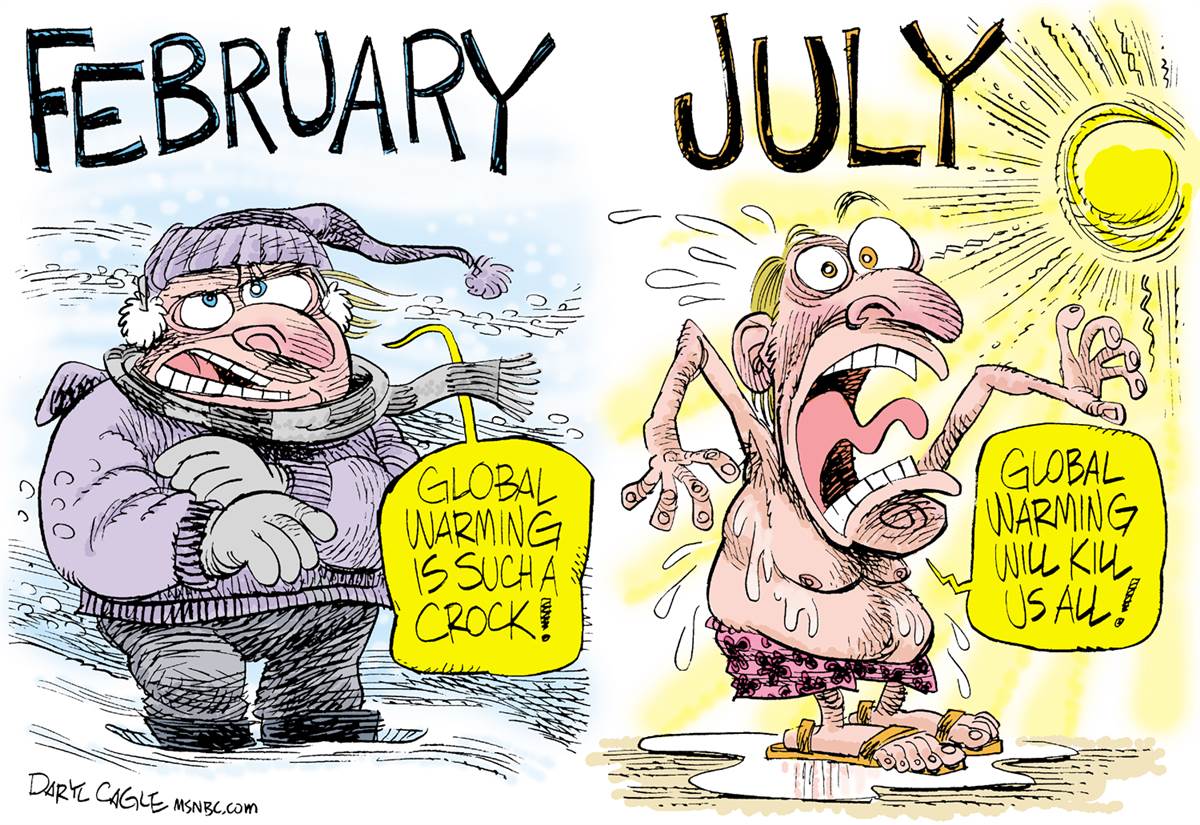
Science of the Spurious: Global Warming and Suicide

27 Friday Jul 2018

Posted by Nuetzel in Global Warming

≈ Leave a comment

Tags

Carbon Mitigation, Causality vs. Correlation, El Nino, Global Warming Hiatus, Inflammatory Chain Reaction, Marshall Burke, Nature Journal, P-Value Problem, Rare Events, Suicide Rate, Suicides and Global Warming

The latest entry in the scare-mongering literature of global warming, published this month in Nature, purports to show that warming will lead to more suicides! I’m not sure whether these researchers deserve an award for naiveté or cynicism, but they should get one or the other. The lead author is listed as Marshall Burke of Stanford University.

The basic finding of their research is that an increase in average monthly temperature of one degree Celsius (1.8 degrees Fahrenheit) increases the monthly suicide rate by 0.68% (or 0.42% when accounting for the previous month’s temperature as well). They might have used the preferred verbiage “is associated with”, rather than “increases”, because they surely know that correlation is not the same as causation, but perhaps they wished to impress the news media. Let’s put their result in perspective: the annual U.S. suicide rate per 100,000 persons was 11.64 over the years 1968-2004 in their sample. A 0.68% increase in the suicide rate would have brought that up to roughly 11.72. Of course, the average U.S. surface temperature did NOT increase by 1 degree Celsius over that period — it was about half that, and temperatures have been relatively flat since then.

The real problem here is that most of the variation in temperatures across the sample used by Burke and his co-authors is seasonal and geographical. While they claim to have accounted for such confounding influences using non-parametric controls, they give few specifics, so I am unconvinced. It has long been known that suicides tend to be seasonal and are higher in the warmer months of the year. The reasons cited vary, including a boost provided by warmth in the energy needed to execute a suicide plan, “inflammatory chain reactions” from high pollen counts, seasonal peaks in bipolar disorder, and stress from greater social interactions during warm weather. These are seasonal phenomena that are not even incidental to the question at hand. And let’s face it: if warmer weather gives you the energy to kill yourself, the temperature is probably not the problem.

The authors also report a positive “effect” of temperatures on suicides using annual data, but with a rather large variance. This result probably captures geographical variation in suicide rates, though again, the authors claim to have made adjustments. Southern states tend have high suicide rates, but no one has suggested that warm, southern climates are to blame. Instead, there are other socioeconomic factors that probably account for this regional variation. I suspect that this is another source of the correlation the authors use to project forward as a likely impact of global warming. (While the inter-mountain West tends to have high suicide rates relative to other regions, many of those states are lightly populated, so they would receive low weights in any analysis of the kind discussed here.)

Finally, the trend toward slightly warmer temperatures between 1968 and the late 1990s was spurred largely by a series of strong El Nino events, especially in 1997-98. Suicide rates in the U.S., on the other hand, reached a high in the mid-1970s, ran slightly lower until hitting another peak in the mid-1980s, and then tapered through the late 1990s even as temperatures spiked. Since 1998, suicides have trended up as temperature trends flattened during the so-called “global warming hiatus”, which is ongoing. This sequence not only contradicts the authors narrative; it reinforces the fact that the variation exploited in the samples may well be seasonal and geographical, and not related to climate trends.

An issue over which Burke, et al demonstrate no awareness is the exaggerated statistical significance of meaningless effects in very large samples. This has been called the “p-value problem” because large samples can lead to vanishingly small p-values (which measure statistical significance). In a very large sample, any small difference may appear to be statistically significant. It’s a well-known pitfall in empirical work. A suicide is what’s known in the statistical literature as a “rare event”, given it’s annual incidence of about 0.01% of the population. I submit that the estimated impact of a 1% change in that rate, a change of 0.0001%, is well-nigh meaningless.

But the authors, undaunted, do their very best to make it seem meaningful. First, they pick a sub-sample that yields a somewhat higher estimated effect. Then they apply it to a future climate change scenario that is considered extreme and “extremely unlikely”, by climate researchers. They calculate the cumulative increase in suicides implied by that estimate out to 2050 — 32 years — for the U.S. and Mexico combined: about 22,000 extra suicides (they give a confidence interval of 9,000 to 39,000). That would be a lot, of course, but aggregating over many years using a high-end estimate and an extreme scenario can make an otherwise tiny effect appear large. And remember, their confidence interval is tightened considerably via the use of many observations on essentially irrelevant seasonal and geographic variation.

Burke and his co-authors have succeeded in publishing a piece of research that is not just flimsy, but that they apply in a way that is grossly misleading. They made it as ripe and plump as possible for promotion by the news media, which seems to love a great scare story. I might just as easily claim that as declines in income are associated with higher suicides, efforts at carbon mitigation requiring high taxes and punitive consumer rates for electric power will lead to an increase in suicides. And I could “prove” it with statistics. Then we would have a double-warming whammy! But I have a better idea: let’s expose bad research for what it is, and that includes just about all of the literature that warns of catastrophe from global warming.

Follow Sacred Cow Chips on WordPress.com

Recent Posts

  • The Case Against Interest On Reserves
  • Immigration and Merit As Fiscal Propositions
  • Tariff “Dividend” From An Indigent State
  • Almost Looks Like the Fed Has a 3% Inflation Target
  • Government Malpractice Breeds Health Care Havoc

Archives

  • January 2026
  • December 2025
  • November 2025
  • October 2025
  • September 2025
  • August 2025
  • July 2025
  • June 2025
  • May 2025
  • April 2025
  • March 2025
  • February 2025
  • January 2025
  • December 2024
  • November 2024
  • October 2024
  • September 2024
  • August 2024
  • July 2024
  • June 2024
  • May 2024
  • April 2024
  • March 2024
  • February 2024
  • January 2024
  • December 2023
  • November 2023
  • August 2023
  • July 2023
  • June 2023
  • May 2023
  • April 2023
  • March 2023
  • February 2023
  • January 2023
  • December 2022
  • November 2022
  • October 2022
  • September 2022
  • August 2022
  • July 2022
  • June 2022
  • May 2022
  • April 2022
  • March 2022
  • February 2022
  • January 2022
  • December 2021
  • November 2021
  • October 2021
  • September 2021
  • August 2021
  • July 2021
  • June 2021
  • May 2021
  • April 2021
  • March 2021
  • February 2021
  • January 2021
  • December 2020
  • November 2020
  • October 2020
  • September 2020
  • August 2020
  • July 2020
  • June 2020
  • May 2020
  • April 2020
  • March 2020
  • February 2020
  • January 2020
  • December 2019
  • November 2019
  • October 2019
  • September 2019
  • August 2019
  • July 2019
  • June 2019
  • May 2019
  • April 2019
  • March 2019
  • February 2019
  • January 2019
  • December 2018
  • November 2018
  • October 2018
  • September 2018
  • August 2018
  • July 2018
  • June 2018
  • May 2018
  • April 2018
  • March 2018
  • February 2018
  • January 2018
  • December 2017
  • November 2017
  • October 2017
  • September 2017
  • August 2017
  • July 2017
  • June 2017
  • May 2017
  • April 2017
  • March 2017
  • February 2017
  • January 2017
  • December 2016
  • November 2016
  • October 2016
  • September 2016
  • August 2016
  • July 2016
  • June 2016
  • May 2016
  • April 2016
  • March 2016
  • February 2016
  • January 2016
  • December 2015
  • November 2015
  • October 2015
  • September 2015
  • August 2015
  • July 2015
  • June 2015
  • May 2015
  • April 2015
  • March 2015
  • February 2015
  • January 2015
  • December 2014
  • November 2014
  • October 2014
  • September 2014
  • August 2014
  • July 2014
  • June 2014
  • May 2014
  • April 2014
  • March 2014

Blogs I Follow

  • Passive Income Kickstart
  • OnlyFinance.net
  • TLC Cholesterol
  • Nintil
  • kendunning.net
  • DCWhispers.com
  • Hoong-Wai in the UK
  • Marginal REVOLUTION
  • Stlouis
  • Watts Up With That?
  • Aussie Nationalist Blog
  • American Elephants
  • The View from Alexandria
  • The Gymnasium
  • A Force for Good
  • Notes On Liberty
  • troymo
  • SUNDAY BLOG Stephanie Sievers
  • Miss Lou Acquiring Lore
  • Your Well Wisher Program
  • Objectivism In Depth
  • RobotEnomics
  • Orderstatistic
  • Paradigm Library
  • Scattered Showers and Quicksand

Blog at WordPress.com.

Passive Income Kickstart

OnlyFinance.net

TLC Cholesterol

Nintil

To estimate, compare, distinguish, discuss, and trace to its principal sources everything

kendunning.net

The Future is Ours to Create

DCWhispers.com

Hoong-Wai in the UK

A Commonwealth immigrant's perspective on the UK's public arena.

Marginal REVOLUTION

Small Steps Toward A Much Better World

Stlouis

Watts Up With That?

The world's most viewed site on global warming and climate change

Aussie Nationalist Blog

Commentary from a Paleoconservative and Nationalist perspective

American Elephants

Defending Life, Liberty and the Pursuit of Happiness

The View from Alexandria

In advanced civilizations the period loosely called Alexandrian is usually associated with flexible morals, perfunctory religion, populist standards and cosmopolitan tastes, feminism, exotic cults, and the rapid turnover of high and low fads---in short, a falling away (which is all that decadence means) from the strictness of traditional rules, embodied in character and inforced from within. -- Jacques Barzun

The Gymnasium

A place for reason, politics, economics, and faith steeped in the classical liberal tradition

A Force for Good

How economics, morality, and markets combine

Notes On Liberty

Spontaneous thoughts on a humble creed

troymo

SUNDAY BLOG Stephanie Sievers

Escaping the everyday life with photographs from my travels

Miss Lou Acquiring Lore

Gallery of Life...

Your Well Wisher Program

Attempt to solve commonly known problems…

Objectivism In Depth

Exploring Ayn Rand's revolutionary philosophy.

RobotEnomics

(A)n (I)ntelligent Future

Orderstatistic

Economics, chess and anything else on my mind.

Paradigm Library

OODA Looping

Scattered Showers and Quicksand

Musings on science, investing, finance, economics, politics, and probably fly fishing.

  • Subscribe Subscribed
    • Sacred Cow Chips
    • Join 128 other subscribers
    • Already have a WordPress.com account? Log in now.
    • Sacred Cow Chips
    • Subscribe Subscribed
    • Sign up
    • Log in
    • Report this content
    • View site in Reader
    • Manage subscriptions
    • Collapse this bar
 

Loading Comments...