• About

Sacred Cow Chips

Sacred Cow Chips

Tag Archives: Digital Assets

Public Debt and AI: Ain’t But One Way Crowding Out

17 Sunday Aug 2025

Posted by Nuetzel in Artificial Intelligence, Deficits

≈ Leave a comment

Tags

AI Capital Expenditures, Artificially Intelligence, Bradford S. Cohen, Carlyle, central planning, Cronyism, crowding out, Daren Acemoglu, Digital Assets, Federal Deficits, Goldman Sachs, Jason Thomas, Megan Jones, Productivity Growth, Public debt, Scarcity, Seth Benzell, Sovereign Wealth Fund, Stanford Digital Economy Lab, Tyler Cowen
There’s a hopeful narrative making the rounds that artificial intelligence will prove to be such a boon to the economy that we need not worry about high levels of government debt. AI investment is already having a substantial economic impact. Jason Thomas of Carlyle says that AI capital expenditures on such things as data centers, hardware, and supporting infrastructure account for about a third of second quarter GDP growth (preliminarily a 3% annual rate). Furthermore, he says relevant orders are growing at an annual rate of about 40%. The capex boom may continue for a number of years before leveling off. In the meantime, we’ll begin to see whether AI is capable of boosting productivity more broadly.

Unfortunately, even with this kind of investment stimulus, there’s no assurance that AI will create adequate economic growth and tax revenue to end federal deficits, let alone pay down the $37 trillion public debt. That thinking puts too much faith in a technology that is unproven as a long-term economic engine. It would also be a naive attitude toward managing debt that now carries an annual interest cost of almost $1 trillion, accounting for about half of the federal budget deficit.

Boom Times?

Predictions of AI’s long-term macro impact are all over the map. Goldman Sachs estimates a boost in global GDP of 7% over 10 years, which is not exactly aggressive. Daren Acemoglu has been even more conservative, estimating a gain of 0.7% in total factor productivity over 10 years. Tyler Cowen has been skeptical about the impact of AI on economic growth. For an even more pessimistic take see these comments.

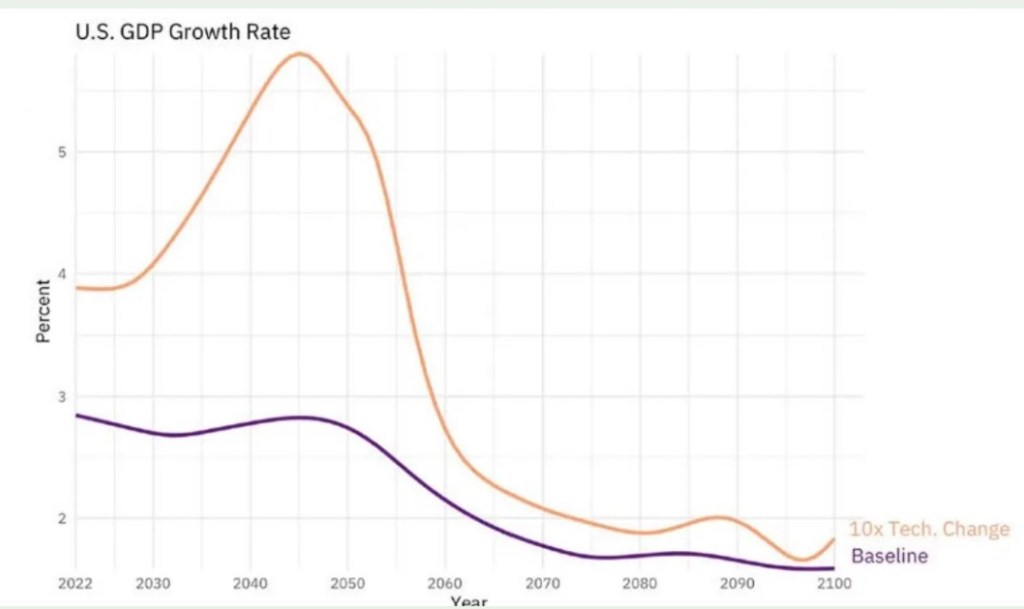
In July, however, Seth Benzell of the Stanford Digital Economy Lab discussed some simulations showing impressive AI-induced growth (see chart at top). The simulations project additional U.S. GDP growth of between 1% – 3% annually over the next 75 years! The largest boost in growth occurs now through the 2050s. This would produce a major advance in living standards. It would also eliminate the federal deficit and cure our massive entitlement insolvency, but the result comes with heavy qualifications. In fact, Benzell ultimately throws cold water on the notion that AI growth will be strong enough to reduce or even stabilize the public debt to GDP ratio.

The Scarcity Spoiler

The big hitch has to do with the scarcity of capital, which I’ve described as an impediment to widespread AI application. Competition for capital will drive interest rates up (3% – 4%, according to Benzell’s model). Ongoing needs for federal financing intensify that effect. But it might not be so bad, according to Benzell, if climbing rates are accompanied by heightened productivity powered by AI. Then, tax receipts just might keep-up with or exceed the explosion in the government’s interest obligations.

A further complication cited by Benzell lurks in insatiable demands for public spending, and politicians who simply can’t resist the temptation to buy votes via public largesse. Indeed, as we’ve already seen, government will try to get in on the AI action, channeling taxpayer funds into projects deemed to be in the public interest. And if there are segments of the work force whose jobs are eliminated by AI, there will be pressure for public support. So even if AI succeeds in generating large gains in productivity and tax revenue, there’s very little chance we’ll see a contagion of fiscal discipline in Washington DC. This will put more upward pressure on interest rates, giving rise to the typical crowding out phenomenon, curtailing private investment in AI.

Playing Catch-Up

The capex boom must precede much of the hoped-for growth in productivity from AI. Financing comes first, which means that rates are likely to rise sooner than productivity gains can be expected. And again, competition from government borrowing will crowd out some private AI investment, slowing potential AI-induced increases in tax revenue.

There’s no chance of the converse: that AI investment will crowd out government borrowing! That kind of responsiveness is not what we typically see from politicians. It’s more likely that ballooning interest costs and deficits generally will provoke even more undesirable policy moves, such as money printing or rate ceilings.

The upshot is that higher interest rates will cause deficits to balloon before tax receipts can catch up. And as for tax receipts, the intangibility of AI will create opportunities for tax flight to more favorable jurisdictions, a point well understood by Benzell. As attorneys Bradford S. Cohen and Megan Jones put it:

“Digital assets can be harder to find and more easily shifted offshore, limiting the tax reach of the U.S. government.”

AI Growth Realism

Benzell’s trepidation about our future fiscal imbalances is well founded. However, I also think Benzell’s modeled results, which represent a starting point in his analysis of AI and the public debt, are too optimistic an assessment of AI’s potential to boost growth. As he says himself,

“… many of the benefits from AI may come in the form of intangible improvements in digital consumption goods. … This might be real growth, that really raises welfare, but will be hard to tax or even measure.”

This is unlikely to register as an enhancement to productivity. Yet Benzell somehow buys into the argument that AI will lead to high levels of unemployment. That’s one of his reasons for expecting higher deficits.

My view is that AI will displace workers in some occupations, but it is unlikely to put large numbers of humans permanently out of work and into state support. That’s because the opportunity cost of many AI applications is and will remain quite high. It will have to compete for financing not only with government and more traditional capex projects, but with various forms of itself. This will limit both the growth we are likely to reap from AI and losses of human jobs.

Sovereign Wealth Fund

I have one other bone to pick with Benzell’s post. That’s in regard to his eagerness to see the government create a sovereign wealth fund. Here is his concluding paragraph:

“Instead of contemplating a larger debt, we should instead be talking about a national sovereign wealth fund, that could ‘own the robots on behalf of the people’. This would both boost output and welfare, and put the welfare system on an indefinitely sustainable path.”

Whether the government sells federal assets or collects booty from other kinds of “deals”, the very idea of accumulating risk assets in a sovereign wealth fund undermines the objective to reduce debt. It will be a struggle for a sovereign wealth fund to consistently earn cash returns to compensate for interest costs and pay down the debt. This is especially unwise given the risk of rising rates. Furthermore, government interests in otherwise private concerns will bring cronyism, displacement of market forces by central planning, and a politicization of economic affairs. Just pay off the debt with whatever receipts become available. This will free up savings for investment in AI capital and hasten the hoped-for boom in productivity.

Summary

AI’s contribution to economic growth probably will be inadequate and come too late to end government budget deficits and reduce our burgeoning public debt. To think otherwise seems far fetched in light of our historical inability to restrain the growth of federal spending. Interest on the federal debt already accounts for about half of the annual budget deficit. Refinancing the existing public debt will entail much higher costs if AI capex continues to grow aggressively, pushing interest rates higher. These dynamics make it pretty clear that AI won’t provide an easy fix for federal deficits and debt. In fact, ongoing federal borrowing needs will sop up savings needed for AI development and diffusion, even as the capital needed for AI drives up the cost of funds to the government. It’s a shame that AI won’t be able to crowd out government.


Stablecoin Digital Dollar Substitutes

16 Wednesday Jul 2025

Posted by Nuetzel in Crypto, Monetary Policy

≈ Leave a comment

Tags

100% Reserves, Anti-CBDC Surveillance State Act, Anti-Money Laundering, Blockchain, CBDC, CLARITY Act, Crypto Week, Crypto-Currencies, Dave Friedman, Digital Assets, Disintermediation, Dollarization, GENIUS Act, Know Your Customer, Monetary Control, Payment Stablecoins, Scott Sumner, STABLE Act, Stablecoins, Taurus, Terra/Luna, Tether, Zero Knowledge Proofs

Stablecoins are a very hot topic, and not only among crypto enthusiasts. This is “Crypto Week” in Congress, but current activity in the stablecoin (SC) space ranges from an explosion of transactions and issuance by banks and other institutions, plans for issuance by other businesses like large retailers, the introduction of new embedded SC features, laws affirming the right of use in non-crypto transactions, regulatory maneuvers, and central bank scrutiny.

The Digital Money Realm

An SC is a digital asset convertible to currency at a value pegged to some other asset with a stable market value. SCs are almost all pegged to the dollar, but they can be algorythmically pegged to a basket of currencies, Treasury securities, gold, silver, or other commodities, or a combination of various kinds of assets. Still, it’s thought that the growth of SCs will reinforce the dollar’s position as the world’s dominant currency.

SCs had their genesis and are still primarily used for settlement of transaction involving crypto-currencies and cross-border transactions. They function as a store of value and provide investors exposure to the underlying asset(s), but they are increasingly seen as transactions media as well. They offer a direct channel to instant settlement without other intermediaries and with low transaction costs.

Unfortunately, the purported stability of SCs has not always held up. In 2022, the collapse of the SC Terra/Luna demonstrated that a run on an SC is a real risk. Pending legislation in the U.S. will attempt to address this risk (see below). Tether is the dominant SC on the market today, and its issuer, Tether Ltd., claims to back it with 100% fiat currency reserves. However, those claims have come under suspicion with concerns about the true liquidity of their backing. Tether has other problems, including money laundering allegations. The bills now under consideration in the Congress would require a major change in the way Tether and other SC issuers do business in the U.S.

Crypto-Week Pending Legislation

SC issuers hold levels of reserves against their outstanding value, but currently only under various state regulations. That’s likely to change soon. Bipartisan legislation is moving through Congress: the so-called GENIUS Act was approved by the Senate in June; the STABLE Act in the House has many similar provisions.

The GENIUS and STABLE bills would require public disclosure, frequent audits, and establish 100 percent reserve requirements for so-called “payment” SCs. The bills also stipulate that reserves must be held in highly liquid assets like U.S. dollars, money market fund shares, and Treasury securities maturing within 93 days. This is likely a disappointment to “hard money” partisans who’d like to see SCs backed by precious metals. Both bills would also prohibit interest-bearing SCs, obviously an impediment to risk-taking by issuers and also a nod to banks hoping to avoid new competitive pressures. Altogether, the bills would make SCs more currency-like and less vehicles for saving or speculation of any kind.

A third piece of federal legislation, the so-called CLARITY Act, would sort out the regulatory roles of different federal agencies pertaining to digital assets.

CBDC

Central banks like the Federal Reserve have taken a keen interest in SCs, which amount to an alternative monetary system. Advocates of a Central Bank Digital Currency (CBDC) maintain that it would have greater stability and public trust than privately-issued SCs. No doubt a CBDC would facilitate investigation of fraud and money laundering, and supporters say it would help preserve the sovereignty of the U.S. monetary system.

However, a CBDC is off the table in the U.S. for the foreseeable “political” future. President Trump has issued an executive order (EO) prohibiting the development or issuance of a CBDC in the U.S. The EO asserts that a CBDC would not promote stability and in fact would do the opposite.

Opposition to a CBDC revolves around several issues: 1) it would cause an atrophy in the private development of digital assets and SCs in the U.S.; 2) a CBDC would create grave concerns about surveillance and potential use of the CBDC as an input to a social credit tool; 3) the alleged risk of a CBDC to the stability of the banking system. #3 is apparently in reference to possible disintermediation when a CBDC is substituted for traditional bank deposits — but SCs have been noted for that same risk.

Neither the GENIUS Act nor the STABLE Act explicitly prohibits a CBDC, which has riled a few conservatives. However, there are provisions in the GENIUS Act that effectively rule a CBDC out at a “retail” and consumer level.

A fourth piece of legislation, the Anti-CBDC Surveillance State Act, would prohibit the Federal Reserve from “… testing, studying, developing, creating, or implementing a central bank digital currency and bar the banks from using such a currency to implement monetary policy.” The bill was passed by the House of Representatives in May, but it has yet to clear the Senate. Some House members might like to have its major provisions incorporated into the current SC legislation, but that remains to be seen, and if such a revision was passed by the House it would require another Senate vote in any case.

Not Quite Like Cash

As a “programmable” currency, a CBDC could be used to control transactions deemed impermissible by a future “regime”. This would be a manifestation of what Dave Friedman calls “The Convergence of AI and the State”. His concerns extend to privately-issued SC’s as well, inasfar as SCs and other payment systems have us “sleepwalking into a cashless society”.

Privacy has been a downside to SCs and all blockchain transactions from the start, but there are several technological extensions that could protect SC transactions and accounts from nosy governments or nefarious actors. Taurus, a crypto custodian, has launched a Stablecoin contract for businesses with privacy features using so-called zero knowledge proofs that would satisfy “Know Your Customer” requirements and anti-money laundering laws, but without revealing amounts paid or the recipient’s identity. Still, there are legitimate concerns regarding access by regulators, and law enforcement could ultimately gain access to account and transaction data given a reasonable suspicion of wrongdoing. This will almost certainly be addressed in any SC legislation that makes it to Trump’s desk.

Macro Policy Implications

Will broader adoption of SCs compromise the ability of central banks to conduct monetary policy? Scott Sumner says no:

“The Fed will still control the monetary base, and they have almost unlimited ability to adjust both the supply and the demand for base money.  This means they will be able to react to the creation of money substitutes as required to prevent any impact on macroeconomic objectives such as employment and the price level.”

When Sumner’s says the Fed controls the demand for base money, he refers to the interest rate the Fed pays on bank reserves.

As noted above, however, it’s widely feared that public substitution of SCs for bank deposits could drain bank reserves, adding variability to the broader demand for monetary assets, thus weakening the relationship between policy actions, the money stock, and other key variables.

Even if this is correct and Summer is wrong, the Federal Reserve should be treated as a special (but very important) case. That’s because the dollar is the dominant global currency, almost all SCs are backed by dollars, and essentially all SCs used in the U.S. will be backed by dollar-denominated assets should GENIUS-type legislation become law. That severely limits any potential disintermediation that SCs might otherwise cause. Control of bank reserves should be manageable, and therefore SCs will not meaningfully weaken the Fed’s control of base money or the transmission of monetary policy.

Things are not so simple for countries having home currencies that play a minor role internationally. SC’s backed by other currencies or assets are then more likely to weaken the central bank’s control of domestic monetary assets. In fact, SCs might create greater vulnerability to “dollarization” in some countries, which would weaken the efficacy of domestic monetary control. If Sumner is correct, the existence of SCs would still add a layer of variability for these central banks, making policy adjustments more complex and error-prone.

Conclusion

Stablecoins are already huge in the crypto world and they are making inroads to the broader financial sector, factor payments, and everyday consumer decisions. Naturally they have attracted a great deal of interest in policy circles, both for their benefits and the risks they present. The purported liquidity and stability of SCs, together with a few prior missteps, make the legislation now before Congress a key to broader adoption, particularly the provisions on reserves and transparency. While not strictly a part of the legislation, the incorporation of privacy features will enhance the value of SCs to all users.

Conservatives and libertarians undoubtedly will welcome the proscription on development of a digital currency by the Fed. Private SCs backed by dollar reserves should allow the Fed to maintain ample control over the monetary base and the supply of monetary assets. Moreover, the growth of dollar-backed SCs will strengthen the dollar’s dominance in international trade and finance. However, while stablecoins can and do reduce transaction costs in a variety of circumstances, dollar-backed SCs cannot be better stores of value than the dollar itself, which we know has had its shortcomings over the years.

The Digital Erosion of Collecting and Ownership

07 Thursday Oct 2021

Posted by Nuetzel in Digital Revolution, Technology

≈ Leave a comment

Tags

8-Tracks, Blockbuster, Blockchain, Cassettes, Cloud Storage, Collecting, Crypto-Assets, Digital Assets, DVDs, Electronic Books, Film Collections, Grateful Dead, Hardware Requirements, Kyle Chayka, Microsoft Office, Music Collections, Netflix, NFTs, Non-Fungible Tokens, Ownership Rights, Personal Library, Phonographs, Photo Albums, Physical Media, Rent vs Own, Streaming Content, Use Rights, VCRs

Our material possessions aren’t the most important things in the world, but they are often part of our identities as people. Almost anything qualifies, from the big, expensive stuff like a home or a car, to whatever we find worth keeping. Declutter if you must, but the things that remain have a lot to do with our well being, even if they exist simply as part of our surroundings. They reflect our past, present, and hopes for the future, and they embody important aspects of our interests and passions.

I don’t doubt that individuals of high spiritual or metaphysical consciousness are able to transcend the desire for material goods. Very well, though for most of us, certain physical possessions matter. People collect things like matchbook covers or fine art because they are important in one way or another. Great works and quirky novelties all have their place… with someone.

We’ve witnessed an accelerating erosion in the personal art of “collecting” certain kinds of things, however, and that is the main subject of this post. It draws heavily on Kyle Chayka’s excellent piece, “The Digital Death of Collecting”. There are at least two aspects of this decline. One has to do with digital storage, which eliminates physical media and presents a new set of administrative issues. The other strand has to do with a loss of ownership. That’s a distinct phenomenon, but it has probably been driven by digital technology, at least to this point.

Losing Physical Control

Much of the entertainment we experience today is delivered electronically. Historically, we used physical storage media of various kinds: books, vinyl records, CDs, DVDs, books on tape, etc… so it was (and still is) possible to accumulate and possess a physical collection of music, for example. It can be fun to document those collections, like my old bootleg Grateful Dead concert tapes. Now, actually owning a collection of physical music media is an anachronism to many (mostly younger) people. Instead, their favorite music is stored on a device, a server, or “in the Cloud”. Often, without a shred of awareness, this has led to a kind of interference with the individual’s ability to possess and control a whole class of property closely associated with the cultural and intellectual self.

For example, with respect to physical media and storage, we used to shoot photos and, once developed, we’d curate them and put our favorites into photo albums. However, for the better part of the past two decades, phones have allowed us to snap photos and take videos more or less indiscriminately. I periodically transfer my photos to an electronic hard drive, with minimal curation, where they are automatically assigned names with inscrutable combinations of letters and numbers. I’ve been doing it for years now, and it’s a mess. How long will it take me to find a particular photo? Even one photo from a particular event? What if the drive fails?

I need to back them up, of course, but that was the original purpose of the external hard drive! As I updated and transitioned to new computers over the years, I failed to maintain a complete set on the new laptop hard drives. Now, they reside only on the external hard drive. Sadly, in the end, many of us are simply unable or unwilling to implement better record management practices. My “collection” of photos has been neglected. I could try to rename these images descriptively and sort them into folders, but digging into it now seems almost an insurmountable task.

To some extent, the advent of digital players had the same impact on music collections. Some listeners never made the transition and consigned themselves to the use of older media and technologies, despite the increasing difficulty and expense of finding recordings. But they kept their physical collections active, which is a gratifying thing. Those who made the transition grappled with new issues in managing their “collections”, often without the satisfaction of arranging and beholding the physical media. Granted, this isn’t always an either/or proposition, but doing both requires extra effort.

Similar transitions took place with digitized movies and reading material. I have a small movie collection, mostly movie musicals, animated children’s films, and a few cult films and classics. Not all are on DVD, and I haven’t added anything to this little trove in years. I still rent discs from Netflix, but like most people, streaming accounts for a growing share of my viewing. As for books, it’s less common today to see handsome collections of books arranged on shelves, but some doggedly attempt to maintain personal libraries, even if they aren’t all bound hardcovers.

Loss of Ownership

The other strand of our evolving relationship with digitized entertainment has to do with ownership itself. Today, we often purchase what amount to listening, viewing, or other “use rights”. This has sealed Chayka’s “Digital Death of Collecting”. Here’s how he sums it up:

“My lostness comes from the sense that our cultural collections are not wholly our own anymore. In the era of algorithmic feeds, it’s as if the bookshelves have started changing shape on their own in real time, shuffling some material to the front and downplaying the rest like a sleight-of-hand magician trying to make you pick a specific card — even as they let you believe it’s your own choice. And this lack of agency is undermining our connections to the culture that we love.”

Again, books are a case in point. Chayka notes that building a personal library is an expression of one’s intellectual history and interests. Yet today, with electronically delivered reading material sans physical media, you don’t really “own” the books you purchase. This blogger states the case well:

“As I’ve tried to point out before, both publishers and distributors like Amazon have spent the past decade or so removing rights that we used to have when books were physical property, and were something that you actually bought — along with the right to resell and/or lend them to whomever you wished, whenever you wished. Those rights no longer exist, which is why it’s better to think of an ebook purchase as an agreement to rent access under specific terms rather than an actual acquisition of something tangible.”

Free To Rent … and Pay As You Go

Subscriptions are replacing ownership in all sorts of contexts, and the use rights they confer are obviously of limited duration. For example, I was surprised when I realized that I could no longer “purchase” Microsoft Office and then download and install it to my computer. Instead, I have to buy annual subscriptions to continue to use it. Now, I don’t really “collect” software, unless the plethora of apps I’ve downloaded to my phone qualifies. Also, I understand that software becomes obsolete, so my “ownership” of Office was really equivalent to an indefinite but limited rental period. Maybe one-year subscriptions will be a better deal, though I have my doubts.

Renting certainly isn’t new in the “film space”. Blockbuster was a huge success for a time. And again, I get two discs at a time from Netflix to this day. People can still “collect” videos, but I suspect it’s not quite as common today in terms of collecting physical media.

I’ll always argue that renting is an economically rational alternative to homeownership. Same with leasing vs. owning a car, or anything else. And people often take a measure of pride even in things they rent. These own vs. rent choices and their relative values depend on one’s circumstances in life as well as one’s preference for control over the items in question.

Our Carts Runneth Over

A huge upside of all these changes is that we’re enjoying an astonishing array of choices as well as unprecedented convenience. (We can argue about the quality of the art, but that’s for another day.) In fact, the scarcity of new “collectibles” in the categories I’ve mentioned here might not be such bad news to collectors who’ve been at it for a while. After all, their existing collections might gain value. However, some forms of storage media might require technical or mechanical skill on the part of the collector. That’s because they have rigid hardware requirements. Eight-track players? Cassette tapes? VCRs? Who supports them? Yes, you can still buy a phonograph, but finding compatible “content” can be challenging. For the rest of us, streaming digital content frees us from those requirements and their inevitable obsolescence.

Unfortunately, our relationship to so much of our personal entertainment bounty seems more ephemeral than in the past. Streaming music and films is fine, but I’m much less likely to “burn them”, and ownership is an all but forgotten possibility. Like Chayka, I find the loss of owned, physical collections that has accompanied the digital revolution lamentable, not to mention the loss of control. I truly believe that if publishers ever quit printing physical books we’ll be poorer for it. But I’m not a complete technophobe, and I think there’s promise in recent developments in blockchain technology that might restore our ability as consumers to own more encompassing rights to digital assets.

Non-fungible tokens (NFTs) are essentially digital assets of almost any kind, with ownership documented in the blockchain. Some of the most publicized NFTs we’ve seen thus far are notoriously lacking in the actual rights they confer to the buyer. However, advances in standards are enabling the creation of more robust NFTs. There is no reason, in principle, why a consumer could not possess an NFT documenting ownership for a digital copy of a particular film, piece of music, e-book, or any other form one might collect. That might solve the ownership issue if and when crypto assets gain more acceptance. Individuals who are especially proud of their collections of NFTs could produce physical tokens to represent each NFT for display, if only for themselves to gaze upon lovingly. These could be plaques, for example, or the physical tokens could look like DVDs or books! Granted, it’s not the same as a real collection of physical media, but it might serve an emotional purpose.

Follow Sacred Cow Chips on WordPress.com

Recent Posts

  • Immigration and Merit As Fiscal Propositions
  • Tariff “Dividend” From An Indigent State
  • Almost Looks Like the Fed Has a 3% Inflation Target
  • Government Malpractice Breeds Health Care Havoc
  • A Tax On Imports Takes a Toll on Exports

Archives

  • December 2025
  • November 2025
  • October 2025
  • September 2025
  • August 2025
  • July 2025
  • June 2025
  • May 2025
  • April 2025
  • March 2025
  • February 2025
  • January 2025
  • December 2024
  • November 2024
  • October 2024
  • September 2024
  • August 2024
  • July 2024
  • June 2024
  • May 2024
  • April 2024
  • March 2024
  • February 2024
  • January 2024
  • December 2023
  • November 2023
  • August 2023
  • July 2023
  • June 2023
  • May 2023
  • April 2023
  • March 2023
  • February 2023
  • January 2023
  • December 2022
  • November 2022
  • October 2022
  • September 2022
  • August 2022
  • July 2022
  • June 2022
  • May 2022
  • April 2022
  • March 2022
  • February 2022
  • January 2022
  • December 2021
  • November 2021
  • October 2021
  • September 2021
  • August 2021
  • July 2021
  • June 2021
  • May 2021
  • April 2021
  • March 2021
  • February 2021
  • January 2021
  • December 2020
  • November 2020
  • October 2020
  • September 2020
  • August 2020
  • July 2020
  • June 2020
  • May 2020
  • April 2020
  • March 2020
  • February 2020
  • January 2020
  • December 2019
  • November 2019
  • October 2019
  • September 2019
  • August 2019
  • July 2019
  • June 2019
  • May 2019
  • April 2019
  • March 2019
  • February 2019
  • January 2019
  • December 2018
  • November 2018
  • October 2018
  • September 2018
  • August 2018
  • July 2018
  • June 2018
  • May 2018
  • April 2018
  • March 2018
  • February 2018
  • January 2018
  • December 2017
  • November 2017
  • October 2017
  • September 2017
  • August 2017
  • July 2017
  • June 2017
  • May 2017
  • April 2017
  • March 2017
  • February 2017
  • January 2017
  • December 2016
  • November 2016
  • October 2016
  • September 2016
  • August 2016
  • July 2016
  • June 2016
  • May 2016
  • April 2016
  • March 2016
  • February 2016
  • January 2016
  • December 2015
  • November 2015
  • October 2015
  • September 2015
  • August 2015
  • July 2015
  • June 2015
  • May 2015
  • April 2015
  • March 2015
  • February 2015
  • January 2015
  • December 2014
  • November 2014
  • October 2014
  • September 2014
  • August 2014
  • July 2014
  • June 2014
  • May 2014
  • April 2014
  • March 2014

Blogs I Follow

  • Passive Income Kickstart
  • OnlyFinance.net
  • TLC Cholesterol
  • Nintil
  • kendunning.net
  • DCWhispers.com
  • Hoong-Wai in the UK
  • Marginal REVOLUTION
  • Stlouis
  • Watts Up With That?
  • Aussie Nationalist Blog
  • American Elephants
  • The View from Alexandria
  • The Gymnasium
  • A Force for Good
  • Notes On Liberty
  • troymo
  • SUNDAY BLOG Stephanie Sievers
  • Miss Lou Acquiring Lore
  • Your Well Wisher Program
  • Objectivism In Depth
  • RobotEnomics
  • Orderstatistic
  • Paradigm Library
  • Scattered Showers and Quicksand

Blog at WordPress.com.

Passive Income Kickstart

OnlyFinance.net

TLC Cholesterol

Nintil

To estimate, compare, distinguish, discuss, and trace to its principal sources everything

kendunning.net

The Future is Ours to Create

DCWhispers.com

Hoong-Wai in the UK

A Commonwealth immigrant's perspective on the UK's public arena.

Marginal REVOLUTION

Small Steps Toward A Much Better World

Stlouis

Watts Up With That?

The world's most viewed site on global warming and climate change

Aussie Nationalist Blog

Commentary from a Paleoconservative and Nationalist perspective

American Elephants

Defending Life, Liberty and the Pursuit of Happiness

The View from Alexandria

In advanced civilizations the period loosely called Alexandrian is usually associated with flexible morals, perfunctory religion, populist standards and cosmopolitan tastes, feminism, exotic cults, and the rapid turnover of high and low fads---in short, a falling away (which is all that decadence means) from the strictness of traditional rules, embodied in character and inforced from within. -- Jacques Barzun

The Gymnasium

A place for reason, politics, economics, and faith steeped in the classical liberal tradition

A Force for Good

How economics, morality, and markets combine

Notes On Liberty

Spontaneous thoughts on a humble creed

troymo

SUNDAY BLOG Stephanie Sievers

Escaping the everyday life with photographs from my travels

Miss Lou Acquiring Lore

Gallery of Life...

Your Well Wisher Program

Attempt to solve commonly known problems…

Objectivism In Depth

Exploring Ayn Rand's revolutionary philosophy.

RobotEnomics

(A)n (I)ntelligent Future

Orderstatistic

Economics, chess and anything else on my mind.

Paradigm Library

OODA Looping

Scattered Showers and Quicksand

Musings on science, investing, finance, economics, politics, and probably fly fishing.

  • Subscribe Subscribed
    • Sacred Cow Chips
    • Join 128 other subscribers
    • Already have a WordPress.com account? Log in now.
    • Sacred Cow Chips
    • Subscribe Subscribed
    • Sign up
    • Log in
    • Report this content
    • View site in Reader
    • Manage subscriptions
    • Collapse this bar
 

Loading Comments...