• About

Sacred Cow Chips

Sacred Cow Chips

Tag Archives: Disposal Costs

Electric Vehicle Fueling Costs in the Real World

31 Sunday Oct 2021

Posted by Nuetzel in Electric Vehicles, Renewable Energy

≈ 1 Comment

Tags

Anderson Economic Group, Biomass, Charging Time, Commercial Power Rates, Deadhead Miles, Dispatchable Capacity, Disposal Costs, Electric Vehicles, EVangelists, Fast Chargers, Fueling Cost, Intermittency, Internal Combustion Engines, Joe Biden, Nuclear Energy, Opportunity cost, Phantom Drain, Power Failures, Power Grid, Recharging Costs, Renewable Power, Thermal Energy
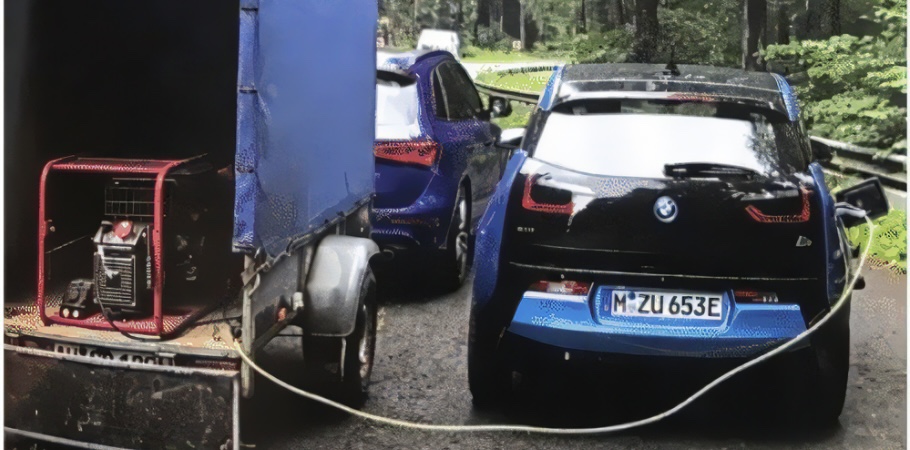
While the photo above exaggerates, honest electric vehicle (EV) owners will tell you that “refueling” is often not cheap or convenient. However, less jaded EV drivers and enthusiasts seem to view recharging costs through an oversimplified economic lens. A realistic accounting involves a variety of cost factors, including the implicit cost of the time needed to recharge when away from home. An analysis recently published by Anderson Economic Group (AEG) provides a thorough comparison of the costs of fueling EVs relative to vehicles powered by internal combustion engines (ICEs).

Promoting the Narrow Focus

AEG notes the shortcomings of most cost studies quoted by “EVangelists” (not AEG’s term):

“Many commonly-cited studies of the cost of driving EVs include only the cost of electric power for EVs, but compare this with the total cost of fueling an ICE vehicle. Moreover, many presume drivers can routinely charge at favorable residential rates, ignoring the much higher costs of the commercial chargers EV drivers must use when they are away from a residential charger (if they have one).”

The kind of incomplete assays to which AEG refers can lead to statements like the following, from none other than Joe Biden:

“When you buy an electric vehicle, you can go across America on a single tank of gas, figuratively speaking. It’s not gas. You plug it in.”

Well no, it’s not a single tank of “gas”. You still have to stop, plug into a source of power mostly generated by fossil fuels, and it might take a while to get back on the road.

Cost Categories

The AEG report concludes that vehicles powered by ICEs are far cheaper to fuel on average than EVs. The analysis considers several categories of fueling costs including:

  • Gasoline Prices vs. Commercial & Residential Power Rates: EV drivers recharging away from home often pay more costly commercial rates.
  • Registration Taxes: applied at EV charging stations, but bundled in fuel price for ICEs;
  • EV Charging Equipment: upgraded “Level 2” chargers are generally “encouraged” at purchase of an EV;
  • Deadhead Miles: usage costs on fueling/charging runs; there are far fewer EV charging stations than gas stations in the U.S., which can lead to costly “excursions”;
  • Charging/Refueling Time: much higher for EV drivers away from home;

Direct Costs

AEG performed their analysis using electric rates, gas prices, and other cost factors as of mid-2021. They did so for six “representative” vehicle classes: entry level, mid-priced and luxury EVs and ICEs. Direct monetary costs account for the first four factors listed above; they do not include the time costs of refueling.

AEG calculates that the direct monetary costs of driving 100 miles in a mid-priced ICE vehicle is $8.95, while the cost in a mid-priced EV using a high proportion of commercial charging is $12.95, about 50% more. The direct cost in a luxury ICE is $12.60, but for a luxury EV it is $14.15 (12% more) for mostly home charging and $15.52 (23% more) for mostly commercial charging.

In addition, AEG finds that the direct cost of EV fueling is far more variable than ICE fueling. This is due to widely varying rates for commercial and residential power, including time-of-day variation, differences in charger efficiency, and the varied structure of pricing at different commercial charging stations.

Implicit Time Cost

It should be obvious that the time costs of refueling EVs are more significant than for ICE vehicles. However, I believe AEG’s report might over-estimate the difference. They say:

“… it takes substantially longer to fuel EVs than for comparable ICE cars. Real world conditions often impose additional burdens, including these two:

  1. Driving and charging time: … it often takes about 20 minutes to drive to a reliable DC fast charger. It often takes another 20 to 30 minutes for the charging process to complete. Of course, this is for fast DC chargers. Slower L2 chargers are much more common …
  2. Recurrent reliability problems: EV drivers face recurring problems at chargers such as breakdowns, software bugs, delays in syncing the mobile application with the charger, charger output being significantly lower than advertised, and outright failures. This is in addition to the problem of vehicles blocking (or “icing”) EV charging spots.

Online forums are full of comments from drivers expressing frustration about these problems.”

All true, as far as it goes. The implicit value of this time depends on the driver’s opportunity cost. Whether valued at the minimum wage or at a much higher opportunity cost, AEG’s straightforward valuation of the time cost is five to six times as high for EV drivers than for ICE drivers, depending on the vehicle class. For EVs, the time cost AEG calculates can be more than $200 a month, or about $20 per 100 miles for a someone who drives 1,000 miles a month, versus about $4 for a similar ICE driver. Adding those values to the direct monetary costs (which AEG does not do) yields a total cost per 100 miles of $33 for a mid-priced EV versus about $13 for an ICE vehicle in that class. That’s 2.5 times more to fuel an EV than a comparable ICE vehicle!

However, I would discount the cost of EV fueling time, because many drivers can use this waiting time productively, whether performing certain work tasks remotely or simply enjoying it as an extension of their leisure time, reading or viewing/listening to content on their mobile devices, for example.

Other Qualifications

AEG acknowledges that their cost comparisons use commercial power rates to account for “free” chargers offered by some stores to shoppers and by some employers to workers as benefits. That’s because stores and employers compensate for that kind of service along pricing and other margins.

AEG does not account for “phantom drain” (the loss of EV battery power while not in use) and the costs of battery degradation over time. Nor do they attempt to quantify the use of battery power while charging takes place (which inflates charging time but also increases direct costs per mile).

I would also note that many of the EV cost disadvantages described by AEG are likely to diminish going forward. More charging stations are being added as the fleet of EVs grows. Battery technology is improving as well, and chargers will become faster on average. In addition, EV “engines” have far less complexity and fewer parts than ICEs, which undoubtedly confers maintenance cost advantages over a period of time.

The Green Itch

Finally, while some consumers might find that EVs scratch a certain green itch, these vehicles are not carbon neutral, as noted above. The vast bulk of the power they use comes from fossil fuels. Higher energy prices in general might or might not work to their advantage, but electric power availability is becoming less reliable as the push toward renewable power generation continues. As we have seen repeatedly, reliance on intermittent power sources has drastic consequences for users in the absence of adequate, dispatchable baseload capacity.

To put a somewhat finer point on the difficulties posed by the intermittency of renewable power, a great deal of EV charging is done at night, when solar panels are not harvesting energy. Wind turbines can harvest a greater proportion of their power at night, but they must be fairly tall to do so (the minimum height ranges from 30 to 100 meters, depending on local conditions). That requirement means that the manufacture and construction of these turbines and their towers is all the more carbon intensive. Furthermore, disposal of both solar panels and wind turbines at the end of their useful lives creates serious environmental issues that green energy advocates have been all too willing to ignore.

Ultimately, until our ability to store power at scale advances dramatically, the issue of renewable intermittency can only be dealt with via adequate baseload power. Growth in the number of EVs will require growth in the dispatchable capacity of the power grid, which means either more plants burning fossil fuels, nuclear power, hydroelectric, biomass, or thermal energy. The alternative is an increasing frequency of blackouts, which would drastically reduce the utility of EVs.
Renewable Power Gains, Costs, and Fantasies

01 Thursday Jul 2021

Posted by Nuetzel in Electric Power, Renewable Energy

≈ 2 Comments

Tags

Baseload, Blackouts, California, Combined-Cycle Gas, Dispatchable Power, Disposal Costs, Dung Burning, Energy Information Administration, External Costs, Fossil fuels, Francis Menton, Germany, Green Propaganda, Interrmittency, Levelized Costs, Modern Renewables, Peak Demand, Plant Utilization, Renewable energy, Solar Power, Texas, The Manhattan Contrarian, Willis Eschenbach, Wind Power

“Modern” renewable energy sources made large gains in providing for global energy consumption over the ten years from 2009-19, according to a recent report, but that “headline” is highly misleading. So is a separate report on the costs of solar and wind power, which claims those sources are now cheaper than any fossil fuel. The underlying facts will receive little critical examination by a hopelessly naive press, nor among analysts with more technical wherewithal. Of course, “green” activists will go on using misinformation like this to have their way with policy makers.

Extinguishing Dung Fires

The “Renewables Global Status Report” was published in mid-June by an organization called REN21: Renewables Now. Francis Menton has a good discussion of the report on his blog, The Manhattan Contrarian. The big finding is a large increase in the global use of “modern” renewable energy sources, from 8.7% of total consumption in 2009 to 11.2% in 2019. The “modern” qualifier is critical: it distinguishes renewables that made gains from those that might be considered antiquated, like dung chips, the burning of which is an energy staple in many underdeveloped parts of the world. In fact, the share of those “non-modern renewables” declined from 11.0% to 8.7%, almost fully accounting for the displacement caused by “modern renewables”. The share of fossil fuels was almost unchanged, down from 80.3% in 2009 to 80.2% in 2019. Whatever the benefits of wind, solar, and other modern green power sources, they did not make much headway in displacing reliable fossil fuel energy.

I certainly can’t argue that replacing dung power with wind, solar, or hydro is a bad thing (but there are more sophisticated ways of converting dung to energy than open flame). However, I contend that replacing open dung fires with fossil-fuel or nuclear capacity would be better than renewables from both a cost and an environmental perspective. Be that as it may, the adoption of “modern renewables” over the ten-year period was not at the expense of fossil fuels, as might be expected if the latter was at a cost disadvantage, and remember that renewables were already given an edge via intense government efforts to subsidize and even require the use of wind and solar power.

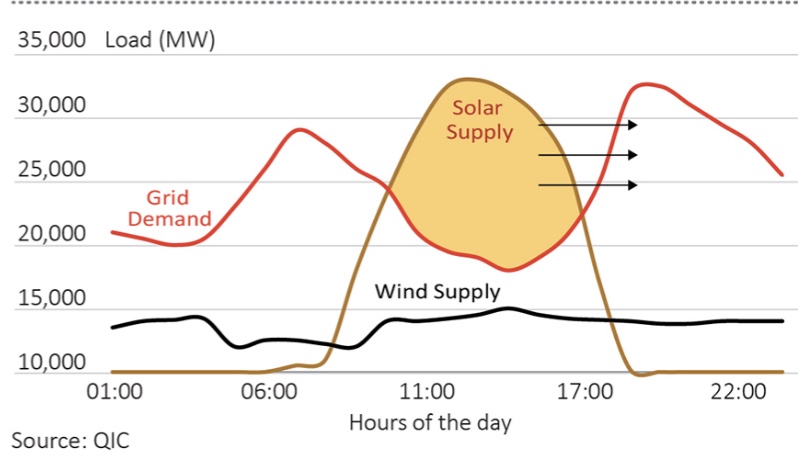
The near-term limits on our ability to substitute renewables for fossil fuels should be fairly obvious. For one thing, renewable power is intermittent, so it cannot be relied upon for baseload generation. The chart at the top of this post demonstrates this reality, though the chart is “optimistic” in the sense that planners have to consider worst-case intermittency, not merely average production by time-of-day. Reliable power sources must be maintained in order to prevent the kinds of disasters like we saw in Texas last winter when demand spiked and output from renewables plunged. This is an area of considerable denialism: a search on “intermittent renewables” gets you an unending list of rosy assessments of energy storage technologies, and very little realistic commentary on today’s needs for meeting base-load or weather-induced demands.

While renewables account for about 29% of global electricity generation, there is another limit on adoption: certain jobs just can’t be done with renewables short of major advances in battery technology. As Menton says:

“Steel mills and tractor trailer trucks and airplanes powered by solar panels? Not happening. … I think these people really believe that if governments will just do the right thing and require airplanes to run on solar panels, then it will promptly happen.”

Cost and Intermittency

Again, we’d expect to see more rapid conversion to renewable energy, at least in compatible applications, as the cost of renewables drops relative to fossil fuels. And major components of their costs have indeed dropped, so much so that the U.S. Energy Information Administration (EIA) now says they are cheaper than fossil fuels in terms of the “levelized cost” of new electric generating capacity. That’s the average cost per megawatt-hour produced over the life of a new installation. The EIA’s calculations are distorted on at least two counts, however, as Willis Eschenbach ably explains here.

The EIA’s cost figures reflect a “capacity factor” that adjusts the megawatts produced to presumed “real world” conditions. It’s more like a utilization adjustment made necessary by a variety of realities (intermittency as well as other technical imperfections) that cause output to run lower than the maximum under ideal conditions. Eschenbach reports that the factors applied by the EIA for solar and wind, at 30% and 41%, respectively, are overstated drastically, which reduces their cost estimates by overstating output. For solar, he cites a more realistic value of 14%, which would more than double the levelized cost of solar. For wind, he quotes a figure of 30%, which would increase the cost of wind power by more than a third. That puts the cost of those renewables well above that of a “combined-cycle gas” plant, which uses exhaust from gas turbines to generate additional power via steam.

The true costs of renewables are likely much higher than nuclear power as well, based on earlier comparisons of nuclear to combined-cycle gas. The EIA does not report a cost for nuclear power, however, because the report is for new capacity, and no additions of nuclear capacity are expected.

The Cost of Back-Up Capacity

Eschenbach notes a second major problem with the EIA cost comparisons. As discussed above, the intermittency of solar and wind power means that their deployment cannot provide for base loads. Other “dispatchable” power technologies, on which production can be ramped up or down at discretion, must be available to meet power needs when renewables are off-line, as is frequently the case. The more we attempt to rely on renewables, the more significant the intermittency problem becomes, as Germany, Texas, and California are discovering.

How to account for the extra cost of dispatchable power required to smooth production or meet peak demand? Renewables are simply incapable of doing so reliably, and back-up capacity ain’t free! Meeting demand at all times requires equivalent dispatchable capacity in the power mix. It requires not just dispatchable baseload capacity, but surge capacity! Meeting long-term growth in demand with renewables implies that new back-up capacity is required as well, and the levelized cost should reflect it. After all, those costs won’t be saved by virtue of adding renewable capacity, unless you plan on blackouts. Thus, the EIA’s levelized cost comparisons of wind, solar and fossil fuel electricity generation are completely phony.

Conclusion

Growth in wind and solar power increased their contribution to global energy needs to more than 11% in 2019, but their gains over the previous ten years came largely at the expense of more “primitive” renewable energy sources, not fossil fuels. And despite impressive declines in the installation costs of wind and solar power, and despite low variable costs, the economics of power generation still favors fossil fuels rather substantially. In popular discussions, this point is often obscured by the heavy subsidies granted to renewables. 

In truth, the “name-plate” capacities of wind and solar installations far exceed typical output, so installation costs are spread over less output than is widely believed. Furthermore, the intermittency of production from these renewable sources means that back-up capacity is still required, almost always from plants fired by fossil fuels. Properly considered, this represents a significant incremental cost of renewable power sources, but it is one that is routinely ignored by environmentalists and even in official reports. It’s also worth noting that “modern” renewables carry significant external costs to the environment both during the useful life of plant and at disposal (and see here). It’s tempting to say all these distortions and omissions are deliberate contributions to the propaganda in favor of government mandates for renewables.

Follow Sacred Cow Chips on WordPress.com

Recent Posts

  • Immigration and Merit As Fiscal Propositions
  • Tariff “Dividend” From An Indigent State
  • Almost Looks Like the Fed Has a 3% Inflation Target
  • Government Malpractice Breeds Health Care Havoc
  • A Tax On Imports Takes a Toll on Exports

Archives

  • December 2025
  • November 2025
  • October 2025
  • September 2025
  • August 2025
  • July 2025
  • June 2025
  • May 2025
  • April 2025
  • March 2025
  • February 2025
  • January 2025
  • December 2024
  • November 2024
  • October 2024
  • September 2024
  • August 2024
  • July 2024
  • June 2024
  • May 2024
  • April 2024
  • March 2024
  • February 2024
  • January 2024
  • December 2023
  • November 2023
  • August 2023
  • July 2023
  • June 2023
  • May 2023
  • April 2023
  • March 2023
  • February 2023
  • January 2023
  • December 2022
  • November 2022
  • October 2022
  • September 2022
  • August 2022
  • July 2022
  • June 2022
  • May 2022
  • April 2022
  • March 2022
  • February 2022
  • January 2022
  • December 2021
  • November 2021
  • October 2021
  • September 2021
  • August 2021
  • July 2021
  • June 2021
  • May 2021
  • April 2021
  • March 2021
  • February 2021
  • January 2021
  • December 2020
  • November 2020
  • October 2020
  • September 2020
  • August 2020
  • July 2020
  • June 2020
  • May 2020
  • April 2020
  • March 2020
  • February 2020
  • January 2020
  • December 2019
  • November 2019
  • October 2019
  • September 2019
  • August 2019
  • July 2019
  • June 2019
  • May 2019
  • April 2019
  • March 2019
  • February 2019
  • January 2019
  • December 2018
  • November 2018
  • October 2018
  • September 2018
  • August 2018
  • July 2018
  • June 2018
  • May 2018
  • April 2018
  • March 2018
  • February 2018
  • January 2018
  • December 2017
  • November 2017
  • October 2017
  • September 2017
  • August 2017
  • July 2017
  • June 2017
  • May 2017
  • April 2017
  • March 2017
  • February 2017
  • January 2017
  • December 2016
  • November 2016
  • October 2016
  • September 2016
  • August 2016
  • July 2016
  • June 2016
  • May 2016
  • April 2016
  • March 2016
  • February 2016
  • January 2016
  • December 2015
  • November 2015
  • October 2015
  • September 2015
  • August 2015
  • July 2015
  • June 2015
  • May 2015
  • April 2015
  • March 2015
  • February 2015
  • January 2015
  • December 2014
  • November 2014
  • October 2014
  • September 2014
  • August 2014
  • July 2014
  • June 2014
  • May 2014
  • April 2014
  • March 2014

Blogs I Follow

  • Passive Income Kickstart
  • OnlyFinance.net
  • TLC Cholesterol
  • Nintil
  • kendunning.net
  • DCWhispers.com
  • Hoong-Wai in the UK
  • Marginal REVOLUTION
  • Stlouis
  • Watts Up With That?
  • Aussie Nationalist Blog
  • American Elephants
  • The View from Alexandria
  • The Gymnasium
  • A Force for Good
  • Notes On Liberty
  • troymo
  • SUNDAY BLOG Stephanie Sievers
  • Miss Lou Acquiring Lore
  • Your Well Wisher Program
  • Objectivism In Depth
  • RobotEnomics
  • Orderstatistic
  • Paradigm Library
  • Scattered Showers and Quicksand

Blog at WordPress.com.

Passive Income Kickstart

OnlyFinance.net

TLC Cholesterol

Nintil

To estimate, compare, distinguish, discuss, and trace to its principal sources everything

kendunning.net

The Future is Ours to Create

DCWhispers.com

Hoong-Wai in the UK

A Commonwealth immigrant's perspective on the UK's public arena.

Marginal REVOLUTION

Small Steps Toward A Much Better World

Stlouis

Watts Up With That?

The world's most viewed site on global warming and climate change

Aussie Nationalist Blog

Commentary from a Paleoconservative and Nationalist perspective

American Elephants

Defending Life, Liberty and the Pursuit of Happiness

The View from Alexandria

In advanced civilizations the period loosely called Alexandrian is usually associated with flexible morals, perfunctory religion, populist standards and cosmopolitan tastes, feminism, exotic cults, and the rapid turnover of high and low fads---in short, a falling away (which is all that decadence means) from the strictness of traditional rules, embodied in character and inforced from within. -- Jacques Barzun

The Gymnasium

A place for reason, politics, economics, and faith steeped in the classical liberal tradition

A Force for Good

How economics, morality, and markets combine

Notes On Liberty

Spontaneous thoughts on a humble creed

troymo

SUNDAY BLOG Stephanie Sievers

Escaping the everyday life with photographs from my travels

Miss Lou Acquiring Lore

Gallery of Life...

Your Well Wisher Program

Attempt to solve commonly known problems…

Objectivism In Depth

Exploring Ayn Rand's revolutionary philosophy.

RobotEnomics

(A)n (I)ntelligent Future

Orderstatistic

Economics, chess and anything else on my mind.

Paradigm Library

OODA Looping

Scattered Showers and Quicksand

Musings on science, investing, finance, economics, politics, and probably fly fishing.

  • Subscribe Subscribed
    • Sacred Cow Chips
    • Join 128 other subscribers
    • Already have a WordPress.com account? Log in now.
    • Sacred Cow Chips
    • Subscribe Subscribed
    • Sign up
    • Log in
    • Report this content
    • View site in Reader
    • Manage subscriptions
    • Collapse this bar
 

Loading Comments...