• About

Sacred Cow Chips

Sacred Cow Chips

Tag Archives: Environmental Protection Agency

The EPA’s Trip To the Constitutional Woodshed

07 Thursday Jul 2022

Posted by Nuetzel in Administrative State, Constitution, Supreme Court, Uncategorized

≈ 1 Comment

Tags

Administrative Law, Administrative Procedures Act, Administrative State, Affordable Care Act, Charles Lipson, Chevron Deference, Clarence Carson, Clean Air Act, Climate Alarmism, Constitutional Law, Environmental Protection Agency, EPA, Francis Menton, Franklin D. Roosevelt, FTC, Gabriel Kolko, Great Society, Humphrey’s Executor, ICC, Jarkesy v. SEC, Jonathan Tobin, Kevin O. Leske, Lyndon B. Johnson, Major Questiins Doctrine, National Labor Relations Board, Neil Gorsuch, New Deal, Philip Hamburger, rent seeking, SEC, Sheldon Richman, Supreme Court, The Manhattan Contrarian, West Virginia v. EPA, Woodrow Wilson

The Supreme Court’s regular docket is done for the year, but one of last week’s rulings is of great interest to those concerned about the constitutional threat posed by the administrative state. In West Virginia v. EPA, the Court held that the Clean Air Act of 1970 does not authorize the EPA to regulate carbon emissions in power generation. Well, that’s getting to be a very old statute and no one thought much about carbon dioxide emissions when it became law, so of course it doesn’t! However, this decision is crucial as a check on the ever-growing, extra-legal power of the administrative bureaucracy. I say “extra-legal” because regulatory agencies are increasingly taking it upon themselves to write rules that reach well beyond their legislative mandates. Only the legislature can make law under our system of government, or at least law that settles “major questions”, a doctrine that the Court has applied in this case.

Consequential Side Issues

While many critics of the West Virginia decision might find this hard to believe, it has nothing to do with the Court’s views about the prospects for climate change. That is not the Court’s job and it knows it, or at least most of the justices know it. Even if climate change poses a real threat of global catastrophe, and it does not, that is not the Court’s job. Its primary function is to preserve constitutional law, and that is what this decision is about. (For more on the folly of climate alarmism, see here, here, and here.)

Apart from its constitutional implications, growth in the number of regulatory rules and their complexity also imposes massive costs on the economy, robbing the private sector of productive opportunities, often with little or no demonstrable public benefit. The unbridled promulgation of rules does, however, benefit special interests. That includes bureaucrats, litigators, and private parties who derive side benefits from regulation, such as protection of monopoly status, competitive advantages, and expanded professional opportunities. Leveraging government and political privilege for private benefit is rent seeking at its very heart, and it’s also at the very heart of fascistic corporatism.

A Little History

Regulation has been a channel for rent seeking going back to the earliest days of the Republic and even before. But a Great Leap Forward in federal regulatory intervention came in the late 1880s with several Supreme Court decisions involving railroad rates, and then the establishment of the Interstate Commerce Commission. The railroads practically begged to be regulated. At the last link, Sheldon Richmsn quotes historian Gabriel Kolko:

“The first regulatory effort, the Interstate Commerce Commission, had been cooperative and fruitful; indeed, the railroads themselves had been the leading advocates of extended federal regulation after 1887.”

The railroads wanted stability, of course, and less competition, and that’s what they got, though in the end they didn’t do themselves any favors. Here’s historian Clarence Carson on the ultimate result:

“Since the railroads could not effectively compete in so many ways, such opportunity for improving their situation as existed would usually be to combine roads cover­ing the same general area so as to maintain some control over rates and get as much of the profitable business as possible within an area. This is what rail­road financiers tended to do. The result, as far as the public was concerned, was a nonintegrated rail system, reduced competition, poorer service, and higher rates.”

Later, Woodrow Wilson and Franklin D. Roosevelt had strong roles in advancing the regulatory state. Wilson was smitten with the scientism inherent in centralized decision making and administrative expertise. He was also loath to concede his vision of administrative planning to democratic ideals. Justice Neil Gorsuch, in his concurrence on the EPA decision, offers some rather disturbing quotes from Wilson:

“Woodrow Wilson famously argued that ‘popular sovereignty’ ‘embarrasse[d]’ the Nation because it made it harder to achieve ‘executive expertness.’ The Study of Administration, 2 Pol. Sci. Q. 197, 207 (1887) (Administration). In Wilson’s eyes, the mass of the people were ‘selfish, ignorant, timid, stubborn, or foolish.’ Id., at 208. He expressed even greater disdain for particular groups, defending ‘[t]he white men of the South’ for ‘rid[ding] themselves, by fair means or foul, of the intolerable burden of governments sustained by the votes of ignorant [African-Americans].’ 9 W. Wilson, History of the American People 58 (1918). He likewise denounced immigrants ‘from the south of Italy and men of the meaner sort out of Hungary and Poland,’ who possessed ‘neither skill nor energy nor any initiative of quick intelligence.’ 5 id., at 212. To Wilson, our Republic ‘tr[ied] to do too much by vote.’ Administration 214.”

FDR’s New Deal was responsible for a huge expansion in the administrative apparatus, as this partial list of federal agencies created under his leadership indicates. Many of these agencies were subsequently ruled unconstitutional, but quite a few live on today with greatly expanded scope and presumed powers.

The Great Society policies of Lyndon B. Johnson also created new agencies and programs, with additional burdens on the ability of the private economy to function properly. Of course, the complexity of the administrative state has increased many-fold with more recent actions such as the Clean Air Act and the Affordable Care Act.

Major Questions

The agencies, despite any expertise they might have in-house, cannot create major rules and mandates without fairly specific statutory authorization. That is a constitutional imperative. It’s not quite clear, however, what test might distinguish a “major question” requiring enabling legislation from lesser matters. There is certainly some room for interpretation. According to Kevin O. Leske:

“Under the [major questions] doctrine, a court will not defer to an agency’s interpretation of a statutory provision in circumstances where the case involves an issue of deep economic or political significance or where the interpretive question could effectuate an enormous and transformative expansion of the agency’s regulatory authority.”

Unfortunately, this judicial deference to agency rule-making and interpretation led to further erosion of the separation of powers and due process rights. Vague legislation, aggressive special interests and rent seekers, and judicial deference have allowed agencies excessive latitude to interpret and stretch their mandates, to enforce expansive regulatory actions, and to adjudicate disputes with regulated entities in proceedings internal to the agencies themselves.

At issue in EPA v. West Virginia were the agency’s steps to radically transform the energy mix used in power generation, with potentially dramatic, negative impacts on the public. The Court said that won’t fly unless Congress gives the EPA more specific instructions along those lines. Agency expertise, by itself, is not enough to override the legitimate democratic interests of the public in such consequential matters.

But what about executive actions of the sort increasingly taken by presidents over the years? Why are those legal? Article Two of the Constitution grants discretion to the president for enforcement of laws and managing the executive branch. Furthermore, pieces of legislation can specifically grant discretionary power to the executive branch in particular areas. Nevertheless, it might be possible for even executive orders issued by the president to “go too far” in interpreting congressional intent. That is within the purview of courts in case of legal challenges.

Unaccountable Agency Power

So called “administrative expertise” was given some degree of deference by the Supreme Court as early as the 1930s. In 1947, the Court decided the application of such expertise should often take precedence over pre-established rules. There was also a recognition that legislators often lacked the expertise to formulate certain regulatory guidelines. The expanding scope and complexity of regulations gave rise to increasing legal disputes, however. This strained the judicial system for at least two reasons: the sheer limits of its capacity and the lack of technical expertise needed to settle many disputes. This ultimately led to the adjudication of many disputes within the agencies themselves. Agency tribunals of subject matter experts were formed to meet these growing demands. This was said to facilitate “cheap justice”, not to mention more rapid decisions. The passage of the Administrative Procedures Act in 1947 was a recognition that administrative law was necessary and required certain standards, though they differ from normal judicial standards, such as rules of evidence. This left very little to brake aggressive and extra-legal rule-making and enforcement by the agencies.

Another disturbing aspect of the growth in administrative power has been the advent of agencies said to be “independent” from the other branches of government, as if to intimate their existence as a fourth branch. As Francis Menton (the Manhattan Contrarian) says, agencies:

“… can create rules for your conduct free from the Congress, and … can prosecute you free from the President. In 1935, in a case called Humphrey’s Executor, the Supreme Court upheld the part of the FTC Act that made the Commissioners immune from discharge by the President other than in very limited circumstances. Humphrey’s Executor has not been overruled to this day.

The FTC was only the beginning of an explosion of creation of such ‘independent’ agencies and otherwise un-separated powers in the federal government. The Federal Reserve was created about the same time (actually 1913), and things really took off during Roosevelt’s New Deal, with agencies like the FCC, SEC, and NLRB.”

Later, the Supreme Court adopted a two-part test to determine whether courts may defer to administrative expertise in interpreting legislative intent, rather than substituting their own judgement or insisting on a clearer legislative mandate. This was the principle of so-called Chevron deference, named for the case Chevron v. Natural Resources Defense Council, in which the Court ruled for the EPA’s definition of a “stationary source” of pollution as “plantwide”. The test for Chevron deference was whether an agency’s rule was a “reasonable” statutory interpretation and whether Congress had not directly addressed the point in question.

Rolling It Back

Philip Hamburger, in his book “Is Administrative Law Unlawful?”, addressed the struggle between administrative power and “regular law” back to the days of “royal prerogative”. The advent of constitutional law was designed to prevent anything resembling the latter.

“… administrative law has returned American government and society to precisely the sort of consolidated or absolute power that the US Constitution―and constitutions in general―were designed to prevent.”

But now we have some very promising developments. Again, in the West Virginia case, the EPA’s authority to regulate carbon emissions in power generation has been denied by the Court, pending any future legislation that would specifically enable that authority. There was no mention of Chevron in this decision whatsoever! That’s a big win for constitutional principle. In another recent case before the Fifth Circuit Court in New Orleans, Jarkesy v. SEC, an administrative law judge (ALJ) at the SEC had assessed damages and fines against Jarkesy, but he challenged the SEC in court, as Menton describes:

“Jarkesy claimed that he was deprived of his Seventh Amendment right to have his case decided by a jury, and also that the SEC had unconstitutionally exercised legislative powers when deciding to try his case before an ALJ without having been given any guiding principles by Congress on how to make that decision. The Fifth Circuit ruled for Jarkesy on both points. This decision has the potential to force some significant changes on how the SEC does business. However, Mr. Jarkesy still does have to continue to run a gantlet that will likely include a request by the government for en banc review by the Fifth Circuit, and then a request for review by the Supreme Court.”

Conclusion

Here is a nice summary of the constitutional issues from an earlier post by Menton:

“… (1) the combining of powers into agencies that would enact, and also enforce, and also adjudicate regulations (directly contrary to the Constitution’s separation of powers into three branches of government); (2) agencies enacting regulations with the force of law on their own say so (contrary to the Constitution’s requirement that all laws be passed by both houses of Congress and presented to the President for signature); and (3) many agencies claiming to be “independent” of the President (contrary to the Constitution’s vesting all ‘ executive power’ in the President).

This is echoed by Jonathan Tobin, who says:

“Government by fiat of intellectuals or scientific experts may or may not be good policy. But it is alien to the U.S. Constitution, and it has nothing to do with democracy.”

One other critical point made by Charles Lipson is that the Court’s West Virginia decision, while sending an unmistakeable message to federal agencies, should also raise awareness in Congress that it is not enough to legislate vague statutes and rely on bureaucrats to make all the decisions about implementation. Instead, “major questions” must be dealt with legislatively and with full accountability to voters. Congress must address these issues, if not up-front, then whenever they arise as disputes in the courts or otherwise. Certainly, the West Virginia decision should make individuals or entities subject to regulatory action less likely to allow major questions to be settled by ALJ rulings within the agencies themselves. The Supreme Court has expressed a willingness for such cases to be reviewed in normal courts of law. That is a very positive development for liberty.
EPA Concedes Puddles, Ditches to Owners

30 Thursday Jan 2020

Posted by Nuetzel in Environment, Federalism, Regulation

≈ Leave a comment

Tags

Anthony K Francois, Christian Britschgi, Clean Water Act, Environmental Protection Agency, EPA, Federalism, Interstate Waters, Jonathan Adler, Navigable Waters Protection Rule, Obama administration, Property and Environment Research Center, Reason.com, Trump Administration, Waters of the United States, WOTUS

Those who like their government served-up intrusive are reacting hysterically to the Environmental Protection Agency’s new Navigable Waters Protection Rule, which forbids the federal government from regulating waters that are not interstate waters or waters that aren’t or cannot be used in any way related to interstate commerce. The federal government will no longer have jurisdiction over normally dry, “ephemeral”  creek beds, private lakes and ponds unconnected to interstate waters, and most ground areas where rainwater pools, such as ditches on private property. This is a very good thing!

The emphasis of the new rule on interstate waters hews more closely to the constitutional limits of federal power than did the rescinded rule that had been imposed by the Obama Administration in 2015, which some called the Waters of the United States (WOTUS) rule (really an interpretation of “navigable waters”, or WOTUS as defined by the 1972 Clean Water Act). Christian Britschgi writes at Reason.com:

“The Obama-era rule was controversial from the get-go, with multiple Red states filing legal challenges claiming it exceeded the federal government’s authority to regulate water pollution. A slew of federal court rulings stayed the implementation of the rule in over half the states.”

Some of the straightforward differences between the new rule and WOTUS were mentioned above, but Anthony K. Francois of the Property and Environment Research Center gets into a bit more detail in his nice summary of these changes in federal authority.

In many cases, state and local governments already have regulatory authority over waters placed off-limits to the EPA. In fact, as Jonathan Adler wrote last summer, some of those state regulations are more stringent than the federal oversight now rescinded. That flies in the face of assertions by activists that states will be patsies in their dealings with property owners (the activists would call them “polluters”). So those who claim that the new rule will cause damage to the environment are really saying they only trust the EPA’s authority in these matters. They are also saying that no private citizen who owns property should be presumed to have rights over the industrial, commercial, or residential use of that property without review by the federal government. Under WOTUS, this represented such a severe abrogation of rights that it interfered with both productive activity and private enjoyment, not to mention the considerable confusion and costly litigation it prompted.

Weighing the costs and benefits of regulatory actions is a difficult undertaking. However, it is far too easy for regulators, with an imbalance of coercive power in their favor, to impose costly standards in locales where there may be little or no net benefit, and where individual property owners have no recourse. Regulators get no reward for protecting individual liberty and property rights, which skews their view of the tradeoff against potential environmental damage. Federal regulatory power is best kept within strict limits. The same goes for state and local regulatory power, but authority at those levels is at least more accountable to local interests on behalf of consumer, business and environmental concerns.

Pruitt Out At EPA; So Is Eco-Absolutism

13 Friday Jul 2018

Posted by Nuetzel in Environment, Regulation

≈ Leave a comment

Tags

Andrew Wheeler, Clean Air Act, Clean Power Plan, Clean Water Act, Compliance Costs, Endangerment Finding, Environmental Justice, Environmental Protection Agency, EPA, Ledyard King, Navigable Waters, Paris Climate Accord, Scott Pruitt, Social Cost of Carbon, Sue and Settle, Superfund, Transparent Science

Green munchkins celebrated the fall of a house of cronyism earlier this month when it crashed right on top of EPA chief Scott Pruitt. Not that the Environmental Protection Agency has ever been free of cronyism and wicked warlocks, but Pruitt stumbled into an awkward appearance of coziness with industry representatives and was seemingly too fond of his expense account. The munchkins, however, will be sorely disappointed to learn that Andrew Wheeler, Pruitt’s replacement on at least an interim basis, will press forward with the same deregulatory agenda. They might imagine Wheeler as the surviving Warlock of the West, but the munchkins are incapable of understanding the deeper nature of wickedness at the EPA.

The agency took an expansive role during the Obama Administration (see this note on “environmental justice”, and this on the use of the “social cost of carbon” in rulemaking, and this on water regulation). Aggressive action was directed at emissions of carbon, a trace greenhouse gas (four parts per 10,000), but one that is necessary for life. In 2009, the EPA reached its “endangerment finding” that greenhouse gases, including carbon, pose a threat to humanity that must be addressed under the powers conferred upon the agency by the Clean Air Act. The Obama Administration viewed this finding as a regulatory carte blanche, ushering in a series of draconian, high-cost measures to reduce U.S. carbon emissions. Unfortunately, the environmental lobby is notorious for its inability to see beyond first-order effects. It cannot come to grips with the fact that green policies often waste more resources than they save, undermine the economy, infringe on liberty, and have their greatest negative impact on the poor.

President Obama also pushed for American participation in the Paris Climate Accord, which would have required transfers of billions of dollars of wealth to the often-corrupt governments of less developed countries for alternative energy projects. Beyond green energy objectives, this was presumably restitution for our past carbon sins. Whatever shortcomings Pruitt might have had, I valued his leadership in opposition to the Paris Accord and his role in dismantling the EPA’s overzealous regulatory model.

Pruitt might have earned praise from the green lobby in at least one area. He placed particular emphasis on streamlining Superfund site remediation, including a radioactive waste site in the St. Louis area. It is one of the so-called “top-10” sites that have been given high priority by the EPA. But there are 1,300 Superfund sites across the country, so Andrew Wheeler will have to be creative to succeed with more than just a few of these cleanups.

Ledyard King discusses the likely course of Scott Pruitt’s legacy under Wheeler, including continued opposition to the Paris Accord, reversing or deemphasizing renewable power mandates, reduced staffing and fewer enforcement actions. The Clean Power Plan is slated for replacement with rules that are not prohibitive to coal-fired power. Emissions from coal-burning are already heavily regulated, and CO2 and its unproven harms do not offer a valid pretext for a wholesale shutdown of the coal industry. Actions under the endangerment finding, if there are any, are likely to be more circumspect going forward. However, there are disconcerting reports that the Trump Administration may seek to subsidize or protect coal interests from more cost-effective alternatives, like natural gas.

According to King, Wheeler will continue Pruitt’s effort to balance representation on EPA advisory boards between academicians and business and state interests, include more geographic diversity on these boards, and end grant awards to members. Wheeler will continue to push for EPA rule-making based on fully-transparent science, rather than studies relying on private data. There are also likely to be efforts to stop “sue-and-settle” actions used by partisans to gain court-ordered consent decrees, which subvert public participation in the regulatory process.

The endangerment finding combined with the dubious and notoriously uncertain “social cost of carbon” gave EPA regulators almost unbridled power to control private activity. This ranged from questionable efficiency standards, uneconomic mandates on energy sources, and prohibitive emissions standards. The EPA also promulgated an expansive definition of “navigable waters” as an excuse to regulate virtually any puddle, or sometimes puddle, as wetland under the Clean Water Act. This overzealousness is a consequence of over-application of the precautionary principle, under which any prospective risk to humanity or the environment provides a rationale for regulation, taxation, or prohibition of an activity. It is also a consequence of refusing to recognize that government regulation, when it offers any benefit, has diminishing returns. The compliance costs of EPA regulations have been estimated to exceed $350 billion annually, a substantial impediment to economic growth that imposes cruel penalties on business, workers, and consumers. It is all the worse that these effects are strongly regressive in their impacts across income levels. Scott Pruitt may have been his own worst enemy, but his departure at this point might well advance the much-needed deregulatory agenda, as it is now that it is in the competent hands of Andrew Wheeler.

Electric Cars: EPA Serves Up Green Kool-Aid To Pair With Subsidies

03 Tuesday Oct 2017

Posted by Nuetzel in Environment, Subsidies, Technology

≈ Leave a comment

Tags

Coyote Blog, Electric Cars, Energy Efficiency, Energy Losses, Environmental Protection Agency, EPA, Eric Schmidt, Fossil fuels, MPG Conversion Factor, MPGe, Storage Density, Tesla, Transmission Losses, Warren Meyer

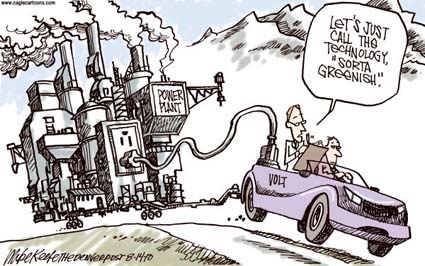
Electric cars don’t save much energy over gas-burners if at all, at least for now. Warren Meyer’s recent Coyote Blog post on this topic is aptly titled “Why Is It So Hard To Get Even Smart People To Think Clearly On Electric Vehicle Efficiency“. Meyer begins by quoting the following tweet from Google smarty Eric Schmidt, which typifies the general level of public awareness regarding the supposed energy savings from electric cars produced by Tesla and many others:

“Electric motors are the unsung hero of clean energy – the latest are 97% efficient, vs. 45% for internal combustion.“

Meyer emphasizes these major points:

  1. the efficiency with which source fuels are converted to physical work via electric and gas-burning cars is more comparable than Schmidt’s tweet suggests;
  2. differences in energy density weigh heavily in favor of fuel-burning vehicles.
  3. the so-called miles-per-gallon equivalent (MPGe) calculated by the U.S. Environmental Protection Agency (EPA) is a sham.

First, Schmidt’s tweet is accurate only if the discussion is confined to simple conversion of energy to physical work performed by the respective engines. The tweet ignores energy losses that occur prior to that conversion: electricity must be generated with far less than 100% efficiency, mainly by burning coal and natural gas. In an earlier Forbes article, Meyer compares this situation to a distorted comparison of two refrigerator installers:

“In both cases the customer lives in a fourth floor walkup. The first installer finds the refrigerator has been left on the street. He has to … haul the appliance up four flights of stairs. After that, relatively speaking, the installation is a breeze. The second installer finds his refrigerator has thoughtfully been delivered right to the customer’s door on the fourth floor. He quickly brings the unit inside and completes the installation. So who is a better installer?“

The fact is that both gas-burning and electric vehicles rely heavily on fossil fuels. And, in addition to losses in the generation process, there are other losses of energy attributable to electric cars: transmission of power involves a significant energy loss, as does charging batteries and storage itself. Meyer considers only the extra losses from production and transmission of electricity in the following comparison:

“We take 97% times 90% transmission efficiency times 50% electricity production efficiency equals 43.6%.  This is actually less than his 45% figure.  By his own numbers, the electric motor is worse….“

Meyer qualifies this comparison, as some of his assumptions are of the “best outcome” variety, but contrary to Schmidt’s assertion, gasoline and electric engines are reasonably comparable in terms of energy efficiency.

Some contend, however, that power losses in electricity transmission are much larger than the 10% Meyer assumes (see the comments on his post). Battery charging involves a loss of perhaps 20%. And a replacement for a Tesla battery, post 8-year warranty, is $8,000 – $12,000, an additional storage “cost” that is virtually non-existent for gas-powered vehicles. Beyond a certain point in its life, that cost will have an impact on a Tesla’s resale value. Moreover, some contend that the production of electric vehicles is more energy-intensive, putting them in an energy efficiency hole right from the get-go.

Meyer then takes up the notion of storage density as an explanation for why early experiments with electric cars were essentially abandoned:

“15 gallons of gasoline weighs 90 pounds and takes up 2 cubic feet. This will carry a 40 mpg car 600 miles. The Tesla Model S 85kwh battery pack weighs 1200 pounds and will carry the car 265 miles (from this article the cells themselves occupy about 4 cubic feet if packed perfectly but in this video the whole pack looks much larger). We can see that even with what Musk claims is twice the energy density of other batteries, the Tesla gets  0.22 miles per pound of fuel/battery while the regular car can get 6.7. More than an order of magnitude, that is simply an enormous difference…“

Meyer notes in the Forbes article that the EPA calculates its MPG conversion factor for electric vehicles by dividing BTU’s in a gallon of gas by the BTUs in a kilowatt hour: 33.7 KwH per gallon. Thus, the EPA multiplies an electric car’s miles per KwH by 33.7 to arrive at the so-called MPG equivalent: MPGe. But as we’ve seen above, the conversion factor ignores the generation and transmission of electricity required at the front end, and the associated energy losses that occur before a single KwH is released by a Tesla battery.

Despite what we hear from the EPA, Tesla, and other interests today, electric cars have not really overcome these disadvantages, at least not yet. The EPA’s MPGe estimates are vastly inflated. Perhaps if they were accurate, these vehicles would not have to rely so heavily on taxpayer subsidies to be competitive. By extension, the presumed environmental benefits of electric cars are nonexistent at this stage of development. I’m certain that Eric Schmidt and many other smart people are capable of understanding these nuances, but they might be too busy tripping over their politics to bother.

Follow Sacred Cow Chips on WordPress.com

Recent Posts

  • Immigration and Merit As Fiscal Propositions
  • Tariff “Dividend” From An Indigent State
  • Almost Looks Like the Fed Has a 3% Inflation Target
  • Government Malpractice Breeds Health Care Havoc
  • A Tax On Imports Takes a Toll on Exports

Archives

  • December 2025
  • November 2025
  • October 2025
  • September 2025
  • August 2025
  • July 2025
  • June 2025
  • May 2025
  • April 2025
  • March 2025
  • February 2025
  • January 2025
  • December 2024
  • November 2024
  • October 2024
  • September 2024
  • August 2024
  • July 2024
  • June 2024
  • May 2024
  • April 2024
  • March 2024
  • February 2024
  • January 2024
  • December 2023
  • November 2023
  • August 2023
  • July 2023
  • June 2023
  • May 2023
  • April 2023
  • March 2023
  • February 2023
  • January 2023
  • December 2022
  • November 2022
  • October 2022
  • September 2022
  • August 2022
  • July 2022
  • June 2022
  • May 2022
  • April 2022
  • March 2022
  • February 2022
  • January 2022
  • December 2021
  • November 2021
  • October 2021
  • September 2021
  • August 2021
  • July 2021
  • June 2021
  • May 2021
  • April 2021
  • March 2021
  • February 2021
  • January 2021
  • December 2020
  • November 2020
  • October 2020
  • September 2020
  • August 2020
  • July 2020
  • June 2020
  • May 2020
  • April 2020
  • March 2020
  • February 2020
  • January 2020
  • December 2019
  • November 2019
  • October 2019
  • September 2019
  • August 2019
  • July 2019
  • June 2019
  • May 2019
  • April 2019
  • March 2019
  • February 2019
  • January 2019
  • December 2018
  • November 2018
  • October 2018
  • September 2018
  • August 2018
  • July 2018
  • June 2018
  • May 2018
  • April 2018
  • March 2018
  • February 2018
  • January 2018
  • December 2017
  • November 2017
  • October 2017
  • September 2017
  • August 2017
  • July 2017
  • June 2017
  • May 2017
  • April 2017
  • March 2017
  • February 2017
  • January 2017
  • December 2016
  • November 2016
  • October 2016
  • September 2016
  • August 2016
  • July 2016
  • June 2016
  • May 2016
  • April 2016
  • March 2016
  • February 2016
  • January 2016
  • December 2015
  • November 2015
  • October 2015
  • September 2015
  • August 2015
  • July 2015
  • June 2015
  • May 2015
  • April 2015
  • March 2015
  • February 2015
  • January 2015
  • December 2014
  • November 2014
  • October 2014
  • September 2014
  • August 2014
  • July 2014
  • June 2014
  • May 2014
  • April 2014
  • March 2014

Blogs I Follow

  • Passive Income Kickstart
  • OnlyFinance.net
  • TLC Cholesterol
  • Nintil
  • kendunning.net
  • DCWhispers.com
  • Hoong-Wai in the UK
  • Marginal REVOLUTION
  • Stlouis
  • Watts Up With That?
  • Aussie Nationalist Blog
  • American Elephants
  • The View from Alexandria
  • The Gymnasium
  • A Force for Good
  • Notes On Liberty
  • troymo
  • SUNDAY BLOG Stephanie Sievers
  • Miss Lou Acquiring Lore
  • Your Well Wisher Program
  • Objectivism In Depth
  • RobotEnomics
  • Orderstatistic
  • Paradigm Library
  • Scattered Showers and Quicksand

Blog at WordPress.com.

Passive Income Kickstart

OnlyFinance.net

TLC Cholesterol

Nintil

To estimate, compare, distinguish, discuss, and trace to its principal sources everything

kendunning.net

The Future is Ours to Create

DCWhispers.com

Hoong-Wai in the UK

A Commonwealth immigrant's perspective on the UK's public arena.

Marginal REVOLUTION

Small Steps Toward A Much Better World

Stlouis

Watts Up With That?

The world's most viewed site on global warming and climate change

Aussie Nationalist Blog

Commentary from a Paleoconservative and Nationalist perspective

American Elephants

Defending Life, Liberty and the Pursuit of Happiness

The View from Alexandria

In advanced civilizations the period loosely called Alexandrian is usually associated with flexible morals, perfunctory religion, populist standards and cosmopolitan tastes, feminism, exotic cults, and the rapid turnover of high and low fads---in short, a falling away (which is all that decadence means) from the strictness of traditional rules, embodied in character and inforced from within. -- Jacques Barzun

The Gymnasium

A place for reason, politics, economics, and faith steeped in the classical liberal tradition

A Force for Good

How economics, morality, and markets combine

Notes On Liberty

Spontaneous thoughts on a humble creed

troymo

SUNDAY BLOG Stephanie Sievers

Escaping the everyday life with photographs from my travels

Miss Lou Acquiring Lore

Gallery of Life...

Your Well Wisher Program

Attempt to solve commonly known problems…

Objectivism In Depth

Exploring Ayn Rand's revolutionary philosophy.

RobotEnomics

(A)n (I)ntelligent Future

Orderstatistic

Economics, chess and anything else on my mind.

Paradigm Library

OODA Looping

Scattered Showers and Quicksand

Musings on science, investing, finance, economics, politics, and probably fly fishing.

  • Subscribe Subscribed
    • Sacred Cow Chips
    • Join 128 other subscribers
    • Already have a WordPress.com account? Log in now.
    • Sacred Cow Chips
    • Subscribe Subscribed
    • Sign up
    • Log in
    • Report this content
    • View site in Reader
    • Manage subscriptions
    • Collapse this bar
 

Loading Comments...