• About

Sacred Cow Chips

Sacred Cow Chips

Tag Archives: James Buchanan

Multipliers Are For Politicians

02 Wednesday May 2018

Posted by Nuetzel in Big Government, Fiscal policy, Stimulus

≈ 1 Comment

Tags

Countercyclical Policy, Fiscal Stimulus, Flexible Wages, Frederic Bastiat, Jakina R. Debnam, James Buchanan, Keynesian School, Matthew D. Mitchell, Milton Friedman, Multiplier Effect, Permanent Income Hypothesis, Procyclical Policy, Ricardian Equivalence, Richard Wagner, Spending Leakages, Underconsumption
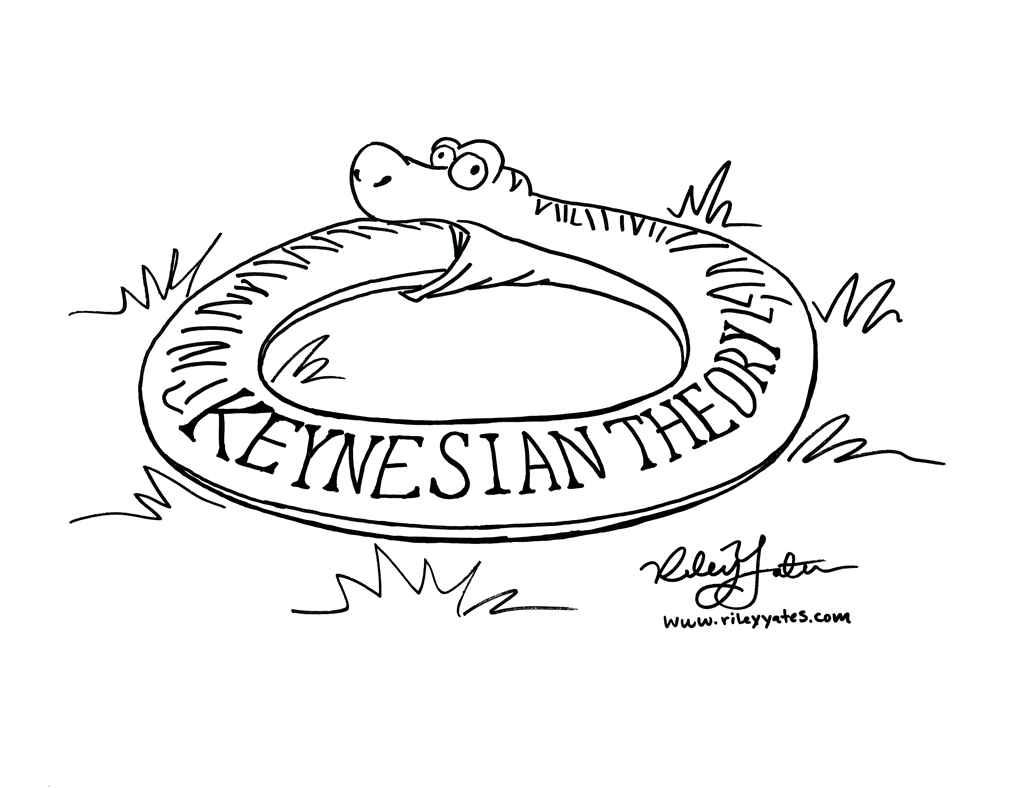
Here’s a major macroeconomic sacred cow among professional economists and the politicians whose fiscal profligacy they enable: the presumed salutary effect of an increase in government spending on economic activity, including its so-called “multiplier effect”. Government fiscal stimulus is prescribed by the Keynesian school of economics to remedy any decline in the total demand for goods. A classic case is “underconsumption”, or excess saving, such that labor and capital resources are in excess supply. The idea is that government will mop-up some of this excess saving by borrowing and spending the proceeds on goods and services, putting resources back to work. In the standard telling, digging holes and refilling them is as effective as anything else. The increased income earned by those resources will be re-spent, creating income for the recipients and leading to repeated rounds of re-spending, each successively smaller due to “leakage” into saving. Adding up all these rounds of extra spending yields a multiple of the original government stimulus, hence the Keynesian multiplier effect. The stimulation of the demand for goods and services pushes the economy back in the direction of full employment, thus correcting the original problem of underconsumption. Nice story.

Keynesian economics is a short-run, demand-based framework that delineates behavior by the constructs of national income accounting, segmenting demand into consumer spending, investment in productive capital, government spending, and net foreign spending (net exports). Except for the limit imposed by full employment, the supply side of the economy and the processes giving rise to growth in productive capacity are ignored.

Within the Keynesian framework, can offer many qualifications to the story of a shortfall in demand to which even a dyed-in-the-wool Keynesian would agree. First, government stimulus cannot have an effect on the real economy at a time when the economy is operating at full capacity, or full employment. The increased government spending will only lead to bidding against other uses of the same resources, increasing the level of wages and prices.

Another qualification within the Keynesian framework is that the leakage from spending at each round of re-spending is made greater by taxes on marginal income, thus reducing the magnitude of the multiplier. In addition, some of the extra income will be spent on foreign goods — another leakage that reduces the multiplier effect on the domestic economy. In fact, this is why multipliers for spending at local levels are thought to be relatively small. The more local the analysis, the more income will be re-spent outside the locality at each round. More fundamentally, private parties should know that increased government borrowing must be repaid eventually. At some level, they know that additional taxes (or an inflation tax) will be necessary to do so. Therefore, their reaction to the additional income derived from government demand will be muted by the need to save for those future liabilities. Put differently, consumers do not view the gain as an increase in their permanent income. That’s essentially the mechanism underlying the “Ricardian equivalence” between methods of funding government spending (government debt or taxes).

In the “real world” there are many other practical problems that lead to ineffectual and even counter-productive government stimulus. One is the problem of cost control endemic to the public sector. Related to this are seemingly unavoidable timing issues. These factors have a strong tendency to make counter-cyclical fiscal programs too costly and too late. There is also the tendency toward graft and cronyism wherever the government spreads its largess. The “perfectibility of man” is certainly not evident in the execution of government stimulus programs. Their economic impacts often become pro-cyclical, or even worse, they become permanent increases in spending authority. More on the latter below.

Deeper objections to the Keynesian framework have to do with its demand-side orientation and the conceit that government, solely by borrowing and spending, can contribute to “real demand” and add to a nation’s output. And even if government spending takes up slack at a time of unemployed resources or excess supplies, it is unlikely to resolve the conditions that led to the decline in private demand. Therefore, even if government stimulus is successful in spurring a temporary increase in actual production and utilization of resources, it is likely to delay or prevent the downward wage and price adjustments necessary to permanently do so.

Recessions are typically characterized by an effort to work off over-investment in various sectors: housing, commercial structures, oil and gas extraction and processing, technology assets, inventories, or factories. Over-inflation of asset values is usually at the root of malinvestment, often accompanied by overinflation of wages and prices. These dislocations do not occur evenly, but the market process acts to correct misallocations and mispricing precisely where they occur. It might take time, but if government steps in to prop-up weak sectors, forgive the economic consequences of mistakes, and place more upward pressure on wages and prices, the dislocations will persist. So again, even if stimulus and the multiplier effect offer a short-term palliative, the benefits are illusory in a real sense. The long-run consequences of failing to allow markets to repair the damage will be negative.

One of the greatest skills that economists should possess is the ability to discern the most plausible counterfactual in a given situation: the world as it would have played out in the absence of a particular event, often a policy initiative. This is a great shortcoming among those who subscribe to the efficacy of government stimulus programs. In the scenario just described, there will be a decline in capital investment, consumption, and saving, but that saving, whatever its level, will still be channeled into capital investments unless the funds sit idle in bank vaults. If the saving is instead absorbed by the government’s effort to fund a stimulus program, even that reduced level of investment will not take place. The net effect is zero! Thus, the Keynesian stimulus and multiplier effect represent a failure of the economics profession to “see the unseen”, as Frederic Bastiat would have put it. Unless government can produce something of value to generate income, perhaps something that improves private returns, it will not contribute to income growth.

Permanent displacement of private capital investment is the most fundamental detriment of government fiscal activism. That it might well supplant private production should come as no surprise. Matthew D. Mitchell and Jakina R. Debnam describe the phenomenon this way:

“The tendency for ostensibly temporary spending to become permanent spending helps explain why policy makers fail to take the Keynesians’ advice when it comes to surpluses. Though governments invariable go into deficit during recessionary periods, they rarely run surpluses during expansionary periods.”

Mitchell and Debnam provide an interesting quote:

“… Richard Wagner and Nobel Laureate James Buchanan concluded: ‘Keynesian economics has turned the politicians loose; it has destroyed the effective constraint on politicians’ ordinary appetites. Armed with the Keynesian message, politicians can spend and spend without the apparent necessity to tax.'”

In a footnote, Mitchell and Debnam note that Milton Friedman once said, “Nothing is so permanent as a temporary government program.” The Keynesian prescription for stimulus allows politicians to assert that they are empowered to rescue the unemployed or those suffering a loss of income. They want you to believe that they can do something. The multiplier gives license to still greater mischief on the part of politicians, because it can help politicians sell almost any pork-barrel project. But continuing government expansion requires that it extract resources from the private economy. That’s true whether the government spends directly on goods or redistributes, and the mechanics of these processes involve additional resource costs. As long as government can borrow private savings, politicians will disguise the true cost of their munificence to constituents. Economists should not be their enablers.

Open Borders and Club Goods

13 Saturday Jan 2018

Posted by Nuetzel in Immigration, Liberty

≈ 1 Comment

Tags

Alex Tabarrok, Bryan Caplan, Citizenship, Club Goods, Common Resources, Congestion Costs, Contestable Goods, Don Boudreaux, Exclusivity, Immigration, James Buchanan, Patrick McNutt, Private Goods, Public goods, Rivalrousness, Safety Net, Sheldon Richman, Social Contract, ThoughtCo., Tyler Cowen

The question of open borders divides libertarians as much as any. The arguments for open borders made by the likes of Bryan Caplan, Alex Tabarrok, Don Boudreaux and Sheldon Richman are in many ways quite appealing. Fewer borders means greater opportunities for gainful trade among individuals. For the U.S., the economic gains from in-migration have been unquestionable. From a pure libertarian perspective, governments should never interfere with the non-violent actions of free individuals, including freedom of movement. These great economists contend, in effect, that there is no real moral distinction between government actions that confine individuals within borders and those that keep people out, though our conciences are less burdened by the latter because the world abroad seems so large.

There is a gnawing contradiction in this viewpoint, however. It relates to the appropriate scope of “ownership”. At the link above, Caplan says:

“The only principled libertarian objection to this is that the citizens of each country are its rightful owners, so they’re entitled to regulate migration as they see fit. … But if you believe this, there is no principled libertarian objection to any act of government. Fortunately, the belief that citizens are countries’ rightful owners is crazy. The social contract is an utter myth. Contracts require unanimous consent, and no country has ever had unanimous consent.“

The Character of a Good

I contest Caplan’s assertion that any one act of government is like all others. Yes, there is always a danger of a majoritarian tyranny in any democracy. But there is also the question of sovereignty, for which borders of some kind are necessary. If policies governing those borders are established legislatively, they should be subject to checks and balances: executive consent as well as judicial review of disputes.

I also contest Caplan’s statement that ownership implies unanimous consent. In fact, there are many forms of property over which decisions do not imply unanimous consent of joint owners. One such form is the subject of what follows, and I believe that form of “ownership” is applicable to one’s citizenship or residency status.

To keep things simple, I’ll frame this discussion only in terms of citizenship. I therefore abstract from issues like green cards, visiting worker programs, and the presence of resident aliens in general. For a nation, the essence of barriers to immigration can be addressed by considering the simpler case of citizens versus non-resident non-citizens. For purposes of this discussion, if you are allowed to arrive on a nation’s shores, you will be a citizen.

If a country’s citizenship can be considered a good worth acquiring, what is its real character? It is privately possessed and not tradable, but not all goods are tradable. An important taxonomy of goods in the public finance literature is based on two dimensions: exclusivity and rivalrousness. The former is the degree to which other parties can be excluded from enjoyment or use of the good or resource.

Most goods have at least some degree of exclusivity: you can be denied admission to a concert, the use of an appliance or furniture, and even parks and port facilities. Pure public goods like national defense and the air we breath are completely non-exclusive, however. Broadcast television is non-exclusive as well, as long as you have the equipment to watch it.

Rivalrousness is the degree to which the use or enjoyment of a good precludes another’s use or enjoyment. My friend can’t eat the steak if I eat the steak. That’s rivalrous. But my friend and I can both enjoy the concert. That’s non-rivalrous. A private good is both exclusionary and rivalrous. A public good is neither.

Citizenship as a Good

Citizenship can be viewed as a bundle of attributes much as any good, but it is an extremely complex bundle: it includes the individual rights enshrined in a nation’s constitution (if any), the personal and economic opportunities available by virtue of access to in-country markets and resources, the culture(s), and any personal risk reduction provided collectively, i.e., a safety net via public support. How, then, would one classify citizenship, or its component attributes, in terms of exclusivity and rivalrousness?

First, the entire citizenship bundle has a high degree of exclusivity. A nation can decide on closed borders, or partially open borders, if it chooses to do so, just as a theme park limits its gate. That is the political decision at hand. The degree of exclusivity of individual components of the bundle matters little if the bundle itself is highly exclusive.

At a high level, citizenship itself is non-rivalrous. My citizenship does not preclude citizenship for anyone else. Therefore, at the level of the bundle, citizenship is exclusive but non-rivalrous, so it has the character of what economists call a “club good“. Citizens are already part of the club; to that extent they are joint “owners”. Like many clubs, decisions about new membership need not be unanimous.

Classification of citizenship attributes as goods is trickier. The exclusivity of citizenship makes the non-rivalrous public goods available to citizens into club goods. Once admitted, for example, you are free to engage in speech, practice a religion of your choice, own a weapon, and receive due process and habeas corpus without interfering with any other citizen’s ability to exercise the same rights. You get national defense and a judicial system. You have equality of opportunity to the extent that your pursuit of economic gain does not interfere directly with anyone else’s opportunities. On the other hand, the freedom of assembly is rivalrous to at least some extent, as we learned last year from events in Charlottesville, VA. In fact, there may be congestion limits to some of the other freedoms mentioned above. 

Access to a nation’s markets permits mutually beneficial trade to take place. An individual’s participation usually does not rule out participation by others, so it is essentially non-rivalrous. (In some markets the entry of new sellers may be limited and exclusionary.) Of course, a nation’s resources are scarce; exploiting them for gain or enjoyment necessarily prevents others from using the same resources. From the point of view of existing citizens, these resources are non-exclusive and rivalrous, and are therefore classified as “common resources”, subject to congestion effects, but they are still exclusive to those citizens. The key here is not whether there are gains from trade, but that there is some rivalrousness embedded in this citizenship attribute.

In addition to the basic rights mentioned earlier, the entire legal structure, regulatory apparatus, and the political process are complex attributes of citizenship. These bear on the limits of legal conduct: Can you buy or sell liquor on Sundays? Do businesses require licensure? Is abortion legal? And on and on. In a democracy, the ability to participate in the political process is non-rivalrous: it does not prevent others from participating. However, the range of possible outcomes of the process can also be viewed as an attribute, and these outcomes, as they are promulgated, are certainly rivalrous. If the “other” side gets extra votes, then the power of my vote is diminished. So the limits of legal conduct are exposed to political rivalry. In the case of open borders, a large number of citizens may not favor existing rules, regulations, and the allocation of public spending.

So the attributes of citizenship are mixed in terms of rivalrousness: Some are rivalrous but many are not. The citizenship bundle, at a more detailed level, is therefore a mix of club goods (exclusive but non-rvalrous) and some goods that are rivalrous. This is important, because under the classical description club goods are public goods provided privately; they are therefore under-provided from the perspective of social welfare and the Pareto criterion that a new citizens can be made better off without making any existing citizen worse off. That might not be the case in the presence of congestion effects.

Should a Club Good Be Unrestricted?

Citizenship has value at the margin to both existing citizens, who should be regarded as established club members, and non-citizens. The foregoing establishes that there are some private (exclusive and rivalrous) attributes attached to citizenship. Sometimes this is due to the impact of congestion on the provision of public goods. Patrick McNutt, in his survey of literature on “Public Goods and Club Goods“, summarizes some basic conditions under which public goods are provided by clubs:

“The public good is not a pure public good, but rather there is an element of congestion as individuals consume the good up to its capacity constraint. What arises then is some exclusion mechanism in order to charge consumers a price for the provision and use of the good. Brown and Jackson (1990, p. 80) had commented that the purpose of a club ‘is to exploit economies of scale, to share the costs of providing an indivisible commodity, to satisfy a taste for association with other individuals who have similar preference orderings’. For Buchanan and Ng the main club characteristic is membership or numbers of consumers and it is this variable that has to be optimised.“

Citizenship (or residency) is generally not price rationed, though there are certainly costs to the immigrant. I make no pretense here as to the determination of an optimal membership from a club or larger social perspective. My point is that rationing membership is a rational choice by club members, or citizens in this case.

Okay, I Like My Club

Tribal affiliations, and ultimately nation states, were a natural outgrowth of early competition for resources, especially when identifying threats from outsiders was a constant preoccupation. Territorialism was a byproduct, and with the establishment of agriculture, the peoples of these early societies probably identified strongly with their homelands.

Modern nation-states have evolved from those early patterns, and nations continue to differ in terms of language, culture, and governance. Successful nations are undoubtedly more liberal (in the classical sense) and open to trade and cross-border movement. Maybe one day all nations will be united under the principles of libertarianism… don’t count on it! For now, to one degree or another, a nation’s inhabitants have an interest in minimizing economic and political risks and retaining access to resources within their borders. I don’t believe that desire is irrational or immoral. If the inhabitants of a nation have a moral obligation to share their rights, wealth, and political process with all comers, then they must accept the possibility that their rights will be compromised, and possibly even complete upheaval. They suffer a loss of sovereignty and a loss in the expected value of their citizenship.

There is obviously no limiting principle to the open borders policy, as Tyler Cowen says. Existing citizens would be obligated to accommodate all those who land upon their shores, granting them the full rights and opportunities accorded to all other residents. Perhaps there would be economic gains in the short or long run, as most libertarians would predict. But perhaps there would be some losses along the way. Perhaps there would be political stability after a large influx of new residents, but perhaps not. And ultimately, perhaps changes in the political climate would feed back to the detriment of economic performance. One simply cannot say, a priori, how things would go. There are risks to the existing citizenry, and if they are obliged to accept those risks, those might well include having to feed, clothe and house new residents. There should be no absolute obligation to accept those risks. If the debate is about individual liberty, then surely imposing those risks via open borders would  abrogate the rights of existing citizens.

Addendum: A Note on the Goods Taxonomy

Given the two dimensions of goods discussed above, exclusivity and rivalrousness, goods are classified as follows:

  • Private goods: exclusive and rivalrous;
  • Public goods: non-exclusive and non-rivalrous;
  • Club goods: exclusive but non-rivalrous: e.g., a concert;
  • Common resources: non-exclusive but rivalrous: the air we breath; an aquifer;

Another category is sometimes defined: contestable goods, which have the character of public goods or even club goods when under light use, and are common resources when under heavy use. There is a difference between an empty park and a crowded park; or an empty road and a crowded road.

See ThoughtCo. for a good exposition on the taxonomy.

Follow Sacred Cow Chips on WordPress.com

Recent Posts

  • Immigration and Merit As Fiscal Propositions
  • Tariff “Dividend” From An Indigent State
  • Almost Looks Like the Fed Has a 3% Inflation Target
  • Government Malpractice Breeds Health Care Havoc
  • A Tax On Imports Takes a Toll on Exports

Archives

  • December 2025
  • November 2025
  • October 2025
  • September 2025
  • August 2025
  • July 2025
  • June 2025
  • May 2025
  • April 2025
  • March 2025
  • February 2025
  • January 2025
  • December 2024
  • November 2024
  • October 2024
  • September 2024
  • August 2024
  • July 2024
  • June 2024
  • May 2024
  • April 2024
  • March 2024
  • February 2024
  • January 2024
  • December 2023
  • November 2023
  • August 2023
  • July 2023
  • June 2023
  • May 2023
  • April 2023
  • March 2023
  • February 2023
  • January 2023
  • December 2022
  • November 2022
  • October 2022
  • September 2022
  • August 2022
  • July 2022
  • June 2022
  • May 2022
  • April 2022
  • March 2022
  • February 2022
  • January 2022
  • December 2021
  • November 2021
  • October 2021
  • September 2021
  • August 2021
  • July 2021
  • June 2021
  • May 2021
  • April 2021
  • March 2021
  • February 2021
  • January 2021
  • December 2020
  • November 2020
  • October 2020
  • September 2020
  • August 2020
  • July 2020
  • June 2020
  • May 2020
  • April 2020
  • March 2020
  • February 2020
  • January 2020
  • December 2019
  • November 2019
  • October 2019
  • September 2019
  • August 2019
  • July 2019
  • June 2019
  • May 2019
  • April 2019
  • March 2019
  • February 2019
  • January 2019
  • December 2018
  • November 2018
  • October 2018
  • September 2018
  • August 2018
  • July 2018
  • June 2018
  • May 2018
  • April 2018
  • March 2018
  • February 2018
  • January 2018
  • December 2017
  • November 2017
  • October 2017
  • September 2017
  • August 2017
  • July 2017
  • June 2017
  • May 2017
  • April 2017
  • March 2017
  • February 2017
  • January 2017
  • December 2016
  • November 2016
  • October 2016
  • September 2016
  • August 2016
  • July 2016
  • June 2016
  • May 2016
  • April 2016
  • March 2016
  • February 2016
  • January 2016
  • December 2015
  • November 2015
  • October 2015
  • September 2015
  • August 2015
  • July 2015
  • June 2015
  • May 2015
  • April 2015
  • March 2015
  • February 2015
  • January 2015
  • December 2014
  • November 2014
  • October 2014
  • September 2014
  • August 2014
  • July 2014
  • June 2014
  • May 2014
  • April 2014
  • March 2014

Blogs I Follow

  • Passive Income Kickstart
  • OnlyFinance.net
  • TLC Cholesterol
  • Nintil
  • kendunning.net
  • DCWhispers.com
  • Hoong-Wai in the UK
  • Marginal REVOLUTION
  • Stlouis
  • Watts Up With That?
  • Aussie Nationalist Blog
  • American Elephants
  • The View from Alexandria
  • The Gymnasium
  • A Force for Good
  • Notes On Liberty
  • troymo
  • SUNDAY BLOG Stephanie Sievers
  • Miss Lou Acquiring Lore
  • Your Well Wisher Program
  • Objectivism In Depth
  • RobotEnomics
  • Orderstatistic
  • Paradigm Library
  • Scattered Showers and Quicksand

Blog at WordPress.com.

Passive Income Kickstart

OnlyFinance.net

TLC Cholesterol

Nintil

To estimate, compare, distinguish, discuss, and trace to its principal sources everything

kendunning.net

The Future is Ours to Create

DCWhispers.com

Hoong-Wai in the UK

A Commonwealth immigrant's perspective on the UK's public arena.

Marginal REVOLUTION

Small Steps Toward A Much Better World

Stlouis

Watts Up With That?

The world's most viewed site on global warming and climate change

Aussie Nationalist Blog

Commentary from a Paleoconservative and Nationalist perspective

American Elephants

Defending Life, Liberty and the Pursuit of Happiness

The View from Alexandria

In advanced civilizations the period loosely called Alexandrian is usually associated with flexible morals, perfunctory religion, populist standards and cosmopolitan tastes, feminism, exotic cults, and the rapid turnover of high and low fads---in short, a falling away (which is all that decadence means) from the strictness of traditional rules, embodied in character and inforced from within. -- Jacques Barzun

The Gymnasium

A place for reason, politics, economics, and faith steeped in the classical liberal tradition

A Force for Good

How economics, morality, and markets combine

Notes On Liberty

Spontaneous thoughts on a humble creed

troymo

SUNDAY BLOG Stephanie Sievers

Escaping the everyday life with photographs from my travels

Miss Lou Acquiring Lore

Gallery of Life...

Your Well Wisher Program

Attempt to solve commonly known problems…

Objectivism In Depth

Exploring Ayn Rand's revolutionary philosophy.

RobotEnomics

(A)n (I)ntelligent Future

Orderstatistic

Economics, chess and anything else on my mind.

Paradigm Library

OODA Looping

Scattered Showers and Quicksand

Musings on science, investing, finance, economics, politics, and probably fly fishing.

  • Subscribe Subscribed
    • Sacred Cow Chips
    • Join 128 other subscribers
    • Already have a WordPress.com account? Log in now.
    • Sacred Cow Chips
    • Subscribe Subscribed
    • Sign up
    • Log in
    • Report this content
    • View site in Reader
    • Manage subscriptions
    • Collapse this bar
 

Loading Comments...