• About

Sacred Cow Chips

Sacred Cow Chips

Tag Archives: Medical Expense Deduction

Liar-Left, Daft-Left Bellow: It’s the Unkindest Tax Cut of All

08 Friday Dec 2017

Posted by Nuetzel in Health Insurance, Taxes

≈ Leave a comment

Tags

Bernie Sanders, Bubble Tax, Cross Subsidies, David Harsanyi, Individual Mandate, Insurability, Jeffrey Tucker, Medical Expense Deduction, Medicare, Obamacare, Paygo, Penalty Tax, Progressive Left, Snopes, Standard Deduction, Tax Reform, Veronique de Rugy

A misapprehension of progressive leftists is that the tax reform bills under debate by the GOP will revoke something from the needy: the poor, cancer patients, the working class, the aged, you name it. Well, that is a misapprehension held by many earnest leftists, but it amounts to deceitful rhetoric from others. David Harsanyi, in an article about the Left’s penchant for corrupting the English language, attempts to set the record straight:

“Whenever the rare threat of a passable Republican bill emerges, we learn from Democrats that thousands, or perhaps millions, of lives are at stake. …

… the most obvious and ubiquitous of the Left’s contorted contentions about the tax bill deliberately muddles the concept of giving and the concept of not taking enough. This distortion is so embedded in contemporary rhetoric that I’m not sure most of the foot soldiers even think it’s odd to say anymore. …  Whatever you make of the separate tax bills the House and Senate have passed, though, the authors do not take one penny from anyone. In fact, no spending is being cut (unfortunately). Not one welfare program is being block-granted. Not one person is losing a subsidy. It’s just a wide-ranging tax cut without any concurrent spending cuts.“

The Left may have a basic math incompetency, or maybe they know better when they insist that the GOP plans will inflict a new burden on the middle class. The middle class actually receives larger reductions in taxes than higher strata. Veronique de Rugy highlighted this point recently:

“President Trump’s intention to give a real tax break to the middle class is counter-productive considering the middle class barely shoulders any of the income tax as it is. The top 10 percent of income earners—households making $133K [or more], not $1 million as most assume—currently pay more than 70 percent of all income tax revenue. The middle quintile pays, on average, 2.6 percent of the federal income tax.

And yet, in both the House and Senate plans the middle class receives the largest tax relief by reducing their marginal tax rates, increasing the child tax credit and doubling the standard deduction. The result is fewer taxpayers would be paying income tax at all, problematic from a small government perspective. It also means a more progressive income tax code than it already is.

The House plan also effectively jacks up the top marginal rate for some high earners by using a 39.6 percent bubble rate on the first $90K earned by single taxpayers making $1 million and married taxpayers making $1.2 million and a 12 percent rate like everyone else.“

I have listened to horror stories about school teachers who, in the past, were able to deduct supplies they purchased for their students. Now, the cruel GOP is trying to take that away! This argument neatly ignores the doubling of the standard deduction. Many teachers will find that it no longer makes sense to itemize deductions, and they will come out ahead. But for the sake of argument, suppose a teacher earning $50,000 itemizes and spends $2,500 on unreimbursed supplies for their students every year. At the Senate plan’s new rate in that bracket, the lost deduction will cost the teacher $550, but about $300 would be saved via rate reductions for every $10,000 of taxable income. The teacher is likely to come out ahead even if he unwisely passes on the improved standard deduction.

Liberal thought-whisperers have goaded their minions into believing that the GOP intends to cut Medicare funds by $25 billion a year going forward. The bills under discussion would do no such thing. However, in a rare gesture of fiscal responsibility, President Obama in 2010 signed the Statutory Pay-As-You-Go Act (Paygo), which may require automatic reductions in outlays when spending or tax changes lead to an increase in federal debt. The act has never been enforced, and Republican leadership in both houses insists that Paygo can and will be waived. Clearly, the GOP’s intent is not to allow the Paygo cuts to take place. Even the left-leaning Snopes.com is reasonably neutral on this point. But if Paygo takes hold, the lefties will have themselves to blame.

At the last link, Snopes also touches on one actual provision of the Senate tax plan, the repeal of the Obamacare individual mandate, or rather, the repeal of the “penalty tax” imposed by the IRS on uninsured individuals. The Supreme Court ruled that it is a tax in 2012, at the time giving rise to a mixture of delight and embarrassment on the Left. The ruling saved Obamacare, but the Left had been loath to call the penalty a tax. The supposed rub here is that repeal of the mandate will be greeted enthusiastically by many young and healthy individuals. Freed from coercion, many of them will elect to go without coverage, leading to a deterioration of the exchange risk pools and causing premiums paid by the remaining exchange buyers to rise. However, the critics conveniently ignore the fact that Obamacare individual subsidies will automatically ratchet upward with increases in the premium on the Silver Plan. So the panic related to this portion of the Senate tax bill is misplaced.

One other point about the mandate: because it coerces the payment of cross-subsidies by the young and healthy to higher-risk insurance buyers, the mandate distorts the pricing of risk, the incentives to insure, and the use of resources in the provision of health insurance and health care itself. This is how the proper function of a market is destroyed. And this is how resources are wasted. Good riddance to the mandate. The high-risk population should be subsidized directly, not through distorted pricing, at least until such time as a market for future insurability can be established. As Jeffrey Tucker has said, repeal of the mandate is a very good first step.

The loss of the medical expense deduction is not a done deal. While the House plan eliminates the deduction, the Senate plan reduces the minimum medical expense requirement from 10% to just 7.5% of qualified income, so it is more generous than under current law. I’ve seen bloggers commit basic misstatements of facts on this and other provisions, such as confusing this limit with a total limit on the amount of the medical deduction. This deduction tends to benefit higher-income individuals who itemize deductions, which will represent a higher threshold under the increased standard deduction. Of course, this deduction appeals to our sense of fairness, but like all the complexities in the tax code, it comes with costs: not only does it add to compliance costs and create a need for higher tax rates, but it subsidizes demand for medical care, much like the tax breaks available on employer-provided health care, and it therefore inflates health care costs for everyone. To the extent that these deductions and many others are still in play, the GOP plans fall short of real tax reform.

The GOP tax bills certainly have their shortcomings. I hope some of them are rectified in conference. The bills do not offer extensive simplification of the tax code, and they would not be truly historic: in real terms, an earlier version of the House bill would have been the fourth biggest cut in U.S. history relative to GDP, and I believe the version that passed the House is smaller. However, many of the arguments mounted by the Left against the bills are without merit and are often deceitful. The Left strongly identifies with the zero-sum philosophy inherent in collectivism, and the misleading arguments I’ve cited are plausible to the less-informed among that crowd. That brings me back to David Harsanyi’s point, discussed at the top of this post: “intellectuals” on the progressive Left find value in corrupting the meaning of words and phrases like “budget cuts”, “giving” and “taking”:

“Everyone tends to dramatize the consequences of policy for effect, of course, but a Democratic Party drifting towards Bernie-ism is far more likely to perceive cuts in taxation as limiting state control and thus an attack on all decency and morality.“

“There is a parallel explanation for the hysterics. With failure comes frustration, and frustration ratchets up the panic-stricken rhetoric. It’s no longer enough to hang nefarious personal motivations on your political opponents — although it certainly can’t hurt! — you have to corrupt language and ideas to imbue your ham-fisted arguments with some kind of basic plausibility.“
The Socially Seductive Tax Deduction

20 Monday Nov 2017

Posted by Nuetzel in Taxes

≈ Leave a comment

Tags

Edward Glaeser, Externalities, Home ownership, Jesse Shapiro, Medical Expense Deduction, Mortgage Interest Deduction, NBER, SALT, State & Local Tax Deduction, Student Loan Interest Deduction, Tax Deductions, Tax Foundation, Tax Reform

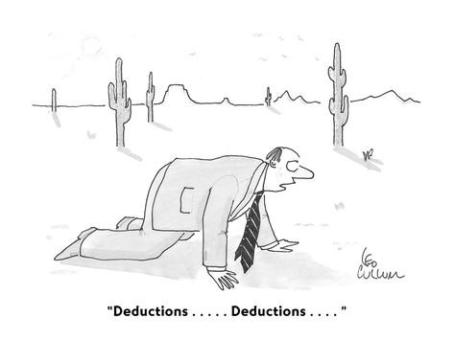
deductions desert

The rat’s nest that is the federal income tax code is a testament to the counter-productive nature of central economic planning. Not only does the tax code force citizens to waste time and other resources on compliance activities. It also encourages us to direct resources into uses that would not be worthwhile in the absence of tax incentives, uses that are not worthwhile in a societal context.

A general rationale for many provisions of the tax code is that they serve some “worthwhile” public purpose. A special tax provision is created to subsidize activities contributing to that purpose. Since that reduces the flow of revenue, tax rates must increase as an offset. However, high tax rates are damaging to economic health in and of themselves. They blunt incentives and drive wedges between the values and rewards that guide all economic decisions.

The competing tax plans under debate in the House and Senate would eliminate or pare back deductions to varying degrees, enabling a reduction in tax rates. I applaud steps in that direction, though a consequence of doing so piecemeal is to invite later tinkering of the sort that got us into this mess in the first place. Both the House and Senate bills are piecemeal. Here is a run-down of some of the deductions that are under review in the GOP plans:

State and Local Tax (SALT) Deductions: this deduction prevents the imposition of federal “taxes on taxes”, which is a worthwhile consideration. However, SALT also gives lower levels of government a “discount” on tax burdens they impose on their citizens, thereby forcing that burden to be shared by members of other jurisdictions. According to the Tax Foundation:

“The deduction favors high-income, high-tax states like California and New York, which together receive nearly one-third of the deduction’s total value nationwide. Six states—California, New York, New Jersey, Illinois, Texas, and Pennsylvania—claim more than half of the value of the deduction.“

Defenders of this deduction note peremptorily that it is used by taxpayers in all fifty states, as if that should come as a surprise. Well of course it is! And those who are taxed most heavily benefit the most from this deduction, and those benefits are most concentrated in high-tax states. The House GOP bill would limit the SALT deduction to $10,000, while the Senate version would eliminate it entirely.

Mortgage Interest (MI) Deduction: Long ago, the idea took hold that ownership of a home was of greater inherent value than mere occupancy. It’s obviously true that owners have greater rights than renters over use of a property. Those benefits are internalized, and owner-occupants might well be more inclined than renters to take pride in, care for, and improve a property. That suggests a social or external benefit from home ownership, one that at least benefits others in the vicinity of a given property.

The MI deduction creates an incentive for debt-financed home ownership, but only for the minority of taxpayers who can benefit from itemizing deductions. It therefore tends to subsidize the housing choices of those at higher levels of income and those with larger homes. It has contributed little, if anything, to the homeownership rate. Here are Edward Glaeser and Jesse Shapiro describing the findings of their NBER Working Paper:

“Externalities from living around homeowners are far too small to justify the deduction. … the home mortgage interest deduction is a particularly poor instrument for encouraging homeownership since it is targeted at the wealthy, who are almost always homeowners. The irrelevance of the deduction is supported by the time series which shows that the ownership subsidy moves with inflation and has changed significantly between 1960 and today, but the homeownership rate has been essentially constant.“

This deduction has fostered a massive over-investment in housing relative to other assets and forms of consumption. The House tax bill would allow a deduction on interest payments for up to $500,000 of mortgage debt, but this limit would apply only to new mortgages. The Senate bill would not alter the deduction in any way. These steps are severely limited in their reform ambitions.

Medical Expense Deduction: To take this deduction, you must 1) be an itemizer; and 2) have eligible medical expenses exceeding 10% of adjusted gross income (AGI). Then, you can deduct only the excess above 10%. A relatively small percentage of taxpayers actually take this deduction, mostly wealthy, older individuals or couples. It can be argued that the deduction encourages overuse of medical resources in some cases, but there are certainly others in which it provides relief from the hardship of an illness requiring expensive care. On the other hand, the deduction might serve to discourage the purchase of supplemental Medicare coverage by individuals who can afford it but are willing to bet that they won’t need it. Part of that bet is covered by the deduction.

The House bill would repeal this deduction in its entirety. The Senate bill would leave it untouched.

Student Loan Interest Deduction: Currently, up to $2,500 of student loan interest can be deducted “above the line” by non-itemizers, but only if their AGI is within certain limits. Higher education is often claimed to have social (external) benefits. To some extent, the student loan interest deduction helps bring the cost of an eduction to within reach of a broader swath of the citizenry. These considerations provide the rationale for public subsidies for funding tuition and other costs with debt. The tax deduction is only one of many forms of education subsidies. Another is provided by the below-market rates at which students are able to borrow from the federal government.

The social benefits of higher education are strongly associated with the value it adds for the individual. It can be argued that as a society, we may have pushed college education well beyond that point. A large number of indebted students decide, too late, that continued enrollment has little value, so they drop out and often default on their federally-subsidized debt. Moreover, these loan subsidies stimulate the demand for college education, which leads to a certain amount of escalation in tuition and fees. These ill effects make elimination of this deduction a tempting way to broaden the income-tax base, enabling a reduction in tax rates.

The House bill eliminates the deduction for student loan interest, but the Senate bill leaves it intact.

Conclusion: There are plenty of shortcomings in both the House and Senate versions of tax reform. Three liberalizing goals of reform are tax simplification, elimination of provisions that benefit special interests, and of course lower rates. Most of the complexities in the tax code benefit special interests in one way or another. The deductions discussed above fall into that category and necessitate higher tax rates on personal income. That in turn makes the deductions more valuable to those who claim them. In terms of the liberalizing goals of reform, the House tax bill is wider ranging than the Senate version, though the Senate bill’s complete elimination of the SALT deduction is better.

Follow Sacred Cow Chips on WordPress.com

Recent Posts

  • The Case Against Interest On Reserves
  • Immigration and Merit As Fiscal Propositions
  • Tariff “Dividend” From An Indigent State
  • Almost Looks Like the Fed Has a 3% Inflation Target
  • Government Malpractice Breeds Health Care Havoc

Archives

  • January 2026
  • December 2025
  • November 2025
  • October 2025
  • September 2025
  • August 2025
  • July 2025
  • June 2025
  • May 2025
  • April 2025
  • March 2025
  • February 2025
  • January 2025
  • December 2024
  • November 2024
  • October 2024
  • September 2024
  • August 2024
  • July 2024
  • June 2024
  • May 2024
  • April 2024
  • March 2024
  • February 2024
  • January 2024
  • December 2023
  • November 2023
  • August 2023
  • July 2023
  • June 2023
  • May 2023
  • April 2023
  • March 2023
  • February 2023
  • January 2023
  • December 2022
  • November 2022
  • October 2022
  • September 2022
  • August 2022
  • July 2022
  • June 2022
  • May 2022
  • April 2022
  • March 2022
  • February 2022
  • January 2022
  • December 2021
  • November 2021
  • October 2021
  • September 2021
  • August 2021
  • July 2021
  • June 2021
  • May 2021
  • April 2021
  • March 2021
  • February 2021
  • January 2021
  • December 2020
  • November 2020
  • October 2020
  • September 2020
  • August 2020
  • July 2020
  • June 2020
  • May 2020
  • April 2020
  • March 2020
  • February 2020
  • January 2020
  • December 2019
  • November 2019
  • October 2019
  • September 2019
  • August 2019
  • July 2019
  • June 2019
  • May 2019
  • April 2019
  • March 2019
  • February 2019
  • January 2019
  • December 2018
  • November 2018
  • October 2018
  • September 2018
  • August 2018
  • July 2018
  • June 2018
  • May 2018
  • April 2018
  • March 2018
  • February 2018
  • January 2018
  • December 2017
  • November 2017
  • October 2017
  • September 2017
  • August 2017
  • July 2017
  • June 2017
  • May 2017
  • April 2017
  • March 2017
  • February 2017
  • January 2017
  • December 2016
  • November 2016
  • October 2016
  • September 2016
  • August 2016
  • July 2016
  • June 2016
  • May 2016
  • April 2016
  • March 2016
  • February 2016
  • January 2016
  • December 2015
  • November 2015
  • October 2015
  • September 2015
  • August 2015
  • July 2015
  • June 2015
  • May 2015
  • April 2015
  • March 2015
  • February 2015
  • January 2015
  • December 2014
  • November 2014
  • October 2014
  • September 2014
  • August 2014
  • July 2014
  • June 2014
  • May 2014
  • April 2014
  • March 2014

Blogs I Follow

  • Passive Income Kickstart
  • OnlyFinance.net
  • TLC Cholesterol
  • Nintil
  • kendunning.net
  • DCWhispers.com
  • Hoong-Wai in the UK
  • Marginal REVOLUTION
  • Stlouis
  • Watts Up With That?
  • Aussie Nationalist Blog
  • American Elephants
  • The View from Alexandria
  • The Gymnasium
  • A Force for Good
  • Notes On Liberty
  • troymo
  • SUNDAY BLOG Stephanie Sievers
  • Miss Lou Acquiring Lore
  • Your Well Wisher Program
  • Objectivism In Depth
  • RobotEnomics
  • Orderstatistic
  • Paradigm Library
  • Scattered Showers and Quicksand

Blog at WordPress.com.

Passive Income Kickstart

OnlyFinance.net

TLC Cholesterol

Nintil

To estimate, compare, distinguish, discuss, and trace to its principal sources everything

kendunning.net

The Future is Ours to Create

DCWhispers.com

Hoong-Wai in the UK

A Commonwealth immigrant's perspective on the UK's public arena.

Marginal REVOLUTION

Small Steps Toward A Much Better World

Stlouis

Watts Up With That?

The world's most viewed site on global warming and climate change

Aussie Nationalist Blog

Commentary from a Paleoconservative and Nationalist perspective

American Elephants

Defending Life, Liberty and the Pursuit of Happiness

The View from Alexandria

In advanced civilizations the period loosely called Alexandrian is usually associated with flexible morals, perfunctory religion, populist standards and cosmopolitan tastes, feminism, exotic cults, and the rapid turnover of high and low fads---in short, a falling away (which is all that decadence means) from the strictness of traditional rules, embodied in character and inforced from within. -- Jacques Barzun

The Gymnasium

A place for reason, politics, economics, and faith steeped in the classical liberal tradition

A Force for Good

How economics, morality, and markets combine

Notes On Liberty

Spontaneous thoughts on a humble creed

troymo

SUNDAY BLOG Stephanie Sievers

Escaping the everyday life with photographs from my travels

Miss Lou Acquiring Lore

Gallery of Life...

Your Well Wisher Program

Attempt to solve commonly known problems…

Objectivism In Depth

Exploring Ayn Rand's revolutionary philosophy.

RobotEnomics

(A)n (I)ntelligent Future

Orderstatistic

Economics, chess and anything else on my mind.

Paradigm Library

OODA Looping

Scattered Showers and Quicksand

Musings on science, investing, finance, economics, politics, and probably fly fishing.

  • Subscribe Subscribed
    • Sacred Cow Chips
    • Join 128 other subscribers
    • Already have a WordPress.com account? Log in now.
    • Sacred Cow Chips
    • Subscribe Subscribed
    • Sign up
    • Log in
    • Report this content
    • View site in Reader
    • Manage subscriptions
    • Collapse this bar
 

Loading Comments...