• About

Sacred Cow Chips

Sacred Cow Chips

Tag Archives: monopoly

Hillary’s “Fix”: Obamacare Squared

26 Wednesday Oct 2016

Posted by Nuetzel in Obamacare

≈ Leave a comment

Tags

Avik Roy, Bill Clinton, Block Grants, Christopher Jacobs, competition, Health Insurer Bailouts, Hillary Clinton, John C. Goodman, Marketplace Regulation, Medicaid, monopoly, Obamacare Exchanges, Obamacare Fixes, Pharmaceutical Patents, Public Option, Reimbursement Rates, Risk corridors, Sally Pipes, Single-Payer System, Wikileaks

hillarys-health-problem

One of Hillary Clinton’s “public positions” is that Obamacare needs a few “fixes”, a considerable understatement. Meanwhile, Wikileaks has revealed that she has “privately” rooted for the failure of Obamacare. For that reason, Bill Clinton’s recent slip-up, in which he portrayed Obamacare as a “crazy” system, had a certain Freudian quality. Indeed, Obamacare looks crazier every year, especially in the middle of premium-hike season.

One of Hillary’s so-called “fixes” is the creation of a “public option”, or health insurance offered by the government to compete on exchanges with private insurance. Private health insurers, with the expiration of the so-called “risk corridors”, do not have continuing access to the public purse to cover their losses; going forward, they must price coverage at rates covering the cost of their respective risk pools. The government, on the other hand, is likely to have pricing flexibility. If exercised, there will be little hope for private insurers to “compete” without bailout money. Health insurance coverage, then, is likely to devolve into a single-payer monopoly, and control over health care delivery will be increasingly monopolized as well.

Sally Pipes says the “public option” is a politically attractive way to make a single-payer system inevitable:

“But progressives face the same problem pushing single-payer they always have — the public won’t stand for it. So they’re dusting off an old idea that will get them to single-payer without using those words.“

So the path from Obamacare to a single-payer system is likely to involve a public option in one form or another. John C. Goodman points out that expanding Medicaid is one way to create a broad public option. Medicaid reimbursement rates are low, however, which is why many doctors refuse to accept patients with Medicaid coverage. Such might be the quality of future coverage under an “affordable” public option. And if Medicaid is enhanced so as to appeal to middle class families, it will be correspondingly more expensive. But for whom? More than likely, the tab will be paid by a combination of insureds and taxpayers. And more than likely, the number of competing Medicaid plans (most of which are now privately offered and managed (e.g., Centene Corporation)) will dwindle.

Christopher Jacobs says that when Obamacare became law, health insurers had every expectation that they’d be bailed out by the government indefinitely. Continuing reimbursement for losses was never guaranteed, however. The pressure to backstop the insurers’ profitability will be stronger as the debate over “fixing” Obamacare advances. But as Jacobs warns, ongoing bailouts mean that these insurers are essentially controlled by the government. The private insurers would essentially become heavily-regulated entities managing the operational details of a de facto single-payer system.

So, there are three distinct possibilities under a Hillary Clinton presidency, assuming she can get any of them though Congress: 1) a public option with no private bailouts; 2) a public option with ongoing bailouts; and 3) no public option with ongoing bailouts. Ultimately, all of these scenarios are likely to devolve toward a de facto single-payer system. So we will have monopoly, central control of health care, and/or bailouts. Who was it that said government is the way we wreck things together?

Hillary has some other “fixes” in mind. Some of these involve more regulation of coverage and pricing, such as mandatory provision of three free “sick” visits with a provider each year and in-network pricing for emergency procedures. These steps will add to the cost burden on private insurers.

Regulating drug companies more heavily is another favorite Hillary Clinton theme, but regulation is perhaps the primary reason why the drug development process is so lengthy and costly. The theory that government will be more effective at negotiating drug prices than insurers is suspect. Outright price regulation is likely to mean reduced availability of various medicines. Patent reform and an expedited drug approval process would be a more effective approach to reducing drug prices.

Clinton has also proposed a tax credit for out-of-pocket health care costs exceeding 5% of income. We’ll need higher tax rates, lower deductions and credits elsewhere, or higher deficits to pay for this one.

Finally, Hillary wants to expand eligibility for Medicare to anyone 55 and older, but as Goodman explains, the kind of Medicare Advantage plans that would be made available to “near seniors” under this proposal are similar to those already offered by private insurers, and at lower cost, and premia for these plans are often payable with pre-tax dollars, or the buyers may be eligible for tax subsidies. This proposal might sound appealing, but it is unlikely to accomplish anything except to create more administrative overhead, regulation and diminish existing offerings.

Obamacare has injected a high degree of central planning into the health care system with disastrous results. It has fallen far short of its own objectives for reducing the number of uninsured, “bending the cost curve” downward, and avoiding disruptions to existing coverage and patient-doctor relationships. Choices have narrowed in terms of coverage options and within networks. Obamacare has imposed unnecessary costs on providers and encouraged a monopolization of health care delivery, hardly a prescription for affordability. And Obamacare has proven to be a budget buster, contrary to the advance hype from its proponents.

I remember standing in a pharmacy shortly after Obamacare was enacted, and I heard a sharp-voiced leftist telling a clerk that Obamacare was just a bridge to single-payer health care. I tried to mind my own business, thinking it unproductive to engage such an individual in public. This fellow was quite pleased with the clever deception that was Obamacare. It was never a secret that the progressive left hoped single-payer would be the ultimate outcome, but it’s interesting to witness their discomfort with the way things are unfolding. Surely they must have known that if “fixes” were necessary, something would have to be broken. Perhaps they thought the politics would get simpler, but the shortcomings of the health care law have inflicted too much pain and shame.

I’m tempted to say that the health care system can be improved only by doing precisely the opposite of everything Clinton has proposed. There’s some truth in that, but it’s not quite that simple. The path to better and more affordable health care is to end the dominant role of third-party payers, placing responsibility on price-sensitive consumers, allowing a variety of choices in coverage, ending tax preferences, reducing regulation and encouraging real competition in the markets for coverage and medical care. Reform of the patent system could introduce more competition to markets for pharmaceuticals. The Medicaid system will have to be relied upon to cover those who otherwise can’t be insured at affordable rates. Proposals for federal funding of Medicaid through block grants to the states is an avenue for achieving greater efficiency and better health care outcomes.

Hillary Clinton’s “fixes” are all likely to exacerbate the worst failings of Obamacare for consumer-patients and taxpayers. More federal spending commitments will not solve the structural problems embedded in the health care law. It will magnify them. The hope among the progressive left remains that single-payer health care will evolve out of the Obamacare system once it is “fixed”. And what will we get? More complete monopolies in coverage and care, higher prices, central regulation, narrowed choice, waiting lists, denial of care, and some combination of higher taxes and deficits. In other words, a more radical version of Obamacare.
Socialism Is Concentrated Power

10 Thursday Mar 2016

Posted by Nuetzel in Big Government, Capitalism, Markets

≈ 1 Comment

Tags

Charles Tiebout, Chelsea German, Concentrated Power, crony capitalism, Don Boudreaux, FEE, Foundation for Economic Education, John D. Rockefeller, Marian Tupy, monopoly, Police Power, Privilege, rent seeking, Richard Rahn, State Control, Tiebout Hypothesis, Vote With Their Feet

Power

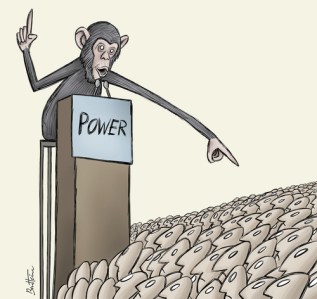
Nobody likes to defend concentrated power, yet socialists earnestly crave power concentrated in the state. And state power is absolute power. They must imagine that those wielding state power, now and always, will be the sort of nice, benevolent folks they imagine themselves to be. Well, if only more power can be concentrated in the state, it will be alright. Good luck with that! Once granted, watch out.

While this sort of magical thinking might seem naive, another paradox of leftist thinking is even more befuddling: the never-yielding distrust of capitalism and private initiative, a system under which power is largely dispersed. The attitude is more than a little misanthropic. It’s as if socialists expect us to believe that someone forces us to engage in transactions with private sellers, transactions that are always unfavorable in some way. But every transaction in a private economy is voluntary, dependent only on how both parties assess benefits relative to costs. Anyone can make a bad deal, of course, and you might get ripped off by an unscrupulous buyer or seller from time-to-time. But you are free to perform due diligence. You are free to assess risks.

The left goes so far as to blame capitalism for poverty, demonstrating a complete disconnect with reality. For a better perspective on the economic miracles made possible by capitalism, I  recommend a few timely pieces of reading: economist Richard Rahn makes note of the incredible bounty of products and technology brought to us by capitalism. This includes transformative breakthroughs in almost every area of life: communication, computing, transportation, refrigeration, safety, food, medicine and on and on:

“Almost all of the great innovations came from those in the private sector who created them out of the desire for more wealth or just intellectual curiosity. The socialist countries have produced almost nothing — except for bread lines, coercive and destructive taxation and regulation, and gulags. Yet politicians all over the world proudly proclaim themselves to be socialists and attack the capitalist wealth creators and innovators — as if the real world had never existed.“

At the Foundation for Economic Education (FEE), Chelsea German and Marian L. Tupy offer ample evidence of capitalism’s successes as they shred an absurd opinion piece in Forbes magazine claiming that  capitalism “will starve humanity“:

“Throughout most of human history, almost everyone lived in extreme poverty. Only in the last two centuries has wealth dramatically increased. Early adopters of capitalism, such as the United States, have seen their average incomes skyrocket.“

German and Tupy have a more detailed post here with statistics showing dramatic increases in the standard of living enjoyed by poor households in the U.S., increases for which capitalism is largely responsible.

Last month, Don Boudreaux reflected on the well being of average Americans today compared to an individual at the extreme high end of the wealth distribution 100 years ago. Boudreaux catalogues the many ways in which John D. Rockefeller’s comforts were drastically inferior to those available today. He concludes that trading places with Rockefeller would be a questionable deal:

“Honestly, I wouldn’t be remotely tempted to quit the 2016 me so that I could be a one-billion-dollar-richer me in 1916. This fact means that, by 1916 standards, I am today more than a billionaire. It means, at least given my preferences, I am today materially richer than was John D. Rockefeller in 1916. And if, as I think is true, my preferences here are not unusual, then nearly every middle-class American today is richer than was America’s richest man a mere 100 years ago.“

I maintain that even when power is concentrated in large private companies, the situation is far preferable to concentrated power in government. First, private companies do not have the police power necessary for absolute government authority. They cannot force you to do anything. Second, private companies do not simply shuffle resources and up-charge, as the left might have you believe; they innovate and create value as an inducement to trade, a concept that is rare in state-controlled activities. When any form of competition is present, private companies discipline each other, encouraging better quality and restraint on the prices charged for their wares. Even trading with a monopolist confers gains from trade, despite its drawbacks relative to trade in competitive markets.

Of course, government is generally not confronted with competition, unless it’s prompted by citizens who “vote with their feet”, as described by Charles Tiebout. That kind of responsiveness argues for decentralized government, however. Government services are typically monopolized, but the “terms of trade” are often worse than a monopolist would offer. It’s difficult to refuse a government service or your obligation to pay, no matter how much you abhor it, and quality usually suffers due to the extreme lack of accountability to citizen-consumers.

Capitalism gets a bad rap when private businesses engage in rent-seeking. That behavior is characterized by attempts to influence government policy for the business’ own benefit, promoting subsidies, other public spending or tax policies that go to the bottom line, and regulatory actions that disproportionally harm competitors. Those efforts put the crony in crony capitalism. But note that rent seeking is not an inherent feature of capitalism. It is enabled by the existence of activist government, its control over resources and its police power. What this means is that cronyism is fostered by power concentrated within the halls of government. In other words, private power becomes more concentrated and more impervious to competitive forces when it is favored by government. That is pure privilege.

If you dislike concentrated power, then vote for small government!


Public Monopolists Say “Don’t Be Choosy”

12 Sunday Jul 2015

Posted by Nuetzel in Markets, School Choice

≈ 3 Comments

Tags

Cafe Hayek, Don Boudreaux, K-12 education, monopoly, Politicized interests, Private education, Public education, Redistribution, Restraint of Trade, School Choice

choice better schools

Imagine a food distribution system that mirrored the organization of K-12 education in the U.S. How do you think it would work out? That thought exercise was conducted four years ago by Don Boudreaux in his Wall Street Journal op-ed: “If Supermarkets Were Like Public Schools”(gated). Boudreaux has helpfully reblogged this op-ed at Cafe Hayek as part of his post “Separate School From State“. Read the whole thing! Because this is a topic in economics and I am so very pedantic, I prefer not to use the term “market” at all in this context. After all, a public “supermarket”, as discussed by Boudreaux, is no more a market than a public school is a market. I will use the term “public grocery store” instead, except when quoting Boudreaux.

The comparison of grocery stores to schools involves outputs that are both considered essential. In fact, there should be no argument that food is the more essential of the two. Yet the essential nature of educating children in a modern society is thought to be an important rationale for the existence of a public school system. Would supporters of public education care to apply the argument that “market forces can’t supply quality education” to another essential product, like food?

Boudreaux invokes several features of K-12 education in “designing” his hypothetical food distribution system:

  • “Residents of each county would pay taxes on their properties.“
  • “Each family would be assigned to a particular supermarket according to its home address. And each family would get its weekly allotment of groceries—’for free’—from its neighborhood public supermarket.“
  • “No family would be permitted to get groceries from a public supermarket outside of its district.“
  • “... families would be free to shop at private supermarkets that charge directly for the groceries they offer. Private-supermarket families, however, would receive no reductions in their property taxes.“

Economic theory predicts that the monopoly status held by public grocery stores over the provision of “free food” within their districts would cause the quality and variety offered at those stores to suffer. This is just a form of restraining trade, which is what monopolists do. The classic monopolist charges a higher price and produces less output. Exactly the same is predicted in Boudreaux’s experiment.

One difference in comparing food stores to schools is that families, presumably, could purchase some of their groceries from private stores and meet the rest of their food needs from their district grocery store at no marginal cost, whereas the school selection is all public or all private. However, this does not invalidate Boudreaux’s assertion that the quality offered by the monopoly provider will suffer.

Like public schools, there would be massive variations in quality across public grocery stores due to variation in the tax base from one district to another. This would tend to reinforce differences in the value of property across districts, because it is so desirable to live in a district with a good public grocery.

Here’s an extended excerpt from Boudreaux:

“Being largely protected from consumer choice, almost all public supermarkets would be worse than private ones. In poor counties the quality of public supermarkets would be downright abysmal. ….

Responding to these failures, thoughtful souls would call for ‘supermarket choice’ fueled by vouchers or tax credits. Those calls would be vigorously opposed by public-supermarket administrators and workers.

Opponents of supermarket choice would accuse its proponents of demonizing supermarket workers (who, after all, have no control over their customers’ poor eating habits at home). Advocates of choice would also be accused of trying to deny ordinary families the food needed for survival. Such choice, it would be alleged, would drain precious resources from public supermarkets whose poor performance testifies to their overwhelming need for more public funds.

As for the handful of radicals who call for total separation of supermarket and state—well, they would be criticized by almost everyone as antisocial devils indifferent to the starvation that would haunt the land if the provision of groceries were governed exclusively by private market forces.

In the face of calls for supermarket choice, supermarket-workers unions would use their significant resources for lobbying—in favor of public-supermarkets’ monopoly power and against any suggestion that market forces are appropriate for delivering something as essential as groceries.“

That sounds all too familiar. Even with massive state redistribution of public grocery store funding from wealthy to poor districts, the result would be much the same, as it is with public schools. Increased grocery store funding cannot correct the larger problems plaguing the community, many of which are created by the welfare state itself. And increased funding does not correct fundamental dislocations created by a monopoly, especially a public monopoly. The entrenched, politicized interests that infest public institutions always resist changes that might improve quality. They are typified by bloated administrative machinery and a general lack of responsiveness to the community. Only competition and choice can eliminate these tendencies and drive improvement.

An objection that might be raised to Boudreaux’s comparison is that public schools must accommodate a student population with wide variations in learning ability. It may be claimed that this variation strains the resources of public relative to private schools. However, that burden is due in large part to the structure of the education system. A benefit of competition and choice is the extent to which it can accommodate diverse needs, and there is no reason why education should prove to be an exception. In fact, diverse needs are already met very well by private education, but they serve only “private school families.” Empowering all families to choose the schools that best accommodate their needs would bring higher quality to our K-12 education system.

Is The Patent a Perversion?

28 Tuesday Apr 2015

Posted by Nuetzel in Property Rights

≈ 2 Comments

Tags

Alex Tabarroc, Arnold Kling, Beautiful Anarchy, Copyright Clause, Daniel Drezner, Eugene Volokh, Exclusivity, Intellectual Property Rights, James Pethokoukas, Jeffrey Tucker, Lawrence Solum, Legal Theory Blog, Mises Daily, monopoly, Patent Thicket, Rivalrous goods, Roderick T. Long, Stephan Kinsella

money-tree-patent-cartoon

No one likes a monopoly except the monopolist, and a monopoly granted by patent is generally no exception. Patents are intended to be temporary, but they are often extended, at high cost to customers, beyond what many consider necessary as an incentive for innovation. There is also doubt about the validity of many “innovations” on which patents are issued. Alex Tabarrok once posted this cute illustration on the excesses of patent law. He has also discussed the existence of “patent thickets”, situations in which “a new product can require the use of hundreds or even thousands of previous patents, giving each patent owner veto-power over innovation“, or at least a way to skim some of the profits. Such thickets serve as a detriment to innovation, contribute to excessive litigation, and ultimately defeat the purpose of rewarding an innovator. Patent “trolls”, who threaten litigation over patent issues but may not own any patents themselves, have become a growing problem. In many ways, intellectual property laws begin to look like a rent-seeker’s playground. James Pethokoukas blogged late last year about a new study by the Congressional Budget Office stating that the U.S. patent system had “weakened the linkage between patenting and innovation“.

There is strong disagreement among libertarians about the validity of intellectual property rights (IP — copyrights, trademarks and patents). My natural sympathies are with the individual who rightfully seeks to benefit from their own creativity and hard work, but whether an innovator should enjoy a state-enforced monopoly on any and all applications of an idea is another matter. If potential competitors, customers and society have an obligation to this individual, some would insist that it is merely an ethical obligation, not one that should be sanctioned by the state.

In what follows, I will mostly refer to generic “ideas”, with the caveat that there are important distinctions between patents, trademarks and copyrights. I do not mean to minimize those distinctions. Rather, my interest lies in the general notion of intellectual property and any fundamental rights that successful “ideation” should confer. I confess that I have a bias in favor of rewarding innovators, but that might be a mere mental remnant of our legacy of IP protection in the U.S.

Suppose that some person, Mr. I, has an idea, and it is the first of its kind. Should Mr. I be granted an exclusive right to the idea and a monopoly on its application? Two qualities of tangible property are thought to be helpful in thinking about this kind of problem: rivalrousness and exclusivity. Rivalrous benefits make sharing difficult and make a thing more suitable as private property. Exclusivity means that others can be restricted from enjoying the benefits. If ideas had these qualities, then possession of an idea would settle the issue of rights without the need for special recognition of IP by government.

Pure public goods like air are non-rivalrous. Ideas themselves are often said to be non-rivalrous, but what is done with them might produce rivalrous benefits. If the benefits of Mr. I’s idea can be enjoyed by one individual without diminishing the benefits to others, then the idea is non-rivalrous.

Exclusivity is a closely-related but separate concept meaning that the benefits can be enjoyed privately, to the exclusion of others. Pure public goods lack both rivalrousness and exclusivity. On the other hand, a painting can be owned and kept in a private home, thus making it exclusive despite the fact that its benefits are largely non-rivalrous; though multiple individuals can enjoy a film simultaneously (non-rivalrous), it can be screened in a private venue charging admission; and while software can be shared, it is possible to achieve a measure of exclusivity by limiting the media (and replicability) through which it is available. However, the idea underlying a productive machine or process may be exclusive only to the extent that it cannot be discovered or reverse-engineered. While a new machine may be purchased from Mr. I and then owned and used exclusively, the idea itself has only limited exclusivity.

To strip the problem down to bare essentials, suppose there are no frictions in the transmission of information and that if Mr. I makes any practical use of his idea, or even mentions it to someone else, then the idea will be immediately known to all others. The idea itself is non-rivalrous and non-exclusive. There could still be gains to marketing applications if there are production costs involved (as that discourages entry), and those gains are rivalrous if the number of potential buyers is limited. To slightly rephrase the original question: Should Mr. I be granted, by the power of the state, an exclusive right and a monopoly on applications of his idea? A brilliant idea may have a rivalrous dimension and its benefits may be exclusive, but any non-exclusivity of the idea itself will diminish its market value. Does that offer sufficient grounds for the existence of IP?

This was essentially Eugene Volokh’s position when he asserted, in 2003, that a non-rivalrous good (water from the water table) has a market value, like any piece of tangible property, as long as it is possible to exclude others from access (to a well). (But that was not Volokh’s main argument in support of IP — see below.) Lawrence Solum at Legal Theory Blog took issue with Volokh’s position on valuation, insisting that it is often impossible to price IP optimally and therefore it is not like tangible property. Here is Volokh’s brief rejoinder, which rests partly on the argument discussed in the next paragraph.

A standard defense for IP is that rewarding invention and creativity enhances incentives for “great works” and technological advance. This was Volokh’s main defense of IP. Many libertarians find this hard to swallow, however. First, they insist that creative action is often driven by non-pecuniary motives. Nevertheless, art and invention are facilitated by funding, so the existence of IP rights may help to secure that support. A second objection is that ideas are frequently not unique; there are many examples of near-simultaneous discoveries. So, as this objection goes, if A hadn’t thought of it, B would have, and the incentive is often unnecessary. That is anything but absolute, however.

A very libertarian argument against property rights for ideas is that defining such a right infringes on the property rights of others. That is, any law restricting the use of an idea by others necessarily prevents them from using their own resources in a particular way. It therefore represents a kind of taking. This post by Stephan Kinsella at the Mises Daily stakes out this position:

“Patents grant rights in ‘inventions’ — useful machines or processes. They are grants by the state that permit the patentee to use the state’s court system to prohibit others from using their own property in certain ways — from reconfiguring their property according to a certain pattern or design described in the patent, or from using their property (including their own bodies) in a certain sequence of steps described in the patent.

In both cases, the state is assigning to A a right to control B’s property: A can tell B not to do certain things with it. Since ownership is the right to control, IP grants to A co-ownership of B’s property.“

Kinsella’s view is that creation, in and of itself, does not imply ownership. It is a transformation of resources, but ultimately the owner of those resources must own the creation. My difficulty with this argument is that an idea, if previously unknown to anyone, has no necessary impact on a prior use of resources owned by others. The ex ante value of those resources is based on their prior use, and that use can be continued. Certainly, if the new idea implies that the prior use is no longer the best use of those resources, then an patent-like restriction on the use of the new idea represents a harm. For example, if the new idea reduces production costs and an established competitor is restricted from using the idea, they will be harmed. Nevertheless, I hesitate to call this a “taking” because there is no restriction on the prior use.

Roderick T. Long makes the same argument as Kinsella in “The Libertarian Case Against Intellectual Property Rights“:

“... information is not a concrete thing an individual can control; it is a universal, existing in other people’s minds and other people’s property, and over these the originator has no legitimate sovereignty. You cannot own information without owning other people.“

Long makes the further claim that ownership of inventions embodying IP is not legitimate because one cannot own a “law of nature”:

“Defenders of patents claim that patent laws protect ownership only of inventions, not of discoveries. (Likewise, defenders of copyright claim that copyright laws protect only implementations of ideas, not the ideas themselves.) But this distinction is an artificial one. Laws of nature come in varying degrees of generality and specificity; if it is a law of nature that copper conducts electricity, it is no less a law of nature that this much copper, arranged in this configuration, with these other materials arranged so, makes a workable battery.“

I find this view preposterous. Nature exists apart from our ability to exploit it. A new piece of knowledge or practical technique is not itself a “law of nature”. It is a discovery about the laws of nature.

Here are Arnold Kling’s thoughts on these and other IP posts, including this short piece from Daniel Drezner, who discusses the importance of credible commitment in protecting rights. A credible commitment does not exist when ex ante assertions of IP protection prove to be malleable ex post, under pressure from critics pointing to the larger gains of rescinding those protections.

I was motivated to write about IP after reading a post by Jeffrey Tucker at the Beautiful Anarchy blog, who wrote about the severe handicaps imposed by government regulation on society. In that post, he briefly disparaged IP. Tucker noted the spooky similarity of the present regulatory environment to Ayn Rand’s novel Anthem. I agree, but there is some irony in this, as Rand herself was a strong supporter of IP rights. Here is what Tucker said about IP:

“Through intellectual property laws, the state literally assigned ownership to ideas that are the source of innovation, thereby restricting them and entangling entrepreneurs in endless litigation and confusion. Products are kept off the market. Firms that would come into existence do not. Profits that would be earned never appear. Intellectual property has institutionalized slow growth and landed the economy in a thicket of absurdity.“

The nation’s founders certainly wished to recognize IP rights, but only within limits. The so-called Copyright Clause in Article I of the U.S. Constitution empowers Congress:

“To promote the Progress of Science and useful Arts, by securing for limited Times to Authors and Inventors the exclusive Right to their respective Writings and Discoveries.”

So, like it or not, IP is recognized in the Constitution. The libertarian arguments against IP are persuasive in some respects, but I am not wholly convinced of their wisdom in terms of promoting innovation and economic growth. However, I am persuaded that shorter patent duration and severe limits on extensions would reward innovators and offer them incentives without the loss of growth implied by a long-term grant of monopoly. And this sort of modification might encourage more efforts to handle IP contractually, a topic that is discussed in detail (and with skepticism) in the post linked above from Long. There may be benefits as well to defining a higher threshold as to patentable ideas. For example, some say that only discoveries, not mere innovations, should be granted patents. “Mere” innovators could still capture gains via first-mover advantage and their own branding efforts, but not via patents.

Newer posts →
Follow Sacred Cow Chips on WordPress.com

Recent Posts

  • The Case Against Interest On Reserves
  • Immigration and Merit As Fiscal Propositions
  • Tariff “Dividend” From An Indigent State
  • Almost Looks Like the Fed Has a 3% Inflation Target
  • Government Malpractice Breeds Health Care Havoc

Archives

  • January 2026
  • December 2025
  • November 2025
  • October 2025
  • September 2025
  • August 2025
  • July 2025
  • June 2025
  • May 2025
  • April 2025
  • March 2025
  • February 2025
  • January 2025
  • December 2024
  • November 2024
  • October 2024
  • September 2024
  • August 2024
  • July 2024
  • June 2024
  • May 2024
  • April 2024
  • March 2024
  • February 2024
  • January 2024
  • December 2023
  • November 2023
  • August 2023
  • July 2023
  • June 2023
  • May 2023
  • April 2023
  • March 2023
  • February 2023
  • January 2023
  • December 2022
  • November 2022
  • October 2022
  • September 2022
  • August 2022
  • July 2022
  • June 2022
  • May 2022
  • April 2022
  • March 2022
  • February 2022
  • January 2022
  • December 2021
  • November 2021
  • October 2021
  • September 2021
  • August 2021
  • July 2021
  • June 2021
  • May 2021
  • April 2021
  • March 2021
  • February 2021
  • January 2021
  • December 2020
  • November 2020
  • October 2020
  • September 2020
  • August 2020
  • July 2020
  • June 2020
  • May 2020
  • April 2020
  • March 2020
  • February 2020
  • January 2020
  • December 2019
  • November 2019
  • October 2019
  • September 2019
  • August 2019
  • July 2019
  • June 2019
  • May 2019
  • April 2019
  • March 2019
  • February 2019
  • January 2019
  • December 2018
  • November 2018
  • October 2018
  • September 2018
  • August 2018
  • July 2018
  • June 2018
  • May 2018
  • April 2018
  • March 2018
  • February 2018
  • January 2018
  • December 2017
  • November 2017
  • October 2017
  • September 2017
  • August 2017
  • July 2017
  • June 2017
  • May 2017
  • April 2017
  • March 2017
  • February 2017
  • January 2017
  • December 2016
  • November 2016
  • October 2016
  • September 2016
  • August 2016
  • July 2016
  • June 2016
  • May 2016
  • April 2016
  • March 2016
  • February 2016
  • January 2016
  • December 2015
  • November 2015
  • October 2015
  • September 2015
  • August 2015
  • July 2015
  • June 2015
  • May 2015
  • April 2015
  • March 2015
  • February 2015
  • January 2015
  • December 2014
  • November 2014
  • October 2014
  • September 2014
  • August 2014
  • July 2014
  • June 2014
  • May 2014
  • April 2014
  • March 2014

Blogs I Follow

  • Passive Income Kickstart
  • OnlyFinance.net
  • TLC Cholesterol
  • Nintil
  • kendunning.net
  • DCWhispers.com
  • Hoong-Wai in the UK
  • Marginal REVOLUTION
  • Stlouis
  • Watts Up With That?
  • Aussie Nationalist Blog
  • American Elephants
  • The View from Alexandria
  • The Gymnasium
  • A Force for Good
  • Notes On Liberty
  • troymo
  • SUNDAY BLOG Stephanie Sievers
  • Miss Lou Acquiring Lore
  • Your Well Wisher Program
  • Objectivism In Depth
  • RobotEnomics
  • Orderstatistic
  • Paradigm Library
  • Scattered Showers and Quicksand

Blog at WordPress.com.

Passive Income Kickstart

OnlyFinance.net

TLC Cholesterol

Nintil

To estimate, compare, distinguish, discuss, and trace to its principal sources everything

kendunning.net

The Future is Ours to Create

DCWhispers.com

Hoong-Wai in the UK

A Commonwealth immigrant's perspective on the UK's public arena.

Marginal REVOLUTION

Small Steps Toward A Much Better World

Stlouis

Watts Up With That?

The world's most viewed site on global warming and climate change

Aussie Nationalist Blog

Commentary from a Paleoconservative and Nationalist perspective

American Elephants

Defending Life, Liberty and the Pursuit of Happiness

The View from Alexandria

In advanced civilizations the period loosely called Alexandrian is usually associated with flexible morals, perfunctory religion, populist standards and cosmopolitan tastes, feminism, exotic cults, and the rapid turnover of high and low fads---in short, a falling away (which is all that decadence means) from the strictness of traditional rules, embodied in character and inforced from within. -- Jacques Barzun

The Gymnasium

A place for reason, politics, economics, and faith steeped in the classical liberal tradition

A Force for Good

How economics, morality, and markets combine

Notes On Liberty

Spontaneous thoughts on a humble creed

troymo

SUNDAY BLOG Stephanie Sievers

Escaping the everyday life with photographs from my travels

Miss Lou Acquiring Lore

Gallery of Life...

Your Well Wisher Program

Attempt to solve commonly known problems…

Objectivism In Depth

Exploring Ayn Rand's revolutionary philosophy.

RobotEnomics

(A)n (I)ntelligent Future

Orderstatistic

Economics, chess and anything else on my mind.

Paradigm Library

OODA Looping

Scattered Showers and Quicksand

Musings on science, investing, finance, economics, politics, and probably fly fishing.

  • Subscribe Subscribed
    • Sacred Cow Chips
    • Join 128 other subscribers
    • Already have a WordPress.com account? Log in now.
    • Sacred Cow Chips
    • Subscribe Subscribed
    • Sign up
    • Log in
    • Report this content
    • View site in Reader
    • Manage subscriptions
    • Collapse this bar
 

Loading Comments...