• About

Sacred Cow Chips

Sacred Cow Chips

Tag Archives: Nullification

Ballot “Access” Or Fraud, Vote “Suppression” Or Security

15 Monday Mar 2021

Posted by Nuetzel in Election Fraud, Voting Rights

≈ Leave a comment

Tags

Absentee Ballots, Article I, Ballot Harvesting, Brennan Center for Justice, Chain of Custody, Conrad Black, Covid-19, Election Security, Elections Clause, For the People Act, H.R. 1, Hans von Spakovsky, Jim Crow Laws, Mail-In Voting, Nullification, Omnibus Election Transformation bill, Signature Verification, Steve Baldwin, Supreme Court, Tenth Amendment, Vaccine Passports, Vote Fraud, Vote Suppression, Voter ID, Voting Rights
Do a search of “suppression” on Twitter and you’ll be treated to an uninterrupted stream of lefty hallucinations and shrieks about GOP efforts to bring back Jim Crow, subvert democracy, and deny people their right to vote. Every state-level initiative to shore up election integrity is labeled suppression. Well, what we should suppress is the country’s headlong plunge into ballot debasement and jobbery. Election fraud is not new, as the Supreme Court noted in 2008. Ballot harvesting is not new. And we knew well ahead of the 2020 presidential election that the usual safeguards against election fraud were being severely compromised. These changes leveraged vulnerabilities that were of concern to the Left in the not too distant past. Now, any mention provokes indignance!

You Gotta Get Up To Participate

Voting is usually a hassle, but the right to vote does not mean voting must be made effortless; it does not relieve the right-holder of obligations to exert what effort might be necessary, including minor inconveniences to verify that their vote is legitimate. COVID-19 gave momentum to those seeking to eliminate certain obligations associated with voting. After all, exposure to a deadly virus at a polling place would have represented more than a minor inconvenience. In response, 28 state governments instituted changes to expand mail-in voting in 2020 in addition to compromises such as allowing late ballots to count, and the changes were often made without legislative authority.

Predictably, these changes enabled widespread fraud, Even now, after many lawsuits over 2020 election fraud were dismissed on procedural grounds, there remain a large number of election fraud cases in the courts. A substantial share of the voting public believes that fraud occurred on a massive scale. The perceived illegitimacy of the 2020 election represents a real threat to the stability of our Republic.

For the People?

It’s unfortunate that relieving the minor inconveniences imposed on voters creates major opportunities for fraud, but it appears to be in the interest of some factions to loosen those screws. Thus, we have a piece of federal legislation called the “For the People Act”, or H.R. 1 (the omnibus election transformation bill), which has passed the House on a strictly partisan vote and is now in the Senate. The bill would completely usurp the primary (though not exclusive) power of states to regulate elections under the Elections Clause of Article I of the Constitution. The breadth and reach of H.R. 1 would be deemed unconstitutional under any sane interpretation. Here is Hans von Spakovsky:

“H.R. 1 would mandate same-day and automatic voter registration, and encourage vote trafficking of absentee ballots. It would eviscerate state voter ID laws and limit the ability of states to verify the accuracy of their voter registration lists.”

And there is much more in the bill that would undermine the integrity of elections, including registration of the many disenfranchised 16- and 17-year-olds who have long been denied votes. A somewhat more detailed summary of H.R. 1 is provided by Conrad Black. It would:

“…compel states to accept mailed-in votes for 15 days prior to and 10 days after Election Day; set up automatic and online voter registration; prohibit review of the eligibility of voters; compel acceptance of ballots cast in the wrong precincts; bar the removal of the ineligible voters from the rolls; permit ballot harvesting; ban any voter identification laws; consign to unelected officials the redrawing of congressional districts; infringe upon free speech by the imposition of ‘onerous legal and administrative burdens on candidates, civic groups, unions, and non-profit organizations’; and establish a disturbingly named ‘Commission to Protect Democratic Institutions’ in order to end-run the courts.”

IDs Required When It Suits Them

We are told that the disenfranchised can’t be expected to produce identification. Is that so? But identification is required in most jurisdictions in order to receive a COVID vaccination, and there are discussions of how we’ll need to produce cards or “vaccine passports” to participate in a wide variety of activities. But an ID for voting is “suppression”?

Lacking identification, how are individuals expected to become “enfranchised” as a functioning members of society? Yes, if they are citizens then they have a right to vote. But one person, one vote requires some means of verified identity. If they know so much as to vote their pocketbooks, yet will not fulfill a simple obligation to produce identification in order to exercise that right, should they be accommodated?

Of course, there are individuals who need a “helping hand” in order to obtain proper identification, but short of inserting subcutaneous microchips, those individuals must be entrusted to keep it in their possession. That certainly doesn’t provide an excuse to cast aside rules intended to safeguard election integrity.

Is it unfair to expect everyone to vote on Election Day? There must be exceptions for those away from home or unable to appear at a polling place for health reasons. Absentee ballots have long been a feature of our voting system, but they must be mailed on time to prevent the gaming we witnessed in 2020. Having the resources to process all voters in one day might be challenging, so perhaps it’s not unreasonable to allow in-person voting over several days. I would also support a holiday for national elections.

Federalism Vs. Centralized Power

Again, it’s no secret that loosely controlled mail-in ballots are ripe for fraud. A drastic expansion of vote-by-mail facilitates efforts to harvest ballots and even manufacture votes. In 2020, deadlines for ballot delivery were extended indiscriminately. Signature verification was sidestepped. Ballots were shredded. Documented chains of custody were often lacking. Despite all that, even now there are many bills in state legislatures that would expand “voter access” in various ways. These are usually steps that would expose the public to more fraudulent elections and devaluation of legitimate votes.

But there is pushback: as of late February, there were 165 bills in 33 states designed to tighten election security, according to the Brennan Center for Justice:

“These proposals primarily seek to: (1) limit mail voting access; (2) impose stricter voter ID requirements; (3) slash voter registration opportunities; and (4) enable more aggressive voter roll purges. These bills are an unmistakable response to the unfounded and dangerous lies about fraud that followed the 2020 election.”

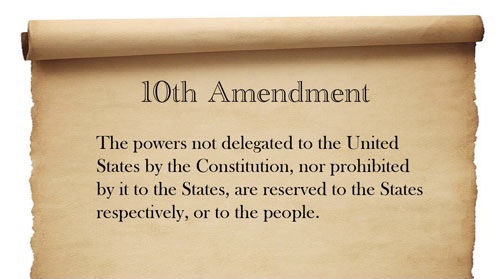
Conservative states can also resist federal efforts to control elections via nullification: arguably unconstitutional attempts by the federal government to regulate elections should not be recognized and enforced by states. Steve Baldwin asserts that the Tenth Amendment gives states the power to do so:

“The powers not delegated to the United States by the Constitution, nor prohibited by it to the States, are reserved to the States respectively, or to the people.”

There is, however, some ambiguity in Article I regarding the federal government‘s power to regulate elections. Despite the “secondary” nature of that federal power, it has certainly been invoked over the last 150 years, primarily in establishing voting rights previously denied on the basis of race and gender. H.R. 1 does not represent an unambiguous defense of voting rights of that kind, however. Instead, by facilitating fraud, it represents wholesale debasement of voting rights.

Let’s hope traditionally conservative states are aggressive in pressing their primary power to regulate elections on multiple fronts: legislative, nullification of federal overreach, as well as court challenges. And let’s hope H.R. 1 goes down to defeat in the Senate, but it will be tight.

Federal Strings and Executive Puppeteers

28 Thursday May 2015

Posted by Nuetzel in Big Government, Federalism, Regulation

≈ Leave a comment

Tags

Administrative State, Cooperative federalism, Executive federalism, Federalism, Michael S. Greve, Nullification, Tenth Amendment

federal bribes

We often think of government bureaucracy as a force of stasis, but it is unlikely to promote stability. At all levels, government administrative organs have a way of growing, absorbing increasing levels of resources and constricting private activity by imposing increasingly complex rules. A large administrative apparatus tends to calcify the economy, undermining growth or even a sustained level of economic activity. The negative consequences of the administrative state were treated twice on this blog last year.

Federalism, on the other hand, is usually viewed as a check on federal power relative to state governments. That was the perspective of “Nullifying the Federal Blob” last year on SCC. However, in “The Rise of Executive Federalism“, Michael S. Greve discusses forms of federalism that can serve as adjuncts or even alternatives to the exercise of federal legislative power. First, he discusses “cooperative federalism”, whereby lower levels of government receive federal funds and in turn administer federal programs:

“With very few exceptions…, virtually all federal domestic programs are administered by state and local governments, often under one of over 1,100 federal funding statutes (such as Medicaid or NCLB). Since its inception under the New Deal, this ‘cooperative’ federalism has proven stupendously successful in doing what it was supposed to do: expand government at all levels.“

Greve draws a connection between political and economic developments over recent decades, the coincident decline of cooperative federalism and the rise of a more aggressive “executive federalism”. These developments include constraints on funding at both the federal and state levels, a decline in the willingness of states to cooperate on certain programs, and a divided Congress. No funding, no federal-state cooperation and no federal legislative direction leaves a vacuum to be filled by federal executive initiative:

“Thus, to make federal programs ‘work’ under current conditions, agencies rewrite statutes, issue expansive waivers, and negotiate deals with individual states on a one-off basis. That is how the ACA is being ‘administered.’ That is how Secretary of Health and Human Services Sylvia Burwell is trying to expand Medicaid. That is how No Child Left Behind is run. And that is how Environmental Protection Agency is trying to impose its Clean Power Plan: ‘stakeholder meetings’ and assurances of regulatory forbearance for cooperating states; unveiled threats against holdout states. This brand of federalism knows neither statutory compliance nor even administrative regularity. It is executive federalism.“

It does not bode well that this perverse form of federalism “is robust to partisan politics.” Greve notes that certain aspects of executive federalism were initiated by the Reagan Administration.

Greve’s advice on combating this trend is to make federalism “less cooperative, one program at a time.” While he’s a little short on specifics, he advises that initiatives such as block grants to states are likely to be counterproductive in restoring traditional federalism. One point on which I part company with Greve is his disparaging reference to “state’s rights” as a battle of “yesterday”. I suspect his underlying objection (which I do not share) is drug legalization at the state level, or any other measure that he might find morally objectionable. Otherwise, I have no issue with what I take to be his favored approach, which seems to involve any assault on the exercise of federal administrative power and rule-making, whether that is through the courts or the exercise of nullification by the states. It is promising that so many states are resisting the imposition of additional administrative and funding burdens attendant to expansive federal sweeteners and control.

Nullifying The Federal Blob

17 Tuesday Feb 2015

Posted by Nuetzel in Uncategorized

≈ 1 Comment

Tags

Article 5 convention, Barton Hinkle, CATO Institute, Constitutional convention, enumerated powers, Federalism, Nullification, Robert Levy, State's Rights, Tenth Amendment Center, The Hill

nullify-obamacare_big

When must a state acquiesce to the demands of the federal government? The question is not as straightforward as many believe. The U.S. Constitution is fairly explicit in “enumerating” the federal government’s powers, which at least tells us that the answer must be “sometimes,” not simply always or never. Powers not specifically granted to the federal  government are generally reserved by the states. This is the principle of federalism, but in practice it leaves plenty of room for disagreement. The federal government has grown enormously in size and in the scope of its activities. It seems inevitable that tensions will arise over specific questions about the limits of federal authority. And over time, in response to challenges, the courts have interpreted some of the enumerated powers more expansively. There is an ongoing debate over what avenues, in addition to the courts, states may follow in challenging federal power. Some have framed it as a debate over state “nullification” of specific federal laws versus a constitutional convention to establish clearer limits on the reach of federal power.

Recently, nullification has been all the rage, as this article in The Hill makes clear. So-called “mandates” often require states to enforce federal laws, which is likely to provoke some objections. And major pieces of federal legislation have become so complex that details must be sorted out by the administrative agencies in charge of implementation. This involves lots of rule-making and delegation of authority that has frequently imposed burdens on state governments. States are increasingly refusing to cooperate. From The Hill:

“The legislative onslaught, which includes bills targeting federal restrictions on firearms, experimental treatments and hemp, reflects growing discord between the states and Washington, state officials say. …

Friction between the states and the federal government dates back to the nation’s earliest days. But there has been an explosion of bills in the last year, according to the Los Angeles-based Tenth Amendment Center, which advocates for the state use of nullification to tamp down on overzealous regulation.”

Later in the same article, the author discusses an effort to organize a constitutional convention:

“… conservatives are pushing for states to invoke Article 5 of the Constitution and hold a ‘convention of states’ to restrict the power and jurisdiction of the federal government. The group Citizens for Self-Government is leading the charge, and three states — Alaska, Georgia and Florida — have already passed resolutions calling for the convention. Another 26 states are considering legislation this year, according to the group’s president, Mark Meckler. It would take 34 states to call a convention. At the convention, Meckler said the states would work to pass amendments that impose fiscal restraints, regulatory restrictions and term limits on federal officials, including members of the Supreme Court. ‘We’ll have [Article 5] applications pending in 41 states within the next few weeks,’ he said. ‘The goal is to hold a convention in 2016.’”

Libertarians are split on the issues of nullification and a constitutional convention. The latter  is addressed by A. Barton Hinkle in Reason, who questions the necessity of a convention and sees certain risks in the effort, such as new provisions that could “backfire”, the possibility of a “runaway convention”, and efforts to riddle the Constitution with “primary laws,” rather than merely improving it as a framework for governing how we are governed.

As for nullification, Robert Levy, board chairman of The CATO Institute, distinguishes between situations in which a state is asked to enforce a federal law and those involving federal enforcement of a law deemed to be unconstitutional by a state. He asserts that states cannot resolve the latter type of dispute via nullification:

“Fans of nullification count on the states to check federal tyranny. But sometimes it cuts the other way; states are also tyrannical. Indeed, if state and local governments could invalidate federal law, Virginia would have continued its ban on inter-racial marriages; Texas might still be jailing gay people for consensual sex; and constructive gun bans would remain in effect in Chicago and elsewhere.

… If a state deems a federal law to be unconstitutional, what’s the proper remedy? The answer is straightforward. Because the Supreme Court is the ultimate authority, the remedy is a lawsuit challenging the constitutionality of the suspect federal regulation or statute.”

Not surprisingly, the Tenth Amendment Center strongly disagrees with the limits on nullification described by Levy:

“Levy’s entire argument rests on the idea that the federal courts possess the sole and final authority to determine the constitutionality of an act. … Levy never addresses the fundamental question facing those who oppose nullification: how does one reconcile the undeniable fact that the state ratifying conventions adopted the Constitution with the understanding that it was creating a general government with specific, limited powers and the idea that a branch of that very same federal government has the final say on the extent of its own powers? Quite simply, you can’t.”

These recent efforts to reign in the federal government are exciting. I am watching the progress of the Article 5 convention effort with great interest. I am not sure I buy into Levy’s arguments against nullification because checks on power should cut both ways: the Constitution allows states to retain powers not specifically granted to the federal government, so the states should guard those powers jealously. It matters not whether the question involves state enforcement of a federal law or a federal law that violates states rights. Likewise, powers specifically granted to the federal government should serve as a check on “state-level tyranny”. Again, that leaves plenty of room for disagreement before the courts.

Follow Sacred Cow Chips on WordPress.com

Recent Posts

  • The Case Against Interest On Reserves
  • Immigration and Merit As Fiscal Propositions
  • Tariff “Dividend” From An Indigent State
  • Almost Looks Like the Fed Has a 3% Inflation Target
  • Government Malpractice Breeds Health Care Havoc

Archives

  • January 2026
  • December 2025
  • November 2025
  • October 2025
  • September 2025
  • August 2025
  • July 2025
  • June 2025
  • May 2025
  • April 2025
  • March 2025
  • February 2025
  • January 2025
  • December 2024
  • November 2024
  • October 2024
  • September 2024
  • August 2024
  • July 2024
  • June 2024
  • May 2024
  • April 2024
  • March 2024
  • February 2024
  • January 2024
  • December 2023
  • November 2023
  • August 2023
  • July 2023
  • June 2023
  • May 2023
  • April 2023
  • March 2023
  • February 2023
  • January 2023
  • December 2022
  • November 2022
  • October 2022
  • September 2022
  • August 2022
  • July 2022
  • June 2022
  • May 2022
  • April 2022
  • March 2022
  • February 2022
  • January 2022
  • December 2021
  • November 2021
  • October 2021
  • September 2021
  • August 2021
  • July 2021
  • June 2021
  • May 2021
  • April 2021
  • March 2021
  • February 2021
  • January 2021
  • December 2020
  • November 2020
  • October 2020
  • September 2020
  • August 2020
  • July 2020
  • June 2020
  • May 2020
  • April 2020
  • March 2020
  • February 2020
  • January 2020
  • December 2019
  • November 2019
  • October 2019
  • September 2019
  • August 2019
  • July 2019
  • June 2019
  • May 2019
  • April 2019
  • March 2019
  • February 2019
  • January 2019
  • December 2018
  • November 2018
  • October 2018
  • September 2018
  • August 2018
  • July 2018
  • June 2018
  • May 2018
  • April 2018
  • March 2018
  • February 2018
  • January 2018
  • December 2017
  • November 2017
  • October 2017
  • September 2017
  • August 2017
  • July 2017
  • June 2017
  • May 2017
  • April 2017
  • March 2017
  • February 2017
  • January 2017
  • December 2016
  • November 2016
  • October 2016
  • September 2016
  • August 2016
  • July 2016
  • June 2016
  • May 2016
  • April 2016
  • March 2016
  • February 2016
  • January 2016
  • December 2015
  • November 2015
  • October 2015
  • September 2015
  • August 2015
  • July 2015
  • June 2015
  • May 2015
  • April 2015
  • March 2015
  • February 2015
  • January 2015
  • December 2014
  • November 2014
  • October 2014
  • September 2014
  • August 2014
  • July 2014
  • June 2014
  • May 2014
  • April 2014
  • March 2014

Blogs I Follow

  • Passive Income Kickstart
  • OnlyFinance.net
  • TLC Cholesterol
  • Nintil
  • kendunning.net
  • DCWhispers.com
  • Hoong-Wai in the UK
  • Marginal REVOLUTION
  • Stlouis
  • Watts Up With That?
  • Aussie Nationalist Blog
  • American Elephants
  • The View from Alexandria
  • The Gymnasium
  • A Force for Good
  • Notes On Liberty
  • troymo
  • SUNDAY BLOG Stephanie Sievers
  • Miss Lou Acquiring Lore
  • Your Well Wisher Program
  • Objectivism In Depth
  • RobotEnomics
  • Orderstatistic
  • Paradigm Library
  • Scattered Showers and Quicksand

Blog at WordPress.com.

Passive Income Kickstart

OnlyFinance.net

TLC Cholesterol

Nintil

To estimate, compare, distinguish, discuss, and trace to its principal sources everything

kendunning.net

The Future is Ours to Create

DCWhispers.com

Hoong-Wai in the UK

A Commonwealth immigrant's perspective on the UK's public arena.

Marginal REVOLUTION

Small Steps Toward A Much Better World

Stlouis

Watts Up With That?

The world's most viewed site on global warming and climate change

Aussie Nationalist Blog

Commentary from a Paleoconservative and Nationalist perspective

American Elephants

Defending Life, Liberty and the Pursuit of Happiness

The View from Alexandria

In advanced civilizations the period loosely called Alexandrian is usually associated with flexible morals, perfunctory religion, populist standards and cosmopolitan tastes, feminism, exotic cults, and the rapid turnover of high and low fads---in short, a falling away (which is all that decadence means) from the strictness of traditional rules, embodied in character and inforced from within. -- Jacques Barzun

The Gymnasium

A place for reason, politics, economics, and faith steeped in the classical liberal tradition

A Force for Good

How economics, morality, and markets combine

Notes On Liberty

Spontaneous thoughts on a humble creed

troymo

SUNDAY BLOG Stephanie Sievers

Escaping the everyday life with photographs from my travels

Miss Lou Acquiring Lore

Gallery of Life...

Your Well Wisher Program

Attempt to solve commonly known problems…

Objectivism In Depth

Exploring Ayn Rand's revolutionary philosophy.

RobotEnomics

(A)n (I)ntelligent Future

Orderstatistic

Economics, chess and anything else on my mind.

Paradigm Library

OODA Looping

Scattered Showers and Quicksand

Musings on science, investing, finance, economics, politics, and probably fly fishing.

  • Subscribe Subscribed
    • Sacred Cow Chips
    • Join 128 other subscribers
    • Already have a WordPress.com account? Log in now.
    • Sacred Cow Chips
    • Subscribe Subscribed
    • Sign up
    • Log in
    • Report this content
    • View site in Reader
    • Manage subscriptions
    • Collapse this bar
 

Loading Comments...