• About

Sacred Cow Chips

Sacred Cow Chips

Tag Archives: Office of Management and Budget

Biden OMB Suggests Minimal Discounts of Future Benefits

28 Wednesday Jun 2023

Posted by Nuetzel in Big Government, Risk, Tradeoffs

≈ Leave a comment

Tags

Administrative State, Certainty Equivalent, Consumer Price Index, Discount Rate, John Cochrane, Joshua Rauh, MIT, Modernizing Regulatory Review, Office of Management and Budget, Present Value, Real Interest Rate, Regulatory Impact Analysis, Risk-Free Rate, TIPS, Tradeoffs, Treasury Bonds, Unintended Consequences
Tweaks to the projected costs and benefits of prospective regulations or programs can be a great way to encourage domination of resources and society by the state. Of course, public policy ideas will never receive serious consideration unless their “expected” benefits exceed costs. It’s therefore critical that the validity of cost and benefit estimates — to say nothing of their objectivity — are always subject to careful review. By no means does that ensure that the projections are reasonable, however.

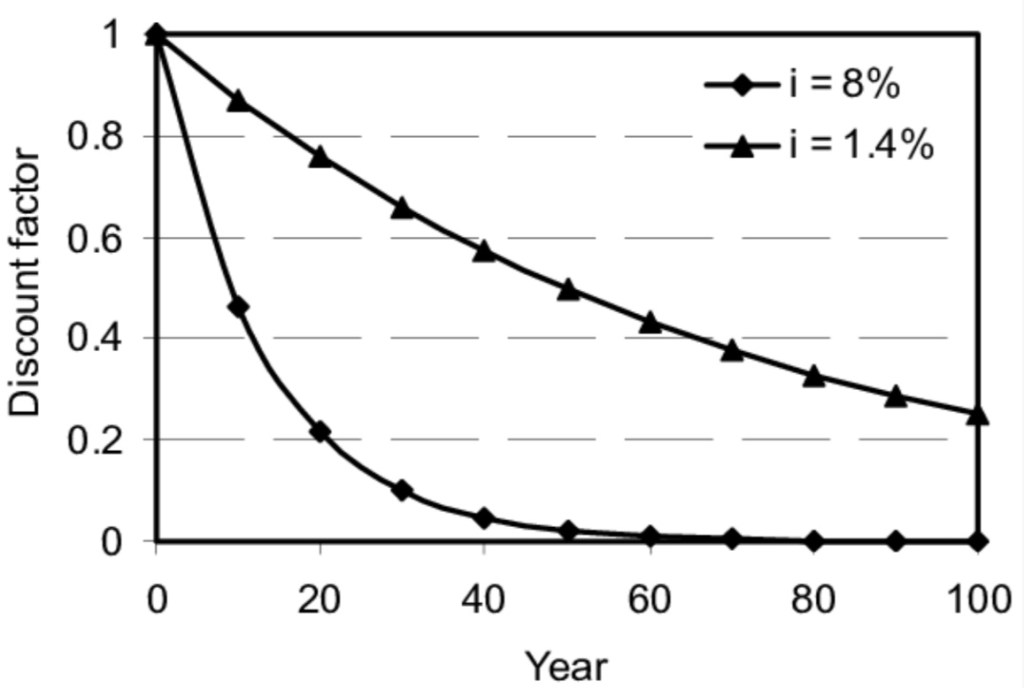
Traditionally less scrutinized is the rate at which the future costs and benefits of a program or regulation are discounted into present value terms. The discount rate can have a tremendous impact on the comparison of costs and benefits when their timing differs significantly, which is usually the case.

Intertemporal Tradeoffs

People generally aren’t willing to forsake present pleasure without at least a decent prospect of future gain. Thus, we observe that the deferral of $1 of consumption today generally brings a reward of more than $1 of future consumption. That’s made possible by the existence of productive opportunities for the use of resources. These opportunities, and the freedom to exploit them, allow a favorable tradeoff at which we transform resources across time for the benefit of both our older selves and our progeny. The interaction of savers and investors in such opportunities results in an equilibrium interest rate balancing the supply and demand for saving.

We can restate the tradeoff to demonstrate the logic of discounting. That is, the promise of $1 in the future induces the voluntary deferral of less than $1 of consumption today. To arrive at the amount of the deferral, the promised $1 in the future is discounted at the consumer’s rate of time preference. The promised $1 must cover the initial deferral of consumption plus the consumer’s perceived opportunity cost of lost consumption in the present, or else the “trade” won’t happen.

Discounting practices are broadly embedded in the economy. They provide a rational basis of evaluating inter-temporal tradeoffs. The calculation of net present values (NPVs) and internal rates of return (the discount rate at which NPV = 0) are standard practices for capital budgeting decisions in the private sector. Public-sector cost-benefit analysis often makes use of discounting methodology as well, which is unequivocally good as long as the process is not rigged.

Government Discounting

The Office of Management and Budget (OMB) provides guidance to federal agencies on matters like cost-benefit analysis. As part of a recent proposal that was prompted by executive orders on “Modernizing Regulatory Review” from the Biden Administration, the OMB has recommended revisions to a 2003 Circular entitled “Regulatory Analysis”. A major aspect of the proposal is a downward adjustment to recommended discount rates, largely dressed up as an update for “changes in market conditions”.

Since 2003, the OMB’s guidance on discount rates called for use of a historical average rate on 10-year government bonds. Before averaging, the rate was converted to a “real rate” in each period by subtracting the rate of increase in the Consumer Price Index (CPI). The baseline discount rate of 3% was taken from the average of that real rate over the 30 years ending in 2002. There has been an alternative discount rate of 7% under the existing guidance intended as a nod to the private costs of capital, but it’s not clear how seriously agencies took this higher value.

The new proposal seeks to update the calculation of recommended discount rates by using more recent data on Treasury rates and inflation. One aspect of the proposal is to utilize the rate on 10-year inflation-indexed Treasury bonds (TIPS) for the years in which it is available (2003-2022). The first ten years of the “new” 30-year average would use the previous methodology. However, the proposal gives examples of how other methods would change the resulting discount rate and requests comments on the most appropriate method of updating the calculation of the 30-year average.

The new baseline discount rate proposed by OMB is 1.7%, and it is lower still for very distant flows of benefits. This is intended as a real, after-tax discount rate on Treasury bonds. It represents an average (and ex post) risk-free rate on bonds held to maturity over the historical period in question, calculated as described by OMB. However, like the earlier guidance, it is not prospective in any sense. And of course it is quite low!

Our Poor Little Rich Ancestors

The projected benefits of regulations or other public initiatives can be highly dubious in the first place. Unintended consequences are the rule rather than the exception. Furthermore, even modest economic growth over several generations will leave our ancestors with far more income and wealth than we have at our disposal today. That means their ability to adapt to changes will be far superior, and they will have access to technologies making our current efforts seem quaint.

Now here’s the thing: discounting the presumed benefits of government intervention at a low rate would drastically inflate their present value. John Cochrane uses an extreme case to illustrate the point. Suppose a climate policy is projected to avoid costs equivalent to 5% of GDP 100 years from now. Those avoided costs would represent a gigantic sum! By then, at just 2% growth, real GDP will be over seven times larger than this year’s output. Cochrane calculates that 5% of real GDP in 2123 is equivalent to 37% of 2023 real GDP. And the presumed cost saving goes on forever.

We can calculate the present value of the climate policy’s benefits to determine whether it’s greater than the proposed cost of the policy. Let’s choose a fairly low discount rate like … oh, say zero. In that case, the present value is infinite, and it is infinite at any discount rate below 2% (such as 1.7%). That’s because the benefits grow at 2% (like real GDP) and go on forever! That’s faster than the diminishing effect of discounting on present value. In mathematical terms, the series does not converge. Of course, this is not discounting. It is non-discounting. Cochrane’s point, however, is that if you take these calculations seriously, you’d be crazy not to implement the policy at any finite cost! You shouldn’t mind the new taxes at all! Or the inflation tax induced by more deficit spending! Or higher regulatory costs passed along to you as a consumer! So just stop your bitching!

Formal Comments to OMB

If Cochrane’s example isn’t enough to convince you of the boneheadedness of the OMB proposal, there are several theoretical reasons to balk. Cochrane provides links to a couple of formal comments submitted to OMB. Joshua Rauh of the Stanford Business School details a few fundamental objections. His first point is that a regulatory impact analysis (RIA), or the evaluation of any other initiative, “should be based on market conditions that prevail at the time of the RIA”. In other words, the choice of a discount rate should not rely on an average over a lengthy historical period. Second, it is unrealistic to assume that the benefits and costs of proposed regulations are risk-free. In fact, unlike Treasury securities, these future streams are quite risky, and they are not tradable, and they are not liquid.

Rauh also notes that the OMB’s proposed decline in discount rates to be applied to benefits or cash flows in more distant periods has no reliable empirical basis. He believes that results based on a constant discount rate should at least be reported. Moreover, agencies should be required to offer justification for their choice of a discount rate relative to the risks inherent in the streams of costs and benefits on any new project or rule.

Rauh is skeptical of recommendations that agencies should add a theoretical risk premium to a risk-free rate, however, despite the analytical superiority of that approach. Instead, he endorses the simplicity of the OMB’s previous guidance for discount rates of 3% and 7%. But he also proposes that RIAs should always include “the complete undiscounted streams of both benefits and costs…”. If there are distributions of possible cost and benefit streams, then multiple streams should be included.

Furthermore, Rauh says that agencies should not recast streams of benefits in the form of certainty equivalents, which interpose various forms of objective functions in order to calculate a “fair guarantee”, rather than a range of actual outcomes. Instead, Rauh insists that straightforward expected values should be used, This is for the sake of transparency and to enable independent assessment of RIAs.

Another comment on the OMB proposal comes from a group of economists at MIT. They have fewer qualms than Rauh regarding the use of risk-adjusted discount rates by government agencies. In addition, they note that risk in the private sector can often be ameliorated by diversification, whereas risks inherent in public policy must be absorbed by changes in taxes, government spending, or unintended costs inflicted on the private sector. Taxpayers, those having stakes in other programs, and the general public bear these risks. Using Treasury rates for discounting presumes that bad outcomes have no cost to society!

Conclusion

Discounting the costs and benefits of proposed regulations and other government programs should be performed with discount rates that reflect risks. Treasury rates are wholly inappropriate as they are essentially risk-free over time horizons often much shorter than the streams of benefits and costs to be discounted. The OMB proposal might be a case of simple thoughtlessness, but I doubt it. To my mind, it aligns a little too neatly with the often expansive agenda of the administrative state. It would add to what is already a strong bias in favor of regulatory action and government absorption of resources. Champions of government intervention are prone to exaggerate the flow of benefits from their pet projects, and low discount rates exaggerate the political advantages they seek. That bias comes at the expense of the private sector and economic growth, where inter-temporal tradeoffs and risks are exploited only at more rational discounts and then tested by markets.

Trump Budget Facts and Falsehoods

02 Friday Jun 2017

Posted by Nuetzel in Federal Budget, Government, Trump Administration

≈ Leave a comment

Tags

Administrative State, Baseline Budget, Budget Reconciliation, Deficit Reduction, Double Counting, Dynamic Scoring, Lawrence Summers, Math Error, Obamacare, Office of Management and Budget, Repeal and Replace, Revenue Neutrality, Ryan McMaken, Spending Priorities, Static Scoring, Steve Bannon, Tax Reform, Trump Budget, Welfare reform

The innumerate left is unhappy over cuts in various categories of spending in the budget proposal submitted by the Trump Administration last week. However, they have adopted “talking points” that are incorrect in an effort to rail against the budget. There is no reduction in overall spending in the proposal. Instead, there is a reduction in the growth of total spending. Ryan McMaken calls the mistaken assertions about spending “the media version of ‘cuts’“. The budget plan calls for an increase in total spending of 41% ($1.7 trillion) by 2027, versus 63% ($2.6 trillion) under the baseline (based on current law). Many of the actual cuts and growth reductions are in so-called discretionary spending. However, in one key mandatory component, Medicaid, spending increases by 39% under the plan, or $146 billion, versus 82% under the baseline. That is not a spending cut.

Another issue over which the Trump budget has been attacked is the so-called “math error,” or “double counting” of economic growth, to which former Treasury Secretary Lawrence Summers alluded with apparent delight. The gist of it is that the proposal somehow double-counted the salutary effects of growth in eliminating the projected deficit over the next ten years. In other words, the tax cuts proposed by Trump would be not just revenue-neutral due to stronger growth; they would result in an increase in tax revenue sufficient to eliminate the deficit by 2027.

Thus far, the Trump tax reform plan has been revealed in only a one-page summary released in late April. In static terms, it implied a loss of revenue of $5 trillion over ten years, though the summary left many features unclear. There could be additional provisions to broaden the tax base that might bring the ten-year static revenue loss down to somewhere between $3 and $4 trillion. In dynamic terms, however, the impact of the tax cuts would be smaller. The cuts would stimulate the economy (yes, they would!), but the precise impact on growth is unknown. In the budget, economic growth is assumed to increase from 1.8% to 3.0% annually over most of the ten year period. That has been criticized as unrealistic, but such a boost would likely be enough to make the tax cuts revenue neutral.

Here is a summary of the budget from the Office of Management and Budget (OMB). The tables at the back of the document, on pages 27 and 29, provide enough information on the cumulative ten-year changes to evaluate Summers’ double-counting claim. Keep in mind that his claim applies to changes expressed relative to a baseline. The proposed budget shows a total ten-year deficit projection of $3.2 trillion, compared to baseline of $6.7 trillion. So the deficits are reduced by a total of $3.5 trillion over the full ten years.

Individual and corporate income tax receipts are virtually unchanged over the ten-year period. There’s our revenue neutrality. Other receipts are down by $0.9 trillion, however. Most of that decline is attributed to a $1 trillion “allowance for repeal and replacement of Obamacare”, presumably elimination of taxes on such things as medical devices, Cadillac insurance policies, and fines for failing to comply with insurance mandates. So increased tax revenues do not account for the decline in the budget deficit.

Total cumulative outlays are reduced by $4.6 trillion in the budget proposal relative to the baseline. That more than accounts for the ten-year deficit reduction. Like the policies or not, the decline in spending is sufficient, relative to the baseline, to fully explain the deficit reduction. Yes, the budget assumes that some of the spending reductions are afforded by the faster assumed rate of economic growth, such as welfare payments, but that is not double-counting.

Revenue neutrality of the tax cuts is certainly an assumption worth questioning, especially because the summary of the tax plan gave every impression of abandoning neutrality. Neutrality was probably imposed on the budget plan as a matter of convenience. In a sense, it made the job of presenting the Administration’s spending priorities (like them or not) a cleaner exercise. For another, while budget reconciliation rules do not require the tax plan to be revenue neutral, Senate leaders have stated their strong desire for neutrality. The Trump budget proposal thereby allows Congress’ budget process to get underway while deferring the introduction of a more detailed and potentially controversial tax plan, one that is obviously still in flux and is likely to involve a loss of revenue, even in a dynamic sense.

The assumed change in economic growth is not solely attributable to tax effects, however. It would be reasonable to expect some growth to be driven by deregulation and the “deconstruction of the administrative state“, as Steve Bannon described so eloquently. This intention is embodied in the budget proposal. In that sense, it was unnecessary for OMB to impose revenue neutrality of the tax plan to eliminate the budget deficit over ten years. The economic growth spurred by deregulation would generate some of the extra growth in tax revenue.

I happen to like many of the priorities expressed in the proposed budget, despite the document’s lack of specificity. This includes the deregulatory initiatives, Obamacare repeal and replacement (we’re waiting…), and some of the welfare reform proposals. I am not happy about the scale of the shift toward defense, and I am not happy that government continues to grow in the aggregate. And as for the still-incubating tax reform plan, I like many of the features originally described, though not all.

Many believe that the Administration’s economic growth assumptions are unrealistic, and many dislike the spending priorities. Those cannot be used as excuses for mischaracterizing the proposal, however. Reductions in some spending categories occur only relative to the baseline growth path. They are not real cuts in spending. Likewise, Summers’ double-counting allegation is false. The recovery of tax revenue via economic growth is not double counted, and there is no “math error”. The proposed reductions in spending relative to the baseline more than account for the deficit reduction. I suspect that Summers’ motives were strictly polemic and not grounded in a careful examination of the budget proposal. He is not innumerate. What’s worse, a number of economists swallowed the “double-counting” story hook, line, and sinker.

Follow Sacred Cow Chips on WordPress.com

Recent Posts

  • Immigration and Merit As Fiscal Propositions
  • Tariff “Dividend” From An Indigent State
  • Almost Looks Like the Fed Has a 3% Inflation Target
  • Government Malpractice Breeds Health Care Havoc
  • A Tax On Imports Takes a Toll on Exports

Archives

  • December 2025
  • November 2025
  • October 2025
  • September 2025
  • August 2025
  • July 2025
  • June 2025
  • May 2025
  • April 2025
  • March 2025
  • February 2025
  • January 2025
  • December 2024
  • November 2024
  • October 2024
  • September 2024
  • August 2024
  • July 2024
  • June 2024
  • May 2024
  • April 2024
  • March 2024
  • February 2024
  • January 2024
  • December 2023
  • November 2023
  • August 2023
  • July 2023
  • June 2023
  • May 2023
  • April 2023
  • March 2023
  • February 2023
  • January 2023
  • December 2022
  • November 2022
  • October 2022
  • September 2022
  • August 2022
  • July 2022
  • June 2022
  • May 2022
  • April 2022
  • March 2022
  • February 2022
  • January 2022
  • December 2021
  • November 2021
  • October 2021
  • September 2021
  • August 2021
  • July 2021
  • June 2021
  • May 2021
  • April 2021
  • March 2021
  • February 2021
  • January 2021
  • December 2020
  • November 2020
  • October 2020
  • September 2020
  • August 2020
  • July 2020
  • June 2020
  • May 2020
  • April 2020
  • March 2020
  • February 2020
  • January 2020
  • December 2019
  • November 2019
  • October 2019
  • September 2019
  • August 2019
  • July 2019
  • June 2019
  • May 2019
  • April 2019
  • March 2019
  • February 2019
  • January 2019
  • December 2018
  • November 2018
  • October 2018
  • September 2018
  • August 2018
  • July 2018
  • June 2018
  • May 2018
  • April 2018
  • March 2018
  • February 2018
  • January 2018
  • December 2017
  • November 2017
  • October 2017
  • September 2017
  • August 2017
  • July 2017
  • June 2017
  • May 2017
  • April 2017
  • March 2017
  • February 2017
  • January 2017
  • December 2016
  • November 2016
  • October 2016
  • September 2016
  • August 2016
  • July 2016
  • June 2016
  • May 2016
  • April 2016
  • March 2016
  • February 2016
  • January 2016
  • December 2015
  • November 2015
  • October 2015
  • September 2015
  • August 2015
  • July 2015
  • June 2015
  • May 2015
  • April 2015
  • March 2015
  • February 2015
  • January 2015
  • December 2014
  • November 2014
  • October 2014
  • September 2014
  • August 2014
  • July 2014
  • June 2014
  • May 2014
  • April 2014
  • March 2014

Blogs I Follow

  • Passive Income Kickstart
  • OnlyFinance.net
  • TLC Cholesterol
  • Nintil
  • kendunning.net
  • DCWhispers.com
  • Hoong-Wai in the UK
  • Marginal REVOLUTION
  • Stlouis
  • Watts Up With That?
  • Aussie Nationalist Blog
  • American Elephants
  • The View from Alexandria
  • The Gymnasium
  • A Force for Good
  • Notes On Liberty
  • troymo
  • SUNDAY BLOG Stephanie Sievers
  • Miss Lou Acquiring Lore
  • Your Well Wisher Program
  • Objectivism In Depth
  • RobotEnomics
  • Orderstatistic
  • Paradigm Library
  • Scattered Showers and Quicksand

Blog at WordPress.com.

Passive Income Kickstart

OnlyFinance.net

TLC Cholesterol

Nintil

To estimate, compare, distinguish, discuss, and trace to its principal sources everything

kendunning.net

The Future is Ours to Create

DCWhispers.com

Hoong-Wai in the UK

A Commonwealth immigrant's perspective on the UK's public arena.

Marginal REVOLUTION

Small Steps Toward A Much Better World

Stlouis

Watts Up With That?

The world's most viewed site on global warming and climate change

Aussie Nationalist Blog

Commentary from a Paleoconservative and Nationalist perspective

American Elephants

Defending Life, Liberty and the Pursuit of Happiness

The View from Alexandria

In advanced civilizations the period loosely called Alexandrian is usually associated with flexible morals, perfunctory religion, populist standards and cosmopolitan tastes, feminism, exotic cults, and the rapid turnover of high and low fads---in short, a falling away (which is all that decadence means) from the strictness of traditional rules, embodied in character and inforced from within. -- Jacques Barzun

The Gymnasium

A place for reason, politics, economics, and faith steeped in the classical liberal tradition

A Force for Good

How economics, morality, and markets combine

Notes On Liberty

Spontaneous thoughts on a humble creed

troymo

SUNDAY BLOG Stephanie Sievers

Escaping the everyday life with photographs from my travels

Miss Lou Acquiring Lore

Gallery of Life...

Your Well Wisher Program

Attempt to solve commonly known problems…

Objectivism In Depth

Exploring Ayn Rand's revolutionary philosophy.

RobotEnomics

(A)n (I)ntelligent Future

Orderstatistic

Economics, chess and anything else on my mind.

Paradigm Library

OODA Looping

Scattered Showers and Quicksand

Musings on science, investing, finance, economics, politics, and probably fly fishing.

  • Subscribe Subscribed
    • Sacred Cow Chips
    • Join 128 other subscribers
    • Already have a WordPress.com account? Log in now.
    • Sacred Cow Chips
    • Subscribe Subscribed
    • Sign up
    • Log in
    • Report this content
    • View site in Reader
    • Manage subscriptions
    • Collapse this bar
 

Loading Comments...