• About

Sacred Cow Chips

Sacred Cow Chips

Tag Archives: Paul Driessen

Hurricane—Warming Link Is All Model, No Data

18 Tuesday Oct 2022

Posted by Nuetzel in Climate science, Hurricanes, Uncategorized

≈ 2 Comments

Tags

Carbon Forcing Models, carbon Sensitivity, Climate Alarmism, Geophysical Fluid Dynamics Laboratory, Glenn Reynolds, Greenhouse Gases, Hurricane Ian, Hurricane Models, IPCC, Model Calibration, Named Storms, National Hurricane Center, National Oceanic and Atmospheric Administration, Neil L. Frank, NOAA, Paul Driessen, Roger Pielke Jr., Ron DeSantis, Ryan Maue, Satellite Data, Tropical Cyclones
There was deep disappointment among political opponents of Florida Governor Ron DeSantis at their inability to pin blame on him for Hurricane Ian’s destruction. It was a terrible hurricane, but they so wanted it to be “Hurricane Hitler”, as Glenn Reynolds noted with tongue in cheek. That just didn’t work out for them, given DeSantis’ competent performance in marshaling resources for aid and cleanup from the storm. Their last ditch refuge was to condemn DeSantis for dismissing the connection they presume to exist between climate change and hurricane frequency and intensity. That criticism didn’t seem to stick, however, and it shouldn’t.

There is no linkage to climate change in actual data on tropical cyclones. It is a myth. Yes, models of hurricane activity have been constructed that embed assumptions leading to predictions of more hurricanes, and more intense hurricanes, as temperatures rise. But these are models constructed as simplified representations of hurricane development. The following quote from the climate modelers at the Geophysical Fluid Dynamics Laboratory (GFDL) (a division of the National Oceanic and Atmospheric Administration (NOAA)) is straightforward on this point (emphases are mine):

“Through research, GFDL scientists have concluded that it is premature to attribute past changes in hurricane activity to greenhouse warming, although simulated hurricanes tend to be more intense in a warmer climate. Other climate changes related to greenhouse warming, such as increases in vertical wind shear over the Caribbean, lead to fewer yet more intense hurricanes in the GFDL model projections for the late 21st century.

Models typically are said to be “calibrated” to historical data, but no one should take much comfort in that. As a long-time econometric modeler myself, I can say without reservation that such assurances are flimsy, especially with respect to “toy models” containing parameters that aren’t directly observable in the available data. In such a context, a modeler can take advantage of tremendous latitude in choosing parameters to include, sensitivities to assume for unknowns or unmeasured relationships, and historical samples for use in “calibration”. Sad to say, modelers can make these models do just about anything they want. The cautious approach to claims about model implications is a credit to GFDL.

Before I get to the evidence on hurricanes, it’s worth remembering that the entire edifice of climate alarmism relies not just on the temperature record, but on models based on other assumptions about the sensitivity of temperatures to CO2 concentration. The models relied upon to generate catastrophic warming assume very high sensitivity, and those models have a very poor track record of prediction. Estimates of sensitivity are highly uncertain, and this article cites research indicating that the IPCC’s assumptions about sensitivity are about 50% too high. And this article reviews recent findings that carbon sensitivity is even lower, about one-third of what many climate models assume. In addition, this research finds that sensitivities are nearly impossible to estimate from historical data with any precision because the record is plagued by different sources and types of atmospheric forcings, accompanying aerosol effects on climate, and differing half-lives of various greenhouse gases. If sensitivities are as low as discussed at the links above, it means that predictions of warming have been grossly exaggerated.

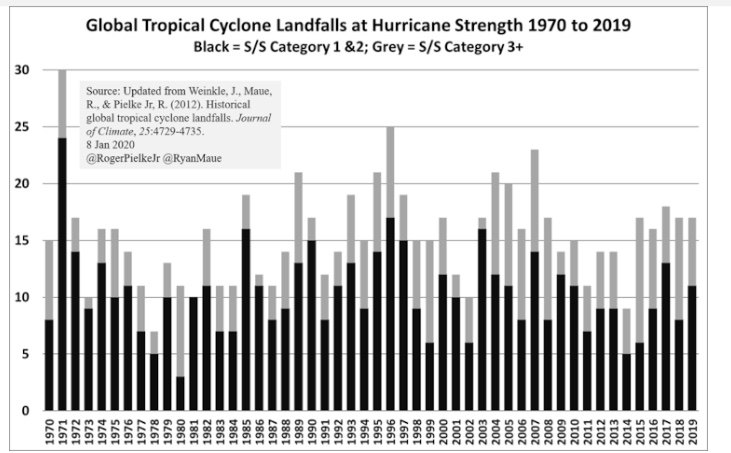
The evidence that hurricanes have become more frequent or severe, or that they now intensify more rapidly, is basically nonexistent. Ryan Maue and Roger Pielke Jr. of the University of Colorado have both researched hurricanes extensively for many years. They described their compilation of data on land-falling hurricanes in this Forbes piece in 2020. They point out that hurricane activity in older data is much more likely to be missing and undercounted, especially storms that never make landfall. That’s one of the reasons for the focus on landfalling hurricanes to begin with. With the advent of satellite data, storms are highly unlikely to be missed, but even landfalls have sometimes gone unreported historically. The farther back one goes, the less is known about the extent of hurricane activity, but Pielke and Maue feel that post-1970 data is fairly comprehensive.

The chart at the top of this post is a summery of the data that Pielke and Maue have compiled. There are no obvious trends in terms of the number of storms or their strength. The 1970s were quiet while the 90s were more turbulent. The absence of trends also characterizes NOAA’s data on U.S. landfalling hurricanes since 1851, as noted by Pail Driessen. Here is Driessen on Florida hurricane history:

“Using pressure, Ian was not the fourth-strongest hurricane in Florida history but the tenth. The strongest hurricane in U.S. history moved through the Florida Keys in 1935. Among other Florida hurricanes stronger than Ian was another Florida Keys storm in 1919. This was followed by the hurricanes in 1926 in Miami, the Palm Beach/Lake Okeechobee storm in 1928, the Keys in 1948, and Donna in 1960. We do not know how strong the hurricane in 1873 was, but it destroyed Punta Rassa with a 14-foot storm surge. Punta Rassa is located at the mouth of the river leading up to Ft. Myers, where Ian made landfall.”

Neil L. Frank, veteran meteorologist and former head of the National Hurricane Center, bemoans the changed conventions for assigning names to storms in the satellite era. A typical clash of warm and cold air will often produce thunderstorms and wind, but few of these types of systems were assigned names under older conventions. They are not typical of systems that usually produce tropical cyclones, although they can. Many of those kinds of storms are named today. Right or wrong, that gives the false impression of a trend in the number of named storms. Not only is it easier to identify storms today, given the advent of satellite data, but storms are assigned names more readily, even if they don’t strictly meet the definition of a tropical cyclone. It’s a wonder that certain policy advocates get away with saying the outcome of all this is a legitimate trend!

As Frank insists, there is no evidence of a trend toward more frequent and powerful hurricanes during the last several decades, and there is no evidence of rapid intensification. More importantly, there is no evidence that climate change is leading to more hurricane activity. It’s also worth noting that today we suffer far fewer casualties from hurricanes owing to much earlier warnings, better precautions, and better construction.

Beepocamyth: Neonics Don’t Kill the Buzz

08 Saturday Feb 2020

Posted by Nuetzel in Agriculture, Biodiversity, Environment, Risk

≈ 1 Comment

Tags

Beepocalypse, Colony Collapse Disorder, Fish & Wildlife Service, Genetic Literacy Project, Glyphosate, Jon Entine, Junk Science, Kayleen Schreiber, National Wildlife Refuges, Neonicotiniods, Neonics, Nydia Velázquez, Paul Driessen, Pesticides, Sierra Club

False claims that a certain class of pesticides threaten the world’s bee populations are commonplace, and we hear the same more recently about various species of birds. The origins of the “beepocalypse” rumor were not based on scientific evidence, but on a narrative that developed among environmental activists in response to a phenomenon called Colony Collapse Disorder (CCD) that began around 2006, roughly a decade after neonicotinoid pesticides (so-called neonics) replaced earlier, more toxic compounds as the pesticides of choice. But Jon Entine writes at The Genetic Literacy Project:

“What causes CCD? It still remains a mystery, in part. But researchers turned up historical examples of CCD-like bee die offs across the globe over hundreds of years, well before the introduction of pesticides, but activist groups would have none of it.”

CCD essentially tapered off by 2009, according to Entine, and the number of honeybee colonies are higher now that before the introduction of neonics. See Entine’s charts at the link showing changes in honeybee populations over time. In Australia, where the use of neonics has been especially heavy, bee populations have grown steadily and remain quite healthy.

Entine’s article provides a nice summary of the real and imagined threats to the world’s bee populations as well as distorted claims associated with normal winter die-offs. He provides a number of useful links on these subjects, and he summarizes research showing the lack of any real threat to bees from neonics:

“Over the past seven years, there have been a flood of studies about the potential impact of neonics on bees. Many small-scale, forced-feeding studies that generally overdosed bees with neonics found various negative effects; not a surprise, many entomologists have said, as they do not replicate real world impacts.

In contrast, a multitude of large-population field studies—the ‘gold-standard’ of bee research—have consistently demonstrated there are no serious adverse effects of neonic insecticides on honeybees at the colony level from field-realistic neonic exposure. …

By last year, even the Sierra Club—for years one of the leading proponents of the honeybee Armageddon narrative—was backpeddling, writing: ‘Honeybees are at no risk of dying off. While diseases, parasites and other threats are certainly real problems for beekeepers, the total number of managed honeybees worldwide has risen 45% over the last half century.'”

Then Entine turns his attention to another front in the war on pesticides: a Canadian study in which white-crowned sparrows were force-fed a mixture of seeds and pesticide via gavage — ie, through a tube:

“Only sparrows force-fed the highest dosage were affected, and then only temporarily. They stopped eating, quickly lost body weight and fat, became disoriented and paused their migratory flight—all after tube full of chemicals was forced down their throat and into their stomach. … That said, within a few days of what was likely a trauma-inducing experience, all recovered completely and continued their migration normally.”

Yet the authors reported that the very existence of some wild birds is threatened by neonics, and the media, always eager to report a crisis, ran with it.

Paul Driessen also describes the junk science underlying misleading narratives regarding pesticide use. It is a driving force behind legislation in the House and Senate that would ban the use of neonics in National Wildlife Refuges, where the Fish & Wildlife Service permits farmers to grow various crops. Driessen has some advice for Rep. Nydia Velázquez (D-NY), a sponsor of the legislation:

“She should also recognize potentially serious threats to bees, wildlife, soils, waters and plants in refuges from sources that she, her colleagues and their environmentalist and media allies routinely ignore: solar panels, for instance. Not only do they blanket many thousands of acres, allowing little to grow beneath or between them. They can also leach cadmium and other metals into soils and waters. They should no longer be built near wildlife refuges.

Finally, it’s not just bees. It’s also birds, and bats – which are already being killed and even eradicated in many areas by America’s 56,000 wind turbines. Imagine what Green New Deal turbine numbers would do.”

More perspective is offered in this excellent six-part (and growing?) “Pesticides and Food” series (all at the link) by Kayleen Schreiber:

  1. Has pesticide use decreased? Yes, dramatically in per capita and per unit of output.
  2. Have pesticides improved?  Yes, with dramatically lower toxicity, improved biodegradability, and lower use rates.
  3. How dangerous is glyphosate (a herbicide)? Not very. Covered in my last post. Glyphosate is only 1/10th as toxic as caffeine.
  4. How do organic pesticides compare to synthetic pesticides? It’s a mixed bag, with great variability across both classes. Organics are more toxic in some applications, and synthetics are more toxic in others.
  5. Soil health: Are synthetic pesticides more sustainable than “natural” organics?  Organics require more tillage, which creates sustainability problems.
  6. Pesticide residues — Something to worry about? The USDA finds little residue in its testing, with extremely low detection rates for both organics and synthetics.


April 22: Happy Human Achievement Day!

21 Sunday Apr 2019

Posted by Nuetzel in Free markets, Free Trade, Human Welfare, Uncategorized

≈ Leave a comment

Tags

Disease, Don Boudreaux, Earth Day, Fossil fuels, Free Markets, Human Ingenuity, Human Progress, Literacy, Marion Tupy, Paul Driessen, Poverty

By way of celebrating human ingenuity, I’ll be driving 600 miles on Monday in a beautiful sedan powered by high-octane fuel. I’ll be clothed in incredibly comfortable fibers and have access to a great variety of listening amusements via satellite. The celebration will continue when I arrive home. I’ll enjoy the comfort of climate-control, electric power, modern plumbing, a refrigerator and pantry full of agricultural bounty, delicious wine, and even more incredible access to entertainment and intellectual pursuits. But it’s not just the goods and technology I’ll celebrate. I’ll also raise a glass to the fabulous, free-market institutions that have made all this possible, effectively allowing us to trade with specialized producers all around the world at low cost, and at prices that signal the true scarcities of resources… ill-considered tariffs aside.

In honor of mankind’s great achievements, I bring you additional testimony from Don Boudreaux, who provides some juicy tidbits to mark our progress. Here is more from Marion Tupy at humanprogess.org. And one more link is from Paul Driessen, who last Thanksgiving wrote of the the many developments since 1800 that have drastically improved human well being, including the ability to exploit fossil fuels that are extremely clean-burning and efficient relative to primitive energy sources.

What riches we enjoy today! Contrary to the claims of doomsayers, busybodies, and self-appointed enforcers of an austere existence, our prospects for continued improvement in human standards of living are excellent. The long arc of technological progress has made the effective abundance of resources greater and more sustainable than ever. As the many charts in Tupy’s article demonstrate, long-term trends in real incomes, poverty, literacy, longevity and the incidence of disease are quite favorable. We owe all that to the spread of human ingenuity, freedom, and voluntary exchange. That’s truly progressive!

The Taxing Logic of Carbon Cost Guesswork

11 Saturday Mar 2017

Posted by Nuetzel in Environment, Taxes, Uncategorized

≈ 1 Comment

Tags

Anthopomorphic, Carbon Dividend, Carbon Tax, Climate Leadership Council, Corrective Taxation, External costs and benefits, Fossil fuels, Greg Mankiw, Martin Feldstein, Paul Driessen, Roger Besdek, Ronald Bailey, Ted Halstead, Universal Basic Inome, Watt's Up With That?

An article by three prominent economists* in the New York Times this week summarized the Climate Leadership Council’s Conservative Case for Climate Action“. The “four pillars” of this climate plan include (1) a revenue-neutral tax on carbon emissions, which are used to fund… (2) quarterly “carbon dividend” payments to all Americans; (3) border tax adjustments to account for carbon emissions and carbon taxes abroad; (4) eliminating all other regulations on emissions of carbon. The “Case” is thus a shift from traditional environmental regulation to a policy based on tax incentives, then wrapped around a redistributive universal income mechanism.

I’ll dispense with the latter “feature” by referencing my recent post on the universal basic income: bad idea! The economists advocate for the carbon dividend sincerely, but also perhaps as a political inducement to the left and confused centrists.

The Limits of Our Knowledge

The most interesting aspect of the “Case” is how it demonstrates uncertainty around the wisdom of carbon restrictions of any kind: traditional regulations, market-oriented trading, or tax incentives. Those all involve assumptions about the extent to which carbon emissions should be restricted, and it’s not clear that any one form of restriction is more ham-handed than another. Traditional regulation may restrict output in various ways. For example, standards on fuel efficiency are an indirect way of restricting output. A carbon market, with private trading in assigned “rights” to emit carbon, is more economically efficient in the sense that a tradeoff is involved for any decision having carbon implications at the margin. However, the establishment of a carbon market ultimately means that a limit must be imposed on the total quantity of rights available for trading.

A carbon tax imputes a cost of carbon emissions to society. It also imposes tradeoffs, so it is similar to carbon trading in being more economically efficient than traditional regulation. A producer can attempt to adjust a production process such that it emits less carbon, and the incidence of the tax falls partly on final consumers, who adjust the carbon intensity of their behavior accordingly. For our purposes here, a tax is more illuminating in the sense that we can assess inputs to the cost imputation. Even a cursory examination shows that the cost estimate can vary widely given reasonable differences in the inputs. So, in a sense, a tax helps to reveal the weakness of the case against carbon and the carbon-based rationale for allowing a coercive environmental authority to sclerose the arteries of the market system.

The three economists propose an initial tax of $40 per metric ton of emitted carbon. The basis for that figure is the so-called “social cost of carbon” (SCC), a theoretical construct that is not readily measured. Economists have long subscribed to the theory of social costs, or negative externalities, and to the legitimacy of government action to force cost causers to internalize social costs via corrective taxation. However, the wisdom of allowing the state to intrude upon markets in this way depends on our ability to actually measure specific external costs.

Fatuous Forecasts

The SCC is based on the presumed long-run costs of an incremental ton of carbon in the environment. I do not use the word “presumed” lightly. The $40 estimate subsumes a variety of speculative assumptions about the climate’s response to carbon emissions, the future economic impact of that response, and the rate at which society should be willing to trade those future costs against present costs. The figure only counts costs, without considering the huge potential benefits of warming, should it actually occur.

Ronald Bailey at Reason illustrates the many controversies surrounding the calculation of the SCC. He notes the tremendous uncertainty surrounding an Obama Administration estimate of $36 a ton in 2007 dollars. It used an outdated climate sensitivity figure much higher than more recent estimates, which would bring the calculated SCC down to just $16.

A discount rate of 3% was applied to projected future carbon costs to produce an SCC in present value terms. The idea is that today’s “collective” would be indifferent between paying this cost today and suffering the burden of future costs inflicted by carbon emissions. This presumes that 3% is the expected return society can earn for the future by investing resources today. Unfortunately, the SCC is tremendously sensitive to the discount rate. Together with the more realistic estimate of climate sensitivity, a discount rate of 7% (the Office of Management and Budget’s regulatory guidance) would actually make the SCC negative!

Another U.S. regulatory standard, according to Bailey, is that calculations of social cost are confined to costs borne domestically. However, the SCC attempts to encompass global costs, inflating the estimate by a factor of 4 to 14 times. The justification for the global calculation is apparent righteousness in owning up to the costs we cause as a nation, and also for the example it sets for other countries in crafting their own carbon policies. Unfortunately, it also magnifies the great uncertainties inherent in this messy calculation.

Lack of Evidence

This guest essay on the Watts Up With That? web site by Paul Driessen and Roger Bezdek takes a less gracious view of the SCC than Bailey, if that is possible. As they note, in addition to climate sensitivity, the SCC must come to grips with the challenge of measuring the economic damage caused by each degree of warming. This includes factors far into the future that simply cannot be projected with any confidence. We are expected to place faith in distant cost estimates of heat-related deaths, widespread crop failures, severe storm damage, coastal flooding, and many other calamities that are little more than scare stories. For example, the widely reported connection between atmospheric carbon concentration and severe weather is demonstrably false, as are reports that Pacific islands have been swallowed by the sea due to global warming.

Ignoring the Benefits

The SCC makes no allowance for the real benefits of burning fossil fuels, which have been a powerful engine of economic growth and still hold the potential to lift the underdeveloped world out of poverty and environmental  distress. The benefits of carbon also include fewer cold-related deaths, higher agricultural output, and a greener environment. It isn’t surprising that these benefits are ignored in the SCC calculation, as any recognition of that promise would undermine the narrative that fossil fuels are unambiguously evil. Indeed, an effort to calculate only the net costs of carbon emissions would likely expose the entire exercise as a sham.

The “four pillars” of the Climate Leadership Council‘s case for climate action rest upon an incredibly flimsy foundation. Like anthropomorphic climate change itself, appropriate measurement of a social cost of carbon is an unsettled issue. Its magnitude is far too uncertain to use as a tool of public policy: as either a tax or a rationale for carbon regulation of any kind. And let’s face it, taxation and regulation are coercive acts that better be undertaken with respect for the distortions they create. In this case, it’s not even clear that carbon emissions should be treated as an external cost in many applications, as opposed to an external benefit. So much for the corrective wisdom of authorities. The government is not well-equipped to centrally plan the economy, let alone the environment.

  • The three economists are Martin Feldstein, Ted Halstead and Greg Mankiw.
Follow Sacred Cow Chips on WordPress.com

Recent Posts

  • Immigration and Merit As Fiscal Propositions
  • Tariff “Dividend” From An Indigent State
  • Almost Looks Like the Fed Has a 3% Inflation Target
  • Government Malpractice Breeds Health Care Havoc
  • A Tax On Imports Takes a Toll on Exports

Archives

  • December 2025
  • November 2025
  • October 2025
  • September 2025
  • August 2025
  • July 2025
  • June 2025
  • May 2025
  • April 2025
  • March 2025
  • February 2025
  • January 2025
  • December 2024
  • November 2024
  • October 2024
  • September 2024
  • August 2024
  • July 2024
  • June 2024
  • May 2024
  • April 2024
  • March 2024
  • February 2024
  • January 2024
  • December 2023
  • November 2023
  • August 2023
  • July 2023
  • June 2023
  • May 2023
  • April 2023
  • March 2023
  • February 2023
  • January 2023
  • December 2022
  • November 2022
  • October 2022
  • September 2022
  • August 2022
  • July 2022
  • June 2022
  • May 2022
  • April 2022
  • March 2022
  • February 2022
  • January 2022
  • December 2021
  • November 2021
  • October 2021
  • September 2021
  • August 2021
  • July 2021
  • June 2021
  • May 2021
  • April 2021
  • March 2021
  • February 2021
  • January 2021
  • December 2020
  • November 2020
  • October 2020
  • September 2020
  • August 2020
  • July 2020
  • June 2020
  • May 2020
  • April 2020
  • March 2020
  • February 2020
  • January 2020
  • December 2019
  • November 2019
  • October 2019
  • September 2019
  • August 2019
  • July 2019
  • June 2019
  • May 2019
  • April 2019
  • March 2019
  • February 2019
  • January 2019
  • December 2018
  • November 2018
  • October 2018
  • September 2018
  • August 2018
  • July 2018
  • June 2018
  • May 2018
  • April 2018
  • March 2018
  • February 2018
  • January 2018
  • December 2017
  • November 2017
  • October 2017
  • September 2017
  • August 2017
  • July 2017
  • June 2017
  • May 2017
  • April 2017
  • March 2017
  • February 2017
  • January 2017
  • December 2016
  • November 2016
  • October 2016
  • September 2016
  • August 2016
  • July 2016
  • June 2016
  • May 2016
  • April 2016
  • March 2016
  • February 2016
  • January 2016
  • December 2015
  • November 2015
  • October 2015
  • September 2015
  • August 2015
  • July 2015
  • June 2015
  • May 2015
  • April 2015
  • March 2015
  • February 2015
  • January 2015
  • December 2014
  • November 2014
  • October 2014
  • September 2014
  • August 2014
  • July 2014
  • June 2014
  • May 2014
  • April 2014
  • March 2014

Blogs I Follow

  • Passive Income Kickstart
  • OnlyFinance.net
  • TLC Cholesterol
  • Nintil
  • kendunning.net
  • DCWhispers.com
  • Hoong-Wai in the UK
  • Marginal REVOLUTION
  • Stlouis
  • Watts Up With That?
  • Aussie Nationalist Blog
  • American Elephants
  • The View from Alexandria
  • The Gymnasium
  • A Force for Good
  • Notes On Liberty
  • troymo
  • SUNDAY BLOG Stephanie Sievers
  • Miss Lou Acquiring Lore
  • Your Well Wisher Program
  • Objectivism In Depth
  • RobotEnomics
  • Orderstatistic
  • Paradigm Library
  • Scattered Showers and Quicksand

Blog at WordPress.com.

Passive Income Kickstart

OnlyFinance.net

TLC Cholesterol

Nintil

To estimate, compare, distinguish, discuss, and trace to its principal sources everything

kendunning.net

The Future is Ours to Create

DCWhispers.com

Hoong-Wai in the UK

A Commonwealth immigrant's perspective on the UK's public arena.

Marginal REVOLUTION

Small Steps Toward A Much Better World

Stlouis

Watts Up With That?

The world's most viewed site on global warming and climate change

Aussie Nationalist Blog

Commentary from a Paleoconservative and Nationalist perspective

American Elephants

Defending Life, Liberty and the Pursuit of Happiness

The View from Alexandria

In advanced civilizations the period loosely called Alexandrian is usually associated with flexible morals, perfunctory religion, populist standards and cosmopolitan tastes, feminism, exotic cults, and the rapid turnover of high and low fads---in short, a falling away (which is all that decadence means) from the strictness of traditional rules, embodied in character and inforced from within. -- Jacques Barzun

The Gymnasium

A place for reason, politics, economics, and faith steeped in the classical liberal tradition

A Force for Good

How economics, morality, and markets combine

Notes On Liberty

Spontaneous thoughts on a humble creed

troymo

SUNDAY BLOG Stephanie Sievers

Escaping the everyday life with photographs from my travels

Miss Lou Acquiring Lore

Gallery of Life...

Your Well Wisher Program

Attempt to solve commonly known problems…

Objectivism In Depth

Exploring Ayn Rand's revolutionary philosophy.

RobotEnomics

(A)n (I)ntelligent Future

Orderstatistic

Economics, chess and anything else on my mind.

Paradigm Library

OODA Looping

Scattered Showers and Quicksand

Musings on science, investing, finance, economics, politics, and probably fly fishing.

  • Subscribe Subscribed
    • Sacred Cow Chips
    • Join 128 other subscribers
    • Already have a WordPress.com account? Log in now.
    • Sacred Cow Chips
    • Subscribe Subscribed
    • Sign up
    • Log in
    • Report this content
    • View site in Reader
    • Manage subscriptions
    • Collapse this bar
 

Loading Comments...