• About

Sacred Cow Chips

Sacred Cow Chips

Tag Archives: Permanent Income Hypothesis

Multipliers Are For Politicians

02 Wednesday May 2018

Posted by Nuetzel in Big Government, Fiscal policy, Stimulus

≈ 1 Comment

Tags

Countercyclical Policy, Fiscal Stimulus, Flexible Wages, Frederic Bastiat, Jakina R. Debnam, James Buchanan, Keynesian School, Matthew D. Mitchell, Milton Friedman, Multiplier Effect, Permanent Income Hypothesis, Procyclical Policy, Ricardian Equivalence, Richard Wagner, Spending Leakages, Underconsumption
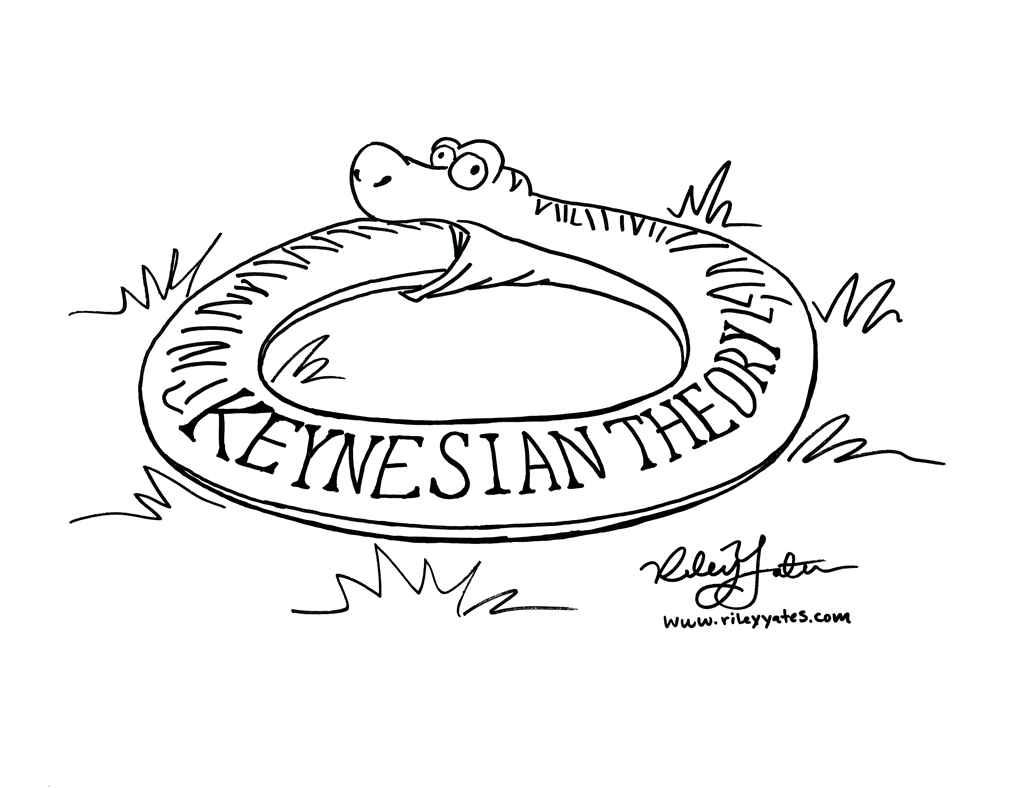
Here’s a major macroeconomic sacred cow among professional economists and the politicians whose fiscal profligacy they enable: the presumed salutary effect of an increase in government spending on economic activity, including its so-called “multiplier effect”. Government fiscal stimulus is prescribed by the Keynesian school of economics to remedy any decline in the total demand for goods. A classic case is “underconsumption”, or excess saving, such that labor and capital resources are in excess supply. The idea is that government will mop-up some of this excess saving by borrowing and spending the proceeds on goods and services, putting resources back to work. In the standard telling, digging holes and refilling them is as effective as anything else. The increased income earned by those resources will be re-spent, creating income for the recipients and leading to repeated rounds of re-spending, each successively smaller due to “leakage” into saving. Adding up all these rounds of extra spending yields a multiple of the original government stimulus, hence the Keynesian multiplier effect. The stimulation of the demand for goods and services pushes the economy back in the direction of full employment, thus correcting the original problem of underconsumption. Nice story.

Keynesian economics is a short-run, demand-based framework that delineates behavior by the constructs of national income accounting, segmenting demand into consumer spending, investment in productive capital, government spending, and net foreign spending (net exports). Except for the limit imposed by full employment, the supply side of the economy and the processes giving rise to growth in productive capacity are ignored.

Within the Keynesian framework, can offer many qualifications to the story of a shortfall in demand to which even a dyed-in-the-wool Keynesian would agree. First, government stimulus cannot have an effect on the real economy at a time when the economy is operating at full capacity, or full employment. The increased government spending will only lead to bidding against other uses of the same resources, increasing the level of wages and prices.

Another qualification within the Keynesian framework is that the leakage from spending at each round of re-spending is made greater by taxes on marginal income, thus reducing the magnitude of the multiplier. In addition, some of the extra income will be spent on foreign goods — another leakage that reduces the multiplier effect on the domestic economy. In fact, this is why multipliers for spending at local levels are thought to be relatively small. The more local the analysis, the more income will be re-spent outside the locality at each round. More fundamentally, private parties should know that increased government borrowing must be repaid eventually. At some level, they know that additional taxes (or an inflation tax) will be necessary to do so. Therefore, their reaction to the additional income derived from government demand will be muted by the need to save for those future liabilities. Put differently, consumers do not view the gain as an increase in their permanent income. That’s essentially the mechanism underlying the “Ricardian equivalence” between methods of funding government spending (government debt or taxes).

In the “real world” there are many other practical problems that lead to ineffectual and even counter-productive government stimulus. One is the problem of cost control endemic to the public sector. Related to this are seemingly unavoidable timing issues. These factors have a strong tendency to make counter-cyclical fiscal programs too costly and too late. There is also the tendency toward graft and cronyism wherever the government spreads its largess. The “perfectibility of man” is certainly not evident in the execution of government stimulus programs. Their economic impacts often become pro-cyclical, or even worse, they become permanent increases in spending authority. More on the latter below.

Deeper objections to the Keynesian framework have to do with its demand-side orientation and the conceit that government, solely by borrowing and spending, can contribute to “real demand” and add to a nation’s output. And even if government spending takes up slack at a time of unemployed resources or excess supplies, it is unlikely to resolve the conditions that led to the decline in private demand. Therefore, even if government stimulus is successful in spurring a temporary increase in actual production and utilization of resources, it is likely to delay or prevent the downward wage and price adjustments necessary to permanently do so.

Recessions are typically characterized by an effort to work off over-investment in various sectors: housing, commercial structures, oil and gas extraction and processing, technology assets, inventories, or factories. Over-inflation of asset values is usually at the root of malinvestment, often accompanied by overinflation of wages and prices. These dislocations do not occur evenly, but the market process acts to correct misallocations and mispricing precisely where they occur. It might take time, but if government steps in to prop-up weak sectors, forgive the economic consequences of mistakes, and place more upward pressure on wages and prices, the dislocations will persist. So again, even if stimulus and the multiplier effect offer a short-term palliative, the benefits are illusory in a real sense. The long-run consequences of failing to allow markets to repair the damage will be negative.

One of the greatest skills that economists should possess is the ability to discern the most plausible counterfactual in a given situation: the world as it would have played out in the absence of a particular event, often a policy initiative. This is a great shortcoming among those who subscribe to the efficacy of government stimulus programs. In the scenario just described, there will be a decline in capital investment, consumption, and saving, but that saving, whatever its level, will still be channeled into capital investments unless the funds sit idle in bank vaults. If the saving is instead absorbed by the government’s effort to fund a stimulus program, even that reduced level of investment will not take place. The net effect is zero! Thus, the Keynesian stimulus and multiplier effect represent a failure of the economics profession to “see the unseen”, as Frederic Bastiat would have put it. Unless government can produce something of value to generate income, perhaps something that improves private returns, it will not contribute to income growth.

Permanent displacement of private capital investment is the most fundamental detriment of government fiscal activism. That it might well supplant private production should come as no surprise. Matthew D. Mitchell and Jakina R. Debnam describe the phenomenon this way:

“The tendency for ostensibly temporary spending to become permanent spending helps explain why policy makers fail to take the Keynesians’ advice when it comes to surpluses. Though governments invariable go into deficit during recessionary periods, they rarely run surpluses during expansionary periods.”

Mitchell and Debnam provide an interesting quote:

“… Richard Wagner and Nobel Laureate James Buchanan concluded: ‘Keynesian economics has turned the politicians loose; it has destroyed the effective constraint on politicians’ ordinary appetites. Armed with the Keynesian message, politicians can spend and spend without the apparent necessity to tax.'”

In a footnote, Mitchell and Debnam note that Milton Friedman once said, “Nothing is so permanent as a temporary government program.” The Keynesian prescription for stimulus allows politicians to assert that they are empowered to rescue the unemployed or those suffering a loss of income. They want you to believe that they can do something. The multiplier gives license to still greater mischief on the part of politicians, because it can help politicians sell almost any pork-barrel project. But continuing government expansion requires that it extract resources from the private economy. That’s true whether the government spends directly on goods or redistributes, and the mechanics of these processes involve additional resource costs. As long as government can borrow private savings, politicians will disguise the true cost of their munificence to constituents. Economists should not be their enablers.

The Insidious Guaranteed Income

26 Sunday Feb 2017

Posted by Nuetzel in Welfare State

≈ 3 Comments

Tags

Artificial Intelligence, Automation, Bryan Caplan, Cash vs. In-Kind Aid, Don Boudreaux, Earned Income Tax Credit, Forced Charity, Guaranteed Income, Incentive Effects, Mises Wire, Nathan Keeble, Permanent Income Hypothesis, Subsidies, Tax Cliff, UBI, Universal Basic Income

free-money-gif

Praise for the concept of a “universal basic income” (UBI) is increasingly common among people who should know better. The UBI’s appeal is based on: 1) improvement in work incentives for those currently on public aid; 2) the permanent and universal cushion it promises against loss of livelihood; 3) the presumed benefits to those whose work requires a lengthy period of development to attain economic viability; and 4) the fact that everyone gets a prize, so it is “fair”. There are advocates who believe #2 is the primary reason a UBI is needed because they fear a mass loss of employment in the age of artificial intelligence and automation. I’ll offer some skepticism regarding that prospect in a forthcoming post.

And what are the drawbacks of a UBI? As an economic matter, it is outrageously expensive in both budgetary terms and, more subtly but no less importantly, in terms of its perverse effects on the allocation of resources. However, there are more fundamental reasons to oppose the UBI on libertarian grounds.

Advocates of a UBI often use $10,000 per adult per year as a working baseline. That yields a cost of a guaranteed income for every adult in the U.S. on the order of $2.1 trillion. We now spend about $0.7 trillion a year on public aid programs, excluding administrative costs (the cost is $1.1 trillion all-in). The incremental cost of a UBI as a wholesale replacement for all other aid programs would therefore be about $1.4 trillion. That’s roughly a 40% increase in federal outlays…. Good luck funding that! And there’s a strong chance that some of the existing aid programs would be retained. The impact could be blunted by excluding individuals above certain income thresholds, or via taxes applied to the UBI in higher tax brackets. However, a significant dent in the cost would require denying the full benefit to a large segment of the middle class, making the program into something other than a UBI.

Nathan Keeble at Mises Wire discusses some of the implications of a UBI for incentives and resource allocation. A traditional criticism of means-tested welfare programs is that benefits decline as market income increases, so market income is effectively taxed at a high marginal rate. (This is not a feature of the Earned Income Tax Credit (EITC).) Thus, low-income individuals face negative incentives to earn market income. This is the so-called “welfare cliff”. A UBI doesn’t have this shortcoming, but it would create serious incentive problems in other ways. A $1.4 trillion hit on taxpayers will distort work, saving and investment incentives in ways that would make the welfare cliff look minor by comparison. The incidence of these taxes would fall heavily on the most productive segments of society. It would also have very negative implications for the employment prospects of individuals in the lowest economic strata.

Keeble describes another way in which a UBI is destructive. It is a subsidy granted irrespective of the value created by work effort. Should an individual have a strong preference for leisure as opposed to work, a UBI subsidy exerts a strong income effect in accommodating that choice. Or, should an individual have a strong preference for performing varieties of work for which they are not well-suited, and despite having a relatively low market value for them, the income effect of a UBI subsidy will tend to accommodate that choice as well. In other words, a UBI will subsidize non-economic activity:

“The struggling entrepreneurs and artists mentioned earlier are struggling for a reason. For whatever reason, the market has deemed the goods they are providing to be insufficiently valuable. Their work simply isn’t productive according to those who would potentially consume the goods or services in question. In a functioning marketplace, producers of goods the consumers don’t want would quickly have to abandon such endeavors and focus their efforts into productive areas of the economy. The universal basic income, however, allows them to continue their less-valued endeavors with the money of those who have actually produced value, which gets to the ultimate problem of all government welfare programs.“

I concede, however, that unconditional cash transfers can be beneficial as a way of delivering aid to impoverished communities. This application, however, involves a subsidy that is less than universal, as it targets cash at the poor, or poor segments of society. The UBI experiments described in this article involve private charity in delivering aid to poor communities in underdeveloped countries, not government sponsored foreign aid or redistribution. Yes, cash is more effective than in-kind aid such as food or subsidized housing, a proposition that economists have always tended to support as a rule. The cash certainly provides relief, and it may well be used as seed money for productive enterprises, especially if the aid is viewed as temporary rather than permanent. But that is not in the spirit of a true UBI.

More fundamentally, a UBI is objectionable from a libertarian perspective because it involves a confiscation of resources. In “Why Libertarians Should Oppose the Universal Basic Income“, Bryan Caplan makes the point succinctly:

“Forced charity is unjust. Individuals have a moral right to decide if and when they want to help others….

Forcing people to help others who can’t help themselves… is at least defensible. Forcing people to help everyone is not. And for all its faults, at least the status quo makes some effort to target people who can’t help themselves. The whole idea of the Universal Basic Income, in contrast, is to give money to everyone whether they need it or not.”

Later, Caplan says:

…libertarianism isn’t about the freedom to be coercively supported by strangers. It’s about the freedom to be left alone by strangers.“

Both Keeble and Caplan would argue that the status quo, with its hodge-podge of welfare programs offering tempting but rotten incentives to recipients, is preferable to the massive distortions that would be created by a UBI. The mechanics of such an intrusion are costly enough, but as Don Boudreaux has warned, the UBI would put government in a fairly dominant position as a provider:

“… such an income-guarantee by government will further fuel the argument that government is a uniquely important and foundational source of our rights and our prosperity – and, therefore, government is uniquely entitled to regulate our behavior.“

Follow Sacred Cow Chips on WordPress.com

Recent Posts

  • Immigration and Merit As Fiscal Propositions
  • Tariff “Dividend” From An Indigent State
  • Almost Looks Like the Fed Has a 3% Inflation Target
  • Government Malpractice Breeds Health Care Havoc
  • A Tax On Imports Takes a Toll on Exports

Archives

  • December 2025
  • November 2025
  • October 2025
  • September 2025
  • August 2025
  • July 2025
  • June 2025
  • May 2025
  • April 2025
  • March 2025
  • February 2025
  • January 2025
  • December 2024
  • November 2024
  • October 2024
  • September 2024
  • August 2024
  • July 2024
  • June 2024
  • May 2024
  • April 2024
  • March 2024
  • February 2024
  • January 2024
  • December 2023
  • November 2023
  • August 2023
  • July 2023
  • June 2023
  • May 2023
  • April 2023
  • March 2023
  • February 2023
  • January 2023
  • December 2022
  • November 2022
  • October 2022
  • September 2022
  • August 2022
  • July 2022
  • June 2022
  • May 2022
  • April 2022
  • March 2022
  • February 2022
  • January 2022
  • December 2021
  • November 2021
  • October 2021
  • September 2021
  • August 2021
  • July 2021
  • June 2021
  • May 2021
  • April 2021
  • March 2021
  • February 2021
  • January 2021
  • December 2020
  • November 2020
  • October 2020
  • September 2020
  • August 2020
  • July 2020
  • June 2020
  • May 2020
  • April 2020
  • March 2020
  • February 2020
  • January 2020
  • December 2019
  • November 2019
  • October 2019
  • September 2019
  • August 2019
  • July 2019
  • June 2019
  • May 2019
  • April 2019
  • March 2019
  • February 2019
  • January 2019
  • December 2018
  • November 2018
  • October 2018
  • September 2018
  • August 2018
  • July 2018
  • June 2018
  • May 2018
  • April 2018
  • March 2018
  • February 2018
  • January 2018
  • December 2017
  • November 2017
  • October 2017
  • September 2017
  • August 2017
  • July 2017
  • June 2017
  • May 2017
  • April 2017
  • March 2017
  • February 2017
  • January 2017
  • December 2016
  • November 2016
  • October 2016
  • September 2016
  • August 2016
  • July 2016
  • June 2016
  • May 2016
  • April 2016
  • March 2016
  • February 2016
  • January 2016
  • December 2015
  • November 2015
  • October 2015
  • September 2015
  • August 2015
  • July 2015
  • June 2015
  • May 2015
  • April 2015
  • March 2015
  • February 2015
  • January 2015
  • December 2014
  • November 2014
  • October 2014
  • September 2014
  • August 2014
  • July 2014
  • June 2014
  • May 2014
  • April 2014
  • March 2014

Blogs I Follow

  • Passive Income Kickstart
  • OnlyFinance.net
  • TLC Cholesterol
  • Nintil
  • kendunning.net
  • DCWhispers.com
  • Hoong-Wai in the UK
  • Marginal REVOLUTION
  • Stlouis
  • Watts Up With That?
  • Aussie Nationalist Blog
  • American Elephants
  • The View from Alexandria
  • The Gymnasium
  • A Force for Good
  • Notes On Liberty
  • troymo
  • SUNDAY BLOG Stephanie Sievers
  • Miss Lou Acquiring Lore
  • Your Well Wisher Program
  • Objectivism In Depth
  • RobotEnomics
  • Orderstatistic
  • Paradigm Library
  • Scattered Showers and Quicksand

Blog at WordPress.com.

Passive Income Kickstart

OnlyFinance.net

TLC Cholesterol

Nintil

To estimate, compare, distinguish, discuss, and trace to its principal sources everything

kendunning.net

The Future is Ours to Create

DCWhispers.com

Hoong-Wai in the UK

A Commonwealth immigrant's perspective on the UK's public arena.

Marginal REVOLUTION

Small Steps Toward A Much Better World

Stlouis

Watts Up With That?

The world's most viewed site on global warming and climate change

Aussie Nationalist Blog

Commentary from a Paleoconservative and Nationalist perspective

American Elephants

Defending Life, Liberty and the Pursuit of Happiness

The View from Alexandria

In advanced civilizations the period loosely called Alexandrian is usually associated with flexible morals, perfunctory religion, populist standards and cosmopolitan tastes, feminism, exotic cults, and the rapid turnover of high and low fads---in short, a falling away (which is all that decadence means) from the strictness of traditional rules, embodied in character and inforced from within. -- Jacques Barzun

The Gymnasium

A place for reason, politics, economics, and faith steeped in the classical liberal tradition

A Force for Good

How economics, morality, and markets combine

Notes On Liberty

Spontaneous thoughts on a humble creed

troymo

SUNDAY BLOG Stephanie Sievers

Escaping the everyday life with photographs from my travels

Miss Lou Acquiring Lore

Gallery of Life...

Your Well Wisher Program

Attempt to solve commonly known problems…

Objectivism In Depth

Exploring Ayn Rand's revolutionary philosophy.

RobotEnomics

(A)n (I)ntelligent Future

Orderstatistic

Economics, chess and anything else on my mind.

Paradigm Library

OODA Looping

Scattered Showers and Quicksand

Musings on science, investing, finance, economics, politics, and probably fly fishing.

  • Subscribe Subscribed
    • Sacred Cow Chips
    • Join 128 other subscribers
    • Already have a WordPress.com account? Log in now.
    • Sacred Cow Chips
    • Subscribe Subscribed
    • Sign up
    • Log in
    • Report this content
    • View site in Reader
    • Manage subscriptions
    • Collapse this bar
 

Loading Comments...