• About

Sacred Cow Chips

Sacred Cow Chips

Tag Archives: Religious Freedom

That Word “Liberal” … I Don’t Think That Means What You Think It Means

03 Wednesday Jan 2024

Posted by Nuetzel in Conservatism, Liberalism, Socialism

≈ Leave a comment

Tags

Adam Smith, Capitalism, Classical Liberal, Conservatism, Consumer Sovereignty, Corporatism, Free Markets, Freedom of Speech, Friedrich Hayek, Liberalism, Libertarianism, MAGA, monopoly, Monopsony, Nate Silver, Natural Rights, Non-Aggression Principle, Perfect Competition, Progressivism, Property Rights, Public goods, Religious Freedom, Right to Life, Scott Sumner, social engineering, Socialism, State Capacity, State Religion, statism, The Wealth of Nations
Leftism has taken on new dimensions amid its preoccupation with identity politics, victimhood, and “wokeness”. Traditional socialists are still among us, of course, but “wokeists” and “identitarians” have been on the progressive vanguard of late, rooting for the deranged human butchers of Hamas and the dismantling of liberal institutions. This didn’t happen overnight, of course, and traditional socialists are mostly fine with it.

An older story is the rebranding of leftism that took place in the U.S. during the first half of the 20th century, when the word “liberal” was co-opted by leftists. Before that, a liberal orientation was understood to be antithetical to the collectivist mindset long associated with the Left. Note also that liberalism retains its original meaning even today in much of Europe. Often we hear the term “classical liberal” to denote the “original” meaning of liberalism, but the modifier should be wholly unnecessary.

Liberalism Is Not “In-Betweenism”

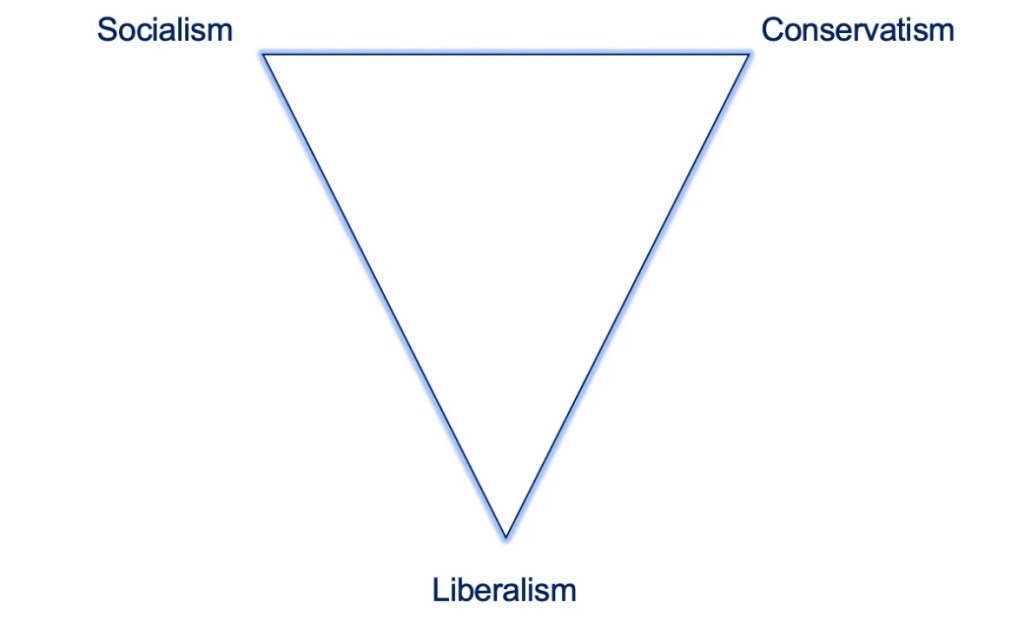
In this vein, Nate Silver presents a basic taxonomy of political orientation in a recent Substack post. It includes the diagram above, which distinguishes between socialism, conservatism, and liberalism. Silver draws on a classic essay written by Friedrich Hayek in 1945, “Why I am Not a Conservative”, in which Hayek discussed the meaning of the word “liberal” (and see here). Liberalism’s true emphasis is a tolerance for individual rights and freedoms, subject to varying articulations of the “nonaggression principle”. That is, “do as you like, but do no harm to others”.

We often see a linear representation distinguishing between so-called progressives on the left and conservatives on the right. Of course, a major hallmark of leftist thinking is extreme interventionism. Leftists or progressives are always keen to detect the slightest whiff of an externality or the slightest departure from the perfectly competitive market ideal. They seem eager to find a role for government in virtually every area of life. While it’s not a limiting case, we can substitute socialism or statism for progressivism on the far left, as Silver does, whereby the state takes primacy in economic and social affairs.

Conservatism, on the other hand, is a deep resistance to change, whether institutional, social, and sometimes economic. Conservatives too often demonstrate a willingness to use the coercive power of the state to prevent change. Hayek noted the willingness of both socialists and conservatives to invoke state power for their own ends.

Similarly, religious conservatives often demand state support beyond that afforded by the freedom to worship in the faith of one’s choice. They might strongly reject certain freedoms held to be fundamental by liberals. Meanwhile, socialists often view mere religious freedom as a threat to the power of the state, or at least they act like it (e.g. see here for an example).

Like conservatives, dedicated statists would doubtless resist change if it meant a loss of their own power. That is, they’d wish to preserve socialist institutions. On this point, witness the vitriol from the Left over what it perceives as threats to the public school monopoly. Witness also the fierce resistance among public employees to reducing the scale of the administrative state, and how advocates of entitlements fiercely resist decreases in the growth rate of those expenditures.

Silver, like Hayek, objects to the traditional, linear framework in which liberals are thought to occupy a range along a line between socialism and conservatism. He objects to that because real liberals value individual liberty as a natural human right, a viewpoint typically abhored by both socialists and conservatives. There is nothing “in between” about it! And of course, conservatives and progressives are equally guilty in their mistaken use of the word “liberal”.

Mapping Political Preferences

Liberty, statism, and conservatism are not exactly orthogonal political dimensions. Larger government almost always means less economic liberty. At a minimum, state dominance implies a social burden associated with public monopoly and monopsony power, as well as tax and welfare-state incentive problems. These features compromise or corrupt the exercise of basic rights. On the other hand, capitalism and its concomitant reliance on consumer sovereignty, individual initiative, free exchange and secure property rights is most in harmony with true liberalism.

For conservatives, resistance to change in support of a traditionally free market economy might offer something of a contradiction. In one sense, it corresponds to upholding market institutions. However, free markets allow new competitors and new technologies to undermine incumbents, who conservatives sometimes wish to defend through regulatory or protectionist measures. And conservatives are almost always too happy to join in the chorus of “price gouging” in response to the healthy operation of the free market in bringing forth supplies.

All that is to say that preferences involving liberty, statism, and traditionalism are not independent of one another. They cannot simply be mapped onto a three-dimensional space. At least the triangular representation gets liberalism out of the middle, but it’s difficult to visualize other ideological positions there. For example, “state religionism” could lie anywhere along the horizontal line at the top or even below it if certain basic liberties are preserved. Facism combines elements of socialism and a deformed version of capitalism that is properly called corporatism, but where would it fall within the triangle?

Big Government Liberalism?

Silver says he leans heavily toward a “big government” version of liberalism, but big government is hard to square with broad liberties. Granted, any well-functioning society must possess a certain level of “state capacity” to defend against private or public violations of individual rights, adjudicate disputes, and provide true public goods. It’s not clear whether Silver’s preferences lie within the bounds of those ambitions. Still, he deserves credit for his recognition that liberalism is wholly different from the progressive, socialist vision. It is the opposite.

The “New” Triangle

Silver attempts to gives the triangular framework a more contemporary spin by replacing conservatism with “MAGA Conservatism” and socialism with “Social Justice Leftism” (SJL), or “wokeism”. Here, I’m treating MAGA as a “brand”. Nothing below is intended to imply that America should not be a great nation.

The MAGA variant of conservatism emphasizes nationalism, though traditional conservatives have never been short on love of nation. For that matter, as a liberal American, it’s easier to forgive nationalist sentiments than it is the “Death to America” refrain we now hear from some SJLs.

The MAGA brand is also centered around a single individual, Donald Trump, whose rhetoric strikes many as nativistic. And Trump is a populist whose policy proposals are often nakedly political and counterproductive.

SJL shares with socialism an emphasis on various forms of redistribution and social engineering, but with a new focus on victimhood based on classes of identity. Of SJL, Silver says:

“Proponents of SJL usually dislike variations on the term ‘woke’, but the problem is that they dislike almost every other term as well. And we need some term for this ideology, because it encompasses quite a few distinctive features that differentiate it both from liberalism and from traditional, socialist-inflected leftism. In particular, SJL is much less concerned with the material condition of the working class, or with class in general. Instead, it is concerned with identity — especially identity categories involving race, gender and sexuality, but sometimes also many others as part of a sort of intersectional kaleidoscope.”
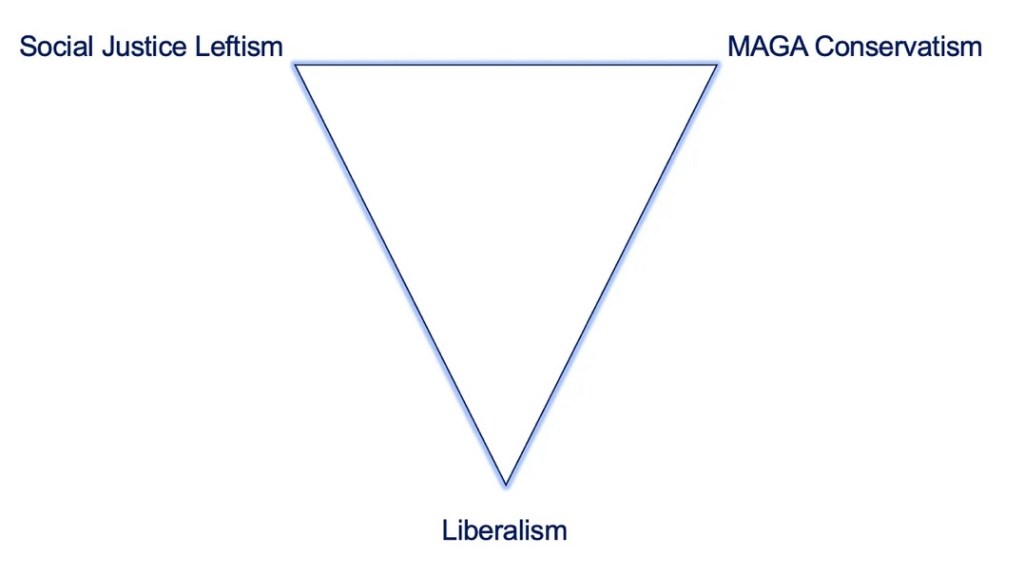
The gulf between liberals and SJLs couldn’t be wider on issues like free speech and “equity”, and equality of opportunity. MAGAns, on the other hand, have some views on individual rights and responsibility that are largely consistent with liberals, but reflexive populism often leads them to advocate policies protecting rents, corporate welfare, and protectionism.

Divided Liberalism

Liberalism emphasizes limited government, individual autonomy, and free exchange. However, there are issues upon which true liberals are of divided opinion. For example, one such area of controversy is the conflict between a woman’s right to choose and the fetal right to life. Many true liberals disagree over whether the rights of a fetus outweigh its mother’s right to choose, but most would concede that the balance shifts to the fetus at some point well short of birth (putting aside potential dangers to the mother’s life). Open borders is another area that can divide true liberals. On one side, the right to unrestricted mobility is thought to supersede any public interest in enforcing borders and limiting the flow of immigrants. On the other side, questions of national sovereignty, national security, as well as social and state capacity to absorb immigrants take primacy.

Don’t Call Lefties “Liberal”… They’re Not!

True liberalism (including most strains of libertarianism) recognizes various roles that a well-functioning state should play, but it also recognizes the primacy of the individual and individual rights as a social underpinning. As Hayek noted, true liberals are not resistant to change per se, unlike conservatives. But modern progressives demand changes of the worst kind: that the state should intervene to pursue their favored objectives, laying claim to an ever-greater share of private resources. This requires government coercion on a massive scale, the antithesis of liberalism. It’s time to recognize that “progressives” aren’t liberals in any sense of the word. For that matter, they don’t even stand for progress.

I’ll close with a quote from Adam Smith that I cribbed from Scott Sumner. Unfortunately, Sumner does not give the full reference, but I’ll take his word that Smith wrote this 20 years before the publication of The Wealth of Nations:

“Little else is requisite to carry a state to the highest degree of opulence from the lowest barbarism, but peace, easy taxes, and a tolerable administration of justice; all the rest being brought about by the natural course of things. All governments which thwart this natural course, which force things into another channel, or which endeavour to arrest the progress of society at a particular point, are unnatural, and to support themselves are obliged to be oppressive and tyrannical.”

Atheism Cannot Disqualify for Public Office

26 Saturday Sep 2020

Posted by Nuetzel in Supreme Court

≈ Leave a comment

Tags

Abortion Rights, Amy Coney Barrett, Bret Kavanaugh, Diane Feinstein, Donald Trump, First Amendment, Religious Freedom, Religious Test, Roe v. Wade, Ruth Bader Ginsburg, Supreme Court

Amy Coney Barrett makes a lousy target for personal attacks by the Left. Barrett is President Trump’s nominee for the Supreme Court vacancy following the death of Justice Ruth Bader Ginsburg. A fabricated scandal against Barrett would be much less credible than even the allegations made against Bret Kavanaugh at his confirmation hearings in 2018. So Democrats believe their best opportunity is to paint Barrett as a religious “crazy” who, if confirmed by the Senate, will allow her religious convictions to influence her opinions on the Court relative to issues such as abortion rights under Roe v. Wade.

Barrett has offered rejoinders to Senator Diane Feinstein’s comments (“The dogma lives loudly within you.“) at the hearings on Barrett’s appointment to the Federal Appeals Court in 2017. In particular, Barrett has noted that a religious test is unconstitutional as a criterion for public office, including judgeships. In fact, in another way, Barrett has demolished the claims made by leftists against the qualifications for the bench of those of deep faith. Her argument exposes the Leftist position as an absurdity.

The presumption is that someone having religious convictions has a certain set of moral principles that might be brought to bear on court decisions. We’re expected to believe that’s a danger unique to those of faith. Barrett notes that non-religious individuals, even atheists, have their own set of moral principles. By the same standard, should we not concern ourselves that an atheistic nominee might bring their moral principles to bear on court decisions? Or are we to believe those principles are somehow superior to those associated with religious convictions? That they should simply be overlooked, but not for those of religious faith? Rather, a fundamental requirement is whether a nominee understands and respects the difference between jurisprudence and legislating from the bench, a distinction that was sometimes lost on Ginsburg.

To assert that an atheist’s moral convictions are more objective than those of a religious individual is a flaw in logic and a horrific value judgement. I am not a particularly religious person, but I respect people of faith as well as the protections afforded to the free practice of religion by the First Amendment of the U.S. Constitution. It’s worth noting that those protections apply to atheists as well as religious sects. As Barrett’s position implies, to distrust the judicial judgement of a person of religious faith is as wrongheaded as to distrust the judicial judgement of a nominee devoid of religious faith.

Balancing Gay Rights and Religious Rights

08 Wednesday Jul 2015

Posted by Nuetzel in Liberty

≈ Leave a comment

Tags

Adoption services, Employment Nondiscrimination Act, Gay Marriage Rights, LGBT, Obergefell v. Hodges, Policies on Bullying, Public Accommodations, Reason Magazine, Religious Exemptions, Religious Freedom, Scott Shackford, Transgender Identity

Government boot

Gay marriage rights are considered a big win among libertarians, but there are thorny issues on the horizon as LGBT activists contest certain liberties of other groups. Last month’s landmark Supreme Court decision in Obergefell v. Hodges established that same-sex marriage is protected by the 14th Amendment to the Constitution. Unfortunately, the established rights of different groups are sometimes in conflict; recognition of one individual right under the Constitution does not invalidate the established rights of others. Rather, these rights exist pari-passu unless some intractable conflict exists. Any challenge to a right of one party by another must be resolved based upon whether the courts find a compelling reason, under the circumstances of the case, to favor one right over another. Depending on the details, the result may establish a narrow or a broad precedent.

Last week, Reason carried a good discussion of several areas of possible conflict between the positions of certain LGBT activists and the libertarian view: “Is This Where Libertarians and the Gay Community Part Ways?“, by Scott Shackford, covered each of the general issues listed below, which I’ll attempt to summarize. The libertarian resolution to most of these issues is dependent upon whether the challenge is against a government entity or a private party. This dichotomy follows from a constitutional philosophy under which the powers of government are strictly enumerated and the presumed rights of private individuals are broad and unenumerated. Many libertarians, Shackford included, believe that conflicts are often easily resolved when all alternatives for both parties are considered. For that reason, simply allowing private social arrangements to evolve is superior to intrusion by government aimed at righting perceived wrongs.

Employment Nondiscrimination: Shackford is skeptical that congressional passage of the long-debated federal Employment Non-Discrimination Act (ENDA) would accomplish much because there has already been such a significant shift in the cultural acceptance of homosexuality. Nevertheless, he is supportive of laws prohibiting anti-gay discrimination by government employers.

The ENDA would grant gay and transgender individuals the same status as other protected classes under federal law. With certain exceptions, it would require private employers to offer employment and benefits to LGBTs and same-sex married couples on the same basis as heterosexuals. This is meaningless unless gay individuals self-identify on job applications. It would also require that employers collect data on sexual preference and transgender status, which is costly, likely to be somewhat unreliable and disturbingly intrusive. But the most vexing aspect of federal law prohibiting discrimination by private employers against LGBTs is the potential conflict with the employer’s religious convictions.

The ENDA exempts religious organizations. The real challenge is balancing the rights of homosexuals with those of private employers having deeply-held religious beliefs opposing homosexuality. Should the rights of gays take precedence over the religious rights of private employers? There should certainly be no presumption that gays are dependent upon religious private employers for work. And there should be no presumption of “hate” on the part of a religious employer who does not wish to offer  any pecuniary support to homosexuals. Thus, it is difficult to argue that the employment rights of gays trump the religious rights of private employers, and because alternatives exist for gays, many libertarians see this as a simple issue of live and let live.

Religious Freedom Exemptions: This is about the asserted freedom to decide not to do  business with LGBTs based on religious convictions. Examples are the Muslim baker and the Christian photographer who do not wish to take business related to same-sex weddings. As I noted in “Suit Me or Face a Lawsuit: Adventures in Litigation Land“, compulsion to practice an art or to engage in any act of expression against one’s religious convictions is not acceptable from a libertarian perspective. That does not justify discrimination in a business’s public accommodations, however, where the doors of the business are open for purchases by the general public. The public at large, protected groups and otherwise, should have the freedom to transact there.

Shackford makes some good points in this section, including a rebuttal of the argument that to be engaged in “doing business” somehow disqualifies an individual from refusing an order based on religion:

“This argument flips the idea of civil liberties completely on its head and attributes the source of our rights to the government, a contradiction of the spirit of our own Constitution.“

Transgender Recognition: Most libertarians believe that individuals should have the right to identify publicly as the gender with which they identify privately:

“Fundamental to liberty is the right to personal identity and expression. This includes gender. Transgender citizens have the same right as everybody else to live their lives as they please without unnecessary government interference.“

Shackford again draws the crucial distinction between government and private sector accommodation for the needs of transgender individuals:

“In the private sector, it’s all a matter of cultural negotiation and voluntary agreements. The law should not be used to mandate private recognition of transgender needs, whether it’s requiring insurance companies cover gender reassignment surgeries or requiring private businesses to accommodate their bathroom choices. The reverse is also true: It would be inappropriate for the government to forbid insurance coverage or to require private businesses to police their own bathrooms to keep transgender folks out.“

Adoption: Shackford notes that gay couples can now adopt children in any state, including a partner’s child. But conflicts arise involving religious adoption agencies that are unwilling to work with homosexuals wishing to adopt. Activists would like to stop the flow of public funds to these institutions, but that position is indefensible on several grounds: adoption is foremost about helping children, and it is counter-productive to undermine an agency with a track record of positive performance. There are secular alternatives for adoption as well. Second, placing children in homes undoubtedly provides benefits to taxpayers that exceed the funds supporting these agencies. Finally, the activist position is indefensible as an attack on religious liberty.

Bullying in Schools: Cultural acceptance of gays or any other difference might not extend readily to the schoolyard. Bullying should always be dealt with firmly, but new legal protections for gays should not give way to policies that may be excessively harsh:

“… whatever is done to try to curtail bullying needs to be managed with the understanding that we are dealing with children on both sides of the issue…. 

The libertarian concern here is, just as with the other issues, using the state or the law to punish people—in this case, children—when there are better social tools for this battle… before considering new policies or laws with the intention of fighting bullying, activists need to remind themselves that public schools now have … oppressive disciplinary policies that they use to discard students at the first sign of trouble. The last thing we need is more ‘zero tolerance’ policies. As it stands, we have children and teenagers being arrested by police for common school misconduct and their families forced to deal with costly and time-wasting court systems. It is an absurd outcome that actually threatens children’s futures.“

Shackford closes with a few thoughts about the usefulness of school choice for helping parents find the most hospitable school environment for their children.

Libertarians have been consistent supporters of gay marriage rights, nondiscrimination by public institutions and in the public accommodations of private businesses. However, libertarians are unlikely to support LGBT activists in attempts to curtail religious liberties. This includes the liberty to run a business in a manner consistent with one’s religious beliefs, whether or not that conflicts with the ideals of the LGBT community. Conflicting rights must be balanced in a way that is most neutral and least harmful. Libertarians generally believe that there is no remedy for a violation of religious rights. When the religious rights of private business owners are protected with respect to their non-public accommodations, any imposition this might inflict on other parties is usually mitigated by the existence of willing competitors. Alas, there is no right to a life free of insults, unintended or otherwise.

Follow Sacred Cow Chips on WordPress.com

Recent Posts

  • The Case Against Interest On Reserves
  • Immigration and Merit As Fiscal Propositions
  • Tariff “Dividend” From An Indigent State
  • Almost Looks Like the Fed Has a 3% Inflation Target
  • Government Malpractice Breeds Health Care Havoc

Archives

  • January 2026
  • December 2025
  • November 2025
  • October 2025
  • September 2025
  • August 2025
  • July 2025
  • June 2025
  • May 2025
  • April 2025
  • March 2025
  • February 2025
  • January 2025
  • December 2024
  • November 2024
  • October 2024
  • September 2024
  • August 2024
  • July 2024
  • June 2024
  • May 2024
  • April 2024
  • March 2024
  • February 2024
  • January 2024
  • December 2023
  • November 2023
  • August 2023
  • July 2023
  • June 2023
  • May 2023
  • April 2023
  • March 2023
  • February 2023
  • January 2023
  • December 2022
  • November 2022
  • October 2022
  • September 2022
  • August 2022
  • July 2022
  • June 2022
  • May 2022
  • April 2022
  • March 2022
  • February 2022
  • January 2022
  • December 2021
  • November 2021
  • October 2021
  • September 2021
  • August 2021
  • July 2021
  • June 2021
  • May 2021
  • April 2021
  • March 2021
  • February 2021
  • January 2021
  • December 2020
  • November 2020
  • October 2020
  • September 2020
  • August 2020
  • July 2020
  • June 2020
  • May 2020
  • April 2020
  • March 2020
  • February 2020
  • January 2020
  • December 2019
  • November 2019
  • October 2019
  • September 2019
  • August 2019
  • July 2019
  • June 2019
  • May 2019
  • April 2019
  • March 2019
  • February 2019
  • January 2019
  • December 2018
  • November 2018
  • October 2018
  • September 2018
  • August 2018
  • July 2018
  • June 2018
  • May 2018
  • April 2018
  • March 2018
  • February 2018
  • January 2018
  • December 2017
  • November 2017
  • October 2017
  • September 2017
  • August 2017
  • July 2017
  • June 2017
  • May 2017
  • April 2017
  • March 2017
  • February 2017
  • January 2017
  • December 2016
  • November 2016
  • October 2016
  • September 2016
  • August 2016
  • July 2016
  • June 2016
  • May 2016
  • April 2016
  • March 2016
  • February 2016
  • January 2016
  • December 2015
  • November 2015
  • October 2015
  • September 2015
  • August 2015
  • July 2015
  • June 2015
  • May 2015
  • April 2015
  • March 2015
  • February 2015
  • January 2015
  • December 2014
  • November 2014
  • October 2014
  • September 2014
  • August 2014
  • July 2014
  • June 2014
  • May 2014
  • April 2014
  • March 2014

Blogs I Follow

  • Passive Income Kickstart
  • OnlyFinance.net
  • TLC Cholesterol
  • Nintil
  • kendunning.net
  • DCWhispers.com
  • Hoong-Wai in the UK
  • Marginal REVOLUTION
  • Stlouis
  • Watts Up With That?
  • Aussie Nationalist Blog
  • American Elephants
  • The View from Alexandria
  • The Gymnasium
  • A Force for Good
  • Notes On Liberty
  • troymo
  • SUNDAY BLOG Stephanie Sievers
  • Miss Lou Acquiring Lore
  • Your Well Wisher Program
  • Objectivism In Depth
  • RobotEnomics
  • Orderstatistic
  • Paradigm Library
  • Scattered Showers and Quicksand

Blog at WordPress.com.

Passive Income Kickstart

OnlyFinance.net

TLC Cholesterol

Nintil

To estimate, compare, distinguish, discuss, and trace to its principal sources everything

kendunning.net

The Future is Ours to Create

DCWhispers.com

Hoong-Wai in the UK

A Commonwealth immigrant's perspective on the UK's public arena.

Marginal REVOLUTION

Small Steps Toward A Much Better World

Stlouis

Watts Up With That?

The world's most viewed site on global warming and climate change

Aussie Nationalist Blog

Commentary from a Paleoconservative and Nationalist perspective

American Elephants

Defending Life, Liberty and the Pursuit of Happiness

The View from Alexandria

In advanced civilizations the period loosely called Alexandrian is usually associated with flexible morals, perfunctory religion, populist standards and cosmopolitan tastes, feminism, exotic cults, and the rapid turnover of high and low fads---in short, a falling away (which is all that decadence means) from the strictness of traditional rules, embodied in character and inforced from within. -- Jacques Barzun

The Gymnasium

A place for reason, politics, economics, and faith steeped in the classical liberal tradition

A Force for Good

How economics, morality, and markets combine

Notes On Liberty

Spontaneous thoughts on a humble creed

troymo

SUNDAY BLOG Stephanie Sievers

Escaping the everyday life with photographs from my travels

Miss Lou Acquiring Lore

Gallery of Life...

Your Well Wisher Program

Attempt to solve commonly known problems…

Objectivism In Depth

Exploring Ayn Rand's revolutionary philosophy.

RobotEnomics

(A)n (I)ntelligent Future

Orderstatistic

Economics, chess and anything else on my mind.

Paradigm Library

OODA Looping

Scattered Showers and Quicksand

Musings on science, investing, finance, economics, politics, and probably fly fishing.

  • Subscribe Subscribed
    • Sacred Cow Chips
    • Join 128 other subscribers
    • Already have a WordPress.com account? Log in now.
    • Sacred Cow Chips
    • Subscribe Subscribed
    • Sign up
    • Log in
    • Report this content
    • View site in Reader
    • Manage subscriptions
    • Collapse this bar
 

Loading Comments...