• About

Sacred Cow Chips

Sacred Cow Chips

Tag Archives: Superabundance

On Noah Smith’s Take Re: Human/AI Comparative Advantage

13 Thursday Jun 2024

Posted by Nuetzel in Artificial Intelligence, Comparative advantage, Labor Markets

≈ 3 Comments

Tags

Absolute Advantage, Agentic AI, Alignment, Andrew Mayne, Artificial Intelligence, Comparative advantage, Compute, Decreasing Costs, Dylan Matthews, Fertility, Floating Point Operations Per Second, Generative AI, Harvey Specter, Inequality, National Security, Noah Smith, Opportunity cost, Producer Constraints, Substitutability, Superabundance, Tyler Cowen

I was happy to see Noah Smith’s recent post on the graces of comparative advantage and the way it should mediate the long-run impact of AI on job prospects for humans. However, I’m embarrassed to have missed his post when it was published in March (and I also missed a New York Times piece about Smith’s position).

I said much the same thing as Smith in my post two weeks ago about the persistence of a human comparative advantage, but I wondered why the argument hadn’t been made prominently by economists. I discussed it myself about seven years ago. But alas, I didn’t see Smith’s post until last week!

I highly recommend it, though I quibble on one or two issues. Primarily, I think Smith qualifies his position based on a faulty historical comparison. Later, he doubles back to offer a kind of guarantee after all. Relatedly, I think Smith mischaracterizes the impact of energy costs on comparative advantages, and more generally the impact of the resources necessary to support a human population.

We Specialize Because…

Smith encapsulates the underlying phenomenon that will provide jobs for humans in a world of high automation and generative AI: “… everyone — every single person, every single AI, everyone — always has a comparative advantage at something!” He tells technologists “… it’s very possible that regular humans will have plentiful, high-paying jobs in the age of AI dominance — often doing much the same kind of work that they’re doing right now …”

… often, but probably transformed in fundamental ways by AI, and also doing many other new kinds of work that can’t be foreseen at present. Tyler Cowen believes the most important macro effects of AI will be from “new” outputs, not improvements in existing outputs. That emphasis doesn’t necessarily conflict with Smith’s narrative, but again, Smith thinks people will do many of the same jobs as today in a world with advanced AI.

Smith’s Non-Guarantee

Smith hedges, however, in a section of his post entitled “‘Possible’ doesn’t mean guaranteed”. This despite his later assertion that superabundance would not eliminate jobs for humans. That might seem like a separate issue, but it’s strongly intertwined with the declining AI cost argument at the basis of his hedge. More on that below.

On his reluctance to “guarantee” that humans will have jobs in an AI world, Smith links to a 2013 Tyler Cowen post on “Why the theory of comparative advantage is overrated”. For example, Cowen says, why do we ever observe long-term unemployment if comparative advantage rules the day? Of course there are many reasons why we observe departures from the predicted results of comparative advantage. Incentives are often manipulated by governments and people differ drastically in their capacities and motivation.

But Cowen cites a theoretical weakness of comparative advantage: that inputs are substitutable (or complementary) by degrees, and the degree might change under different market conditions. An implication is that “comparative advantages are endogenous to trade”, specialization, and prices. Fair enough, but one could say the same thing about any supply curve. And if equilibria exist in input markets it means these endogenous forces tend toward comparative advantages and specializations balancing the costs and benefits of production and trade. These processes might be constrained by various frictions and interventions, and their dynamics might be complex and lengthy, but that doesn’t invalidate their role in establishing specializations and trade.

The Glue Factory

Smith concerns himself mainly with another one of Cowen’s “failings of comparative advantage”: “They do indeed send horses to the glue factory, so to speak.” The gist here is that when a new technology, motorized transportation, displaced draft horses, there was no “wage” low enough to save the jobs performed by horses. Smith says horses were too costly to support (feed, stables, etc…), so their comparative advantage at “pulling things” was essentially worthless.

True, but comparing outmoded draft horses to humans in a world of AI is not quite appropriate. First, feedstock to a “glue factory” better not be an alternative use for humans whose comparative advantages become worthless. We’ll have to leave that question as an imperative for the alignment community.

Second, horses do not have versatile skill sets, so the comparison here is inapt due to their lack of alternative uses as capital assets. Yes, horses can offer other services (racing, riding, nostalgic carriage rides), but sadly, the vast bulk of work horses were “one-trick ponies”. Most draft horses probably had an opportunity cost of less than zero, given the aforementioned costs of supporting them. And it should be obvious that a single-use input has a comparative advantage only in its single use, and only when that use happens to be the state-of-the-art, or at least opportunity-cost competitive.

The drivers, on the other hand, had alternatives, and saw their comparative advantage in horse-driving occupations plunge with the advent of motorized transport. With time it’s certain many of them found new jobs, perhaps some went on to drive motorized vehicles. The point is that humans have alternatives, the number depending only on their ability to learn a crafts and perhaps move to a new location. Thus, as Smith says, “… everyone — every single person, every single AI, everyone — always has a comparative advantage at something!” But not draft horses in a motorized world, and not square pegs in a world of round holes.

AI Producer Constraints

That brings us to the topic of what Smith calls producer-specific constraints, which place limits on the amount and scope of an input’s productivity. For example, in my last post, there was only one super-talented Harvey Specter, so he’s unlikely to replace you and keep doing his own job. Thus, time is a major constraint. For Harvey or anyone else, the time constraint affects the slope of the tradeoff (and opportunity costs) between one type of specialization versus another.

Draft horses operated under the constraints of land, stable, and feed requirements, which can all be viewed as long-run variable costs. The alternative use for horses at the glue factory did not have those costs.

Humans reliant on wages must feed and house themselves, so those costs also represent constraints, but they probably don’t change the shape of the tradeoff between one occupation and another. That is, they probably do not alter human comparative advantages. Granted, some occupations come with strong expectations among associates or clients regarding an individual’s lifestyle, but this usually represents much more than basic life support. In the other end of the spectrum, displaced workers will take actions along various margins: minimize living costs; rely on savings; avail themselves of charity or any social safety net as might exist; and ultimately they must find new positions at which they maintain comparative advantages.

The Compute Constraint

In the case of AI agents, the key constraint cited by Smith is “compute”, or computer resources like CPUs or GPUs. Advancements in compute have driven the AI revolution, allowing AI models to train on increasingly large data sets and levels of compute. In fact, by one measure of compute, floating point operations per second (FLOPs), compute has become drastically cheaper, with FLOPs per dollar almost doubling every two years. Perhaps I misunderstand him, but Smith seems to assert the opposite: that compute costs are increasing. Regardless, compute is scarce, and will always be scarce because advancements in AI will require vast increases in training. This author explains that while lower compute costs will be more than offset by exponential increases in training requirements, there nevertheless will be an increasing trend in capabilities per compute.

Every AI agent will require compute, and while advancements are enabling explosive growth in AI capabilities, scarce compute places constraints on the kinds of AI development and deployment that some see as a threat to human jobs. In other words, compute scarcity can change the shape of the tradeoffs between various AI applications and thus, comparative advantages.

The Energy Constraint

Another producer constraint on AI is energy. Certainly highly complex applications, perhaps requiring greater training, physical dexterity, manipulation of materials, and judgement, will require a greater compute and energy tradeoff against simpler applications. Smith, however, at one point dismisses energy as a differential producer constraint because “… humans also take energy to run.” That is a reference to absolute energy requirements across inputs (AI vs. human), not differential requirements for an input across different outputs. Only the latter impinge on tradeoffs or opportunity costs facing an inputs. Then, the input having the lowest opportunity cost for a particular output has a comparative advantage for that output. However, it’s not always clear whether an energy tradeoff across outputs for humans will be more or less skewed than for AI, so this might or might not influence a human comparative advantage.

Later, however, Smith speculates that AI might bid up the cost of energy so high that “humans would indeed be immiserated en masse.” That position seems inconsistent. In fact, if AI energy demands are so intensive, it’s more likely to dampen the growth in demand for AI agents as well as increase the human comparative advantage because the most energy-intensive AI applications will be disadvantaged.

And again, there is Smith’s caution regarding the energy required for human life support. Is that a valid long-run variable cost associated with comparative advantages possessed by humans? It’s not wrong to include fertility decisions in the long-run aggregate human labor supply function in some fashion, but it doesn’t imply that energy requirements will eliminate comparative advantages. Those will still exist.

Hype, Or Hyper-Growth?

AI has come a long way over the past two years, and while its prospective impact strikes some as hyped thus far, it has the potential to bring vast gains across a number of fields within just a few years. According to this study, explosive economic growth on the order of 30% annually is a real possibility within decades, as generative AI is embedded throughout the economy. “Unprecedented” is an understatement for that kind of expansive growth. Dylan Matthews in Vox surveys the arguments as to how AI will lead to super-exponential economic growth. This is the kind of scenario that would give rise to superabundance.

I noted above that Smith, despite his unwillingness to guarantee that human jobs will exist in a world of generative AI, asserts (in an update) at the bottom of his post that a superabundance of AI (and abundance generally) would not threaten human comparative advantages. This superabundance is a case of decreasing costs of compute and AI deployment. Here Smith says:

“The reason is that the more abundant AI gets, the more value society produces. The more value society produces, the more demand for AI goes up. The more demand goes up, the greater the opportunity cost of using AI for anything other than its most productive use. 

“As long as you have to make a choice of where to allocate the AI, it doesn’t matter how much AI there is. A world where AI can do anything, and where there’s massively huge amounts of AI in the world, is a world that’s rich and prosperous to a degree that we can barely imagine. And all that fabulous prosperity has to get spent on something. That spending will drive up the price of AI’s most productive uses. That increased price, in turn, makes it uneconomical to use AI for its least productive uses, even if it’s far better than humans at its least productive uses. 

“Simply put, AI’s opportunity cost does not go to zero when AI’s resource costs get astronomically cheap. AI’s opportunity cost continues to scale up and up and up, without limit, as AI produces more and more value.”

This seems as if Smith is backing off his earlier hedge. Some of that spending will be in the form of fabulous investment projects of the kinds I mentioned in my post, and smaller ones as well, all enabled by AI. But the key point is that comparative advantages will not go away, and that means human inputs will continue to be economically useful.

I referenced Andrew Mayne in my last post. He contends that the income growth made possible by AI will ensure that plenty of jobs are available for humans. He mentions comparative advantage in passing, but he centers his argument around applications in which human workers and AI will be strong complements in production, as will sometimes be the case.

A New Age of Worry

The economic success of AI is subject to a number of contingencies. Most important is that AI alignment issues are adequately addressed. That is, the “self-interest” of any agentic AI must align with the interests of human welfare. Do no harm!

The difficulty of universal alignment is illustrated by the inevitability of competition among national governments for AI supremacy, especially in the area of AI-enabled weaponry and espionage. The national security implications are staggering.

A couple of Smith‘s biggest concerns are the social costs of adjusting to the economic disruptions AI is sure to bring, as well as its implications for inequality. Humans will still have comparative advantages, but there will be massive changes in the labor market and transitions that are likely to involve spells of unemployment and interruptions to incomes for some. The speed and strength of the AI revolution may well create social upheaval. That will create incentives for politicians to restrain the development and adoption of AI, and indeed, we already see the stirrings of that today.

Finally, Smith worries that the transition to AI will bring massive gains in wealth to the owners of AI assets, while workers with few skills are likely to languish. I’m not sure that’s consistent with his optimism regarding income growth under AI, and inequality matters much less when incomes are rising generally. Still, the concern is worthy of a more detailed discussion, which I’ll defer to a later post.
The Comparative Human Advantage

10 Thursday Aug 2017

Posted by Nuetzel in Automation, Technology, Tradeoffs

≈ 1 Comment

Tags

Absolute Advantage, Automation, Comparative advantage, Elon Musk, Kardashev Scale, Minimum Wage, Opportunity cost, Scarcity, Specialization, Superabundance, Trade

There are so many talented individuals in this world, people who can do many things well. In fact, they can probably do everything better than most other people in an absolute sense. In other words, they can produce more of everything at a given cost than most others. Yet amazingly, they still find it advantageous to trade with others. How can that be?

It is due to the law of comparative advantage, one of the most important lessons in economics. It’s why we specialize and trade with others for almost all of ours needs and wants, even if we are capable of doing all things better than them. Here’s a simple numerical example… don’t bail out on me (!):

  • Let’s say that you can produce either 1,000 bushels of barley or 500 bushels of hops in a year, or any combination of the two in those proportions. Each extra bushel of hops you produce involves the sacrifice of two bushels of barley.
  • Suppose that I can produce only 500 bushels of barley and 400 bushels of hops in a year, or any combination in those proportions. It costs me only 1.25 bushels of barley to produce an extra bushel of hops.
  • You can produce more hops than I can, but hops are costlier for you at the margin: 2 bushels of barley to get an extra bushel of hops, more than the 1.25 bushels it costs me.
  • That means you can probably obtain a better combination (for you) of barley and hops by specializing in barley and trading some of it to me for hops. You don’t have to do everything yourself. It’s just not in your self-interest even if you have an absolute advantage over me in everything!

This is not a coincidental outcome. Exploiting opportunities for trade with those who face lower marginal costs effectively increases our real income. In production, we tend to specialize — to do what we do — because we have a comparative advantage. We specialize because our costs are lower at the margin in those activities. And that’s also what motivates trade with others. That’s why nations should trade with others. And, as I mentioned about one week ago here, that’s why we have less to fear from automation than many assume.

Certain tasks will be automated as increasingly productive “robots” (or their equivalents) justify the costs of the resources required to produce and deploy them. This process will be accelerated to the extent that government makes it appear as if robots have a comparative advantage over humans via minimum wage laws and other labor market regulations. As a general rule, employment will be less vulnerable to automation if wages are flexible. 

What if one day, as Elon Musk has asserted, robots can do everything better than us? Will humans have anywhere to work? Yes, if human labor is less costly at the margin. Once deployed, a robot in any application has other potential uses, and even a robot has just 24 hours in a day. Diverting a robot into another line of production involves the sacrifice of its original purpose. There will always be uses in which human labor is less costly at the margin, even with lower absolute productivity, than repurposing a robot or the resources needed to produce a new robot. That’s comparative advantage! That will be true for many of the familiar roles we have today, to say nothing of the unimagined new roles for humans that more advanced technology will bring.

Some have convinced themselves that a fully-automated economy will bring an end to scarcity itself. Were that to occur, there would be no tradeoffs except one kind: how you use your time (barring immortality). Superabundance would cause the prices of goods and services to fall to zero; real incomes would approach infinity. In fact, income as a concept would become meaningless. Of course, you will still be free to perform whatever “work” you enjoy, physical or mental, as long as you assign it a greater value than leisure at the margin.

Do I believe that superabundance is realistic? Not at all. To appreciate the contradictions inherent in the last paragraph, think only of the scarcity of talented human performers and their creativity. Perhaps people will actually enjoy watching other humans “perform” work. They always have! If the worker’s time has any other value (and it is scarce to them), what can they collect in return for their “performance”? Adulation and pure enjoyment of their “work”? Some other form of payment? Not everything can be free, even in an age of superabundance.

Scarcity will always exist to one extent or another as long as our wants are insatiable and our time is limited. As technology solves essential problems, we turn our attention to higher-order needs and desires, including various forms of risk reduction. These pursuits are likely to be increasingly resource intensive. For example, interplanetary or interstellar travel will be massively expensive, but they are viewed as desirable pursuits precisely because resources are, and will be, scarce. Discussions of the transition of civilizations across the Kardashev scale, from “Type 0” (today’s Earth) up to “Type III” civilizations, capable of harnessing the energy equivalent of the luminosity of its home galaxy, are fundamentally based on presumed efforts to overcome scarcity. Type III is a long way off, at best. The upshot of ongoing scarcity is that opportunity costs of lines of employment will remain positive for both robots and humans, and humans will often have a comparative advantage.

Robots and Tradeoffs

31 Wednesday Aug 2016

Posted by Nuetzel in Living Wage, Markets, Technology

≈ 1 Comment

Tags

AI, Artificial Intelligence, Biohacking, Capital Intensity, Collaborative Automation, Cyborgization, David Autor, Don Boudreaux, Exoskeletons, Factor Substitution, Farmbots, George Selgin, gier.org, Hal Varian, Human Augmentation, Labor Productivity, Minimum Wage, Owning Machines, Pew Research Center, Resource Allocation, Robert Samuelson, Robotics, Scarcity, Singularity Hub, Superabundance, Work-Leisure Tradeoff

image

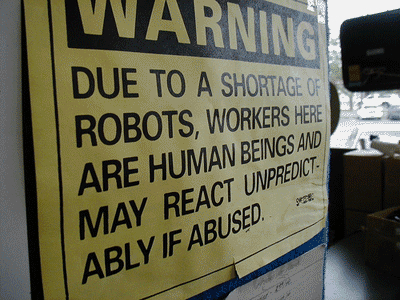
The other day, a few colleagues were lamenting the incipient robot domination of the workplace. It is true that advances in automation and robotics are likely to displace workers in a variety of fields over the next few decades. However, the substitution of capital for labor is not a new phenomenon. It’s been happening since the start of the industrial age. At the same time, capital has been augmenting labor, making it more productive and freeing it up for higher-valued uses, many of which were previously unimagined. The large-scale addition of capital to the production process has succeeded in raising labor productivity dramatically, and labor income has soared as a consequence. That is likely to continue as increasingly sophisticated robots assume certain tasks entirely and collaborate with workers on others, even in the service sector.

Advanced forms of automation are another step in the progression of technology. The process itself, however, and the adoption of robotics, might well be hastened by public policy that pushes labor costs to levels not commensurate with productivity. I wrote about this process in “Automate No Job Before Its Time” on Sacred Cow Chips late last year. The point of that essay was that government-imposed wage floors create an incentive for automation. Because a wage floor has its impact at the bottom of the wage scale, at which workers are the least-skilled, this form of government intervention creates a regrettable and unnatural acceleration in the automation process. Other mandated benefits and workplace regulations can have similar effects.

Robert Samuelson makes the same points in “Our Robot Panic Is Overblown“. He notes the effectiveness of the U.S. economy in creating jobs over time in the presence of increasing capital-intensity. But he also warns of potential missteps, including the dangers of government activism:

“There are two dangers for the future. One is that the new jobs created by new technologies will require knowledge and skills that are in short supply, leaving unskilled workers without income and the economy with skill scarcities. … The second danger is that government will damage or destroy the job creation process. We live in a profit-making economic system. Government’s main role is to maintain the conditions that make hiring profitable. … If we make it too costly for private firms to hire (through high minimum wages, mandated costs and expensive regulations) — or too difficult to fire — guess what? They won’t hire. That’s what ought to worry us, not the specter of more robots.“

Historically, automation has actually created more jobs than it has destroyed. In general, however, the new jobs have required higher levels of skills than the jobs lost. In “Why Are There Still So Many Jobs? The History and Future of Workplace Automation“, David Autor of MIT says it this way:

“Automation does indeed substitute for labor—as it is typically intended to do. However, automation also complements labor, raises output in ways that lead to higher demand for labor, and interacts with adjustments in labor supply. … journalists and even expert commentators tend to overstate the extent of machine substitution for human labor and ignore the strong complementarities between automation and labor that increase productivity, raise earnings, and augment demand for labor.“

As with almost all automation, robots will replace workers in the most routine tasks. Tasks involving less routine will not be as readily assumed by robots. To a large degree, people misunderstand the nature of automation in the workplace. The introduction of robots often requires collaboration with humans, but again, these humans must have more highly-developed skills than a typical line worker.

Hal Varian, who is the chief economist at Google, describes the positive implications of the ongoing trend to automate (see the link in the last paragraph of this post), namely, less drudgery and more leisure:

“If ‘displace more jobs’ means ‘eliminate dull, repetitive, and unpleasant work,’ the answer would be yes. How unhappy are you that your dishwasher has replaced washing dishes by hand, or your vacuum cleaner has replaced hand cleaning? My guess is this ‘job displacement’ has been very welcome, as will the ‘job displacement’ that will occur over the next 10 years. The work week has fallen from 70 hours a week to about 37 hours now, and I expect that it will continue to fall. This is a good thing. Everyone wants more jobs and less work. Robots of various forms will result in less work, but the conventional work week will decrease, so there will be the same number of jobs (adjusted for demographics, of course).“

An extreme version of the “robot domination” narrative is that one day in the not-too-distant future, human labor will be obsolete. Automation is not limited to repetitive or menial tasks by any means. A wide variety of jobs requiring advanced skills have the potential to be automated. Already, robots are performing certain tasks formerly done only by the likes of attorneys, surgeons, and computer programmers. Robots have the potential to repair each other, to self-replicate, to solve high-order analytical problems and to engage in self-improvement. With advances in artificial intelligence (AI), might humans one day become wholly obsolete for productive tasks? What does that portend for the future of so many human beings and their dependents who, heretofore, have relied only on their labor to earn a living?

There are any number of paths along which the evolution of technology, and its relationship to workers and consumers, might play out. The following paragraphs examine some of the details:

The Human Touch: There will probably always be consumers who prefer to transact with humans, as opposed machines. This might be limited to a subsegment of the population, and it might be limited to the manufacture of certain artisan goods, such as hand-rolled cigars, or certain services. Some of these services might require qualities that are more uniquely human, such as empathy, and the knowledge that one is dealing with a human would be paramount. This niche market might be willing to pay premium prices, much as consumers of organic foods are willing to pay an extra margin. However, it will be necessary to retain the perceived quality of the human touch and to remain reasonably competitive with automated alternatives on price.

Human Augmentation: Another path for the development of technology is the cyborgization of labor. This might seem rather distasteful to current sensibilities, but it’s a change that is probably inevitable. At least some will choose it. Here is an interesting definition offered by geir.org:

“Cyborgization is the enhancement of a biological being with mechanical or non-genetically delivered biological devices or capabilities. It includes organ or limb replacements, internal electronics, advanced nanomachines, and enhanced or additional capabilities, limbs, or senses.“

These types of modifications can make “enhanced” humans competitive with machines in all kinds of tasks. The development of these kinds of technologies is taking place within the context of rehabilitative medical care and even military technology, such as powerful exoskeletons, but the advances will make their way into normal civilian life. There is also development activity taking place among extreme hobbyists underground, such as “biohackers” who perform self-experimentation, embedding magnets or electronic chips in their bodies in attempts to develop a “sixth sense” or enhanced physical abilities. Even these informal efforts, while potentially risky to the biohackers themselves, might lead to changes that will benefit mankind, much like the many great garage tinkerers who have been important to innovation in the past.

Owning Machines: Ownership of capital will take on a greater role in providing for lifetime earnings. Can the distribution of capital ever be broadened to the extent needed to replace lost labor income? There are ways in which this can occur. The first thing to note is that the transition to a labor-free economy, were that to transpire, would play out over many years. Second, we have witnessed an impressive diffusion of advanced technologies in recent decades. Today, consumers across the income spectrum hold computers in their pockets that are more than the equivalent of the supercomputers that existed 50 years ago. Today’s little computers are far more useful in many ways, given wireless internet connectivity. There are many individuals for whom these devices are integral to earning an income. Thus, the rate of return on these machines can be quite impressive. The same is true of computers, software (sometimes viewed as capital) and printers, not to mention other “modern” contrivances with income-earning potential such as cars, trucks and a vast array of other tools and hardware. Machines with productive potential will continue to make their way into our lives, both as consumers and as individual producers. This also will include value-added production of goods at home, even for use or consumption within the household (think 3D printers, or backyard “farmbots”).

Saving Constructs: Most of the examples above involve machines that require some degree of human collaboration. Of course, even the act of consuming involves labor: I must lift the fork to my mouth for every bite! But in terms of earning income from machines, are there other ways in which ownership of capital can be broadened? The first answer is an old one: saving! But there is no way most individuals at the start of their “careers” can garner a significant share of income from capital. Other social arrangements are probably necessary. One of great importance is the family and family continuity. Many who have contemplated a zero-labor future imagine a world in which there are only two kinds of actors: individuals and the state. Stable families, however, hold the potential for accumulating capital over time to provide a flow of income for their members. Other forms of social organization can fill this role, but they must be able to accumulate capital endowments across generations. Of course, in an imagined world with minimal opportunities for labor, some have concluded that society must collectively provide a guaranteed income. To indulge that view for just a moment, a world of complete automation would almost certainly be a world of superabundance, so goods would be extremely cheap. That means a safety net could be provided at a very low cost. Nonetheless, it would be far preferable to do so by distributing a minimal number of shares of ownership in machines. These shares would have some value, and to improve resource allocation, it should be the individual’s responsibility to manage those shares.

Economic Transition: The dynamics of the transition to robot-dominated production raise some interesting economic questions. Should the advancement of robotics and artificial intelligence create a massive substitution away from labor, it will be spurred by 1) massive upward shifts in the productivity of capital relative to its cost; and 2) real wages that exceed labor’s marginal productivity. There will be stages of surging demand for the kinds of advanced labor skills that are complementary to robots. The demand for less advanced labor services does not have to fall to zero, however. There will be new opportunities that cannot be predicted today. Bidding for scarce capital resources and the flow of available saving will drive up capital costs, slowing the transition. And as long as materials, energy and replacement parts have a cost, and as long as savers demand a positive real return, there will be a margin along which it will be profitable to employ various forms of labor. But downward adjustment of real wages will be required. Government wage-floor policies must be abandoned. That will not be as difficult as it might sound: the kind of automation envisioned here would have profound effects on overall costs and the supply of goods, leading to deflation in the prices of consumables. As long as real factor prices can adjust, there will almost certainly remain a balance between the amounts of capital and labor employed.

In “Robots Are Nothing New“, Don Boudreaux passes along this comment from George Selgin:

“I’ve always been aghast at finding many otherwise intelligent economists arguing as if technology had a mind of its own, developing willy-nilly, or even perversely, in relation to the relative scarcity of available factors, including labor. Only thus can it happen that labor-saving technology develops to a point where labor, instead of being relatively scarce, becomes superabundant!

The fundamental problem, I believe, is confusion of the role of technological change with that of government interference with the pricing of labor services that is among the things to which technology in turn responds. Labor-saving technology becomes associated with unemployment, not because the last is a consequence of the former, but because both are contemporaneous consequences of a common cause, to wit: minimum wage laws and other such interference that sets wage rates above their market-clearing levels.“

There is much disagreement on the implications of automation. This excellent survey of experts by the Pew Research Center contains a number of insights. Also, visit Singularity Hub for a number of great articles on automation and AI, some of which are surprising. I believe that these technologies hold a great deal of promise for humanity. The process will not take place as suddenly as some fear, but ill-conceived policies such as a mandated “living wage” would put us on an unnaturally speedy trajectory. Opportunities for the least-skilled workers will be foreclosed too soon, before those individuals can develop skills and improve their odds of establishing a life free of dependency. Too rapid an adoption of advanced automation and AI would increase the likelihood of choosing suboptimal production methods that might be difficult to change later, and it would leave little time for education and training for workers who might otherwise leverage new technologies. The benefits of automation and their diffusion can be maximized by allowing advances to take a natural course, guided by market forces, with as little interference from government as possible.

Follow Sacred Cow Chips on WordPress.com

Recent Posts

  • The Case Against Interest On Reserves
  • Immigration and Merit As Fiscal Propositions
  • Tariff “Dividend” From An Indigent State
  • Almost Looks Like the Fed Has a 3% Inflation Target
  • Government Malpractice Breeds Health Care Havoc

Archives

  • January 2026
  • December 2025
  • November 2025
  • October 2025
  • September 2025
  • August 2025
  • July 2025
  • June 2025
  • May 2025
  • April 2025
  • March 2025
  • February 2025
  • January 2025
  • December 2024
  • November 2024
  • October 2024
  • September 2024
  • August 2024
  • July 2024
  • June 2024
  • May 2024
  • April 2024
  • March 2024
  • February 2024
  • January 2024
  • December 2023
  • November 2023
  • August 2023
  • July 2023
  • June 2023
  • May 2023
  • April 2023
  • March 2023
  • February 2023
  • January 2023
  • December 2022
  • November 2022
  • October 2022
  • September 2022
  • August 2022
  • July 2022
  • June 2022
  • May 2022
  • April 2022
  • March 2022
  • February 2022
  • January 2022
  • December 2021
  • November 2021
  • October 2021
  • September 2021
  • August 2021
  • July 2021
  • June 2021
  • May 2021
  • April 2021
  • March 2021
  • February 2021
  • January 2021
  • December 2020
  • November 2020
  • October 2020
  • September 2020
  • August 2020
  • July 2020
  • June 2020
  • May 2020
  • April 2020
  • March 2020
  • February 2020
  • January 2020
  • December 2019
  • November 2019
  • October 2019
  • September 2019
  • August 2019
  • July 2019
  • June 2019
  • May 2019
  • April 2019
  • March 2019
  • February 2019
  • January 2019
  • December 2018
  • November 2018
  • October 2018
  • September 2018
  • August 2018
  • July 2018
  • June 2018
  • May 2018
  • April 2018
  • March 2018
  • February 2018
  • January 2018
  • December 2017
  • November 2017
  • October 2017
  • September 2017
  • August 2017
  • July 2017
  • June 2017
  • May 2017
  • April 2017
  • March 2017
  • February 2017
  • January 2017
  • December 2016
  • November 2016
  • October 2016
  • September 2016
  • August 2016
  • July 2016
  • June 2016
  • May 2016
  • April 2016
  • March 2016
  • February 2016
  • January 2016
  • December 2015
  • November 2015
  • October 2015
  • September 2015
  • August 2015
  • July 2015
  • June 2015
  • May 2015
  • April 2015
  • March 2015
  • February 2015
  • January 2015
  • December 2014
  • November 2014
  • October 2014
  • September 2014
  • August 2014
  • July 2014
  • June 2014
  • May 2014
  • April 2014
  • March 2014

Blogs I Follow

  • Passive Income Kickstart
  • OnlyFinance.net
  • TLC Cholesterol
  • Nintil
  • kendunning.net
  • DCWhispers.com
  • Hoong-Wai in the UK
  • Marginal REVOLUTION
  • Stlouis
  • Watts Up With That?
  • Aussie Nationalist Blog
  • American Elephants
  • The View from Alexandria
  • The Gymnasium
  • A Force for Good
  • Notes On Liberty
  • troymo
  • SUNDAY BLOG Stephanie Sievers
  • Miss Lou Acquiring Lore
  • Your Well Wisher Program
  • Objectivism In Depth
  • RobotEnomics
  • Orderstatistic
  • Paradigm Library
  • Scattered Showers and Quicksand

Blog at WordPress.com.

Passive Income Kickstart

OnlyFinance.net

TLC Cholesterol

Nintil

To estimate, compare, distinguish, discuss, and trace to its principal sources everything

kendunning.net

The Future is Ours to Create

DCWhispers.com

Hoong-Wai in the UK

A Commonwealth immigrant's perspective on the UK's public arena.

Marginal REVOLUTION

Small Steps Toward A Much Better World

Stlouis

Watts Up With That?

The world's most viewed site on global warming and climate change

Aussie Nationalist Blog

Commentary from a Paleoconservative and Nationalist perspective

American Elephants

Defending Life, Liberty and the Pursuit of Happiness

The View from Alexandria

In advanced civilizations the period loosely called Alexandrian is usually associated with flexible morals, perfunctory religion, populist standards and cosmopolitan tastes, feminism, exotic cults, and the rapid turnover of high and low fads---in short, a falling away (which is all that decadence means) from the strictness of traditional rules, embodied in character and inforced from within. -- Jacques Barzun

The Gymnasium

A place for reason, politics, economics, and faith steeped in the classical liberal tradition

A Force for Good

How economics, morality, and markets combine

Notes On Liberty

Spontaneous thoughts on a humble creed

troymo

SUNDAY BLOG Stephanie Sievers

Escaping the everyday life with photographs from my travels

Miss Lou Acquiring Lore

Gallery of Life...

Your Well Wisher Program

Attempt to solve commonly known problems…

Objectivism In Depth

Exploring Ayn Rand's revolutionary philosophy.

RobotEnomics

(A)n (I)ntelligent Future

Orderstatistic

Economics, chess and anything else on my mind.

Paradigm Library

OODA Looping

Scattered Showers and Quicksand

Musings on science, investing, finance, economics, politics, and probably fly fishing.

  • Subscribe Subscribed
    • Sacred Cow Chips
    • Join 128 other subscribers
    • Already have a WordPress.com account? Log in now.
    • Sacred Cow Chips
    • Subscribe Subscribed
    • Sign up
    • Log in
    • Report this content
    • View site in Reader
    • Manage subscriptions
    • Collapse this bar
 

Loading Comments...