• About

Sacred Cow Chips

Sacred Cow Chips

Tag Archives: Uber

They Pave Paradise Because Users Pay No Price

24 Wednesday Jan 2024

Posted by Nuetzel in Price Mechanism, Scarcity

≈ Leave a comment

Tags

Car Dependence, Cloverleaf Interchanges, Congestion pricing, Diamond Interchange, Diverging Diamond, Dynamic Pricing, Failure of the Commons, Flyover Ramps, Gas Taxes, Infrastructure Investment and Jobs Act, Interstate Highways, Jessica Trounstine, Joe Biden, Joel Kotkin, Lyft, New York City, Paved Paradise, Private Roads, Reddit, Robert P. Murphy, Sarasota, Socialized Roads, SunPass, Tolls, Uber, Urban planning, Urban Sprawl, Willian Frey
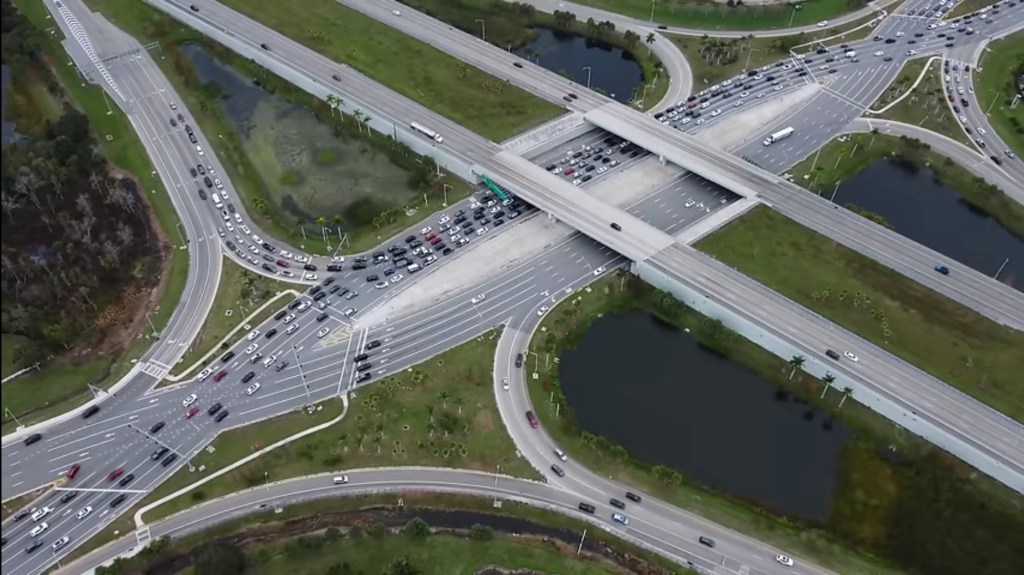
The interchange above is just a few miles from my new home. It’s the world’s largest “diverging diamond” design and it usually works quite well, so I was interested to see this video discussing both its benefits and the conditions under which it hasn’t performed well.

Unfortunately, the video maintains a dubious focus on car dependence in most urban areas. The tale it tells is daunting… and if the reaction on Reddit is any indication, it seems to excite the populist mind. The narrator blames car dependence and sprawl on poor urban planning. I agree in a sense, and I’ll even stipulate that our car dependence is often excessive, but not because anyone could have “planned” better. Top-down planning is notoriously failure-prone. Rather, the corrective is something the creators of the video never contemplate: effective pricing for the use of roads.

There is deserved emphasis near the end of the video on the cost of building and maintaining roads and interchanges. For example, the cost of the interchange above was $74.5 million when it was built about 15 years ago. That sounds exorbitant, and it’s natural for people (and especially urban planners) to question the necessity of building an interchange of that magnitude in what many feel “should be” an outlying district. Did sprawl make it necessary? Can that be avoided in a growing region? What can or should be done?

Good Interchange Design

The interchange in question is at I-75 and University Parkway in Sarasota, FL. It’s used by many drivers to access a large shopping mall, other commercial centers, and nearby residential areas. The video stresses the diverging diamond’s effectiveness and safety in handling high flows of traffic. The design reduces the number of conflict points relative to conventional diamond interchanges, especially for crossing traffic.

Both diverging diamonds and conventional diamond interchanges have advantages over cloverleaf designs. While the latter have no crossover conflict points, they require more land use. They also create additional complexities for grading and drainage, and they are often constrained in the length of space available for left-turn merges. Furthermore, a cloverleaf places more severe limits on traffic flow. Flyover ramps are another alternative that can save space but entail greater expense.

The interchange in question serves an area of rapid growth. Residents increasingly complain about traffic, especially when “snow birds” are in town during the winter months. The video shows that even the diverging diamond has problems once traffic reaches a certain volume. But new residential communities and commercial areas continue to come on-line, adding to traffic flows and requiring additional roads and infrastructure. Again, the narrator believes the resulting traffic and sprawl could have been avoided, and he’s partly correct as far as that goes.

Sprawl Reflects Preferences

The video fails to consider important qualifications to the “car dependence” critique of suburban sprawl. For example, many people like to use their cars and enjoy the freedom of mobility their cars confer. More importantly, most people prefer to live in low-density residential environments rather than dense urban neighborhoods, or even the kinds of communities depicted as ideal in the video. I’m one of those people. More space, more privacy, and more greenery (though I grant that sprawling mall parking lots are not my favorite aesthetic).

Joel Kotkin presents data along those lines, quoting research by Jessica Trounstine, who says, “preferences for single-family development are ubiquitous.” And low-density communities have broad appeal across demographics, as noted by Kotkin:

“Even in blue states, the majority of ethnic minorities live in suburbs, who have accounted for virtually all the suburban growth over the past decade. William Frey of the Brookings Institution notes that in 1990 roughly 20 percent of suburbanites were non-white. That rose to 30 percent in 2000 and 45 percent in 2020.”

Urban Planning Myopia

As to the video’s emphasis on car dependence, its most serious omission is a failure to recognize the economics of pricing. Road use comes with various costs, but the key here is the zero price at the margin for using specific routes, interchanges, bridges, and suburban parking lots. There are many exceptions to be sure, but the video makes no mention of road pricing as a development tool. Nor does it consider “socialized roads” as the chief cause of ever-expanding demands for roads, parking, and the all-too-typical failure of these ersatz “commons”.

The federal government is complicit in this. After all, the interstate highway system was a federal initiative, and interchanges (along with concomitant commercial development) are integral to its success. Interstate highways often supplemented regional efforts to facilitate commuting to cities from distant suburbs. More recently, Joe Biden’s Infrastructure Investment and Jobs Act of 2021 added $110 billion a year from the government’s general fund to subsidize highways and bridges. It should be no surprise that federal gas taxes don’t fund these subsidies. (Gas taxes are user fees only in a vague sense, as they don’t price specific routes at the margin).

More Roads, Trains, Buses?

There are two knee-jerk reactions to congested roads. The first is a tendency to double-down on invested plant, building more, bigger, and wider roads in the hope that they can handle the growing traffic load. Presumably this must be funded by taxpayers, as in the past, and seldom if ever by charging per marginal use of these facilities. This “solution” basically calls for more socialized roads.

The second knee-jerk reaction to congestion, and it is also a reaction to the real or presumed shortcomings of a “paved paradise”, is to call for more buses, streetcars, or light rail. But mass transit systems seldom pay for their operating costs let alone their capital costs. One of the reasons, of course, is that they must compete with free roads!

What else might the urban planners have us do? We can’t just tear down the sprawling developments and road infrastructure and start over. However, we can accomplish a few other things like: 1) raise revenue from users to make the upkeep of road infrastructure self-funding; 2) minimize congestion, emissions, and time-use while improving safety; and 3) stem growth in demand that eventually would require more lanes, more parking, and other measures to maximize traffic flow. Pricing the actual use of roads would do all these things in greater or lesser degree, and it would more effectively balance development preferences with costs. In turn, positive road-use prices would incentivize other development models such as the “human-centric” communities the video’s narrator finds so attractive.

Those Who Benefit Shall Pay

Tolls for the use of roads and bridges (and paid parking) are hardly new ideas. Tolls on bridges were a natural continuation of fees charged by operators of ferry boats. Tolling was instituted by large landholders to extract rents from anyone wishing to traverse their property, and only later was used as a mechanism for funding road construction and maintenance. But like any price, tolls serve to ration the availability of a resource.

Today, tolling in the U.S. is an increasingly important source of funding for highways and bridges. This importance is growing due to a less sanguine outlook for gas tax collections. In any case, tolls are often more advantageous politically than taxes. Technological advance has allowed tolling to become more cost effective as well. In Florida, for example, the SunPass system allows drivers to cruise through toll collection points at moderate speeds. It’s also used for parking at certain facilities like airports. SunPass holders are required to set up automatic “recharge” of their available balance for toll payments. Similar systems are in place in other states.

Technology has enabled dynamic congestion pricing to be implemented by commercial interests like Uber and Lyft. This means that price responds to demand and supply conditions in real time. In coming years, congestion pricing is likely to be instituted by jurisdictions experiencing heavy traffic volumes. New York City’s congestion pricing plan has stalled, but it would charge a toll on vehicles using Manhattan streets below Central Park.

Law of Demand

Tolls at interchanges like the one at I-75 and University Parkway would help to allocate resources more efficiently. First, the mechanics could be simple enough in concept, but toll booths are probably out of the question, and toll authorities would have to sort through various administrative issues.

Let’s suppose SunPass was put to use here, with the revenue distributed to several jurisdictions or agencies responsible for maintaining the interchange and a defined set of connecting streets. When a driver exits I-75 to University, enters I-75 from University, or uses the through lanes on University, the SunPass transponder in their vehicle would communicate with the toll system to record their passage, and their account would be charged the appropriate toll. The charge might differ for through lanes versus I-75 entry or exit. Over the course of a month, tolls on various roads and interchanges would accumulate and be summarized by road or interchange on a statement for the driver.

Vehicles without SunPass (or another toll system partnering with SunPass) would have to be charged via photo identification of tags with billing by mail once a month. This is already a feature of toll roads in Florida (and other states) when vehicles without a SunPass use the SunPass lanes. The volume of mail billing would increase substantially, but that is not an obstacle in principle.

One other wrinkle would allow existing residents of neighborhoods with street entrances within one or two miles of the interchange to receive discounted tolls. That seems fair, but the danger is that discounts of this kind, if extended too far, would blunt incentives that otherwise discourage overuse and underpriced road sprawl. It would also add another layer of complexity to the tolling system.

The behavior of drivers will change in response to tolls. They derive benefits from using particular interchanges which depend upon the importance of errands or appointments in each vicinity, the distance and convenience of other shopping areas, the time of day, and the time saved by using any one route instead of alternates. The toll paid for using an interchange might depend on the size of vehicle, the time of day, or some measure of average congestion at that time of day. A higher toll prompts drivers to consider other routes, other shopping areas (including on-line shopping), or different times of day for those errands. Thus, tolls will redistribute traffic across space and time and are likely to reduce overall traffic at the most congested interchanges, at least at peak hours when tolls are highest.

Smart Pricing

The advent and installation of more sophisticated tolling infrastructure will enable “smart roads”, time-of-day pricing, or even dynamic congestion pricing on some routes. Integrating dynamic pricing with information systems guiding driver decisions about route choice and timing would be another major step. Implementing sophisticated route pricing systems like this will take time, but ultimately the technology will allow tolls to be applied broadly and efficiently… if we allow it to happen.

Private Vs. Public

The private sector is likely to play a greater role in a world of more widespread tolling. To some extent this will take the form of more privately-owned roads. Short of that, many toll roads and smart roads will be privately administered and operated. Private concerns will also play a major role in provisioning infrastructure and systems for more widespread and sophisticated toll roads.

There is a long history of private roads in the U.S. Robert P. Murphy offers a brief summary:

“… many analysts simply assume, because currently the government virtually monopolizes the production and administration of roads, that it must always have done so. And yet, from the 1790s through the 1830s, the private sector was responsible for the creation and operation of many turnpikes. According to economist Daniel Klein, ‘The turnpike companies were legally organized like corporate businesses of the day. The first, connecting Philadelphia and Lancaster, was chartered in 1792, opened in 1794, and proved significant in the competition for trade.’3 ‘By 1800,’ Klein reports, ‘sixty-nine companies had been chartered’ in New England and the Middle Atlantic states. Merchants would often underwrite the expense of building a turnpike, knowing that it would bring in extra traffic to their businesses.”

In Norway and Sweden, most roads are owned and operated privately, though most of the private roads are local. The funding is generally provided by property owners along those routes. Private roads are increasingly common in the U.S., but they are mostly confined to private communities funded by residents. Broader private ownership of roads, and tolling, is likely to occur in the U.S. as governments at all levels struggle with issues of funding, maintenance, traffic control, and growth.

Pricing For Scarcity

There will be political obstacles to widespread tolling and road congestion pricing. Questions of equity and privacy will be raised, but pricing may hold the key to achieving more equitable outcomes. Greater reliance on tolls would avoid regressive tax increases, and selective tolls themselves might well have a progressive incidence, to the extent that congestion tends to be high in prosperous commercial districts. It would make alternatives like mass transit more competitive and viable as well. Furthermore, price signals will cause geographic patterns of commerce and development to shift, potentially encouraging the kinds of high-density, pedestrian communities long-favored by urban planners.

Urban sprawl and auto dependence are old targets of the urban planning community, not to mention the populist left. But those critics rely on a stylized characterization of geographic and social arrangements that happen to be preferred by masses of individuals. As an economist, I sympathize with the critics because those preferences are revealed under incentives that do not reflect the scarcity and real costs of roads and driving. However, in the absence of adequate price incentives, solutions offered by critics of sprawl and autos are at worst brutally intrusive and at best ineffectual. More efficient pricing of roads can be achieved with the installation of tolling solutions that are now technologically feasible. Optimizing tolls over specific roads, bridges, blocks, intersections, and interchanges will require more sophisticated systems, but for now, let’s at least get road-use prices going in the right direction!

Inequality and Inequality Propaganda

21 Saturday Dec 2019

Posted by Nuetzel in Income Distribution, Inequality, Uncategorized

≈ Leave a comment

Tags

Alexandria Ocasio-Cortez, Bernie Sanders, Capitalism, Consumer Surplus, David Splinter, Declaration of Independence, Declination blog, Diffusion of Technology, Economic Mobility, Edward F. Leamer, Elizabeth Warren, Gerald Auten, Income Distribution, Inequality, J. Rodrigo Fuentes, Jeff Jacoby, Luddite, Marginal cost, Mark Perry, Marriage Rates, Pass-Through Income, Redistribution, Robert Samuelson, Scalability, Thales, Uber, Workaholics

I’m an “inequality skeptic”, first, with respect to its measurement and trends; and second, with respect to its consequences. Economic inequality in the U.S. has not increased over the past 60 years as often claimed. And some degree of ex post inequality, in and of itself, has no implication for real economic well-being at any point on the socioeconomic spectrum, the growls of class-warmongers aside. So I’m not just a skeptic. I’m telling you the inequality narrative is BS! The media has been far too eager to promote distorted metrics that suggest widening disparities and presumed injustice. Left-wing politicians such as Bernie Sanders, Elizabeth Warren, and Alexandra Ocasio-Cortez pounce on these reports with opportunistic zeal, fueling the flames of class warfare among their sycophants.

Measurement

Comparisons of income groups and their gains over time have been plagued by a number of shortcomings. Jeff Jacoby reviews issues underlying the myth of a widening income gap. Today, the top 1% earns about the same share of income as in the early 1960s, according to a recent study by two government economists, Gerald Auten and David Splinter.

Jacoby recounts distortions in the standard measures of income inequality:

  • The comparisons do not account for tax burdens and redistributive government transfer payments, which level incomes considerably. As for tax burdens, the top 1% paid more taxes in 2018 than the bottom 90% combined.
  • The focus of inequality metrics is typically on households, the number of which has expanded drastically with declines in marriage rates, especially at lower income levels. Incomes, however, are more equal on a per capital basis.
  • The use of pension and retirement funds like IRAs and 401(k) plans has increased substantially over the years. The share of stock market value owned by retirement funds increased from just 4% in 1960 to more than 50% now. As Jacoby says, this has “democratized” gains in asset prices.
  • A change in the tax law in 1986 led to reporting of more small business income on individual returns, which exaggerated the growth of incomes at the high-end. That income had already been there.
  • People earn less when they are young and more as they reach later stages of their careers. That means they move up through the income distribution over time, yet the usual statistics seem to suggest that the income groups are static. Jacoby says:

“Contrary to progressive belief, America is not divided into rigid economic strata. The incomes of the wealthy often decline, while many taxpayers go from being poor at one point to not-poor at another. Research shows that more than one-tenth of Americans will make it all the way to the top 1 percent for at least one year during their working lives.”

Mark Perry recently discussed America’s record middle-class earnings, emphasizing some of the same subtletles listed above. A middle income class ($35k-$100k in constant dollars) has indeed shrunk over the past 50 years, but most of that decrease was replaced by growth in the high income strata (>$100k), and the lower income class (<$35k) shrank almost as much as the middle group in percentage terms.

Causes

What drives the inequality we actually observe, after eliminating the distortions mentioned above? The reflexive answer from the Left is capitalism, but capitalism fosters great social and economic mobility relative to authoritarian or socialist regimes. That a few get fabulously rich under capitalism is often a positive attribute. A friend of mine contends that most of the great fortunes made in recent history involve jobs for which the product or service produced is highly scalable. So, for example, on-line software and networks “scale” and have produced tremendous fortunes. Another way of saying this is that the marginal cost of serving additional customers is near zero. However, those fortunes are earned because consumers extract great value from these products or services: they benefit to an extent exceeding price. So while the modern software tycoon is enriched in a way that produces inequality in measured income, his customers are enriched in ways that aren’t reflected in inequality statistics.

Mutually beneficial trade creates income for parties on only one side of a given transaction, but a surplus is harvested on both sides. For example, an estimate of the consumer surplus earned in transactions with the Uber ride-sharing service in 2015 was $1.60 for every dollar of revenue earned by Uber! That came to a total of $18 billion of consumer surplus in 2015 from Uber alone. These benefits of free exchange are difficult to measure, and are understandably ignored by official statistics. They are real nevertheless, another reason to take those statistics, and inequality metrics, with a grain of salt.

Certain less lucrative jobs can also scale. For example, the work of a systems security manager at a bank produces benefits for all customers of the bank, and at very low marginal cost for new customers. Conversely, jobs that don’t scale can produce great wealth, such as the work of a highly-skilled surgeon. While technology might make him even more productive over time, the scalability of his efforts are clearly subject to limits. Yet the demand for his services and the limited supply of surgical skills leads to high income. Here again, both parties at the operating table make gains (if all goes well), but only one party earns income from the transaction. These examples demonstrate that standard metrics of economic inequality have severe shortcomings if the real objective is to measure differences in well-being. 

Economist Robert Samuelson asserts that “workaholics drive inequality“, citing a recent study by Edward E. Leamer and J. Rodrigo Fuentes that appeals to statistics on incomes and hours worked. They find the largest income gains have accrued to earners with high educational attainment. It stands to reason that higher degrees, and the longer hours worked by those who possess them, have generated relatively large income gains. Samuelson also cites the ability of these workers to harness technology. So far, so good: smart, hard-working students turn into smart, hard workers, and they produce a disproportionate share of value in the marketplace. That seems right and just. And consumers are enriched by those efforts. But Samuelson dwells on the negative. He subscribes to the Ludditical view that the gains from technology will accrue to the few:

“The Leamer-Fuentes study adds to our understanding by illuminating how these trends are already changing the way labor markets function. … The present trends, if continued, do not bode well for the future. If the labor force splits between well-paid workaholics and everyone else, there is bound to be a backlash — there already is — among people who feel they’re working hard but can’t find the results in their paychecks.“

That conclusion is insane in view of the income trends reviewed above, and as a matter of economic logic: large income gains might accrue to the technological avant guarde, but those individuals buy things, generating additional demand and income gains for other workers. And new technology diffuses over time, allowing broader swaths of the populace to capture value both in consumption and production. Does technology displace some workers? Of course, but it also creates new, previously unimagined opportunities. The history of technological progress gives lie to Samuelson’s perspective, but there will always be pundits to say “this time it’s different”, and it probably sounds heroic to their ears.

Consequences

The usual discussions of economic inequality in media and politics revolve around an egalitarian ideal, that somehow we should all be equal in an absolute and ex post sense. That view is ignorant and dangerous. People are not equal in terms of talent and their willingness to expend effort. In a free society, the most talented and motivated individuals will produce and capture more value. Attempts to make it otherwise can only interfere with freedoms and undermine social welfare across the spectrum. This post on the Declination blog, “The Myth of Equality“, is broader in its scope but makes the point definitively. It quotes the Declaration of Independence:

“We hold these truths to be self-evident, that all men are created equal, that they are endowed by their Creator with certain unalienable Rights, that among these are Life, Liberty and the Pursuit of Happiness.”

The poster, “Thales”, goes on to say:

“The context of this was within an implied legal framework of basic rights. All men have equal rights granted by God, and a government is unjust if it seeks to deprive a man of these God-given rights. … This level of equality is both the basis for a legal framework limiting the power of government, and a reference to the fact that we all have souls; that God may judge them. God, being omniscient, can be an absolute neutral arbiter of justice, having all the facts, and thus may treat us with absolute equality. No man could ever do this, though justice is often better served by man at least making a passing attempt at neutrality….”

Attempts to go beyond this concept of ex ante equality are doomed to failure. To accept that inequalities must always exist is to acknowledge reality, and it serves to protect rights and opportunities broadly. To do otherwise requires coercion, which is violent by definition. In any case, inequality is not as extreme as standard metrics would have us believe, and it has not grown more extreme.

Don’t Cry for the Former Taxi Monopoly

23 Friday Mar 2018

Posted by Nuetzel in competition, monopoly, Technology, Uncategorized

≈ Leave a comment

Tags

Cartel, Consumer Surplus, Creative Destruction, Human capital, Lyft, Mark Perry, Ride sharing, Taxi Medallions, Taxi Monopoly, Uber, Warren Meyer

It would be odd to argue that innovation is not unequivocally positive, that its costs will exceed its benefits. Certainly there are downsides: human capital invested in the methods and technologies supplanted by an innovation is devalued, jobs may be lost, retraining becomes necessary, and even consumers must get used to new ways of doing things, which is not costless. But most of these costs are temporary. And when an innovation eliminates an incumbent’s monopoly, the former monopolist’s profit ends up back in the pockets of consumers.

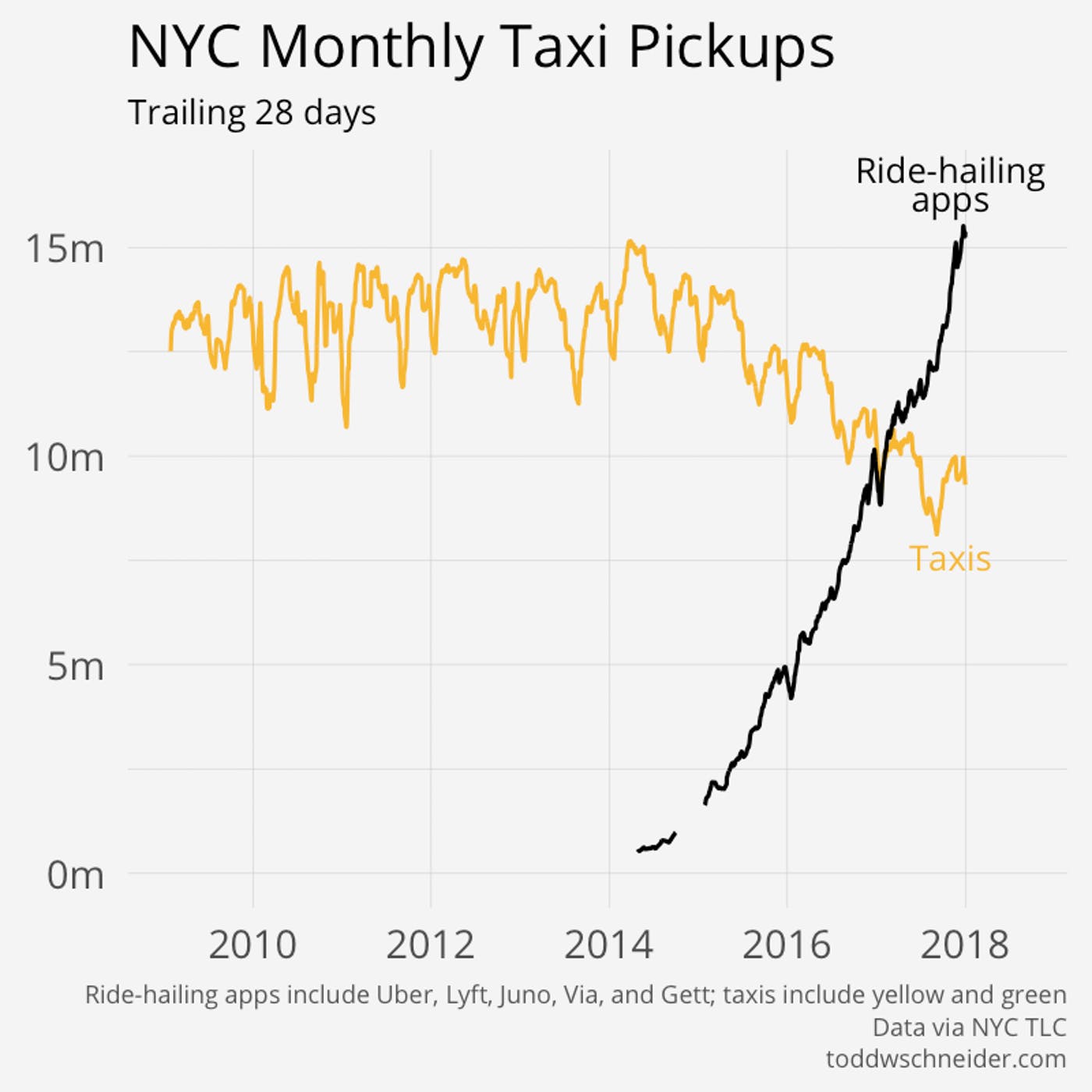
People do seem to focus excessively on the downside of innovation without carefully tallying the benefits. For example, this article focuses on the loss of New York City taxi pickups since ride sharing services like Uber and Lyft began to have an impact in 2014. Mark Perry reproduces a chart from that article, which is featured above. The number of monthly taxi rides in NYC has fallen by about one-third since then, from an average of 13+ million to about 9 million in 2017. In fact, Perry reports that the market for taxi medallions has tanked since then as well, with plunging medallion prices and many medallions sold out of bankruptcy and foreclosure. But don’t be too quick to shed tears for a monopoly lost.

The same chart shows the massive upside to ride sharing, as discussed here by Warren Meyer. The size of the total market has nearly doubled, from about 13 million per month to roughly 24 million (adding the two lines together). And it was a quick transition! That’s what happens when real competition is introduced to a market: prices fall and quantity increases, with an attendant increase in the welfare of consumers. That increase always exceeds the loss suffered by the former monopolist or cartel (as the case may be), which was earning excessive profits at the expense of consumers before the innovation had a market impact. And many former taxi drivers have made the switch to ride sharing providers, and they seem to prefer it for the flexibility and autonomy it offers. Yes, the best innovations benefit workers as well as consumers.

Competition can bloom when government opens markets to competitors or when an innovation creates new alternatives for consumers. In the case of ride sharing, both were necessary. For many years, NYC restricted the supply of taxi medallions, which kept taxi fares artificially high. The formal approval of ride sharing services in the city was not uncontested. But once it was approved, consumers took advantage of superior dispatching and payment technologies enabled by their smart phones, as well as security features and rating systems, not to mention lower fares. Again, these developments have contributed massively to consumer well-being, which is ultimately the point of all economic activity. Traditional taxis have to try to keep up. The ride sharing industry has inflicted the kind of creative destruction for which consumers are quite grateful.

Sharing Apps and Market Benefits

24 Saturday Jun 2017

Posted by Nuetzel in Markets, Transaction Costs

≈ Leave a comment

Tags

Airbnb, Allocative efficiency, competition, Double Coincidence of Wants, Medium of Exchange, Michael Munger, Property Rights, Ride sharing, Sharing economy, Transaction Costs, Transactions Technology, Uber

Transaction costs prevent lots of trades. So many that we often aren’t aware of their potentiality. Michael Munger asserts that transaction costs are so prohibitive that we tend to accumulate a lot of stuff that we could otherwise do without. That’s what he says in “Why we can’t break up with our stuff — yet“.

Transaction costs of all kinds have fallen dramatically over time. One of the greatest innovations in “transactions technology” was the avoidance of barter with the broad acceptance of a medium of exchange (money). Without a medium of exchange, trade requires a “double coincidence of wants”, which often makes the effort to engage in trade impractical. No less important was the establishment of secure property rights such that the integrity of a contract or transaction was protected, whether enforced by possible repercussions from other traders or through the police power of the state. Secure property rights and the use of money facilitated the development of markets and pricing that conveyed better information about scarcity. Other historical developments that reduced transaction costs include better transportation, communication, packaging, and more efficient distribution and supply chain management. In a variety of complex transactions, such as real estate, standardization of contracts has reduced transaction costs.

Those costs have been reduced dramatically of late by new communication and computing technologies. The size of these reductions is difficult to quantify in such prominent examples as Uber ride-sharing and Airbnb home-sharing, but there is no question that the new supplies of rides and accommodations would not have materialized absent the enabling on-line “apps”. The ease, low-cost and minimal risk of these transactions is incredible.

Suppose that hotels in Soho average $400 per night for a suite and that Airbnb rentals in Soho average $300. It’s fair to say that the average Airbnb host in Soho, without Airbnb, faced transaction costs in arranging for qualified occupants of at least $100 plus Airbnb’s fees. Probably much more. Now, it’s true that the hotel suites and the Airbnb rentals are fundamentally different “products”, but they are alternatives for meeting a particular need.

Similar reductions in transaction costs are occurring across a wide variety of sectors besides transportation and vacation rentals: trading in new and used goods, handymen, concierge services, snow plowing, home-sitting, food delivery, and hook-ups are but a few examples.

Munger’s twist on this story is that dramatically lower transaction costs will mean we’ll all need to own much less “stuff” on average, because we can “share”, or at least buy what we need at minimal transaction cost. Or, what we have will be used more intensively because we can share it profitably.

Munger mentions the high cost of owning an auto that he uses for about 5 out of 168 total hours in a week. The costs include dedicated “storage” space, both at home and at work, and sometimes the extra cost of “storing” it in airport parking. He could certainly afford to arrange alternative forms of transportation. Is owning the auto worthwhile because the transaction costs of the alternatives are too high? Well, Munger owns a nice car and he probably likes to drive it, so there is more to it than transaction costs. Still, if we mention the “convenience” of having a car at one’s disposal, that is really an expression of transaction costs avoided via ownership.

If the cost of arranging an acceptable and ready alternative is minimal, why own a car? This decision is very real in certain congested locales with costly real estate (e.g., parking New York City). In short, Munger believes even fewer individuals will bother to own personal autos, or that those cars will be less idle (rented to users), as technology reduces transaction costs:

“Why do I pay to store my car rather than let other people use it and collect rent? Transaction costs. …But we are living in the beginning of a pivotal era that will transform our relationship to ‘stuff’ (we’ll need less of it) and to each other (we’ll share more). For all of human history until about 1995, the desire to reduce transaction costs was tied to the desire to sell a particular product. Now, entrepreneurs are combining three things — mobile platforms, software apps, and internet connections — to sell reductions in transaction costs with no product attached. And that combination will change everything.“

Will that also mean fewer personally-owned kitchen appliances? Home furnishings? Clothing? Power tools? Stereo components? Probably not. Even if it’s easy to find a willing renter for my power tools or stereo components from time-to-time, I might not want to bother with the required exchanges (at pick-up and return). I use power tools from time-to-time, but I won’t want to shlep back and forth to rent them from someone when I could own them myself at relatively low cost. Perhaps I’ll rent a tiller or a power washer, but not a power drill. Maybe I could hire a gopher on the Air-gopher app to get the tools I need and return them when I’m done, but that adds back to my transaction costs. So there are certain limits to how far this can go in reducing our “stuff”.

Nevertheless, there is no question that there will be many new trades and competitive opportunities to exploit as transaction costs fall, and that implies more choice, lower prices, and less waste in the larger allocative sense. Those, I believe, are the major benefits of sharing technologies. For example, if you enjoy cooking but are the sole member of your household, imagine an app that allows you to sell your extra preparations to other individuals, or to give them away at a minimal transaction cost. Or, if you are able to perform odd jobs but prefer to take them at your convenience, you will likely be able to bid for projects of your choice. If you have a talent for teaching guitar, you could solicit business and even provide the lessons remotely through an on-line app. The major impediment to the development of such market innovations is potential interference by government or other entrenched interests who wish to prevent competition. Licensing laws and various forms of regulation and taxes could easily smother or eliminate the benefits of sharing technologies, and that would be a shame.

I’ll close with a digression on Munger’s hypothesis: why do I own or keep a lot of “stuff? It’s not all about transaction costs. Most people harbor nostalgic feelings for their “stuff”. I hate parting with my old shirts, old drivers licenses, theater programs, and ticket stubs. Most of those things have approximately zero market value. Some people believe it’s just plain wasteful to pitch something that can be put back into working order, like an old lawnmower. Transaction costs might be to blame, but the failure to junk the mower in the first place may be driven by a depression-era instinct for penny-pinching. The hoarder might simply underestimate the benefits of a new mower, or perhaps they deserve credit for undertaking a restoration project they enjoy.

I find myself hoarding all kinds of things that I think might be useful to me somehow, someday. Particularly things like miscellaneous nuts & bolts, sundry pieces of hardware, wire, old fixtures, pieces of lumber, and my late Dad’s old tools. I’m certain I won’t ever use 95%+ of these items, but it’s reassuring to have the inventory. Then again, every time I need an odd item, I find myself in my basement work room searching through all that stuff. Invariably, I end up on my way to the hardware store to get what I need. So much for minimizing transaction costs. What would it cost me to pitch all of it? An afternoon of painful evaluation… yet that too represents a transaction cost!

Government Wants To Gut Your Gig

24 Friday Jul 2015

Posted by Nuetzel in Big Government, Regulation

≈ Leave a comment

Tags

Bill De Blasio, Economic conservatism, Erik Sherman, Gig economy, Hillary Clinton, Megan McArdle, Overtime rules, rent seeking, Sharing economy, St. Louis Metropolitan Taxi Commission, Taskrabbit, Taxi deserts, Uber

uber-cartoonjpg

Big government is an inherently conservative enterprise when it comes to protecting  the economic status quo. It frequently acts on behalf of entrenched interests by quashing innovation and competition. This is well illustrated by resistance to the “gig economy” (or “sharing economy”) and companies like Uber and Taskrabbit. The gig economy is growing rapidly because it is often more affordable than traditional channels and it offers tremendous convenience. Enabled by the internet, customized tasks or “gigs” can be performed anywhere for anyone demanding them. My son in New York City just found a talented carpenter through an on-line app, who stopped by his apartment in the evening and mounted a big-screen TV on the wall. The service he provided was not new, but the deal was facilitated and even enhanced by technology in a way that in some cases is reordering economic relationships. The competitive pressure this can create is drawing resistance with the aid of government power.

In St. Louis, there is an ongoing conflict between the Taxicab Commission and Uber, which has not yet gained entry to the market. Three of eight members of the commission own cab companies. They have succeeded in keeping Uber and Lyft out of the market for over a year. A resolution might be possible soon, but the commission is still haggling with Uber over insurance coverage levels, fingerprints and background checks.

On the national stage, the biggest issue surrounding the gig economy is the formal relationship between workers and any company they might represent. Should those workers be treated as independent contractors or employees? Companies like Uber insist that their drivers are independent, but the government would prefer that they be treated as employees. In some cases, that would oblige employers to offer certain benefits. Erik Sherman covers this issue in “How the U.S. Just Knee-Capped the ‘Gig Economy’“. According to Uber, most of its drivers are part-time and like it that way, so it’s not clear that the government can force Uber (under current rules) to pay for extra benefits, or how many of its drivers that would affect. Still, it is instructive that the government is applying pressure in this area, potentially undermining competitive forces and voluntary relationships formed between innovative businesses and their working partners.

Big government advocates are extremely uncomfortable with the gig economy, but there are a fair number of progressives who place a high value on their ability to transact with “gigsters”. Politicians such as Hillary Clinton, who “skewered” the gig economy last week, risk fracturing their own base by advocating steps that could threaten innovative enterprises like Uber. In another statist attack on Uber, New York Mayor Bill De Blasio recently proposed to “cap” the company’s growth while the city studied its impact on traffic. Fortunately, he has backed down.

Progressives should love the value that the gig economy brings to segments of society whose members otherwise can’t afford or can’t access traditional services. For example, residents of low-income neighborhoods often find themselves living in “taxi deserts” when forced to rely on the entrenched cab companies. Megan McArdle makes this point in “Uber Serves the Poor by Going Where Taxis Don’t“. Aside from the technology angle, this is basic capitalism in action. When government steps in to restrict the conditions under which services may be offered, and raises the cost, it lends a degree of monopoly power to the entrenched providers and blocks the diffusion of services to all segments of the market. This should be seen as antithetical to the progressive agenda, but politicians and cronies don’t always see it that way.

The advantages of the gig economy have been made possible by technology, but another key element is that it has unleashed a flood of voluntary activity to fill gaps that were heretofore inadequately addressed. There have been some principled objections to the business practices of Uber and other gig sponsors, which often involve details regarding the splitting of revenue. Despite these concerns, there are benefits to workers who choose to participate, including a great deal of flexibility in choosing working hours and conditions. Second guessing their motives and the opportunity costs they face is a purely speculative and presumptuous exercise. Furthermore, on other fronts, government has been engaged in a seemingly intentional effort to make only part-time work available, as with recent changes in overtime rules and Obamacare regulations; at least the gig economy fits into that framework.

Traditional service providers, some of whom enjoyed government-enforced monopolies, have reacted to new competition by calling for protection. This rent-seeking behavior is typical in the history of regulation, which has often taken root under strong pressure for protection by entrenched interests. Progressives should reject this perverse form of economic conservatism.

St. Louis Cab Cartel Blocks Uber, Lyft

11 Wednesday Jun 2014

Posted by Nuetzel in Uncategorized

≈ Leave a comment

Tags

Glenn Reynolds, Lyft, Ride sharing, St. Louis, Uber

Image

Ride-sharing services Uber and Lyft have been thwarted in their efforts to enter the St. Louis market thus far. These would-be competitors offer local politicians “insufficient opportunities for graft,” according to Glenn Reynolds. Uber and Lyft are doing business in many major markets in the U.S. and abroad, but entrenched interests continue to fight their existence, not through market competition, but via influence on local governments. The St. Louis Business Journal ran a video on the local efforts of Uber and Lyft in early May — linked here. Lyft now awaits the decision of a St. Louis Circuit Court judge, discussed here, as to whether its business model falls under the regulations of the Metropolitan Taxicab Commission. Coincidentally, the MTC is controlled by local taxi companies.

Follow Sacred Cow Chips on WordPress.com

Recent Posts

  • Immigration and Merit As Fiscal Propositions
  • Tariff “Dividend” From An Indigent State
  • Almost Looks Like the Fed Has a 3% Inflation Target
  • Government Malpractice Breeds Health Care Havoc
  • A Tax On Imports Takes a Toll on Exports

Archives

  • December 2025
  • November 2025
  • October 2025
  • September 2025
  • August 2025
  • July 2025
  • June 2025
  • May 2025
  • April 2025
  • March 2025
  • February 2025
  • January 2025
  • December 2024
  • November 2024
  • October 2024
  • September 2024
  • August 2024
  • July 2024
  • June 2024
  • May 2024
  • April 2024
  • March 2024
  • February 2024
  • January 2024
  • December 2023
  • November 2023
  • August 2023
  • July 2023
  • June 2023
  • May 2023
  • April 2023
  • March 2023
  • February 2023
  • January 2023
  • December 2022
  • November 2022
  • October 2022
  • September 2022
  • August 2022
  • July 2022
  • June 2022
  • May 2022
  • April 2022
  • March 2022
  • February 2022
  • January 2022
  • December 2021
  • November 2021
  • October 2021
  • September 2021
  • August 2021
  • July 2021
  • June 2021
  • May 2021
  • April 2021
  • March 2021
  • February 2021
  • January 2021
  • December 2020
  • November 2020
  • October 2020
  • September 2020
  • August 2020
  • July 2020
  • June 2020
  • May 2020
  • April 2020
  • March 2020
  • February 2020
  • January 2020
  • December 2019
  • November 2019
  • October 2019
  • September 2019
  • August 2019
  • July 2019
  • June 2019
  • May 2019
  • April 2019
  • March 2019
  • February 2019
  • January 2019
  • December 2018
  • November 2018
  • October 2018
  • September 2018
  • August 2018
  • July 2018
  • June 2018
  • May 2018
  • April 2018
  • March 2018
  • February 2018
  • January 2018
  • December 2017
  • November 2017
  • October 2017
  • September 2017
  • August 2017
  • July 2017
  • June 2017
  • May 2017
  • April 2017
  • March 2017
  • February 2017
  • January 2017
  • December 2016
  • November 2016
  • October 2016
  • September 2016
  • August 2016
  • July 2016
  • June 2016
  • May 2016
  • April 2016
  • March 2016
  • February 2016
  • January 2016
  • December 2015
  • November 2015
  • October 2015
  • September 2015
  • August 2015
  • July 2015
  • June 2015
  • May 2015
  • April 2015
  • March 2015
  • February 2015
  • January 2015
  • December 2014
  • November 2014
  • October 2014
  • September 2014
  • August 2014
  • July 2014
  • June 2014
  • May 2014
  • April 2014
  • March 2014

Blogs I Follow

  • Passive Income Kickstart
  • OnlyFinance.net
  • TLC Cholesterol
  • Nintil
  • kendunning.net
  • DCWhispers.com
  • Hoong-Wai in the UK
  • Marginal REVOLUTION
  • Stlouis
  • Watts Up With That?
  • Aussie Nationalist Blog
  • American Elephants
  • The View from Alexandria
  • The Gymnasium
  • A Force for Good
  • Notes On Liberty
  • troymo
  • SUNDAY BLOG Stephanie Sievers
  • Miss Lou Acquiring Lore
  • Your Well Wisher Program
  • Objectivism In Depth
  • RobotEnomics
  • Orderstatistic
  • Paradigm Library
  • Scattered Showers and Quicksand

Blog at WordPress.com.

Passive Income Kickstart

OnlyFinance.net

TLC Cholesterol

Nintil

To estimate, compare, distinguish, discuss, and trace to its principal sources everything

kendunning.net

The Future is Ours to Create

DCWhispers.com

Hoong-Wai in the UK

A Commonwealth immigrant's perspective on the UK's public arena.

Marginal REVOLUTION

Small Steps Toward A Much Better World

Stlouis

Watts Up With That?

The world's most viewed site on global warming and climate change

Aussie Nationalist Blog

Commentary from a Paleoconservative and Nationalist perspective

American Elephants

Defending Life, Liberty and the Pursuit of Happiness

The View from Alexandria

In advanced civilizations the period loosely called Alexandrian is usually associated with flexible morals, perfunctory religion, populist standards and cosmopolitan tastes, feminism, exotic cults, and the rapid turnover of high and low fads---in short, a falling away (which is all that decadence means) from the strictness of traditional rules, embodied in character and inforced from within. -- Jacques Barzun

The Gymnasium

A place for reason, politics, economics, and faith steeped in the classical liberal tradition

A Force for Good

How economics, morality, and markets combine

Notes On Liberty

Spontaneous thoughts on a humble creed

troymo

SUNDAY BLOG Stephanie Sievers

Escaping the everyday life with photographs from my travels

Miss Lou Acquiring Lore

Gallery of Life...

Your Well Wisher Program

Attempt to solve commonly known problems…

Objectivism In Depth

Exploring Ayn Rand's revolutionary philosophy.

RobotEnomics

(A)n (I)ntelligent Future

Orderstatistic

Economics, chess and anything else on my mind.

Paradigm Library

OODA Looping

Scattered Showers and Quicksand

Musings on science, investing, finance, economics, politics, and probably fly fishing.

  • Subscribe Subscribed
    • Sacred Cow Chips
    • Join 128 other subscribers
    • Already have a WordPress.com account? Log in now.
    • Sacred Cow Chips
    • Subscribe Subscribed
    • Sign up
    • Log in
    • Report this content
    • View site in Reader
    • Manage subscriptions
    • Collapse this bar
 

Loading Comments...