• About

Sacred Cow Chips

Sacred Cow Chips

Tag Archives: Wildfires

Tis the Season of Peak Climate Propaganda

09 Wednesday Aug 2023

Posted by Nuetzel in Climate

≈ 1 Comment

Tags

Björn Lomberg, Climate Change, Cooling the Past, Dust Bowl, El Nino, EPA, global warming, Heat Wave Index, Heat Waves, Hunga Tonga, Lancet, NASA, PBS News Hour, Satellite Temperatures, Thermometer Sitings, Urban Heat Island Effect, Water Temperatures, Water Vapor, Wildfires
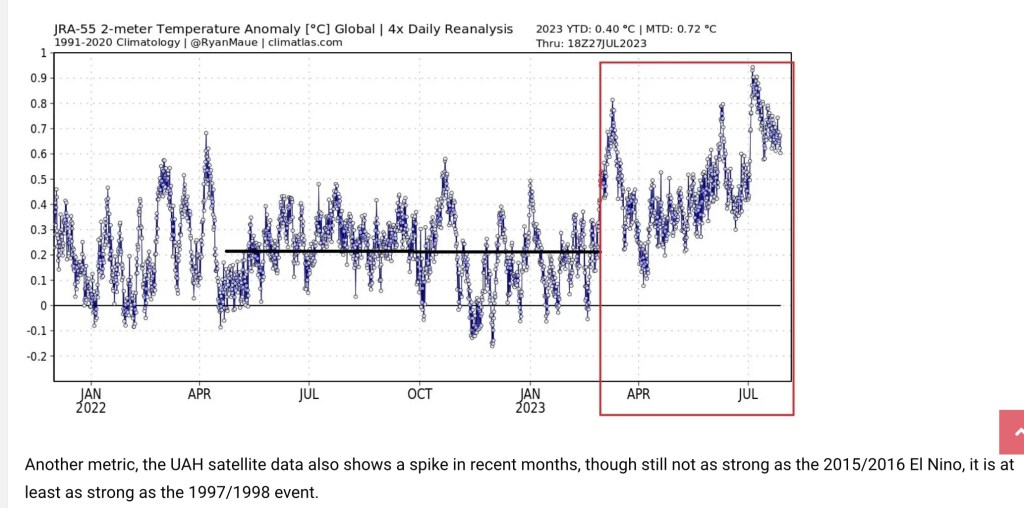
It happens every summer! It’s been hot, and the news media and professional grifters in the anti-carbon climate-change establishment want us to panic about it. Granted, the weather really was quite hot for several weeks in July across parts of the U.S., Europe, and elsewhere, but it’s cooled off considerably since then, especially in my neck of the woods.

July is typically the warmest month of the year, and July 2023 was the warmest July for the troposphere on the satellite record. (The troposphere is the lowest 13 km of the atmosphere, but that’s an average — it’s thicker toward equatorial latitudes, thinner toward the poles.) However, attribution of this summer’s heat waves to carbon-induced climate change is misplaced. What follows are a few considerations in evaluating this claim, and the lengths to which climate activists go to distort weather data and reporting.

The Biggest Greenhouse Gas

One speculative explanation for the recent heat wave has gained some traction: the eruption of the Hunga Tonga-Hunga Ha’apai volcano in the South Pacific on Jan. 15, 2022 (and see here). This underwater eruption spewed massive quantities of water vapor into the stratosphere, which encircled the globe in fairly short order. Water vapor acts as a greenhouse gas, and it is by far the most important greenhouse gas. This plume of vapor may have affected the climate with a delay, and it is not expected to dissipate for at least a couple of years. However, there are theories that the eruption might have led to some offsetting effects due to the reflective properties of water and ice in the stratosphere. See here for an interesting debate on the estimated effects of this “shock” to the atmosphere.

NASA has estimated that the Hunga Tonga eruption resulted in a 10% increase in atmospheric water vapor, while the European Space Agency puts the increase at 13%. Now, in addition to this added water vapor, we have the early effects of an El Niño event in the Pacific, which may elevate temperatures over the next couple of years.

However, the temperatures in July simply don’t justify the claim that we’re experiencing “unprecedented” warmth. The satellite records go back only to 1979, which is an especially narrow window on climatological scales. The longer record of temperatures shows earlier periods of higher temperatures, For example, U.S. surface temperature records indicate that the 1930s had periods warmer than this July. Moreover, while estimates of paleo-climate data are a matter of great dispute, there is no question that the globe has experienced warmer temperatures in the past, with an ice-free Arctic.

So, was July 3 really the hottest day in history? No way, and the worst part of this warm spell wasn’t even the warmth. Rather, it was the attempts to make weather a political matter, as if public policymakers possess some kind of control knob over weather phenomena, or as if we should bestow upon them dictatorial powers to act on their fantasy.

Longer Trends

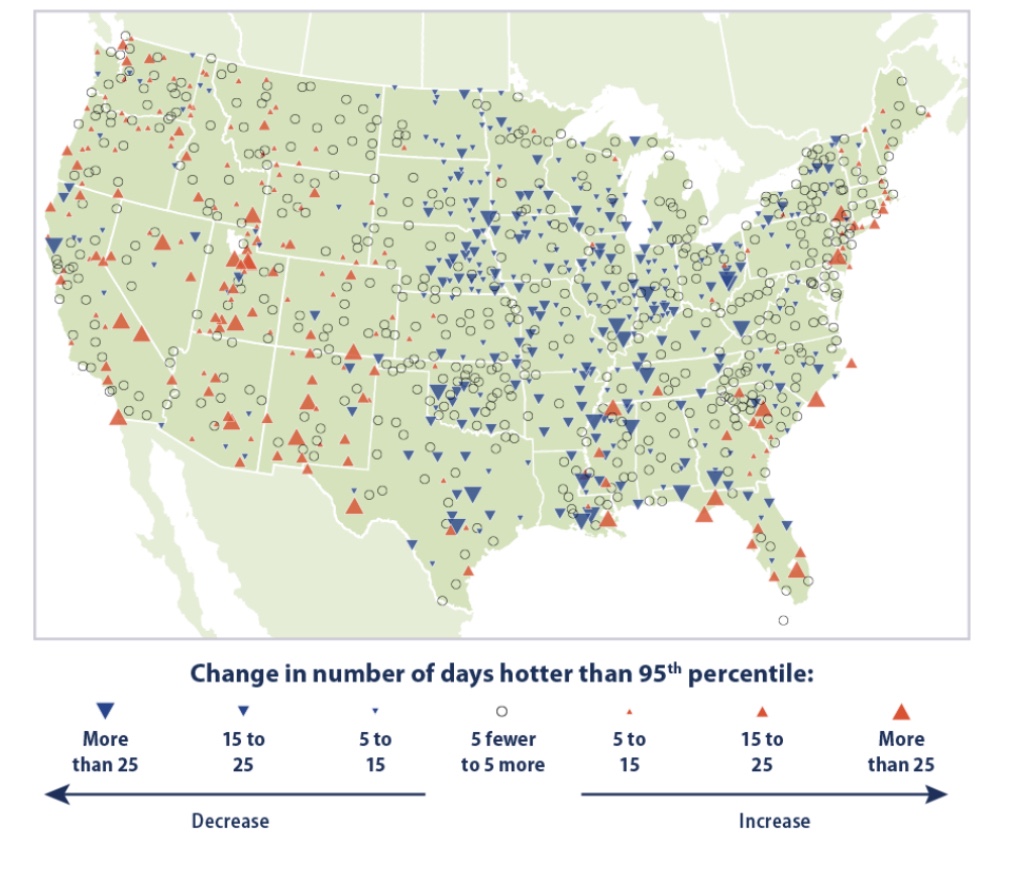
There’s plenty of other evidence running contrary to the “hotter-than-any-time in-history” foolishness. Take a look at trends in hot and cool weather from individual U.S. weather stations over a somewhat longer time span than the satellite record. The red symbols shown on the map below mark stations reporting increases in the number of unusually hot days (heat in the 95th percentile) between 1948 – 2020, with larger symbols corresponding to greater increases in extremely hot days. The blue symbols mark stations reporting increases in the number of unusually cool days (in the 5th percentile) over the same period. The data in this chart is published by the EPA, and it is definitely not alarming.
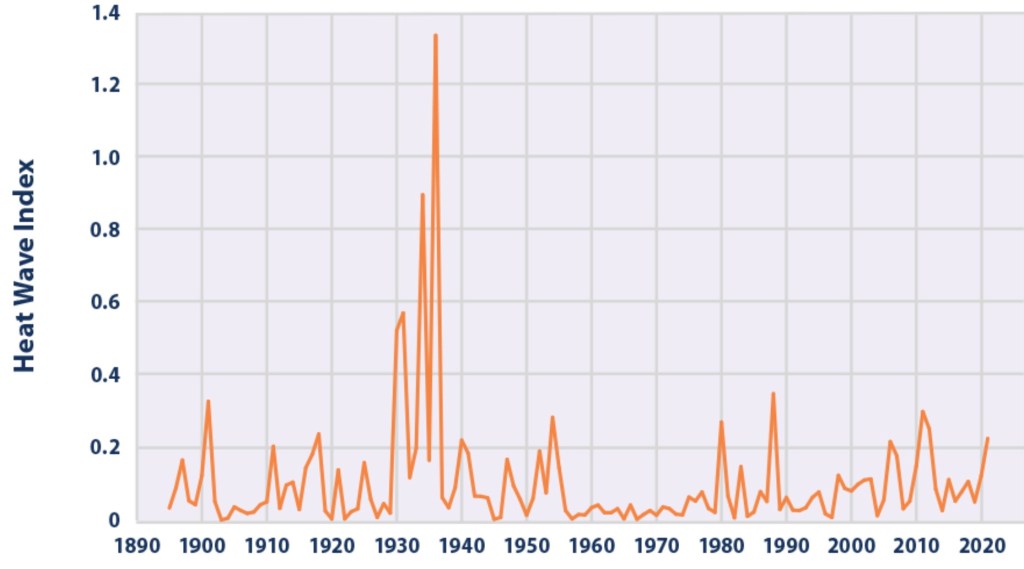
The next chart shows the so-called Heat Wave Index produced by the EPA. Recent spikes in the index are muted relative to the Dust Bowl days of the 1930s.
Journalism or Exaggeration?

Reports of hot weather in Europe have been distorted as well, often placing more emphasis on forecasts of high temperatures than on the temperatures themselves. It’s almost as if authorities, with the aid of the news media and naive weather reporters, are determined to raise an exaggerated sense of alarm among the citizenry. Almost?

Cold 10x Deadlier Than Heat

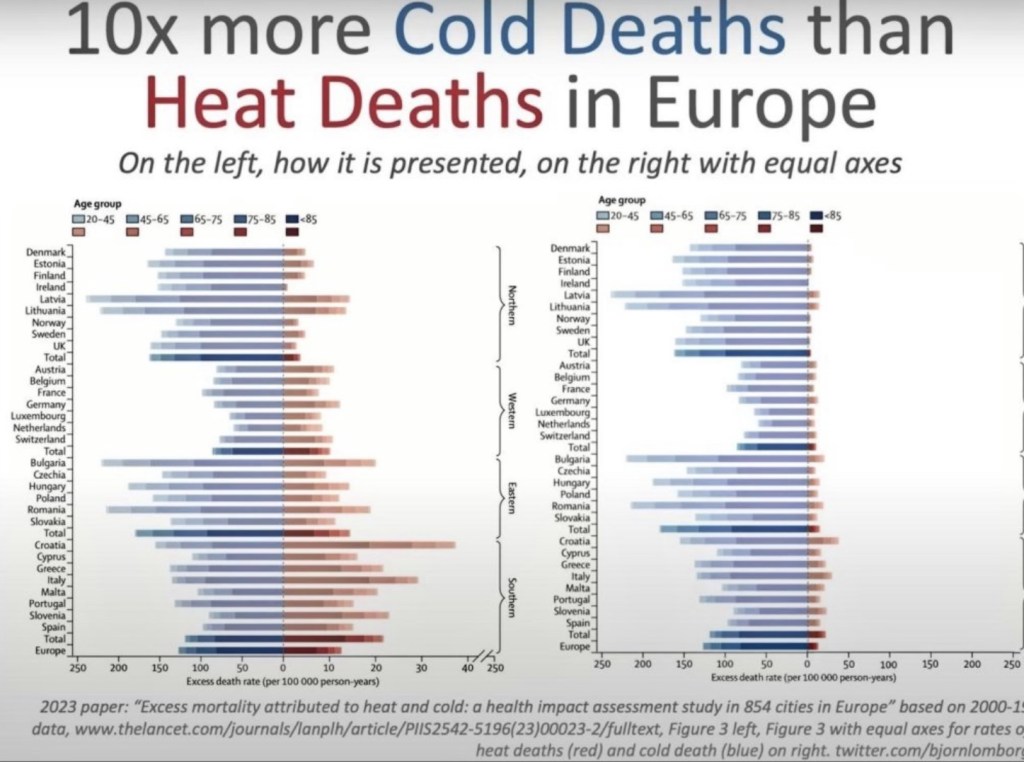
The next chart vividly illustrates an attempt to propagandize climate misinformation. Take a look at the left side of this illustration, which appeared in the medical journal Lancet. Note the difference in the horizontal scale for heat deaths vs. cold deaths. The chart on the right side uses equivalent scales for heat vs. cold deaths. This should qualify the journal for some kind of award for mendacity, or perhaps sheer stupidity. It’s the cold that really kills, not the heat! I’m moving south!
Finding Hot Water

And here’s a take-down of some incredible water temperature propaganda. A PBS News Hour reporter has pushed claims that South Florida water temperatures reached 101 degrees this summer. The emphasis on a single reading was taken from a buoy not subject to the cooling effects of deep water circulation, and it is located where fresh water often overlays salt water, which traps heat. Data from other buoys not far away showed much lower temperatures.

Spreads Like Wildfire

Another fallacious claim we hear too often is that global warming is literally causing the world to go up in flames. The facts run contrary to these scare stories. Björn Lomborg notes the following:

“For more than two decades, satellites have recorded fires across the planet’s surface. The data are unequivocal: Since the early 2000s, when 3% of the world’s land caught fire, the area burned annually has trended downward.

“In 2022, the last year for which there are complete data, the world hit a new record-low of 2.2% burned area. Yet you’ll struggle to find that reported anywhere.”

The heavy focus by the media on this year’s wild fires in North America offers a perfect example of the media’s tendency to “cherry pick for clicks”. Africa and Europe have had little burning this year, and in North America, arson has played a conspicuous role (and see here) in the wildfires.

Distorted Measurements

Personally, I have trouble accepting claims that temperatures are any warmer now than they were in my youth, at least where I grew up. My subjective and local assessment aside, there are strong reasons to doubt the reliability and significance of trends in official temperature records. The urban heat-island effect has distorted temperatures by ever greater magnitudes, as growing metropolitan areas absorb heat readily compared to rural green space.

Furthermore, poor siting of weather stations and temperature gauges has become all too common. This includes equipment located at airports and other areas in close proximity to asphalt or concrete. This contributes to an upward bias in more recent temperature data. It’s also worth noting in this context that satellite temperature readings must be calibrated periodically to surface temperatures. If the latter are corrupted in any way, the satellite readings may be corrupted as well.

“Adjusting” the Past

Official historical records also include a variety of “adjustments” to temperature data that raise concerns. Ostensibly, these adjustments are justified by an interest in maintaining a consistent historical record. Changes in equipment or it’s exact location can create discontinuities, for example. Unfortunately, the adjustments appear to have had a systematic tendency to “cool the past” relative to more recent data. This reinforcement of the warming trend over the past few decades is suspicious, to say the least. It does very little to build confidence in the agencies responsible for these records.

Conclusion

The hot temperatures in July brought the usual deluge of propaganda, including distortions in the reporting of weather phenomena. And we hear increasing calls to force transition to EVs (which are powered mostly by fossil-fuel electric plants), subsidize intermittent renewable power sources, and to end the use of air conditioning and gas stoves. Yet these coercive measures would do nothing to prevent summer heat or climate change generally. Water vapor represents 95% of greenhouse gases, and the huge vapor shock from the Hunga Tonga eruption might well make us prone to warmer temperatures for at least some months to come, mixed with signals from the Pacific El Niño pattern. But these are not evidence of a man-made crisis, despite perverse cheers from those rooting for more draconian state intrusions and an end to growth, or indeed, a reversal in gains to human well being.
Canadian Wildfires, Smoky Days Are Recurring Events

11 Sunday Jun 2023

Posted by Nuetzel in Forest Fires, Global Warming, Wildfires

≈ Leave a comment

Tags

Anthropomorphic Global Warming, Boreal Forests, Canadian Fires, Climate Change, Dark Days, David Marcus, Edward Struzik, Fire Suppression, Forest Management, Prescribed Burns, Québec Fires, rent seeking, Wildfires

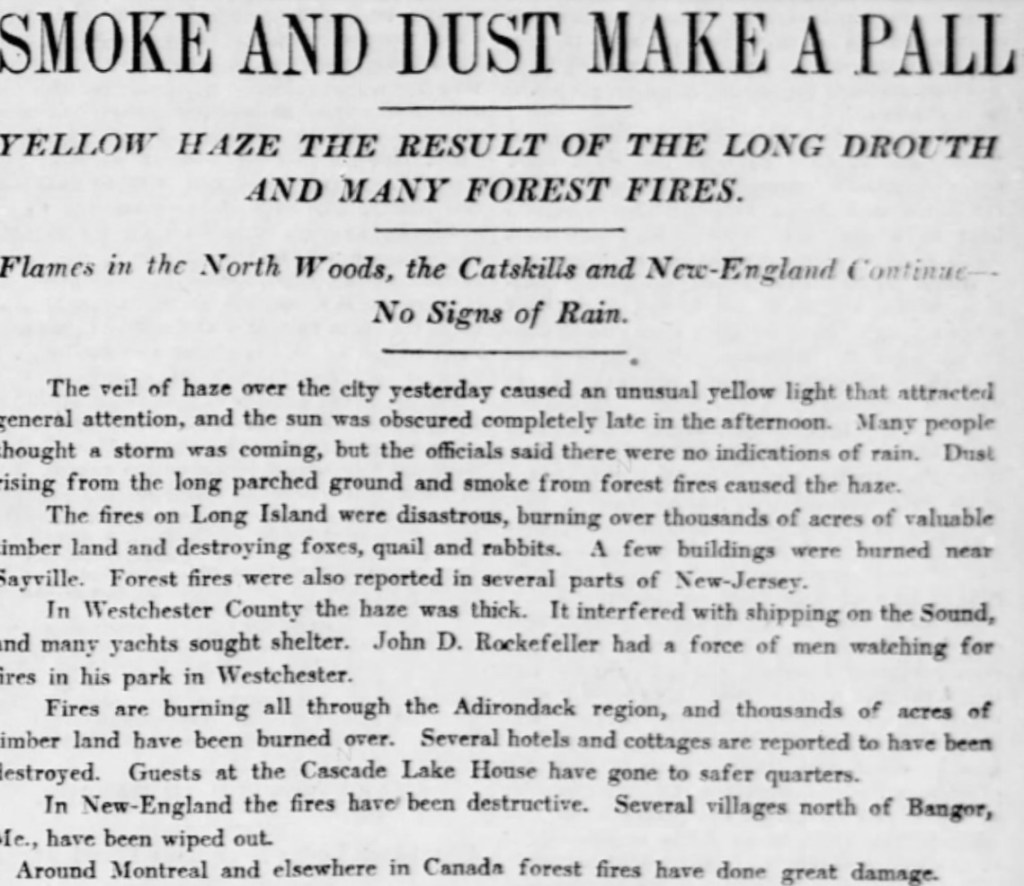
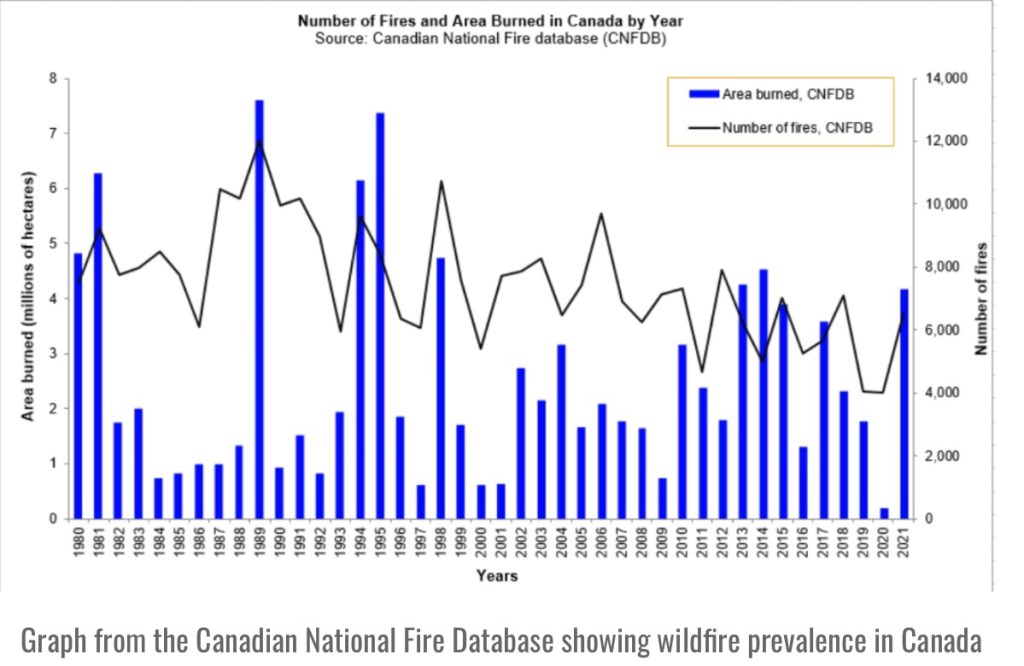
Smoke from this spring’s terrible forest fires in Canada has fouled the air in much of the country and blown into the northeastern U.S. and mid-Atlantic coastal states. The severity of the fires, if they continued at this pace over the rest of the fire season, would break Canadian records for number of fires and burned area.

Large wildfires with smoky conditions occur in these in regions from time-to-time, and it’s not unusual for fires to ignite in the late spring. The article shown above appeared in the New York Tribune on June 5, 1903. Other “dark day” episodes were recorded in New England in 1706, 1732, 1780, 1814, 1819, 1836, 1881, 1894, and 1903, and several times in the 20th century. I list early years specifically because they preceded by decades (even centuries) the era of supposed anthropomorphic global warming, now euphemistically known as “climate change”.

More recently, however, in the past 10 years, Quebec experienced relatively few wildfires. That left plenty of tinder in the boreal forests with highly flammable, sappy trees. In May, a spell of sunshine helped dry the brush in the Canadian forests. Then lightning and human carelessness sparked the fires, along with multiple instances of arson, some perpetrated by climate change activists.

On top of all that, poor forest management contributed to the conflagrations. So-called fire suppression techniques have done more harm than good over the years, as I’ve discussed on this blog in the past. David Marcus emphasizes the point:

“For years, Canadian parks officials have been warning that their country does not do enough to cull its forests and now we’re witnessing the catastrophic results.

It’s simple really. Edward Struzik, author of ‘Dark Days at Noon, The Future of Fire’ lays it out well.

‘We have been suppressing fires for so many decades in North America that we have forests that are older than they should be,’ he said. …

‘Prescribed burns are one of the best ways to mitigate the wildfire threat,’ he added.”

Nevertheless, the media are eager to blame climate change for any calamity. That’s one part simple naïveté on the part of young journalists, fresh off the turnip truck as it were, with little knowledge or inclination to understand the history and causes of underlying forest conditions. But many seasoned reporters are all too ready to support the climate change narrative as well. There’s also an element of calculated political misinformation in these claims, abetted by those seeking rents from government climate policies.

Wildfires are as old as time; without good forest management practices they are necessary for forest renewal. Agitation to sow climate panic based on wildfires is highly unscrupulous. There is no emergency except for the need to reform forest management, reduce the fuel load, and more generally, put an end to the waste of resources inherent in government climate change initiatives.

See this tweet! Hmmm.

Relax: Natural Variability Causes Heatwaves

30 Saturday Jul 2022

Posted by Nuetzel in Global Warming

≈ 2 Comments

Tags

Al Gore, Anthony WAtts, Build Back Better, Cliff Mass, Climate Emergency, CO2, Emergency Powers, Forest Management, Greenhouse Gases, Heat Index, Heatwaves, Joe Biden, National Oceanic and Atmospheric Administration, NOAA, Urban Heat Island, Wildfires

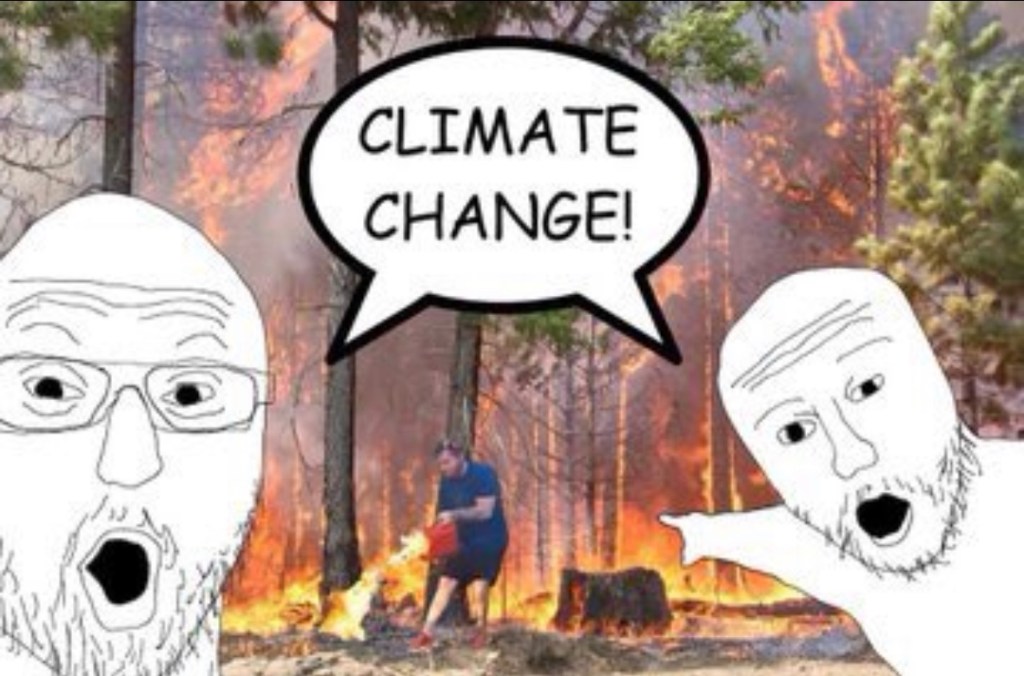
Lately almost any passing weather phenomenon is said to have been rooted in climate change and higher carbon concentrations. The recent heatwaves that seared parts of Europe and the U.S. are no exception, and climate change activists always find heat spells ripe for rhetorical exploitation. But while these would-be Cassandras and Gretas push their fearful narrative, there are strong reasons to doubt that these weather events are any cause for alarm. This summer’s heat waves, like all others, were of limited geographic scope, and they certainly weren’t the most severe heat waves on record in terms of either duration or magnitude. More on that below.

Data Problems

Temperature measurements tend to be exaggerated these days because so many “official” temperature records come from local airports or other urban sites rich in impervious cover and heat absorbing building materials. This gives rise to the so-called “urban heat island effect”, which refers to the elevated temperatures measured in urban versus rural areas. It’s even worse than that, however, as the vast majority of active weather stations in the U.S. are sited at “hot spots”, and many of them are poorly maintained. Data problems plague European temperature records as well.

Furthermore, official temperature records are extremely short on climatological scales, going back only about 150 years in the U.S. And these records have been “adjusted” by weather authorities like the National Oceanographic and Atmospheric Administration (NOAA), usually with the early records “cooled” relative to more recent readings. That means the long-term trend in temperatures is biased upward.

Climate Catastrophists

Nevertheless, Joe Biden has been threatening to declare a wholly unjustified “climate emergency“, perhaps thinking these dog days are the perfect time to assume a host of new emergency powers. It’s unclear whether the new “Build Back” bill making its way through Congress will be enough to satisfy the appetite of Biden’s handlers for costly and ultimately ineffective climate measures.

It’s tempting to think delirium from the heat waves is what prompted Al Gore to compare climate change skeptics to the dithering police officers in Uvalde, TX, but Gore’s fever is nothing new. We’re still waiting for the world to end, which he once predicted would occur by 2016.

Even weather reporters on TV are breathless in their descriptions of the heatwaves. They’ve certainly become dramatists for the climate-change cause. And people love good scare stories. It gives them an excuse to polish up their pitchforks! Or to be lazy and stay inside. It’s telling that so many people now quote heat index values (which combine heat and humidity), rather than actual temperatures, in the warm summer months. After all, it’s more thrilling to say it’s 105 outside than it is to say 95.

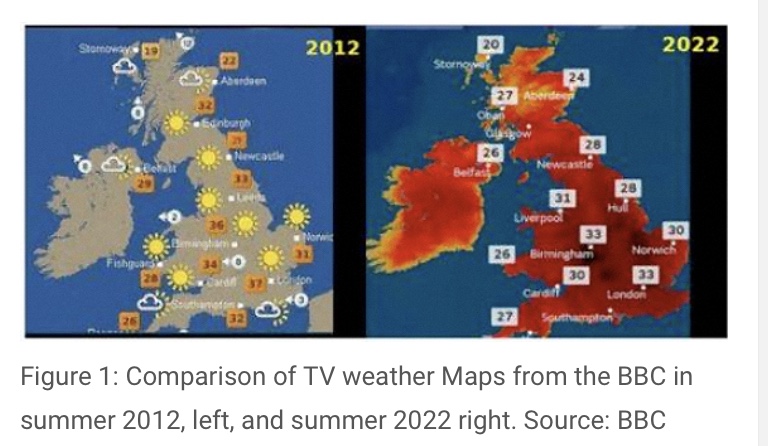
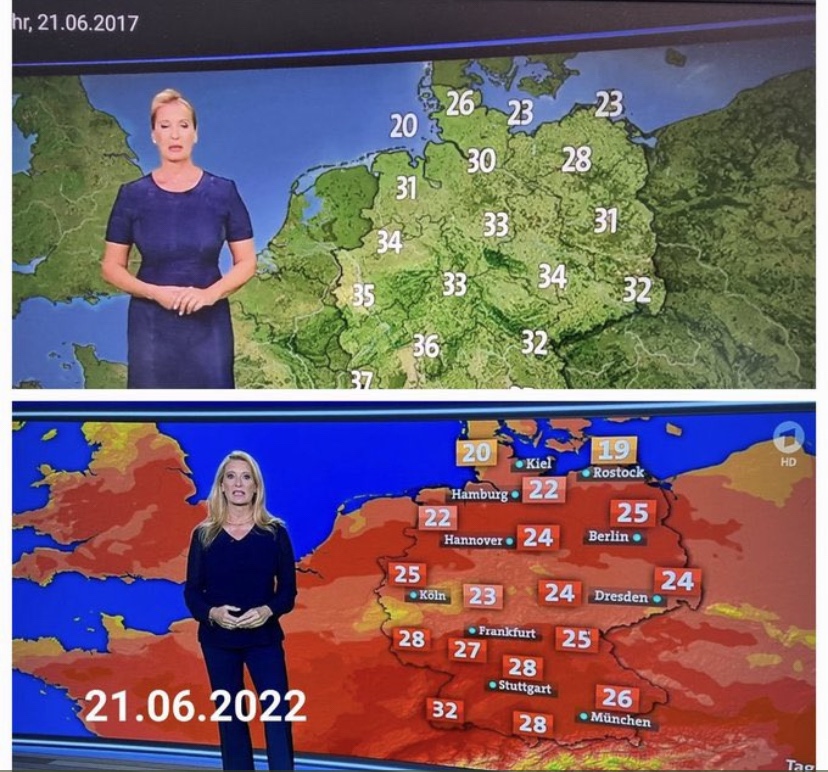
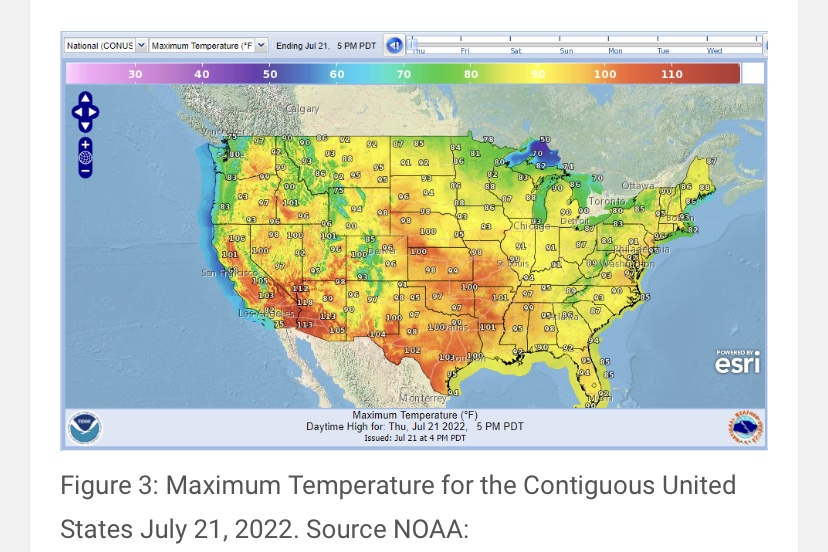
Anyway, compare the paired maps in each of the graphics below (here are links to sources for the first and second):

The temperatures are comparable, but the use of RED colors on the 2022 maps is so much more frightening! This post from Anthony Watts provides a list of links to news sources taking alarmist perspectives on the heatwaves in the U.S. and Europe, and falsely attributing the heatwaves to CO2.

Same Old High Pressure Domes

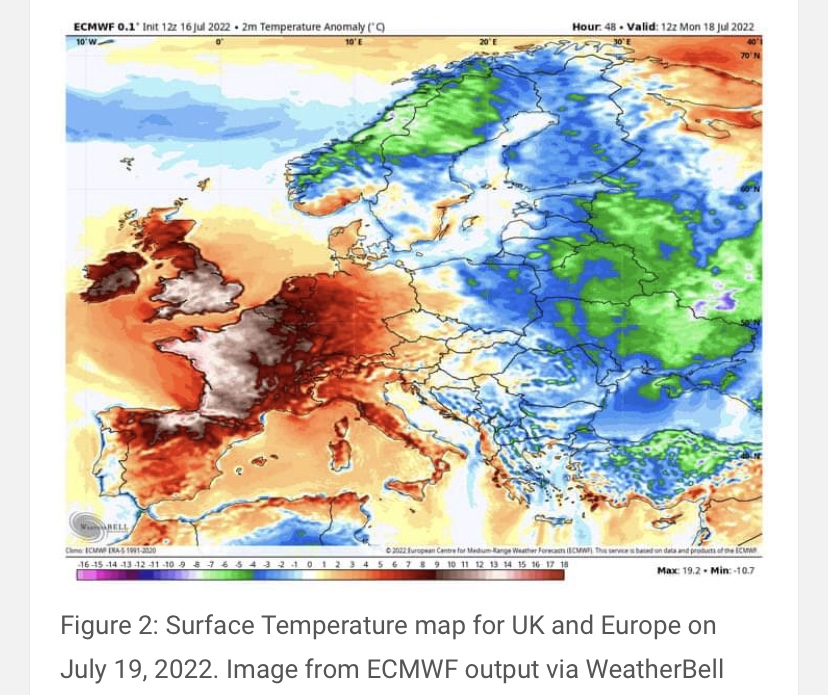
Cliff Mass offers a bone to the climate change community. He thinks perhaps 5% – 10% of the recent temperature anomaly in the UK is attributable to greenhouse gases. An effect of that magnitude is hardly worthy of government action, let alone panic. Mass says:

“Natural variability of the atmosphere was the proximate cause of the warmth and does not represent an existential threat to the population of Europe.”

The heat wave phenomenon is typical of slow-moving high-pressure systems that often develop during the summer months. These domes of high pressure vary in temperature and geographic breadth, and they are sandwiched between or adjacent to low-pressure systems with cooler temperatures. That’s been the case in both Europe and the U.S. during this summer’s heat waves, as illustrated by the following graphics, The northern hemisphere is not entirely enveloped in a heat wave.

And the rest of the globe? In the tropics (below 20 degrees latitude), June 2022 was the coolest June in 22 years, according to satellite temperature readings! Furthermore, the monthly anomaly in June was the coolest in 10 years. In the Southern Hemisphere, Australia and South America have had extremely cold winters. Antarctica had its coldest winter on record in 2021. Yet Joe Biden is under the misapprehension that we’re experiencing “a climate emergency”.

These are not the worst heat waves on record. Both the U.S. and Europe experienced higher temperatures and prolonged heat waves during the 1930s. For example, St.Louis, Missouri matched or exceeded 110 degrees four times in the 1930s, and twice in 1954, whereas the city topped out at 102 so far this year, and that was after a cool spring. There was an extreme European heat wave in 1976 that was drier and much lengthier, and others occurred in 1911 and 1906. Of course, available temperature comparisons are distorted because the early readings weren’t as impacted by urban heat islands. There are historical accounts of drastic heat waves much earlier, such as the 1500s and 1700s. Here is more heatwave history, in case you’re interested.

We’ll Be Fine

Heat isn’t the only story, of course. A wide range of other disastrous events are blamed on climate change. Wildfires are a prime example, but as we know, wildfires are not new, and the worst wildfires have more to do with poor forest management than anything else. Likewise, there is little if any association between extreme weather events and climate change. In that context, it’s also worth noting that cold weather is much deadlier than hot weather. The climate today, and going forward, presents far fewer dangers to humanity than in the past.

I did a lot of dirty, outdoor work in my youth, and it was hot! There were times just as hot as this summer, if not worse, I’d venture to say. Anyone old enough to have lived through the 1970s or even the 1950s should recognize the heatwave Chicken Littles as such.

Certainty Laundering and Fake Science News

05 Wednesday Dec 2018

Posted by Nuetzel in Global Warming, Risk, Science

≈ Leave a comment

Tags

Ashe Schow, Certainty Laundering, Ceteris Paribus, Fake News, Fake Science, Fourth Annual Climate Assessment, Money Laundering, Point Estimates, Statistical Significance, Warren Meyer, Wildfires

Intriguing theories regarding all kinds of natural and social phenomena abound, but few if any of those theories can be proven with certainty or even validated at a high level of statistical significance. Yet we constantly see reports in the media about scientific studies purporting to prove one thing or another. Naturally, journalists pounce on interesting stories, and they can hardly be blamed when scientists themselves peddle “findings” that are essentially worthless. Unfortunately, the scientific community is doing little to police this kind of malpractice. And incredible as it seems, even principled scientists can be so taken with their devices that they promote uncertain results with few caveats.

Warren Meyer coined the term “certainty laundering” to describe a common form of scientific malpractice. Observational data is often uncontrolled and/or too thin to test theories with any degree of confidence. What’s a researcher to do in the presence of such great uncertainties? Start with a theoretical model in which X is true by assumption and choose parameter values that seem plausible. In all likelihood, the sparse data that exist cannot be used to reject the model on statistical grounds. The data are therefore “consistent with a model in which X is true”. Dramatic headlines are then within reach. Bingo!

The parallel drawn by Meyer between “certainty laundering” and the concept of money laundering is quite suggestive. The latter is a process by which economic gains from illegal activities are funneled through legal entities in order to conceal their subterranean origins. Certainty laundering is a process that may encompass the design of the research exercise, its documentation, and its promotion in the media. It conceals from attention the noise inherent in the data upon which the theory of X presumably bears.

Another tempting exercise that facilitates certainty laundering is to ask how much a certain outcome would have changed under some counterfactual circumstance, call it Z. For example, while atmospheric CO2 concentration increased by roughly one part per 10,000 (0.01%) over the past 60 years, Z might posit that the change did not take place. Then, given a model that embodies a “plausible” degree of global temperature sensitivity to CO2, one can calculate how different global temperatures would be today under that counterfactual. This creates a juicy but often misleading form of attribution. Meyer refers to this process as a way of “writing history”:

“Most of us are familiar with using computer models to predict the future, but this use of complex models to write history is relatively new. Researchers have begun to use computer models for this sort of retrospective analysis because they struggle to isolate the effect of a single variable … in their observational data.”

These “what-if-instead” exercises generally apply ceteris paribus assumptions inappropriately, presuming the dominant influence of a single variable while ignoring other empirical correlations which might have countervailing effects. The exercise usually culminates in a point estimate of the change “implied” by X, without any mention of possible errors in the estimated sensitivity nor any mention of the possible range of outcomes implied by model uncertainty. In many such cases, the actual model and its parameters have not been validated under strict statistical criteria.

Meyer goes on to describe a climate study from 2011 that was quite blatant about its certainty laundering approach. He provides the following quote from the study:

“These question cannot be answered using observations alone, as the available time series are too short and the data not accurate enough. We therefore used climate model output generated in the ESSENCE project, a collaboration of KNMI and Utrecht University that generated 17 simulations of the climate with the ECHAM5/MPI-OM model to sample the natural variability of the climate system. When compared to the available observations, the model describes the ocean temperature rise and variability well.”

At the time, Meyer wrote the following critique:

“[Note the first and last sentences of this paragraph] First, that there is not sufficiently extensive and accurate observational data to test a hypothesis. BUT, then we will create a model, and this model is validated against this same observational data. Then the model is used to draw all kinds of conclusions about the problem being studied.

This is the clearest, simplest example of certainty laundering I have ever seen. If there is not sufficient data to draw conclusions about how a system operates, then how can there be enough data to validate a computer model which, in code, just embodies a series of hypotheses about how a system operates?”

In “Imprecision and Unsettled Science“, I wrote about the process of calculating global surface temperatures. That process is plagued by poor quality and uncertainties, yet many climate scientists and the media seem completely unaware of these problems. They view global and regional temperature data as infallible, but in reality these aggregated readings should be recognized as point estimates with wide error bands. Those bands imply that the conclusions of any research utilizing aggregate temperature data are subject to tremendous uncertainty. Unfortunately, that fact doesn’t get much play.

As Ashe Schow explains, junk science is nothing new. Successful replication rates of study results in most fields are low, and the increasing domination of funding sources by government tends to promote research efforts supporting the preferred narratives of government bureaucrats.

But perhaps we’re not being fair to the scientists, or most scientists at any rate. One hopes that the vast majority theorize with the legitimate intention of explaining phenomena. The unfortunate truth is that adequate data for testing theories is hard to come by in many fields. Fair enough, but Meyer puts his finger on a bigger problem: One simply cannot count on the media to apply appropriate statistical standards in vetting such reports. Here’s his diagnosis of the problem in the context of the Fourth National Climate Assessment and its estimate of the impact of climate change on wildfires:

“The problem comes further down the food chain:

  1. When the media, and in this case the US government, uses this analysis completely uncritically and without any error bars to pretend at certainty — in this case that half of the recent wildfire damage is due to climate change — that simply does not exist
  2. And when anything that supports the general theory that man-made climate change is catastrophic immediately becomes — without challenge or further analysis — part of the ‘consensus’ and therefore immune from criticism.”

That is a big problem for science and society. A striking point estimate is often presented without adequate emphasis on the degree of noise that surrounds it. Indeed, even given a range of estimates, the top number is almost certain to be stressed more heavily. Unfortunately, the incentives facing researchers and journalists are skewed toward this sort of misplaced emphasis. Scientists and other researchers are not immune to the lure of publicity and the promise of policy influence. Sensational point estimates have additional value if they support an agenda that is of interest to those making decisions about research funding. And journalists, who generally are not qualified to make judgements about the quality of scientific research, are always eager for a good story. Today, the spread of bad science, and bad science journalism, is all the more virulent as it is propagated by social media.

The degree of uncertainty underlying a research result just doesn’t sell, but it is every bit as crucial to policy debate as a point estimate of the effect. Policy decisions have expected costs and benefits, but the costs are often front-loaded and more certain than the hoped-for benefits. Any valid cost-benefit analysis must account for uncertainties, but once a narrative gains steam, this sort of rationality is too often cast to the wind. Cascades in public opinion and political momentum are all too vulnerable to the guiles of certainty laundering. Trends of this kind are difficult to reverse and are especially costly if the laundered conclusions are wrong.

The Disastrous Boomerang Effect of Fire Suppression

15 Thursday Nov 2018

Posted by Nuetzel in Environment, Wildfires

≈ Leave a comment

Tags

Biomass Harvesting, Camp Fire, Climate Change, Donald Trump, Fire Suppression, Forest Fires, Forest Management, George E. Gruell, PG&E, Prescribed Burns, Sierra Nevada, Spontaneous Combustion, Timber Harvest, U.S. Forest Service, Warren Meyer, Wildfires

We can lament the tragic forest fires burning in California, but a discussion of contributing hazards and causes is urgent if we are to minimize future conflagrations. The Left points the finger at climate change. Donald Trump, along with many forestry experts, point at forest mismanagement. Whether you believe in climate change or not, Trump is correct on this point. However, he blames the state of California when in fact a good deal of the responsibility falls on the federal government. And as usual, Trump has inflamed passions with unnecessarily aggressive rhetoric and threats:

“There is no reason for these massive, deadly and costly forest fires in California except that forest management is so poor. Billions of dollars are given each year, with so many lives lost, all because of gross mismanagement of the forests. Remedy now or no more Fed payments.”

Trump was condemned for his tone, of course, but also for the mere temerity to discuss the relationship between policy and fire hazards at such a tragic moment. Apparently, it’s a fine time to allege causes that conform to the accepted wisdom of the environmental Left, but misguided forest management strategy is off-limits.

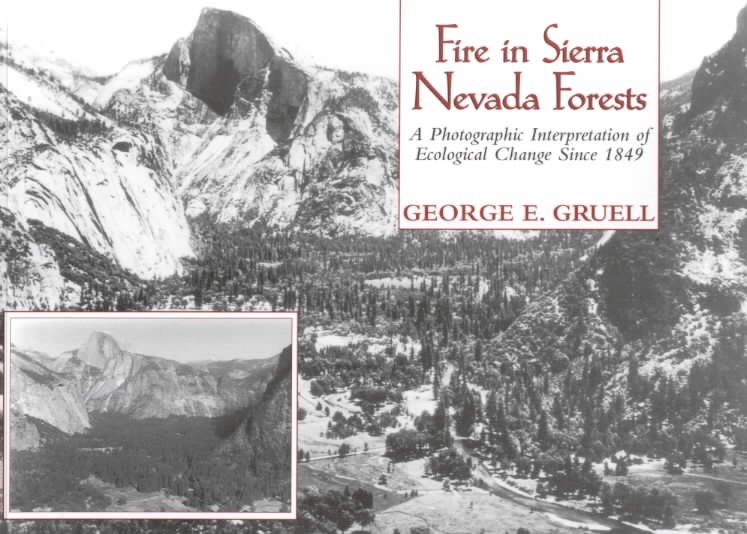
The image at the top of this post is from the cover of a book by wildlife biologist George E. Gruell, published in 2001. The author includes hundreds of historical photos of forests in the Sierra Nevada range from as early as 1849. He pairs them with photos of the same views in the late 20th century, such as the photo inset on the cover shown above. The remarkable thing is that the old forests were quite thin by comparison. The following quote is from a review of the book on Amazon:

“Even the famed floor of Yosemite is now mostly forested with conifers. I myself love conifers but George makes an interesting point that these forests are “man made” and in many ways are unhealthy from the standpoint that they lead to canopy firestorms that normally don’t exsist when fires are allowed to naturally burn themselves out. Fire ecology is important and our fear of forest fires has led to an ever worsening situation in the Sierra Nevada.”

I posted this piece on forest fires and climate change three months ago. There is ample reason to attribute the recent magnitude of wildfires to conditions influenced by forest management policy. The contribution of a relatively modest change in average temperatures over the past several decades (but primarily during the 1990s) is rather doubtful. And the evidence that warming-induced drought is the real problem is weakened considerably by the fact that the 20th century was wetter than normal in California. In other words, recent dry conditions represent something of a return to normal, making today’s policy-induced overgrowth untenable.

Wildfires are a natural phenomenon and have occurred historically from various causes such as lightning strikes and even spontaneous combustion of dry biomass. They are also caused by human activity, both accidental and intentional. In centuries past, Native Americans used so-called controlled or prescribed burns to preserve and restore grazing areas used by game. In the late 19th and early 20th centuries, fire suppression became official U.S. policy, leading to an unhealthy accumulation of overgrowth and debris in American forests over several decades. This trend, combined with a hot, dry spell in the 1930s, led to sprawling wildfires. However, Warren Meyer says the data on burnt acreage during that era was exaggerated because the U.S. Forest Service insisted on counting acres burned by prescribed burns in states that did not follow its guidance against the practice.

The total acreage burned by wildfires in the U.S. was minimal from the late 1950s to the end of the century, when a modest uptrend began. In California, while the number of fires continued to decline over the past 30 years, the trend in burnt acreage has been slightly positive. Certainly this year’s mega-fires will reinforce that trend. So the state is experiencing fewer but larger fires.

The prior success in containing fires was due in part to active logging and other good forest management policies, including prescribed burns. However, the timber harvest declined through most of this period under federal fire suppression policies, California state policies that increased harvesting fees, and pressure from environmentalists. The last link shows that the annual “fuel removed” from forests in the state has declined by 80% since the 1950s. But attitudes could be changing, as both the state government and environmentalists (WSJ, link could be gated) are beginning to praise biomass harvesting as a way to reduce wildfire risk. Well, yes!

The reason wildfire control ever became a priority is the presence of people in forest lands, and human infrastructure as well. Otherwise, the fires would burn as they always have. Needless to say, homes or communities surrounded by overgrown forests are at great risk. In fact, it’s been reported that the massive Camp Fire in Northern California was caused by a PG&E power line. If so, it’s possible that the existing right-of-way was not properly maintained by PG&E, but it may also be that rights-of-way are of insufficient width to prevent electrical sparks from blowing into adjacent forests, and that’s an especially dangerous situation if those forests are overgrown.

Apparently Donald Trump is under the impression that state policies are largely responsible for overgrown and debris-choked forests. In fact, both federal and state environmental regulations have played a major role in discouraging timber harvesting and prescribed burns. After all, the federal government owns about 57% of the forested land in California. Much of the rest is owned privately or is tribal land. Trump’s threat to withhold federal dollars was his way of attempting to influence state policy, but the vast bulk of federal funds devoted to forest management is dedicated to national forests. A relatively small share subsidizes state and community efforts. Disaster-related funding is and should be a separate matter, but Trump made the unfortunate suggestion that those funds are at issue. Nevertheless, he was correct to identify the tremendous fire hazard posed by overgrown forests and excessive debris on the forest floor. Changes to both federal and state policy must address these conditions.

For additional reading, I found this article to give a balanced treatment of the issues.

Forest Fires Ignite Climate Change Delusions

10 Friday Aug 2018

Posted by Nuetzel in Global Warming, Wildfires

≈ 5 Comments

Tags

Arson, Bob Zybach, Cal Fire, Controlled Burns, Dust Bowl, Fire Suppression, Forest Fires, Forest Management, Grazing, High Pressure System, Logging, Megafires, Mendocino Complex Fire, Thomas Fire, Wildfires

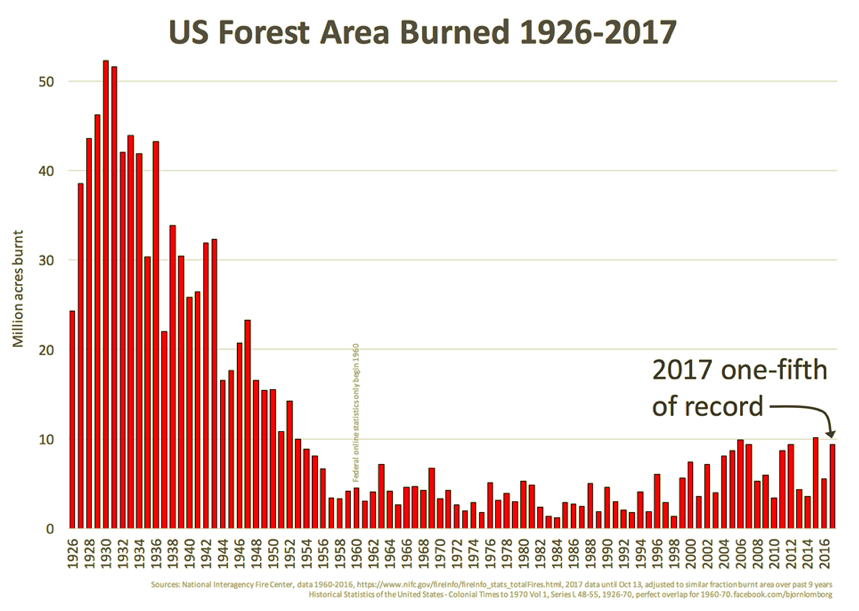
The geographic extent of this summer’s forest fires won’t come close to the aggregate record for the U.S. Far from it. Yes, there are some terrible fires now burning in California, Oregon, and elsewhere, and the total burnt area this summer in the U.S. is likely to exceed the 2017 total. But as the chart above shows, the burnt area in 2017 was less than 20% of the record set way back in 1930. The same is true of the global burnt area, which has declined over many decades. In fact, this 2006 paper reported the following:

“Analysis of charcoal records in sediments [31] and isotope-ratio records in ice cores [32] suggest that global biomass burning during the past century has been lower than at any time in the past 2000 years. Although the magnitude of the actual differences between pre-industrial and current biomass burning rates may not be as pronounced as suggested by those studies [33], modelling approaches agree with a general decrease of global fire activity at least in past centuries [34]. In spite of this, fire is often quoted as an increasing issue around the globe [11,26–29].”

People have a tendency to exaggerate the significance of current events. Perhaps the youthful can be forgiven for thinking hot summers are a new phenomenon. Incredibly, more “seasoned” folks are often subject to the same fallacies. The fires in California have so impressed climate alarmists that many of them truly believe global warming is the cause of forest fires in recent years, including the confused bureaucrats at Cal Fire, the state’s firefighting agency. Of course, the fires have given fresh fuel to self-interested climate activists and pressure groups, an opportunity for greater exaggeration of an ongoing scare story.

This year, however, and not for the first time, a high-pressure system has been parked over the West, bringing southern winds up the coast along with warmer waters from the south, keeping things warm and dry inland. It’s just weather, though a few arsonists and careless individuals always seem to contribute to the conflagrations. Beyond all that, the impact of a warmer climate on the tendency for biomass to burn is considered ambiguous for realistic climate scenarios.

And what of the “mega-fires” burning in the West, like the huge Mendocino Complex Fire and last year’s Thomas Fire? Unfortunately, many decades of fire suppression measures — prohibitions on logging, grazing, and controlled burns — have left the forests with too much dead wood and debris, especially on public lands. From the last link:

“Oregon, like much of the western U.S., was ravaged by massive wildfires in the 1930s during the Dust Bowl drought. Megafires were largely contained due to logging and policies to actively manage forests, but there’s been an increasing trend since the 1980s of larger fires.

Active management of the forests and logging kept fires at bay for decades, but that largely ended in the 1980s over concerns too many old growth trees and the northern spotted owl. Lawsuits from environmental groups hamstrung logging and government planners cut back on thinning trees and road maintenance.

[Bob] Zybach [a forester] said Native Americans used controlled burns to manage the landscape in Oregon, Washington and northern California for thousands of years. Tribes would burn up to 1 million acres a year on the west coast to prime the land for hunting and grazing, Zybach’s research has shown.

‘The Indians had lots of big fires, but they were controlled,’ Zybach said. ‘It’s the lack of Indian burning, the lack of grazing’ and other active management techniques that caused fires to become more destructive in the 19th and early 20th centuries before logging operations and forest management techniques got fires under control in the mid-20th Century.”

The annual burnt area from wildfires has declined over the past ninety years both in the U.S. and globally. Even this year’s wildfires are unlikely to come close to the average burn extent of the 1930s. The large wildfires this year are due to a combination of decades of poor forest management along with a weather pattern that has trapped warm, dry air over the West. The contention that global warming has played a causal role in the pattern is balderdash, but apparently that explanation seems plausible to the uninformed, and it is typical of the propaganda put forward by climate change interests.

Follow Sacred Cow Chips on WordPress.com

Recent Posts

  • Immigration and Merit As Fiscal Propositions
  • Tariff “Dividend” From An Indigent State
  • Almost Looks Like the Fed Has a 3% Inflation Target
  • Government Malpractice Breeds Health Care Havoc
  • A Tax On Imports Takes a Toll on Exports

Archives

  • December 2025
  • November 2025
  • October 2025
  • September 2025
  • August 2025
  • July 2025
  • June 2025
  • May 2025
  • April 2025
  • March 2025
  • February 2025
  • January 2025
  • December 2024
  • November 2024
  • October 2024
  • September 2024
  • August 2024
  • July 2024
  • June 2024
  • May 2024
  • April 2024
  • March 2024
  • February 2024
  • January 2024
  • December 2023
  • November 2023
  • August 2023
  • July 2023
  • June 2023
  • May 2023
  • April 2023
  • March 2023
  • February 2023
  • January 2023
  • December 2022
  • November 2022
  • October 2022
  • September 2022
  • August 2022
  • July 2022
  • June 2022
  • May 2022
  • April 2022
  • March 2022
  • February 2022
  • January 2022
  • December 2021
  • November 2021
  • October 2021
  • September 2021
  • August 2021
  • July 2021
  • June 2021
  • May 2021
  • April 2021
  • March 2021
  • February 2021
  • January 2021
  • December 2020
  • November 2020
  • October 2020
  • September 2020
  • August 2020
  • July 2020
  • June 2020
  • May 2020
  • April 2020
  • March 2020
  • February 2020
  • January 2020
  • December 2019
  • November 2019
  • October 2019
  • September 2019
  • August 2019
  • July 2019
  • June 2019
  • May 2019
  • April 2019
  • March 2019
  • February 2019
  • January 2019
  • December 2018
  • November 2018
  • October 2018
  • September 2018
  • August 2018
  • July 2018
  • June 2018
  • May 2018
  • April 2018
  • March 2018
  • February 2018
  • January 2018
  • December 2017
  • November 2017
  • October 2017
  • September 2017
  • August 2017
  • July 2017
  • June 2017
  • May 2017
  • April 2017
  • March 2017
  • February 2017
  • January 2017
  • December 2016
  • November 2016
  • October 2016
  • September 2016
  • August 2016
  • July 2016
  • June 2016
  • May 2016
  • April 2016
  • March 2016
  • February 2016
  • January 2016
  • December 2015
  • November 2015
  • October 2015
  • September 2015
  • August 2015
  • July 2015
  • June 2015
  • May 2015
  • April 2015
  • March 2015
  • February 2015
  • January 2015
  • December 2014
  • November 2014
  • October 2014
  • September 2014
  • August 2014
  • July 2014
  • June 2014
  • May 2014
  • April 2014
  • March 2014

Blogs I Follow

  • Passive Income Kickstart
  • OnlyFinance.net
  • TLC Cholesterol
  • Nintil
  • kendunning.net
  • DCWhispers.com
  • Hoong-Wai in the UK
  • Marginal REVOLUTION
  • Stlouis
  • Watts Up With That?
  • Aussie Nationalist Blog
  • American Elephants
  • The View from Alexandria
  • The Gymnasium
  • A Force for Good
  • Notes On Liberty
  • troymo
  • SUNDAY BLOG Stephanie Sievers
  • Miss Lou Acquiring Lore
  • Your Well Wisher Program
  • Objectivism In Depth
  • RobotEnomics
  • Orderstatistic
  • Paradigm Library
  • Scattered Showers and Quicksand

Blog at WordPress.com.

Passive Income Kickstart

OnlyFinance.net

TLC Cholesterol

Nintil

To estimate, compare, distinguish, discuss, and trace to its principal sources everything

kendunning.net

The Future is Ours to Create

DCWhispers.com

Hoong-Wai in the UK

A Commonwealth immigrant's perspective on the UK's public arena.

Marginal REVOLUTION

Small Steps Toward A Much Better World

Stlouis

Watts Up With That?

The world's most viewed site on global warming and climate change

Aussie Nationalist Blog

Commentary from a Paleoconservative and Nationalist perspective

American Elephants

Defending Life, Liberty and the Pursuit of Happiness

The View from Alexandria

In advanced civilizations the period loosely called Alexandrian is usually associated with flexible morals, perfunctory religion, populist standards and cosmopolitan tastes, feminism, exotic cults, and the rapid turnover of high and low fads---in short, a falling away (which is all that decadence means) from the strictness of traditional rules, embodied in character and inforced from within. -- Jacques Barzun

The Gymnasium

A place for reason, politics, economics, and faith steeped in the classical liberal tradition

A Force for Good

How economics, morality, and markets combine

Notes On Liberty

Spontaneous thoughts on a humble creed

troymo

SUNDAY BLOG Stephanie Sievers

Escaping the everyday life with photographs from my travels

Miss Lou Acquiring Lore

Gallery of Life...

Your Well Wisher Program

Attempt to solve commonly known problems…

Objectivism In Depth

Exploring Ayn Rand's revolutionary philosophy.

RobotEnomics

(A)n (I)ntelligent Future

Orderstatistic

Economics, chess and anything else on my mind.

Paradigm Library

OODA Looping

Scattered Showers and Quicksand

Musings on science, investing, finance, economics, politics, and probably fly fishing.

  • Subscribe Subscribed
    • Sacred Cow Chips
    • Join 128 other subscribers
    • Already have a WordPress.com account? Log in now.
    • Sacred Cow Chips
    • Subscribe Subscribed
    • Sign up
    • Log in
    • Report this content
    • View site in Reader
    • Manage subscriptions
    • Collapse this bar
 

Loading Comments...