• About

Sacred Cow Chips

Sacred Cow Chips

Tag Archives: adverse selection

Beware of Government Health Care Yet To Come

02 Sunday Feb 2025

Posted by Nuetzel in Health Care

≈ Leave a comment

Tags

adverse selection, Affordable Care Act, Arnold Kling, Bryan Caplan, Claim Denials, David Chavous, Donald Trump, Employer-Provided Coverage, Essential Benefits, Hospital Readmissions, Joel Zinberg, Liam Sigaud, Make America Healthy Again, Matt Margolis, Michael F. Cannon, Moral Hazard, Noah Smith, Obamacare, Peter Earle, Pharmacy Benefit Managers, Portability, Pre-Authorization Rules, Pre-Existing Conditions, Premium Subsidies, Robert F. Kennedy Jr, Sebastian Caliri, Steven Hayward, Tax-Deductible Premiums, third-party payments, Universal Health Accounts

Ongoing increases in the resources dedicated to health care in the U.S., and their prices, are driven primarily by the abandonment of market forces. We have largely eliminated the incentives that markets create for all buyers and sellers of health care services as well as insurers. Consumers bear little responsibility for the cost of health care decisions when third parties like insurers and government are the payers. A range of government interventions have pushed health care spending upward, including regulation of insurers, consumer subsidies, perverse incentives for consolidation among health care providers, and a mechanism by which pharmaceutical companies negotiate side payments to insurers willing to cover their drugs.

It’s not yet clear whether the Trump Administration and its “Make America Healthy Again” agenda will serve to liberate market forces in any way. Skeptics can be forgiven for worrying that MAHA will be no more than a cover for even more centrally-planned health care, price controls, and regulation of the pharmaceutical and food industries, not to mention consumer choices. Robert F. Kennedy Jr., who is likely to be confirmed by the Senate as Donald Trump’s Secretary of Health and Human Services, has strong and sometimes defensible opinions about nutrition and public health policies. He is, however, an inveterate left-winger and is not an advocate for market solutions. Trump himself has offered only vague assurances on the order of “You won’t lose your coverage”.

Government Control

The updraft in health care inflation coincided with government dominance of the sector. Steven Hayward points out that the cost pressure began at about the same time as Medicare came into existence in 1965. This significantly pre-dates the trend toward aging of the population, which will surely exacerbate cost pressures as greater concentrations of baby boomers approach or exceed life expectancy over the next decade.

Government now controls or impinges on about 84% of health care spending in the U.S., as noted by Michael F. Cannon. The tax deductibility of employer-provided health insurance is a massive example of federal manipulation and one that is highly distortionary. It reinforces the prevalence of third-party payments, which takes decision-making out of consumers’ hands. Equalizing the tax treatment of employer-provided health coverage would obviously promote tax equity. Just as importantly, however, tax-subsidized premiums create demand for inflated coverage levels, which raise prices and quantities. And today, the federal government requires coverages for routine care, going beyond the basic function of insurance and driving the cost of care and insurance upward.

The traditional non-portability of employer-provided coverage causes workers with uninsurable pre-existing conditions to lose coverage when they leave a job. Thus, Cannon states that the tax exclusion for employer coverage penalizes workers who instead might have chosen portable individual coverage in a market setting without tax distortions. Cannon proposes a reform whereby employer coverage would be replaced with deposits into tax-free Universal Health Accounts owned by workers, who could then purchase their own insurance.

In 2024, federal subsidies for health insurance coverage were about $2 trillion, according to the Congressional Budget Office (CBO). Those subsidies are projected to grow to $3.5 trillion by 2034 (8.5% of GDP). Joel Zinberg and Liam Sigaud emphasize the wasteful nature of premium subsidies for exchange plans mandated by the Affordable Care Act (ACA), better known as Obamacare. Subsidies were temporarily expanded in 2021, but only until 2026. They should be allowed to expire. These subsidies increase the demand for health care, but they are costly to taxpayers and are offered to individuals far above the poverty line. Furthermore, as Zinberg and Sigaud discuss, subsidized coverage for the previously uninsured does very little to improve health outcomes. That’s because almost all of the health care needs of the formerly uninsured were met via uncompensated care at emergency rooms, clinics, medical schools, and physician offices.

Proportionate Consumption

Perhaps surprisingly, and contrary to popular narratives, health care spending in the U.S. is not really out-of-line with other developed countries relative to personal income and consumption expenditures (as opposed to GDP). We spend more on health care because we earn and consume more of everything. This shouldn’t allay concern over health care spending because our economic success has not been matched by health outcomes, which have lagged or deteriorated relative to peer nations. Better health might well have allowed us to spend proportionately less on health care, but this has not been the case. There are explanations based on obesity levels and diet, but important parts of the explanation can be found elsewhere.

It should also be noted that a significant share of our decades-long increases in health care spending can be attributed to quantities, not just prices, as explained at the last link above.

Health Consequences

The ACA did nothing to slow the rise in the cost of health care coverage. In fact, if anything, the ACA cemented government dominance in a variety of ways, reinforcing tendencies for cost escalation. Even worse, the ACA had negative consequences for patient care. David Chavous posted a good X thread in December on some of the health consequences of Obamacare:

1) The ACA imposed penalties on certain hospital readmissions, which literally abandoned people at death’s door.

2) It encouraged consolidation among providers in an attempt to streamline care and reduce prices. This reduced competitive pressures, however, which had the “unforeseen” consequence of raising prices and discouraging second opinions. The former goes against all economic logic while the latter goes against sound medical decision-making.

3) The ACA forced insurers to offer fewer options, increasing the cost of insurance by encouraging patients to wait until they had a pre-existing condition to buy coverage. Care was almost certainly deferred as well. Ultimately, that drove up premiums for healthy people and worsened outcomes for those falling ill.

4) It forced drug companies to negotiate with Pharmacy Benefit Managers (PBMs) to get their products into formularies. The PBMs have acted as classic middlemen, accomplishing little more than driving up drug prices and too often forcing patients to skimp on their prescribed dosage, or worse yet, increasing their vulnerability to lower-priced quackery.

The Insurers

So the ACA drastically increased the insured population (including the new burden of covering pre-existing conditions). It also forced insurers to meet draconian cost-control thresholds. Little wonder that claim rejection increased, a phenomenon often at the root of public animosity toward health insurers. Peter Earle cites several reasons for the increase in denial rates while noting that claim rejection has made little difference in insurer profit margins.

Matt Margolis points out that under the ACA, we’ve managed to worsen coverage in exchange for higher premiums and deductibles. All while profits have been capped. Claim denials or delays due to pre-authorization rules (which delay care) have become routine following the implementation of Obamacare.

Perhaps the biggest mistake was forcing insurers to cover pre-existing conditions without allowing them to price for risk. Rather than forcing healthy individuals to pay for risks they don’t face, it would be more economically sensible to directly subsidize coverage for those in high-risk pools.

Noah Smith also defends the health insurers. For example, while UnitedHealth Group has the largest market share in the industry, its net profit margin of 6.1% is only about half of the average for the S&P 500. Other major insurers earn even less by this metric. Profits just don’t explain why American health care spending is so high. Ultimately, the services delivered and charges assessed by providers explain high U.S. health care spending, not insurer profits or administrative costs.

Under the ACA, insurance premiums pay the bulk of the cost of health care delivery, including the cost of services more reasonably categorized as routine health maintenance. The latter is like buying insurance for oil changes. Furthermore, there are no options to decline any of the ten so-called “essential benefits” under the ACA, thus increasing the cost of coverage.

Medical Records

Arnold Kling argues that the ACA’s emphasis on uniform, digitized medical records is not a productive avenue for achieving efficiencies in health care delivery. Moreover, it’s been a key factor driving the increasing concentration in the health care industry. Here is Kling:

“My point is that you cannot do this until you tighten up the health care delivery process, making it more rigid and uniform. And I would not try to do that. Health care does not necessarily lend itself to being commoditized. You risk making health care in America less open to innovation and less responsive to the needs of people.

“So far, all that has been accomplished by the electronic medical records drive has been to put small physician practices out of business. They have not been able to absorb the overhead involved in implementing these systems, so that they have been forced to lose their independence, primarily to hospital-owned conglomerates.”

Separating Health and State

The problem of rising health care costs in the U.S. is capsulized by Bryan Caplan in his call for the separation of health and state. The many policy-driven failures discussed above offer more than adequate rationale for reform. The alternative suggested by Caplan is to “pull the plug” on government involvement in health care, relying instead on the free market.

Caplan debunks a few popular notions regarding the appropriate role for markets in health care and health insurance. In particular, it’s often alleged that moral hazard and adverse selection would encourage unhealthy behaviors and encourage the worst risks to over-insure, causing insurance markets to fail. But these problems arise only when risk is not priced efficiently, precisely what the government has accomplished by attempting to equalizing rates.

Pulling the plug on government interference in health care would also mean deregulating both insurance offerings and pricing, encouraging the adoption of portable coverage, expediting drug approvals based on peer-country approvals, reforming pharmacy benefit management, ending deadly Medicare drug price controls, and encouraging competition among health care providers.

Value Vs. Volume

There are a host of other reforms that could bring more sanity to our health care system. Many of these are covered here by Sebastian Caliri, with some emphasis on the potential role of AI in improving health care. Some of these are at odds with Kling’s skepticism regarding digitized health records.

Perhaps the most fundamental reforms entertained by Caliri have to do with health care payments. One is to make payments dependent on outcomes rather than diagnostic codes established and priced by the American Medical Association. To paraphrase Caliri, it would be far better for Americans to pay for value rather than volume.

Another payment reform discussed by Caliri is expanding direct payments to providers such as capitation fees, whereby patients pay to subscribe to a bundle of services for a fixed fee. Finally, Caliri discusses the importance of achieving “site-neutral payments”, eliminating rules that allow health systems to charge a higher premium relative to independent providers for identical services.

For what it’s worth, Arnold Kling disagrees that changing payment metrics would be of much help because participants will learn to game a new system. Instead, he emphasizes the importance of reducing consumer incentives for costly treatments having little benefit. No dispute there!

Avoid the Single-Payer Calamity

I’ll close this jeremiad with a quote from Caliri’s piece in which he contrasts the knee-jerk, leftist solution to our nation’s health care dilemma with a more rational, market-oriented approach:

“Single payer solutions and government control favored by the left are no solutions at all. Moving to a monopsonist system like Canada is a recipe for strangling innovation and rationing access. Just ask our neighbors to the north who have to wait a year for orthopedic surgery. The UK’s National Health Service (NHS) is teetering on the brink of collapse. We need to sort out some other way forward.

“Other parts of the economy provide inspiration for what may actually work. In the realm of information technology, for example, fifty years has taken us from expensive four operation calculators to ubiquitous, free, artificial intelligence capable of passing the Turing Test. We can argue about the precise details but most of this miracle came from profit-seeking enterprises competing in a free market to deliver the best value for the buyer’s dollar.“
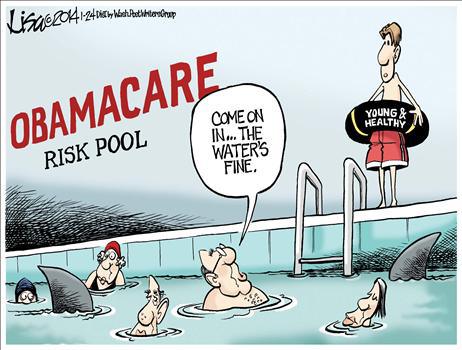
ObumbleCare & The Adverse Selectors

11 Wednesday Nov 2015

Posted by Nuetzel in Obamacare

≈ Leave a comment

Tags

adverse selection, Death Spiral, Emergency room utilization, Exchange-based plans, Medicaid expansion, Mercatus Center, Michael Tanner, Non-market solutions, Obamacare, Obamacare enrollment

Risk Pool

“… out in the real world, the bad news keeps coming, drop by drop, drip by drip, until we are seeing a virtual flood of Obamacare awfulness.“

That’s from Michael D. Tanner in “What’s Wrong With Obamacare?” Tonight, I offer  you a list of some of the drippings:

  • Flat enrollment, expected to be less than half of the original projection for 2016;
  • Almost all (97%) newly insureds under Obamacare are enrolled under expanded Medicaid, unaided by the many complexities introduced by Obamacare;
  • 12 of 23 federal health care insurance coops have failed as of Nov. 3;
  • High medical loss ratios are threatening the viability of insurers in 27 states, a result of adverse selection by relatively sick enrollees;
  • With unfavorable risk pools, premiums for all 2016 exchange-based plans are rising 20.3%, well above the 7.5% figure quoted by HHS for “Silver” plans;
  • Health insurance does not guarantee health care, and many of the newly insured are finding that providers are scarce, given reimbursement rates;
  • Emergency rooms utilization is up, as patients know they can get care there;
  • Rationing of care is increasingly a matter of waiting time, as it is in other countries that rely on non-market solutions to health care;
  • As many as 700,000 low-income enrollees are at risk of losing their coverage because they did not file tax returns;
  • For many, the penalty for not having coverage ($695 next year) is lower than the premium they would pay for coverage;
  • More than 5 million individuals lost their coverage under Obamacare, generally policies that were preferred over the new alternatives;
  • Poor incentives and burdensome provider requirements are pushing costs up.
  • Employers are attempting to minimize the cost of Obamacare. The law makes hiring more expensive and leads to substitution of part-time for full-time workers;

The “death spiral” might not be far-off for Obamacare. Here is Tanner’s assessment:

“The young and healthy simply haven’t signed up for Obamacare in the same numbers as those who are older and sicker. The only way for insurers to offset their skyrocketing [Medical Loss Ratios] is to hike premiums still further. … premiums in the worst states could have to rise by an average of 34 percent, and possibly as much as 52 percent. But premium hikes of that magnitude would almost certainly further discourage younger and healthier Americans from buying insurance.“

There is no question that Obamacare will have to be replaced or changed substantially.  Unfortunately, Obamacare apologists simply can’t come to grips with the reality of the law’s failure. They would do well to start focusing on new solutions to the problems that Obamacare was intended to solve. To that end, the Mercatus Center commissioned a collection of seven essays on how best to deal with the problem of pre-existing conditions, now published on the Mercatus web site. Market-based solutions are needed to encourage competition among insurers, incentivize innovation and cost control, and reestablish the primacy of the patient-provider relationship.

More Unpleasant Obamacare Arithmetic

15 Monday Jun 2015

Posted by Nuetzel in Obamacare, Uncategorized

≈ Leave a comment

Tags

adverse selection, Affordable Care Act, Death Spiral, Expanded Medicaid eligibility, Forbes, Obamacare, Political Calculations, Reinsurance program, Risk corridors, Robert Laszewski

How-the-ACA-Works

States with expanded Medicaid eligibility may be more vulnerable to adverse selection, hastening the death spiral of their Obamacare insurance exchanges relative to states without expanded Medicaid. This is because 1) the expanded, eligible Medicaid population is young, and 2) pricing (net of subsidies) and benefits on the exchanges encourage sicker individuals to purchase plans with richer benefits. The Political Calculations blog presents this case in “How Medicaid’s Expansion Tips the Scales Against Obamacare“:

“… we observe that the states that did not expand their Medicaid programs have a much larger share of their ACA-enrollment occurring in the lower-tier metal plans that would tend to be favored by healthier individuals. Meanwhile, in the states that expanded the enrollment of their Medicaid programs under the law, we find that a significantly larger portion of their ACA enrollments were in the plans that would be favored by less healthy individuals.

In fact, we see that in Medicaid expansion states, 13.2% of their ACA enrollment occurred in the highest-tier Gold and Platinum level plans, while non-Medicaid expansion states saw 7.7% of their enrollment for these highest tiers of health insurance coverage.

The seemingly small 5.5% difference between these two figures becomes exceptionally significant when you consider how extremely concentrated health care expenditures are in the United States, where just 5% of U.S. patients are responsible for generating 50% of all health care spending in the nation.“

It will be difficult to confirm this hypothesis using data on premium increases, or actual exchange failure, until the temporary risk corridors and transitional reinsurance program expire. However, this year, several of the states in which proposed premium increases are the largest have expanded Medicaid eligibility. Robert Laszewski has a good discussion about some the reasons for the large premium increases in Forbes. It’s early and there are signs that it will get worse.

As noted last week on this blog, Medicaid itself does not stack up well in terms of how highly it is valued by recipients and the moral hazard inherent in the program. Here we see an additional bug: expanded Medicaid appears to siphoning away younger potential enrollees from the exchanges in those states, worsening the problem of adverse selection, which will negatively affect their claims experience.

More Obamacare Follies

31 Thursday Jul 2014

Posted by Nuetzel in Uncategorized

≈ Leave a comment

Tags

ACA, adverse selection, crony capitalism, Don Boudreaux, Medicare, Megan McArdle, Obamacare, rent seeking

follies
Disconcerting news regarding the administration of the ACA just keeps on coming. The so-called “risk corridors” represent a bailout for health insurers for whom Obamacare premium revenue proves inadequate. Sure enough, but more interesting is how the Obama administration attempted to manipulate several provisions of the law on reimbursement in order to keep insurers happy after other changes with negative implications for their risk pools. In addition, when insurers expressed alarm about the “budget neutrality” of the corridors, the administration backtracked on that position. “… the administration had a choice: provide a bailout, or face the unpleasant prospect of having insurers price their products honestly.” The unfolding of these events is detailed in Emails Show Cozy Government- Insurer Alliance….

Don’t get too excited about the improvement in Medicare’s finances under the ACA. The chief actuary for the Centers for Medicaid and Medicare Services says that the ACA’s Medicare changes aren’t sustainable. Reimbursement rates under the ACA are inadequate barring “an unprecedented change in health care delivery systems and payment mechanisms.” In other words, an unlikely advance in productivity will be necessary in order to make Medicare’s finances work.

A few days ago, I posted about the Halbig vs. Sebelius District Court decision here, highlighting Jonathan Gruber’s one-time defense of the ACA’s rules that premium subsidies could be paid only on policies purchased on state exchanges. More recently, he claimed that the rule was not the intent of the legislation. Here are some further thoughts from Don Boudreaux on Gruber’s memory lapse, in which he links to a piece by Megan McArdle. Boudreaux:

The very claim that such a simple “mistake” infects the ACA calls into question the competence (or the incentives, or both) of elites, both political and intellectual, who seek ever more power for government.

Deductible Concept Sprung On Newly Insured

19 Saturday Jul 2014

Posted by Nuetzel in Uncategorized

≈ Leave a comment

Tags

ACA, adverse selection, Deductible Shock, Obamacare, Unintended Consequences

image

No, the monthly premium on your Obamacare coverage does NOT cover your deductible and copayments. You’re still on the hook for those bills. Apparently, that reality comes as a shock to many of the newly insured. And apparently, that reaction was unexpected by the drafters of the ACA as well as HHS, the state exchanges, and various organizations involved in the implementation of Obamacare. So, many of the previously uninsured, intended as the chief beneficiaries of the ACA, are feeling disillusioned, even jilted, by the terms of their coverage. As if the poor risk profile of enrollees weren’t bad enough, and amid continuing doubts about whether those purchasing coverage under Obamacare are actually paying their premia, the confusion among this constituency is a bad omen for the sustainability of the program.

Aside

Just Insurance? Or Unjust Insurance?

29 Sunday Jun 2014

Posted by Nuetzel in Uncategorized

≈ Leave a comment

Tags

ACA, adverse selection, central planning, Obamacare, Risk Ratings

Ambulance

Voices from the left keep insisting that universal coverage and a single, all-inclusive risk pool is “just insurance,” and that anyone standing in opposition just “doesn’t understand insurance.” The argument is usually extended to the idea that all individuals must receive and pay for a comprehensive set of benefits, going far beyond any reasonable notion of catastrophic coverage. Proponents of this view advocate an extreme form of socialized health coverage that eliminates private choice and traditional risk-rating.

In a free society, individuals cannot be coerced into cross-subsidizing activities that might violate their religious convictions. It is hoped that this will be affirmed by the Supreme Court’s Hobby Lobby decision, likely to be issued this Monday.

Likewise, in a free society, individuals should not be forced to cross-subsidize private choices made by others. Preserving the right of individuals to purchase the benefits and coverage levels of their choice at reasonable premia (e.g., catastrophic care only or “wellness” features, no pregnancy coverage for senior citizens, risk-based pricing) is crucial. Providing care for high-risk individuals with pre-existing conditions need not involve a dismantling of the private health insurance market.

Of course, Obamacare has fallen short of the socialist “ideal,” either before or after all of the exceptions, delays, and waivers made by the administration and HHS. Its design, nevertheless, has had a destructive impact on the private insurance market, and the program is straining under the effort to provide high-risk coverage. In “Obamacare’s Prognosis Grows Dimmer,” Lanhee Chen discusses how adverse selection is playing out on the Obamacare exchanges. Based on the evidence available thus far, the exchanges appear to be laden with a high percentage of sick individuals. This is likely to lead to more premium shock for enrollees as we head into the mid-term elections.

A path toward providing effective coverage for pre-existing conditions is discussed in this article. It asserts that a solution hinges on the ability for individuals to make seamless transitions between employer-provided coverage and individual coverage, even with pre-existing conditions. Since that ability must apply nationwide, the authors also assert that there must be a role for federal funding of the high-risk pool of individuals making the transition to the individual market.

Drink Deep The Dregs… And Get Used To It

24 Monday Mar 2014

Posted by Nuetzel in Uncategorized

≈ Leave a comment

Tags

adverse selection, Obamacare


Image

Attempts by the administration and its cheerleaders to sell Obamacare in the last weeks of the open enrollment period (ending March 31) look increasingly desperate. John C. Goodman in the WSJ describes the law’s spectacular failure to achieve its stated objectives as well as the inherent unworkability caused by the mandates, subsidies, and incentives created by the ACA. No, it is not “just insurance,” unless you think community rating can be sustained in an actuarial black hole of adverse selection. The ACA is a mess.

Follow Sacred Cow Chips on WordPress.com

Recent Posts

  • Immigration and Merit As Fiscal Propositions
  • Tariff “Dividend” From An Indigent State
  • Almost Looks Like the Fed Has a 3% Inflation Target
  • Government Malpractice Breeds Health Care Havoc
  • A Tax On Imports Takes a Toll on Exports

Archives

  • December 2025
  • November 2025
  • October 2025
  • September 2025
  • August 2025
  • July 2025
  • June 2025
  • May 2025
  • April 2025
  • March 2025
  • February 2025
  • January 2025
  • December 2024
  • November 2024
  • October 2024
  • September 2024
  • August 2024
  • July 2024
  • June 2024
  • May 2024
  • April 2024
  • March 2024
  • February 2024
  • January 2024
  • December 2023
  • November 2023
  • August 2023
  • July 2023
  • June 2023
  • May 2023
  • April 2023
  • March 2023
  • February 2023
  • January 2023
  • December 2022
  • November 2022
  • October 2022
  • September 2022
  • August 2022
  • July 2022
  • June 2022
  • May 2022
  • April 2022
  • March 2022
  • February 2022
  • January 2022
  • December 2021
  • November 2021
  • October 2021
  • September 2021
  • August 2021
  • July 2021
  • June 2021
  • May 2021
  • April 2021
  • March 2021
  • February 2021
  • January 2021
  • December 2020
  • November 2020
  • October 2020
  • September 2020
  • August 2020
  • July 2020
  • June 2020
  • May 2020
  • April 2020
  • March 2020
  • February 2020
  • January 2020
  • December 2019
  • November 2019
  • October 2019
  • September 2019
  • August 2019
  • July 2019
  • June 2019
  • May 2019
  • April 2019
  • March 2019
  • February 2019
  • January 2019
  • December 2018
  • November 2018
  • October 2018
  • September 2018
  • August 2018
  • July 2018
  • June 2018
  • May 2018
  • April 2018
  • March 2018
  • February 2018
  • January 2018
  • December 2017
  • November 2017
  • October 2017
  • September 2017
  • August 2017
  • July 2017
  • June 2017
  • May 2017
  • April 2017
  • March 2017
  • February 2017
  • January 2017
  • December 2016
  • November 2016
  • October 2016
  • September 2016
  • August 2016
  • July 2016
  • June 2016
  • May 2016
  • April 2016
  • March 2016
  • February 2016
  • January 2016
  • December 2015
  • November 2015
  • October 2015
  • September 2015
  • August 2015
  • July 2015
  • June 2015
  • May 2015
  • April 2015
  • March 2015
  • February 2015
  • January 2015
  • December 2014
  • November 2014
  • October 2014
  • September 2014
  • August 2014
  • July 2014
  • June 2014
  • May 2014
  • April 2014
  • March 2014

Blogs I Follow

  • Passive Income Kickstart
  • OnlyFinance.net
  • TLC Cholesterol
  • Nintil
  • kendunning.net
  • DCWhispers.com
  • Hoong-Wai in the UK
  • Marginal REVOLUTION
  • Stlouis
  • Watts Up With That?
  • Aussie Nationalist Blog
  • American Elephants
  • The View from Alexandria
  • The Gymnasium
  • A Force for Good
  • Notes On Liberty
  • troymo
  • SUNDAY BLOG Stephanie Sievers
  • Miss Lou Acquiring Lore
  • Your Well Wisher Program
  • Objectivism In Depth
  • RobotEnomics
  • Orderstatistic
  • Paradigm Library
  • Scattered Showers and Quicksand

Blog at WordPress.com.

Passive Income Kickstart

OnlyFinance.net

TLC Cholesterol

Nintil

To estimate, compare, distinguish, discuss, and trace to its principal sources everything

kendunning.net

The Future is Ours to Create

DCWhispers.com

Hoong-Wai in the UK

A Commonwealth immigrant's perspective on the UK's public arena.

Marginal REVOLUTION

Small Steps Toward A Much Better World

Stlouis

Watts Up With That?

The world's most viewed site on global warming and climate change

Aussie Nationalist Blog

Commentary from a Paleoconservative and Nationalist perspective

American Elephants

Defending Life, Liberty and the Pursuit of Happiness

The View from Alexandria

In advanced civilizations the period loosely called Alexandrian is usually associated with flexible morals, perfunctory religion, populist standards and cosmopolitan tastes, feminism, exotic cults, and the rapid turnover of high and low fads---in short, a falling away (which is all that decadence means) from the strictness of traditional rules, embodied in character and inforced from within. -- Jacques Barzun

The Gymnasium

A place for reason, politics, economics, and faith steeped in the classical liberal tradition

A Force for Good

How economics, morality, and markets combine

Notes On Liberty

Spontaneous thoughts on a humble creed

troymo

SUNDAY BLOG Stephanie Sievers

Escaping the everyday life with photographs from my travels

Miss Lou Acquiring Lore

Gallery of Life...

Your Well Wisher Program

Attempt to solve commonly known problems…

Objectivism In Depth

Exploring Ayn Rand's revolutionary philosophy.

RobotEnomics

(A)n (I)ntelligent Future

Orderstatistic

Economics, chess and anything else on my mind.

Paradigm Library

OODA Looping

Scattered Showers and Quicksand

Musings on science, investing, finance, economics, politics, and probably fly fishing.

  • Subscribe Subscribed
    • Sacred Cow Chips
    • Join 128 other subscribers
    • Already have a WordPress.com account? Log in now.
    • Sacred Cow Chips
    • Subscribe Subscribed
    • Sign up
    • Log in
    • Report this content
    • View site in Reader
    • Manage subscriptions
    • Collapse this bar
 

Loading Comments...