• About

Sacred Cow Chips

Sacred Cow Chips

Tag Archives: Anthropomorphic Global Warming

Canadian Wildfires, Smoky Days Are Recurring Events

11 Sunday Jun 2023

Posted by Nuetzel in Forest Fires, Global Warming, Wildfires

≈ Leave a comment

Tags

Anthropomorphic Global Warming, Boreal Forests, Canadian Fires, Climate Change, Dark Days, David Marcus, Edward Struzik, Fire Suppression, Forest Management, Prescribed Burns, Québec Fires, rent seeking, Wildfires

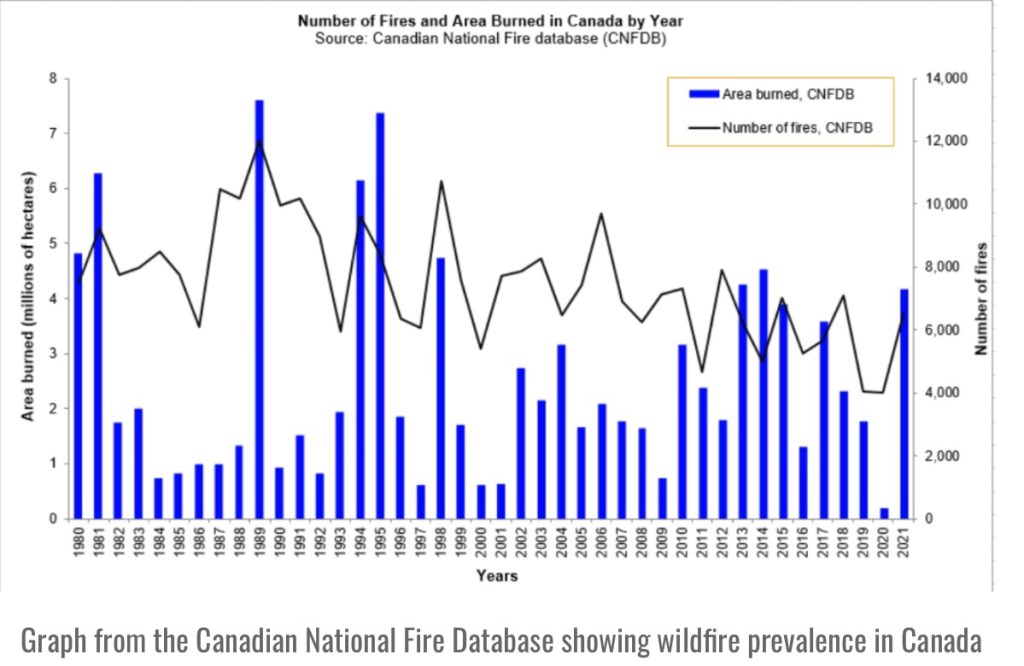
Smoke from this spring’s terrible forest fires in Canada has fouled the air in much of the country and blown into the northeastern U.S. and mid-Atlantic coastal states. The severity of the fires, if they continued at this pace over the rest of the fire season, would break Canadian records for number of fires and burned area.

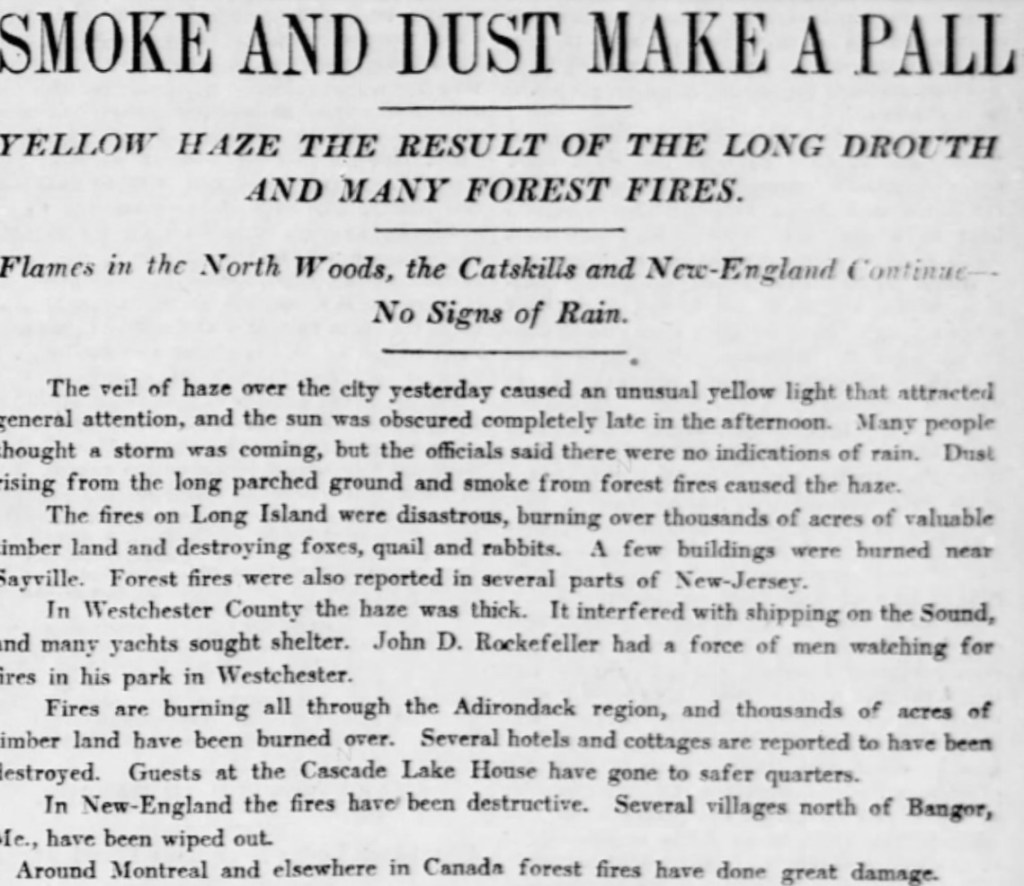
Large wildfires with smoky conditions occur in these in regions from time-to-time, and it’s not unusual for fires to ignite in the late spring. The article shown above appeared in the New York Tribune on June 5, 1903. Other “dark day” episodes were recorded in New England in 1706, 1732, 1780, 1814, 1819, 1836, 1881, 1894, and 1903, and several times in the 20th century. I list early years specifically because they preceded by decades (even centuries) the era of supposed anthropomorphic global warming, now euphemistically known as “climate change”.

More recently, however, in the past 10 years, Quebec experienced relatively few wildfires. That left plenty of tinder in the boreal forests with highly flammable, sappy trees. In May, a spell of sunshine helped dry the brush in the Canadian forests. Then lightning and human carelessness sparked the fires, along with multiple instances of arson, some perpetrated by climate change activists.

On top of all that, poor forest management contributed to the conflagrations. So-called fire suppression techniques have done more harm than good over the years, as I’ve discussed on this blog in the past. David Marcus emphasizes the point:

“For years, Canadian parks officials have been warning that their country does not do enough to cull its forests and now we’re witnessing the catastrophic results.

It’s simple really. Edward Struzik, author of ‘Dark Days at Noon, The Future of Fire’ lays it out well.

‘We have been suppressing fires for so many decades in North America that we have forests that are older than they should be,’ he said. …

‘Prescribed burns are one of the best ways to mitigate the wildfire threat,’ he added.”

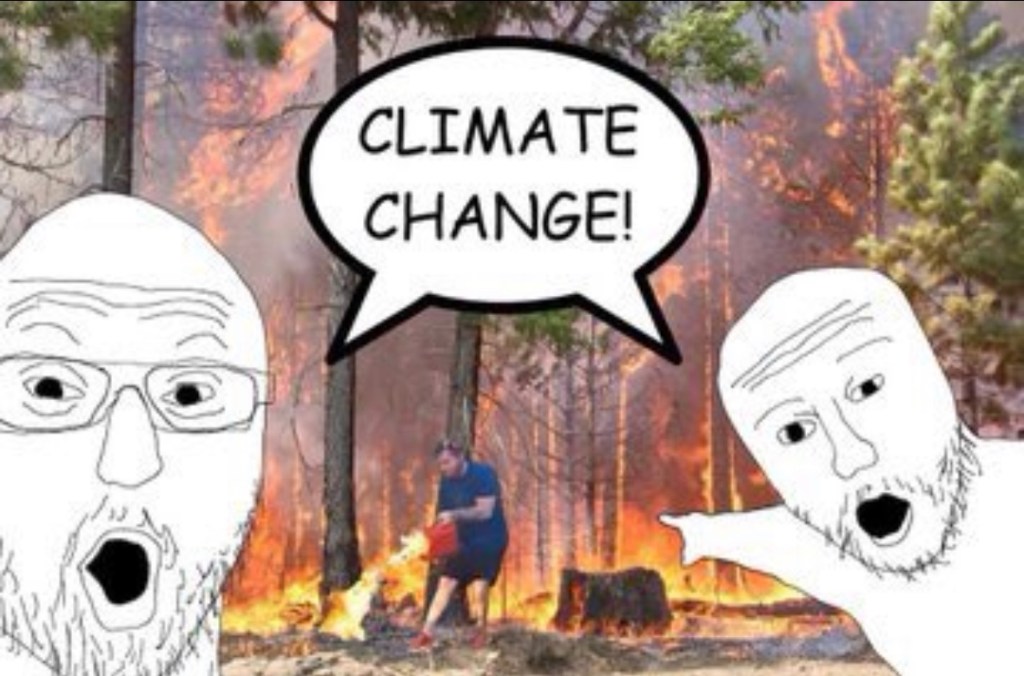
Nevertheless, the media are eager to blame climate change for any calamity. That’s one part simple naïveté on the part of young journalists, fresh off the turnip truck as it were, with little knowledge or inclination to understand the history and causes of underlying forest conditions. But many seasoned reporters are all too ready to support the climate change narrative as well. There’s also an element of calculated political misinformation in these claims, abetted by those seeking rents from government climate policies.

Wildfires are as old as time; without good forest management practices they are necessary for forest renewal. Agitation to sow climate panic based on wildfires is highly unscrupulous. There is no emergency except for the need to reform forest management, reduce the fuel load, and more generally, put an end to the waste of resources inherent in government climate change initiatives.

See this tweet! Hmmm.

Paris Climate Dance: a Concon

07 Wednesday Jun 2017

Posted by Nuetzel in Global Warming, Redistribution, Uncategorized

≈ Leave a comment

Tags

AGW, Anthropomorphic Global Warming, Axial Tilt, Barack Obama, Carbon Concentration, Carbon Forcing Models, Carbon Intensity, Climate Feedbacks, Dementors, Donald Trump, Green Climate Fund, Harry Potter, Jeffrey Tucker, Paris Climate Accord, Paris Climate Summit, Steven Allen

Ah, Paris, we bid you adieu. For both scientific and economic reasons, the Paris Climate Accord is pure numbskullery. We should all be grateful that President Trump has decided to revoke the expensive promises made by Barack Obama under the agreement in a willful effort to appease the world’s rent seekers.

From a scientific perspective, the accord’s prescriptions are premised on a partial effect: absent any feedbacks, carbon emissions would raise the atmospheric temperature slightly. But feedback effects are massively important, as anyone familiar with the climate models’ terrible track record of predictive performance might guess. Water vapor, cloud formation, wind currents, and the response of the Earth’s biomass are just some of the effects that impinge on the relationship between atmospheric carbon and temperatures. In addition, carbon forcings are relatively minor compared to the energy impulses delivered by natural sources, including solar activity and the Earth’s varying axial tilt. Paleoclimate data shows that the world has been this warm before, and warmer.

The economic case against the Paris Accord is even stronger. The very idea that authorities would impose huge material sacrifices on mankind in an effort to prevent a threat for which the evidence is so weak should give pause to any rational individual. Beyond that, however, the real function of the accord was not so much carbon mitigation as it was a shift in the distribution of wealth. This quote of Steven Allen, in a scathing assessment of the agreement, is instructive (forgive his mid-sentence switch to sarcasm):

“Mainly, it’s about taking money from taxpayers and consumers and businesspeople and electricity ratepayers and giving it to crony capitalists, and taking money from people in relatively successful countries and giving that money to rich people in poor countries, to the benefit of members of governing elites who support the Paris deal for the good of humanity and not at all because they expect to line their pockets with it.“

World carbon emissions were expected to keep rising at least through 2030 under the agreement. The subsidies it promised to crony capitalists in the renewable energy industry were to generously fund technologies that are not economically viable without government support, to the detriment of relatively clean-burning fossil fuels, not to mention nuclear power. The U.S. promised to reduce absolute carbon emissions, but the world’s greatest emitter of carbon dioxide, China, promised only to seek to limit emissions per unit of GDP, but not until sometime down the road. That means China’s level of emissions might not reverse, given the rapid growth of the Chinese economy. India’s commitment is similar. And Russia promised a reduction relative to a depressed 1990 level of emissions, which means they have plenty of room for growth.

As for the U.S., where absolute carbon emissions have been decreasing since 2007, the Paris Accord relied on so-called “voluntary” limits to be imposed by federal mandates. Financial demands were made by developing countries under the deal: $100 billion per year. And who would pay for that? Taxpayers in the developed countries, of course. One can only imagine the lust of unaccountable third-world officialdom for those funds. Thus far, the U.S. has paid only $1 billion into the so-called Green Climate Fund, and at least half of that was taken from a State Department account from which disbursal did not require Congressional approval.

Jeffrey Tucker, who is anything but a fan of Donald Trump, minced no words in his assessment of the Paris “treaty”. Here are a few selected quotes:

“The Paris Agreement is a ‘voluntary’ agreement because its architects knew it would never pass the US Senate as a treaty. Why? Because the idea of the agreement is that the US government’s regulatory agencies would impose extreme mandates on its energy sector: how it should work, what kinds of emissions it should produce, the best ways to power our lives (read: not fossil fuels), and hand over to developing world regimes billions and even trillions of dollars in aid, a direct and ongoing forcible transfer of wealth from American taxpayers to regimes all over the world, at the expense of American freedom and prosperity. …

The exuberant spokespeople talked about how ‘the United States’ had ‘agreed’ to ‘curb its emissions’ and ‘fund’ the building of fossil-free sectors all over the world. It was strange because the ‘United States’ had not in fact agreed to anything: not a single voter, worker, owner, or citizen. Not even the House or Senate were involved. This was entirely an elite undertaking to manage property they did not own and lives that were not theirs to control. …

The Paris Agreement is no different in its epistemological conceit than Obamacare, the war on drugs, nation-building, universal schooling, or socialism itself. They are all attempts to subvert the capacity of society to manage itself on behalf of the deluded dreams of a few people with power and their lust for controlling social and economic outcomes.“

The popular fascination with climate scare stories has provided a useful channel of influence for would-be central planners and redistributionists. These social dementors reject the proposition that science is a process of continuing challenge and testing, thereby subverting the very notion of scientific inquiry. They make the laughable claim that 170 years of temperature data, much of which is quite sketchy, is sufficient to draw strong conclusions about the trends and dynamics of the climate on a four billion year-old planet.

Even worse, the climate alarmists insist that they have a monopoly on scientific knowledge, despite a significant share of skeptics in the climate science community. But in pursuit of that monopoly, the alarmists have gone so far as to undermine the integrity of the peer review process in the climate literature and to manipulate temperature data to exaggerate recent records. They have promoted the false claims that cyclonic storm energy has increased with carbon concentration and that sea levels are rising at an increasing rate. (Coastal property values don’t seem to reflect those concerns.) They would have us confuse actual climate data with model predictions, and they continue to offer prescriptions based on carbon-forcing models after many years of terrible forecast performance. They claim that a small increment (one part per 10,000) to the concentration of a trace atmospheric gas will dominate other forces exerting far greater variations in energy. They ignore the benefits that an increase in nourishing carbon dioxide and warming can provide. And they make the anthropocentric claim that a costly sacrifice by mankind, in an attempt to reduce that trace gas slightly if at all, will pay off reliably by reducing global temperatures, despite the very modest claims on those grounds by the Paris Accord itself.

Here is a link to 17 earlier posts on Sacred Cow Chips having to do with the hypothesis of anthropomorphic global warming, including this one written in late 2015, at the time of the Paris Climate Summit.

The Broken-Climate Canard

19 Thursday May 2016

Posted by Nuetzel in Global Warming

≈ Leave a comment

Tags

AGW, Al Gore, Anthropomorphic Global Warming, Climate Alarmism, Climate Causality, Climate Change, CO2, Coyote Blog, Draught Severity, Hurricane Katrina, Little Ice Age, Measurement Technology Bias, Publication Bias, Tornadic Activity, Warren Meyer, Weather or Climate Change

MovieDisaster

In the imagination of the climate alarmist, almost everything portends an approaching catastrophe. A hurricane? Tornado? Draught? Warm spell? Cold spell? Blizzard? Bad harvest? To their way of thinking, these are all signs that CO2 is damaging the climate. Obviously, these are weather events that imply nothing in the absence of corroborating evidence, though you wouldn’t know it from listening to the precaution pols. Warren Meyer at Coyote Blog has posted another in his series of essays on this topic, this time called “Are We Already Seeing Climate Change?” He provides links to the earlier installments — all interesting. In this installment, he covers five topics under the heading “Manufacturing A Sense that the Climate Is Broken”, which I think would have made a better title for his post. I’ll try to summarize the five points briefly, but do read the whole thing:

Publication Bias:  This quote speaks for itself: “Every single tail-of-the-distribution weather event from around the world is breathlessly reported, leaving the impression among viewers that more such events are occurring, even when there is in fact no such trend. Further, since weather events can drive media ratings, there is an incentive to make them seem scarier.”

Claiming a Trend From One Data Point: This is the kind of error to which I alluded in the first paragraph. Think of Al Gore’s reaction to Hurricane Katrina. The charts offered by Meyer in this section are very nice. There is no upward trend in any of the following: hurricane energy; severe tornadic activity; the incidence of draughts or draught severity; heat waves; extremely hot days; and there is no abatement in the upward trend in crop yields. In fact, there is no trend in high temperature records in the U.S. The upward trend in average surface temperatures in the U.S. is entirely due to warmer nighttime temperatures.

Measurement Technology Bias: We now have the technology to measure various aspects of the climate from space. We can track polar ice extent with much more precision. Doppler radar technology and weather chasers have helped to identify more small tornados than we’d have known of 50 years ago. But when events seem noteworthy to alarmists, they draw extreme conclusions. To their great chagrin, these phenomena are often products of our enhanced ability to measure things.

What Is Normal?: This is related to measurement bias. Our detailed records on surface temperatures go back about 150 years, which is an extremely short slice of history. Temperature proxies from earlier eras, such as ice cores and fossilized tree rings, tell us that the recent past is not all that unusual. Moreover, we also know that glacier melting and sea level increases have been happening for much longer than the buildup of CO2. Those trends began near the end of the “Little Age Age”, around 1800. And there is evidence that these types of developments have happened before. Alarmists, however, assume that what we’ve witnessed in the recent past is unprecedented.

Collapsing Causality in a Complex System To a Single Variable:  “With all the vast complexity of the climate, are we really to believe that every unusual weather event is caused by a 0.013 percentage point change (270 ppm to 400 ppm) in the concentration of one atmospheric gas?” Not likely! Here Meyer helps put the recent temperature trends in perspective: they are tiny relative to their annual variation, which occurs both across seasons and within days.

The public seems to regard the co-called climate catastrophe with more skepticism today than perhaps ten years ago. Not only do the facts contradict the dire predictions of carbon-forcing climate models and alarmist scare stories, but people also recognize that the costs of attempting to avoid a global warming trend are massive and, well, probably not worth it. Moreover, they rightly suspect unworthy political motives in the alarmist community. If some carbon-induced warming is an eventuality, and that’s an “if”, it might well prove to be beneficial for people and the planet. Relax!


Climate Negotiators To Discuss Economic Cannibalism

18 Wednesday Nov 2015

Posted by Nuetzel in Global Warming

≈ 1 Comment

Tags

AGW, Anthropomorphic Global Warming, Bjorn Lomborg, Carbon Emissions, Climate Change, COP 21, Don Boudreaux, economic growth, Foundation For a Positive Planet, Global Carbon Budget, Industrial Pollution, IPCC, Kuznets Curve, Manhattan Institute, Natural Pollution, Oren Cass

globalwarming_vodka_500

There is virtually zero chance that the coming round of international talks on climate change will produce a substantive agreement. The United Nations’ 21st Conference of the Parties (COP 21) on Climate Change is scheduled will be held in Paris, France from November 30 to December 11. The failure of earlier conferences to produce a meaningful pact informs us of the low odds of success: this conference, like the others, will be unproductive in any real sense. As in the past, there are severely conflicting objectives among the parties. Oren Cass explains the reasons in a recent report from the Manhattan Institute, “Leading Nowhere: The Futility and Farce of Global Climate Negotiations“:

“… there is no plausible path to an agreement premised on collective action or compensation: developing nations that must bear the brunt of emissions reductions in any successful scenario cannot achieve those reductions while pursuing rapid economic growth; developed nations cannot sufficiently compensate developing ones for forgoing such growth. Evidence from recent negotiations, as well as preparations for the next round of talks, reinforces this conclusion. … [A] third path to an agreement—coercion—has received little attention. No group of nations appears prepared to employ the approach and risk subsequent conflict.“

Even the President of the Foundation For a Positive Planet asks, “What Purpose Does COP 21 Still Serve?”

It’s worth emphasizing that the the developing world will account for 79% of the world’s cumulative carbon emissions by 2100 under a moderate growth scenario developed by the Intergovernmental Panel on Climate Change (IPCC). Cass points out that even if the world’s developed countries ceased all carbon emissions immediately, developing countries would face an impossible task in cutting emissions sufficiently to stay within the IPCC’s estimated “safe carbon budget” for the globe. The best that can be said is that the IPCC might be trying to set the bar high for negotiators, although that would make claims of success at COP 21 difficult. Perhaps that’s fine for activists, because they’ll have an ongoing “crisis” to meet their insatiable need for doomsaying.

Relatively impoverished developing countries will not wish to sacrifice their own economic growth at the altar of climate worship without compensation. In fact, redistribution might be a better description than compensation, which just might be the real point of the conference for many developing countries. Promises of carbon reductions are not guarantees in any case. Future compensation to the developing world, if any, should be contingent on actual results. But no matter the outcome of the negotiations, the importance of cheap words will be exaggerated.

The magnitude of any negotiated reductions in carbon emissions will be inadequate to put much of a dent in actual, climate outcomes, but they will be costly. Writing in the Wall Street Journal, Bjorn Lomborg describes estimates of lost global output due to proposed carbon cutbacks of $1 – $2 trillion each year by 2030 and beyond. That’s roughly 1% – 2% of projected real GDP. of course, there is considerable uncertainty around those estimates and even more around the magnitude of the possible climate effects. Lomborg estimates a best-case outcome amounting to a reduction in global temperatures of a fraction of a degree Fahrenheit. That difference could easily be swamped by natural climate effects. Worth it?

Indeed, imposed limits on economic growth will compound the difficulty of improving carbon efficiency and would consign third-world populations to an impoverished existence in both economic and environmental terms.

President Obama has promised significant carbon reduction in the U.S. However, the COP 21 negotiations do not fall under the “fast-track” authority that Obama was granted by Congress last May over trade agreements. Instead, the hoped-for climate agreement has been characterized as an update to a 1992 treaty to avoid a Congressional ratification process. In addition, Obama has already issued executive orders to push forward the climate measures he has promised to other parties to COP 21. So much for the separation of powers. However, a number of states are not taking it lying down. In fact, 24 states and others have filed suit against the new regulations, asking the D.C. Circuit Court to stay the regulatory plan while the case moves through the courts.

Anthropomorphic global warming (AGW) has been a preoccupation of the alarmist left since the late 20th century, when surface temperatures trended upward for a few decades. Climate change (10 posts at this link), on the other hand, is and always has been a fact of life, but the satellite temperature record has been trendless since the mid 1990s, while the alarmist climate models have predicted significant warming. Beyond the predictions themselves, there is little to suggest that some warming would constitute a disaster for mankind, and perhaps it would be a boon.

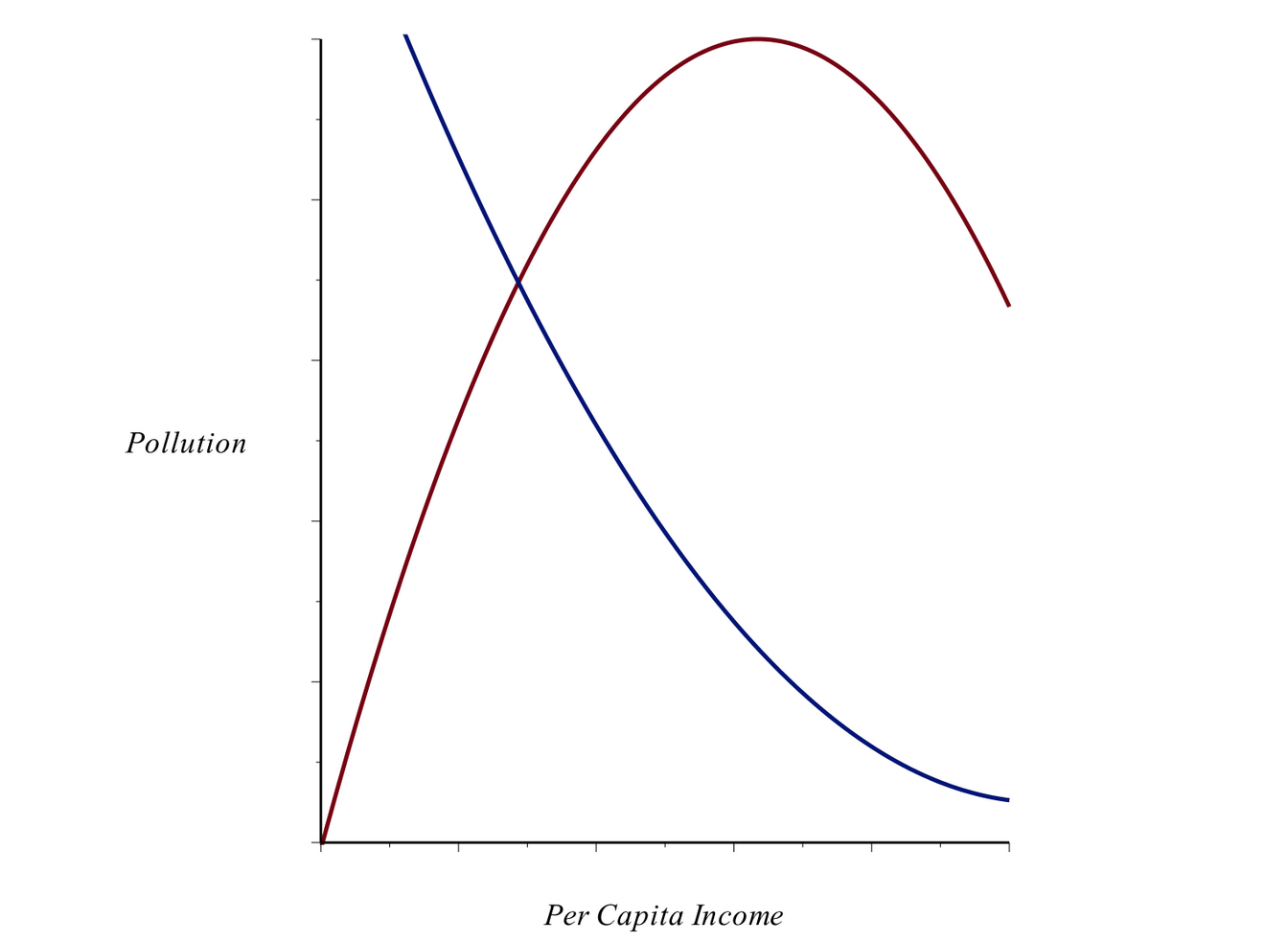
Nevertheless, even if we stipulate that carbon emissions must be reduced, there is an innocuous alternative to government regulatory intrusions and taxes for achieving that end: the enhanced carbon efficiency and technological innovation that economic growth makes possible. One of my favorite bloggers, economist Don Boudreaux, explains the logic of this alternative in this excellent post: “Economic Growth and Pollution Abatement“. He takes a “broad view” of pollution, not simply carbon or other industrial pollutants, because there are many forms of “natural” pollution that inflict greater misery than carbon ever will. With that in mind, Boudreaux appeals to the following relationships between pollution and income (or production):

Pollution Chart

Here is his description of the chart:

“The red curve in the nearby graph is the standard environmental Kuznets curve. This red curve shows the relationship between per-capita income and industrial pollutants. The blue curve shows the relationship between per-capita income and what we might, as a short-hand, call “naturally occurring pollutants” (that is, filth such as bacteria, mud on indoor floors, and rodent and bird droppings from the ceiling of one’s home).“

The red curve implies that a cleaner environment is a “luxury good”. I would also point out that the ascent of the red line at relatively low income levels will be muted by the substitution of cleaner fuels for primitive forms such as dung- and wood-burning, often burned indoors. This is consistent with Boudreaux’s point, though in a way that is not directly addressed by his explanation of the chart:

“… my hypothesis – which I believe is borne out by the historical record – is that people almost immediately start to consume greater cleanliness as they become wealthier.“

The combination of the two lines in the chart shows that economic growth is not unambiguously “bad” for the environment. It has certainly proven to be a good thing in terms of human health and welfare. As a consequence, developing countries should not be so foolish as to sacrifice economic growth for immediate carbon reductions. On the other hand, they may well make “promises” in exchange for massive compensation.

Neither should the world be singularly focused on immediate carbon reductions, because economic growth will be accompanied by improvements in carbon efficiency and the development of technologies far superior to today’s wasteful renewables. The activists attending COP 21 hope to improve the world, but they would saddle humanity with unnecessary burdens. I pity the denizens of countries whose leaders force costly authoritarian energy policies upon them in an effort to set, or comply with, a radical agenda. Oh, wait, that might be us! But I am optimistic that any agreement reached in Paris, if there is any, won’t hold or won’t matter.

A Cooked-Up Climate Consensus

14 Tuesday Jul 2015

Posted by Nuetzel in Global Warming

≈ 3 Comments

Tags

97% Consensus, AGW, Anthropomorphic Global Warming, Climate Change, Climate change consensus, Climate fraud, Ian Plimer, John Cook, Matt Ridley, Peer Review Process, Richard Tol, Scientism, University of Queensland

Settled-Science

Consensus: the world is flat; the science is settled. Consensus: the earth is at the center of the universe; the science is settled. Consensus: bloodletting can cure diseases; the science is settled. Did these ideas truly represent scientific consensus? They probably thought so at the time, but it’s more likely that they derived from long- and widely-held assumptions that had never been tested adequately via scientific methods. It might have been difficult, if not impossible, to test those propositions using the methods available at the time. There are certainly other examples of  “settled science” that were later revised, such as certain aspects of Newtonian physics.

The so-called “consensus” on climate change is similar to the first few “scientistic” assertions above, except that it’s a much less honest mistake. The most prominent claim about it is that 97% of climate scientists agree that humans have contributed to global warming. That is incorrect in several ways. Its genesis is a 2013 paper by John Cook of the University of Queensland. Richard Tol of the University of Sussex examines the facts surrounding the Cook paper in “Global warming consensus claim does not stand up“. The claim itself is a misrepresentation of Cook’s findings, according to Tol:

“The 97% refers to the number of papers, rather than the number of scientists. The alleged consensus is about any human role in climate change, rather than a dominant role….“

It is well known that the peer review process in the climate research community was fundamentally corrupt during the period covered by Cook’s examination of the literature. Papers submitted to academic journals by climate “dissenters” were often shut out, which would have biased Cook’s findings even if his review had been conducted honestly. Tol goes on to note the distortions introduced by Cook’s research, including a non-representative sample of papers:

“The sample was padded with irrelevant papers. An article about TV coverage on global warming was taken as evidence for global warming. In fact, about three-quarters of the papers counted as endorsements had nothing to say about the subject matter.“

It gets even worse:

“Cook enlisted a small group of environmental activists to rate the claims made by the selected papers. Cook claims that the ratings were done independently, but the raters freely discussed their work. There are systematic differences between the raters. Reading the same abstracts, the raters reached remarkably different conclusions – and some raters all too often erred in the same direction. Cook’s hand-picked raters disagreed what a paper was about 33% of the time. In 63% of cases, they disagreed about the message of a paper with the authors of that paper.“

On top of all that, Cook was uncooperative when asked to make his data available to other researchers. Apparently a hacker obtained the data, which revealed a highly questionable data collection process (and that Cook had lied regarding the existence of time stamps on the surveys):

“After collecting data for 8 weeks, there were 4 weeks of data analysis, followed by 3 more weeks of data collection. The same people collected and analysed the data. After more analysis, the paper classification scheme was changed and yet more data collected.“

In short, the Cook research upon which the 97% claim is based is trash. There are a number of points upon which climate researchers can largely agree in principle, including the fact that greenhouse gases would warm the planet, but only if ceteris paribus is invoked. There are many feedback effects and confounding influences that change the relationship, and the actual time span of data that can be brought to bear on the issue is strikingly short to justify bold conclusions. Unfortunately, the research environment is so politicized that even the data itself is subject to manipulation. Astonishingly, many assertions about the actual climate are, in fact, based on model output, not actual data!

There is strong disagreement at the highest levels of the scientific community regarding the balance of the evidence on climate change and whether it justifies radical policy change. Matt Ridley examines this issue in “The Climate Wars’ Damage To Science“:

“Today’s climate science, as Ian Plimer points out in his chapter in The Facts, is based on a ‘pre-ordained conclusion, huge bodies of evidence are ignored and analytical procedures are treated as evidence’. Funds are not available to investigate alternative theories. Those who express even the mildest doubts about dangerous climate change are ostracised, accused of being in the pay of fossil-fuel interests or starved of funds; those who take money from green pressure groups and make wildly exaggerated statements are showered with rewards and treated by the media as neutral.“

Ridley goes on to recount the litany of scandals that have erupted within the climate establishment over the past few years. It is well worth reading, but ultimately these developments can’t help but damage science, its reputation with the public, and its usefulness to mankind.

Fitting Data To Models At NOAA

08 Monday Jun 2015

Posted by Nuetzel in Global Warming

≈ 6 Comments

Tags

AGW, Anthony WAtts, Anthropomorphic Global Warming, buoy vs ship temperatures, Carl Beisner, Global Mean Temperature, Global Warming Hiatus, Judith Curry, National Oceanic and Atmospheric Administration, NOAA, Ross McKitrick, Temperature adjustments, Watt's Up With That?

Dilbert Made Up Numbers

If the facts don’t suit your agenda, change them! The 18-year “hiatus” in global warming, which has made a shambles of climate model predictions, is now said to have been based on “incorrect data”, according to researchers at National Oceanic and Atmospheric Administration (NOAA). Translation: they have created new data “adjustments” that tell a story more consistent with their preferred narrative, namely, that man-made carbon emissions are forcing global temperatures upward, more or less steadily. The New York Times’ report on the research took a fairly uncritical tone, despite immediate cautions and rebuttals from a number of authorities. On balance, the NOAA claims seem rather laughable.

Ross McKitrick has an excellent discussion of the NOAA adjustments on the Watts Up With That? blog (WUWT). His post reinforces the difficulty of aggregating temperature data in a meaningful way. A given thermometer in a fixed location can yield drifting temperatures over time due to changes in the surrounding environment, such as urbanization. In addition, weather stations are dispersed in irregular ways with extremely uneven coverage, and even worse, they have come and gone over time. There are gaps in the data that must be filled. There might be international differences in reporting practices as well. Sea surface temperature measurement is subject to even greater uncertainty. They can be broadly classified into temperatures collected on buoys and those collected by ships, and the latter have been taken in a variety of ways, from samples collected in various kinds of buckets, hull sensors, engine room intakes, and deck temperatures. The satellite readings, which are a recent development, are accurate in tracking changes, but the levels must be calibrated to other data. Here’s McKitrick on the measurements taken on ships:

“… in about half the cases people did not record which method was used to take the sample (Hirahari et al. 2014). In some cases they noted that, for example, ERI readings were obtained but they not indicate the depth. Or they might not record the height of the ship when the MAT reading is taken.“

The upshot is that calculating a global mean temperature is a statistical exercise fraught with uncertainty. A calculated mean at any point in time is an estimate of a conceptual value. The estimate is one of many possible estimates around the “true” value. Given the measurement difficulties, any meaningful confidence interval for the true mean would likely be so broad as to render inconsequential the much-discussed temperature trends of the past 50 years.

McKitrick emphasizes the three major changes made by NOAA, all having to do with sea surface temperatures:

  1. NOAA has decided to apply an upward adjustment to bring buoy temperature records into line with ship temperatures. This is curious, because most researchers have concluded that the ship temperatures are subject to greater bias. Also, the frequency of buoy records has been rising as a share of total sea temperature readings.
  2. NOAA added extra weight to the buoy readings, a decision which was unexplained.
  3. They applied a relatively large downward adjustment to temperatures collected by ships during 1998-2000.

Even the difference between the temperatures measured by ships and buoys (0.12 degrees Celsius), taken at face value, has a confidence interval (95%?) that is about 29 times as large as the difference. That adjustments such as those above are made with a straight face is nothing short of preposterous.

A number of other researchers have weighed in on the NOAA adjustments. Carl Beisner summarizes some of this work. He quotes McKitrick as well as Judith Curry:

“I think that uncertainties in global surface temperature anomalies is [sic] substantially understated. The surface temperature data sets that I have confidence in are the UK group and also Berkeley Earth. This short paper in Science is not adequate to explain and explore the very large changes that have been made to the NOAA data set. The global surface temperature datasets are clearly a moving target.“

There are a number of other posts this week on WUWT regarding the NOAA adjustments. Some of the experts, like Judith Curry, emphasize the new disparities created by NOAA’s adjustments with other well-regarded temperature series. It will be interesting to see how these differences are debated. Let’s hope that the discussion is driven wholly by science and not politics, but I fear that the latter will have a major impact on the debate. It has already.

Follow Sacred Cow Chips on WordPress.com

Recent Posts

  • Immigration and Merit As Fiscal Propositions
  • Tariff “Dividend” From An Indigent State
  • Almost Looks Like the Fed Has a 3% Inflation Target
  • Government Malpractice Breeds Health Care Havoc
  • A Tax On Imports Takes a Toll on Exports

Archives

  • December 2025
  • November 2025
  • October 2025
  • September 2025
  • August 2025
  • July 2025
  • June 2025
  • May 2025
  • April 2025
  • March 2025
  • February 2025
  • January 2025
  • December 2024
  • November 2024
  • October 2024
  • September 2024
  • August 2024
  • July 2024
  • June 2024
  • May 2024
  • April 2024
  • March 2024
  • February 2024
  • January 2024
  • December 2023
  • November 2023
  • August 2023
  • July 2023
  • June 2023
  • May 2023
  • April 2023
  • March 2023
  • February 2023
  • January 2023
  • December 2022
  • November 2022
  • October 2022
  • September 2022
  • August 2022
  • July 2022
  • June 2022
  • May 2022
  • April 2022
  • March 2022
  • February 2022
  • January 2022
  • December 2021
  • November 2021
  • October 2021
  • September 2021
  • August 2021
  • July 2021
  • June 2021
  • May 2021
  • April 2021
  • March 2021
  • February 2021
  • January 2021
  • December 2020
  • November 2020
  • October 2020
  • September 2020
  • August 2020
  • July 2020
  • June 2020
  • May 2020
  • April 2020
  • March 2020
  • February 2020
  • January 2020
  • December 2019
  • November 2019
  • October 2019
  • September 2019
  • August 2019
  • July 2019
  • June 2019
  • May 2019
  • April 2019
  • March 2019
  • February 2019
  • January 2019
  • December 2018
  • November 2018
  • October 2018
  • September 2018
  • August 2018
  • July 2018
  • June 2018
  • May 2018
  • April 2018
  • March 2018
  • February 2018
  • January 2018
  • December 2017
  • November 2017
  • October 2017
  • September 2017
  • August 2017
  • July 2017
  • June 2017
  • May 2017
  • April 2017
  • March 2017
  • February 2017
  • January 2017
  • December 2016
  • November 2016
  • October 2016
  • September 2016
  • August 2016
  • July 2016
  • June 2016
  • May 2016
  • April 2016
  • March 2016
  • February 2016
  • January 2016
  • December 2015
  • November 2015
  • October 2015
  • September 2015
  • August 2015
  • July 2015
  • June 2015
  • May 2015
  • April 2015
  • March 2015
  • February 2015
  • January 2015
  • December 2014
  • November 2014
  • October 2014
  • September 2014
  • August 2014
  • July 2014
  • June 2014
  • May 2014
  • April 2014
  • March 2014

Blogs I Follow

  • Passive Income Kickstart
  • OnlyFinance.net
  • TLC Cholesterol
  • Nintil
  • kendunning.net
  • DCWhispers.com
  • Hoong-Wai in the UK
  • Marginal REVOLUTION
  • Stlouis
  • Watts Up With That?
  • Aussie Nationalist Blog
  • American Elephants
  • The View from Alexandria
  • The Gymnasium
  • A Force for Good
  • Notes On Liberty
  • troymo
  • SUNDAY BLOG Stephanie Sievers
  • Miss Lou Acquiring Lore
  • Your Well Wisher Program
  • Objectivism In Depth
  • RobotEnomics
  • Orderstatistic
  • Paradigm Library
  • Scattered Showers and Quicksand

Blog at WordPress.com.

Passive Income Kickstart

OnlyFinance.net

TLC Cholesterol

Nintil

To estimate, compare, distinguish, discuss, and trace to its principal sources everything

kendunning.net

The Future is Ours to Create

DCWhispers.com

Hoong-Wai in the UK

A Commonwealth immigrant's perspective on the UK's public arena.

Marginal REVOLUTION

Small Steps Toward A Much Better World

Stlouis

Watts Up With That?

The world's most viewed site on global warming and climate change

Aussie Nationalist Blog

Commentary from a Paleoconservative and Nationalist perspective

American Elephants

Defending Life, Liberty and the Pursuit of Happiness

The View from Alexandria

In advanced civilizations the period loosely called Alexandrian is usually associated with flexible morals, perfunctory religion, populist standards and cosmopolitan tastes, feminism, exotic cults, and the rapid turnover of high and low fads---in short, a falling away (which is all that decadence means) from the strictness of traditional rules, embodied in character and inforced from within. -- Jacques Barzun

The Gymnasium

A place for reason, politics, economics, and faith steeped in the classical liberal tradition

A Force for Good

How economics, morality, and markets combine

Notes On Liberty

Spontaneous thoughts on a humble creed

troymo

SUNDAY BLOG Stephanie Sievers

Escaping the everyday life with photographs from my travels

Miss Lou Acquiring Lore

Gallery of Life...

Your Well Wisher Program

Attempt to solve commonly known problems…

Objectivism In Depth

Exploring Ayn Rand's revolutionary philosophy.

RobotEnomics

(A)n (I)ntelligent Future

Orderstatistic

Economics, chess and anything else on my mind.

Paradigm Library

OODA Looping

Scattered Showers and Quicksand

Musings on science, investing, finance, economics, politics, and probably fly fishing.

  • Subscribe Subscribed
    • Sacred Cow Chips
    • Join 128 other subscribers
    • Already have a WordPress.com account? Log in now.
    • Sacred Cow Chips
    • Subscribe Subscribed
    • Sign up
    • Log in
    • Report this content
    • View site in Reader
    • Manage subscriptions
    • Collapse this bar
 

Loading Comments...