• About

Sacred Cow Chips

Sacred Cow Chips

Tag Archives: Capacity Factors

Wind, Solar, and the Five Circles of Dormant Capital

22 Monday Apr 2024

Posted by Nuetzel in Energy, Global Warming, Industrial Policy

≈ 1 Comment

Tags

Backup Power, Battery Technology, Capacity Factors, Center of the American Experiment, Climate Change, Dante’s Inferno, Dispatchable Power, Dormant Capital, Fossil Furls, Green Energy, Imposed Costs, Industrial Planning, Isaac Orr, Mackinac Center for Public Policy, Malinvestment, Mitch Rolling, Power Outages, Power Tramsmission, Solar Energy, Space Based Solar Power, Subsidies, Wind Energy

This is a first for me…. The following is partly excerpted from a post of two weeks ago, but I’ve made a number of edits and additions. The original post was way too long. This is a bit shorter, and I hope it distills a key message.

~~~~~~~~~~~~~~~~~~~~~~~~~~~~~~~~~~~~~

Failures of industrial policies are nothing new, but the current manipulation of electric power generation by government in favor of renewable energy technologies is egregious. These interventions are a reaction to an overwrought climate crisis narrative, but they have many shortcomings and risks of their own. Chief among them is whether the power grid will be capable of meeting current and future demand for power while relying heavily on variable resources, namely wind and sunshine. The variability implies idle and drastically underutilized hours every day without any ability to call upon the assets to produce when needed.

The variability is vividly illustrated by the chart above showing a representative daily profile of power demand versus wind and solar output. Below, with apologies to Dante, I describe the energy hellscape into which we’re being driven on the horns of irrational capital outlays. These projects would be flatly rejected by any rational investor but for the massive subsidies afforded by government.

The First Circle of Dormancy: Low Utilization

Wind and solar power assets have relatively low rates of utilization due to the intermittency of wind and sunshine. Capacity factors for wind turbines averaged almost 36% in the U.S. in 2022, while solar facilities averaged only about 24%. This compared with nuclear power at almost 93%, natural gas (66%), and coal (48%).

Despite their low rates of utilization, new wind and solar facilities are always touted at their full nameplate capacity. We hear a great deal about “additions to capacity”, which overstate the actual power-generating potential by factors of three to four times. More importantly, this also means wind and solar power costs per unit of output are often vastly understated. These assets contribute less economic value to the electric grid than more heavily utilized generating assets.

Sometimes wind and solar facilities are completely idle or dormant. Sometimes they operate at just a fraction of capacity. I will use the terms “idle” and dormant” euphemistically in what follows to mean assets operating not just at low levels of utilization, but for those prone to low utilization and also falling within the Second Circle of Dormancy.

The Second Circle of Dormancy: Non-Dispatchability

The First Circle of Dormancy might be more like a Purgatory than a Hell. That’s because relatively low average utilization of an asset could be justifiable if demand is subject to large fluctuations. This is the often case, as with assets like roads, bridges, restaurants, amusement parks, and many others. However, capital invested in wind and solar facilities is idle on an uncontrollable basis, which is more truly condemnable. Wind and solar do not provide “dispatchable” power, meaning they are not “on call” in any sense during idle or less productive periods. Not only is their power output uncontrollable, it is not entirely predictable.

Again, variable but controllable utilization allows flexibility and risk mitigation in many applications. But when utilization levels are uncontrollable, the capital in question has greatly diminished value to the power grid and to power customers relative to dispatchable sources having equivalent capacity and utilization. It’s no wonder that low utilization, variability, and non-dispatchability are underemphasized or omitted by promoters of wind and solar energy. This sort of uncontrollable down-time is a drain on real economic returns to capital.

The Third Circle of Dormancy: Transmission Infrastructure

The idleness that besets the real economic returns to wind and solar power generation extends to the transmission facilities necessary for getting power to the grid. Transmission facilities are costly, but that cost is magnified by the broad spatial distribution of wind and solar generating units. Transmission from offshore facilities is particularly complex. When wind turbines and solar panels are dormant, so are the transmission facilities needed to reach them. Thus, low utilization and the non-dispatchability of those units diminishes the value of the capital that must be committed for both power generation and its transmission.

The Fourth Circle of Dormancy: Backup Power Assets

The reliability of the grid requires that any commitment to variable wind and solar power must also include a commitment to back-up capacity. As another example, consider shipping concerns that are now experimenting with sails on cargo ships. What is the economic value of such a ship without back-up power? Can you imagine these vessels drifting in the equatorial calms for days on end? Even light winds would slow the transport of goods significantly. Idle, non–dispatchable capital, is unproductive capital.

Likewise, solar-powered signage can underperform or fail over the course of several dark, wintry days, even with battery backup. The signage is more reliable and valuable when it is backed-up by another power source. But again, idle, non-dispatchable capital is unproductive capital.

The needed provision of backup power sources represents an imposed cost of wind and solar, which is built into the cost estimates shown in a section below. But here’s another case of dormancy: some part of the capital commitment, either primary energy sources or the needed backups, will be idle regardless of wind and solar conditions… all the time. Of course, back-up power facilities should be dispatchable because they must serve an insurance function. Backup power therefore has value in preserving the stability of the grid even while completely idle. However, at best that value offsets a small part of the social loss inherent in primary reliance on variable and non-dispatchable power sources.

We can’t wholly “replace” dispatchable generating capacity with renewables without serious negative consequences. At the same time, maintaining existing dispatchable power sources as backup carries a considerable cost at the margin for wind and solar. At a minimum, it requires normal maintenance on dispatchable generators, periodic replacement of components, and an inventory of fuel. If renewables are intended to meet growth in power demand, the imposed cost is far greater because backup sources for growth would require investment in new dispatchable capacity.

The Fifth Circle of Dormancy: Outages

The pursuit of net-zero carbon emissions via wind and solar power creates uncontrollably dormant capital, which increasingly lacks adequate backup power. Providing that backup should be a priority, but it’s not.

Perhaps much worse than the cost of providing backup power sources is the risk and imposed cost of grid instability in their absence. That cost would be borne by users in the form of outages. Users are placed at increasing risk of losing power at home, at the office and factories, at stores, in transit, and at hospitals. This can occur at peak hours or under potentially dangerous circumstances like frigid or hot weather.

Outage risks include another kind of idle capital: the potential for economy-wide shutdowns across a particular region of all electrified physical capital. Not only can grid failure lead to economy-wide idle capital, but this risk transforms all capital powered by electricity into non-dispatchable productive capacity.

Reliance on wind and solar power makes backup capacity an imperative. Better still, just scuttle the wind and solar binge and provide for growth with reliable sources of power!

Quantifying Infernal Costs

A “grid report card“ from the Mackinac Center for Public Policy gets right to the crux of the imposed-cost problem:

“… the more renewable generation facilities you build, the more it costs the system to make up for their variability, and the less value they provide to electricity markets.”

The report card uses cost estimates for Michigan from the Center of the American Experiment. Here are the report’s average costs per MWh through 2050, including the imposed costs of backup power:

—Existing coal plant: $33/MWh

—Existing gas-powered: $22

— New wind: $180

—New solar: $278

—New nuclear reactor (light water): $74

—Small modular reactor: $185

—New coal plant: $106 with carbon capture and storage (CCS)

—New natural gas: $64 with CCS

It’s should be no surprise that existing coal and gas facilities are the most cost effective. Preserve them! Of the new installations, natural gas is the least costly, followed by the light water reactor and coal. New wind and solar capacity are particularly costly.

Proponents of net zero are loath to recognize the imposed cost of backup power for two reasons. First, it is a real cost that can be avoided by society only at the risk of grid instability, something they’d like to ignore. To them, it represents something of an avoidable external cost. Second, at present, backup dispatchable power would almost certainly entail CO2 emissions, violating the net zero dictum. But in attempting to address a presumed externality (climate warming) by granting generous subsidies to wind and solar investors, the government and NGOs induce an imposed cost on society with far more serious and immediate consequences.

Deadly Sin: Subsidizing Dormant Capital

Wind and solar capital outlays are funded via combinations of private investment and public subsidies, and the former is very much contingent on the latter. That’s because the flood of subsidies is what allows private investors a chance to profit from uncontrollably dormant capital. Wind and solar power are far more heavily subsidized than fossil fuels, as noted by Mitch Rolling and Isaac Orr:

“In 2022, wind and solar generators received three and eighteen times more subsidies per MWh, respectively, than natural gas, coal, and nuclear generators combined. Solar is the clear leader, receiving anywhere from $50 to $80 per MWh over the last five years, whereas wind is a distant second at $8 to $10 per MWh …. Renewable energy sources like wind and solar are largely dependent on these subsidies, which have been ongoing for 30 years with no end in sight.”

But even generous subsidies often aren’t enough to ensure financial viability. Rent-enabled malinvestments like these crowd out genuinely productive capital formation. Those lost opportunities span the economy and are not limited to power plants that might otherwise have used fossil fuels.

Despite billions of dollars in “green energy” subsidies, bankruptcy has been all too common among wind and solar firms. That financial instability demonstrates the uneconomic nature of many wind and solar investments. Bankruptcy pleadings represent yet another way investors are insulated against wind and solar losses.

Subsidized Off-Hour (Wasted) Output

This almost deserves a sixth circle, except that it’s not about dormancy. Wind and solar power are sometimes available when they’re not needed, in which case the power goes unused because we lack effective power storage technology. Battery technology has a long way to go before it can overcome this problem.

When wind and solar facilities generate unused and wasted power during off-hours, their operators are nevertheless paid for that power by selling it into the grid where it goes unused. It’s another subsidy to wind and solar power producers, and one that undermines incentives for investment in batteries.

A Path To Redemption

Space-based solar power beamed to earth may become a viable alternative to terrestrial wind and solar production within a decade or so. The key advantages would be constancy and the lack of an atmospheric filter on available solar energy, producing power 13 times as efficiently as earth-bound solar panels. From the last link:

“The intermittent nature of terrestrial renewable power generation is a major concern, as other types of energy generation are needed to ensure that lights stay on during unfavorable weather. Currently, electrical grids rely either on nuclear plants or gas and coal fired power stations as a backup…. “

Construction of collection platforms in geostationary orbit will take time, of course, but development of space-based solar should be a higher priority than blanketing vast tracts of land with inefficient solar panels while putting power users at risk of outages.

No Sympathy for Malinvestment

This post identified five ways in which investments in wind and solar power create frequent and often extended periods of damnably dormant physical capital:

  • Low Utilization
  • Nondispatchable Utilization
  • Idle Transmission Infrastructure
  • Idle Backup Generators
  • Outages of All Electrified Capital

Power demand is expected to soar given the coming explosion in AI applications, and especially if the heavily-subsidized and mandated transition to EVs comes to pass. But that growth in demand will not and cannot be met by relying solely on renewable energy sources. Their variability implies substantial idle capacity, higher costs, and service interruptions. Such a massive deployment of dormant capital represents an enormous waste of resources, and the sad fact is it’s been underway for some time.

In the years ahead, the net-zero objective will motivate more bungled industrial planning as a substitute for market-driven forces. Costs will be driven higher by the imposed costs of backup capacity and/or outages. Ratepayers, taxpayers, and innocents will all share these burdens.

Creating idle, non-dispatchable physical capital is malinvestment which diminishes future economic growth. The boom in wind and solar activity began in earnest during the era of negative real interest rates. Today’s higher rates might slow the malinvestment, but they won’t bring it to an end without a substantial shift in the political landscape. Instead, taxpayers will shoulder an even greater burden, as will ratepayers whose power providers are guaranteed returns on their regulated rate bases.

Tangled Up In Green Industrial Policy II: Rewarding Idle Capital

06 Saturday Apr 2024

Posted by Nuetzel in Energy, Global Warming, Industrial Policy

≈ 1 Comment

Tags

AI, Capacity Factors, Carbon Capture, Casey Handmer, Center of the American Experiment, Charles Glasser, crowding out, Dispatchable Power, EV Mandates, Externalities, Heat Island Effect, Hydrocarbons, Idle Capital, IMF, Imposed Cost, Industrial Policy, Institute for Energy Research, Lazard Levelized Costs, Lionel Shriver, Long Tailpipe, Mackinac Center for Public Policy, Malinvestment, Modular Reactors, Natural Gas, Net Zero, Nuclear Fusion, Power Transmission, Production Possibilities, Renewable energy, Simon P. Michaux, Subsidies, Toxicity, Travis Fisher, Wildlife Hazards

A week ago I posted about electrification and particularly EV mandates, one strand of government industrial policy under which non-favored sectors of the economy must labor. This post examines a related industrial policy: manipulation of power generation by government policymakers in favor of renewable energy technologies, while fossil fuels are targeted for oblivion. These interventions are a reaction to an overwrought climate crisis narrative, but they present many obstacles, oversights and risks of their own. Chief among them is whether the power grid will be capable of meeting current and future demand for power while relying heavily on variable resources: wind and sunshine.

Like almost everything I write, this post is too long! Here is a guide to what follows. Scroll down to whatever sections might be of interest:

  • Malinvestment: Idle capital
  • Key Considerations to chew on
  • False Premises: zero CO2? Low cost?
  • Imposed Cost: what and how much?
  • Supporting Growth: with renewables?
  • Resource Constraints: they’re tight!
  • Technological Advance: patience!
  • The Presumed Elephant: CO2 costs
  • Conclusion

Malinvestment

The intermittency of wind and solar power creates a fundamental problem of physically idle capital, which leaves the economy short of its production possibilities. To clarify, capital invested in wind and solar facilities is often idle in two critical ways. First, wind and solar assets have relatively low rates of utilization because of their variability, or intermittency. Second, neither provides “dispatchable” power: it is not “on call” in any sense during those idle periods, which are not entirely predictable. Wind and solar assets therefore contribute less value to the electric grid than dispatchable sources of power having equivalent capacity and utilization.

Is “idle capital” a reasonable characterization? Consider the shipping concerns that are now experimenting with sails on cargo ships. What is the economic value of such a ship without back-up power? Can you imagine them drifting in the equatorial calms for days on end? Even light winds would slow the transport of goods significantly. Idle capital might be bad enough, but a degree of idleness allows flexibility and risk mitigation in many applications. Idle, non–dispatchable capital, however, is unproductive capital.

Likewise, solar-powered signage can underperform or fail over the course of several dark, wintry days, even with battery backup. The signage is more reliable and valuable when it is backed-up by another power source. Again, idle, non-dispatchable capital is unproductive capital.

The pursuit of net-zero carbon emissions via wind and solar power creates idle capital, which increasingly lacks adequate backup power. That should be a priority, but it’s not. This misguided effort is funded from both private investment and public subsidies, but the former is very much contingent on the latter. That’s because the flood of subsidies is what allows private investors to profit from idle capital. Rent-enabled investments like these crowd out genuinely productive capital formation, which is not limited to power plants that might otherwise use fossil fuels.

Creating idle or unemployed physical capital is malinvestment, and it diminishes future economic growth. The surge in this activity began in earnest during the era of negative real interest rates. Today, in an era of higher rates, taxpayers can expect an even greater burden, as can ratepayers whose power providers are guaranteed returns on their regulated rate bases.

Key Consideration

The forced transition to net zero will be futile, but especially if wind and solar energy are the primary focus. Keep the following in mind:

  • The demand for electricity is expected to soar, and soon! Policymakers have high hopes for EVs, and while adoption rates might fall well short of their goals, they’re doing their clumsy best to force EVs down our throats with mandates. But facilitating EV charging presents difficulties. Lionel Shriver states the obvious: “Going Electric Requires Electricity”. Reliable electricity!
  • Perhaps more impressive than prospects for EVs is the expected growth in power demand from data centers required by the explosion of artificial intelligence applications across many industries. It’s happening now! This will be magnified with the advent of artificial general intelligence (AGI).
  • Dispatchable power sources are needed to back-up unreliable wind and solar power to ensure service continuity. Maintaining backup power carries a huge “imposed cost” at the margin for wind and solar. At present, that would entail CO2 emissions, violating the net zero dictum.
  • Perhaps worse than the cost of backup power would be the cost borne by users under the complete elimination of certain dispatchable power sources. An imposed cost then takes the form of outages. Users are placed at risk of losing power at home, at the office and factories, at stores, in transit, and at hospitals at peak hours or under potentially dangerous circumstances like frigid or hot weather.
  • Historically, dispatchable power has allowed utilities to provide reliable electricity on-demand. Just flip the switch! This may become a thing of the past.
  • Wind and solar power are sometimes available when they’re not needed, in which case the power goes unused because we lack effective power storage technology.
  • Wind and solar power facilities operate at low rates of utilization, yet new facilities are always touted at their full nameplate capacity. Capacity factors for wind turbines averaged almost 36% in the U.S. in 2022, while solar facilities averaged only about 24%. This compared with nuclear power at almost 93%, natural gas (66%), and coal (48%). Obviously, the low capacity factors for wind and solar reflect their variable nature, rather than dispatchable responses to fluctuations in power demand.
  • Low utilization and variability are underemphasized or omitted by those promoting wind and solar plant in the media and often in discussions of public policy, and no wonder! We hear a great deal about “additions to capacity”, which overstate the actual power-generating potential by factors of three to four times. Here is a typical example.
  • Wind and solar power are far more heavily subsidized than fossil fuels. This is true in absolute terms and especially on the basis of actual power output, which reveals their overwhelmingly uneconomic nature. From the link above, here are Mitch Rolling and Isaac Orr on this point:
    • “In 2022, wind and solar generators received three and eighteen times more subsidies per MWh, respectively, than natural gas, coal, and nuclear generators combined. Solar is the clear leader, receiving anywhere from $50 to $80 per MWh over the last five years, whereas wind is a distant second at $8 to $10 per MWh …. Renewable energy sources like wind and solar are largely dependent on these subsidies, which have been ongoing for 30 years with no end in sight.”
  • The first-order burden of subsidies falls on taxpayers. The second-order burdens manifest in an unstable grid and higher power costs. But just to be clear, subsidies are paid by governments to producers or consumers to reduce the cost of activity favored by policymakers. However, the International Monetary Fund frequently cites “subsidy” figures that include staff estimates of unaddressed externalities. These are based on highly-simplified models and subject to great uncertainty, of course, especially when dollar values are assigned to categories like “climate change”. Despite what alarmists would have us believe, the extent and consequences of climate change are not settled scientific issues, let alone the dollar cost.
  • Wind and solar power are extremely land- and/or sea-intensive. For example, Casey Handmer estimates that a one-Gigawatt data center, if powered by solar panels, would need a footprint of 20,000 acres. 
  • Solar installations are associated with a significant heat island effect: “We found temperatures over a PV plant were regularly 3–4 °C warmer than wildlands at night….”
  • Wind and solar power both represent major hazards to wildlife both during and after construction.
    • In addition to the destruction of habitat both on- and offshore, turbine blades create noise, electromagnetism, and migration barriers. Wind farms have been associated with significant bird and bat fatalities. Collisions with moving blades are one thing, but changes to the winds and air pressure around turbines are also a danger to avian species.
    • There is a strong likelihood that offshore wind development is endangering whales and dolphins.
    • Solar farms present dangers to waterfowl. These creatures are tricked into diving toward what they believe to be bodies of water, only to crash into the panels.
  • The production of wind and solar equipment requires the intensive use of scarce resources, including environmentally-sensitive materials. Extracting these materials often requires the excavation of massive amounts of rock subject to extensive processing. Mining and processing rely heavily on diesel fuel. Net zero? No.
  • Wind and solar facilities often present major threats of toxicity at disposal, or even sooner. A recent hail storm in Texas literally destroyed a solar farm, and the smashed panels have prompted concerns not only about solar “sustainability”, but also that harsh chemicals may be leaking into the local environment.
  • The transmission of power is costly, but that cost is magnified by the broad spatial distribution of wind and solar generating units. Transmission from offshore facilities is particularly complex. And high voltage lines run into tremendous local opposition and regulatory scrutiny.
  • When wind turbines and solar panels are idle, so are the transmission facilities needed to reach them. Thus, low utilization and the variability of those units drives up the capital needed for power and power transmission.
  • There is also an acute shortage of transformers, which presents a major bottleneck to grid development and stability.
  • While zero carbon is the ostensible goal, zero carbon nuclear power has been neglected by our industrial planners. That neglect plays off exaggerated fears about safety. Fortunately, there is a growing realization that nuclear power may be surest way to carbon reductions while meeting growth in power demand. In fact, new data centers will go off-grid with their own modular reactors.
  • At the Shriver link, he notes the smothering nature of power regulation, which obstructs the objective of providing reliable power and any hope of achieving net zero.
  • The Biden administration has resisted the substitution of low CO2 emitting power sources for high CO2 emitting sources. For example, natural gas is more energy efficient in a variety of applications than other fuel sources. Yet policymakers seem determined to discourage the production and use of natural gas.

False Premises

Wind and solar energy are touted by the federal government as zero carbon and low-cost technologies, but both claims are false. Extracting the needed resources, fabricating, installing, connecting, and ultimately disposing of these facilities is high in carbon emissions.

The claim that wind and solar have a cost advantage over traditional power sources is based on misleading comparisons. First, putting claims about the cost of carbon aside, it goes without saying that the cost of replacing already operational coal or natural gas generating capacity with new wind and solar facilities is greater than doing nothing.

The hope among net zero advocates is that existing fossil fuel generating plant can be decommissioned as more renewables come on-line. Again, this thinking ignores the variable nature of renewable power. Dispatchable backup power is required to reliably meet power demand. Otherwise, fluctuating power supplies undermine the economy’s productive capacity, leading to declines in output, income, health, and well being. That is costly, but so is maintaining and adding back-up capacity. Costs of wind and solar should account for this necessity. It implies that wind and solar generating units carry a high cost at the margin.

Imposed Costs

A “grid report card” from the Mackinac Center for Public Policy notes the conceptual flaw in comparing the levelized cost (à la Lazard) of a variable resource with one capable of steady and dispatchable performance. From the report, here is the crux of the imposed-cost problem:

“… the more renewable generation facilities you build, the more it costs the system to make up for their variability, and the less value they provide to electricity markets.”

A committment to variable wind and solar power along with back-up capacity also implies that some capital will be idle regardless of wind and solar conditions. This is part of the imposed cost of wind and solar built into the accounting below. But while back-up power facilities will have idle periods, it is dispatchable and serves an insurance function, so it has value even when idle in preserving the stability of the grid. For that matter, sole reliance on dispatchable power sources requires excess capacity to serve an insurance function of a similar kind.

The Mackinac report card uses estimates of imposed cost from an Institute for Energy Research to construct the following comparison (expand the view or try clicking the image for a better view):

The figures shown in this table are somewhat dated, but the Mackinac authors use updated costs for Michigan from the Center of the American Experiment. These are shown below in terms of average costs per MWh through 2050, but the labels require some additional explanation.

The two bars on the left show costs for existing coal ($33/MWh) and gas-powered ($22) plants. The third and fourth bars are for new wind ($180) and solar ($278) installations. The fifth and sixth bars are for new nuclear reactors (a light water reactor ($74) and a small modular reactor($185)). Finally, the last two bars are for a new coal plant ($106) and a natural gas plant ($64), both with carbon capture and storage (CCS). It’s no surprise that existing coal and gas facilities are the most cost effective. Natural gas is by far the least costly of the new installations, followed by the light water reactor and coal.

The Mackinac “report card” is instructive in several ways. It provides a detailed analysis of different types of power generation across five dimensions, including reliability, cost, cleanliness, and market feasibility (the latter because some types of power (hydro, geothermal) have geographic limits. Natural gas comes out the clear winner on the report card because it is plentiful, energy dense, dispatchable, clean burning, and low-cost.

Supporting Growth

Growth in the demand for power cannot be met with variable resources without dispatchable backup or intolerable service interruptions. Unreliable power would seriously undermine the case for EVs, which is already tenuous at best. Data centers and other large users will go off-grid before they stand for it. This would represent a flat-out market rejection of renewable investments, ESGs be damned!

Casey Handmer makes some interesting projections of the power requirements of data centers supporting not just AI, but AGI, which he discusses in “How To Feed the AIs”. Here is his darkly humorous closing paragraph, predicated on meeting power demands from AGI via solar:

“It seems that AGI will create an irresistibly strong economic forcing function to pave the entire world with solar panels – including the oceans. We should probably think about how we want this to play out. At current rates of progress, we have about 20 years before paving is complete.”

Resource Constraints

Efforts to force a transition to wind and solar power will lead to more dramatic cost disadvantages than shown in the Mackinac report. By “forcing” a transition, I mean aggressive policies of mandates and subsidies favoring these renewables. These policies would effectuate a gross misallocation of resources. Many of the commodities needed to fabricate the components of wind and solar installations are already quite scarce, particularly on the domestic U.S. front. Inflating the demand for these commodities will result in shortages and escalating costs, magnifying the disadvantages of wind and solar power in real economic terms.

To put a finer point on the infeasibility of the net zero effort, Simon P. Michaux produced a comparative analysis in 2022 of the existing power mix versus a hypothetical power mix of renewable energy sources performing an equal amount of work, but at net-zero carbon emissions (the link is a PowerPoint summary). In the renewable energy scenario, he calculated the total quantities of various resources needed to achieve the objective over one generation of the “new” grid (to last 20 -30 years). He then calculated the numbers of years of mining or extraction needed to produce those quantities based on 2019 rates of production. Take a look at the results in the right-most column:

Those are sobering numbers. Granted, they are based on 2019 wind and solar technology. However, it’s clear that phasing out fossil fuels using today’s wind and solar technology would be out of the question within the lifetime of anyone currently living on the planet. Michaux seems to have a talent for understatement:

“Current thinking has seriously underestimated the scale of the task ahead.”

He also emphasizes the upward price pressure we’re likely to witness in the years ahead across a range of commodities.

Technological Breakthroughs

Michaux’s analysis assumes static technology, but there may come a time in the not-too-distant future when advances in wind and solar power and battery storage allow them to compete with hydrocarbons and nuclear power on a true economic basis. The best way to enable real energy breakthroughs is through market-driven economic growth. Energy production and growth is hampered, however, when governments strong-arm taxpayers, electricity buyers, and traditional energy producers while rewarding renewable developers with subsidies.

We know that improvements will come across a range of technologies. We’ve already seen reductions in the costs of solar panels themselves. Battery technology has a long way to go, but it has improved and might some day be capable of substantial smoothing in the delivery of renewable power. Collection of solar power in space is another possibility, as the feasibility of beaming power to earth has been demonstrated. This solution might also have advantages in terms of transmission depending on the locations and dispersion of collection points on earth, and it would certainly be less land intensive than solar power is today. Carbon capture and carbon conversion are advancing technologies, making net zero a more feasible possibility for traditional sources of power. Nuclear power is zero carbon, but like almost everything else, constructing plants is not. Nevertheless, fission reactors have made great strides in terms of safety and efficiency. Nuclear fusion development is still in its infancy, but there have been notable advances of late.

Some or all of these technologies will experience breakthroughs that could lead to a true, zero-carbon energy future. The timeline is highly uncertain, but it’s likely to be faster than anything like the estimates in Michaux’s analysis. Who knows? Perhaps AI will help lead us to the answers.

A Presumed Elephant

This post and my previous post have emphasized two glaring instances of government failure on their own terms: a headlong plunge into unreliable renewable energy, and forced electrification done prematurely and wrong. Some would protest that I left the veritable “elephant in the room”: the presumed external or spillover costs associated with CO2 emissions from burning fossil fuels. Renewables and electrification are both intended to prevent those costs.

External costs were not ignored, of course. Externalities were discussed explicitly in several different contexts such as the mining of new materials, EV tire wear, the substitution of “cleaner” fuels for others, toxicity at disposal, and the exaggerated reductions in CO2 from EVs when the “long tailpipe” problem is ignored. However, I noted explicitly that estimates of unaddressed externalities are often highly speculative and uncertain, and especially the costs of CO2 emissions. They should not be included in comparisons of subsidies.

Therefore, the costs of various power generating technologies shown above do not account for estimates of externalities. If you’re inclined, other SCC posts on the CO2 “elephant” can be found here.

Conclusion

Power demand is expected to soar given the coming explosion in AI applications, and especially if the heavily-subsidized and mandated transition to EVs comes to pass. But that growth in demand will not and cannot be met by relying on renewable energy sources. Their variability implies substantial idle capacity, higher costs, and service interruptions. Such a massive deployment of idle capital would represents an enormous waste of resources, but the sad fact is it’s been underway for some time.

In the years ahead, the net-zero objective will prove representative of a bumbling effort at industrial planning. Costs will be driven higher, including the cost inflicted by outages and environmental damage. Ratepayers, taxpayers, and innocents will share these burdens. Travis Fisher is spot on when he says the grid is becoming a “dangerous liability” thanks to wounds inflicted by subsidies, regulations, and mandates.

As Charles Glasser put it on Instapundit:

“The National Electrical Grid is teetering on collapse. The shift away from full-time available power (like fossil fuels, LNG, etc.) to so-called ‘green’ sources has deeply impacted reliability.”

“Also, as more whale-killing off-shore wind farms are planned, the Biden administration forgot to plan for the thousands of miles of transmission lines that will be needed. And in a perfect example of leftist autophagy, there is considerable opposition from enviro-groups who will tie up the construction of wind farms and transmission lines in court for decades.”

Meanwhile, better alternatives to wind and solar have been routinely discouraged. The substantial reductions in carbon emissions achieved in the U.S. over the past 15 years were caused primarily by the substitution of natural gas for coal in power generation. Much more of that is possible. The Biden Administration, however, wishes to prevent that substitution in favor of greater reliance on high-cost, unreliable renewables. And the Administration wishes to do so without adequately backing up those variable power sources with dispatchable capacity. Likewise, nuclear power has been shunted aside, despite its safety, low risk, and dispatchability. However, there are signs of progress in attitudes toward bringing more nuclear power on-line.

Industrial policy usually meets with failure, and net zero via wind and solar power will be no exception. Like forced electrification, unreliable power fails on its own terms. Net zero ain’t gonna happen any time soon, and not even by 2050. That is, it won’t happen unless net zero is faked through mechanisms like fraudulent carbon credits (and there might not be adequate faking capacity for that!). Full-scale net-zero investment in wind and solar power, battery capacity, and incremental transmission facilities will drive the cost of power upward, undermining economic growth. Finally, wind and solar are not the environmental panacea so often promised. Quite the contrary: mining of the necessary minerals, component fabrication, installation, and even operation all have negative environmental impacts. Disposal at the end of their useful lives might be even worse. And the presumed environmental gains … reduced atmospheric carbon concentrations and lower temperatures, are more scare story than science.

Postscript: here’s where climate alarmism has left us, and this is from a candidate for the U.S. Senate (she deleted the tweet after an avalanche of well-deserved ridicule):

Cassandras Feel An Urgent Need To Crush Your Lifestyle

12 Thursday Jan 2023

Posted by Nuetzel in Climate science, Environmental Fascism

≈ 1 Comment

Tags

Atmospheric Aerosols, Capacity Factors, Carbon Emissions, Carbon-Free Buildings, Chicken Little, Climate Alarmism, Coercion, Electric Vehicles, Elon Musk, Extreme Weather Events, Fossil fuels, Gas Stoves, Judith Curry, Land Use, Model Bias, Nuclear power, Paul Ehrlich, Renewable energy, rent seeking, Sea Levels, Settled Science, Solar Irradience, Solar Panels, Subsidies, Temperature Manipulation, Toyota Motors, Urban Heat Islands, Volcanic activity, Wind Turbines

Appeals to reason and logic are worthless in dealing with fanatics, so it’s too bad that matters of public policy are so often subject to fanaticism. Nothing is more vulnerable on this scale than climate policy. Why else would anyone continue to listen to prognosticators of such distinguished failure as Paul Ehrlich? Perhaps most infamously, his 1970s forecasts of catastrophe due to population growth were spectacularly off-base. He’s a man without any real understanding of human behavior and how markets deal efficiently and sustainably with scarcity. Here’s a little more detail on his many misfires. And yet people believe him! That’s blind faith.

The foolish acceptance of chicken-little assertions leads to coercive and dangerous policy prescriptions. These are both unnecessary and very costly in direct and hidden ways. But we hear a frantic chorus that we’d better hurry or… we’re all gonna die! Ironically, the fate of the human race hardly matters to the most radical of the alarmists, who are concerned only that the Earth itself be in exactly the same natural state that prevailed circa 1800. People? They don’t belong here! One just can’t take this special group of fools too seriously, except that they seem to have some influence on an even more dangerous group of idiots called policymakers.

Judith Curry, an esteemed but contrarian climate expert, writes of the “faux urgency” of climate action, and how the rush to implement supposed climate mitigations is a threat to our future:

“Rapid deployment of wind and solar power has invariably increased electricity costs and reduced reliability, particularly with increasing penetration into the grid. Allegations of human rights abuses in China’s Xinjiang region, where global solar voltaic supplies are concentrated, are generating political conflicts that threaten the solar power industry. Global supply chains of materials needed to produce solar and wind energy plus battery storage are spawning new regional conflicts, logistical problems, supply shortages and rising costs. The large amount of land use required for wind and solar farms plus transmission lines is causing local land use conflicts in many regions.”

Curry also addresses the fact that international climate authorities have “moved the goalposts” in response to the realization that the so-called “crisis” is not nearly as severe as we were told not too long ago. And she has little patience for delusions that authorities can reliably force adjustments in human behavior so as to to reduce weather disasters:

“Looking back into the past, including paleoclimatic data, there has been more extreme weather [than today] everywhere on the planet. Thinking that we can minimize severe weather through using atmospheric carbon dioxide as a control knob is a fairy tale.”

The lengths to which interventionists are willing to go should make consumer/taxpayers break out their pitchforks. It’s absurd to entertain mandates forcing vehicles powered by internal combustion engines (ICEs) off the road, and automakers know it. Recently, the head of Toyota Motors acknowledged his doubts that electric vehicles (EVs) can meet our transportation demands any time soon:

“People involved in the auto industry are largely a silent majority. That silent majority is wondering whether EVs are really OK to have as a single option. But they think it’s the trend so they can’t speak out loudly. Because the right answer is still unclear, we shouldn’t limit ourselves to just one option.”

In the same article, another Toyota executive says that neither the market nor the infrastructure is ready for a massive transition to EVs, a conclusion only a dimwit could doubt. Someone should call the Big 3 American car companies!

No one is a bigger cheerleader for EVs than Elon Musk. In the article about Toyota, he is quoted thusly:

“At this time, we actually need more oil and gas, not less. Realistically I think we need to use oil and gas in the short term, because otherwise civilization will crumble. One of the biggest challenges the world has ever faced is the transition to sustainable energy and to a sustainable economy. That will take some decades to complete.”

Of course, for the foreseeable future, EVs will be powered primarily by electricity generated from burning fossil fuels. So why the fuss? But as one wag said, that’s only until the government decides to shut down those power plants. After that, good luck with your EV!

Gas stoves are a new target of our energy overlords, but this can’t be about fuel efficiency, and it’s certainly not about the quality of food preparation. The claim by an environmental think tank called “Carbon-Free Buildings” is that gas stoves are responsible for dangerous indoor pollutants. Of course, the Left was quick to rally around this made-up problem, despite the fact that they all seem to use gas stoves and didn’t know anything about the issue until yesterday! And, they insist, racial minorities are hardest hit! Well, they might consider using exhaust fans, but the racialist rejoinder is that minorities aren’t adequately informed about the dangers and mitigants. Okay, start a safe-use info campaign, but keep government away from an embedded home technology that is arguably superior to the electric alternative in several respects.

Renewable energy mandates are a major area of assault. If we were to fully rely on today’s green energy technologies, we’d not just threaten our future, but our immediate health and welfare. Few people, including politicians, have any awareness of the low rates at which green technologies are actually utilized under real-world conditions.

“Worldwide average solar natural capacity factor (CF) reaches about ~11-13%. Best locations in California, Australia, South Africa, Sahara may have above 25%, but are rare. (see www.globalsolaratlas.info, setting direct normal solar irradiance)

Worldwide average wind natural capacity factors (CF) reach about ~21-24%. Best off-shore locations in Northern Europe may reach above 40%. Most of Asia and Africa have hardly any usable wind and the average CF would be below 15%, except for small areas on parts of the coasts of South Africa and Vietnam. (see www.globalwindatlas.info, setting mean power density)”

Those CFs are natural capacity factors (i.e., the wind doesn’t always blow or blow at “optimal” speeds, and the sun doesn’t always shine or shine at the best angle), The CFs don’t even account for “non-natural” shortfalls in actual utilization and other efficiency losses. It would be impossible for investors to make these technologies profitable without considerable assistance from taxpayers, but they couldn’t care less about whether their profits are driven by markets or government fiat. You see, they really aren’t capitalists. They are rent seekers playing a negative-sum game at the expense of the broader society.

There are severe environmental costs associated with current wind and solar technologies. Awful aesthetics and the huge inefficiencies of land use are bad enough. Then there are deadly consequences for wildlife. Producing inputs to these technologies requires resource-intensive and environmentally degrading mining activities. Finally, the costs of disposing of spent, toxic components of wind turbines and solar panels are conveniently ignored in most public discussions of renewables.

There is still more hypocritical frosting on the cake. Climate alarmists are largely opposed to nuclear power, a zero-carbon and very safe energy source. They also fight to prevent development of fossil fuel energy plant for impoverished peoples around the world, which would greatly aid in economic development efforts and in fostering better and safer living conditions. Apparently, they don’t care. Climate activists can only be counted upon to insist on wasteful and unreliable renewable energy facilities.

Before concluding, it’s good to review just a few facts about the “global climate”:

1) the warming we’ve seen in forecasts and in historical surface temperature data has been distorted by urban heat island effects, and weather instruments are too often situated in local environments rich in concrete and pavement.

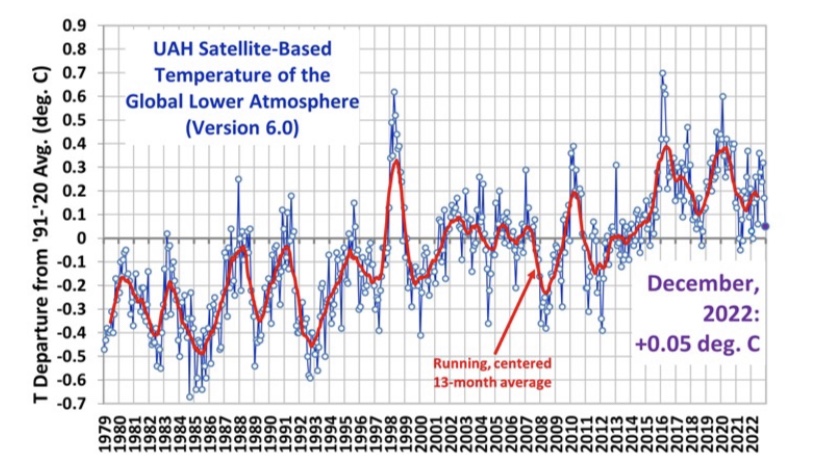
2) Satellite temperatures are only available for the past 43 years, and they have to be calibrated to surface measurements, so they are not independent measures. But the trend in satellite temperatures over the past seven years has been flat or negative at a time when global carbon emissions are at all-time highs.

3) There have been a series of dramatic adjustments to historical data that have “cooled the past” relative to more recent temperatures.

4) The climate models producing catastrophic long-term forecasts of temperatures have proven to be biased to the high side, having drastically over-predicted temperature trends over the past two- to three decades.

5) Sea levels have been rising for thousands of years, and we’ve seen an additional mini-rebound since the mini-ice age of a few hundred years ago. Furthermore, the rate of increase in sea levels has not accelerated in recent decades, contrary to the claims of climate alarmists.

6) Storms and violent weather have shown no increase in frequency or severity, yet models assure us that they must!

Despite these facts, climate change fanatics will only hear of climate disaster. We should be unwilling to accept the climatological nonsense now passing for “settled science”, itself a notion at odds with the philosophy of science. I’m sad to say that climate researchers are often blinded by the incentives created by publication bias and grant money from power-hungry government bureaucracies and partisan NGOs. They are so blinded, in fact, that research within the climate establishment now almost completely ignores the role of other climatological drivers such as the solar irradiance, volcanic activity, and the role and behavior of atmospheric aerosols. Yes, only the global carbon dial seems to matter!

No one is more sympathetic to “the kids” than me, and I’m sad that so much of the “fan base” for climate action is dominated by frightened members of our most youthful generations. It’s hard to blame them, however. Their fanaticism has been inculcated by a distinctly non-scientific community of educators and journalists who are willing to accept outrageous assertions based on “toy models” concocted on weak empirical grounds. That’s not settled science. It’s settled propaganda.

Follow Sacred Cow Chips on WordPress.com

Recent Posts

  • Immigration and Merit As Fiscal Propositions
  • Tariff “Dividend” From An Indigent State
  • Almost Looks Like the Fed Has a 3% Inflation Target
  • Government Malpractice Breeds Health Care Havoc
  • A Tax On Imports Takes a Toll on Exports

Archives

  • December 2025
  • November 2025
  • October 2025
  • September 2025
  • August 2025
  • July 2025
  • June 2025
  • May 2025
  • April 2025
  • March 2025
  • February 2025
  • January 2025
  • December 2024
  • November 2024
  • October 2024
  • September 2024
  • August 2024
  • July 2024
  • June 2024
  • May 2024
  • April 2024
  • March 2024
  • February 2024
  • January 2024
  • December 2023
  • November 2023
  • August 2023
  • July 2023
  • June 2023
  • May 2023
  • April 2023
  • March 2023
  • February 2023
  • January 2023
  • December 2022
  • November 2022
  • October 2022
  • September 2022
  • August 2022
  • July 2022
  • June 2022
  • May 2022
  • April 2022
  • March 2022
  • February 2022
  • January 2022
  • December 2021
  • November 2021
  • October 2021
  • September 2021
  • August 2021
  • July 2021
  • June 2021
  • May 2021
  • April 2021
  • March 2021
  • February 2021
  • January 2021
  • December 2020
  • November 2020
  • October 2020
  • September 2020
  • August 2020
  • July 2020
  • June 2020
  • May 2020
  • April 2020
  • March 2020
  • February 2020
  • January 2020
  • December 2019
  • November 2019
  • October 2019
  • September 2019
  • August 2019
  • July 2019
  • June 2019
  • May 2019
  • April 2019
  • March 2019
  • February 2019
  • January 2019
  • December 2018
  • November 2018
  • October 2018
  • September 2018
  • August 2018
  • July 2018
  • June 2018
  • May 2018
  • April 2018
  • March 2018
  • February 2018
  • January 2018
  • December 2017
  • November 2017
  • October 2017
  • September 2017
  • August 2017
  • July 2017
  • June 2017
  • May 2017
  • April 2017
  • March 2017
  • February 2017
  • January 2017
  • December 2016
  • November 2016
  • October 2016
  • September 2016
  • August 2016
  • July 2016
  • June 2016
  • May 2016
  • April 2016
  • March 2016
  • February 2016
  • January 2016
  • December 2015
  • November 2015
  • October 2015
  • September 2015
  • August 2015
  • July 2015
  • June 2015
  • May 2015
  • April 2015
  • March 2015
  • February 2015
  • January 2015
  • December 2014
  • November 2014
  • October 2014
  • September 2014
  • August 2014
  • July 2014
  • June 2014
  • May 2014
  • April 2014
  • March 2014

Blogs I Follow

  • Passive Income Kickstart
  • OnlyFinance.net
  • TLC Cholesterol
  • Nintil
  • kendunning.net
  • DCWhispers.com
  • Hoong-Wai in the UK
  • Marginal REVOLUTION
  • Stlouis
  • Watts Up With That?
  • Aussie Nationalist Blog
  • American Elephants
  • The View from Alexandria
  • The Gymnasium
  • A Force for Good
  • Notes On Liberty
  • troymo
  • SUNDAY BLOG Stephanie Sievers
  • Miss Lou Acquiring Lore
  • Your Well Wisher Program
  • Objectivism In Depth
  • RobotEnomics
  • Orderstatistic
  • Paradigm Library
  • Scattered Showers and Quicksand

Blog at WordPress.com.

Passive Income Kickstart

OnlyFinance.net

TLC Cholesterol

Nintil

To estimate, compare, distinguish, discuss, and trace to its principal sources everything

kendunning.net

The Future is Ours to Create

DCWhispers.com

Hoong-Wai in the UK

A Commonwealth immigrant's perspective on the UK's public arena.

Marginal REVOLUTION

Small Steps Toward A Much Better World

Stlouis

Watts Up With That?

The world's most viewed site on global warming and climate change

Aussie Nationalist Blog

Commentary from a Paleoconservative and Nationalist perspective

American Elephants

Defending Life, Liberty and the Pursuit of Happiness

The View from Alexandria

In advanced civilizations the period loosely called Alexandrian is usually associated with flexible morals, perfunctory religion, populist standards and cosmopolitan tastes, feminism, exotic cults, and the rapid turnover of high and low fads---in short, a falling away (which is all that decadence means) from the strictness of traditional rules, embodied in character and inforced from within. -- Jacques Barzun

The Gymnasium

A place for reason, politics, economics, and faith steeped in the classical liberal tradition

A Force for Good

How economics, morality, and markets combine

Notes On Liberty

Spontaneous thoughts on a humble creed

troymo

SUNDAY BLOG Stephanie Sievers

Escaping the everyday life with photographs from my travels

Miss Lou Acquiring Lore

Gallery of Life...

Your Well Wisher Program

Attempt to solve commonly known problems…

Objectivism In Depth

Exploring Ayn Rand's revolutionary philosophy.

RobotEnomics

(A)n (I)ntelligent Future

Orderstatistic

Economics, chess and anything else on my mind.

Paradigm Library

OODA Looping

Scattered Showers and Quicksand

Musings on science, investing, finance, economics, politics, and probably fly fishing.

  • Subscribe Subscribed
    • Sacred Cow Chips
    • Join 128 other subscribers
    • Already have a WordPress.com account? Log in now.
    • Sacred Cow Chips
    • Subscribe Subscribed
    • Sign up
    • Log in
    • Report this content
    • View site in Reader
    • Manage subscriptions
    • Collapse this bar
 

Loading Comments...