• About

Sacred Cow Chips

Sacred Cow Chips

Tag Archives: Chicago

Allocating Vaccine Supplies: Lives or “Justice”?

29 Tuesday Dec 2020

Posted by Nuetzel in Pandemic, Public Health, Uncategorized, Vaccinations

≈ 1 Comment

Tags

Alex Tabarrok, CDC, Chicago, Co-Morbidities, Covid-19, Emma Woodhouse, Essential Workers, Historical Inequities, Infection Fatality Rate, Long-Term Care, Megan McArdle, Super-Spreaders, Transmission, Vaccinations, Vaccine Allocation, Vaccine Passports

There are currently two vaccines in limited distribution across the U.S. from Pfizer and Moderna, but the number and variety of different vaccines will grow as we move through the winter. For now, the vaccine is in short supply, but that’s even more a matter of administering doses in a timely way as it is the quantity on hand. There are competing theories about how best to allocate the available doses, which is the subject of this post. I won’t debate the merits of refusing to take a vaccine except to say that I support anyone’s right to refuse it without coercion by public authorities. I also note that certain forms of discrimination on that basis are not necessarily unreasonable.

The vaccines in play all seem to be highly effective (> 90%, which is incredible by existing standards). There have been a few reports of side effects — certainly not in large numbers — but it remains to be seen whether the vaccines will have any long-term side effects. I’m optimistic, but I won’t dismiss the possibility.

Despite competing doctrines about how the available supplies of vaccine should be allocated, there is widespread acceptance that health care workers should go first. I have some reservations about this because, like Emma Woodhouse, I believe staff and residents at long-term care facilities should have at least equal priority. Yet they do not in the City of Chicago and probably in other areas. I have to wonder whether unionized health care workers there are the beneficiaries of political favoritism.

Beyond that question, we have the following competing priorities: 1) the vulnerable in care homes and other elderly individuals (75+, while younger individuals with co-morbidities come later); 2) “essential” workers of all ages (from police to grocery store clerks — decidedly arbitrary); and 3) basically the same as #2 with priority given to groups who have suffered historical inequities.

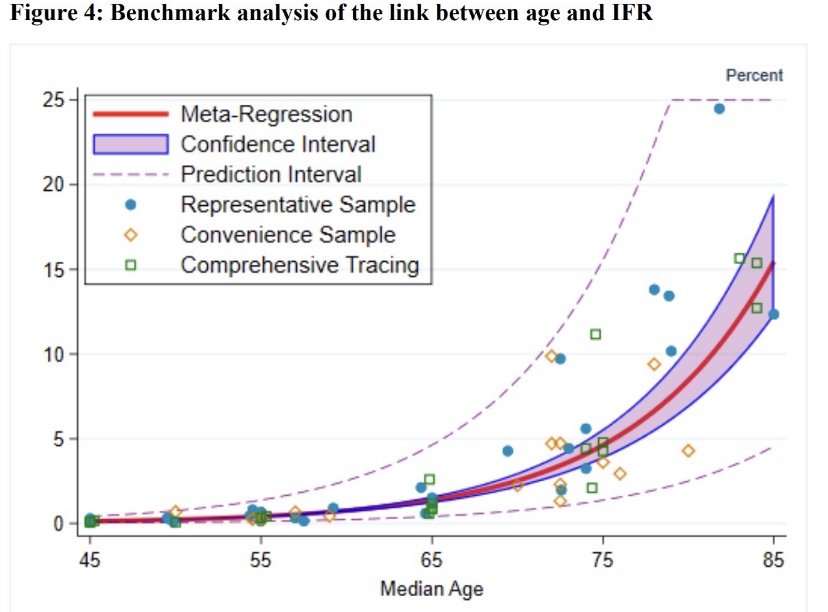
#1 is clearly the way to save the most lives, at least in the short-run. Over 40% of the deaths in the U.S. have been in elder-care settings, and COVID infection fatality rates mount exponentially with age:
To derive the implications of #1 and #2, it’s more convenient to look at the share of deaths within each age cohort, since it incorporates the differences in infection rates and fatality rates across age groups (the number of “other” deaths is much larger than COVID deaths, of course, despite similar death shares):
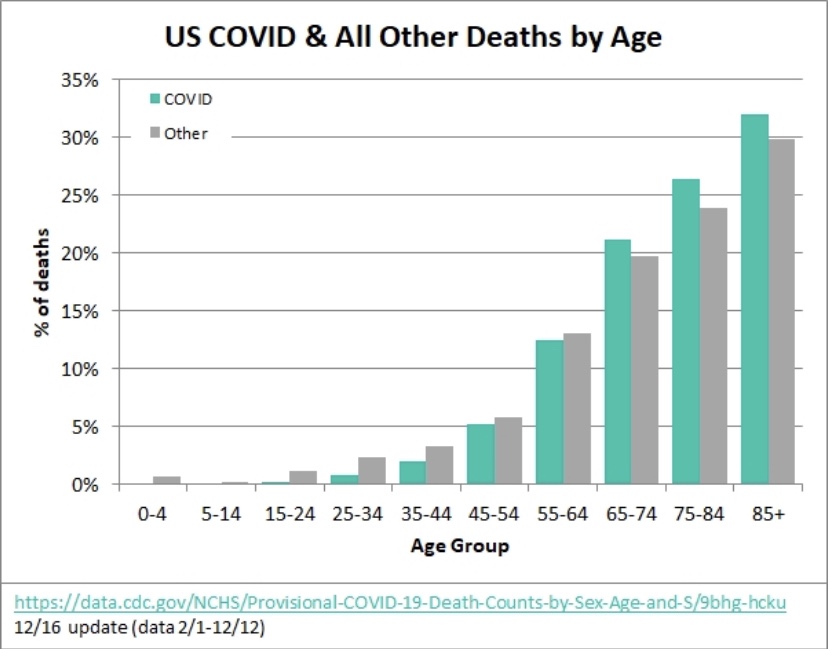
The 75+ age group has accounted for about 58% of all COVID deaths in the U.S., and ages 25 – 64 accounted for about 20% (an approximate age range for essential workers). This implies that nearly three times as many lives can be saved by prioritizing the elderly, at least if deaths among so-called essential workers mimic deaths in the 25 – 64 age cohorts. However, the gap would be smaller and perhaps reversed in terms of life-years saved.

Furthermore, this is a short-run calculation. Over a longer time frame, if essential workers are responsible for more transmission across all ages than the elderly, then it might throw the advantage to prioritizing essential workers over the elderly, but it would take a number of transmission cycles for the differential to play out. Yes, essential workers are more likely to be “super-spreaders” than work-at-home, corporate employees, or even the unemployed, but identifying true super-spreaders would require considerable luck. Moreover, care homes generally house a substantial number of elderly individuals and staff in a confined environment, where spread is likely to be rampant. So the transmission argument for #2 over #1 is questionable.

The over-riding problem is that of available supply. Suppose enough vaccine is available for all elderly individuals within a particular time frame. That’s about 6.6% of the total U.S. population. The same supply would cover only about 13% of the younger age group identified above. Essential workers are a subset of that group, but the same supply would fall far short of vaccinating all of them; lives saved under #2 would then fall far short of the lives saved under #1. Quantities of the vaccine are likely to increase over the course of a few months, but limited supplies at the outset force us to focus the allocation decision on the short-term, making #1 the clear winner.

Now let’s talk about #3, minority populations, historical inequities, and the logic of allocating vaccine on that basis. Minority populations have suffered disproportionately from COVID, so this is really a matter of objective risk, not historical inequities… unless the idea is to treat vaccine allocations as a form of reparation. Don’t laugh — that might not be far from the intent, and it won’t count as a credit toward the next demand for “justice”.
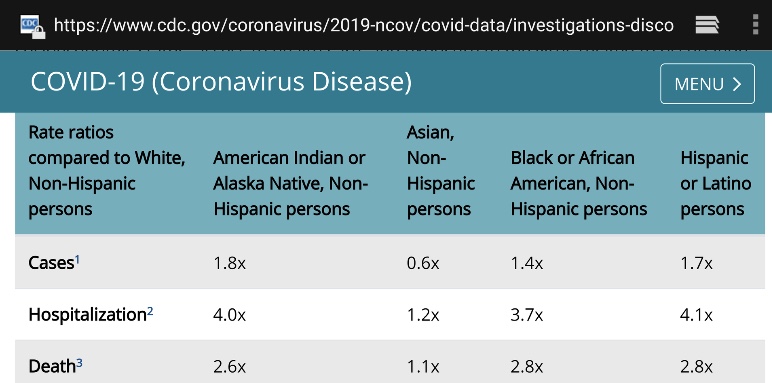
For the sake of argument, let’s assume that minorities have 3x the fatality rate of whites from COVID (a little high). Roughly 40% of the U.S. population is non-white or Hispanic. That’s more than six times the size of the full 75+ population. If all of the available doses were delivered to essential workers in that group, it would cover less than half of them and save perhaps 30% of minority COVID deaths over a few months. In contrast, minorities might account for up to two-thirds of the deaths among the elderly. Therefore, vaccinating all of the elderly would save 58% of elderly COVID deaths and about 39% of minority deaths overall!

The COVID mortality risk to the average white individual in the elderly population is far greater than that faced by the average minority individual in the working age population. Therefore, no part of #3 is sensible from a purely mathematical perspective. Race/ethnicity overlaps significantly with various co-morbidities and the number of co-morbidities with which individuals are afflicted. Further analysis might reveal whether there is more to be gained by prioritizing by co-morbidities rather than race/ethnicity.

Megan McArdle has an interesting column on the CDC’s vaccination guidelines issued in November, which emphasized equity, like #3 above. But the CDC walked back that decision in December. The initial November decision was merely the latest of the the agency’s fumbles on COVID policy. In her column, McArdle notes that the public has understood that the priority was to save lives since the very start of the pandemic. Ideally, if objective measures show that identifiable characteristics are associated with greater vulnerability, then those should be considered in prioritizing individuals who desire vaccinations. This includes age, co-morbidities, race/ethnicity, and elements of occupational risk. But lesser associations with risk should not take precedence over greater associations with risk unless an advantage can be demonstrated in terms of lives saved, historical inequities or otherwise.

The priorities for the early rounds of vaccinations may differ by state or jurisdiction, but they are all heavily influenced by the CDC’s guidelines. Some states pay lip service to equity considerations (if they simply said race/ethnicity, they’d be forced to operationalize it), while others might actually prioritize doses by race/ethnicity to some degree. Once the initial phase of vaccinations is complete, there are likely to be more granular prioritizations based on different co-morbidities, for example, as well as race/ethnicity. Thankfully, the most severe risk gradient, advanced age, will have been addressed by then.

One last point: the Pfizer and Moderna vaccines both require two doses. Alex Tabarrok points out that first doses appear to be highly effective on their own. In his opinion, while supplies are short, the second dose should be delayed until all groups at substantially elevated risk can be vaccinated…. doubling the supply of initial doses! The idea has merit, but it is unlikely to receive much consideration in the U.S. except to the extent that supply chain problems make it unavoidable, and they might.

Benford’s Law and Election Fraud Detection

12 Thursday Nov 2020

Posted by Nuetzel in Election Fraud

≈ 1 Comment

Tags

Allegheny County, Benford’s Law, Chicago, Donald Trump, Election Fraud, First-Digit Testr, Fulton County, Golden Age of Gaia, Joe Biden, Leading Digit Test, MIlwaukee, Recounts, Second-Digit Test, Test Statistic, Walter Mebane

Like many others, I strongly suspect widespread ballot fraud in the presidential election, as well as miscounting due to software problems in certain jurisdictions. I therefore fully support the legal challenges and recounts now getting underway. However, there is one indicator of fraud, now widely cited by Republicans, in which I have no confidence as applied. It’s a statistical tool based on Benford’s Law, which can serve as a signal of voter fraud. I mentioned it briefly in my last post. At the risk of getting ahead of myself, here’s what I said then:

“… Benford’s Law … is a “forensic” test of fraud based on statistical theory, but I do not trust the form in which it’s been invoked thus far. Violations have been cited in several counties over the past few days. However, a violation of this law obviously doesn’t constitute direct evidence of fraud, and the test is a reliable indicator only when the number of voters in different precincts vary by orders of magnitude (there must be a mix of [numbers in the] 10s, 100s, 1,000s, 10,000s). With precinct sizes, that is often not the case. There is a more reliable form of Bedford’s law, but I have not seen its application to any results in this election.“

The last link above is to a paper by Walter Mebane of the University of Michigan. I’ll refer to his work below, including some post-election tests he’s conducted.

First Digits

Benford’s Law holds that many collections of numbers encountered in nature or human affairs (populations of ant colonies, accounting data) will have a large proportion of leading digits that are low numbers. For example, the number 1 will tend to appear as the leading digit about 30% of the time; the number 2 will be the leading digit about 18% of the time, while the number 9 will be the leading digit less than 5% of the time. The broader the range of the numbers, the more accurately they will conform to Benford’s Law. As I stated above, a range of numbers covering several orders of magnitude will approximate Benford’s Law fairly well, while a range confined to a single order of magnitude generally won’t conform unless its distribution is extremely skewed toward the low end of the range.

What does that have to do with election fraud? If the number of votes across different voting precincts cover several orders of magnitude (for example, single digits, 10s, 100s, and 1,000s), they should conform to Benford’s Law. The distribution of first digits across precincts should look a lot like the chart above. If they don’t conform, it’s an indication that votes may have been altered or added. That’s because Benford’s Law tends to break down when an independent process leads to additive changes to the original numbers (rather than multiplicative changes, such as population growth).

So again, there have been claims that several cities had presidential voting patterns suggesting violations of Benford’s Law for Joe Biden, but not for Donald Trump and other candidates. These were Milwaukee, WI, Chicago, IL, and Allegheny County, PA. Subsequently I saw similar claims about other cities and counties, such as Fulton County, GA.

The chart below shows the results for Milwaukee. I show only three of the candidates’ distributions of first digits, but the other candidates, who garnered relatively few votes, look much like the one on the far right. The chart shows that Joe Biden’s distribution looks nothing like Benford’s Law would suggest, while Trump’s does. The assertion is that Biden’s pattern is a sign of fraudulent voting.

The problem with these claims is that the size of the precincts and variations in votes across wards might not support the validity of Benford’s Law. I looked at the 327 election wards in the City of Milwaukee, which range in size from just a few voters to several thousand, but most have less than 1,000 voters. The average turnout of registered voters across wards was over 78%, and the average number of ballots cast per ward was 757. Biden received almost 80% of the votes in Milwaukee, or about 595 per ward; Trump received an average of 148.

(I should note that in seven wards there were controversial, post-election upward adjustments in the number of registered voters, where voter turnout had originally been calculated as greater than 100%. Needless to say, that is rather suspicious. However, I disclose now that the data were collected after these adjustments were made.)

What’s important in the application of Benford’s Law is the distribution of votes across wards. Biden’s distribution of votes across wards in Milwaukee was concentrated between 186 and 1,196 (the middle 90% of his distribution of ward votes), and again, centered at 595. For Trump, 90% of his ward vote totals were between 14 and 412. It should be no surprise that a large share of Biden’s vote totals would have leading digits of 4, 5, and 6, while Trump had lower leading digits. So the charts of leading digits for Milwaukee are really artifacts of the narrow distributions of ward votes for these candidates. Broader distributions covering several orders of magnitude would provide first-digit analysis more capable of indicating fraud, if it occurred.

Second Digits

The other Benford-type test of fraud mentioned above is based on the second digit of vote totals, and it is not sensitive to the width of the vote distributions. The typical pattern of second digits is much less pronounced than first digits, but there is still a smooth decline from smaller to larger second digits. I found the two charts below on the Golden Age of Gaia site, of all places. They contrast the frequency of second digits from the Biden and Trump vote totals by precinct for ballots in Allegheny County, PA. The usual pattern of second digits is plotted along the orange line, but whoever prepared these charts mislabelled the horizontal axes (they should run from zero to nine).

Joe Biden’s frequencies are irregular, with significant differences for some values of the second digit. Trump’s pattern is more typical. However, I learned today that Walter Mebane had performed a few second-digit tests on Allegheny County and Milwaukee. He calculates an overall test statistic for the full set of second-digit values and finds the statistics for those counties to be within a certain reasonable range, or at least he felt they could be explained by other factors.

Visually, however, there is a sharp contrast between the Biden and Trump charts. And the data has been in flux, so it’s not clear that the charts correspond to exactly the same data tested by Mebane.

In the end, these tests offer no real guidance in this case. All tests of this kind offer circumstantial evidence, at best, and they are invalid under some circumstances. As Mebane said in his 2006 paper:

“… to prevent election fraud, appropriate practices need to be used while the election is being conducted. Insecure or opaque voting technology or election administration procedures should not be used. The election environment should not foment chaos and confusion. Not only should elections be secure and fair, but everyone should know they are secure and fair.“

Chaos and confusion…. yes, that sounds about like the 2020 election environment. Mebane is obviously aware of the limitations of the statistics in which he specializes. Nevertheless, these tests are broadly used in a variety of applications. Crazy results raise suspicions, but sometimes they are not the best leads in pursuing claims of election fraud. There are plenty of other red flags in the present case. The states now in dispute are close, and most of those votes will be subject to recount anyway.

Follow Sacred Cow Chips on WordPress.com

Recent Posts

  • Immigration and Merit As Fiscal Propositions
  • Tariff “Dividend” From An Indigent State
  • Almost Looks Like the Fed Has a 3% Inflation Target
  • Government Malpractice Breeds Health Care Havoc
  • A Tax On Imports Takes a Toll on Exports

Archives

  • December 2025
  • November 2025
  • October 2025
  • September 2025
  • August 2025
  • July 2025
  • June 2025
  • May 2025
  • April 2025
  • March 2025
  • February 2025
  • January 2025
  • December 2024
  • November 2024
  • October 2024
  • September 2024
  • August 2024
  • July 2024
  • June 2024
  • May 2024
  • April 2024
  • March 2024
  • February 2024
  • January 2024
  • December 2023
  • November 2023
  • August 2023
  • July 2023
  • June 2023
  • May 2023
  • April 2023
  • March 2023
  • February 2023
  • January 2023
  • December 2022
  • November 2022
  • October 2022
  • September 2022
  • August 2022
  • July 2022
  • June 2022
  • May 2022
  • April 2022
  • March 2022
  • February 2022
  • January 2022
  • December 2021
  • November 2021
  • October 2021
  • September 2021
  • August 2021
  • July 2021
  • June 2021
  • May 2021
  • April 2021
  • March 2021
  • February 2021
  • January 2021
  • December 2020
  • November 2020
  • October 2020
  • September 2020
  • August 2020
  • July 2020
  • June 2020
  • May 2020
  • April 2020
  • March 2020
  • February 2020
  • January 2020
  • December 2019
  • November 2019
  • October 2019
  • September 2019
  • August 2019
  • July 2019
  • June 2019
  • May 2019
  • April 2019
  • March 2019
  • February 2019
  • January 2019
  • December 2018
  • November 2018
  • October 2018
  • September 2018
  • August 2018
  • July 2018
  • June 2018
  • May 2018
  • April 2018
  • March 2018
  • February 2018
  • January 2018
  • December 2017
  • November 2017
  • October 2017
  • September 2017
  • August 2017
  • July 2017
  • June 2017
  • May 2017
  • April 2017
  • March 2017
  • February 2017
  • January 2017
  • December 2016
  • November 2016
  • October 2016
  • September 2016
  • August 2016
  • July 2016
  • June 2016
  • May 2016
  • April 2016
  • March 2016
  • February 2016
  • January 2016
  • December 2015
  • November 2015
  • October 2015
  • September 2015
  • August 2015
  • July 2015
  • June 2015
  • May 2015
  • April 2015
  • March 2015
  • February 2015
  • January 2015
  • December 2014
  • November 2014
  • October 2014
  • September 2014
  • August 2014
  • July 2014
  • June 2014
  • May 2014
  • April 2014
  • March 2014

Blogs I Follow

  • Passive Income Kickstart
  • OnlyFinance.net
  • TLC Cholesterol
  • Nintil
  • kendunning.net
  • DCWhispers.com
  • Hoong-Wai in the UK
  • Marginal REVOLUTION
  • Stlouis
  • Watts Up With That?
  • Aussie Nationalist Blog
  • American Elephants
  • The View from Alexandria
  • The Gymnasium
  • A Force for Good
  • Notes On Liberty
  • troymo
  • SUNDAY BLOG Stephanie Sievers
  • Miss Lou Acquiring Lore
  • Your Well Wisher Program
  • Objectivism In Depth
  • RobotEnomics
  • Orderstatistic
  • Paradigm Library
  • Scattered Showers and Quicksand

Blog at WordPress.com.

Passive Income Kickstart

OnlyFinance.net

TLC Cholesterol

Nintil

To estimate, compare, distinguish, discuss, and trace to its principal sources everything

kendunning.net

The Future is Ours to Create

DCWhispers.com

Hoong-Wai in the UK

A Commonwealth immigrant's perspective on the UK's public arena.

Marginal REVOLUTION

Small Steps Toward A Much Better World

Stlouis

Watts Up With That?

The world's most viewed site on global warming and climate change

Aussie Nationalist Blog

Commentary from a Paleoconservative and Nationalist perspective

American Elephants

Defending Life, Liberty and the Pursuit of Happiness

The View from Alexandria

In advanced civilizations the period loosely called Alexandrian is usually associated with flexible morals, perfunctory religion, populist standards and cosmopolitan tastes, feminism, exotic cults, and the rapid turnover of high and low fads---in short, a falling away (which is all that decadence means) from the strictness of traditional rules, embodied in character and inforced from within. -- Jacques Barzun

The Gymnasium

A place for reason, politics, economics, and faith steeped in the classical liberal tradition

A Force for Good

How economics, morality, and markets combine

Notes On Liberty

Spontaneous thoughts on a humble creed

troymo

SUNDAY BLOG Stephanie Sievers

Escaping the everyday life with photographs from my travels

Miss Lou Acquiring Lore

Gallery of Life...

Your Well Wisher Program

Attempt to solve commonly known problems…

Objectivism In Depth

Exploring Ayn Rand's revolutionary philosophy.

RobotEnomics

(A)n (I)ntelligent Future

Orderstatistic

Economics, chess and anything else on my mind.

Paradigm Library

OODA Looping

Scattered Showers and Quicksand

Musings on science, investing, finance, economics, politics, and probably fly fishing.

  • Subscribe Subscribed
    • Sacred Cow Chips
    • Join 128 other subscribers
    • Already have a WordPress.com account? Log in now.
    • Sacred Cow Chips
    • Subscribe Subscribed
    • Sign up
    • Log in
    • Report this content
    • View site in Reader
    • Manage subscriptions
    • Collapse this bar
 

Loading Comments...