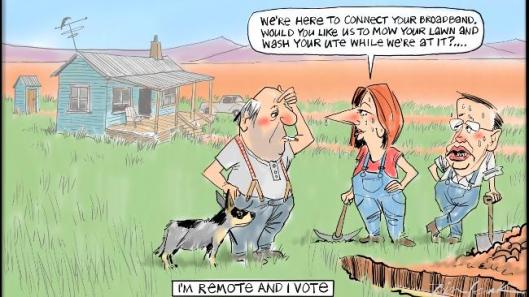
Rural telecommunications service is often inferior in speed and quality to what is available in urban areas. This is one basis of the so-called “digital divide” in the U.S., the gaps that exist between various groups in terms of access to broadband telecom service. The urban rural “divide” is actually much smaller than the gaps that exist within urban areas, but much of the attention in public policy debates seems to focus on rural broadband availability. Telecom infrastructure is far more expensive to provide in the hinterlands due to the distances and occasional natural barriers that must be traversed. This was true before the revolution in wireless technology and still is, though wireless has reduced the severity of the tradeoff. Given the cost differential, it strikes me as unreasonable for rural users to expect the same levels of service at the same cost as urbanites. They can either pay the higher cost of provision to receive high-end service, make do with service levels that can be delivered at rates they are willing to pay, or go without. Or, if a high level of service is critical and the user is unwilling to pay the cost, they can move to a place at which it is available at lower cost.
For many years, however, public policy has been premised on the notion that rural telecom users deserve subsidies from the general user population, or from taxpayers, in order to promote equal access to basic telephony and, more recently, broadband access. The Universal Service Fund, to which telecom users pay a fee on their bills every month, is based on this premise. Its extension to broadband is a classic example of first-world luxury made necessity, now asserted to be an obligation owed by society to every individual. It is the philosophical underpinning for a huge allocation of federal funds for rural telecom spending that is now expected as part of President Trump’s infrastructure plan.
Broadband Availability
The quality of telecom service includes speed and other factors (such as latency, which refers to data delays). Here, I’ll confine the discussion to the speed at which data can be downloaded (upload speeds are always a bit slower). Minimum speeds of 5 – 8 Mbps are required to stream HD video, according to the FCC. Higher speeds are necessary for heavy users with several devices or “running more than one high-demand application at the same time.”
Broadband speeds vary tremendously across the U.S., but it’s important to remember that speeds are increasing dramatically over time. Small towns are undoubtedly concentrated at the lower end of the distribution of speed availability at any point in time. Today, the gap between the availability of speeds in urban and rural areas is minimal up to about 10 Mbps, but it widens above that level. In fact, the speeds available via certain wireline technologies can vary significantly even within one small town (to say nothing of the significant variation within urban areas). Away from town, the availability of wireline broadband is much more limited. Fixed wireless broadband service (point-to-point) can often be deployed at speeds comparable to wireline service, and those speeds and their availability will increase with the rollout of new (5G) wireless technology. Still, that might not be an option in many isolated communities and remote locales without additional facilities like relay stations. Satellite service is often available at speeds up to 25 Mbps, in-town or out, but like wireless, it has some reliability issues.
Nevertheless, to one degree or another, broadband service is often available in rural areas, or can be available if customers are open to a range of alternative technologies (and again, available speeds are increasing). Obviously, some technologies are better suited to reaching particular areas, depending on distances and terrain. Many rural communities are finding affordable solutions that combine technologies that best leverage existing infrastructure and the natural features of the landscape.
Alms or Unfettered Choice
A reality of life in a hard-to-serve location is that broadband service will be costly… for someone. Enter the interventionists, who view “rurals” with paternalistic sympathy. Rural customers, and certain solutions for broadband delivery discussed above, are already subsidized by the federal government in some instances. And again, the Trump Administration is ready to throw more federal money at rural telecom infrastructure. These subsidies are questionable from a public finance perspective because they presume that rural areas are “underserved” on a cost-benefit basis, a case that is often dubious.
The biggest rub is that most people who live in rural areas do so by choice, a point recently articulated by Nick Gillespie. He recounts the experiences of his ancestors, who came from poor European villages to America to seek a better life. By comparison, today’s American rural population is highly privileged. Few are mired in circumstances beyond their control, contrary to the popular view. Gillespie notes that rural median income is only about 3.5% less than urban income (including suburbs), while rural homeownership rates are higher and poverty rates are lower than in urban areas. Indeed, it’s no secret that many urban elites purchase rural property to escape congested city life. Those are some of the would-be recipients of federally-funded rural broadband infrastructure.
In the end, Americans tend to live where they do by choice. Alternatives not acted upon generally reveal a preference for staying put. Some people prefer the amenities of small town or country life for any number of reasons, including a generally low cost of living. They accept the disadvantages of a rural life such as the lack of proximity to advanced emergency treatment facilities and, at least historically, less connectedness to media. Obviously, city dwellers tend to prefer urban amenities and accept the disadvantages of city or suburban life, like congestion. Those who wish to move from country to city, or vice versa, are free to do so, but they must pay the cost of the move. Likewise, it’s reasonable to expect that those desiring to transform the amenities of a place to their liking should pay the cost. Bringing almost any form of broadband infrastructure to areas with low population density is a costly proposition, but today’s rural consumers have more choices than ever before, and the speed and quality of broadband will continue to improve there without federal intervention.
Rural vs. Urban Adoption Gaps
The rural population is older on average, and it is less educated on average, so rural adoption rates are always likely to be lower. This point has been emphasized by Brian Whitacre, who has stated that the urban-rural “digital divide” might always exist to some extent. But this phenomenon is not unique to rural areas. Adoption rates within urban areas are highly variable, and the intra-urban broadband gaps by race, age, and income dwarf the urban-rural gap. That too is unlikely to change any time soon.
Federal Cash for Cronies & Conferees
Last year, FCC Commissioner Michael O’Reilly warned of the dangers of direct federal involvement in broadband infrastructure investment. These include the market distortions caused by picking winners and losers among providers based on non-market assessments, the graft that such a process invites, discrimination in favor of high-cost fiber technology, poor coordination across government bureaucracies, and insufficient oversight leading to chronic overpayments. Sadly, however, even Ajit Pai, Chairman of the FCC and a man whose opposition to network neutrality I have applauded, has proposed more federal spending on rural telecom infrastructure. The big telecom recipients of the buildout funds don’t mind the subsidies, of course. The rural recipients of new services at artificially low cost can’t mind too much. But federal taxpayers and broadband ratepayers should question this activity. I’m hopeful that there will be a silver lining: it is likely to be private infrastructure.


 Sacred Cow Chips