• About

Sacred Cow Chips

Sacred Cow Chips

Tag Archives: FDIC

A Social Security “Private Option” and Federal Debt

03 Tuesday Dec 2024

Posted by Nuetzel in Privatization, Social Security

≈ Leave a comment

Tags

Donald Trump, FDIC, Federal Debt, FICA, Fiscal Theory of Price Level, Government Budget Constraint, Insolvency, John Cochrane, Medicare, Penn-Wharton Budget Model, Ponzi Scheme, Primary Surplus, Private Option, Privatization, Social Security, Trust Funds, Unbanked Households
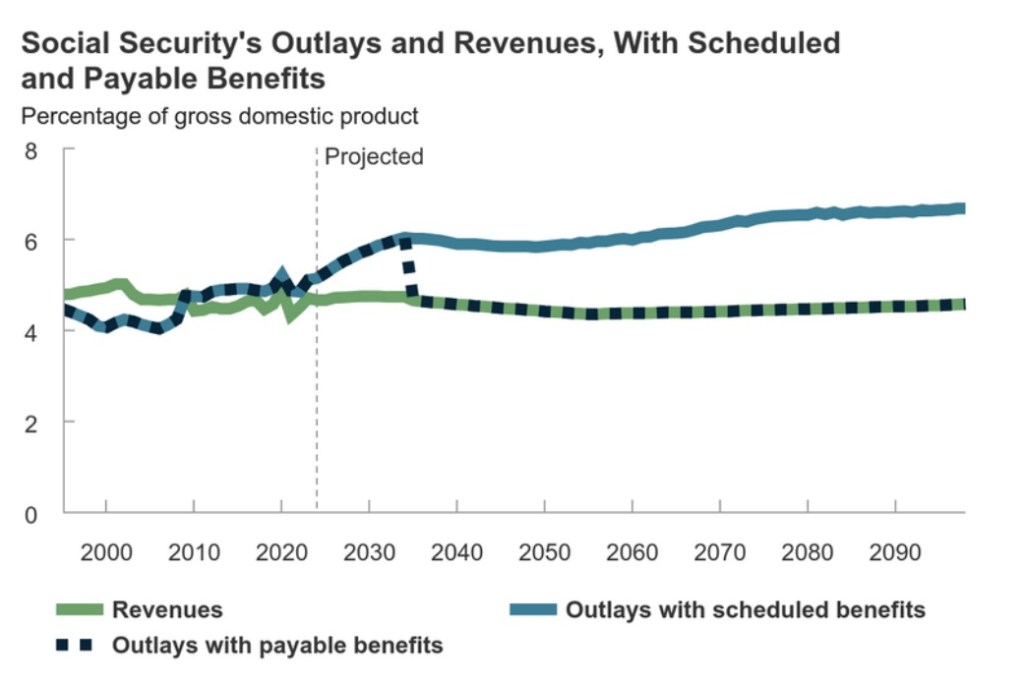
Social Security wasn’t designed as a true saving vehicle for workers. Instead, SS has always been a pay-as-you-go system under which current benefits are funded by the payroll taxes levied on the current employed population. In fact, many Americans earn lousy effective returns on their tax “contributions” (also see here), though low-income individuals do much better than those near or above the median income. Worst of all, under pay-as-you-go, the system can collapse like a Ponzi scheme when the number of workers shrinks drastically relative to the retired population, leading to the kind of situation we face today.

Unfunded Obligations

Payroll tax revenue is no longer adequate to pay for current Social Security and Medicare benefits, and the problem is huge: according to the Penn-Wharton Budget Model, the unfunded obligations of Social Security (including old age, survivorship and disability) through 2095 have a present value of $18.1 trillion in constant 2024 dollars (using a discount rate of 4.4%). The comparable figure for Medicare Part A is $18.6 trillion. Together these amount to more than the current national debt.

Barring earlier reform, the Social Security Trust Fund is expected to be exhausted in 2033 (excluding the disability fund). At that point, a 20% reduction in benefits will be required by law. (More on the trust fund below.)

What To Do?

The most prominent reform proposals involve reduced benefits for wealthy beneficiaries, increased payroll taxes on high earners, and an increase in the retirement age. However, President-Elect Donald Trump shows no inclination to make any changes on his watch. This is unfortunate because the sooner the system’s insolvency is addressed, the less draconian the necessary reforms will be.

A neglected reform idea is for SS to be privatized. Many observers agree in principle that current workers could earn better returns over the long-term by investing funds in a conservative mix of equities and bonds. The transition to private accounts could be made voluntary, so that no one is forced to give up the benefits to which they’re “entitled”.

Takers would receive an initial deposit from the government in a tax-deferred account. For participating pre-retirees, ongoing FICA contributions (in whole or in part) would be deposited into their private accounts. They could purchase a private annuity with the balance at retirement if they choose. The income tax treatment of annuity payments or distributions could mimic the current tax treatment of SS benefits.

Given that the balance remaining at death would be heritable, some individuals might be willing to accept an initial deposit less than the actuarial PV of the future SS benefits they’ve accumulated to-date (discounted at an internal rate of return equating future benefits “earned” to-date and contributions to-date). I also believe many individuals would willingly accept a lower initial deposit because they would gain some control over investment direction. Such voluntarily-accepted reductions in initial deposits to personal accounts would mean the government’s issue of new debt would be smaller than the decrease in future benefit obligations.

Nevertheless, funding the accounts at the time of transition would necessitate a huge and immediate increase in federal debt. Market participants and political interests are likely to fear an impossible strain on the credit market. Perhaps the transition could be staged over time to make it less “shocking”, but that would complicate matters. In any case, heavy debt issuance is the rub that dissuades most observers from supporting privatization.

Fiscal Theory of Price Level

The fiscal theory of the price level (FTPL) implies that such a privatization might not be an insurmountable challenge after all, at least in terms of comparative dynamics. Much background on FTPL can be found at John Cochrane’s Grumpy Economist Substack.

FTPL asserts that fiscal policy can influence the price level due to a constraint on the market value of government debt. This market value must be in balance with the expected stream of future government primary surpluses. This is known as the government budget constraint.

The primary surplus excludes the government’s interest expense, a budget component that must be paid out of the primary surplus or else borrowed. Of course, the market value of government debt incorporates the discounted value of future interest payments.

This budget constraint must be true in an expectational sense. That is, the market must be convinced that future surpluses will be adequate to pay all future obligations associated with the debt. Otherwise, the value of the debt must change.

Should a spending initiative require the government to issue new debt with no credible offset in terms of future surpluses, the market value of the debt must decline. That means interest rates and/or the price level must rise. If interest rates are fixed by the monetary authority (the Fed) then only prices will rise.

A SS Private Option Under FTPL

But what about FTPL in the context of entitlement reform, specifically a privatization of Social Security? Suppose the government issues debt and then deposits the proceeds into personal accounts to fund future benefits. Future government surpluses (deficits) would increase (decrease) by the reduction in future SS benefit payments.

This improved budgetary position should be highly credible to financial markets, despite the fact that benefits are not and never have been guaranteed. If it is credible to markets, the new debt would not raise prices, nor would it be valued differently than existing debt. There need not be any change in interest rates.

But Thin Ice

There are risks, of course. It might be too much to hope that other federal spending can be restrained. That kind of failure would subvert the rationale for any budgetary reform. A variety of other crises and economic shocks are also possible. Those could disrupt markets and jeopardize budget discipline as well. Given a severe shock, interest expense could more readily explode given the massive debt issuance required by the reform discussed here. So there are big risks, but one might ask whether they could turn out to be more disastrous in the absence of reform.

Other Details

The private account “offers” extended to workers or beneficiaries relative to the actuarial PVs of their future benefits would be controversial. Different offer percentages (discounts) could be tested to guage uptake.

Another issue: provisions would have to be made for individuals in “unbanked” households, estimated by the FDIC to be about 4.2% of all U.S. households in 2023. Voluntary uptake of the “offer” is likely to be lower among the unbanked and among those having less confidence in their ability to make financial decisions. However, even a simplified set of choices might be superior to the returns under today’s SS, even for low-income workers, not to mention the very real threat of future reductions in benefits. Furthermore, financial institutions might compete for new accounts in part by offering some level of financial education for new clients.

A similar reform could be applied to Medicare, which like SS is also technically insolvent. Participating beneficiaries could receive some proportion of expected future benefits in a private account, which they could use to pay for private or public health insurance coverage or medical expenses. From a budget perspective, the increase in federal debt would be balanced against the reduction in future Medicare benefits, which would constitute a credible increase (decrease) in future surpluses (deficits).

Credibility

But again, how credible would markets find the decrease in benefit obligations? Direct reductions in future entitlements should be convincing, though politicians are likely to find plenty of other ways to use the savings.

On the other hand, markets already give some weight to the possibility of future benefit cuts (or other policies that would reduce SS shortfalls). So it’s likely that markets will give the reform’s favorable budget implications significant but only “incremental credit”.

Another possible complication is that the market, prior to execution of the reform, might discount the uptake by workers and current retirees. This would necessitate better offers to improve uptake and more debt issuance for a given reduction in future obligations. Skepticism along these lines might worsen implications for the price level and interest rates.

The Trust Fund

Finally, what about the SS Trust Fund? Can it play in role in the reform discussed above? The answer depends on how the trust fund fits into the federal government’s budgetary position.

The trust fund holds as assets only non-marketable Treasury securities acquired in the past when SS contributions exceeded benefit payments. The excess payroll tax revenue was placed in the trust fund, which in turn lent the funds to the federal government to help meet other budgetary needs. Hence the bond holdings.

In terms of the government’s fiscal position, the money has already been pissed away, as it were. The bonds in the trust fund do not represent a pot of money. As noted above, with our age demographics now reversed, payroll taxes no longer meet benefits. Thus, bonds in the trust fund must be redeemed to pay all SS obligations. The Treasury must pay off the bonds via general revenue or by borrowing additional amounts from the public.

Post-reform, if continuing deficits are the order of the day, redeeming bonds in the trust fund would do nothing to improve the government’s fiscal position. If the trust fund “cashes them in” to help meet benefit payments, the federal government must borrow to raise that cash. In other words, the bonds in the trust fund would be more or less superfluous.

But what if the federal budget swings into a surplus position post-reform? In that case, federal tax revenue would cover the redemption of at least some of the bonds held by the trust fund. SS beneficiaries would then have a meaningful claim on federal taxpayers through the trust fund and the government’s surplus position, which would reduce the new federal debt required by the reform.

Conclusion

The Social Security and Medicare systems are in desperate need reform, but there is little momentum for any such undertaking. Meanwhile, exhaustion of the SS and Medicare trust funds creeps ever closer, along with required benefit cuts. All of the reform options would be painful in one way or another. A voluntary privatization would require a huge makeover, but it might be the least painful option of all. Current workers and beneficiaries would not be compelled to make choices they found inferior. Moreover, the new debt necessary to pay for the reforms would be matched by a reduction in future government obligations. The fiscal theory of the price level implies that the reform would not be inflationary and need not depress the value of Treasury bonds, provided the reform is accompanied by long-term budget discipline.

~~~~~~~~~~~~~~~~~~~~~~~~~~~~~~~~~~~

Note: the chart at the top of this post was produced by the Congressional Budget Office and appears in this publication.
Bankers, Risk and the Rents of Slippery Skin

12 Monday Mar 2018

Posted by Nuetzel in Banking, rent seeking

≈ Leave a comment

Tags

Deposit Insurance, Fannie Mae. Freddie Mac, Fat Tails, FDIC, Fractional Reserves, Frank Hollenbeck, GSEs, Guatam Mukunda, Gvernment Sponsored Enterprises, Irving Fisher, It's a Wonderful Life, John Cochrane, Laurence Kotlikoff, Milton Friedman, Nassim Taleb, Ralph Musgrave, rent seeking, Skin in the Game, Too big to fail

Risk taking is important to the economic success of a nation. Creative energy demands it, and it is critical to achieving economic growth and wealth creation. But it’s obviously possible to take too much risk or risks that are ill-considered, and that is all the more likely when risk-takers are absolved of the consequences of their actions. That is, healthy risk-taking and responsibility are inextricably linked. One can’t truly be said to take a risk if the cost of failure is borne by another party. It’s easy to understand why risk-taking becomes excessive or misdirected when that is the case.

Risk Shifting

There are various ways in which a party can parlay risky undertakings into easy gains by shifting the risks to others. For example, any piece of merchandise comes with the risk that it will not perform as advertised. Some traders might be tempted to sell unreliable merchandise and shift risk to the buyer without recourse. This is an area in which we must rely on a bulwark of private governance: caveat emptor. On the other hand, government tends to subsidize risk-taking in various ways: limited liability under the corporate form of business organization, bank deposit insurance, bankruptcy laws, the implicit government guarantee on mortgage assets, and the “too-big-to-fail” mentality of government bailouts.

Whose Skin In the Game?

These are examples of what Nassim Taleb bemoans as the failure to have “skin in the game”. The quoted expression happens to be the title of his new book. I have both praised and castigated Taleb’s work in the past. He made an interesting contribution about the nature and risk of extreme events in his book “Black Swan”, such as his application of so-called “fat tails” in probability distributions, though some have claimed the ideas were anything but original. I was highly critical of Taleb’s alarmist hyperbole on the effects of GMOs. In the present case, however, he considers “the asymmetry of risk bearing” to be a major social problem, and I’m generally in agreement with the point. The most interesting part of the brief discussion at the link is the following:

“In Taleb’s universe, the fieriest circle of hell is reserved for bankers and neoconservatives. ‘The best thing that could happen to society is the bankruptcy of Goldman Sachs,’ he tells me. ‘Banking is rent-seeking of industrial proportions.’ Taleb, who became rich as a derivatives trader, is not a foe of capitalism but of ‘cronyism’. ‘If you’re taking risks, God bless you. This is why I accept inequality. I’ve seen people go from trader to cab driver and back again.’“

Banks are a prominent example of the risk-shifting phenomenon. First of all, banking institutions are not required to hold much capital against their assets. In fact, recently banks have had average equity of less than 6% of assets. That’s much higher than during the financial crisis of ten years ago, but it is still rather thin and hardly represents much “skin in the game”.

Fractional Reserves

It should come as no surprise that a bank’s assets are funded largely by account balances held by depositors (liabilities), and not by equity capital. But your bank balance is not kept as cash in the vault. Instead, it is loaned out to the bank’s credit clients or used to purchase securities. This is facilitated by “fractional reserve banking”, whereby banks need only keep a fraction of their depositors’ money on hand as cash (or in their own reserve deposit accounts with the Federal Reserve). This generally works well on a day-to-day basis because depositors seldom ask to redeem more than a small fraction of their money on a given day.

Reserve requirements are set by the Federal Reserve and range from 0-10%, depending on the size of a banks’ deposit account balances. At the upper figure, a dollar of new cash deposits would allow a bank to extend new loans of up to $0.90. This legal practice divides many in the economics profession. Some believe it represents fraud rather than sound banking. This article by Frank Hollenbeck at the Mises Canada web site states that it is improper for a bank to lend a depositor’s money to others:

“Suppose you lived in the 18th century and had 100 ounces of gold. It’s heavy and you do not live in a safe neighborhood, so you decide to bring it to a goldsmith for safekeeping. In exchange for this gold, the goldsmith gives you ten tickets where eachis clearly marked as claims against 10 ounces. …

… Quickly the goldsmith realizes there is an easy, fraudulent, way to get rich: just lend out the gold to someone else by creating another 10 tickets. Since the tickets are rarelyredeemed, the goldsmith figures he can run this scam for a very long time. Of course, it is not his gold, but since it is in his vault, he can act as though it is his money to use. This is fractional reserve banking with a voluntary reserve requirement of 50%. Today, modern US banks have a reserve requirement of between 0% and 10%. This is also how the banking systemcan create money out of thin air, or basically counterfeit money, and steal the purchasing power from others without actually having to produce real goods and services.”

Another aspect of the argument against fractional reserves is that it creates economic instability, fueling booms and busts as the quantity of money in circulation sometimes exceeds or falls short of the needs of the public. Many authorities have taken a negative view of fractional reserve banking through the years: Irving Fisher, Milton Friedman, John Cochrane, Ralph Musgrave, and Laurence Kotlikoff, to name a few prominent economists (see this recent paper by Musgrave).

In Defense of Fractional Reserves

Others have defended fractional reserves as a practice that has and would again arise in a free market environment. According to this view, depositors would accept the logic of allowing banks to lend a portion of the funds in their accounts in order to generate income, rather than charging larger fees for “storage” and administration. If the depositing public is aware of the risk and has competing choices among banks, then the argument that banks expose depositors to excessive risk via fractional reserves is moot. Fractional reserves can exist in a private money economy in which competitive pressures reward banks (and their privately circulating notes) having sound lending practices. In fact, some would say that the very idea of a 100% reserve requirement is an unacceptable government intrusion into the private relationship between banks and their customers. All of that is true.

Some have compared fractional reserve banking to the sale of insurance. Consumers buy insurance to take advantage of pooled risk, but they have no expectation of a refund unless they incur the kind of insured loss in question. Bank depositors, on the other hand, expect a return of their funds in-full. Yes, low risk is an attribute they desire, and pooling across the withdrawal needs of many depositors is one reason why banks can invest and pass a part of the return on to depositors, both in interest and reduced fees. So, despite the differing needs and expectations of their customers, there is some validity to the comparison of insurers to fractional-reserve bankers.

Amplification of Shifted Risks

Do fractional reserves allow banks to take risks without having skin in the game? Absolutely! With as little as 6% equity at risk, banks have relatively little to lose relative to depositors. Yes, banks pay the FDIC to insure deposits, and premiums are higher for riskier banks. However, not all deposits are insured by the FDIC. More importantly, at the end of 2017, the entire FDIC deposit insurance fund was about 0.7% of commercial bank assets. One big bank failure would wipe it out, or a few hundred small ones. That’s well within the realm of possibility and historical experience. So, where does that leave depositors? Their skin is very much in the game, and the game is about the risks taken by banks in investing depositors’ funds.

We now live in the era of “too-big-to-fail” (TBTF), whereby large banks (and sometimes industrial firms) are viewed as so “systemically important” that they cannot be allowed to fail. Taxpayers must bail them out in the event they become insolvent. Thus, taxpayers have skin in the game. Banks collect rents to the extent that their returns exceed those commensurate with the risks for which they are actually “on the hook”.

Another avenue through which banks off-load risk is the extent to which Fannie Mae and Freddie Mac are still presumed to have the federal government’s implicit guarantee against default on the mortgage debt they purchase from banks. That is beyond the scope of the present discussion, however. And I have not discussed the role of large investment banks in the capital markets. That’s a whole other dimension of the story. This article by Guatam Mukunda in the Harvard Business Review provides a perspective on rent seeking in investment banking.

Conclusion

The combination of deposit insurance, TBTF and other risk-insulating subsidies, layered on top of a fractional reserve banking system, places banks into Taleb’s “fieriest circle of hell”. These factors blunt bank incentives to manage risk effectively as well as consumer incentives to conduct adequate due diligence in their banking relationships. It means that risk is not priced properly, because banks are likely to ignore risks from which they are shielded. Therefore, banks may allocate resources into excessively risky uses. The consequences for depositors and taxpayers can be dramatic.

Fractional reserves are not “fraud” in the sense that the system has unsuspecting victims. Anyone who has watched “It’s a Wonderful Life” knows that banks lend your deposits to others. But fractional reserves magnify the risk-mitigating privileges conferred upon the banking industry by government through various mechanisms. This “risk-cleansing” is converted to rents and collected by banks for their shareholders, but the risks are still borne by society. To the extent that fractional reserves create instability, deposit insurance is viewed as a necessity, but banks should pay a market premium to an insurer to cover the actual risk inherent in the system. Too-big-to-fail should end, as should the implicit subsidy collected by banks through the government-sponsored enterprises.

Follow Sacred Cow Chips on WordPress.com

Recent Posts

  • The Case Against Interest On Reserves
  • Immigration and Merit As Fiscal Propositions
  • Tariff “Dividend” From An Indigent State
  • Almost Looks Like the Fed Has a 3% Inflation Target
  • Government Malpractice Breeds Health Care Havoc

Archives

  • January 2026
  • December 2025
  • November 2025
  • October 2025
  • September 2025
  • August 2025
  • July 2025
  • June 2025
  • May 2025
  • April 2025
  • March 2025
  • February 2025
  • January 2025
  • December 2024
  • November 2024
  • October 2024
  • September 2024
  • August 2024
  • July 2024
  • June 2024
  • May 2024
  • April 2024
  • March 2024
  • February 2024
  • January 2024
  • December 2023
  • November 2023
  • August 2023
  • July 2023
  • June 2023
  • May 2023
  • April 2023
  • March 2023
  • February 2023
  • January 2023
  • December 2022
  • November 2022
  • October 2022
  • September 2022
  • August 2022
  • July 2022
  • June 2022
  • May 2022
  • April 2022
  • March 2022
  • February 2022
  • January 2022
  • December 2021
  • November 2021
  • October 2021
  • September 2021
  • August 2021
  • July 2021
  • June 2021
  • May 2021
  • April 2021
  • March 2021
  • February 2021
  • January 2021
  • December 2020
  • November 2020
  • October 2020
  • September 2020
  • August 2020
  • July 2020
  • June 2020
  • May 2020
  • April 2020
  • March 2020
  • February 2020
  • January 2020
  • December 2019
  • November 2019
  • October 2019
  • September 2019
  • August 2019
  • July 2019
  • June 2019
  • May 2019
  • April 2019
  • March 2019
  • February 2019
  • January 2019
  • December 2018
  • November 2018
  • October 2018
  • September 2018
  • August 2018
  • July 2018
  • June 2018
  • May 2018
  • April 2018
  • March 2018
  • February 2018
  • January 2018
  • December 2017
  • November 2017
  • October 2017
  • September 2017
  • August 2017
  • July 2017
  • June 2017
  • May 2017
  • April 2017
  • March 2017
  • February 2017
  • January 2017
  • December 2016
  • November 2016
  • October 2016
  • September 2016
  • August 2016
  • July 2016
  • June 2016
  • May 2016
  • April 2016
  • March 2016
  • February 2016
  • January 2016
  • December 2015
  • November 2015
  • October 2015
  • September 2015
  • August 2015
  • July 2015
  • June 2015
  • May 2015
  • April 2015
  • March 2015
  • February 2015
  • January 2015
  • December 2014
  • November 2014
  • October 2014
  • September 2014
  • August 2014
  • July 2014
  • June 2014
  • May 2014
  • April 2014
  • March 2014

Blogs I Follow

  • Passive Income Kickstart
  • OnlyFinance.net
  • TLC Cholesterol
  • Nintil
  • kendunning.net
  • DCWhispers.com
  • Hoong-Wai in the UK
  • Marginal REVOLUTION
  • Stlouis
  • Watts Up With That?
  • Aussie Nationalist Blog
  • American Elephants
  • The View from Alexandria
  • The Gymnasium
  • A Force for Good
  • Notes On Liberty
  • troymo
  • SUNDAY BLOG Stephanie Sievers
  • Miss Lou Acquiring Lore
  • Your Well Wisher Program
  • Objectivism In Depth
  • RobotEnomics
  • Orderstatistic
  • Paradigm Library
  • Scattered Showers and Quicksand

Blog at WordPress.com.

Passive Income Kickstart

OnlyFinance.net

TLC Cholesterol

Nintil

To estimate, compare, distinguish, discuss, and trace to its principal sources everything

kendunning.net

The Future is Ours to Create

DCWhispers.com

Hoong-Wai in the UK

A Commonwealth immigrant's perspective on the UK's public arena.

Marginal REVOLUTION

Small Steps Toward A Much Better World

Stlouis

Watts Up With That?

The world's most viewed site on global warming and climate change

Aussie Nationalist Blog

Commentary from a Paleoconservative and Nationalist perspective

American Elephants

Defending Life, Liberty and the Pursuit of Happiness

The View from Alexandria

In advanced civilizations the period loosely called Alexandrian is usually associated with flexible morals, perfunctory religion, populist standards and cosmopolitan tastes, feminism, exotic cults, and the rapid turnover of high and low fads---in short, a falling away (which is all that decadence means) from the strictness of traditional rules, embodied in character and inforced from within. -- Jacques Barzun

The Gymnasium

A place for reason, politics, economics, and faith steeped in the classical liberal tradition

A Force for Good

How economics, morality, and markets combine

Notes On Liberty

Spontaneous thoughts on a humble creed

troymo

SUNDAY BLOG Stephanie Sievers

Escaping the everyday life with photographs from my travels

Miss Lou Acquiring Lore

Gallery of Life...

Your Well Wisher Program

Attempt to solve commonly known problems…

Objectivism In Depth

Exploring Ayn Rand's revolutionary philosophy.

RobotEnomics

(A)n (I)ntelligent Future

Orderstatistic

Economics, chess and anything else on my mind.

Paradigm Library

OODA Looping

Scattered Showers and Quicksand

Musings on science, investing, finance, economics, politics, and probably fly fishing.

  • Subscribe Subscribed
    • Sacred Cow Chips
    • Join 128 other subscribers
    • Already have a WordPress.com account? Log in now.
    • Sacred Cow Chips
    • Subscribe Subscribed
    • Sign up
    • Log in
    • Report this content
    • View site in Reader
    • Manage subscriptions
    • Collapse this bar
 

Loading Comments...