• About

Sacred Cow Chips

Sacred Cow Chips

Tag Archives: Government Budget Constraint

Funding Private Social Security Accounts

02 Sunday Aug 2026

Posted by Nuetzel in Privatization, Social Security

≈ Leave a comment

Tags

Cash Offer, CATO Institute, COLA Indexing, Covid-19, David Beckworth, Donald Trump, Equity Returns, Eric Leeper, FICA Taxes, Fiscal Theory of Price Level, Francesco Bianchi, Government Budget Constraint, Heritability, John Cochrane, Means Testing, Michael Woodford, NBER, Old Age and Survivors Insuurance, Privatization, Sebastian Merkel, Social Security Administration, Spousal Benefits, TrumpIRA, Trust Fund

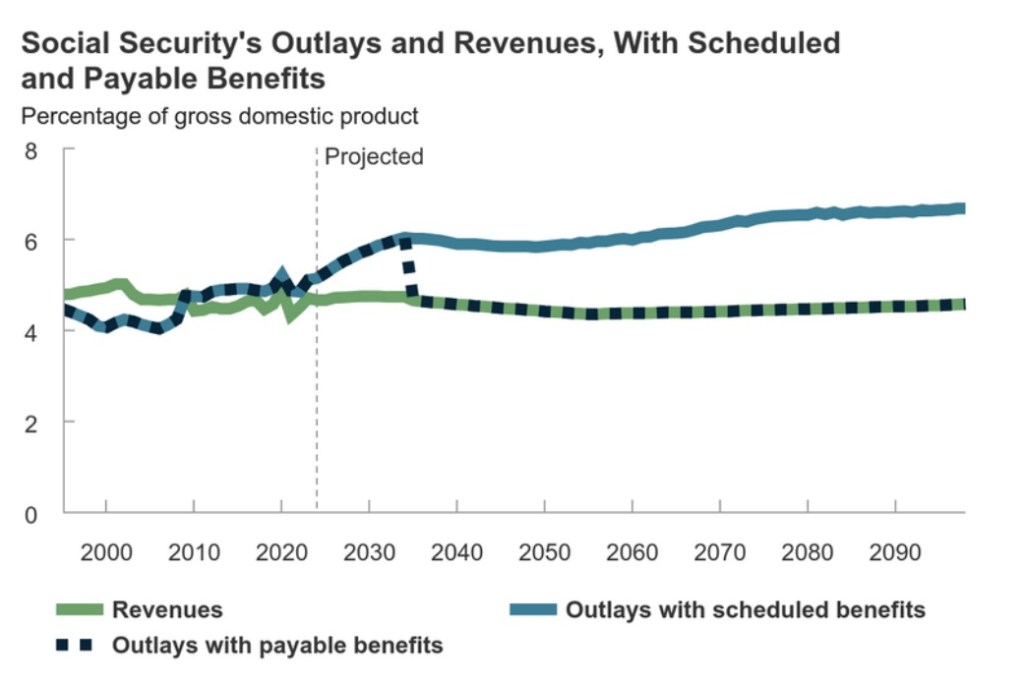
The 2026 report of the Board of Trustees of the Social Security Administration (SSA) says the retirement system’s official insolvency’s will occur in 2032Q4. This is the time at which the Old Age and Survivors Insurance (OASI) trust fund will be depleted, and it is a year earlier than SSA last projected. The disability income (DI) trust fund will last until 2034. The chart at the top combines the OASI and DI programs, so it shows a slightly later overall insolvency than OASI alone. Likewise, the theoretical benefit cuts shown in the chart are at the time of the combined insolvency, and they differ from mandated reductions in retirement benefits alone (22%).

Of course, the OASI and DI trust funds don’t really hold true “assets” for the federal government. Holdings consist of government bonds, which the SSA redeems with the Treasury Department to meet benefit obligations. In turn, Treasury must sell new bonds (borrow) to cover the SSA’s redemption. So the trust funds really only constitute additional Treasury “borrowing authority” on behalf of SSA.

Do Something!

Again, by law, depletion of the OASI trust fund will trigger an automatic 22% reduction in benefits. Needless to say, no one wants to see that happen, but no one wants to face up to the problem through reforms, either. Still, the issue will have to be confronted soon enough. By then, of course, President Trump will be off the hook. However, it would certainly be better to get the ball rolling sooner rather than later. An earlier fix would probably require somewhat less draconian reforms. It also would avoid a last-minute, heated political debate, the outcome of which is likely to be a bad policy choice.

Here’s a good summary of possible reforms from the CATO Institute. These options could shore-up the social security system. They span raising the retirement age, tax increases, cuts to benefits/spousal benefits, adjusted benefit “bend points”, adjustments to COLA indexing, means testing, and even flat benefit levels. But even CATO doesn’t broach the topic of the deeper reform required by privatization or even self-directed investment choices.

Make Me An Offer

In this section I discuss the potential willingness of current and future beneficiaries to accept a lump sum cash offer. I’ll defer discussion of how those cash offers might be funded until a section below. In late 2024, I argued that many future beneficiaries would willingly accept a cash deposit today, all tax-deferred, of less than the actuarial value of their future benefits earned to-date (as calculated by SSA):

“Given that the balance remaining at death would be heritable, some individuals might be willing to accept an initial deposit less than the actuarial PV of the future SS benefits they’ve accumulated to-date (discounted at an internal rate of return equating future benefits “earned” to-date and contributions to-date). I also believe many individuals would willingly accept a lower initial deposit because they would gain some control over investment direction.

There is a long history of economic research investigating the reasons for low demand for annuities (akin to OASI benefits). Control over investment direction brings the opportunity to earn greater returns on “contributions” (FICA payroll taxes). While equity returns have their ups and downs, they generally exceed the returns “earned” by workers on Social Security. It’s pretty much a given that most people investing in 401(k)s would rather have their savings there than governed by SSA benefit formulas!

How can such a discounted cash offer be estimated? The actuarial PV of benefits at an appropriate discount rate geared to equity returns would be straightforward to calculate. Alternatively, trials on sample populations of retirees and active workers could be used to gauge uptake at various discounts. Later, trial participants could be given the option to keep their choice, to opt into whatever structure is finally adopted, or to revert to traditional benefits. The cash offer would almost certainly be worth more to future retirees, who have more time to earn superior returns at lower risk, than to current retirees.

Realistic Offers

A discount averaging 22% is well within the range of possibility in the aggregate, which would match the benefit cuts due in 2032 barring reform. This NBER paper found that many participants would accept a lump-sum at a 25% discount from actuarial value, while this paper found that non-retirees value their future benefits at a discount of 30%.

It’s likely that a number of beneficiaries will decline the cash offer out of conservatism, fear, or ignorance. Perhaps some will opt-in over time. But all indications are, from the annuity research, that most future retirees would accept an offer. So too might a significant number of current retirees, perhaps early in their retirement years, or who might highly value a chance to leave a bequest, or who might fear that poor health will limit the value of taking traditional SS benefits.

How To Fund Up-Front Payments

The upshot is that the availability of such a cash option would sharply reduce future benefit outlays. The rub is that the cash must be funded up-front. It would represent a huge addition to the government’s current borrowing needs, which sounds like an insurmountable obstacle to the success of the initiative. The fear is that immediate pressure on capital markets and interest rates could create an economic upheaval the likes of which we’ve never seen. More than anything else, the funding problem has led many to dismiss the possibility of privatization.

There is, however, an alternative view: the very reduction in the flow of future benefit obligations makes the plan more than feasible. That is because, in present value terms, the value of the reduction in future benefits would exceed the immediate borrowing necessary to pay the cash offers.

This reasoning is based on the government’s long-term budget constraint, which forces equality between the real value of government debt outstanding and the real present value of expected future government surpluses. Capital markets must value government debt on that basis, lest the debt’s value must be justified by a fiction.

The long-term budget constraint is central to the fiscal theory of the price level (FTPL). John Cochrane has written extensively on FTPL, and its adherents range from Eric Leeper, Michael Woodford, Sebastian Merkel, Francesco Bianchi, and to some degree David Beckworth.

Under the government budget constraint, a large increase in borrowing unaccompanied by any increase in future surpluses must leave the real value of debt outstanding unchanged. This happens because the real amount of debt is inflated away sufficiently or revalued as interest rates are bid upward.

In the case of a Social Security cash offer at a discount from actuarial present value, immediate borrowing should be more than offset by reductions in future SS benefit obligations. If financial markets find the future benefit reductions credible, there should be no upward pressure on interest rates or the price level. In fact, perhaps the opposite.

Of course, all this assumes that politicians possess fiscal discipline. Assuming they understand the gain in the government’s fiscal position, they cannot rush to commit to new programs, spending initiatives, or tax cuts that would sop up the increase in future surpluses (reduction in future deficits).

Trump Accounts

The Trump Administration has assiduously avoided serious discussion of SS reform. Instead, never missing a chance to stamp the Trump brand everywhere, the president has championed a “new” saving vehicle called TrumpIRA. It allows private workers without an employer-sponsored savings plan to establish an IRA account through the TrumpIRA web site. Qualified savers who establish such an account will be eligible for a $1,000 government matching contribution. So Trump has found another way to commit taxpayer resources that do not exist. Given our ongoing massive fiscal imbalance, you’d think his economic team might clue him in on a key lever that should be employed to increase national savings: deficit reduction! Instead, he’s busy subsidizing TrumpIRAs, Trump Baby Bonds, and plowing billions into government stakes in private companies.

The SS system itself, as it now exists, represents a huge disincentive to save. Privatization would sweep away those bad incentives, especially if the private accounts could be used for additional savings beyond existing FICA “contributions”. And access to those additional amounts saved should be open at any time, subject to a normal tax on withdrawal.

Summary

My earlier post on this topic contains much more detail on a voluntary privatization plan for Social Security, including potential risks. This is the sort of initiative that should be under discussion in policy-making circles. Sadly, the Administration doesn’t see any advantage in addressing SS reform at all, and other parties have dismissed privatization as a fiscal boondoggle. However, a substantial reduction in future benefit obligations would be more than sufficient to offset the short-term borrowing needed to offer cash to fund heritable, self-directed, private accounts at a discount from the actuarial present value of future benefits.
A Social Security “Private Option” and Federal Debt

03 Tuesday Dec 2024

Posted by Nuetzel in Privatization, Social Security

≈ 1 Comment

Tags

Donald Trump, FDIC, Federal Debt, FICA, Fiscal Theory of Price Level, Government Budget Constraint, Insolvency, John Cochrane, Medicare, Penn-Wharton Budget Model, Ponzi Scheme, Primary Surplus, Private Option, Privatization, Social Security, Trust Funds, Unbanked Households

Social Security wasn’t designed as a true saving vehicle for workers. Instead, SS has always been a pay-as-you-go system under which current benefits are funded by the payroll taxes levied on the current employed population. In fact, many Americans earn lousy effective returns on their tax “contributions” (also see here), though low-income individuals do much better than those near or above the median income. Worst of all, under pay-as-you-go, the system can collapse like a Ponzi scheme when the number of workers shrinks drastically relative to the retired population, leading to the kind of situation we face today.

Unfunded Obligations

Payroll tax revenue is no longer adequate to pay for current Social Security and Medicare benefits, and the problem is huge: according to the Penn-Wharton Budget Model, the unfunded obligations of Social Security (including old age, survivorship and disability) through 2095 have a present value of $18.1 trillion in constant 2024 dollars (using a discount rate of 4.4%). The comparable figure for Medicare Part A is $18.6 trillion. Together these amount to more than the current national debt.

Barring earlier reform, the Social Security Trust Fund is expected to be exhausted in 2033 (excluding the disability fund). At that point, a 20% reduction in benefits will be required by law. (More on the trust fund below.)

What To Do?

The most prominent reform proposals involve reduced benefits for wealthy beneficiaries, increased payroll taxes on high earners, and an increase in the retirement age. However, President-Elect Donald Trump shows no inclination to make any changes on his watch. This is unfortunate because the sooner the system’s insolvency is addressed, the less draconian the necessary reforms will be.

A neglected reform idea is for SS to be privatized. Many observers agree in principle that current workers could earn better returns over the long-term by investing funds in a conservative mix of equities and bonds. The transition to private accounts could be made voluntary, so that no one is forced to give up the benefits to which they’re “entitled”.

Takers would receive an initial deposit from the government in a tax-deferred account. For participating pre-retirees, ongoing FICA contributions (in whole or in part) would be deposited into their private accounts. They could purchase a private annuity with the balance at retirement if they choose. The income tax treatment of annuity payments or distributions could mimic the current tax treatment of SS benefits.

Given that the balance remaining at death would be heritable, some individuals might be willing to accept an initial deposit less than the actuarial PV of the future SS benefits they’ve accumulated to-date (discounted at an internal rate of return equating future benefits “earned” to-date and contributions to-date). I also believe many individuals would willingly accept a lower initial deposit because they would gain some control over investment direction. Such voluntarily-accepted reductions in initial deposits to personal accounts would mean the government’s issue of new debt would be smaller than the decrease in future benefit obligations.

Nevertheless, funding the accounts at the time of transition would necessitate a huge and immediate increase in federal debt. Market participants and political interests are likely to fear an impossible strain on the credit market. Perhaps the transition could be staged over time to make it less “shocking”, but that would complicate matters. In any case, heavy debt issuance is the rub that dissuades most observers from supporting privatization.

Fiscal Theory of Price Level

The fiscal theory of the price level (FTPL) implies that such a privatization might not be an insurmountable challenge after all, at least in terms of comparative dynamics. Much background on FTPL can be found at John Cochrane’s Grumpy Economist Substack.

FTPL asserts that fiscal policy can influence the price level due to a constraint on the market value of government debt. This market value must be in balance with the expected stream of future government primary surpluses. This is known as the government budget constraint.

The primary surplus excludes the government’s interest expense, a budget component that must be paid out of the primary surplus or else borrowed. Of course, the market value of government debt incorporates the discounted value of future interest payments.

This budget constraint must be true in an expectational sense. That is, the market must be convinced that future surpluses will be adequate to pay all future obligations associated with the debt. Otherwise, the value of the debt must change.

Should a spending initiative require the government to issue new debt with no credible offset in terms of future surpluses, the market value of the debt must decline. That means interest rates and/or the price level must rise. If interest rates are fixed by the monetary authority (the Fed) then only prices will rise.

A SS Private Option Under FTPL

But what about FTPL in the context of entitlement reform, specifically a privatization of Social Security? Suppose the government issues debt and then deposits the proceeds into personal accounts to fund future benefits. Future government surpluses (deficits) would increase (decrease) by the reduction in future SS benefit payments.

This improved budgetary position should be highly credible to financial markets, despite the fact that benefits are not and never have been guaranteed. If it is credible to markets, the new debt would not raise prices, nor would it be valued differently than existing debt. There need not be any change in interest rates.

But Thin Ice

There are risks, of course. It might be too much to hope that other federal spending can be restrained. That kind of failure would subvert the rationale for any budgetary reform. A variety of other crises and economic shocks are also possible. Those could disrupt markets and jeopardize budget discipline as well. Given a severe shock, interest expense could more readily explode given the massive debt issuance required by the reform discussed here. So there are big risks, but one might ask whether they could turn out to be more disastrous in the absence of reform.

Other Details

The private account “offers” extended to workers or beneficiaries relative to the actuarial PVs of their future benefits would be controversial. Different offer percentages (discounts) could be tested to guage uptake.

Another issue: provisions would have to be made for individuals in “unbanked” households, estimated by the FDIC to be about 4.2% of all U.S. households in 2023. Voluntary uptake of the “offer” is likely to be lower among the unbanked and among those having less confidence in their ability to make financial decisions. However, even a simplified set of choices might be superior to the returns under today’s SS, even for low-income workers, not to mention the very real threat of future reductions in benefits. Furthermore, financial institutions might compete for new accounts in part by offering some level of financial education for new clients.

A similar reform could be applied to Medicare, which like SS is also technically insolvent. Participating beneficiaries could receive some proportion of expected future benefits in a private account, which they could use to pay for private or public health insurance coverage or medical expenses. From a budget perspective, the increase in federal debt would be balanced against the reduction in future Medicare benefits, which would constitute a credible increase (decrease) in future surpluses (deficits).

Credibility

But again, how credible would markets find the decrease in benefit obligations? Direct reductions in future entitlements should be convincing, though politicians are likely to find plenty of other ways to use the savings.

On the other hand, markets already give some weight to the possibility of future benefit cuts (or other policies that would reduce SS shortfalls). So it’s likely that markets will give the reform’s favorable budget implications significant but only “incremental credit”.

Another possible complication is that the market, prior to execution of the reform, might discount the uptake by workers and current retirees. This would necessitate better offers to improve uptake and more debt issuance for a given reduction in future obligations. Skepticism along these lines might worsen implications for the price level and interest rates.

The Trust Fund

Finally, what about the SS Trust Fund? Can it play in role in the reform discussed above? The answer depends on how the trust fund fits into the federal government’s budgetary position.

The trust fund holds as assets only non-marketable Treasury securities acquired in the past when SS contributions exceeded benefit payments. The excess payroll tax revenue was placed in the trust fund, which in turn lent the funds to the federal government to help meet other budgetary needs. Hence the bond holdings.

In terms of the government’s fiscal position, the money has already been pissed away, as it were. The bonds in the trust fund do not represent a pot of money. As noted above, with our age demographics now reversed, payroll taxes no longer meet benefits. Thus, bonds in the trust fund must be redeemed to pay all SS obligations. The Treasury must pay off the bonds via general revenue or by borrowing additional amounts from the public.

Post-reform, if continuing deficits are the order of the day, redeeming bonds in the trust fund would do nothing to improve the government’s fiscal position. If the trust fund “cashes them in” to help meet benefit payments, the federal government must borrow to raise that cash. In other words, the bonds in the trust fund would be more or less superfluous.

But what if the federal budget swings into a surplus position post-reform? In that case, federal tax revenue would cover the redemption of at least some of the bonds held by the trust fund. SS beneficiaries would then have a meaningful claim on federal taxpayers through the trust fund and the government’s surplus position, which would reduce the new federal debt required by the reform.

Conclusion

The Social Security and Medicare systems are in desperate need reform, but there is little momentum for any such undertaking. Meanwhile, exhaustion of the SS and Medicare trust funds creeps ever closer, along with required benefit cuts. All of the reform options would be painful in one way or another. A voluntary privatization would require a huge makeover, but it might be the least painful option of all. Current workers and beneficiaries would not be compelled to make choices they found inferior. Moreover, the new debt necessary to pay for the reforms would be matched by a reduction in future government obligations. The fiscal theory of the price level implies that the reform would not be inflationary and need not depress the value of Treasury bonds, provided the reform is accompanied by long-term budget discipline.

~~~~~~~~~~~~~~~~~~~~~~~~~~~~~~~~~~~

Note: the chart at the top of this post was produced by the Congressional Budget Office and appears in this publication.

Follow Sacred Cow Chips on WordPress.com

Recent Posts

  • Trial Lawyers Reveal Preference For Less Safety
  • Funding Private Social Security Accounts
  • Chinese State, CCP, Cronies Exploit Wage Earners
  • Some Dimensions Of the AI/Data Center Freakout
  • Warsh and Fed Confront a Crossroads On Policies

Archives

  • August 2026
  • July 2026
  • June 2026
  • May 2026
  • April 2026
  • March 2026
  • February 2026
  • January 2026
  • December 2025
  • November 2025
  • October 2025
  • September 2025
  • August 2025
  • July 2025
  • June 2025
  • May 2025
  • April 2025
  • March 2025
  • February 2025
  • January 2025
  • December 2024
  • November 2024
  • October 2024
  • September 2024
  • August 2024
  • July 2024
  • June 2024
  • May 2024
  • April 2024
  • March 2024
  • February 2024
  • January 2024
  • December 2023
  • November 2023
  • August 2023
  • July 2023
  • June 2023
  • May 2023
  • April 2023
  • March 2023
  • February 2023
  • January 2023
  • December 2022
  • November 2022
  • October 2022
  • September 2022
  • August 2022
  • July 2022
  • June 2022
  • May 2022
  • April 2022
  • March 2022
  • February 2022
  • January 2022
  • December 2021
  • November 2021
  • October 2021
  • September 2021
  • August 2021
  • July 2021
  • June 2021
  • May 2021
  • April 2021
  • March 2021
  • February 2021
  • January 2021
  • December 2020
  • November 2020
  • October 2020
  • September 2020
  • August 2020
  • July 2020
  • June 2020
  • May 2020
  • April 2020
  • March 2020
  • February 2020
  • January 2020
  • December 2019
  • November 2019
  • October 2019
  • September 2019
  • August 2019
  • July 2019
  • June 2019
  • May 2019
  • April 2019
  • March 2019
  • February 2019
  • January 2019
  • December 2018
  • November 2018
  • October 2018
  • September 2018
  • August 2018
  • July 2018
  • June 2018
  • May 2018
  • April 2018
  • March 2018
  • February 2018
  • January 2018
  • December 2017
  • November 2017
  • October 2017
  • September 2017
  • August 2017
  • July 2017
  • June 2017
  • May 2017
  • April 2017
  • March 2017
  • February 2017
  • January 2017
  • December 2016
  • November 2016
  • October 2016
  • September 2016
  • August 2016
  • July 2016
  • June 2016
  • May 2016
  • April 2016
  • March 2016
  • February 2016
  • January 2016
  • December 2015
  • November 2015
  • October 2015
  • September 2015
  • August 2015
  • July 2015
  • June 2015
  • May 2015
  • April 2015
  • March 2015
  • February 2015
  • January 2015
  • December 2014
  • November 2014
  • October 2014
  • September 2014
  • August 2014
  • July 2014
  • June 2014
  • May 2014
  • April 2014
  • March 2014

Blogs I Follow

  • Passive Income Kickstart
  • OnlyFinance.net
  • TLC Cholesterol
  • Nintil
  • kendunning.net
  • DCWhispers.com
  • Hoong-Wai in the UK
  • Marginal REVOLUTION
  • Stlouis
  • Watts Up With That?
  • American Elephants
  • The View from Alexandria
  • The Gymnasium
  • A Force for Good
  • Notes On Liberty
  • troymo
  • SUNDAY BLOG Stephanie Sievers
  • Miss Lou Acquiring Lore
  • Your Well Wisher Program
  • Objectivism In Depth
  • RobotEnomics
  • Orderstatistic
  • Paradigm Library
  • Scattered Showers and Quicksand
  • Jam Review

Blog at WordPress.com.

Passive Income Kickstart

OnlyFinance.net

TLC Cholesterol

Nintil

To estimate, compare, distinguish, discuss, and trace to its principal sources everything

kendunning.net

The Future is Ours to Create

DCWhispers.com

Hoong-Wai in the UK

A Commonwealth immigrant's perspective on the UK's public arena.

Marginal REVOLUTION

Small Steps Toward A Much Better World

Stlouis

Watts Up With That?

The world's most viewed site on global warming and climate change

American Elephants

Defending Life, Liberty and the Pursuit of Happiness

The View from Alexandria

In advanced civilizations the period loosely called Alexandrian is usually associated with flexible morals, perfunctory religion, populist standards and cosmopolitan tastes, feminism, exotic cults, and the rapid turnover of high and low fads---in short, a falling away (which is all that decadence means) from the strictness of traditional rules, embodied in character and inforced from within. -- Jacques Barzun

The Gymnasium

A place for reason, politics, economics, and faith steeped in the classical liberal tradition

A Force for Good

How economics, morality, and markets combine

Notes On Liberty

Spontaneous thoughts on a humble creed

troymo

SUNDAY BLOG Stephanie Sievers

Escaping the everyday life with photographs from my travels

Miss Lou Acquiring Lore

Gallery of Life...

Your Well Wisher Program

Attempt to solve commonly known problems…

Objectivism In Depth

Exploring Ayn Rand's revolutionary philosophy.

RobotEnomics

(A)n (I)ntelligent Future

Orderstatistic

Economics, chess and anything else on my mind.

Paradigm Library

OODA Looping

Scattered Showers and Quicksand

Musings on science, investing, finance, economics, politics, and probably fly fishing.

Jam Review

"If you get confused, listen to the music play."

  • Subscribe Subscribed
    • Sacred Cow Chips
    • Join 128 other subscribers
    • Already have a WordPress.com account? Log in now.
    • Sacred Cow Chips
    • Subscribe Subscribed
    • Sign up
    • Log in
    • Report this content
    • View site in Reader
    • Manage subscriptions
    • Collapse this bar
Loading Comments...