
Tags
ABC, Charlie Kirk, DEI, Eugene Volokh, First Amendment, Free Speech, Hate Speech, Jimmy Kimmel, Julie Borowsky, MAGA, Pickering v. Bd. of Education, Second Amendment, Trust

I just can’t express any sympathy for those fired from their jobs for publicly endorsing or “celebrating” the assassination of Charlie Kirk. Regardless of how you felt about Charlie Kirk’s words, he was a nonviolent public figure who did everything he could to engage peacefully with those who disagreed with his views. Praising his assassination is morally repugnant.
The fairness and even the legality of these dismissals has been called into question, however. As Eugene Volokh notes, the First Amendment offers protection “against criminal punishment, civil liability” for all speech unless it “is intended to and likely to cause imminent illegal conduct”. It does not protect the speaker from other consequences, however, such as continued employment or social ostracism. It goes without saying that this applies to both sides of any debate.
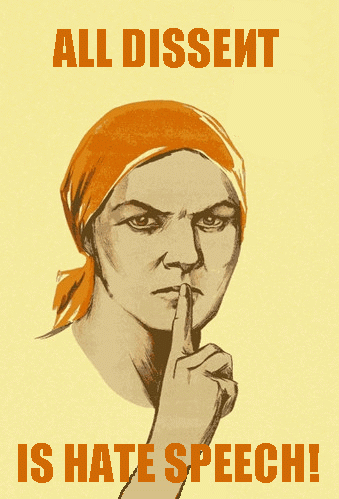
But job dismissals for expressing controversial opinions should not extend beyond issues likely to threaten the mission of the employing organization, including reputation and the well being of clients and other employees. Even more importantly, prosecution under so-called “hate speech” laws (a flawed construct) should not extend outside the bounds of the First Amendment, and should not be prosecuted selectively on political grounds.
One prominent action with which I’m not comfortable is the “indefinite” cancellation of Jimmy Kimmel, who (like others on the Left) thought it would be clever to make the absurd claim, during his late-night monologue, that Kirk’s assassin was one of the MAGA tribe. Kimmel did not “celebrate” the murder per se, but his statement was enough to get his show pulled, for now. The cancellation was lauded by the Right as a response to the market. That’s plausible: Kimmel’s pronouncement might have damaged ABC’s brand, though it didn’t have far to drop. The Trump Administration seems to have employed some strong-arm tactics in this episode, however, which is awful. In any case, I’d rather keep Kimmel out there making a fool of himself.
Of course, private employers can generally employ whom they want and can often cite agreed-upon codes of conduct as justification for dismissals, if necessary. Who wants an employee announcing to the world that he or she endorses the murder of someone with whom they happen to disagree on public policy or expressions of faith? Or who wants an employee openly stating such a monstrous opinion in the workplace? It’s simply bad business to risk offense to customers, sowing discord in the workplace, or affiliating in any way with an individual willing to demonstrate such depraved values.
Things are a little different for public employees. In his post, Volokh outlined general legal conditions under which a public employee can be disciplined. These are (the full list is a quote):
- the speech is said by the employee as part of the employee’s job duties, Garcetti v. Ceballos (2006), or
- the speech is not on a matter of public concern, Connick v. Myers (1983), or
- the damage caused by the speech to the efficiency of the government agency’s operation outweighs the value of the speech to the employee and the public, Pickering v. Bd. of Ed. (1968).
As Volokh says, strictly speaking, these conditions do not establish categorical grounds for dismissing a public employee for praising violence. He cites case law to support that position. But the third condition listed is critical in many cases. On that point, he notes that the case in question involved a private conversation with the speaker’s co-worker/boyfriend. So that case hardly seems dispositive.
Volokh goes on to say that #3 above, or really the Pickering case, establishes a kind of heckler’s veto for public employers. That is, it:
“… often allows government to fire employees because their speech sufficiently offends coworkers or members of the public. …
“This conclusion by lower courts applying Pickering might, I think, stem from the judgment that employees are hired to do a particular job cost-effectively for the government: If their speech so offends others (especially clients or coworkers) that keeping the employees on means more cost for the government than benefit, the government needn’t continue to pay them for what has proved to be a bad bargain.“
Whether it involves someone in the public or the private sector, concerns about endorsing the murder of an ideological opponent are particularly acute when issued by those in jobs requiring a high level of trust. That covers a broad swath of workers, but especially those in health care, education, and law enforcement. Can you trust a nurse, a surgeon, or any other caregiver who would endorse murder as a proper response to political or ideological differences? Are you willing to allow your child to be instructed by such an individual at any level? For that matter, would you trust a news anchor who spouted that kind of rhetoric?
It’s certainly doesn’t present as “normal” to espouse or praise murder and other violent acts, regardless of ideological passion. In fact, most people would fairly question the stability of anyone cheerleading for murder and the risk they might present to society. Words are cheap, but it might well signal an elevated propensity for acts of violent retaliation for perceived wrongs.
The question of trust really permeates our interactions with the whole of society, so the kind of behavior we’ve witnessed from this quarter is threatening. Will my waitress, overhearing a conversation, befoul or poison the food she serves me? Will my ride share driver deliver me to a torture chamber? Will a neighborhood contact attempt to exact some kind of retribution? It’s not quite there yet, but the encroachment is real. This should be more salient to anyone with an accessible social media profile who wishes to express an honest opinion, particularly on a college campus.
A brief word about some of the Charlie Kirk quotes that have made the rounds. They are often excerpted and divorced from the full context of the argument he was attempting to make. Julie Borowsky on X provides some direct, full quotes of Kirk on several important topics. I happen to think he made valid (if not fully developed) points about the value of the Second Amendment, the divisiveness of DEI, overuse of the word “empathy”, and the downsides of Civil Rights Act. At the same time, I am certain I’d disagree with other positions Kirk held, like his support for tariffs. Still, they were all debating points on policy (or matters of faith), and they did not qualify as “hate speech”, which is a subjective notion and highly resistant to consensus. In any case, his comments could never have justified the insane reaction of Kirk’s assassin or those who cheered his murder.

 Sacred Cow Chips