• About

Sacred Cow Chips

Sacred Cow Chips

Tag Archives: Price Discrimination

It’s Time to Make Woke Corporations Hurt!

12 Wednesday May 2021

Posted by Nuetzel in Corporatism, Social Justice, Virtue Signaling

≈ Leave a comment

Tags

Amazon, Apple, Bank of America, Black Lives Matter, Coca Cola, Delta Airlines, Disney, Disney Plus, Disparate impact, Diversity, EEOC, ESG Scores, Fuzzy Logic Blog, Joe Biden, Price Discrimination, Race-Based Discounts, Stakeholder Capitalism, Whole Foods, Wokeness

It’s a BLM discount! You need only shout the magic words! Ah, but if “woke” corporations are sincere in their avowals to help end racial injustice, there is so much more they can do! In fact, let me describe an idea so good and rich that we really must partner with Black Lives Matter and Antifa to bring it on!

Yes, we know how much the social justice warriors of corporate America care about diversity, inclusion, and eliminating unconscious bias. Also, in their business practices, they are eager to avoid “disparate impacts” on “protected classes” of individuals. However, if they want to get serious, they need to put real money where their mouths are. The Fuzzy Logic blog (FLB) suggests that we dare corporations celebrating “wokeness” to offer free products and services to people of color (POC)!

There is a strong rationale under current law for a slightly less drastic version of this proposal. For example, in 2019, the median household income of African Americans was about 60% that of whites, but Disney charges blacks and whites the same admission price to their theme parks. That means it costs a black family proportionately more of their income than a white family to spend a day at the park in Orlando. That, my friends, is a disparate impact!

I’m not aware of any legal challenges along these lines, but it’s not as if “one price” is a business necessity, which would otherwise offer Disney a defense against such a claim. Disney already offers discounts to seniors and other groups. But why wait for the EEOC to take action when Disney can demonstrate its high-mindedness and good faith by offering race-based discounts right now?

It would be fun to see how the company reacts to pressure for that kind of action. Based on income disparities, the company could discount tickets by 40% to African Americans and by about 26% for Hispanics. Discounting should be extended to Disney Plus subscriptions as well. Those discounts can be revisited each year with appropriate adjustments until such time as income parity is achieved.

In reality, differential pricing is practiced broadly by American businesses. It’s called price discrimination, and it is generally legal. Higher prices tend to be charged to market segments with less elastic (price-sensitive) demand, and lower prices are offered to segments with more elastic demand. It is a rational and often profit-maximizing approach to pricing, but its practice tends to be more subtle than discriminating on price with respect to race or ethnicity. It’s safe to say that pressure to do so would be disruptive and unwelcome to these firms. So I still like the idea!

But again, FLB’s post goes much farther: given past injustices, why limit the reparations to a correction for the disparate impact of pricing? Something more radical is needed as this is a matter of conscience, not merely a legal hurdle to neutralize income disparities:

“These companies (and the many thousands more engaged in this woke crap) must put their own profits where their big, fat lying mouths are. There will be no government bailouts for them; they must pay for their part in condoning and pushing white supremacy for the past bazillion years, and they must pay with their own wealth, wealth they say they accumulated on the backs of black and brown people.”

Therefore, FLB insists that Disney should offer free admission and streaming on Disney Plus to certain racial and ethnic minorities for a period of several years…and free accommodations at Disney Hotels! What a tremendous show of good faith in wokeness that would be!

We’re picking on Disney, and it’s not alone in its professed racial consciousness and pursuit of equal outcomes. There are so many others! Coca-Cola could issue coupons redeemable at full price through a program of outreach in minority communities. Delta Airlines could institute a program of “Black Life Passports” to bona fide African Americans (meaning one must identify as such!) for discounted or free fares. Bank of America will probably want to exceed the minimum requirements under community banking law by offering free banking services and heavily discounted account management fees to African Americans. Amazon will no doubt want to offer free Prime memberships to certain minorities and perhaps throw in some freebies at Whole Foods as well. And Apple has plenty of merchandise to give away. Why wait for Joe Biden to offer free phones in the run-up to the 2024 election like his old boss did?

You probably won’t be happy about this proposal if you’re a corporate shareholder, but then you should not be happy to have witnessed increasing management preoccupation with social justice, and you should not have been happy as your “agents” lost sight of their fundamental missions as business organizations: to produce something well and thereby do well for customers and shareholders. The sad consequence of “stakeholder capitalism” is that everything a business is supposed to do gets done worse.

I recently discussed the assignment of “scores” to public companies for their focus and performance on environmental, social, and governance (ESG) factors. These ESG scores are used by “woke” fund managers and advisors to select or rate stocks. I personally have no wish to invest in companies seeking to boost their ESGs, but you can read all about that at the link. For our purposes here, ESGs might serve well as a tool for identifying entities most in need of pressure to offer discounts and freebies to POC.

It would be great to see agitation against the woke-most corporations for race-based discounts and free products. Perhaps a broad discussion of the idea would prompt social justice warriors to get on board. It might provide some laughs, but the real hope is to shake the corporate wokesters from their virtue-signaling stupor. Most shareholders wouldn’t like race-based discounts, of course, and that’s part of the idea. A conceivable defensive maneuver for our “target” entities would be a lobbying effort for government action such as tax-financed reparations. That won’t necessarily be cheap for them or their shareholders, however. Get woke, go broke!

Statists Might Like To Vaccinate Against Many Things

25 Monday Nov 2019

Posted by Nuetzel in Vaccinations

≈ Leave a comment

Tags

Anti-Vaxxers, Community Protection Threshold, Contagion, Contra-Indications, Externality, Federaalism, Herd Immunity, Immunization, Jeffrey Singer, Lancet, Measles, Mercury, Michigan Vaccine Law, Post Hoc Ergo Propter Hoc, Precautionary Principle, Price Discrimination, Private Governance, Vaccine Hesitancy, Vaccine Preservatives, Vaccine Resistors, Whooping Cough

The vaccine debate illustrates a widespread misunderstanding about the meaning of an “advanced society”. It does not mean that difficult social problems must be dealt with always and everywhere in a uniform way, as supporters of vaccine mandates seem to assume. Instead, it often means that society can respect differences in the preferences of individuals by allowing varied approaches to problem-solving across jurisdictions, as well as across public and private institutions. This latter notion of advancement respects individual freedom and facilitates experiential social learning. But is that varied approach wise in a world of communicable diseases?

One standard of “community” protection assumes that vaccines work with a high degree of certainty within groups of individuals, especially with a second booster. The share of the population vaccinated against most common childhood diseases is fairly high. In fact, these shares mostly exceed their respective “community protection thresholds” — the percentage required to prevent a particular disease from spreading. That means achieving so-called “herd immunity”. Of course, that will not be true across many local subgroups. Nevertheless, if one accepts this standard, a runaway contagion in the U.S. is an extremely remote possibility, affording some flexibility for respecting preferences for and against vaccination.

My Friend, the Vaccine Resistor

One of my best friends is a passionate vaccine resistor (VR). I won’t say he’s “vaccine hesitant” because that doesn’t come close to his position. I won’t call him an “anti-vaxxer” because he doesn’t mind if others avail themselves of vaccines (and besides, the term has taken on such derogatory connotation. He’s a fine fellow, very smart, lots of fun to be with, and we have plenty of mutual interests. We’ve argued about vaccinations before, and a few other medical and nutritional issues, but we mostly stay out of each others’ ways on these topics.

But I recently witnessed my pal get into a “debate” on social media with a mutual acquaintance and some of her connections. She happens to be a nurse. She’d posted a photo of an attractive young woman in a t-shirt imprinted, “Vaccines Cause Adults”. My buddy spoke up and said “Not for everyone!’, and he posted a link to an article that he felt supported his position. Of course, a number of barbed responses came his way. Okay, some of those were fair debate points, though barbed, but others were quite derisive, ad hominem attacks on him. He responded by posting links to more articles and research, which might not have been productive. It’s usually a waste of time to argue with people on social media. But to his great credit he maintained his equanimity. The episode made me feel a bit sad. People can be such assholes on social media. I was put off by the nurse’s refusal to moderate . That’s a typical pattern: posters allow their other friends to hurl terrible insults at anyone who disagrees, even when it’s an old friend. Mind you, I stayed on the sidelines in this case, except that I originally “liked” the nurse’s meme.

Later, I had a private exchange with my friend. I’m on board with vaccinations. I believe that widespread immunization contributes to public health, but I told him there are certain points on which I can sympathize with VRs. Without knowing the details, he encouraged me to write a blog post on the subject. I’m not sure he’ll like the results. However, as noted above, I’m willing to make a few concessions to my buddy’s side of the argument, and I wish we could identify a path that would settle the debate.

My Standpoint

This is one part my pal won’t like. Are VRs anti-science? First, VR’s come in several varieties. Some might resist only some vaccines and not others. But VRs do not disavow empiricism, as they claim their own set of empirical findings to support their position, however one might regard the research quality. 

I believe many VRs are misled by a serious post hoc ergo propter hoc fallacy: after this, therefore because of this. For example, for many observers, the purported link between autism and the measles, mumps and rubella vaccine was put to rest when the British medical journal Lancet retracted the original article supporting that claim as faulty. That doesn’t wash with more radical VRs, many of whom seem to have someone on the autism spectrum in their own families. They are understandably sensitive, but please forgive me: that suggests a need to find some external explanation, a source of blame not related to genetics.

Radical VRs are selective proponents of the precautionary principle: any risk of harm from a vaccine delivered in any amount is too great a risk. They seem reluctant to acknowledge the reality of a dose-response relationship, which bears on the risks of exposure to certain compounds often present in vaccine formulations. VRs will not acknowledge that vaccines present a manageable risk. And then there are the misleading references to disease incidence counts, as opposed to disease incidence rates, that are all too common (though my friend is almost certainly innocent on this count).

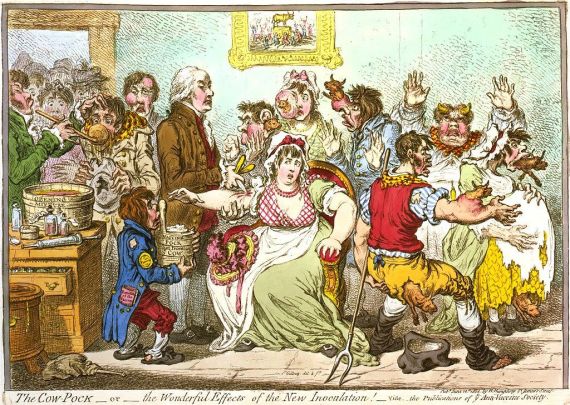
Vaccine resistance is not a new phenomenon, as the cartoon above from 1802 illustrates. Certain people will always find the idea of injecting germs into their systems deeply unsettling. Of course, that’s a very natural basis of resistance. A person’s body is their own property, after all. My default position is that an individual’s control over their own body is inviolable, and parents should always be the first authority over decisions about their children. The real issue, however, is the question of whether unvaccinated children inflict external costs on others.

Points of Contention

The major objections of VRs fall into several categories: 1) preservatives; 2) multiple viruses; 3) vulnerable infants; 4) contra-indications; 5) inefficacy; and 6) free choice. There may be others, but I’ll go with those.

Preservatives: Some vaccines still use a form of mercury, but a much more innocuous variant than the one VRs found so objectionable a few decades ago. Still, they object. And they object to many other compounds used in minute quantities as preservatives, such as formaldehyde, which occurs naturally in our bodies. I think the following test is helpful: if it were proposed that VRs take new versions of the vaccines that had zero preservatives, many would still refuse, especially if they were asked to pay the additional cost of providing them in that form. Thus, preservatives are revealed to be something of a side show.

Multiple Viruses: VRs object to the administration of vaccines that inoculate against several viruses in one dose or within a short window of time. This objection has some plausibility, since an injection of several different “bugs’ at once might place excessive stress on the body, even if the risk is still small. But again, would VRs volunteer to take single strain vaccines in a schedule over a lengthier period of time? Probably not.

Vulnerable Infants: VRs say it’s too risky to vaccinate infants in their first few months of life. This too is a plausible objection, and it would seem like a relatively easy concession to make in the interests of compromise … except, it won’t ever be good enough. Radical VRs will not agree to having their children vaccinated at any age.

Contra-Indications: There are undoubtedly genetic factors that pre-dispose certain individuals to an adverse reaction to certain vaccines. These might be rare, so an effort to compromise by requiring a thorough genetic profile before vaccination would be costly. I believe profiling is a reasonable demand for individuals to make, however, provided they pay the cost themselves.

Inefficacy: My friend posted an intriguing article about the drastic declines that occurred in the incidence of various diseases before the introduction of vaccines to prevent those diseases. This might not be the same link, but it makes the same argument. That doesn’t mean vaccines don’t work, of course. There is a vast literature that shows that they do. Bing it! And in cases such as smallpox, the use of “folk applications” of puss to a small scratch in the skin were in use long before the vaccine was available. Nevertheless, the VRs contend that the historical rates of disease incidence provide evidence against vaccinating. They also contend that diseases like measles are not serious enough to warrant precautions like vaccines. Measles can be deadly, though not as deadly as the flu.

Free Choice: This is the point on which I’m most sympathetic to VRs. Again, we own our own bodies and should have authority over our own minor children, yet communicable diseases seem to be a classic case of externality. Susceptible individuals may inflict a cost on others by refusing vaccination or segregation. Other people own their bodies too, and they have a right to avoid exposure. They too can isolate themselves or take precautions as they deem necessary. If both parties wish to participate in society, then both hold rights they allege to be threatened by the other. That complicates the task of reconciling these interests in private, voluntary ways, and yet they often are reconciled privately.

Solutions?

The debate today often revolves around mandatory vaccination, which would be an extreme measure relying on the coercive power of the state. The rationale is that even a vaccinated majority would be subject to an unnecessarily high risk of infection when in frequent contact with an unvaccinated minority. It’s difficult to endorse such broad intrusiveness when we’re dealing with a negative externality of such minute probability. And such a policy is not at all defensible without exceptions for individuals for whom a vaccine is contra-indicated.

Tolerating differences in vaccination rules across cities, school districts, or even states, may be a reasonable approach to settling the debate in the long run. These variations allow empirical evidence to accumulate on the efficacy of different vaccine regimes. It also allows individuals and families to “vote with their feet”, migrating to jurisdictions that best suit their preferences. These are the basic foundations of federalism, a principle of great usefulness in preserving freedoms while addressing regional differences of opinion on contentious issues.

Michigan has a policy allowing unvaccinated children to attend schools, but a waiver must be obtained requiring the child’s parents to attend a vaccine education program. The policy is credited with increasing vaccination rates. The problem is that VRs tend to view this requirement as an infringement on their rights. Advocates of the policy might argue that the situation should be viewed as an arms-length, voluntary exchange between two parties, in this case a family and a public entity. The vaccine education program is just the price one must pay in lieu of vaccination. The exchange is not arms length, however, as it would be if the school were a private entity. The VR parents who refuse the waiver are not rebated for taxes paid for local schools. In fact, like all taxes, the payment is coerced.

It’s not always necessary to appeal to some form of government action, even at local levels. For example, private schools may require vaccination among enrollees, and private businesses, especially health care providers, may require staff to be vaccinated. Life and health insurers may wish to price risk differently for the unvaccinated. VRs might object that they are subject to discrimination by institutions requiring immunization, or who price discriminate in favor of the immunized, but VRs are free to form competitive institutions, even on small scales or as mutual companies. To the extent that such private rules are unjustified, the institutions who discriminate are likely to learn or lose eventually. That’s the beauty of market solutions. In these ways, non-coercive private governance is far preferable to action by the state.

Dr. Jeffrey Singer is an advocate of immunization who opposes mandatory vaccine laws, as he explained a few years ago in “Vaccination and Free Will“. He suggested elsewhere, in “Seeking Balance In Vaccination Laws“, that schools, instead of requiring immunization, could mitigate the risk of a contagion by insisting that unvaccinated children be held out of school when a particular threat arises and remain out until it passed. That’s a reasonable idea, but I suspect many pro-vax parents would fear that it doesn’t go far enough in protecting against the introduction of a disease by an unvaccinated child.

Conclusion

Recent increases in the incidence of diseases such as measles, mumps and whooping cough are extremely troubling. Whether these outbreaks bear any relationship to patterns of vaccination in the population is certainly a valid question. To the extent that more families and individuals wish to be immunized, and that private institutions wish to take action to increase vaccination rates within their sphere of influence, I’m all for it. Vaccination laws are a different matter.

Political action at the local level might mean that school districts and other public entities will require vaccinations or vaccine education programs. Alternatives exist for those refusing to vaccinate, but broad mandatory vaccination is too coercive. Such measures carry significant costs, not least of which is a loss of liberty and normalization of losses of liberty. It’s not clear that a vaccination mandate at the national level, or even a state vaccination mandate, can offer benefits sufficient to justify those costs. Nudges are irritating and may be costly, but forcible intrusions are way out-of-bounds. Unfortunately, there are parties that simply can’t resist the temptations of behavioral control, and that’s worthy of resistance. Let’s continue to muddle through with an essentially federalist approach to vaccination policy. I regard that as a hallmark of an advanced society.


 

Net Neutrality: Degradation For All

20 Tuesday Jun 2017

Posted by Nuetzel in Net neutrality, Regulation

≈ 1 Comment

Tags

Ajit Pai, Bronwyn Howell, Common Carriers, Consumer Surplus, Content Providers, Coyote Blog, FCC, Internet Backbone, ISPs, Net Neutrality, Netflix, Network Capacity, Network Congestion, Oligopoly, Price Discrimination, Tiered Rates, Tim Wu, Usage-Based Pricing, Warren Meyer

The FCC recently voted to reverse its earlier actions on so-called net neutrality, which would have treated internet service providers (ISPs) as “common carriers” and subjected them to detailed federal regulation of their services, pricing, and profits. Many believe net neutrality would ensure a sort of fairness and nondiscrimination on the internet, but it is actually a destructive regulatory regime under which certain firms are allowed to extract economic rents from the efforts of others. Warren Meyer has a nice take on this at Coyote Blog:

“Net Neutrality is one of those Orwellian words that mean exactly the opposite of what they sound like…. What [it] actually means is that certain people … want to tip the balance in this negotiation towards the content creators ….  Netflix, for example, takes a huge amount of bandwidth that costs ISP’s a lot of money to provide. But Netflix doesn’t want the ISP’s to be be able to charge for this extra bandwidth Netflix uses – Netflix wants to get all the benefit of taking up the lion’s share of ISP bandwidth investments without having to pay for it. Net Neutrality is corporate welfare for content creators.“

I made the same point almost three years ago in “The Non-Neutrality of Network Hogs“. Meyer emphasizes that in the net-neutrality fight, the primary tension is between content creators and ISPs (and transport providers), but it is like any other battle to capture the gains from a vertical supply chain. Think of suppliers of goods versus shippers, for example, or traditional publishers versus delivery services, or oil extraction versus refining. Ultimately, all of the various parties must cover their costs in order to survive, and obviously each would like to capture a larger share of the value from its stage of the production process. In a series of arms-length transactions, one might assume that their shares would correspond roughly to the value they add to the final product, but things are more complicated than that. Much depends on the competitive state of the market and on the cost structures faced by different parties.

While the ISPs are often said to exercise monopoly power, there are few if any local markets in which that is actually the case, even in rural areas. Almost everywhere in the U.S., local internet markets could be better described as oligopolistic: there are at least a couple of rival firms (and alternatives for consumers), even if the technologies are sometimes radically different, so some competition exists. The same is true of the internet backbone.

Obviously, content providers compete with one another in a large sense, but many popular forms of content are unique and consumers demand access to them through their ISPs. Therefore, some content providers exercise a degree of monopoly power. And they might also require a lot of bandwidth.

The nature of the costs faced by ISPs and content providers is quite different. The latter have a much lower proportion of fixed costs than ISPs, who must invest in network capacity. Ultimately, the costs of providing that capacity must be priced. At first blush, it seems natural for users of capacity to be billed proportionately, but allocating those costs over customers and over time is a complex undertaking. Like all problems in economics, however, network usage involves a scarce resource. A large increment to demand can lead to network congestion and higher costs, not only directly to the ISPs but to users experiencing a degradation in the speed and quality of their service. ISPs have traditionally had the flexibility to negotiate with large content providers, reaching mutually agreeable terms. That’s what brought us to the state of today’s internet, and most observers would say that it’s pretty damn good!

It is the network that makes all of these wonderful services possible. The ISPs provide and maintain that network, and they must provide for expansion of that network as traffic grows. It is important that ISPs have adequate incentives to do so. However, the form of regulation to which so-called common carriers are subjected is known historically for its failure to provide good incentives. That history goes back as far as 130 years in transportation and about 80 years in telecommunications. This is why many analysts, and FCC Chairman Ajit Pai, contend that common carrier status for ISPs, and “net neutrality”, would lead to shortfalls in network capacity and a deterioration in the quality of service. It would also reward large content providers (think Netflix) in the short term at the expense of ISPs, essentially giving the former access to the existing network at less than cost. That’s the whole idea for industry advocates of net netrality, of course. But in the end, net neutrality is a shortsighted goal, even for the content providers.

The content providers have made every effort to propagandize the public, stoking fears that the ISPs are treating certain kinds of traffic unfairly. Without net neutrality, would ISPs unfairly discriminate against certain kinds of content? Or against certain types of users? Price discrimination is one of the primary criticisms of the presumed behavior of ISPs in the absence of net neutrality. Economist Bronwyn Howell points out that price discrimination is not unusual, however, and is not necessarily undesirable. Indeed, consumers of internet, telephone, mobile, and cable TV services seem to prefer certain forms of price discrimination! Consumers with heavy usage who purchase flat rate monthly internet access pay a lower charge per Gb than light users. Consumers who purchase “bundles” of internet and voice service may benefit from price discrimination relative to those who choose not to bundle their services. Strictly usage-based pricing would prevent price discrimination on this basis, but few would advocate the abolition of bundled offers, which provide benefits in terms of flexibility of use and predictability of cost, yielding net welfare gains for many consumers at no incremental cost to others. Like all voluntary trade, these are positive sum transactions: consumers capture more  “surplus” value while ISPs earn a greater contribution to the fixed costs of the network.

When ISPs charge a data rate based on usage, consumers face a positive marginal cost on incremental data. As usage increases, its marginal value to the consumer declines; the consumer will not use data beyond the point at which its value equals the data rate they pay. That places a cap on consumer surplus (the area above the price and below the consumer’s demand curve). When the consumer faces a zero marginal cost (an unlimited data plan), their usage rises to the point at which its marginal value is zero. The total amount of “surplus” in that scenario is larger, and it is possible for an ISP to split the gain with the consumer by offering a price for unlimited usage. Thus, as long as the network capacity is in place, both parties are made better off! If not, the practice can lead to congestion, but competition for users often dictates that such packages be offered.

Especially in the presence of positive network externalities, it makes no sense for the ISPs, as a group, to price users or traffic out of the market, unless they are punished for doing otherwise at below cost. As always, pricing is an exercise in balancing costs with the benefits to potential buyers. It should remain a private and unfettered exercise ending only in trades that are mutually beneficial.

And what of network capacity and the big content providers? At the “price discrimination” link above, Howell says:

“… available bandwidth allowed Netflix to happen, not the other way around. But now, as Netflix comes to dominate existing bandwidth, leading to higher costs, it is causing externalities (delays) and higher costs (ISP fees are now rising in real terms in some markets) to pay for new capacity.“

Should the ISPs charge all customers higher rates in order to manage growth in traffic and fund new capacity? How can they allocate costs to the cost-causers? Usage-based data rates are one simple alternative. Tiered rates would act to minimize the extent to which light users are penalized. ISPs have also negotiated with individual content providers directly, reaching agreements to compensate ISPs for access to their customers. Tim Wu, the Columbia Law professor credited with coining the term “net neutrality”, was quoted at the last link bemoaning these types of deals:

“‘I think it is going to be bad for consumers,’ he added, because such costs are often passed through to the customer.“

Well, yes! Netflix charges its customers, and it will attempt to recover these payments for network capacity. Streaming is an integral component of the service they offer, and they cannot do it without the ISPs. Would Wu propose that the pipes be provided at less than cost?

Some have said that it is more economically efficient for ISPs to charge users directly for incremental short-run network “externalities” caused by large data demands. (Conceptually, it is better to think of these costs as long-run marginal costs of network expansion.) It may be that a tiered rate structure can approximate the optimal solution, and packages are often tiered by download speed. Nevertheless, passing costs along to large content providers is a viable approach to allocating costs as well.

Another argument is that small content providers cannot afford these payments. However, if they don’t generate a significant amount of traffic, they probably won’t have to negotiate special deals. If they grow to require a large share of the “pipe”, it would indicate that they have passed a market test. Ultimately, their customers should pay the costs of providing the capacity in one way or another.

Net neutrality and regulation of ISPs is the wrong approach to encouraging the growth and value delivered by the internet. It would stifle incentives to provide the needed capacity and to develop new network technologies. We certainly didn’t get here by treating the ISPs like public utilities. Rather, the process was facilitated by the freedom to experiment technologically and contractually. ISPs are well aware that the value of their networks are enhanced by ubiquity. Affordable access to a broad share of the population is in their best interest. In the end, consumers are sovereign and should be the sole arbiters of the value offered by ISPs and content providers. Regulators will promise to protect us, but the inevitable result will be a market hampered by rules that degrade the network, leading to substandard service and a less vibrant internet.

Follow Sacred Cow Chips on WordPress.com

Recent Posts

  • Immigration and Merit As Fiscal Propositions
  • Tariff “Dividend” From An Indigent State
  • Almost Looks Like the Fed Has a 3% Inflation Target
  • Government Malpractice Breeds Health Care Havoc
  • A Tax On Imports Takes a Toll on Exports

Archives

  • December 2025
  • November 2025
  • October 2025
  • September 2025
  • August 2025
  • July 2025
  • June 2025
  • May 2025
  • April 2025
  • March 2025
  • February 2025
  • January 2025
  • December 2024
  • November 2024
  • October 2024
  • September 2024
  • August 2024
  • July 2024
  • June 2024
  • May 2024
  • April 2024
  • March 2024
  • February 2024
  • January 2024
  • December 2023
  • November 2023
  • August 2023
  • July 2023
  • June 2023
  • May 2023
  • April 2023
  • March 2023
  • February 2023
  • January 2023
  • December 2022
  • November 2022
  • October 2022
  • September 2022
  • August 2022
  • July 2022
  • June 2022
  • May 2022
  • April 2022
  • March 2022
  • February 2022
  • January 2022
  • December 2021
  • November 2021
  • October 2021
  • September 2021
  • August 2021
  • July 2021
  • June 2021
  • May 2021
  • April 2021
  • March 2021
  • February 2021
  • January 2021
  • December 2020
  • November 2020
  • October 2020
  • September 2020
  • August 2020
  • July 2020
  • June 2020
  • May 2020
  • April 2020
  • March 2020
  • February 2020
  • January 2020
  • December 2019
  • November 2019
  • October 2019
  • September 2019
  • August 2019
  • July 2019
  • June 2019
  • May 2019
  • April 2019
  • March 2019
  • February 2019
  • January 2019
  • December 2018
  • November 2018
  • October 2018
  • September 2018
  • August 2018
  • July 2018
  • June 2018
  • May 2018
  • April 2018
  • March 2018
  • February 2018
  • January 2018
  • December 2017
  • November 2017
  • October 2017
  • September 2017
  • August 2017
  • July 2017
  • June 2017
  • May 2017
  • April 2017
  • March 2017
  • February 2017
  • January 2017
  • December 2016
  • November 2016
  • October 2016
  • September 2016
  • August 2016
  • July 2016
  • June 2016
  • May 2016
  • April 2016
  • March 2016
  • February 2016
  • January 2016
  • December 2015
  • November 2015
  • October 2015
  • September 2015
  • August 2015
  • July 2015
  • June 2015
  • May 2015
  • April 2015
  • March 2015
  • February 2015
  • January 2015
  • December 2014
  • November 2014
  • October 2014
  • September 2014
  • August 2014
  • July 2014
  • June 2014
  • May 2014
  • April 2014
  • March 2014

Blogs I Follow

  • Passive Income Kickstart
  • OnlyFinance.net
  • TLC Cholesterol
  • Nintil
  • kendunning.net
  • DCWhispers.com
  • Hoong-Wai in the UK
  • Marginal REVOLUTION
  • Stlouis
  • Watts Up With That?
  • Aussie Nationalist Blog
  • American Elephants
  • The View from Alexandria
  • The Gymnasium
  • A Force for Good
  • Notes On Liberty
  • troymo
  • SUNDAY BLOG Stephanie Sievers
  • Miss Lou Acquiring Lore
  • Your Well Wisher Program
  • Objectivism In Depth
  • RobotEnomics
  • Orderstatistic
  • Paradigm Library
  • Scattered Showers and Quicksand

Blog at WordPress.com.

Passive Income Kickstart

OnlyFinance.net

TLC Cholesterol

Nintil

To estimate, compare, distinguish, discuss, and trace to its principal sources everything

kendunning.net

The Future is Ours to Create

DCWhispers.com

Hoong-Wai in the UK

A Commonwealth immigrant's perspective on the UK's public arena.

Marginal REVOLUTION

Small Steps Toward A Much Better World

Stlouis

Watts Up With That?

The world's most viewed site on global warming and climate change

Aussie Nationalist Blog

Commentary from a Paleoconservative and Nationalist perspective

American Elephants

Defending Life, Liberty and the Pursuit of Happiness

The View from Alexandria

In advanced civilizations the period loosely called Alexandrian is usually associated with flexible morals, perfunctory religion, populist standards and cosmopolitan tastes, feminism, exotic cults, and the rapid turnover of high and low fads---in short, a falling away (which is all that decadence means) from the strictness of traditional rules, embodied in character and inforced from within. -- Jacques Barzun

The Gymnasium

A place for reason, politics, economics, and faith steeped in the classical liberal tradition

A Force for Good

How economics, morality, and markets combine

Notes On Liberty

Spontaneous thoughts on a humble creed

troymo

SUNDAY BLOG Stephanie Sievers

Escaping the everyday life with photographs from my travels

Miss Lou Acquiring Lore

Gallery of Life...

Your Well Wisher Program

Attempt to solve commonly known problems…

Objectivism In Depth

Exploring Ayn Rand's revolutionary philosophy.

RobotEnomics

(A)n (I)ntelligent Future

Orderstatistic

Economics, chess and anything else on my mind.

Paradigm Library

OODA Looping

Scattered Showers and Quicksand

Musings on science, investing, finance, economics, politics, and probably fly fishing.

  • Subscribe Subscribed
    • Sacred Cow Chips
    • Join 128 other subscribers
    • Already have a WordPress.com account? Log in now.
    • Sacred Cow Chips
    • Subscribe Subscribed
    • Sign up
    • Log in
    • Report this content
    • View site in Reader
    • Manage subscriptions
    • Collapse this bar
 

Loading Comments...