• About

Sacred Cow Chips

Sacred Cow Chips

Tag Archives: Private Goods

Tampons For Men From a Strapped Public Purse

18 Sunday Aug 2024

Posted by Nuetzel in Gender Differences, Scarcity

≈ Leave a comment

Tags

Condom Dispensers, Cost-Benefit, Female to Male Transition, Free Tampons, FTM, Gender Transition, Gender-Affirming Care, Hysterectomy, Intersex, Market Test, Menstruation, MTF, Non-Binary Population, Overactive Bladders, Pay Toilets, Private Goods, Public Budgets, Public Restrooms, Tampon Dispenser, Tampons in Men’s Rooms, Tax Burdens, Trans Population, Trans-Men
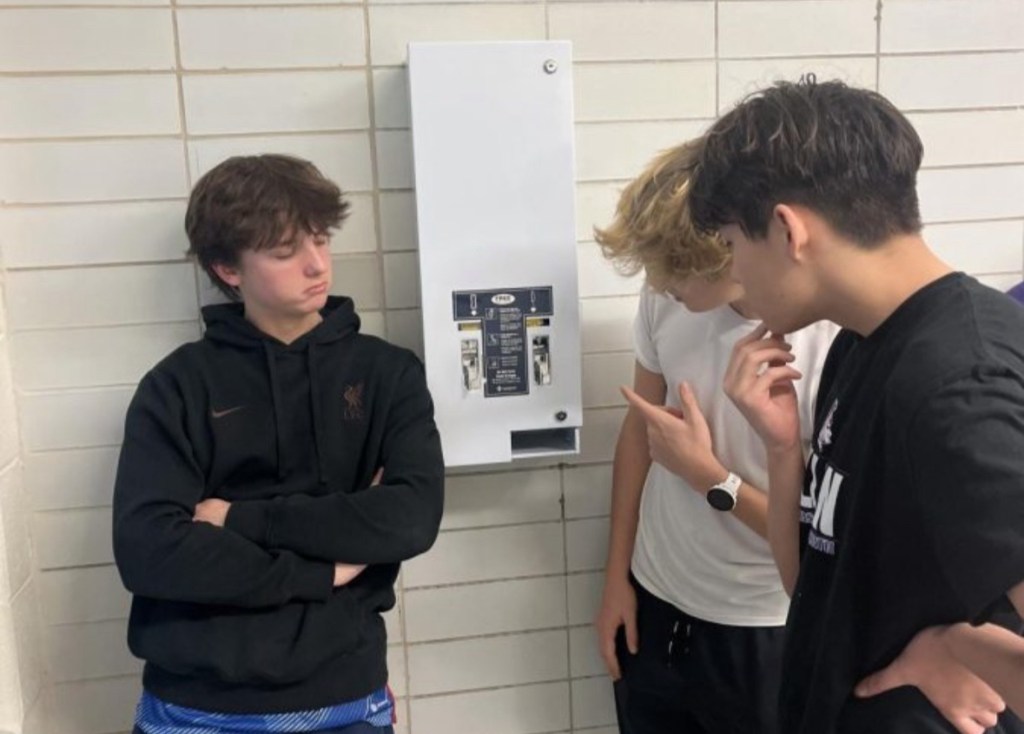
I had to laugh when I saw this tweet on X the other day:

Cis men, if you were to walk into a public restroom and see menstrual products near the soap dispensers, how would it negatively affect your life?

Please provide specific examples.

— Rebecca Fachner (@rebecca_fachner) August 9, 2024

I actually think she was fishing for sympathetic comments from … anyone. Or it was intended as a rhetorical question, as the poster seems to regard many cis-men as the meanies in this affair. But let’s give her the benefit of the doubt. Maybe she really wanted to engage with men who object to tampon dispensers in men’s public restrooms.

Before getting started, I want to be clear that I’m using the term “public restroom” to mean a restroom available to the general public and furnished by the public sector. I distinguish these from restrooms in commercial establishments intended for use by customers only.

Tampon Dispensing Is Not Cost-Free

So I have a question: who will be asked to pay for the dispensers in men’s public restrooms, their installation, servicing, and the tampons themselves? Will the tampons be dispensed at no charge, as some advocates would like? That’s the case in some public schools, so there might be a tendency to think tampons should be free in other men’s public restrooms. Of course, another possibility is to install pay vending machines for tampons, and I will address that in later sections. Here I note that I’d have no objection if they paid for themselves.

Free tampons in men’s public restrooms, or even priced tampons that don’t cover their costs, would represent a use of public resources. Taxpayers would be on the hook. Alternatively, some other public expenditure might be reduced to make room in government budgets for the new amenity. Public budgets are notoriously strapped, and foregoing other budget needs would carry an opportunity cost. Public resources should be put to the most urgent public needs, which might run the gamut from critical services like law enforcement, sanitation, and street repair to the staffing of mental health facilities.

If this strikes you as economic small-ball, remember that demands for public funds are seemingly without end. Whether taxes are increased or the budget is reallocated, “my life” is affected to a degree by every new demand that is met. To pay for tampon dispensers in men’s public restrooms, resources must be diverted from some other valued use.

Beneficiaries

Surely Ms. Fachner believes that tampons in men’s restrooms confer social benefits. Might those benefits exceed the opportunity cost of the necessary resources?

Well, biological males don’t have ovaries, they can’t get pregnant, and they don’t have periods, so we can scratch them off the list of potential beneficiaries. This is about trans- or intersex men who menstruate or perhaps suffer bleeding from hysterectomies. As I’ll discuss below, this is a small minority of users of men’s public restrooms.

But wait, here’s one advocate:

“Our culture does not really acknowledge the diversity of menstruating individuals.“

Statements like that lend absolutely no clarity. In fact, it’s a gross obfuscation made in an effort to redefine reality and exaggerate the prevalence of menstruating males.

Estimates of the Trans-Male Population

The transgender population was estimated at about 0.5% – 0.6% of the total U.S. population in 2022, based on two studies. That’s about one in every 200 individuals. However, male-to-female (MTF) transitions are 2 – 4 times more common than female to male (FTM) transitions. Combining these estimates yields one FTM in every 400 – 800 men. Of course, not all FTMs menstruate (and they don’t menstruate over the entirety of a given month). So men who might need a tampon in a public restroom are a small minority.

Nonbinaries?

Some would insist that any such estimate should account for the nonbinary population of individuals who menstruate. Part of this group is the intersex (hermaphrodite) population who identify as males. A number of these individuals have had gender-affirming care and would already have been counted as FTMs in the studies linked above (and I will continue to use “FTM” as inclusive of this group). However, I’m skeptical of the non-binary classification on surveys because some otherwise “straight” individuals use it to signal their participation in the avant guarde of gender identification, perceiving it as something fashionable or even virtuous.

Nevertheless, one 2022 poll found that the trans plus nonbinary population was about 1.6% of all adults. Combining this with the MTF/FTM estimates above, an implied upper bound on the male tampon “market” would be about 3 out of every 400 distinct visitors to a men’s restroom, or less than one out of every hundred. If the nonbinary classification is taken at face value, it’s still a small minority and probably far less than 1/100.

Woe Is We

A great many of us suffer inconveniences in life, some of them terrible, but it would be extremely costly and irrational for the state to attempt to neutralize every one of them. For example, people with overactive bladders are far more common than the trans population. Should the state accommodate them by doubling the number of public restrooms? At some point it’s worth recognizing that claims on public resources can become preposterous.

The economic argument against outfitting all men’s public restrooms with tampon dispensers falls into a broader category of common-sense resistance to eliminating (or compensating) for every tiny cross borne by anyone: every minor strife, inconvenience, or “micro-aggression” individuals might experience. The cumulative effect of this cavalcade of demands on society and on each other, which cannot all be met, is to breed discontent while stifling social and economic progress. We live in the real world where scarcity matters. We must therefore be sensible about where and how we expend our energy and resources.

Costs

I haven’t yet explored the specific costs associated with adding tampon dispensers to men’s public restrooms. Not surprisingly, it’s difficult to pin them down completely, but a few notes are helpful.

The cost of a free-tampon dispenser ranges from about $90 to $140. A pay tampon vending machine ranges from about $300 – $500. Then the dispensers have to be installed, stocked, and serviced, and there is a potentially greater cost of sanitation within each restroom. This article includes cost data from 2017-2019 for a public school district in Massachusetts. It’s ambiguous as to whether installations of free dispensers occurred in women’s restrooms only or all restrooms, but much of the article is written as if it applies to women and girls. To be clear, I don’t take issue with providing free tampon dispensers in school restrooms for females.

The dispensers and receptacles for the school district totaled $33,000, which presumably included the labor cost of installation. The annual cost of keeping the dispensers stocked was just $2.48 per student annually, but it’s not clear whether that average includes labor, or whether the divisor is the female student population or all students. Certainly all of these costs would be greater today.

Don’t Putsch It

The FTM minority is likely to grow, especially in parts of the country where advocates for the gender dysphoric have won legislative battles over gender-affirming care for youths. This is a huge mistake. It’s highly unethical to encourage unalterable, life-changing medical interventions for what often amount to youthful anxieties that usually pass with age. But these initiatives go hand-in-hand with bills requiring free menstrual products in all school restrooms and in all public restrooms. It would be more reasonable to suggest to any biological female considering a gender transition, who must weigh many considerations, that they’ll sometimes be inconvenienced by the need to pack a precautionary tampon.

Crazy Counter-Arguments

There were some interesting comments on Ms. Fachner’s tweet. One contended that men should have tampons available in the event that a female companion happens to need one. Well, it’s so nice to know that chivalry still has a place among the woke! But if a woman needs a tampon while she’s out, and if she has any sense, she’ll try the womens’ restroom herself before asking a male companion to check the men’s room.

Another commenter felt that the availability of tampons in men’s restrooms is the equivalent of condom dispensers in womens’ restrooms. Not quite! A woman out with a male companion might wish to have protection available if she expects to have intercourse. I’m not sure how many public women’s restrooms have condom dispensers, but you might find paid dispensers at truck stops, dance clubs, or other private venues where the sexes meet and greet. In any event, interest in condoms in women’s restrooms might well be a more common phenomenon than FTMs unprepared for the onset of a period.

Market Test

The mere existence of vending machines for condoms and other products in the restrooms of private establishments proves that these offerings satisfy a sort of market test. The charges for those products, including tampons, pads, and condoms in women’s restrooms, might or might not cover all of the associated costs. However, even if they don’t, the machines are provided as a courtesy to customers and/or because competitors provide them. Either way, as a market proposition, the establishments find the machines to be advantageous.

Would private establishments find it profitable to offer tampons and pads in vending machines in men’s restrooms? It’s possible, and businesses catering to non-traditional lifestyles are more likely to offer menstrual products in men’s restrooms, if only as a courtesy to FTM customers. However, it’s uncommon at best among mainstream businesses. Again, the economic logic is dependent on the volume of menstrual products likely to be dispensed. If they add value, the market is likely to provide them. This might be more plausible for machines that vend multiple products.

Successful pricing of tampons in men’s public restrooms would be easier if the probable volume was greater, but it will be quite low relative to women’s restrooms. Thus, the up-front fixed costs are difficult to justify. In any case, vending machines of any type are less common in public restrooms. Perhaps that’s because the items sold would not cover all of the associated costs. Or perhaps it’s because public administrators lack the incentives that motivate actions in the private sector. Enter the activists!

Market Failure?

One might argue that passing the market test is irrelevant because public facilities are intended to offer a range of services which the market can’t be relied upon to provide. That’s not clear cut in the case of restrooms themselves, and I’ve advocated for more pay toilets in the past. However, tampons are very much a private good. A trans-male with an unmet need for a tampon is in a bad spot, and he might generate external costs. However, I maintain that the situation is fairly uncommon, and those hypothetical external costs are fairly easy to internalize. This is not a true market failure nor a public priority.

Finally, I note again that Ms. Fachner addresses her question only to cis-men. I have news for her: like any other form of common sense, the rudimentary economic logic of costs and benefits is inclusive and available to all, regardless of sexual preference and gender identification.

Lords of the Planetary Commons Insist We Banish Sovereignty, Growth

29 Thursday Feb 2024

Posted by Nuetzel in Central Planning, Environmental Fascism, Global Warming, Liberty

≈ Leave a comment

Tags

Anthropocene, Beamed Solar Power, Carbon Capture, Carbon Forcings, Cliff Mass, Common Pool Resources, Elinor Ostrom, Externalities, Fusion Power, Geoengineering, Geothermal Power, global warming, Heat Islands, Interspecies Justice, IPCC, Lula Da Silva, Munger Test, Nuclear power, Orbital Solar Collection, Paris Climate Accords, Planetary Commons, Polycentrism, Private Goods, Property Rights, Public goods, Redistribution, Solar Irradiance, Spillovers, Tipping points

We all share Planet Earth as our home, so there’s a strong sense in which it qualifies as a “commons”. That’s one sensible premise of a new paper entitled “The planetary commons: A new paradigm for safeguarding Earth-regulating systems in the Anthropocene”. The title is a long way of saying that the authors desire broad-based environmental regulation, and that’s what ultimately comes across.

First, a preliminary issue: many resources qualify as commons in the very broadest sense, yet free societies have learned over time that many resources are used much more productively when property rights are assigned to individuals. For example, modern agriculture owes much to defining exclusive property rights to land so that conflicting interests don’t have to compete (e.g,, the farmer and the cowman). Federal land is treated as a commons, however. There is a rich history on the establishment of property rights, but within limits, the legal framework in place can define whether a resource is treated as a commons, a club good, or private property. The point here is that there are substantial economic advantages to preserving strong property rights, rather than treating all resources as communal.

The authors of the planetary commons (PC) paper present a rough sketch for governance over use of the planet’s resources, given their belief that a planetary crisis is unfolding before our eyes. The paper has two main thrusts as I see it. One is to broadly redefine virtually all physical resources as common pool interests because their use, in the authors’ view, may entail some degree of external cost involving degradation of the biosphere. The second is to propose centralized, “planetary” rule-making over the amounts and ways in which those resources are used.

It’s an Opinion Piece

The PC paper is billed as the work product of a “collaborative team of 22 leading international researchers”. This group includes four attorneys (one of whom was a lead author) and one philosopher. Climate impact researchers are represented, who undoubtedly helped shape assumptions about climate change and its causes that drive the PC’s theses. (More on those assumptions in a section below.) There are a few social scientists of various stripes among the credited authors, one meteorologist, and a few “sustainability”, “resilience”, and health researchers. It’s quite a collection of signees, er… “research collaborators”.

Grabby Interventionists

The reasoning underlying a “planetary commons” (PC) is that the planet’s biosphere qualifies as a commons. The biosphere must include virtually any public good like air and sunshine, any common good like waterways, or any private good or club good. After all, any object can play host to tiny microbes regardless of ownership status. So the PC authors characterization of the planet’s biosphere as a commons is quite broad in terms of conventional notions of resource attributes.

We usually think of spillover or external costs as arising from some use of a private resource that imposes costs on others, such as air or water pollution. However, mere survival requires that mankind exploit both public and non-public resources, acts that can always be said to impact the biosphere in some way. Efforts to secure shelter, food, and water all impinge on the earth’s resources. To some extent, mankind must use and shape the biosphere to succeed, and it’s our natural prerogative to do so, just like any other creature in the food chain.

Even if we are to accept the PC paper’s premise that the entire biosphere should be treated is a commons, most spillovers are de minimus. From a public policy perspective, it makes little sense to attempt to govern over such minor externalities. Monitoring behavior would be costly, if not impossible, at such an atomistic level. Instead, free and civil societies rely on a high degree of self-governance and informal enforcement of ethical standards to keep small harms to a minimum.

Unfortunately, the identification and quantification of meaningful spillover costs is not always clear-cut. This has led to an increasingly complex regulatory environment, an increasingly litigious business environment, and efforts by policymakers to manage the detailed inputs and outputs of the industrial economy.

All of that is costly in its own right, especially because the activities giving rise to those spillovers often enable large welfare enhancements. Regulators and planners face great difficulties in estimating the costs and benefits of various “correctives”. The very undertaking creates risk that often exceeds the cost of the original spillover. Nevertheless, the PC paper expands on the murkiest aspects of spillover governance by including “… all critical biophysical Earth-regulating systems and their functions, irrespective of where they are located…” as part of a commons requiring “… additional governance arrangements….”

Adoption of the PC framework would authorize global interventions (and ultimately local interventions, including surveillance) on a massive scale based on guesswork by bureaucrats regarding the evolution of the biosphere.

Ostrom Upside Down

Not only would the PC framework represent an expansion of the grounds for intervention by public authorities, it seeks to establish international authority for intervention into public and private affairs within sovereign states. The authors attempt to rationalize such far-reaching intrusions in a rather curious way:

“Drawing on the legacy of Elinor Ostrom’s foundational research, which validated the need for and effectiveness of polycentric approaches to commons governance (e.g., ref. 35, p. 528, ref. 36, p. 1910), we propose that a nested Earth system governance approach be followed, which will entail the creation of additional governance arrangements for those planetary commons that are not yet adequately governed.”

Anyone having a passing familiarity with Elinor Ostrom’s work knows that she focused on the identification of collaborative solutions to common goods problems. She studied voluntary and often strictly private efforts among groups or communities to conserve common pool resources, as opposed to state-imposed solutions. Ostrom accepted assigned rights and pricing solutions to managing common resources, but she counseled against sole reliance on market-based tools.

Surely the PC authors know they aren’t exactly channeling Ostrom:

“An earth system governance approach will require an overarching global institution that is responsible for the entire Earth system, built around high-level principles and broad oversight and reporting provisions. This institution would serve as a universal point of aggregation for the governance of individual planetary commons, where oversight and monitoring of all commons come together, including annual reporting on the state of the planetary commons.”

Polycentricity was used by Ostrom to describe the involvement of different, overlapping “centers of authority”, such as individual consumers and producers, cooperatives formed among consumers and producers, other community organizations, local jurisdictions, and even state or federal regulators. Some of these centers of authority supersede others in various ways. For example, solutions developed by cooperatives or lower centers of authority must align with the legal framework within various government jurisdictions. However, as David Henderson has noted, Ostrom observed that management of pooled resources at lower levels of authority was generally superior to centralized control. Henderson quotes Ostrom and a co-author on this point:

“When users are genuinely engaged in decisions regarding rules affecting their use, the likelihood of them following the rules and monitoring others is much greater than when an authority simply imposes rules.”

The authors of the PC have something else in mind, and they bastardize the spirit of Ostrom’s legacy in the process. For example, the next sentence is critical for understanding the authors’ intent:

“If excessive emissions and harmful activities in some countries affect planetary commons in other areas—for example, the melting of polar ice—strong political and legal restrictions for such localized activities would be needed.”

Of course, there are obvious difficulties in measuring impacts of various actions on polar ice, assigning responsibility, and determining the appropriate “restrictions”. But in essence, the PC paper advocates for a top-down model of governance. Polycentrism is thus reduced to “you do as we say”, which is not in the spirit of Ostrom’s research.

Planetary Governance

Transcending national sovereignty on questions of the biosphere is key to the authors’ ambitions. At a bare minimum, the authors desire legally-binding commitments to international agreements on environmental governance, unlike the unenforceable promises made for the Paris Climate Accords:

“At present, the United Nations General Assembly, or a more specialized body mandated by the Assembly, could be the starting point for such an overarching body, even though the General Assembly, with its state-based approach that grants equal voting rights to both large countries and micronations, represents outdated traditions of an old European political order.”

But the votes of various “micronations” count for zilch when it comes to real “claims” on the resources of other sovereign nations! Otherwise, there is nothing “voluntary” about the regime proposed in the PC paper.

“A challenge for such regimes is to duly adapt and adjust notions of state sovereignty and self-determination, and to define obligations and reciprocal support and compensation schemes to ensure protection of the Earth system, while including comprehensive stewardship obligations and mandates aimed at protecting Earth-regulating systems in a just and inclusive way.”

So there! The way forward is to adopt the broadest possible definition of market failure and global regulation of any and all private activity touching on nature in any way. And note here a similarity to the Paris Accords: achieving commitments would fall to national governments whose elites often demonstrate a preference for top-down solutions.

Ah Yes, Redistribution

It should be apparent by now that the PC paper follows a now well-established tradition in multi-national climate “negotiations” to serve as subterfuge for redistribution (which, incidentally, includes the achievement of interspecies justice):

“For instance, a more equal sharing of the burdens of climate stabilization would require significant multilateral financial and technology transfers in order not to harm the poorest globally (116).”

The authors insist that participation in this governance would be “voluntary”, but the following sentence seems inconsistent with that assurance:

“… considering that any move to strengthen planetary commons governance would likely be voluntarily entered into, the burdens of conservation must be shared fairly (115).”

Wait, what? “Voluntary” at what level? Who defines “fairness”? The authors approvingly offer this paraphrase of the words of Brazilian President Lula da Silva,

“… who affirmed the Amazon rainforest as a collective responsibility which Brazil is committed to protect on behalf of all citizens around the world, and that deserves and justifies compensation from other nations (117).”

Let Them Eat Cake

Furthermore, PC would require de-growth and so-called “sufficiency” for thee (i.e., be happy with less), if not for those who’ll design and administer the regime.

“… new principles that align with novel Anthropocene dynamics and that could reverse the path-dependent course of current governance. These new principles are captured under a new legal paradigm designed for the Anthropocene called earth system law and include, among others, the principles of differentiated degrowth and sufficiency, the principle of interconnectivity, and a new planetary ethic (e.g., principle of ecological sustainability) (134).”

If we’re to take the PC super-regulators at their word, the regulatory regime would impinge on fertility decisions as well. Just who might we trust to govern humanity thusly? If we’re wise enough to apply the Munger Test, we wouldn’t grant that kind of power to our worst enemy!

Global Warmism

The underlying premise of the PC proposal is that a global crisis is now unfolding before our eyes: anthropomorphic global warming (AGW). The authors maintain that emissions of carbon dioxide are the cause of rising temperatures, rapidly rising sea levels, more violent weather, and other imminent disasters.

“It is now well established that human actions have pushed the Earth outside of the window of favorable environmental conditions experienced during the Holocene…”

“Earth system science now shows that there are biophysical limits to what existing organized human political, economic, and other social systems can appropriate from the planet.”

For a variety of reasons, both of these claims are more dubious than one might suppose based on popular narratives. As for the second of these, mankind’s limitless capacity for innovation is a more powerful force for sustainability than the authors would seem to allow. On the first claim, it’s important to note that the PC paper’s forebodings are primarily based on modeled, prospective outcomes, not historical data. The models are drastically oversimplified representations of the earth’s climate dynamics driven by exogenous carbon forcing assumptions. Their outputs have proven to be highly unreliable, overestimating warming trends almost without exception. These models exaggerate climate sensitivity to carbon forcings, and they largely ignore powerful natural forcings such as variations in solar irradiance, geological heating, and even geological carbon forcings. The models are also notorious for their inadequate treatment of feedback effects from cloud cover. Their predictions of key variables like water vapor are wildly in error.

The measurement of the so-called “global temperature” is itself subject to tremendous uncertainty. Weather stations come and go. They are distributed very unevenly across land masses, and measurement at sea is even sketchier. Averaging all these temperatures would be problematic even if there were no other issues… but there are. Individual stations are often sited poorly, including distortions from heat island effects. Aging of equipment creates a systematic upward bias, but correcting for that bias (via so-called homogenization) causes a “cooling the past” bias. It’s also instructive to note that the increase in global temperature from pre-industrial times actually began about 80 years prior to the onset of more intense carbon emissions in the 20th century.

Climate alarmists often speak in terms of temperature anomalies, rather than temperature levels. In other words, to what extent do temperatures differ from long-term averages? The magnitude of these anomalies, using the past several decades as a base, tend to be anywhere from zero degrees to well above one degree Celsius, depending on the year. Relative to temperature levels, the anomalies are a small fraction. Given the uncertainty in temperature levels, the anomalies themselves are dwarfed by the noise in the original series!

Pick Your Own Tipping Point

It seems that “tipping point” scares are heavily in vogue at the moment, and the PC proposal asks us to quaff deeply of these narratives. Everything is said to be at a tipping point into irrecoverable disaster that can be forestalled only by reforms to mankind’s unsustainable ways. To speak of the possibility of other causal forces would be a sacrilege. There are supposed tipping points for the global climate itself as well as tipping points for the polar ice sheets, the world’s forests, sea levels and coastal environments, severe weather, and wildlife populations. But none of this is based on objective science.

For example, the 1.5 degree limit on global warming is a wholly arbitrary figure invented by the IPCC for the Paris Climate Accords, yet the authors of the PC proposal would have us believe that it was some sort of scientific determination. And it does not represent a tipping point. Cliff Mass explains that climate models do not behave as if irreversible tipping points exist.

Consider also that there has been absolutely no increase in the frequency or intensity of severe weather.

Likewise, the rise of sea levels has not accelerated from prior trends, so it has nothing to do with carbon forcing.

One thing carbon forcings have accomplished is a significant greening of the planet, which if anything bodes well for the biosphere

What about the disappearance of the polar ice sheets? On this point, Cliff Mass quotes Chapter 3 of the IPCC’s Special Report on the implications of 1.5C or more warming:

“there is little evidence for a tipping point in the transition from perennial to seasonal ice cover. No evidence has been found for irreversibility or tipping points, suggesting that year-round sea ice will return given a suitable climate.”

The PC paper also attempts to connect global warming to increases in forest fires, but that’s incorrect: there has been no increasing trend in forest fires or annual burned acreage. If anything, trends in measures of forest fire activity have been negative over the past 80 years.

Concluding Thoughts

The alarmist propaganda contained in the PC proposal is intended to convince opinion leaders and the public that they’d better get on board with draconian and coercive steps to curtail economic activity. They appeal to the sense of virtue that must always accompany consent to authoritarian action, and that means vouching for sacrifice in the interests of environmental and climate equity. All the while, the authors hide behind a misleading version of Elinor Ostrom’s insights into the voluntary and cooperative husbandry of common pool resources.

One day we’ll be able to produce enough carbon-free energy to accommodate high standards of living worldwide and growth beyond that point. In fact, we already possess the technological know-how to substantially reduce our reliance on fossil fuels, but we lack the political will to avail ourselves of nuclear energy. With any luck, that will soften with installations of modular nuclear units.

Ultimately, we’ll see advances in fusion technology, beamed non-intermittent solar power from orbital collection platforms, advances in geothermal power, and effective carbon capture. Developing these technologies and implementing them at global scales will require massive investments that can be made possible only through economic growth, even if that means additional carbon emissions in the interim. We must unleash the private sector to conduct research and development without the meddling and clumsy efforts at top-down planning that typify governmental efforts (including an end to mandates, subsidies, and taxes). We must also reject ill-advised attempts at geoengineered cooling that are seemingly flying under the regulatory radar. Meanwhile, let’s save ourselves a lot of trouble by dismissing the interventionists in the planetary commons crowd.

New Socialists Fail Socialism 101

02 Sunday Sep 2018

Posted by Nuetzel in Big Government, Socialism

≈ Leave a comment

Tags

Alexandria Ocasio-Cortez, Authoritarian, Compassion, Democratic Socialism, Exclusivity, Free Rider Problem, Imprimis, Jeffrey Tucker, Maine Wire, Matthew Gagnon, Means of Production, Private Goods, Public goods, Safety Net, Socialism, The Claremont Review of Books, William Vogeli

Not many self-styled socialists can actually provide a proper definition of socialism these days. That includes the celebrated Alexandria Ocasio-Cortez, the New York congressional candidate who has proven herself to be an incredible stumble-bum in numerous media appearances since her primary victory over incumbent democrat Joe Crowley. Maine Wire‘s Matthew Gagnon calls her “belligerently ignorant” as she tweets what she believes to be examples of democratic socialism. Gagnon dissects some of her flakey assertions. The sad truth is that Ocasio-Cortez is fairly typical of her generation, despite her dual college majors in economics and political science.

Gagnon notes that socialism is public ownership of the means of production. But socialism is somehow regarded as a “soft” version of communism: less authoritarian, perhaps. That premise deserves closer examination. There is only one way that the public sector can take possession of private property: by force. A new, authoritarian regime might simply commandeer property, nationalize it, and revoke prior ownership claims at the point of a gun or a club. The government would ultimately impose new rules under which management of formerly private enterprises must operate, and it would engage in centralized decision-making and planning to a large extent. This is essentially communism. Some personal freedoms might be preserved, but they are likely to be severely curtailed; dissidence is not likely to be tolerated.

There is another mechanism by which society can declare public ownership of productive resources that is nominally less authoritarian: democracy. Citizens or their elected representatives simply vote for the state to acquire particular resources and enterprises, in whole or in part. Enabling legislation might authorize administrative agencies to determine how the former private owners of these enterprises are to be compensated. To one extent or another, this involves takings of private property and rights, and it boils down to a very real tyranny of the majority: we will vote to take possession of your business; we will vote to create a bureau that will determine its worth and your compensation; we will vote that henceforth you may not operate this business on your own behalf, but only in the service of the people; and we will vote on what rights you possess. This is the ugly tyranny of democratic socialism, and it still requires force.

Self-proclaimed socialists are fond of proclaiming that we already have socialism in many sectors of the economy. They cite public parks, roads, bridges, K-12 education, and other goods and services sometimes provided by the public sector. There is a key distinction, however, that separates many of these examples from actual socialism: whether a good is actually a “public good”, meaning that its benefits are non-exclusive, as opposed to a private good that yields exclusive benefits. A more precise definition of socialism, in my view, is public ownership of the means of producing private goods.

The typical example of a public good is national defense: the benefits I receive do not reduce the benefits you receive, so those benefits are non-exclusive. I have little personal incentive to pay for national defense if anyone else is willing to pay for it, as I’ll receive the benefits anyway. But who will pay if everyone tries to free-ride on others? That’s why the provision of public goods is an appropriate function of government, and it is not generally what is meant by socialism. Gagnon is correct that government involvement in an activity is not the same as socialism, and he correctly ridicules some examples of governmental activities (and non-governmental activities like cooperatives) that Ocasio-Cortez believes to be socialism.

In contrast to public goods, private goods are exclusive in their benefits. The development of a private market can be counted upon to fulfill demands for such goods because private individuals are willing to pay. However, when government grants itself an advantaged position as a provider in such a market, such as a monopoly franchise, we can safely describe it as socialism. Many goods are not purely private, having some degree of non-exclusivity in their benefits. This is commonly asserted to be the case for K-12 education, but the matter is not as clear-cut as the public education establishment would have you believe. The bulk of the benefits to education accrue privately. Therefore, it is fair to describe public K-12 education in the U.S. as socialism. And it is largely a disaster.

Is a social safety net rightly described as socialism? Gagnon thinks not and, strictly speaking, the welfare state does not require public ownership of the means of production, only a means of redistribution. It requires funding, so private resources will be extracted via taxes, and the same is true of public goods. Taxes do not make it “socialism”. Let’s stipulate for the moment that there is a true safety net supporting only those unable to support themselves, either on a temporary or a permanent basis. This may yield non-exclusive benefits to the extent that such a “lifeline” reduces crime, begging, and our personal discomfort with the possibility that other individuals might starve. However, on an ex ante basis, some of these benefits represent a form of risk reduction that, in principle, could be arranged privately. To the extent that we vote to provide these potentially private benefits, those parts of the safety net can be construed as democratic socialism. In practice, our “safety net” covers a large number of able-bodied individuals. Unfortunately, it does a poor job of encouraging self-sufficiency. Like most public benefit programs, it is expansive, poorly designed, and has pernicious effects on the private economy that act to the long-term detriment of its intended beneficiaries.

Leftists fancy that socialism is “compassionate” and righteous, despite its predictably harsh outcomes. The misleading conceit that universal alms-giving by the state is always empowering to individual recipients, and potential voters, is an extremely corrosive element of democratic socialism. William Voegeli, Senior Editor of The Claremont Review of Books, writing in Imprimis makes “The Case Against Liberal Compassion“. (I dislike his misuse of the word “liberal” — too many conservatives are willing to cede that label to the Left.) Voegeli notes the “never enough” mentality of welfare statists, who refuse to acknowledge that the expansive growth of the welfare state over the past five decades has failed to reduce rates of poverty. The programs are rife with fraud, waste and bad incentives. If leftists are truly compassionate, Voegeli insists, they ought to take more interest in fixing problems that leave less for the truly needy and create dependencies rather than simply increasing the flow of funding.

Many well-meaning individuals are careless about affiliating with socialist causes because they do not understand what it actually means, and they often lack any historical and theoretical perspective on the implications of socialism. The flirtation is dangerous, and we can only attempt to educate and reason with them. Some will grow into greater wisdom. Some, like Bernie Sanders, will never come around. While we educate, let’s keep their hands away from the reins of power.

Open Borders and Club Goods

13 Saturday Jan 2018

Posted by Nuetzel in Immigration, Liberty

≈ 1 Comment

Tags

Alex Tabarrok, Bryan Caplan, Citizenship, Club Goods, Common Resources, Congestion Costs, Contestable Goods, Don Boudreaux, Exclusivity, Immigration, James Buchanan, Patrick McNutt, Private Goods, Public goods, Rivalrousness, Safety Net, Sheldon Richman, Social Contract, ThoughtCo., Tyler Cowen

The question of open borders divides libertarians as much as any. The arguments for open borders made by the likes of Bryan Caplan, Alex Tabarrok, Don Boudreaux and Sheldon Richman are in many ways quite appealing. Fewer borders means greater opportunities for gainful trade among individuals. For the U.S., the economic gains from in-migration have been unquestionable. From a pure libertarian perspective, governments should never interfere with the non-violent actions of free individuals, including freedom of movement. These great economists contend, in effect, that there is no real moral distinction between government actions that confine individuals within borders and those that keep people out, though our conciences are less burdened by the latter because the world abroad seems so large.

There is a gnawing contradiction in this viewpoint, however. It relates to the appropriate scope of “ownership”. At the link above, Caplan says:

“The only principled libertarian objection to this is that the citizens of each country are its rightful owners, so they’re entitled to regulate migration as they see fit. … But if you believe this, there is no principled libertarian objection to any act of government. Fortunately, the belief that citizens are countries’ rightful owners is crazy. The social contract is an utter myth. Contracts require unanimous consent, and no country has ever had unanimous consent.“

The Character of a Good

I contest Caplan’s assertion that any one act of government is like all others. Yes, there is always a danger of a majoritarian tyranny in any democracy. But there is also the question of sovereignty, for which borders of some kind are necessary. If policies governing those borders are established legislatively, they should be subject to checks and balances: executive consent as well as judicial review of disputes.

I also contest Caplan’s statement that ownership implies unanimous consent. In fact, there are many forms of property over which decisions do not imply unanimous consent of joint owners. One such form is the subject of what follows, and I believe that form of “ownership” is applicable to one’s citizenship or residency status.

To keep things simple, I’ll frame this discussion only in terms of citizenship. I therefore abstract from issues like green cards, visiting worker programs, and the presence of resident aliens in general. For a nation, the essence of barriers to immigration can be addressed by considering the simpler case of citizens versus non-resident non-citizens. For purposes of this discussion, if you are allowed to arrive on a nation’s shores, you will be a citizen.

If a country’s citizenship can be considered a good worth acquiring, what is its real character? It is privately possessed and not tradable, but not all goods are tradable. An important taxonomy of goods in the public finance literature is based on two dimensions: exclusivity and rivalrousness. The former is the degree to which other parties can be excluded from enjoyment or use of the good or resource.

Most goods have at least some degree of exclusivity: you can be denied admission to a concert, the use of an appliance or furniture, and even parks and port facilities. Pure public goods like national defense and the air we breath are completely non-exclusive, however. Broadcast television is non-exclusive as well, as long as you have the equipment to watch it.

Rivalrousness is the degree to which the use or enjoyment of a good precludes another’s use or enjoyment. My friend can’t eat the steak if I eat the steak. That’s rivalrous. But my friend and I can both enjoy the concert. That’s non-rivalrous. A private good is both exclusionary and rivalrous. A public good is neither.

Citizenship as a Good

Citizenship can be viewed as a bundle of attributes much as any good, but it is an extremely complex bundle: it includes the individual rights enshrined in a nation’s constitution (if any), the personal and economic opportunities available by virtue of access to in-country markets and resources, the culture(s), and any personal risk reduction provided collectively, i.e., a safety net via public support. How, then, would one classify citizenship, or its component attributes, in terms of exclusivity and rivalrousness?

First, the entire citizenship bundle has a high degree of exclusivity. A nation can decide on closed borders, or partially open borders, if it chooses to do so, just as a theme park limits its gate. That is the political decision at hand. The degree of exclusivity of individual components of the bundle matters little if the bundle itself is highly exclusive.

At a high level, citizenship itself is non-rivalrous. My citizenship does not preclude citizenship for anyone else. Therefore, at the level of the bundle, citizenship is exclusive but non-rivalrous, so it has the character of what economists call a “club good“. Citizens are already part of the club; to that extent they are joint “owners”. Like many clubs, decisions about new membership need not be unanimous.

Classification of citizenship attributes as goods is trickier. The exclusivity of citizenship makes the non-rivalrous public goods available to citizens into club goods. Once admitted, for example, you are free to engage in speech, practice a religion of your choice, own a weapon, and receive due process and habeas corpus without interfering with any other citizen’s ability to exercise the same rights. You get national defense and a judicial system. You have equality of opportunity to the extent that your pursuit of economic gain does not interfere directly with anyone else’s opportunities. On the other hand, the freedom of assembly is rivalrous to at least some extent, as we learned last year from events in Charlottesville, VA. In fact, there may be congestion limits to some of the other freedoms mentioned above. 

Access to a nation’s markets permits mutually beneficial trade to take place. An individual’s participation usually does not rule out participation by others, so it is essentially non-rivalrous. (In some markets the entry of new sellers may be limited and exclusionary.) Of course, a nation’s resources are scarce; exploiting them for gain or enjoyment necessarily prevents others from using the same resources. From the point of view of existing citizens, these resources are non-exclusive and rivalrous, and are therefore classified as “common resources”, subject to congestion effects, but they are still exclusive to those citizens. The key here is not whether there are gains from trade, but that there is some rivalrousness embedded in this citizenship attribute.

In addition to the basic rights mentioned earlier, the entire legal structure, regulatory apparatus, and the political process are complex attributes of citizenship. These bear on the limits of legal conduct: Can you buy or sell liquor on Sundays? Do businesses require licensure? Is abortion legal? And on and on. In a democracy, the ability to participate in the political process is non-rivalrous: it does not prevent others from participating. However, the range of possible outcomes of the process can also be viewed as an attribute, and these outcomes, as they are promulgated, are certainly rivalrous. If the “other” side gets extra votes, then the power of my vote is diminished. So the limits of legal conduct are exposed to political rivalry. In the case of open borders, a large number of citizens may not favor existing rules, regulations, and the allocation of public spending.

So the attributes of citizenship are mixed in terms of rivalrousness: Some are rivalrous but many are not. The citizenship bundle, at a more detailed level, is therefore a mix of club goods (exclusive but non-rvalrous) and some goods that are rivalrous. This is important, because under the classical description club goods are public goods provided privately; they are therefore under-provided from the perspective of social welfare and the Pareto criterion that a new citizens can be made better off without making any existing citizen worse off. That might not be the case in the presence of congestion effects.

Should a Club Good Be Unrestricted?

Citizenship has value at the margin to both existing citizens, who should be regarded as established club members, and non-citizens. The foregoing establishes that there are some private (exclusive and rivalrous) attributes attached to citizenship. Sometimes this is due to the impact of congestion on the provision of public goods. Patrick McNutt, in his survey of literature on “Public Goods and Club Goods“, summarizes some basic conditions under which public goods are provided by clubs:

“The public good is not a pure public good, but rather there is an element of congestion as individuals consume the good up to its capacity constraint. What arises then is some exclusion mechanism in order to charge consumers a price for the provision and use of the good. Brown and Jackson (1990, p. 80) had commented that the purpose of a club ‘is to exploit economies of scale, to share the costs of providing an indivisible commodity, to satisfy a taste for association with other individuals who have similar preference orderings’. For Buchanan and Ng the main club characteristic is membership or numbers of consumers and it is this variable that has to be optimised.“

Citizenship (or residency) is generally not price rationed, though there are certainly costs to the immigrant. I make no pretense here as to the determination of an optimal membership from a club or larger social perspective. My point is that rationing membership is a rational choice by club members, or citizens in this case.

Okay, I Like My Club

Tribal affiliations, and ultimately nation states, were a natural outgrowth of early competition for resources, especially when identifying threats from outsiders was a constant preoccupation. Territorialism was a byproduct, and with the establishment of agriculture, the peoples of these early societies probably identified strongly with their homelands.

Modern nation-states have evolved from those early patterns, and nations continue to differ in terms of language, culture, and governance. Successful nations are undoubtedly more liberal (in the classical sense) and open to trade and cross-border movement. Maybe one day all nations will be united under the principles of libertarianism… don’t count on it! For now, to one degree or another, a nation’s inhabitants have an interest in minimizing economic and political risks and retaining access to resources within their borders. I don’t believe that desire is irrational or immoral. If the inhabitants of a nation have a moral obligation to share their rights, wealth, and political process with all comers, then they must accept the possibility that their rights will be compromised, and possibly even complete upheaval. They suffer a loss of sovereignty and a loss in the expected value of their citizenship.

There is obviously no limiting principle to the open borders policy, as Tyler Cowen says. Existing citizens would be obligated to accommodate all those who land upon their shores, granting them the full rights and opportunities accorded to all other residents. Perhaps there would be economic gains in the short or long run, as most libertarians would predict. But perhaps there would be some losses along the way. Perhaps there would be political stability after a large influx of new residents, but perhaps not. And ultimately, perhaps changes in the political climate would feed back to the detriment of economic performance. One simply cannot say, a priori, how things would go. There are risks to the existing citizenry, and if they are obliged to accept those risks, those might well include having to feed, clothe and house new residents. There should be no absolute obligation to accept those risks. If the debate is about individual liberty, then surely imposing those risks via open borders would  abrogate the rights of existing citizens.

Addendum: A Note on the Goods Taxonomy

Given the two dimensions of goods discussed above, exclusivity and rivalrousness, goods are classified as follows:

  • Private goods: exclusive and rivalrous;
  • Public goods: non-exclusive and non-rivalrous;
  • Club goods: exclusive but non-rivalrous: e.g., a concert;
  • Common resources: non-exclusive but rivalrous: the air we breath; an aquifer;

Another category is sometimes defined: contestable goods, which have the character of public goods or even club goods when under light use, and are common resources when under heavy use. There is a difference between an empty park and a crowded park; or an empty road and a crowded road.

See ThoughtCo. for a good exposition on the taxonomy.

Follow Sacred Cow Chips on WordPress.com

Recent Posts

  • The Case Against Interest On Reserves
  • Immigration and Merit As Fiscal Propositions
  • Tariff “Dividend” From An Indigent State
  • Almost Looks Like the Fed Has a 3% Inflation Target
  • Government Malpractice Breeds Health Care Havoc

Archives

  • January 2026
  • December 2025
  • November 2025
  • October 2025
  • September 2025
  • August 2025
  • July 2025
  • June 2025
  • May 2025
  • April 2025
  • March 2025
  • February 2025
  • January 2025
  • December 2024
  • November 2024
  • October 2024
  • September 2024
  • August 2024
  • July 2024
  • June 2024
  • May 2024
  • April 2024
  • March 2024
  • February 2024
  • January 2024
  • December 2023
  • November 2023
  • August 2023
  • July 2023
  • June 2023
  • May 2023
  • April 2023
  • March 2023
  • February 2023
  • January 2023
  • December 2022
  • November 2022
  • October 2022
  • September 2022
  • August 2022
  • July 2022
  • June 2022
  • May 2022
  • April 2022
  • March 2022
  • February 2022
  • January 2022
  • December 2021
  • November 2021
  • October 2021
  • September 2021
  • August 2021
  • July 2021
  • June 2021
  • May 2021
  • April 2021
  • March 2021
  • February 2021
  • January 2021
  • December 2020
  • November 2020
  • October 2020
  • September 2020
  • August 2020
  • July 2020
  • June 2020
  • May 2020
  • April 2020
  • March 2020
  • February 2020
  • January 2020
  • December 2019
  • November 2019
  • October 2019
  • September 2019
  • August 2019
  • July 2019
  • June 2019
  • May 2019
  • April 2019
  • March 2019
  • February 2019
  • January 2019
  • December 2018
  • November 2018
  • October 2018
  • September 2018
  • August 2018
  • July 2018
  • June 2018
  • May 2018
  • April 2018
  • March 2018
  • February 2018
  • January 2018
  • December 2017
  • November 2017
  • October 2017
  • September 2017
  • August 2017
  • July 2017
  • June 2017
  • May 2017
  • April 2017
  • March 2017
  • February 2017
  • January 2017
  • December 2016
  • November 2016
  • October 2016
  • September 2016
  • August 2016
  • July 2016
  • June 2016
  • May 2016
  • April 2016
  • March 2016
  • February 2016
  • January 2016
  • December 2015
  • November 2015
  • October 2015
  • September 2015
  • August 2015
  • July 2015
  • June 2015
  • May 2015
  • April 2015
  • March 2015
  • February 2015
  • January 2015
  • December 2014
  • November 2014
  • October 2014
  • September 2014
  • August 2014
  • July 2014
  • June 2014
  • May 2014
  • April 2014
  • March 2014

Blogs I Follow

  • Passive Income Kickstart
  • OnlyFinance.net
  • TLC Cholesterol
  • Nintil
  • kendunning.net
  • DCWhispers.com
  • Hoong-Wai in the UK
  • Marginal REVOLUTION
  • Stlouis
  • Watts Up With That?
  • Aussie Nationalist Blog
  • American Elephants
  • The View from Alexandria
  • The Gymnasium
  • A Force for Good
  • Notes On Liberty
  • troymo
  • SUNDAY BLOG Stephanie Sievers
  • Miss Lou Acquiring Lore
  • Your Well Wisher Program
  • Objectivism In Depth
  • RobotEnomics
  • Orderstatistic
  • Paradigm Library
  • Scattered Showers and Quicksand

Blog at WordPress.com.

Passive Income Kickstart

OnlyFinance.net

TLC Cholesterol

Nintil

To estimate, compare, distinguish, discuss, and trace to its principal sources everything

kendunning.net

The Future is Ours to Create

DCWhispers.com

Hoong-Wai in the UK

A Commonwealth immigrant's perspective on the UK's public arena.

Marginal REVOLUTION

Small Steps Toward A Much Better World

Stlouis

Watts Up With That?

The world's most viewed site on global warming and climate change

Aussie Nationalist Blog

Commentary from a Paleoconservative and Nationalist perspective

American Elephants

Defending Life, Liberty and the Pursuit of Happiness

The View from Alexandria

In advanced civilizations the period loosely called Alexandrian is usually associated with flexible morals, perfunctory religion, populist standards and cosmopolitan tastes, feminism, exotic cults, and the rapid turnover of high and low fads---in short, a falling away (which is all that decadence means) from the strictness of traditional rules, embodied in character and inforced from within. -- Jacques Barzun

The Gymnasium

A place for reason, politics, economics, and faith steeped in the classical liberal tradition

A Force for Good

How economics, morality, and markets combine

Notes On Liberty

Spontaneous thoughts on a humble creed

troymo

SUNDAY BLOG Stephanie Sievers

Escaping the everyday life with photographs from my travels

Miss Lou Acquiring Lore

Gallery of Life...

Your Well Wisher Program

Attempt to solve commonly known problems…

Objectivism In Depth

Exploring Ayn Rand's revolutionary philosophy.

RobotEnomics

(A)n (I)ntelligent Future

Orderstatistic

Economics, chess and anything else on my mind.

Paradigm Library

OODA Looping

Scattered Showers and Quicksand

Musings on science, investing, finance, economics, politics, and probably fly fishing.

  • Subscribe Subscribed
    • Sacred Cow Chips
    • Join 128 other subscribers
    • Already have a WordPress.com account? Log in now.
    • Sacred Cow Chips
    • Subscribe Subscribed
    • Sign up
    • Log in
    • Report this content
    • View site in Reader
    • Manage subscriptions
    • Collapse this bar
 

Loading Comments...