• About

Sacred Cow Chips

Sacred Cow Chips

Tag Archives: Trade Deficit

My Foolish Hopes For Free Trade Bargaining

24 Saturday May 2025

Posted by Nuetzel in Central Planning, Free Trade

≈ 2 Comments

Tags

Balance of Payments, Big Beautiful Bill, central planning, Coercion, Cronyism, Donald Trump, Eric Boehm, Fiscal Restraint, Foreign Investment, Free trade, Liberation Day, National Security, Non-Tariff Barriers, Price Pressures, Punitive Tariffs, Reciprocal Tariffs, Retaliatory Tariffs, Selective Tariffs, Tariff Exceptions, Tariff Incidence, Trade Deals, Trade Deficit
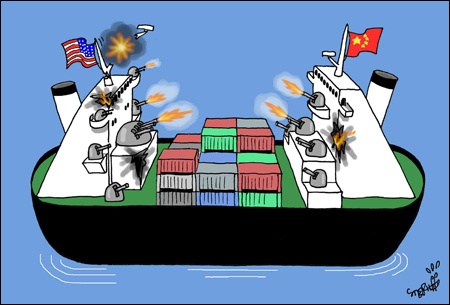
Just a few weeks back I engaged in wishful speculation that Trump’s drastic imposition of “reciprocal” and punitive tariffs could actually prove to be a free-trade play, but only if the U.S. used its universally dominant position in trade wisely at the bargaining table. I worried, however, that any notion Trump might have along those lines was eclipsed by his antipathy for otherwise harmless trade deficits. Another bad indicator was his conviction that manipulating tariffs could restore “fairness” in trade relations while raising revenue to pay for the selective tax cuts he promised for tips, overtime wages, and social security benefits.

Aside from that, I won’t repeat all of Trump’s fallacies about trade (and see here and here) except where they’ve impinged on recent developments.

One Raw Deal

My hopes for reduced trade barriers were dashed when the first “deal” (or really a “Memorandum of Understanding”) was announced with the United Kingdom. The U.S. runs a trade surplus with the UK, so one might think Trump would find it unnecessary to levy tariffs on U.S. imports from the UK. No dice! Clearly this was not motivated by the trade deficit bogeyman of Trump’s fever dreams. The White House stated that buyers of goods from the UK will pay the minimum 10% tariff (up from 3.3% before Trump took office).

Trump simply likes tariffs. Apparently he’s never given much thought to their incidence, which falls largely on domestic consumers and businesses. The MAGA faithful are in blissful denial that such a burden exists, despite ample evidence of its reality.

As Eric Boehm notes, the U.S. received a few concessions on British tariffs under the deal, but the reductions only amount to about a 2% equivalent. There are sharp reductions in special tariffs on U.S. agricultural products, especially meat. There are also exceptions to tariffs on certain British goods, like autos (up to 100,000 units). The selective nature of the concessions on both sides underscores the cronyist underpinnings of this style of economic governance, which amounts to ad hoc central planning.

Also troubling is the misleading spin the Administration attempted to put on news coverage of the deal. They claimed to have reduced tariffs of goods imported from the UK, which is true only in comparison to post-“Liberation Day” tariff levels established in early April. In fact, the baseline tariff now applied to most UK goods sold in the U.S. has more than tripled since last year! As Boehm states, American consumers and businesses are paying a lot more for this “deal” than their British counterparts.

Raw Deals To Be?

The “deal” with China is worse, partly because it’s only a 90-day pause in implementation (pending negotiation), and partly because the “reciprocal” tariff rate of 30% applied to Chinese goods is much higher than before Trump imposed the punitive rates. Still worse, the 10% tariff on U.S. exports to China applied during the pause is also much higher. What a deal! And it could get worse. These tariff hikes have little to do with “national security” and they are regressive, having disproportionately large burdens on lower-income consumers and small businesses.

The only other agreement announced thus far is with India. It is not a “trade deal” at all, but a so-called “Terms of Reference On Bilateral Trade Agreement”. It is a “roadmap” for future negotiations. Perhaps it will come together quickly, but it’s hard to expect much after the UK agreement.

Uniting Western Civilization

Just this week we had another hardball move by Trump: a 50% tariff on goods from the European Union starting in June, up from an average of about 3.8% on a trade-weighted basis. The new tariff rate is also higher than the 10% baseline tariff in place since the 90-day pause was announced in April. Trump claims the EU has been levying tariffs of 39% on U.S. goods, which might include what the Administration would call effective tariffs from non-tariff barriers to trade. Or it might refer to retaliatory tariffs announced by the EU in response to Trump’s Liberation Day announcement, but all of those have been paused. In any case, the World Trade Organization says EU tariffs on US goods average 4.8%. Quite a difference!

The move against the EU is much like Trump’s earlier ploy with China, but he says he’s “not looking for a deal”. He also says talks with the EU are “going nowhere”, though the Polish Trade Minister reassures that talks are “ongoing”. The outcome is likely to be a disappointment for anyone (like me) hoping for freer trade. The EU will probably make commitments to buy something from the U.S., maybe beef or liquified natural gas. But U.S. tariffs on EU goods will be higher than in the past.

So, thus far we have only one “deal” (such as it is), one roadmap for negotiations to follow, and a bunch of pauses pending negotiation (China included). The Trump team says about 100 countries hope to negotiate trade deals, but that is a practical impossibility. Even Trump says “… it’s not possible to meet the number of people that want to see us.” But it could be easy: just drop all U.S. trade barriers and allow protectionist countries to tax their own citizens, denying them access to free choice.

Bullying Enemies, Allies and Producers

Higher U.S. tariffs will put some upward pressure on the prices of imports and import-competing goods. We haven’t seen this play out just yet, but it’s early. In a defensive move, Trump is attempting to bully and shame domestic companies such as WalMart for attempting to protect their bottom lines in the face of tariffs. He also warned automakers about their pricing before carving out an exception for them. And now Apple has been singled-out by Trump for a special 25% tariff after it had announced plans to move assembly of iPhones to India, rather than in the U.S.

You better stay on Trump’s good side. This is a loathsome kind of interference. It encourages firms to seek favors in the form of tariff exemptions or to accept what amounts to state expropriation of profits. Cronyism and coercion reign.

Swamped By Spendthrifts?

The market seems to believe the negative impact of tariffs on economic growth will be more than offset by other stimulative forces. This includes the extension of Trump’s 2017 tax cuts. The so-called “big beautiful bill” passed by the House of Representatives also includes new tax breaks on tip and overtime pay, and an increase in the deduction for state and local taxes. While the bill reduces the growth of federal spending, there is disappointment that spending wasn’t reduced. The Senate might pass a version with more cuts, but the market sees nothing but deficits going forward. This is not the sort of “fiscal restraint” the market hoped for, particularly with escalating interest costs on the burgeoning federal debt.

Conflicting Goals

Trump has bargained successfully for some major investments in the U.S. by wealthy nations like Saudi Arabia and Dubai, as well as a few major manufacturing and technology firms. That’s wonderful. He doesn’t understand, however, that strong foreign investment in the U.S. will encourage larger trade deficits. That’s because foreign capital inflows raise incomes, which increase demand for imports. In addition, the capital inflows cause the value of the dollar to appreciate, making imports cheaper but exports more expensive for foreigners. It would be a shame if Trump reacted to these eventualities by doubling down on tariffs.

Conclusion

Alas, my hopes that Trump’s bellicose trade rhetoric was mere posturing were in vain. He could have used our dominant trading position to twist arms for lower trade barriers all around. While I worried that he massively misunderstood the meaning of trade deficits, and that he viewed higher tariffs as a magic cure, I should have worried much more!
Trade Charades and a Capital Crusade

15 Tuesday Apr 2025

Posted by Nuetzel in Balance of Payments, Federal Budget, Protectionism

≈ 4 Comments

Tags

Balance of Payments, Capital Account, Capital Deepening, Capital Surplus, central planning, Cronyism, Current Account, Donald Trump, Federal Budget Deficit, John Cochrane, Reciprocal Tariffs, Scott Lincicome, Trade Barriers, Trade Deficit

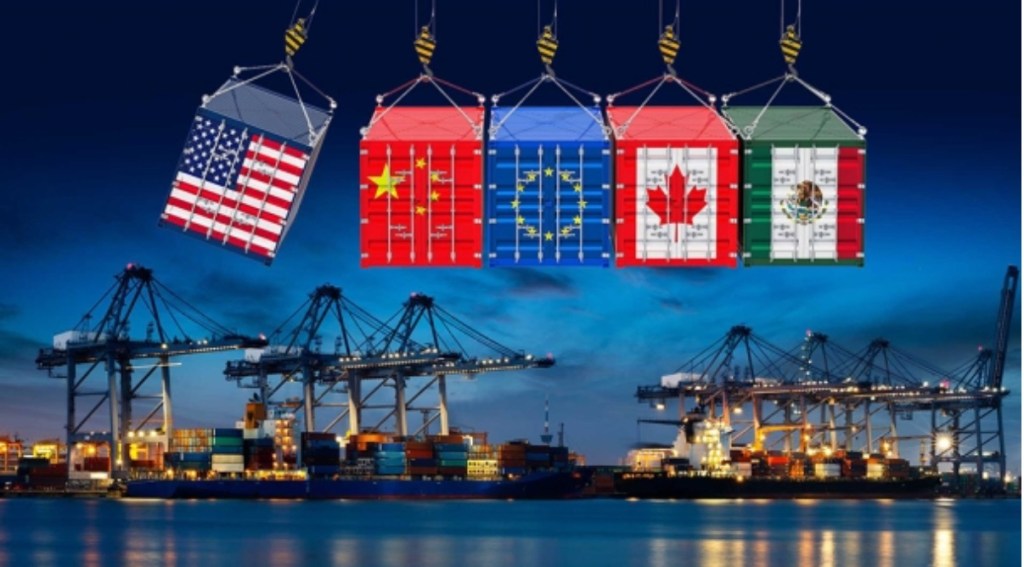
I’m nowhere near eating crow over the skepticism I’ve directed at Donald Trump’s trade offensive. The uncertainty created by his erratic policy changes is very likely to drag the U.S. into recession. However, there were signs last week of movement in a more promising direction, as he placed a 90-day pause on the targeted “reciprocal” tariffs announced in early April. However, a “baseline” universal tariff of 10% still applies to all imported goods. So do tariffs targeted at China, which have ratcheted up through a few rounds of retaliation. Now, he’s announced exemptions for some key electronics products, many of which come from China, and there are signs that he’s ready to exempt imports of auto parts. Needless to say, the tariffs and their exemptions represent an ill-advised escapade in central planning, replete with ample opportunities for politically-motivated favoritism and prejudice.

Why the Pause?

The pause in reciprocal tariffs was ostensibly intended to allow time to negotiate lower trade barriers with “more than 75 countries” that came forward to engage with Trump rather than retaliate. Now, there are said to be as many as 90 countries that wish to negotiate. This more or less aligns with an evolution of the strategy I described in my last post: game theory suggests that a dominant trading partner may be able to threaten or impose higher tariffs and ultimately achieve agreement on a regime with lower trade barriers on both sides. In Trump’s case, that would involve reaching many different bilateral agreements within a very short time, an imposing challenge given the history of trade negotiations. So far we have no deals, though Trump claims some are close. If only we didn’t have to reach formal agreements not to interfere with mutually beneficial trade!

A debate ensued almost immediately over whether Trump’s pause showed that he “caved” to the negative market reaction to his tariffs, but perhaps he acted primarily because a number of nations approached with hats in hand. Trump knew he had the leverage to force other nations to make concessions on trade barriers. They obviously responded.

The timing of the pause was surely a combination of those overtures, market reaction, advisor opinion, and Trump’s own instincts. This view is buttressed by the unaltered universal 10% tariffs, the remaining special tariffs on specific nations and product categories, and the punative tariffs on China. Furthermore, Trump knows he can reimpose a targeted tariff on any country that refuses a deal satisfactory to him. Let’s hope he’s reasonable and doesn’t allow his love affair with tariffs to color his position in these talks.

My hope is that the Trump Administration can negotiate a large number of new agreements with trading partners to reduce or eliminate tariffs and other barriers to trade. Obviously the pause is no guarantee of success, and severe challenges remain with more belligerent trading partners, especially China.

Disclaimer!

None of the foregoing is intended as a dispensation for the many apparent misconceptions Trump has about trade. In the MAGA cult clamor to defend all-things Trump, there have been a number of absurd claims about tariffs and trade, such as: tariffs are not a tax; tariffs don’t raise the price of imports; trade deficits are a deduction from GDP; tariffs can replace the income tax; trade deficits will bankrupt the country; high tariffs produced rapid growth in the late 19th century; “reciprocal” tariffs will eliminate our bilateral trade deficits; U.S. manufacturing is in crisis; value added taxes are trade barriers; it’s better to export goods than services; and trade deficits reduce investment. Every one a laugher, but I’ll leave most of them aside for now.

In the remainder of this post, I’ll focus on Trump’s aims for coaxing firms, via tariff avoidance, to make capital investment in the U.S., and the implications of that effort for the trade balance. An influx of capital might be construed as a strength of Trump’s policy agenda, though his effort to “cut deals” in this manner is a form of economic meddling as well as a vehicle for cronyism. Moreover, he doesn’t understand the nexus between foreign investment, the federal deficit, and the balance of payments. He’ll be disappointed to learn that his notion that trade deficits are ruinous conflicts with his vision of encouraging foreign accumulations of productive U.S. assets.

Oh No! A Capital Surplus!

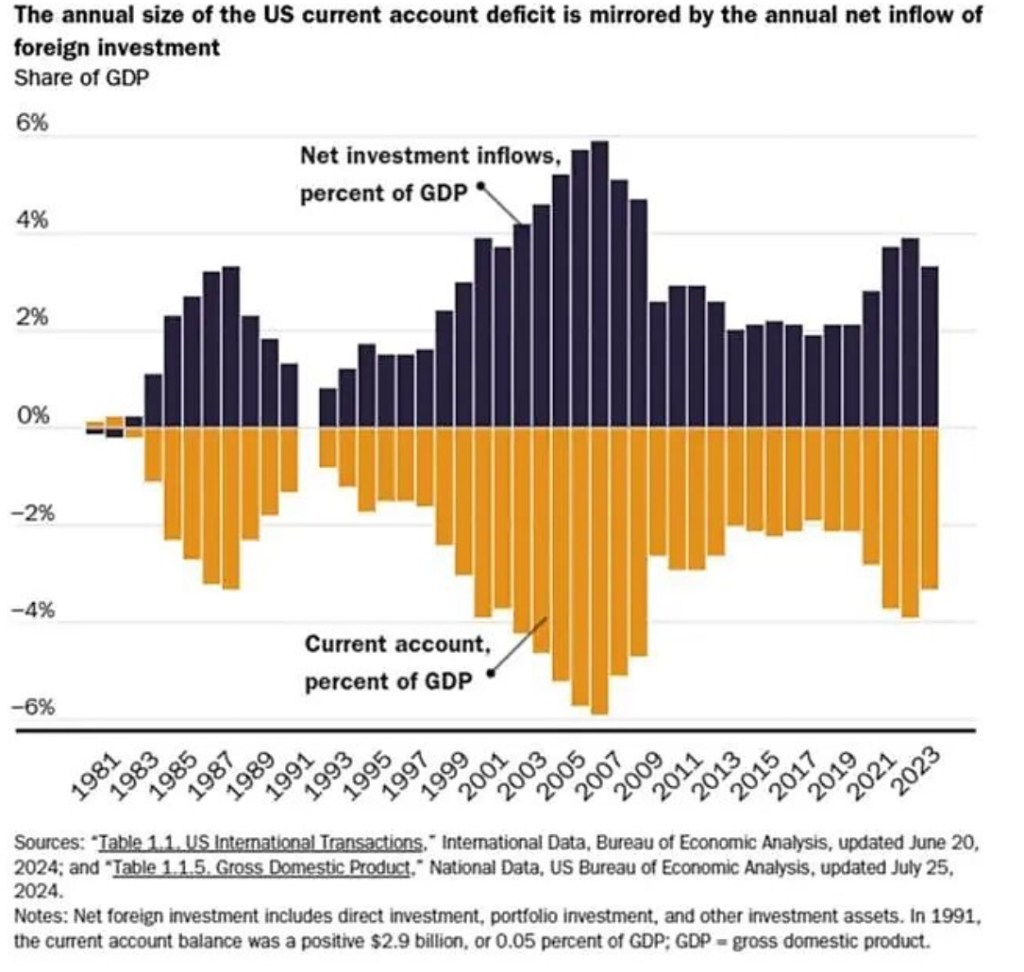
It isn’t a widely understood equivalence, but each year we have a surplus in foreign purchases of U.S. assets (the capital account surplus) that is roughly matched by a deficit in trade for foreign goods and services (the current account deficit). This is why the balance of payments (BoP) balances! Here is the near mirror image of these two sides of the BoP, from Scott Lincicome’s “Things Everyone Should Know about Trade Deficits”:

The two sides of the BoP are very much codetermined. One does not exclusively drive the other.

It’s wonderful to be in a position to avail ourselves of foreign savings to invest in our economy. Unfortunately, a large portion of this foreign investment finances our huge government budget deficit, and that is a real problem. Otherwise, the investment would make a greater contribution to U.S. growth.

Funding the Federal Deficit

As John Cochrane explains, transfer payments account for a large share of government spending and borrowing. In turn, these transfers are spent by recipients on consumer goods, some of which come from overseas. Cochrane emphasizes that we are borrowing from abroad, as shown by our capital surplus, to finance this consumption, rather than investing foreign capital in productive assets. While one might conclude that our capital surplus and our trade deficit are creating a long-term vulnerability, the root of the problem is the federal government’s largess.

There is a sense in which different prongs of Trump’s policy agenda could act to address this problem. These are his efforts to reduce government waste, deregulate, and encourage direct investment in new plant and equipment. Reducing the federal budget deficit is paramount, but huge doubts remain over his determination to control spending or undertake real entitlement reforms. Tariffs will generate some revenue, but part of that will be required to offset other tax breaks Trump is contemplating.

Deepening the Capital Base

Trump harps on the need for firms, both foreign and domestic, to produce goods here in the U.S. Currently he’s taking credit for $5 trillion of new investment in the U.S., though we really don’t know whether all of these are “new deals” or had already been planned. Deregulation can improve incentives to invest in physical capital and increase the speed with which it comes online. To the extent that investment in productive capital replaces government borrowing, the debt we accumulate (held by foreign and domestic lenders) will be more sustainable.

However, Trump seems oblivious to a fact made inescapable by the balance of payments relationship. This new investment, should it come to fruition, will bring with it future excesses of imports over exports. Foreign demand for U.S. capital assets lifts domestic income and leads to a stronger dollar, both of which boost imports and the trade deficit. The trade deficit will persist even if foreign investment in new factories fully replaces the bloated federal deficit as a use of foreign capital.

Of course, the intent of Trump’s reshoring campaign is for new domestic output to substitute for imports and increase exports. That would bring positive returns for domestic and foreign capital, but rising income and a stronger dollar will stimulate demand for other imports, while exports would flag with the strength of the dollar. In any case, the new investments and a larger capital surplus will increase the trade deficit.

Trade Enragement Syndrome

31 Sunday Jul 2016

Posted by Nuetzel in Free Trade, Protectionism

≈ Leave a comment

Tags

Bernie Sanders, Capital Account Surplus, Don Boudreaux, Donald Trump, Free trade, Geocentrism, Heliocentrism, Import Competition, monopoly power, NAFTA, Protectionism, Trade Deficit, Trans-Pacific Partnership

tradebarriers

Trade makes us richer, not poorer. The anti-trade rhetoric spouted by neo-mercantilists like Donald Trump and Bernie Sanders is about as sensible as a boycott on goods produced in the next town, or for that matter, on anyone with whom one might otherwise choose to trade. Don Boudreaux perfectly captures my feelings about the rising trend of protectionist sentiment by comparing it to geocentrism:

“Lately I feel as I imagine an astronomer would today feel if, centuries after Copernicus and Galileo proved beyond a shadow of a doubt that the earth isn’t the center of the solar system, large numbers of people – including popular media pundits and politicians – began to insist that the sun and the planets and the stars do indeed all revolve around a stationary earth that is situated in the center of the universe.“

The very motivation for trade is to obtain something of value that one did not produce, to acquire that which one cannot easily acquire without trade, or to acquire it on more favorable terms than otherwise. It recognizes the reality that one’s productive efforts should be focused in an area that best suits their skills or natural talents. That’s better for the individual and better for society! Countries should produce what they are best at producing, which gives them a cost advantage in their areas of specialization. Trade allows individuals and nations to specialize in production but diversify in consumption, allowing them to enjoy access to the broadest possible range of goods and services produced worldwide.

The consummation of any trade heralds the attainment of mutual benefits to the parties: one produces and employs at a profit; the other consumes a thing of greater value than the price paid. The payments for foreign goods must come from either domestically-produced goods or from foreign investment in domestic real estate, buildings, factories or other real and financial assets. That is, if we purchase more goods from abroad than we export, then foreigners must either hold the dollars they receive or invest them in other ways. The latter represent trades in assets, and those trades, too, are mutually beneficial. The result is that U.S. investors gain and/or the economy benefits from new, productivity-enhancing plant and equipment, not terrible outcomes. Trade deficits are balanced by capital surpluses, and trade surpluses are balanced by capital deficits. Taken together, trade in goods and capital (assets) always balance and are mutually beneficial in every case, whether we run a trade deficit or a surplus.

That said, it’s worth emphasizing that so-called free trade agreements are something of a sham. Countries don’t trade. People do. Unfortunately, I have indulged the notion of national trade negotiation in the past, if only implicitly, by vouching for trade agreements like NAFTA and TPP as sort of second-best solutions to the horrid reality of trade restrictions promulgated by protectionist politicians. I reasoned that dismantling those barriers, one-country (or region) at-a-time was preferable to doing nothing. However, negotiations like these become mired in extraneous issues such as environmental policies, labor laws, immigration rules and other commercial policies. Nor do those negotiations always inhibit domestic subsidies to politically-favored activities. Indeed, they might actually encourage subsidies for value-eroding projects. Again, the entire process of trade negotiations is extraneous to the extent that trade takes place between individuals. Unfettered gains from trade require the absence of trade barriers. Dropping them unilaterally would benefit consumers, encourage efficiency by domestic producers, and provide a great example for other nations.

Opponents of trade, like Messrs. Trump and Sanders, lack a basic understanding of the reasons why individuals engage in cooperative exchange. Or at least they fail to acknowledge, for political reasons or sheer density, that what improves well-being at home is freedom to transact, across our borders as well as within our borders. To prevent this activity is to forcibly deny individual freedom. Boudreaux makes this point be asking trade opponents a series of questions, the first few of which are listed below:

“– Are you made richer if the supermarket … at which you once shopped hires armed goons to force you to start shopping there again?

– Do you believe that the owners and the employees of [that store] are so ethically entitled to your continuing patronage as a consumer that they are justified in employing armed goons to prevent you from shopping elsewhere?

– Do you believe that, now that [the store] has successfully forced you not to shop at competing supermarkets, that the owners and employees … will work as diligently and as creatively as possible to keep the prices they charge low and the quality of their service high?

– Do you believe that the higher profits and higher wages reaped by [the store’s] owners and workers as a result of their holding you hostage as a customer make you more prosperous?

– Do you believe that the higher profits and higher wages reaped by [the store’s] owners and workers as a result of their holding you hostage as a customer make your community more prosperous, even though [the store’s] higher profits and higher wages are necessarily funded by money that you and other … ‘customers’ are forced not to spend on other goods, services, or investment options?

– If you believe that [the store] has a right to force you not to shop for food at other supermarkets, do you believe also that [the store] has a right to force you not to grow more of your own food, or not to eat out more often at restaurants, or not to go on a diet?“

It is difficult to believe that educated people believe restrictions on the freedom of individuals to cooperate with others will improve their well being. Of course, those educated people are often politicians who stand to benefit from frightening voters, and who have no interest in reminding them that a flow of foreign goods broadens choices, reduces prices, and provides valuable discipline to domestic businesses. Without competitive discipline, we forgo important benefits and instead allow quality and price to come under the arrogant power of monopolists. There are, of course, many producers who are willing to provide meaningful support to politicians who will protect them from foreign competition. That’s not capitalism. Its cronyism!


Good Leaders Aren’t Trade Warriors

30 Wednesday Mar 2016

Posted by Nuetzel in Free Trade, Protectionism

≈ 1 Comment

Tags

Bernie Sanders, CATO Institute, Currency Manipulation, Daniel J. Ikenson, Direct Foreign Investment, Don Boudreaux, Donald Trump, Dumping, Federal Reserve, Free trade, Hillary Clinton, NAFTA, Open Trade, Paul Krugman, People's Bank of China, Predatory Pricing, Protectionism, Reserve Currency, Ted Cruz, TPP, Trade Deficit, Trade War, Unfair Competition

Protectionism

The protectionist foreign trade rhetoric issued by the major-party presidential candidates is intended to appeal to ignorant economic instincts. Donald Trump and Bernie Sanders come to mind most readily, but Ted Cruz and Hillary Clinton are jumping in with similar campaign positioning. The thrust of these populist, anti-trade appeals is that America is losing jobs to “unfair” foreign competition, an argument that distorts the very objective of trade: consumers take part in exchange in order to consume; they capture value from high quality, unique merchandise and competitive terms. Ultimately, producers engage in trade to gain the wherewithal to consume. Consumption is the real end-game.

It can be misleading to talk about “nations” engaging in trade with each other, despite the emphasis placed on trade agreements like NAFTA and TPP. In the first place, it is better to stress consumers and producers, rather than “nations”, because most foreign trade is private, cooperative activity, not national decision-making. But the candidates persist in characterizing trade as a “contest”. That misleading notion is what prompts governments to muck up the trade environment by imposing restrictions on the free flow of goods and services. Trade agreements have been heralded as great achievements, but they never approximate a regime of truly liberalized trade because the latter requires no formal agreement whatsoever, merely a hands-off approach by government. And trade agreements tend to entangle trade issues with other policy objectives, holding consumers hostage in the process.

We hear from opportunistic candidates that jobs are lost to trade with foreigners. But again, consumption, not “jobs” per se, is the real objective of economic activity. If domestic jobs are lost, it is generally because consumers judge the value produced inferior to what’s offered from abroad. American consumers should not be obliged to support inferior value, domestic market power unchecked by competition, monopoly prices and limited choices. Patriotic jingoism attempts to blind us from these economic imperatives.

The standard protectionist narrative is that foreign “nations” cheat on trade with the U.S. via currency manipulation, predatory pricing or “dumping”, “unfair” wages or other unfair labor practices. Do any of these objections to free trade hold water?

The “fairness” of foreign wages and labor practices is a matter of perspective. Wages cannot be considered unfair merely because they are low relative to U.S. wages. Wages paid to workers by foreign exporters tend to be consistent with the standard of living in those societies, and they are often some of the best income opportunities available there. This is economic dynamism that lifts masses from the grips of poverty. It’s absurd to caste it as “exploitation”.

Is it “unfair” to competitors in the U.S.? Not if they know how to compete and are allowed to do so. Unfortunately, government regulatory policies in the U.S. often present obstacles to the competitiveness of domestic producers. This is well-illustrated by Daniel J. Ikenson of The CATO Institute in “Crucifying Trade For The Sins Of Domestic Policy“. He emphasizes that trade promotes economic growth, but when it causes job losses for some workers, U.S. economic policies make it difficult for those workers to find new jobs.

“Incentivize businesses to hire people to train them in exchange for their commitment to work for the company for a period of time. Reform a corporate tax system that currently discourages repatriation of an estimated $2 trillion of profits parked in U.S. corporate coffers abroad, deterring domestic investment, which is needed for job creation. Curb excessive and superfluous regulations that raise the costs of establishing and operating businesses without any marginal improvements in social, safety, environmental, or health outcomes. Permanently eliminate imports duties on intermediate goods to reduce production costs and make U.S.-based businesses more globally competitive. Advocate the retirement of protectionist occupational licensing practices.“

So-called “dumping” by foreign producers, or selling below cost, is an unsustainable practice, by definition. Pricing below cost is difficult to prove, especially if local wages are low and raw inputs are plentiful. If dumping can be proven, retaliation might feel good but would punish American consumers. A foreign producer might be subsidized by its government as a matter of industrial policy and economic planning, an unhealthy policy to begin with, and possibly to facilitate a long-run market advantage in foreign trade. The U.S. itself is thick with subsidized industry, however, so arguing for retaliation on those grounds is more than a little hypocritical.

I rarely quote Paul Krugman, but when I do, it’s from work he’s done as an actual economist, not as an agenda-driven pundit. So we have the following Krugman quote courtesy of Don Boudreaux:

“I believe that if the rhetoric that portrays international trade as a struggle continues to dominate the discourse, then policy debate will in the end be dominated by men like [James] Goldsmith, who are willing to take that rhetoric to its logical conclusion. That is, trade will be treated as war, and the current system of relatively open world markets will disintegrate because nobody but a few professors believes in the ideology of free trade.

And that will be a shame, because for all their faults the professors are right. The conflict among nations that so many policy intellectuals imagines prevails is an illusion; but it is an illusion that can destroy the reality of mutual gains from trade.“

David Harsanyi asks how American consumers will like more restrictive trade policy when forced to pay more for smart phones, laptops, HDTVs, cars, food, and any number of other goods. The usual anti-trade narrative is that foreign producers have harmed the manufacturing sector disproportionately, but in another article, Ikenson lays bare the fallacy that U.S. manufacturing has been victimized by trade.

The consequences of trade restrictions are higher prices, reduced production and reduced consumption, an undesirable combination of outcomes. This means higher prices of imported goods as well as domestic goods, whose producers will face less competition by virtue of the trade barriers. With reduced availability of imported goods, economic theory predicts that domestic producers will not fully meet the frustrated demands. This is a classic response of producers with monopoly power: restraint of trade. The negative consequences are compounded when foreign governments impose retaliatory measures against the U.S., harming American exporters.

A further misgiving expressed by politicians regarding free trade is that America’s trade deficit implies greater indebtedness to the rest of the world. This argument has been made by a few leftist economists who misunderstand the nature of direct investment, and who tend to think erroneously of economic outcomes as zero-sum. It’s true that foreign producers who receive dollars in exchange for goods often invest those proceeds in U.S. assets. A fairly small share of that investment is in debt issued by U.S. governments and private companies. But a much larger share is invested in U.S. equities and real assets, which are not U.S. debts. As Don Boudreaux points out, the domestic sellers of those assets generally reinvest in other U.S. assets, so private U.S. ownership of global capital is not diminished by increased foreign investment in the U.S.

An interesting aspect of the trade debate is that the dollar’s role as a global reserve currency implies that the U.S. must run a chronic trade deficit. The rest of the world uses dollars to trade goods and assets, but to acquire dollars, foreigners must sell things to holders of dollars in the U.S. This keeps the foreign exchange value of the dollar elevated, which makes imports cheaper to Americans and U.S. exports more costly to foreigners. Those dollars are a form of U.S. debt, but it is debt for which we should feel flattered, as long as confidence in the dollar remains. A diminished role for the dollar in world trade would lead to a surplus of dollars, undermining its value and promoting inflation in the U.S. Let’s hope for a gradual transition to that world.

Finally, the presidential candidates allege that foreign currency manipulation is another reason for American job losses. One prominent example occurred last year when China allowed the renminbi to decline to more realistic levels on foreign exchange markets. Donald Trump called this an unfair trade tactic, but apparently the People’s Bank felt that it couldn’t support the renminbi without undermining economic growth. The earlier dollar peg also helped to keep Chinese inflation in check. Contrary to Trump’s assertions, if China stopped manipulating its currency altogether, the renminbi would go even lower!

Beyond the opportunistic political arguments, the point is that central banks (including the U.S. Federal Reserve) manage their currencies to achieve a variety of objectives, not merely to promote exports. That is not an endorsement of such policies. It is an objective fact. Anyone can argue that a foreign currency is “too low” if their objective is to demonize a country and it’s exports to the U.S., but the assertion may not be grounded in facts as markets assess them.

The arguments against open trade policies are generally specious, hypocritical or grounded in a mentality of victimhood. Vibrant producers who are free of government restrictions should welcome the expanded markets available to them abroad and should not seek redress against competition via government protection. Liberalized trade has engendered tremendous economic benefits over the years, while protectionist policies have only brought severe contractions. Let’s be free and trade freely!


Follow Sacred Cow Chips on WordPress.com

Recent Posts

  • The Case Against Interest On Reserves
  • Immigration and Merit As Fiscal Propositions
  • Tariff “Dividend” From An Indigent State
  • Almost Looks Like the Fed Has a 3% Inflation Target
  • Government Malpractice Breeds Health Care Havoc

Archives

  • January 2026
  • December 2025
  • November 2025
  • October 2025
  • September 2025
  • August 2025
  • July 2025
  • June 2025
  • May 2025
  • April 2025
  • March 2025
  • February 2025
  • January 2025
  • December 2024
  • November 2024
  • October 2024
  • September 2024
  • August 2024
  • July 2024
  • June 2024
  • May 2024
  • April 2024
  • March 2024
  • February 2024
  • January 2024
  • December 2023
  • November 2023
  • August 2023
  • July 2023
  • June 2023
  • May 2023
  • April 2023
  • March 2023
  • February 2023
  • January 2023
  • December 2022
  • November 2022
  • October 2022
  • September 2022
  • August 2022
  • July 2022
  • June 2022
  • May 2022
  • April 2022
  • March 2022
  • February 2022
  • January 2022
  • December 2021
  • November 2021
  • October 2021
  • September 2021
  • August 2021
  • July 2021
  • June 2021
  • May 2021
  • April 2021
  • March 2021
  • February 2021
  • January 2021
  • December 2020
  • November 2020
  • October 2020
  • September 2020
  • August 2020
  • July 2020
  • June 2020
  • May 2020
  • April 2020
  • March 2020
  • February 2020
  • January 2020
  • December 2019
  • November 2019
  • October 2019
  • September 2019
  • August 2019
  • July 2019
  • June 2019
  • May 2019
  • April 2019
  • March 2019
  • February 2019
  • January 2019
  • December 2018
  • November 2018
  • October 2018
  • September 2018
  • August 2018
  • July 2018
  • June 2018
  • May 2018
  • April 2018
  • March 2018
  • February 2018
  • January 2018
  • December 2017
  • November 2017
  • October 2017
  • September 2017
  • August 2017
  • July 2017
  • June 2017
  • May 2017
  • April 2017
  • March 2017
  • February 2017
  • January 2017
  • December 2016
  • November 2016
  • October 2016
  • September 2016
  • August 2016
  • July 2016
  • June 2016
  • May 2016
  • April 2016
  • March 2016
  • February 2016
  • January 2016
  • December 2015
  • November 2015
  • October 2015
  • September 2015
  • August 2015
  • July 2015
  • June 2015
  • May 2015
  • April 2015
  • March 2015
  • February 2015
  • January 2015
  • December 2014
  • November 2014
  • October 2014
  • September 2014
  • August 2014
  • July 2014
  • June 2014
  • May 2014
  • April 2014
  • March 2014

Blogs I Follow

  • Passive Income Kickstart
  • OnlyFinance.net
  • TLC Cholesterol
  • Nintil
  • kendunning.net
  • DCWhispers.com
  • Hoong-Wai in the UK
  • Marginal REVOLUTION
  • Stlouis
  • Watts Up With That?
  • Aussie Nationalist Blog
  • American Elephants
  • The View from Alexandria
  • The Gymnasium
  • A Force for Good
  • Notes On Liberty
  • troymo
  • SUNDAY BLOG Stephanie Sievers
  • Miss Lou Acquiring Lore
  • Your Well Wisher Program
  • Objectivism In Depth
  • RobotEnomics
  • Orderstatistic
  • Paradigm Library
  • Scattered Showers and Quicksand

Blog at WordPress.com.

Passive Income Kickstart

OnlyFinance.net

TLC Cholesterol

Nintil

To estimate, compare, distinguish, discuss, and trace to its principal sources everything

kendunning.net

The Future is Ours to Create

DCWhispers.com

Hoong-Wai in the UK

A Commonwealth immigrant's perspective on the UK's public arena.

Marginal REVOLUTION

Small Steps Toward A Much Better World

Stlouis

Watts Up With That?

The world's most viewed site on global warming and climate change

Aussie Nationalist Blog

Commentary from a Paleoconservative and Nationalist perspective

American Elephants

Defending Life, Liberty and the Pursuit of Happiness

The View from Alexandria

In advanced civilizations the period loosely called Alexandrian is usually associated with flexible morals, perfunctory religion, populist standards and cosmopolitan tastes, feminism, exotic cults, and the rapid turnover of high and low fads---in short, a falling away (which is all that decadence means) from the strictness of traditional rules, embodied in character and inforced from within. -- Jacques Barzun

The Gymnasium

A place for reason, politics, economics, and faith steeped in the classical liberal tradition

A Force for Good

How economics, morality, and markets combine

Notes On Liberty

Spontaneous thoughts on a humble creed

troymo

SUNDAY BLOG Stephanie Sievers

Escaping the everyday life with photographs from my travels

Miss Lou Acquiring Lore

Gallery of Life...

Your Well Wisher Program

Attempt to solve commonly known problems…

Objectivism In Depth

Exploring Ayn Rand's revolutionary philosophy.

RobotEnomics

(A)n (I)ntelligent Future

Orderstatistic

Economics, chess and anything else on my mind.

Paradigm Library

OODA Looping

Scattered Showers and Quicksand

Musings on science, investing, finance, economics, politics, and probably fly fishing.

  • Subscribe Subscribed
    • Sacred Cow Chips
    • Join 128 other subscribers
    • Already have a WordPress.com account? Log in now.
    • Sacred Cow Chips
    • Subscribe Subscribed
    • Sign up
    • Log in
    • Report this content
    • View site in Reader
    • Manage subscriptions
    • Collapse this bar
 

Loading Comments...