• About

Sacred Cow Chips

Sacred Cow Chips

Tag Archives: Zero-Carbon

Wind and Solar Power: Brittle, Inefficient, and Destructive

03 Thursday Nov 2022

Posted by Nuetzel in Environment, Nuclear power, Renewable Energy, Uncategorized

≈ 1 Comment

Tags

@MartialData1, @Mining_Atoms, B. F. Randall, Baseload Power, Blake Lovewall, Carbon Credits, Carbon Sink, Dispatchable Power, Fossil fuels, Greenwashing, Grid Stability, Intermittency, Land Use, Martian Data, Nuclear power, Plant Life Cycle, Polysilicons, Renewable energy, Solar Power, Turbine Blades, Wind Power, Zero-Carbon
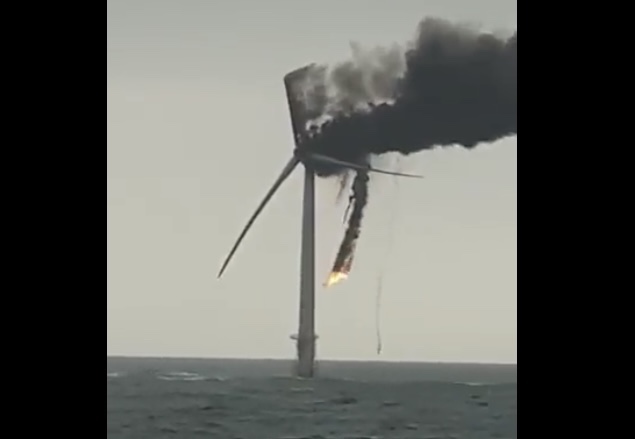
Just how renewable is “renewable” energy, or more specifically solar and wind power? Intermittent though they are, the wind will always blow and the sun will shine (well, half a day with no clouds). So the possibility of harvesting energy from these sources is truly inexhaustible. Obviously, it also takes man-made hardware to extract electric power from sunshine and wind — physical capital— and it is quite costly in several respects, though taxpayer subsidies might make it appear cheaper to investors and (ultimately) users. Man-made hardware is damaged, wears out, malfunctions, or simply fails for all sorts of reasons, and it must be replaced from time to time. Furthermore, man-made hardware such as solar panels, wind turbines, and the expansions to the electric grid needed to bring the power to users requires vast resources and not a little in the way of fossil fuels. The word “renewable” is therefore something of a misnomer when it comes to solar and wind facilities.

Solar Plant

B. F. Randall (@Mining_Atoms) has a Twitter thread on this topic, or actually several threads (see below). The first thing he notes is that solar panels require polysilicon, which not recyclable. Disposal presents severe hazards of its own, and to replace old solar panels, polysilicon must be produced. For that, Randall says you need high-purity silica from quartzite rock, high-purity coking coal, diesel fuel, and large flows of dispatchable (not intermittent) electric power. To get quartzite, you need carbide drilling tools, which are not renewable. You also need to blast rock using ammonium nitrate fuel oil derived from fossil fuels. Then the rock must be crushed and often milled into fine sand, which requires continuous power. The high temperatures required to create silicon are achieved with coking coal, which is also used in iron and steel making, but coking coal is non-renewable. The whole process requires massive amounts of electricity generated with fossil fuels. Randall calls polysilicon production “an electricity beast”.

Greenwashing

The resulting carbon emissions are, in reality, unlikely to be offset by any quantity of carbon credits these firms might purchase, which allow them to claim a “zero footprint”. Blake Lovewall describes the sham in play here:

“The biggest and most common Carbon offset schemes are simply forests. Most of the offerings in Carbon marketplaces are forests, particularly in East Asian, African and South American nations. …

The only value being packaged and sold on these marketplaces is not cutting down the trees. Therefore, by not cutting down a forest, the company is maintaining a ‘Carbon sink’ …. One is paying the landowner for doing nothing. This logic has an acronym, and it is slapped all over these heralded offset projects: REDD. That is a UN scheme called ‘Reduce Emissions from Deforestation and Forest Degradation’. I would re-name it to, ‘Sell off indigenous forests to global investors’.”

Lovewall goes on to explain that these carbon offset investments do not ensure that forests remain pristine by any stretch of the imagination. For one thing, the requirements for managing these “preserves” are often subject to manipulation by investors working with government; as such, the credits are often vehicle for graft. In Indonesia, for example, carbon credited forests have been converted to palm oil plantations without any loss of value to the credits! Lovewall also cites a story about carbon offset investments in Brazil, where the credits provided capital for a massive dam in the middle of the rainforest. This had severe environmental and social consequences for indigenous peoples. It’s also worth noting that planting trees, wherever that might occur under carbon credits, takes many years to become a real carbon sink.

While I can’t endorse all of Lovewall’s points of view, he makes a strong case that carbon credits are a huge fraud. They do little to offset carbon generated by entities that purchase them as offsets. Again, the credits are very popular with the manufacturers and miners who participate in the fabrication of physical capital for renewable energy installations who wish to “greenwash” their activities.

Wind Plant

Randall discusses the non-renewability of wind turbines in a separate thread. Turbine blades, he writes, are made from epoxy resins, balsa wood, and thermoplastics. They wear out, along with gears and other internal parts, and must be replaced. Land disposal is safe and cheap, but recycling is costly and requires even greater energy input than the use of virgin feedstocks. Randall’s thread on turbines raised some hackles among wind energy defenders and even a few detractors, and Randall might have overstated his case in one instance, but the main thrust of his argument is irrefutable: it’s very costly to recycle these components into other usable products. Entrepreneurs are still trying to work out processes for doing so. It’s not clear that recycling the blades into other products is more efficient than sending them to landfills, as the recycling processes are resource intensive.

But even then, the turbines must be replaced. Recycling the old blades into crates and flooring and what have you, and producing new wind turbines, requires lots of power. And as Randall says, replacement turbines require huge ongoing quantities of zinc, copper, cement, and fossil fuel feedstocks.

The Non-Renewability of Plant

It shouldn’t be too surprising that renewable power machinery is not “renewable” in any sense, despite the best efforts of advocates to convince us of their ecological neutrality. Furthermore, the idea that the production of this machinery will be “zero carbon” any time in the foreseeable future is absurd. In that respect, this is about like the ridiculous claim that electric vehicles (EVs) are “zero emission”, or the fallacy that we can achieve a zero carbon world based on renewable power.

It’s time the public came to grips with the reality that our heavy investments in renewables are not “renewable” in the ecological sense. Those investments, and reinvestments, merely buy us what Randall calls “garbage energy”, by which he means that it cannot be relied upon. Burning garbage to create steam is actually a more reliable power source.

Highly Variable With Low Utilization

Randall links to information provided by Martian Data (@MartianManiac1) on Europe’s wind energy generation as of September 22, 2022 (see the tweet for Martian Data’s sources):

“Hourly wind generation in Europe for past 6 months:
Max: 122GW
Min: 10.2GW
Mean: 41.0
Installed capacity: ~236GW
”

That’s a whopping 17.4% utilization factor! That’s pathetic, and it means the effective cost is quintuple the value at nameplate capacity. Take a look at this chart comparing the levels and variations in European power demand, nuclear generation, and wind generation over the six months ending September 22nd (if you have trouble zooming in here, try going to the thread):
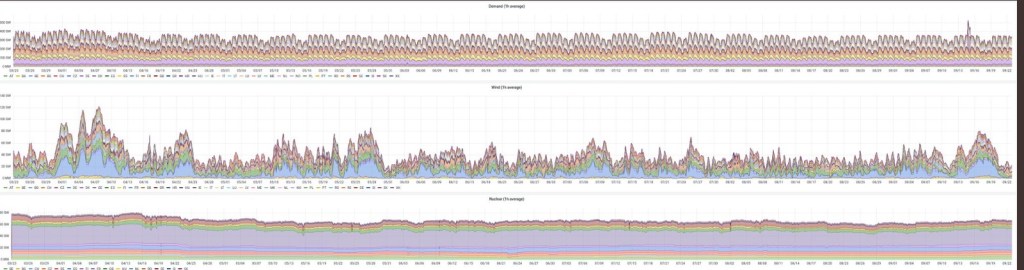
The various colors represent different countries. Here’s a larger view of the wind component:
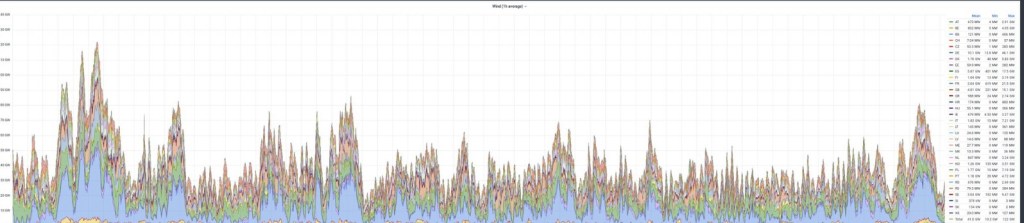
A stable power grid cannot be built upon this kind of intermittency. Here is another comparison that includes solar power. This chart is daily covering 2021 through about May 26, 2022.
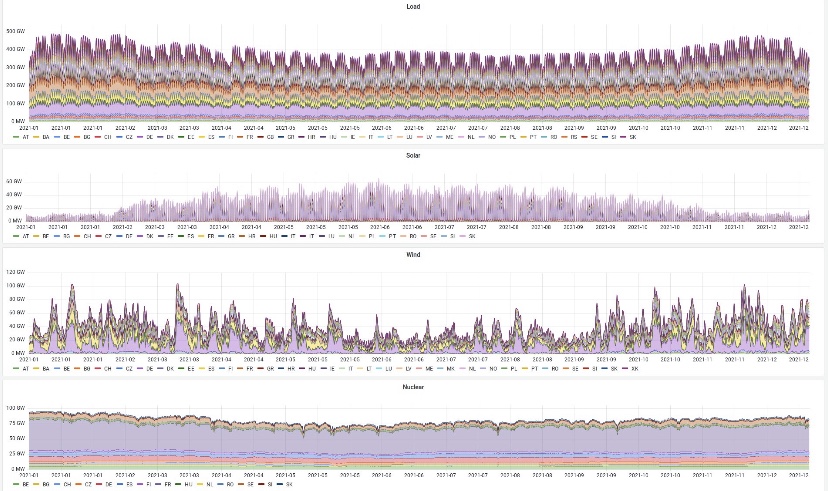
As for solar capacity utilization, it too is unimpressive. Here is Martian Data’s note on this point, followed by a chart of solar generation over the course of a few days in June:

“so ~15% solar capacity is whole year average. ~5% winter ~20% summer. And solar is brief in summer too…, it misses both both morning and evening peaks in demand.”
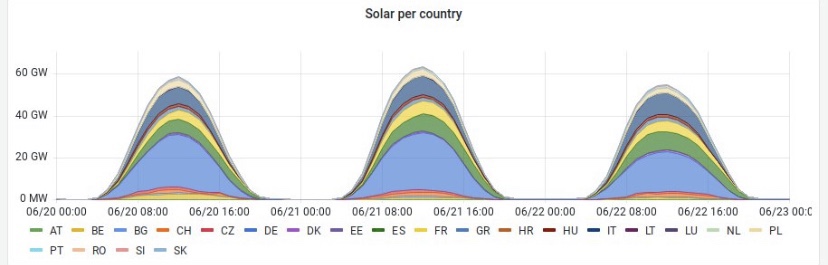
Like wind, the intermittency of solar power makes it an impractical substitute for traditional power sources. Check out Martian Data’s Twitter feed for updates and charts from other parts of the world.

Nuclear Efficiency

Nuclear power generation is an excellent source of baseload power. It is dispatchable and zero carbon except at plant construction. It also has an excellent safety record, and newer, modular reactor technologies are safer yet. It is cheaper in terms of generating capacity and it is more flexible than renewables. In fact, in terms of the resource costs of nuclear power vs. renewables over plant cycles, it’s not even close. Here’s a chart recently posted by Randall showing input quantities per megawatt hour produced over the expected life of each kind of power facility (different power sources are labeled at bottom, where PV = photovoltaic (solar)):
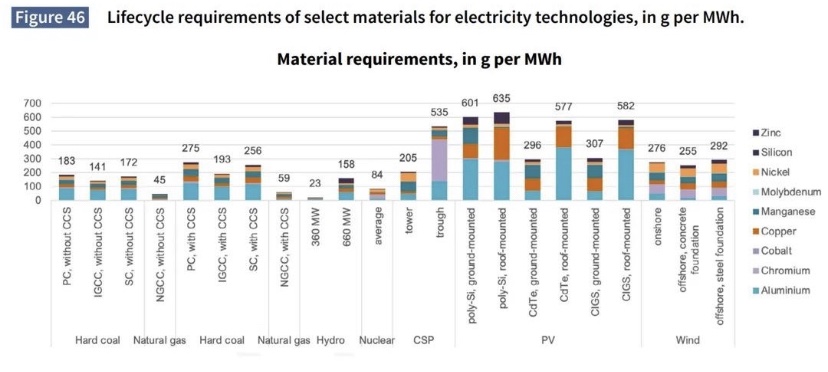
In fairness, I’m not completely satisfied with these comparisons. They should be stated in terms of current dollar costs, which would neutralize differences in input densities and reflect relative scarcities. Nevertheless, the differences in the chart are stark. Nuclear produces cheap, reliable power.

The Real Dirt

Solar and wind power are low utilization power sources and they are intermittent. Heavy reliance on these sources creates an extremely brittle power grid. Also, we should be mindful of the vast environmental degradation caused by the mining of minerals needed to produce solar panels and wind turbines, including their inevitable replacements, not to mention the massive land use requirements of wind and solar power. Also disturbing is the hazardous dumping of old solar panels from the “first world” now taking place in less developed countries. These so-called clean-energy sources are anything but clean or efficient.

ESG Scoring: Political Tool Disguised as Investment Guide

30 Wednesday Mar 2022

Posted by Nuetzel in Capital Markets, Corporatism, Environmental Fascism, Social Justice

≈ 3 Comments

Tags

Access to Capital, Antitrust, Blackrock, Climate Action 100+, Corporatism, Diversity, Equity, ESG Fees, ESG Scores, Great Reset, Green Energy, Inclusion, John Cochrane, Mark Brnovich, Principal-Agent Problem, Renewable energy, Renewables, rent seeking, Shareholder Value, Social Justice, Stakeholder Capitalism, Sustainability, Too big to fail, Ukraine Invasion, Vladimir Putin, Woke Investors, Zero-Carbon

ESG scores are used to rate companies on “Environmental, Social, and Governance” criteria. The truth, however, is that ESGs are wholly subjective measures of company performance. There are many different ESG scores available, with no uniform standards for methodology, specific inputs, or weighting schemes. If you think quarterly earnings reports are manipulated, ESGs are an even more pliable tool for misleading investors. It is a market fad, and fund managers are using it as an excuse to charge higher fees to investors. But like any trending phenomenon, for a time, the focus on ESGs might feed-back positively to returns on favored companies. That won’t be sustainable, however, without legislative and regulatory cover, plus a little manipulative help from the ESG engineers and “Great Reset” propagandists.

It’s 100% Political, 0% Economic

ESGs are founded on prioritizing objectives that have little to do with shareholder value or any well-understood yardsticks of financial or operating performance. The demands on company resources for scoring highly on ESG are often nakedly political. This includes adoption of environmental goals such as fraudulent “zero carbon” impacts, the nebulous “sustainability” objective promoted by “green” activists, diversity, inclusion and equity initiatives, and support for activist groups such as Black Lives Matter and Antifa.

Concepts like “stakeholder value” are critical to the rationale for ESGs. “Stakeholders” can include employees, suppliers, and customers, as well as potential employees. suppliers, and customers. In other words, they can be just about anyone in the broader community, or more likely activists for “social change” whose interests have but the thinnest connection to the business’s productive activities. In essence, so-called stakeholder capitalism amounts to a ceding of control over corporate resources, and ultimately confiscation of wealth from equity owners.

Corporations have long engaged in various kinds of defensive actions, amounting to a modern-day trade in indulgences. No one will be upset about your gas-powered fleet if you buy enough carbon offsets, which just might neutralize the impact of the fleet on your ESG! On a more sinister level, ESG’s provide opportunities for cover against information that might be damaging to firms, such as the use of slave labor overseas. Flatter the right people, give to their causes, “partner” with them on pet initiatives, and your sins will be ignored and your ESG will climb! And ESGs are used in attempts to pacify leftist investors who see the corporation as a vessel for their own social objectives, quite apart from any mission it might have had as a productive enterprise.

Your ESG will shine if you do business that’s politically-favored, like renewable energy, despite its inefficiencies and significant environmental blemishes. But ESGs are not merely used to reward those anointed as virtuous by the Left. They are more forcefully used to punish firms in industries that are out of favor, or firms refusing to participate in buying off authoritarian crusaders. For example, you might be so berserk as to think fossil fuels and climate change represent imminent threats of catastrophe. Naturally, you’ll want to punish oil and gas producers. In fact, if you are in charge of ESG modeling, you might want to penalize almost any extraction industry, with certain exceptions: the massive extraction and disposal costs of renewables will pass without notice.

All these machinations occur despite the huge uncertainty surrounding flimsy, model-based predictions of warming and global catastrophe. Never mind that fossil fuels are still relied upon to provide for most of our energy needs and will be for some time to come, including base-load power generation when intermittency prevents renewables from meeting demand. The stability of the power grid depends upon the availability of carbon-based energy, which in fact is marvelously efficient. Yet the ESG crowd (not to mention the Biden Administration) seeks to drive up its cost, including the cost of capital, and these added costs fall most heavily on the poor.

ESG-guided efforts by activists to deny capital to certain segments of the energy sector may constitute antitrust violations. Some big players in the financial industry, who together manage trillions of dollars in investment funds, belong to an advocacy organization called Climate Action 100+. They coordinate on a mission to completely transform the energy industry via “green” investments and divestments of presumptively “dirty” concerns. These players and their clients have huge investments in green energy, and it is in their interest to provide cheap capital to those firms while denying capital to fossil fuel industries. As Arizona Attorney General Mark Brnovich writes at the link above, this is restraint of trade “hiding in plain sight”.

Manipulation

ESGs could be the mother of all principal-agent problems. Corporate CEOs, hired by ownership as stewards and managers of productive assets, are promoting these metrics and activities, which may not align with the interests of ownership. ESG’s are not standardized, and most users will have little insight into exactly how these “stakeholder” sausages are stuffed. In fact, much of the information used for ESGs is extremely ad hoc, not universally disclosed, and is often qualitative. The applicability of these scores to the universe of stocks, and their reliability in guiding investment decisions, is extremely questionable no matter what the investor’s objectives. And of course the models can be manipulated to produce scores that suit the preferences of money managers who have a stake in certain firms or industry segments, and who inflate their fees in exchange for ESG investment advice. And firms can certainly engage in deceptions that boost ESGs, as already discussed.

Like many cultural or consumer trends, investment trends can feed off themselves for a time. If there are enough “woke” investors, ESGs might well feed an unvirtuous cycle of stock purchases in which returns become positively correlated with wokeness. Such a divorce from business fundamentals will eventually take its toll on returns, especially when economic or other conditions present challenges, but that’s not the answer you’ll get from many stock pickers and investment pundits.

At the same time, there are ways in which the preoccupation with ESGs dovetails with the rents often sought in the political arena. Subsidies, for example, will be awarded to firms producing renewables. Politically favored firms are also likely to receive better regulatory treatment.

There are other ways in which firms engaging in wasteful activities can survive profitably, at least for a time. Monopoly power is one, and companies often develop a symbiosis with regulators that hampers smaller competitors. This is traditional rent-seeking corporatism in action, along with the “too-big-to-fail” regime. Sometimes sheer growth in demand for new technologies or networking potential helps to conceal waste. Hot opportunities can leave growing companies awash in cash, some of which will be burned in wasteful endeavors. ESG scoring offers them additional cover.

Cracks In the Edifice

John Cochrane notes a fundamental, long-term contradiction for those who invest based on ESGs: an influx of capital will tend to drive down returns in those firms and industries, while the returns on firms having low ESGs will be driven upward. Yet advocates claim you can invest for virtue and superior returns. That can’t outlast real market forces, especially as ESG efforts dilute any mission a firm might have as a productive enterprise.

Vladimir Putin’s brutal invasion of Ukraine has revealed other cracks in the ESG edifice. We now have parties arguing that defense stocks should be awarded ESG points! Also, that oil production by specific nations should be scored highly. There is also an awakening to the viability of nuclear power as an energy source. Then we have the problem of delivering on Biden’s promise to Europe of more liquified natural gas exports. That will be difficult given the way Biden has bludgeoned the industry, as well as the ESG conspiracy to deny it access to capital. Just watch the ESG hacks backpedal. Now, even the evangelists at Blackrock are wavering. To see the thread of supposed ESG consistency unravel would be enough to make you laugh if the entire conspiracy weren’t so grotesque.

Closing

The pretensions underlying “green” initiatives undertaken by large corporations are good mainly for virtue signaling, to collect public subsidies, and to earn better ESG scores. They are usually wasteful in a pure economic sense. The same is true of social justice and diversity initiatives, which can be perversely racist in their effects and undermine the rule of law.

Ultimately, we must recognize that the best contribution any producer can make to society is to create value for shareholders and customers by doing what it does well. The business world, however, has gone far astray in the direction of rank corporatism, and keep this in mind: any company supporting a sprawling HR department, pervasive diversity efforts, “sustainability” initiatives, and preoccupations with “stakeholder” outreach is distracted from its raison d’etre, its purpose as a business enterprise to produce something of value. It is probably captive to outside interests who have essentially commandeered management’s attention and shareholders’ resources.

When it comes to investing, I prefer absolute neutrality with respect to out-of-mission social goals. Sure, do no harm, but the focus should remain squarely on goals inherent in the creation of value for customers and shareholders.

Follow Sacred Cow Chips on WordPress.com

Recent Posts

  • The Case Against Interest On Reserves
  • Immigration and Merit As Fiscal Propositions
  • Tariff “Dividend” From An Indigent State
  • Almost Looks Like the Fed Has a 3% Inflation Target
  • Government Malpractice Breeds Health Care Havoc

Archives

  • January 2026
  • December 2025
  • November 2025
  • October 2025
  • September 2025
  • August 2025
  • July 2025
  • June 2025
  • May 2025
  • April 2025
  • March 2025
  • February 2025
  • January 2025
  • December 2024
  • November 2024
  • October 2024
  • September 2024
  • August 2024
  • July 2024
  • June 2024
  • May 2024
  • April 2024
  • March 2024
  • February 2024
  • January 2024
  • December 2023
  • November 2023
  • August 2023
  • July 2023
  • June 2023
  • May 2023
  • April 2023
  • March 2023
  • February 2023
  • January 2023
  • December 2022
  • November 2022
  • October 2022
  • September 2022
  • August 2022
  • July 2022
  • June 2022
  • May 2022
  • April 2022
  • March 2022
  • February 2022
  • January 2022
  • December 2021
  • November 2021
  • October 2021
  • September 2021
  • August 2021
  • July 2021
  • June 2021
  • May 2021
  • April 2021
  • March 2021
  • February 2021
  • January 2021
  • December 2020
  • November 2020
  • October 2020
  • September 2020
  • August 2020
  • July 2020
  • June 2020
  • May 2020
  • April 2020
  • March 2020
  • February 2020
  • January 2020
  • December 2019
  • November 2019
  • October 2019
  • September 2019
  • August 2019
  • July 2019
  • June 2019
  • May 2019
  • April 2019
  • March 2019
  • February 2019
  • January 2019
  • December 2018
  • November 2018
  • October 2018
  • September 2018
  • August 2018
  • July 2018
  • June 2018
  • May 2018
  • April 2018
  • March 2018
  • February 2018
  • January 2018
  • December 2017
  • November 2017
  • October 2017
  • September 2017
  • August 2017
  • July 2017
  • June 2017
  • May 2017
  • April 2017
  • March 2017
  • February 2017
  • January 2017
  • December 2016
  • November 2016
  • October 2016
  • September 2016
  • August 2016
  • July 2016
  • June 2016
  • May 2016
  • April 2016
  • March 2016
  • February 2016
  • January 2016
  • December 2015
  • November 2015
  • October 2015
  • September 2015
  • August 2015
  • July 2015
  • June 2015
  • May 2015
  • April 2015
  • March 2015
  • February 2015
  • January 2015
  • December 2014
  • November 2014
  • October 2014
  • September 2014
  • August 2014
  • July 2014
  • June 2014
  • May 2014
  • April 2014
  • March 2014

Blogs I Follow

  • Passive Income Kickstart
  • OnlyFinance.net
  • TLC Cholesterol
  • Nintil
  • kendunning.net
  • DCWhispers.com
  • Hoong-Wai in the UK
  • Marginal REVOLUTION
  • Stlouis
  • Watts Up With That?
  • Aussie Nationalist Blog
  • American Elephants
  • The View from Alexandria
  • The Gymnasium
  • A Force for Good
  • Notes On Liberty
  • troymo
  • SUNDAY BLOG Stephanie Sievers
  • Miss Lou Acquiring Lore
  • Your Well Wisher Program
  • Objectivism In Depth
  • RobotEnomics
  • Orderstatistic
  • Paradigm Library
  • Scattered Showers and Quicksand

Blog at WordPress.com.

Passive Income Kickstart

OnlyFinance.net

TLC Cholesterol

Nintil

To estimate, compare, distinguish, discuss, and trace to its principal sources everything

kendunning.net

The Future is Ours to Create

DCWhispers.com

Hoong-Wai in the UK

A Commonwealth immigrant's perspective on the UK's public arena.

Marginal REVOLUTION

Small Steps Toward A Much Better World

Stlouis

Watts Up With That?

The world's most viewed site on global warming and climate change

Aussie Nationalist Blog

Commentary from a Paleoconservative and Nationalist perspective

American Elephants

Defending Life, Liberty and the Pursuit of Happiness

The View from Alexandria

In advanced civilizations the period loosely called Alexandrian is usually associated with flexible morals, perfunctory religion, populist standards and cosmopolitan tastes, feminism, exotic cults, and the rapid turnover of high and low fads---in short, a falling away (which is all that decadence means) from the strictness of traditional rules, embodied in character and inforced from within. -- Jacques Barzun

The Gymnasium

A place for reason, politics, economics, and faith steeped in the classical liberal tradition

A Force for Good

How economics, morality, and markets combine

Notes On Liberty

Spontaneous thoughts on a humble creed

troymo

SUNDAY BLOG Stephanie Sievers

Escaping the everyday life with photographs from my travels

Miss Lou Acquiring Lore

Gallery of Life...

Your Well Wisher Program

Attempt to solve commonly known problems…

Objectivism In Depth

Exploring Ayn Rand's revolutionary philosophy.

RobotEnomics

(A)n (I)ntelligent Future

Orderstatistic

Economics, chess and anything else on my mind.

Paradigm Library

OODA Looping

Scattered Showers and Quicksand

Musings on science, investing, finance, economics, politics, and probably fly fishing.

  • Subscribe Subscribed
    • Sacred Cow Chips
    • Join 128 other subscribers
    • Already have a WordPress.com account? Log in now.
    • Sacred Cow Chips
    • Subscribe Subscribed
    • Sign up
    • Log in
    • Report this content
    • View site in Reader
    • Manage subscriptions
    • Collapse this bar
 

Loading Comments...