• About

Sacred Cow Chips

Sacred Cow Chips

Monthly Archives: July 2014

Deductible Concept Sprung On Newly Insured

19 Saturday Jul 2014

Posted by Nuetzel in Uncategorized

≈ Leave a comment

Tags

ACA, adverse selection, Deductible Shock, Obamacare, Unintended Consequences

image

No, the monthly premium on your Obamacare coverage does NOT cover your deductible and copayments. You’re still on the hook for those bills. Apparently, that reality comes as a shock to many of the newly insured. And apparently, that reaction was unexpected by the drafters of the ACA as well as HHS, the state exchanges, and various organizations involved in the implementation of Obamacare. So, many of the previously uninsured, intended as the chief beneficiaries of the ACA, are feeling disillusioned, even jilted, by the terms of their coverage. As if the poor risk profile of enrollees weren’t bad enough, and amid continuing doubts about whether those purchasing coverage under Obamacare are actually paying their premia, the confusion among this constituency is a bad omen for the sustainability of the program.

Roth Plan Advantage Often Ephemeral

13 Sunday Jul 2014

Posted by Nuetzel in Uncategorized

≈ Leave a comment

Tags

Qualified Plans, Retirement Planning, Roth IRA, Tax-deferred savings, traditional IRAs

busfare

Roth tax-deferred savings vehicles (IRAs and 401Ks) are frequently touted as superior to traditional IRA or 401K savings for young savers, sometimes for the wrong reasons. Both types of vehicles offer tax advantages for retirement saving. Roth contributions are taxed immediately, but they grow tax-free and are completely tax-free at withdrawal. Traditional IRA and 401k contributions (“traditionals”) are tax-deductible, but the contributions and growth are taxed at withdrawal. The key determinant of which type of plan contribution is best at a given time is the tax rate faced today relative to the years of withdrawal. Based on this consideration, the Roth is better (for today’s contribution) if today’s tax rate is lower. If today’s tax rate is higher than during the withdrawal period, the traditional plan is more advantageous.

Comparing the two types of saving vehicles must be done on a basis that is equivalent in terms of post-tax, post-contribution income. For example, suppose an individual with a current annual income of $50,000 desires to set aside 6% of their income in their employer’s Roth 401k. The individual’s marginal tax rate is 15% federal plus 5% state. Therefore, they must part with pre-tax income of $3,750 to generate a net $3,000 plan contribution (ignoring the FICA tax). The individual has a “disposable” income after taxes and saving of $50,000 – $10,000 (taxes) – $3,000 = $37,000. Instead, if the individual contributed $3,750 to a traditional 401k, their disposable income would be exactly the same. (The contribution is tax deductible, but the extra tax savings from the 401k deduction is invested in the plan.) This equivalence in terms of the current disposable income is crucial, because the extra contribution in the traditional plan made possible by the immediate tax deduction serves to offset the Roth’s later tax advantage. Megan McArdle, for whom I have tremendous respect, overlooks this point in a piece about Roths here. Moreover, the number of years of untaxed growth in a Roth does not matter if the traditional vehicle grows as well, contrary to one popular explanation of the Roth’s advantages.

Some Easy Math: The conclusions stated above can be deduced easily from basic equations for future value (FV – for the time of the last contribution) in the presence of proportional taxes:

Net FV(Roth) = Gross Monthly Contrib x FVfactor x (1 – tax rate @ contrib)

Gross FV(Trad) = Gross Monthly Contrib x FVfactor

Net FV(Trad) = Gross Monthly Contrib x FVfactor x (1 – tax rate @ w/drawal)

where FVfactor is a function of the return on savings (naturally assumed to be common to the plans) and the number of months of contributions. Obviously, the two plans are equivalent if the two tax rates are equal. While these equations assume that the plan values are compared at the time of the last contribution, the results are robust to longer or differing patterns of withdrawals, as long as the same gross returns are available to both plans (this statement ignores certain rules for mandatory distributions, discussed later).

Comparing Future Outcomes: The table below shows comparisons of Roth and traditional contributions under various scenarios (click on the “?” icon to view the table). The withdrawals in these examples are structured as fixed monthly payouts (annuities) over 30 years. Returns during “retirement” (4%) are assumed to be lower than during the years of contributions (7%). The two vehicles yield the same ultimate level of benefits if the tax rates are the same during the years of contribution and withdrawal (the first “panel” of four rows in the table). If the current tax rate is lower, the traditional vehicle benefits more from the immediate tax deduction than the Roth gains later via non-taxable withdrawals (the second and third panels). The opposite is true if the current tax rate is higher than during the years of withdrawal (the fourth panel). The rightmost column of the table shows the aggregate value of the government’s tax revenue on a time-valued basis, carried forward (traditional) or discounted (Roth) to the date at which contributions end. It should come as no surprise that the difference in the net value of the two vehicles to the saver is equal to the difference in the government’s take (but of opposite sign). If you expect your tax rate to be lower in retirement, you lose and the government wins if you elect to be taxed early on retirement saving, i.e., the Roth.

Likely Tax Rates? What tax rate assumptions are realistic for most savers? First, current marginal federal and state tax rates should be applied to gross Roth contributions. However, a strong argument can be made that tax rates during the period of withdrawal (traditional) should be lower than during the years of contribution. There are three resaons for this:

1) Retirement incomes tend to be lower than during working years for most savers, which often implies a lower tax bracket.

2) Just as importantly, withdrawals from accumulated savings may not represent marginal income, because they are often taxed across multiple brackets because they represent a substantial portion of retirement income. An average tax rate may be more appropriate for calculating the net benefit of withdrawals from a traditional plan. To some extent, this depends upon how social security benefits are taxed, since those benefits may represent “base income” for purposes of calculating an average tax rate applicable to plan withdrawals. Regardless, it can be argued that taxable withdrawals should be assessed at lower tax rates than taxable contributions.

3)   Finally, many retirees choose to spend their post-working years in states with lower or no state income taxes, such as Florida and Texas. This would imply an even greater advantage for traditional plans over Roths.

Despite these considerations, there are many young savers laboring in cubicles who are cheerfully anticipating much higher earning years ahead, even for those distant years of retirement from the corner office. For this group, it is possible that contributions to a Roth make sense, but probably not beyond a certain point in their careers, when their marginal tax rate rises above the likely tax rate they will face in retirement. By then, the Roth option will be foreclosed if their incomes exceed the Roth limits on earnings eligibility. Still, the Roth is probably less likely to pan out as the best choice for most workers currently above the 25% federal tax bracket and many at or below it.

Other Roth Advantages: There may be other potential advantages of Roth savings over traditional tax-deferred plans. One is that Roths give the saver more flexibility over the timing of withdrawals simply because the withdrawals are not taxed as ordinary income. (Early Roth withdrawals are subject to the 10% penalty tax (before age 59½, with exceptions.)) Perhaps more importantly, by taking the tax hit immediately on Roth contributions, with no tax liability on future earnings, a Roth has a more certain tax impact than a traditional plan. It may be comforting to think that one’s tax rate is likely to be low in retirement, but who can say how high tax rates will be in the future, given the sorry state of government finances? Then again, the federal government could one day elect to violate its pledge not to tax Roth withdrawals, or it could even impose a wealth tax with broad applicability to all Roth and traditional plan balances. Death and taxes may be certain, but the integrity of government is not.

Finally, there are no mandatory Roth distributions at any age. This flexibility may be useful to some retirees, since complete deferral of taes beyond age 70½ is impossible on traditional plan assets. In terms of estate planning, the final accumulation of assets in a Roth can be passed along to heirs income tax-free. Therefore, an inherited Roth will have more value than a traditional plan if the heirs are in relatively high tax brackets. This argument is often used in favor of Roth conversions from traditional plans, even for individuals of advanced age. Extending the logic, even if traditional plans had no mandatory distributions, Roths would have an estate planning advantage beyond age 70½ if the heirs are in higher tax brackets than their benefactor. In any case, the traditional option is foreclosed for this purpose, given the mandatory distribution requirement on traditional tax-deferred savings.

Trampling On the Right To Have Others Pay

12 Saturday Jul 2014

Posted by Nuetzel in Uncategorized

≈ Leave a comment

obamacare

“If it weren’t for state power, the Little Sisters of the Poor would be happily not facilitating the birth-control purchases of its employees; the Barack Obama administration has attempted to force them to do otherwise.” That’s from Megan McArdle in a good piece on the Supreme Court’s Hobby Lobby decision. Here’s more:

The interesting question is why people on the other side view ceasing the coercion as itself coercive while arguing that the original law did not, in fact, force anyone to violate their religious beliefs. …while the religious right views religion as a fundamental, and indeed essential, part of the human experience, the secular left views it as something more like a hobby, so for them it’s as if a major administrative rule was struck down because it unduly burdened model-train enthusiasts.

That’s worth an LOL! Oh yes, it’s coercive if we can’t be permitted to coerce you. As a friend recently quipped, your reproductive decisions might not be your employer’s business, but you make it their business when you ask them to pay for your decisions. The economics of the decisions are secondary to First Amendment rights, as buttressed by the Religious Freedom Restoration Act.

The Hobby Lobby decision was not strictly about contraception, but as to the economics of contraception and whether it pays for itself, as many insist, this post offers some interesting perspectives. The economics are not quite as settled as some would have you believe.

What a Joy To Be a Social Scientist With ESSP

09 Wednesday Jul 2014

Posted by Nuetzel in Uncategorized

≈ Leave a comment

Tags

Arnold Kling, central planning, Scientism, Social Science

The world of social phenomena is so complex that we should be guarded in accepting appeals to scientism. As Arnold Kling points out, social scientism is insidious because it may appear to comport with “common sense,” yet this frequently involves a fallacy of division. Kling believes we should do our best to exercise “ESSP,” or Epistemological Skepticism about Social Phenomena. The egos of central planners are fed by social scientism of the type described by Kling, but their promises regularly fail to pan out, leading to a kind of societal senescence. But if we all rev up our ESSP, and keep are meddling hands off, we’re likely to enjoy a more creative and prosperous society. Let freedom ring!

The Parasite In Our Midst

09 Wednesday Jul 2014

Posted by Nuetzel in Uncategorized

≈ Leave a comment

Tags

Bureaucracy, crony capitalism, federal bureaucracy, Glenn Reynolds, Public Choice, regulation, rent seeking, Revolving Door

Revolving-Door

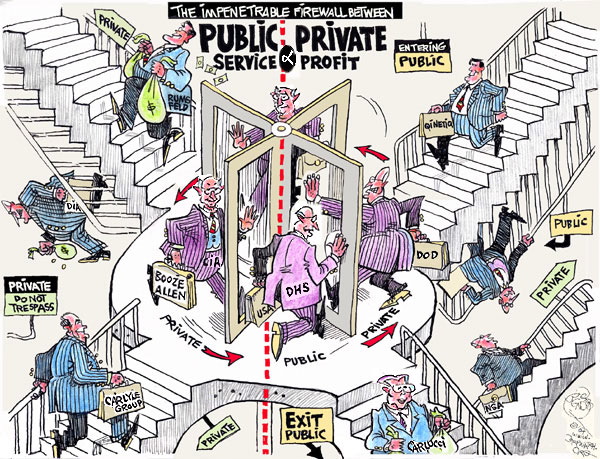
The administrative state is costly in many ways. It not only creates obstacles to economic growth. In promulgating and complying with its dictates, it absorbs vast amounts of resources within both the public and the private sectors. It also provides an avenue through which private elites can curry favor via lucrative contracts and favorable regulatory treatment, often gaining competitive advantages and even monopoly status. The opportunities for graft are legion, of course. The infamous revolving door in and out of government service reinforces the rent seeking potential afforded by this “fourth branch” of government. It is a prime example of the dangers of being governed by men rather than laws. Bureaucrats seem to become self-empowered to make wide-ranging and arbitrary decisions regarding matters not anticipated by any enabling legislation.

In “Bled Dry By The New Class,” Glenn Reynolds offers some insightful remarks regarding the sociological phenomenon that is the administrative state. He provides a telling quote from a frustrated Greek entrepreneur, which should be taken as a warning for us: “I, like thousands of others trying to start businesses, learned that I would be at the mercy of public employees who interpreted the laws so they could profit themselves.”

Bad Wind Has No Payback

04 Friday Jul 2014

Posted by Nuetzel in Uncategorized

≈ Leave a comment

Throwing_money_at_wind_power

I have often heard greens discuss energy gains associated with alternative energy sources, to the exclusion of other resource costs. The idea of energy gain can be very meaningful. For example, nuclear fusion is only now approaching the point of an energy gain. Of course, making fusion an economic source of energy requires much more efficiency than a simple energy gain. Yet the narrative for certain “green” technologies is that energy gains are all that matters. This thinking is fundamentally flawed, to put it kindly. Here is the full embodiment of the idea, as described by Anthony Watts:

US researchers have carried out an environmental lifecycle assessment of 2-megawatt wind turbines mooted for a large wind farm in the US Pacific Northwest. Writing in the International Journal of Sustainable Manufacturing, they conclude that in terms of cumulative energy payback, or the time to produce the amount of energy required of production and installation, a wind turbine with a working life of 20 years will offer a net benefit within five to eight months of being brought online.   

The reaction at Coyoteblog is amusing. As noted there, the total resource costs of manufacturing and installing the energy production and distribution facilities are just as real in any “green” sense as the energy expended. This is to say nothing of some of the other shortfalls in assumptions mentioned at the link, as well as the avian death toll. The “payback” measure used by the wind farm researchers constitutes naivete at best and propaganda in pursuit of rents at worst.

I’m convinced that the environmentally-concerned public has the best intentions, but there is a deep misunderstanding at play: the notion that the state must intervene to facilitate the adoption of “sustainable” technologies, never mind that these technologies often require massive subsidies to be economically viable. A nice quote on this point from Coyoteblog:

Environmentalists seem to all feel that capitalism is the enemy of sustainability, but in fact capitalism is the greatest system to promote sustainability that has ever been devised. Every single resource has a price that reflects its relative scarcity as compared to demand. Scarcer resources have higher prices that automatically promote conservation and seeking of substitutes. So an analysis of an investment’s ability to return its cost is in effect a sustainability analysis. 


The Jobs Report: All Part-Time; Full-Time Down Half-a-Mil

04 Friday Jul 2014

Posted by Nuetzel in Uncategorized

≈ Leave a comment

Full- vs. Part-Time

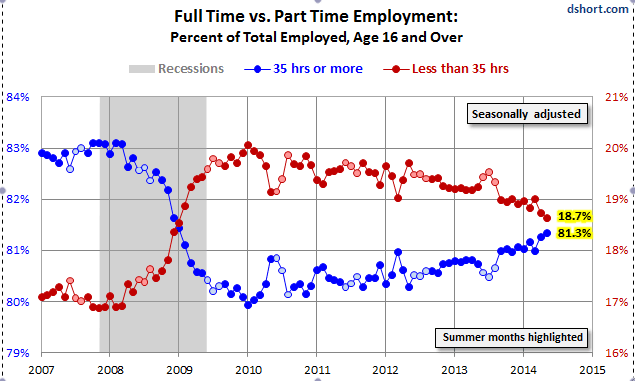
There were many breathless reports about today’s release of employment data for June, including this bit of coverage from Forbes. The report was better than expected in many ways: the number of jobs created was fairly strong; there were positive revisions to prior months; the official unemployment rate fell, as did the total “U-6” unemployment rate, which includes the unemployed plus potential workers “marginally attached” to job search and those employed part-time for economic reasons; labor force participation held steady, which must be viewed positively given recent trends.

The report seemed to reinforce impressions that the economy is gaining momentum, a welcome relief after the decline in real GDP in the first quarter. Some referred to June as a possible “inflection point,” but that obviously remains to be seen. Labor market conditions have been less than robust, the unemployment rate is still high for this stage of an economic expansion, and there are still far too many long-term unemployed and discouraged workers.

In addition, very little attention was paid by the media and most economists to a disturbing pattern in the jobs created in June: While total employment increased, there were 523,000 fewer full-time jobs (seasonally adjusted), while part-time employment increased 799,000. ZeroHedge has a brief discussion with a few charts. This undermines the case for real strength. There are fears that more full-time workers will be reduced to part-time status as the (delayed) Obamacare employer mandate takes hold in 2015. The chart above does not include the data for June: 80.8% full-time and 19.2% part-time, so the gap widened.

Redistributing a “Progressively” Smaller Pie

03 Thursday Jul 2014

Posted by Nuetzel in Uncategorized

≈ Leave a comment

Tags

bailout, Casey Mulligan, Disincentives, Redistribution, Welfare State

Dilbert Layoffs

“A Recovery Stymied By Redistribution” contains excerpts from a recent speech by Casey Mulligan of the University of Chicago. It’s about the destructive power of bad incentives, and it reeks of common sense. It’s long been recognized that efforts to soften economic blows can have damaging incentive effects. Today, those well-intentioned efforts have been expanded beyond the point at which they become counterproductive, and the negative effects are being compounded by new programs that can act as taxes on work effort.

I’ve witnessed some of the phenomena Mulligan describes first-hand. There is no question that some people can be tempted to accept benefits in exchange for a less than vigorous job-search effort, sometimes for no search effort at all, and sometimes fraudulently when they already have gainful employment. Mulligan quotes a job recruiter who, during the recession, “ran into a hurdle he hadn’t seen before. People would apply for jobs not with the intention of accepting it, but to demonstrate to the unemployment office that they were looking for work.” Mulligan also describes ways in which employers have seen reductions in their incentives to retain marginal workers.

Some programs are better than others at minimizing disincentives created by assistance. But here is what Ben Franklin thought:

I am for doing good to the poor, but I differ in opinion of the means. I think the best way of doing good to the poor, is not making them easy in poverty, but leading or driving them out of it. In my youth I traveled much, and I observed in different countries, that the more public provisions were made for the poor, the less they provided for themselves, and of course became poorer. And, on the contrary, the less was done for them, the more they did for themselves, and became richer.

— On the Price of Corn and Management of the Poor, November 1766

Damaging disincentives are also created by efforts to ease economic blows to businesses. Corporate bailouts, for example, create perverse, one-sided “win-can’t lose” sets of outcomes, leading to taxpayer subsidies and excessive risk-taking.


Time For OTC Contraceptives

02 Wednesday Jul 2014

Posted by Nuetzel in Uncategorized

≈ Leave a comment

Tags

Contraceptives, Hobby Lobby, Obamacare, OTC, Prescription Drugs, Small Government, Vox

Image

Here are seven reasons birth control pills shouldn’t require a prescription, offered by Adrianna McIntyre in Vox. There is much concern over “access” to contraceptives in the wake of the Hobby Lobby decision. While any new concern is largely misplaced, the biggest impediments to access might well be the prescription status of these drugs and their cost. Making contraceptives available over-the-counter would do a great deal to reduce these problems while leaving everyone else with a clear conscience. In fact, it would greatly improve access for the uninsured, a group which will remain large despite the best intentions of Obamacare supporters. As the Vox article notes, physicians support the move to make contraceptives available OTC, and it is highly feasible politically, though support will be contingent on certain safeguards, such as restrictions on sales to minors. Otherwise, it is a classic “small government” solution.

Abortifacients and Hobby Lobby

01 Tuesday Jul 2014

Posted by Nuetzel in Uncategorized

≈ Leave a comment

Tags

Abortifacients, ACA, Contraception Mandate, Corporate Form, Hobby Lobby, Obamacare, Supreme Court

Image

Some are apparently too lazy, propagandized or ignorant to understand the facts underlying the Supreme Court’s Hobby Lobby decision. But not too lazy to re-tweet or re-post unreliable information.

Here is what the decision means:

1) The decision was narrower than the sloppy memes and some media reports would have you believe. Of the 20 different contraceptives approved for use by the FDA, only four are affected by the decision. Hobby Lobby offers the other 16 through its employee health plan, and it will continue to offer them. The four it is no longer required to offer through its plan are so-called abortifacients, which destroy an already fertilized egg. The ruling does not imply that Hobby Lobby can avoid covering other “mandated benefits” under Obamacare, including the other 16 contraceptives. (In my view, however, the entire coverage mandate should be struck down as well, keeping employer-provided health care benefits a private contactual matter. The specifics of the mandate were not part of the ACA legislation. They were promulgated by bureaucrats at HHS for whom overreach has no meaning.)

2) In general, when individuals decide to associate or act under a corporate form, the corporation assumes the rights they possess as individuals. Human action taken under the corporate form does not involve a diminution of individual rights. Yet the left acts as if people have no rights when acting under the corporate form. Incorrect. Speech, religion — all rights that are granted to individuals under the Constitution are guaranteed to them whether they act as a corporate association or not.

3) The decision in Hobby Lobby applies only to closely-held corporations, the shares of which are not publicly traded. These are not the “faceless corporations” of popular infamy, but are often family-owned companies, associations of partners, or professional practices. Publicly-traded corporations are not affected by the ruling. Only privately-held corporations with more than 50 employees (under the original provisions of the ACA) are affected.

4) The decision does NOT interfere with womens’ rights to obtain most contraceptives. It means that the government cannot force Hobby Lobby to pay for abortifacients, and female employees have an unrestricted right to pay for abortifacients out of their own pockets. They are employed, after all. In addition, the ruling has nothing to do with coverage of abortion procedures that might be necessary when a mother’s life is at risk.

5) The government is not restricted, except as a possible matter of politics, from offering all women free access to abortifacients. It has not offered to do so, however. Therefore, under the 1993 Religious Freedom Restoration Act (RFRA), signed by President Clinton, the Court held that the government cannot impose any burden on private parties (including individuals organized as closely-held corporations) in violation of their religious beliefs if there is a less burdensome alternative available. The RFRA’s importance to the Hobby Lobby ruling is discussed here.

6) Some have accused Hobby Lobby’s owners of hypocrisy, since they sell goods imported from China, where abortion is often coerced by the state. And that might be hypocritical, but the only possible relevance to the case would be if the purchase of Chinese goods reflected on the sincerity of their religious beliefs. That is a litmus test that few would sanction. A beauty of private markets is that they tend to be impersonal, allowing individuals of different cultural practices and beliefs to trade peacefully with one another if they so desire. That has no bearing on the type of labor contract that Hobby Lobby may offer its own employees. In any case, the ruling applies more broadly than to Christian importers of Chinese goods.

Newer posts →
Follow Sacred Cow Chips on WordPress.com

Recent Posts

  • The Case Against Interest On Reserves
  • Immigration and Merit As Fiscal Propositions
  • Tariff “Dividend” From An Indigent State
  • Almost Looks Like the Fed Has a 3% Inflation Target
  • Government Malpractice Breeds Health Care Havoc

Archives

  • January 2026
  • December 2025
  • November 2025
  • October 2025
  • September 2025
  • August 2025
  • July 2025
  • June 2025
  • May 2025
  • April 2025
  • March 2025
  • February 2025
  • January 2025
  • December 2024
  • November 2024
  • October 2024
  • September 2024
  • August 2024
  • July 2024
  • June 2024
  • May 2024
  • April 2024
  • March 2024
  • February 2024
  • January 2024
  • December 2023
  • November 2023
  • August 2023
  • July 2023
  • June 2023
  • May 2023
  • April 2023
  • March 2023
  • February 2023
  • January 2023
  • December 2022
  • November 2022
  • October 2022
  • September 2022
  • August 2022
  • July 2022
  • June 2022
  • May 2022
  • April 2022
  • March 2022
  • February 2022
  • January 2022
  • December 2021
  • November 2021
  • October 2021
  • September 2021
  • August 2021
  • July 2021
  • June 2021
  • May 2021
  • April 2021
  • March 2021
  • February 2021
  • January 2021
  • December 2020
  • November 2020
  • October 2020
  • September 2020
  • August 2020
  • July 2020
  • June 2020
  • May 2020
  • April 2020
  • March 2020
  • February 2020
  • January 2020
  • December 2019
  • November 2019
  • October 2019
  • September 2019
  • August 2019
  • July 2019
  • June 2019
  • May 2019
  • April 2019
  • March 2019
  • February 2019
  • January 2019
  • December 2018
  • November 2018
  • October 2018
  • September 2018
  • August 2018
  • July 2018
  • June 2018
  • May 2018
  • April 2018
  • March 2018
  • February 2018
  • January 2018
  • December 2017
  • November 2017
  • October 2017
  • September 2017
  • August 2017
  • July 2017
  • June 2017
  • May 2017
  • April 2017
  • March 2017
  • February 2017
  • January 2017
  • December 2016
  • November 2016
  • October 2016
  • September 2016
  • August 2016
  • July 2016
  • June 2016
  • May 2016
  • April 2016
  • March 2016
  • February 2016
  • January 2016
  • December 2015
  • November 2015
  • October 2015
  • September 2015
  • August 2015
  • July 2015
  • June 2015
  • May 2015
  • April 2015
  • March 2015
  • February 2015
  • January 2015
  • December 2014
  • November 2014
  • October 2014
  • September 2014
  • August 2014
  • July 2014
  • June 2014
  • May 2014
  • April 2014
  • March 2014

Blogs I Follow

  • Passive Income Kickstart
  • OnlyFinance.net
  • TLC Cholesterol
  • Nintil
  • kendunning.net
  • DCWhispers.com
  • Hoong-Wai in the UK
  • Marginal REVOLUTION
  • Stlouis
  • Watts Up With That?
  • Aussie Nationalist Blog
  • American Elephants
  • The View from Alexandria
  • The Gymnasium
  • A Force for Good
  • Notes On Liberty
  • troymo
  • SUNDAY BLOG Stephanie Sievers
  • Miss Lou Acquiring Lore
  • Your Well Wisher Program
  • Objectivism In Depth
  • RobotEnomics
  • Orderstatistic
  • Paradigm Library
  • Scattered Showers and Quicksand

Blog at WordPress.com.

Passive Income Kickstart

OnlyFinance.net

TLC Cholesterol

Nintil

To estimate, compare, distinguish, discuss, and trace to its principal sources everything

kendunning.net

The Future is Ours to Create

DCWhispers.com

Hoong-Wai in the UK

A Commonwealth immigrant's perspective on the UK's public arena.

Marginal REVOLUTION

Small Steps Toward A Much Better World

Stlouis

Watts Up With That?

The world's most viewed site on global warming and climate change

Aussie Nationalist Blog

Commentary from a Paleoconservative and Nationalist perspective

American Elephants

Defending Life, Liberty and the Pursuit of Happiness

The View from Alexandria

In advanced civilizations the period loosely called Alexandrian is usually associated with flexible morals, perfunctory religion, populist standards and cosmopolitan tastes, feminism, exotic cults, and the rapid turnover of high and low fads---in short, a falling away (which is all that decadence means) from the strictness of traditional rules, embodied in character and inforced from within. -- Jacques Barzun

The Gymnasium

A place for reason, politics, economics, and faith steeped in the classical liberal tradition

A Force for Good

How economics, morality, and markets combine

Notes On Liberty

Spontaneous thoughts on a humble creed

troymo

SUNDAY BLOG Stephanie Sievers

Escaping the everyday life with photographs from my travels

Miss Lou Acquiring Lore

Gallery of Life...

Your Well Wisher Program

Attempt to solve commonly known problems…

Objectivism In Depth

Exploring Ayn Rand's revolutionary philosophy.

RobotEnomics

(A)n (I)ntelligent Future

Orderstatistic

Economics, chess and anything else on my mind.

Paradigm Library

OODA Looping

Scattered Showers and Quicksand

Musings on science, investing, finance, economics, politics, and probably fly fishing.

  • Subscribe Subscribed
    • Sacred Cow Chips
    • Join 128 other subscribers
    • Already have a WordPress.com account? Log in now.
    • Sacred Cow Chips
    • Subscribe Subscribed
    • Sign up
    • Log in
    • Report this content
    • View site in Reader
    • Manage subscriptions
    • Collapse this bar
 

Loading Comments...