• About

Sacred Cow Chips

Sacred Cow Chips

Author Archives: Nuetzel

Post-Election Thoughts: The “Idiocracy”

11 Friday Nov 2016

Posted by Nuetzel in Free Speech, Liberty, Tyranny

≈ Leave a comment

Tags

Barack Obama, Carly Fiorina, Donald Trump, Hillary Clinton, Homophobia, Identity Politics, Misogyny, Peter Thiel, Political Correctness, racism, Robby Soave, Walter Williams

racism

I keep reading about “idiots” in my news feed, directed by angry supporters of Hillary Clinton at anyone who voted for Donald Trump. These crestfallen partisans do not appreciate an irony: their very arrogance and desire to proscribe the freedom of others to speak and act freely actually helped to coalesce Trump’s support. So smug are they in their beliefs and attitudes that they are able to render high-handed judgements as to whether certain beliefs are socially acceptable. That there are many dimensions to social problems is lost on this crowd: it’s all or nothing. You are an idiot, a racist, a misogynist, or a homophobe if you support free speech (because it might offend), private property (you are greedy), free markets (capitalist pig), law enforcement (racist), gun rights (violent), or if you hold attitudes that are “traditional” or religious. In fact, you are probably suspect if you are white, asian, or in any way successful: you are too privileged to understand the negative consequences of your privilege.

Here’s my disclaimer: I don’t particularly like Donald Trump and some of his antics. I strongly disagree with a few of his most prominent policy proposals. Nevertheless, I voted for him because Hillary Clinton is so obviously a devotee of centralized power and she is irredeemably crooked. I was repelled by the identity politics she celebrated, and I found a certain aspect of Donald Trump’s disregard for political correctness to be refreshing.

The fact is that many voters are sick and tired of the name-calling by the left, and of the proscriptive behavior it enables. I’m one of them. Robby Soave at Reason just wrote an excellent article on this point:

“The leftist drive to enforce a progressive social vision was relentless, and it happened too fast. I don’t say this because I’m opposed to that vision—like most members of the under-30 crowd, I have no problem with gender neutral pronouns—I say this because it inspired a backlash that gave us Trump….

There is a cost to depriving people of the freedom (in both the legal and social senses) to speak their mind. The presidency just went to the guy whose main qualification, according to his supporters, is that he isn’t afraid to speak his.“

In the wake of an election that didn’t go their way, the identity politickers are proving themselves to be petulant and vulgar creeps. They decry the Trump election as racist by placing entire demographics and regions into an “idiot” trick bag. They cry racism on counties in which the majority voted for Barack Obama in 2012, but flipped to Donald Trump in 2016.

But no one is shamed. I’d have loved it if Carly Fiorina had been nominated. I’d vote for Walter Williams if he ran for president. I have great respect for Peter Thiel but I don’t know whether I’d vote for him. I might. In the end, it’s usually about policies, and if your policy portfolio has an excessive basis in identity politics and political correctness, and if you are strident about it, don’t be surprised if you stir some resentment. The idiots just might be the ones shooting themselves in the foot.

Note: Yes, I’ve used that cartoon before. I like it!

Clinton Corruption Remedy: Keep Her Out

07 Monday Nov 2016

Posted by Nuetzel in Corruption, statism

≈ Leave a comment

Tags

Broomstick One, Clinton Foundation, Constitutional Remedy, Cronyism, Department of Justice, Department of State, Deroy Murdock, DOJ, Donald Trump, FBI, Gary Johnson, Government Corruption, Hillary Clinton, Impeachent, Independent Women's Forum, Influence Buying, Jason Chaffetz, Jeffrey Epstein, Lisa Schiffren, Loretta Lynch, Money Laudering, Pay to Play, statism, Trey Gowdy, Wikileaks

clinton-family-corruption

Would I ever vote for Donald Trump? I’ve been critical of Trump’s positions on foreign trade, immigration policy and eminent domain. I think he’s an extremely risky candidate for any supporter of small government. But I’ve been much more critical of Hillary Clinton: she is a statist through and through, and she so often finds herself in close proximity to corruption and some other highly suspicious circumstances. I consider myself a libertarian, and I like Gary Johnson. Unfortunately, Johnson has disappointed me with his selection of Bill Weld as a running mate, his goofs on foreign policy and his often poor presentation of libertarian principles.

FBI Director James Comey has again concluded that there was no intent on Clinton’s part to violate national security with her private email server, but he also concluded that she was reckless in conducting sensitive government business, including the transmission of classified information, on that server. Unfortunately, Comey limited his investigation to the period during which she was Secretary of State. The server, however, was put in place before she was confirmed by Congress. The question of intent makes that time period relevant, but Comey ignored it. She broke the law concerning the handling of classified documents, there is no question about that. No less than five of Clinton’s aides took the Fifth Amendment to avoid prosecution. Evidently, Mr. Comey has been under pressure from a highly-politicized Justice Department. There are other investigations underway at the FBI and by Congress involving the Clintons, however.

The deluge of information via Wikileaks over the past month reflects horribly on the Clintons. I don’t care whether the leaks came from government sources, the Russians, or from other foreign actors. No one has challenged the authenticity of these leaks. Again, Hillary Clinton compromised national security by conducting her duties as Secretary of State on a private computer server. That’s what got her into the email mess. Now, we’ve learned that she gave her housekeeper access to her computer to print documents! At least five foreign intelligence services hacked into that server. Clinton also obstructed justice on the matter by destroying evidence and perjuring herself before Congress.

Wikileaks has shed additional light on the Clinton Foundation as well. The foundation functions as a money laundering scheme intended to disguise influence-buying as charitable giving, with the Clinton’s and their cronies as the real beneficiaries. Foreign governments, including several middle eastern powers, funneled money to the foundation while Hillary served as Secretary of State. Here’s Deroy Murdock on the Foundation:

“… its 2014 IRS filings show that it spent a whopping 5.76 percent of its funds on actual charitable activities — far below the 65 percent that the Better Business Bureau calls kosher. That paltry figure also mocks Hillary’s Las Vegas lie, uttered at the final presidential debate on October 19: ‘We at the Clinton Foundation spend 90 percent — 90 percent of all the money that is donated on behalf of programs of people around the world and in our own country.’ The Clinton Slush Fund . . . uh . . . Foundation seems to be mainly a travel and full-employment program for Hillary’s government in waiting. It’s also a bribe pump that sucks in money and spews out favors.“

The Clintons also have had strong ties to individuals with criminal histories, such as the notorious child predator Jeffrey Epstein. And Hillary Clinton’s reputation for contemptuous behavior toward others was so strong that State Department security personnel requested reassignment. It’s been reported that members of her Secret Service detail called her plane “Broomstick One“.

A Hillary Clinton victory in the president election will not end the investigations. Congressional leaders such as Jason Chaffetz and Trey Gowdy have vowed to press on aggressively, given that Clinton lied before their committees and to the American people about the existence of classified emails on her server. Impeachment by the House might occur, though Clinton’s offenses have occurred prior to her term in office, and the Senate would never attain the two-thirds majority necessary to convict.

It is possible that the FBI investigation into the Clinton Foundation will be damaging, but it is unlikely to bring an indictment. The DOJ under Clinton would be headed by Loretta Lynch or some other Hillary/Obama sycophant. There will be no DOJ indictment or special prosecutor as long as the Attorney General reports to the criminal herself. (The FBI cannot indict; it can only recommend indictment.) There would hardly be a real opportunity to render justice to Hillary at the federal level.

A local jurisdiction could bring an indictment for criminal activity. The Anthony Weiner laptop investigation by the NYPD could be troublesome for Clinton, depending on the extent to which any Clinton dealings with Jeffrey Epstein were recorded there.

There remains only one sure constitutional remedy for Hillary Clinton’s corruption: Tuesday’s election. Preventing her from taking office must be priority one. Hillary Clinton’s days of insider dealing would then be over, as would the politicized government created by Barack Obama, who was just recorded encouraging illegal aliens to vote! But Gary Johnson obviously won’t beat Clinton… the only real option is Donald Trump.

Yes, Trump is risky, and I’ll have plenty to criticize on my blog if he takes office. He is plainspoken but sometimes crude and offensive. Naturally, that “style” is especially offensive to the tender snowflakes who cling to identity politics, but I do not believe Trump is a racist. It’s true, I don’t know exactly what we’d get with Trump. I suspect he has some statist tendencies of his own, but I prefer that risk to the corruption and certain statism of Hillary Clinton.

So I must vote for Donald Trump. Putting Hillary Clinton in the White House would compromise our system of government. She is an accomplished grafter and cronyist, expert at leveraging her position of power for personal enrichment, and she is prone to taking retribution against enemies. The IRS, the DOJ and other agencies have already become partisan organizations under Obama. And as I mentioned earlier, Clinton is a statist who desires centralized power. That is always dangerous.

Read this excellent essay: “The Case Against Hillary Clinton“, by Lisa Schiffren of the Independent Women’s Forum.

Here is a page with a number of past posts about Hillary Clinton on Sacred Cow Chips.

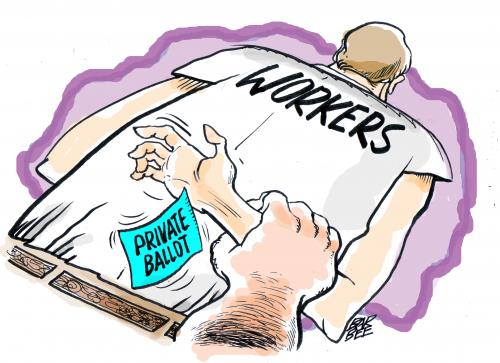
Give Workers Choice to Rule Unions

02 Wednesday Nov 2016

Posted by Nuetzel in Labor Markets

≈ Leave a comment

Tags

Collective Bargaining, James B. Jacobs, James Sherk, Labor Racketeering, NLRB, NPR, Principle-Agent Problem, Service Employees International Union, Union Corruption

img_3725

Collective bargaining via union representation is a right that deserves protection, but the value of that right is often undermined by union officials because the law empowers them to do so. In a case decided in September, however, a court confirmed that a union cannot force itself on an employer without worker support (and workers must file a request with the National Labor Relations Board (NLRB)).

Almost ten years ago, the Service Employees International Union (SEIU) insinuated itself as representing the employees of Professional Janitorial Service (PJS). The business insisted on a vote of its employees by secret ballot. Fair enough, right? That much is consistent with law and the administrative rules of the NLRB (see the link above). Had I worked for the business, its demand for a secret-ballot vote would have earned my respect. At that point, however, SEIU turned to questionable tactics:

“Unions win such elections more often than not, but the SEIU did not want to leave it to chance. So it retaliated against the company by libeling it with false accusations about illegal labor practices and overtime violations.

The SEIU claimed that Professional fired staff for trying to unionize, and had forced others to work off the books. Both allegations were dismissed as unfounded — lies, in other words — by the Labor Department.

The union’s libel was part of a broader campaign to drive Professional out of business unless it surrendered to union demands. Behind the scenes, the SEIU used its political connections to steer contracts away from the company. Emails showed SEIU officials electronically high-fiving each other every time Professional lost a contract.“

It took almost a decade, but PJS recently emerged victorious in its legal battle with SEIU. A jury in Houston ruled that SEIU defamed PJS, awarding the business a judgement of $5.3 million for damages. This article reports that SEIU kept a “campaign manual” that it relied upon in it’s effort to “kill PJS”, as they so delicately put it. PJS isn’t done yet:

“In a statement, PJS added that they ‘will now ask local prosecutors to investigate apparent perjury by union officials and an attorney who testified in the trial, and will increase its efforts with state legislators to remove the SEIU from eligibility in state-provided union dues collection programs.’“

SEIU has a long history of corruption, so it’s great to see the union’s tactics exposed before a jury. Apparently, too many employers have settled out of court, allowing SEIU to force its way into their businesses without a fair process, and those businesses have taken undeserved hits to their reputations along the way.

What incentives motivate such aggressive tactics? They undoubtedly reflect the value a union organization can capture through exclusive representation of workers and mandatory payment of dues. That is the general theme of “Unelected Unions: Why Workers Should Be Allowed to Choose Their Representatives“, by James Sherk. Once a workplace is successfully unionized, the union not only holds a monopoly on the supply of labor to the business; the government also grants to the union a monopoly over the services it provides to workers via exclusive representation. The workers are a captive market, short of a difficult and risky (for individual workers) decertification process.

That latter form of monopoly power, enforced by legal rules and court precedent, creates a severe principal-agent problem in union representation of workers. Union officials (the agents) have the incentives and power to capture excessive value from the workers they represent (the principles). This value, and historically questionable union financial reporting, has often made union activity a magnet for organized crime elements. This NPR story demonstrates the widespread nature of union corruption. An article about labor corruption by James B. Jacobs describes several common forms of labor racketeering:

“Organized crime bosses exploit unions and union members through alliances with corrupted or intimidated union officials…. In return, union officials provide mobsters access to the union treasury, pension and welfare funds, no-show jobs with the union, and support in establishing and enforcing employer cartels…. Some organized crime members have held formal union office…. In addition, of course, corrupt union officials, whether or not connected to organized crime figures, engage in ‘ordinary’ organizational corruption, such as misappropriation of funds. The most distinctive form of corruption by union officials is taking employers’ bribes to ignore violations of the collective bargaining contract, or even to allow employer to operate nonunion shops….“

Sterk and Jacobs both emphasize the potential that worker choice over their representation has for cleaning up union corruption. Here is an excerpt from Sterk’s conclusion:

“Congress and state legislatures should require unions to run for re-election, or allow workers to designate their own bargaining representative. Workers should not be forced to accept a union’s services.“

The right of workers to control their representation was at the heart of PJS’s original insistence on a worker vote, by secret ballot, over whether they desired representation by SEIU. And SEIU’s underhanded tactics illustrate the importance of giving workers strong control over their unions from the start. While mechanisms creating greater worker choice and control might not be foolproof, it is more likely to minimize union corruption and to maximize the incentives of union officials to truly promote the interests of their workers.

Hillaryeconomics: Swelling the State

30 Sunday Oct 2016

Posted by Nuetzel in statism

≈ Leave a comment

Tags

Affordable Care Act, Anthony Weiner, Bill Clinton, Buffet Rule, Carried Interest Rule, Clinton Foundation, Daniel J. Mitchell, Exit Tax, Hillary Clinton, Hugo Chavez, Infrastructure bank, Joseph Stiglitz, Minimum Wage, Paid Family Leave, Peter Suderman, Public Option, Redistribution, Solyndra, Venezuela

14523095_10207590802749873_5458832984536437934_n

Who cares about Hillary Clinton’s economic plan while her campaign quivers in the shadow of Weiner’s hard drive? Despite all the hubbub over Mrs. Clinton’s sloppy security practices, and her lies and destruction of evidence regarding those practices, it’s a good idea to remind ourselves of some of the frontrunner’s policy proposals and the general philosophy that informs them. Daniel J. Mitchell must have been feeling jovial when he took a crack at deciphering Hillary Clinton’s economic plan. He offered translations of each of 42 Hillary catch-phrases, but the translations were identical:

“Notwithstanding all the previous failures of government, both in America and elsewhere in the world, I’m going to make American more like Greece and Venezuela by using coercion to impose more spending, taxes, and regulation.“

Mitchell highlights two general themes at the start: one is the left’s constant misuse of the term “investment’ to describe spending on almost any government initiative; the other is the still fashionable Keynesian theory that a low-productivity government can make the economy grow by a multiple of any claim on resources it deigns to make.

I’ll try to do Mitchell one better. Here’s a run-down of the catch-phrases he cites along with my own interpretations:

  • “…support advanced manufacturing” — because the government is adept at picking winners with taxpayer money, like Solyndra. Does “advanced manufacturing” involve politically-favored outputs, as opposed to market-favored outputs? Does it involve robots, or workers? Is it somehow preferable to “advanced services”?
  • “a lot of urgent and important work to do” — there oughtta’ be more laws;
  • “go out and make that happen” — we must impose the heavy hand of the state;
  • “enormous capacity for clean energy production” — …if only we can provide our cronies with enough subsidies on your dime;
  • “if we do it together” — …kumbaya; we’ll wreck the private economy together;
  • “things that your government could do” — like, wreck everything;
  • “I will have your back every single day” — …with a sharp knife, in case it’s in my interest to betray you;
  • “make our economy work for everyone” — we’ll redistribute your wealth;
  • “restore fairness to our economy” — be prepared to share your success;
  • “go to bat for working families” — …by punishing your employer; but look, we have freebies!
  • “pass the biggest investment” — mandatory campaign promise;
  • “modernizing our roads, our bridges” — shovel-ready” projects;
  • “help cities like Detroit and Flint” — redistribute resources to poorly-governed communities and impose federal oversight;
  • “repair schools and failing water systems” — because local needs and the federal government are a perfect match;
  • “we should be ambitious” — about government domination;
  • “connect every household in America to broadband” — even if they don’t want it, and even if they’ve chosen to live in the badlands; at your cost, of course;
  • “build a cleaner, more resilient power grid” — reduce carbon emissions by inflating your utility bill; dismantle markets and direct energy resources centrally;
  • “creating an infrastructure bank” — we need another big federal agency, extending control and conjuring opportunities for cronyism and graft;
  • “we’re going to invest $10 billion” — Whew! I thought you were going to say $100 billion. But… can you define “investment”?
  • “bring business, government, and communities together” — …we’ll be as one at the federal level;
  • “fight to make college tuition-free” — so that even the least qualified have a strong incentive to enroll, on your dime;
  • “liberate millions of people who already have student debt” — because meeting the terms of a contract is a form of enslavement;
  • “support high-quality union training programs” — with federal subsidies on your dime; non-union training programs would be so …exploitative;
  • “We will do more” — …cause we’re from the government, and we’re here to help!
  • “Investments at home” — Invest? Can you define that? Do you mean “spend”?
  • “we need to make it fairer” — … by redistributing your income to others;
  • “we will fight for a more progressive…tax code” — reduce those ugly private work incentives and quash the bourgeois tendency to save and invest in physical capital;
  • “pay a new exit tax” — don’t get the idea it’s YOUR company; you didn’t build that;
  • “Wall Street, corporations, and the super-rich, should finally pay their fair share” –because the highest corporate tax rate in the industrialized world is not high enough, and besides, we can pass the booty back to elites in myriad ways, as long as they give to the Clinton Foundation;
  • “I support the so-called ‘Buffett Rule'” — …to quench the thirst of class warriors;
  • “add a new tax on multi-millionaires” — we must tax wealth because a high income tax rate just isn’t enough to encourage capital flight;
  • “close the carried interest loophole” — cause we think that loophole actually exists, and hey, it sounds good to class warriors;
  • “I want to invest” — Invest? Can you define that? Do you mean “spend”?
  • “affordable childcare available to all Americans” — …so that no parent need pay any attention to price; but your tax credit will diminish if you earn extra income, so don’t earn too much, for God’s sake!
  • “Paid family leave” — …because it isn’t expensive enough to hire you already;
  • “Raising the federal minimum wage” — … so the least skilled will be jobless and dependent on the state;
  • “expanding Social Security” — …so what if it’s already insolvent? Oh, you must mean “expanding” payroll taxes!!
  • “strengthening unions” — …because we mean to kill the sharing economy, and it isn’t expensive enough to hire you already;
  • “improve the Affordable Care Act” — if it’s broke, break it more thoroughly;
  • “a public option health insurance plan” — …shhh… don’t say single payer!
  • “build a new future with clean energy” — in our judgement, your inflated utility bills will help all mankind; besides, we want to take control, and wreck something.
  • Bonus: “wage equality once and for all” — because it should be illegal for employers to pay based on occupational risk, demands for paid leave and flexible hours, skill differentials and available supplies.

Lest you think my interpretation of that bonus quotation is unfair, remember: the so-called gender wage gap is almost entirely explained by the factors I’ve listed.

Hillary Clinton’s economic view is straight out of the statist theater of the absurd. Joseph Stiglitz, one of Hillary’s economic advisors, in 2007 endorsed Venezuelan socialism under Hugo Chavez, which proved to be disastrous. Was she forced to the left by Bernie Sanders? To some extent, perhaps. But Peter Suderman notes that Clinton’s current policy agenda constitutes a thorough rejection of Bill Clinton’s economic policies. The irony!

Hillary’s “Fix”: Obamacare Squared

26 Wednesday Oct 2016

Posted by Nuetzel in Obamacare

≈ Leave a comment

Tags

Avik Roy, Bill Clinton, Block Grants, Christopher Jacobs, competition, Health Insurer Bailouts, Hillary Clinton, John C. Goodman, Marketplace Regulation, Medicaid, monopoly, Obamacare Exchanges, Obamacare Fixes, Pharmaceutical Patents, Public Option, Reimbursement Rates, Risk corridors, Sally Pipes, Single-Payer System, Wikileaks

hillarys-health-problem

One of Hillary Clinton’s “public positions” is that Obamacare needs a few “fixes”, a considerable understatement. Meanwhile, Wikileaks has revealed that she has “privately” rooted for the failure of Obamacare. For that reason, Bill Clinton’s recent slip-up, in which he portrayed Obamacare as a “crazy” system, had a certain Freudian quality. Indeed, Obamacare looks crazier every year, especially in the middle of premium-hike season.

One of Hillary’s so-called “fixes” is the creation of a “public option”, or health insurance offered by the government to compete on exchanges with private insurance. Private health insurers, with the expiration of the so-called “risk corridors”, do not have continuing access to the public purse to cover their losses; going forward, they must price coverage at rates covering the cost of their respective risk pools. The government, on the other hand, is likely to have pricing flexibility. If exercised, there will be little hope for private insurers to “compete” without bailout money. Health insurance coverage, then, is likely to devolve into a single-payer monopoly, and control over health care delivery will be increasingly monopolized as well.

Sally Pipes says the “public option” is a politically attractive way to make a single-payer system inevitable:

“But progressives face the same problem pushing single-payer they always have — the public won’t stand for it. So they’re dusting off an old idea that will get them to single-payer without using those words.“

So the path from Obamacare to a single-payer system is likely to involve a public option in one form or another. John C. Goodman points out that expanding Medicaid is one way to create a broad public option. Medicaid reimbursement rates are low, however, which is why many doctors refuse to accept patients with Medicaid coverage. Such might be the quality of future coverage under an “affordable” public option. And if Medicaid is enhanced so as to appeal to middle class families, it will be correspondingly more expensive. But for whom? More than likely, the tab will be paid by a combination of insureds and taxpayers. And more than likely, the number of competing Medicaid plans (most of which are now privately offered and managed (e.g., Centene Corporation)) will dwindle.

Christopher Jacobs says that when Obamacare became law, health insurers had every expectation that they’d be bailed out by the government indefinitely. Continuing reimbursement for losses was never guaranteed, however. The pressure to backstop the insurers’ profitability will be stronger as the debate over “fixing” Obamacare advances. But as Jacobs warns, ongoing bailouts mean that these insurers are essentially controlled by the government. The private insurers would essentially become heavily-regulated entities managing the operational details of a de facto single-payer system.

So, there are three distinct possibilities under a Hillary Clinton presidency, assuming she can get any of them though Congress: 1) a public option with no private bailouts; 2) a public option with ongoing bailouts; and 3) no public option with ongoing bailouts. Ultimately, all of these scenarios are likely to devolve toward a de facto single-payer system. So we will have monopoly, central control of health care, and/or bailouts. Who was it that said government is the way we wreck things together?

Hillary has some other “fixes” in mind. Some of these involve more regulation of coverage and pricing, such as mandatory provision of three free “sick” visits with a provider each year and in-network pricing for emergency procedures. These steps will add to the cost burden on private insurers.

Regulating drug companies more heavily is another favorite Hillary Clinton theme, but regulation is perhaps the primary reason why the drug development process is so lengthy and costly. The theory that government will be more effective at negotiating drug prices than insurers is suspect. Outright price regulation is likely to mean reduced availability of various medicines. Patent reform and an expedited drug approval process would be a more effective approach to reducing drug prices.

Clinton has also proposed a tax credit for out-of-pocket health care costs exceeding 5% of income. We’ll need higher tax rates, lower deductions and credits elsewhere, or higher deficits to pay for this one.

Finally, Hillary wants to expand eligibility for Medicare to anyone 55 and older, but as Goodman explains, the kind of Medicare Advantage plans that would be made available to “near seniors” under this proposal are similar to those already offered by private insurers, and at lower cost, and premia for these plans are often payable with pre-tax dollars, or the buyers may be eligible for tax subsidies. This proposal might sound appealing, but it is unlikely to accomplish anything except to create more administrative overhead, regulation and diminish existing offerings.

Obamacare has injected a high degree of central planning into the health care system with disastrous results. It has fallen far short of its own objectives for reducing the number of uninsured, “bending the cost curve” downward, and avoiding disruptions to existing coverage and patient-doctor relationships. Choices have narrowed in terms of coverage options and within networks. Obamacare has imposed unnecessary costs on providers and encouraged a monopolization of health care delivery, hardly a prescription for affordability. And Obamacare has proven to be a budget buster, contrary to the advance hype from its proponents.

I remember standing in a pharmacy shortly after Obamacare was enacted, and I heard a sharp-voiced leftist telling a clerk that Obamacare was just a bridge to single-payer health care. I tried to mind my own business, thinking it unproductive to engage such an individual in public. This fellow was quite pleased with the clever deception that was Obamacare. It was never a secret that the progressive left hoped single-payer would be the ultimate outcome, but it’s interesting to witness their discomfort with the way things are unfolding. Surely they must have known that if “fixes” were necessary, something would have to be broken. Perhaps they thought the politics would get simpler, but the shortcomings of the health care law have inflicted too much pain and shame.

I’m tempted to say that the health care system can be improved only by doing precisely the opposite of everything Clinton has proposed. There’s some truth in that, but it’s not quite that simple. The path to better and more affordable health care is to end the dominant role of third-party payers, placing responsibility on price-sensitive consumers, allowing a variety of choices in coverage, ending tax preferences, reducing regulation and encouraging real competition in the markets for coverage and medical care. Reform of the patent system could introduce more competition to markets for pharmaceuticals. The Medicaid system will have to be relied upon to cover those who otherwise can’t be insured at affordable rates. Proposals for federal funding of Medicaid through block grants to the states is an avenue for achieving greater efficiency and better health care outcomes.

Hillary Clinton’s “fixes” are all likely to exacerbate the worst failings of Obamacare for consumer-patients and taxpayers. More federal spending commitments will not solve the structural problems embedded in the health care law. It will magnify them. The hope among the progressive left remains that single-payer health care will evolve out of the Obamacare system once it is “fixed”. And what will we get? More complete monopolies in coverage and care, higher prices, central regulation, narrowed choice, waiting lists, denial of care, and some combination of higher taxes and deficits. In other words, a more radical version of Obamacare.

A Land Under The Rule of Hillary

20 Thursday Oct 2016

Posted by Nuetzel in Corruption

≈ Leave a comment

Tags

Austin Bay, Benghazi, Claire McCaskill, Clinton Body Count, Clinton Enemies List, Clinton Foundation, Clinton Global Initiative, Clinton Presidential Library, Dinesh D'Souza, Donna Brazille, FBI Revolt, Friends of Bill, Haiti, Hillary Clinton, Influence Buying, Ira Magaziner, James Comey, Jennifer Palmieri, John Kerry, Jonathan Turley, Kimberley Strassel, Laureate International, Matt Lauer, Pay to Play, Private email Server, Qatar, Quid Pro Quo, Sam Stein, Snopes, Trey Gowdy, Uranium One, Walden University, Wikileaks, William Safire

crooked-hillary

I just had to laugh when I saw a progressive cite “the rule of law” as a compelling reason to vote for Hillary Clinton. First, while she might not be a policy clone of Barack Obama, you can bet that she’ll take a similarly dismissive view of Constitutional principles, subjugating our governing framework to her own brand of executive authority whenever and wherever possible. The rule of law hasn’t stopped the Clintons from proving their cronyist bona fides, using positions of power to reward friends, foundation contributors, and to accumulate personal wealth. The Clinton’s are inveterate liars, having misled the American public on numerous occasions, as well as Congress. In 1996, New York Times writer William Safire called Hillary Clinton a “congenital liar“. The Clinton’s are also vindictive: they have done their level best to destroy the reputations of various enemies over the years, and there is widespread suspicion that much dirtier deeds have been perpetrated in order to protect their interests.

Foundation of Graft

I quote here the opening paragraph of a July post on Sacred Cow Chips entitled “Clinton Foundation Domain of Darkness“:

“Hillary Clinton provides a fascinating case study in the art of graft, and the Clinton Foundation provides her with brilliant cover. The foundation masquerades as a legitimate charity, avoids taxes, and it provides a vehicle for what’s known as ‘pay-to-play’ influence-buying. It appears that Bill Clinton made a lucrative career of this while his wife was serving in public office. It was a sensitive issue when Hillary Clinton was Secretary of State, given the potential for compromising national objectives. It is still sensitive in view of the many gifts to the Clinton Foundation provided by foreign entities, not to mention the handsome speaking fees paid by foreign entities to the Clintons.“

Now we know, thanks to Wikileaks, that certain Clinton Foundation (CF) contributors and “Friends of Bill” (FOBs) were given priority access to Hillary Clinton and other senior State Department officials.

The next few paragraphs contain information described more fully at the first link above. The first point is the Clinton’s cozy relationship with Russian interests. CF accepted contributions from individuals hoping to arrange a large deal giving Uranium One, a Russian company, control of one-fifth of all uranium production capacity in the U.S., a deal that Hillary Clinton’s State Department had to approve. Sounds like pay-for-play to me!

Also noteworthy is the relationship between CF and Laureate International Universities and Walden University Online, which have been accused of scamming earnest students. CF received substantial donations from Laureate‘s chairman, and Bill Clinton received millions as honorary chancellor of Laureate. In turn, Laureate received millions in State Department grants.

The devastating earthquake that struck Haiti in 2010 provided another avenue through which the Clinton’s were able to enrich their cronies. The complicated web of relationships included CF ties to organizations that received State Department funding. Here is Dinesh D’Souza:

“… a number of companies that received contracts in Haiti happened to be entities that made large donations to the Clinton Foundation. The Haitian contracts appeared less tailored to the needs of Haiti than to the needs of the companies that were performing the services. In sum, Haitian deals appeared to be a quid pro quo for filling the coffers of the Clintons.“

Gifts from foreign governments to CF are clearly red flags of potential influence buying. Many of the donors were Middle Eastern governments eager to acquire weapons from the U.S.  Hillary Clinton’s State Department, once again, was in a position to help them. Via Wikileaks, we know that Clinton’s campaign has been accepting contributions from lobbyists representing these governments. The Huffington Post‘s Senior Politics Editor, Sam Stein, says that Qatar’s $1 million birthday gift to Bill Clinton “confirms sort of the worst portraits of the Clintons and how they operated out of office.” What other favors could a Clinton presidency make possible?

As a charity, CF performs poorly, with less than 6% of its 2014 spending going to actual charitable causes, contrary to Hillary Clinton’s claims that 90% went to charity. The last link provides the following quote from The Federalist regarding historical totals from CF:

“The Clinton Foundation’s three largest charitable ‘program service accomplishments,’ according to its tax reports, are the Clinton Global Initiative ($23.2 million), the Clinton Presidential Library ($12.3 million), and the Clinton Climate Initiative ($8.3 million).”

The article also quotes Ira Magaziner, once among the top executives at CF:

“This is not charity. The whole thing is bankable. It’s a commercial proposition.”

The Vengeful Touch

The Clinton’s have a reputation for being vindictive and for being fairly ruthless in dealing with those who cross them. Here is a story on a Clinton request to discredit Congressman Trey Gowdy, who was looking into her deleted emails:

“Jennifer Palmieri, director of communications for the 2016 Hillary Clinton campaign, wrote an e-mail to staff where she says, ‘HRC asked me what offense we could do today to set up Gowdy for Face The Nation tomorrow.’“

This story about a detailed list of Hillary Clinton’s enemies is instructive. Apparently, Claire McCaskill and John Kerry were at the top of the list after the 2008 presidential campaign.

Hillary is also known to be extremely ill-tempered. Check out this account of Hillary Clinton’s post-townhall tirade against moderator Matt Lauer, according to a female NBC producer and a cameraman. Hillary was enraged because Lauer had asked a pointed question about her private email server and her handling of classified documents, a question that did not appear on the pre-approved list provided to her in advance of the townhall. She threw a profanity-laced tantrum upon leaving the stage, according to these accounts. She promised to have Lauer fired threw a glass of water into the face of an assistant, and finally delivered an arguably racist insult to DNC Chair Donna Brazile’s face.

There are many accounts of Hillary Clinton’s abusive behavior toward staff, both at the White House during her tenure as First Lady and later at the State Department. Here is the latest, from an FBI summary of an interview with one of its own security officials:

“CLINTON’s treatment of the DS [diplomatic security] agents assigned to protect her was so contemptuous that many of them sought reassignment or employment elsewhere. …by the end of CLINTON’s tenure, [her protective detail] was staffed largely with new agents because it was difficult to find senior agents willing to work for her.”

The FBI’s summary of the interview also describes Clinton’s routine violation of standard security protocols.

It’s long been rumored that the Clinton’s have dealt quite harshly with enemies who pose legal threats. The number of mysterious deaths of individuals who were apparently dangerous to the Clintons could be a series of strange coincidences. However, the laws of probability don’t provide strong support for that theory. Perhaps many of the deceased individuals were involved in other dangerous activities, but that would not reflect well on the Clintons, either. There are web sites that keep track of the Clinton “body count”. Left-leaning sites such as Snopes.com routinely label that scorekeeping as pure speculation and false, but often do so even before investigations are complete. Three recent deaths, discussed here, involved individuals believed to have information damaging to the DNC and/or the Clintons.

Security and the Email Imbroglio

Hillary Clinton’s careless and criminal email practices should convince any American that she is unfit for the job of President. Her efforts to obstruct the investigation into those practices are nothing short of spectacular, and are themselves worthy of prosecution. It’s even more appalling and corrupt that she has Obama’s Justice Department and FBI Director James Comey in the tank, so prosecution is unlikely to proceed without extraordinary developments. Fortunately, Wikileaks and FOIA requests have uncovered some of the deleted emails. It’s also clear that the FBI is in a state of internal revolt over the questionable handling of the email investigation and Comey’s ultimate refusal to recommend prosecution. The revolt could lead to additional revelations having major consequences for Clinton, Comey and others inside the government.

Austin Bay condenses Clinton’s email scandal into a “Three-Headed Crime” and highlights the bastardized way in which Comey managed to compromise his agency:

  • The Server Head: the “rogue email server … that she controlled. … designed to evade laws regulating the retention of government documents and thus evade scrutiny and accountability.“
  • The Loose Lips Head: “Hillary used her off-the-books and non-secure server system to transmit and analyze classified national security information ….“
  • The Nixon Head: “Hillary and her aides tried to hide evidence the rogue server existed and evidence they routinely mishandled of classified information.“

The email scandal came to light as a result of the Administration’s response to the terrorist attack on an American diplomatic compound in Benghazi, Libya. Here is Bay:

“The House of Representatives began investigating the Benghazi attack and questioning the Obama Administration’s Great Benghazi Lie. Testimony wasn’t the only issue. The House had subpoena power. Providing inquisitive representatives and senators with Hillary’s Benghazi-related communications would expose the rogue email operation. Better start destroying evidence.“

Bay notes that even Jonathan Turley, who had originally defended Comey’s decision not to refer the email case for prosecution, changed his mind as more details came to light. Apparently, the revelation that the Justice Department gave “immunity to the parties on both ends of those communications” struck Turley as a tactic wholly unsuitable for a serious investigation. He doesn’t quite say that Comey or the DOJ were acting on Hillary’s behalf, but the case certainly gives that appearance.

The Press In Her Pocket

My attempt to get a fix on the suspicious history and current state of the Clinton’s and their gang of operatives relies, to some extent, on nontraditional news sources. The mainstream media is willing to ignore Hillary Clinton’s many transgressions, with almost no mention of the latest Wikileaks dumps, FBI document releases, and other documented Clinton indiscretions. Kimberley Strassel is correct in saying that this is in no small part Donald Trump’s fault, as he manages to create a circus of distractions on an almost daily basis. Here is her conclusion:

“Mrs. Clinton has been exposed to have no core, to be someone who constantly changes her position to maximize political gain. Leaked speeches prove that she has two positions (public and private) on banks; two positions on the wealthy; two positions on borders; two positions on energy. Her team had endless discussions about what positions she should adopt to appease ‘the Red Army’—i.e. ‘the base of the Democratic Party.’

Voters might not know any of this, because while both presidential candidates have plenty to answer for, the press has focused solely on taking out Mr. Trump. And the press is doing a diligent job of it.“

It’s ironic that the press takes so little interest in the Clinton misadventures. Or rather, the truth is that many in the press intentionally omit reporting of these issues. That helps to maintain a solid base of low-information voters in Hillary’s thrall, under the misapprehension that she has any respect for the rule of law.

Saving Social Security

14 Friday Oct 2016

Posted by Nuetzel in Privatization, Social Security

≈ 2 Comments

Tags

Disablity, FICA Tax, Redistribution, Self-Directed Investments, Social Insurance, Social Security, Social Security Privatization, Social Security Returns, Social Security Trust Fund, Survivors' Benefits

madoff

Social Security benefit levels are anything but sure for current workers, given the likelihood of benefit cuts to preserve the long-term solvency of the system. In fact, even without those cuts, Social Security provides very poor yields for retirees on their lifetime contributions. Instead of a tradeoff between risk and return, the system offers bad outcomes along both dimensions: lousy benefit levels that are not at all “safe”.

To get a clear sense of just how bad the returns on Social Security contributions (i.e., FICA tax deductions) truly are, take a look at this Sacred Cow Chips post from late 2015: “Stock Crash At Retirement? Still Better Than Social Security“. According to the Social Security Administration’s own calculations, without any future changes in the program, a retiree can expect to get back 1 to 4 times their lifetime contributions (obviously, this is not discounted). If you think that’s acceptable, consider a real alternative:

“Suppose you are given an option to invest your FICA taxes (and your employer’s [FICA] contributions) over your working life in a stock market index fund. After 40 years or so, based on historical returns, you’ll have stashed away about 12 – 18 times your total contributions (that range is conservative — 40 years through 2014 would have yielded 19x contributions). A horrible preretirement crash might leave you with half that much.“

Allowing workers to self-direct their contributions over a lengthy working life, whether they invest in equities, government bonds, or other assets, holds much more promise  as a way to provide for their retirement needs.

As for risk, projected benefit levels are worse when possible program changes are considered. It’s widely accepted that changes must be made to the way contributions by current workers are handled and how future benefits are determined, or else the system’s value to them will be a greatly diminished. The Social Security Trust Fund, which once funded government deficits via FICA surpluses over benefit disbursements (while the demographics of the labor force allowed), has dwindled, and it has never been invested to earn the returns necessary for long-term solvency. Shall today’s workers face later eligibility? Reduced benefit levels? Or both? Or can we face up to the reality that workers will do better by choosing the way their funds are invested?

The contributions of today’s workers are paid out directly to current retirees. This practice must be modified, but the nation still faces a large and immediate liability to current retirees. How will it be paid if the system is overhauled to allow self-directed investment alternatives? Current workers must pay for some portion of that liability, but that portion could be phased out over several decades. The transition, however, would initially require additional taxes, borrowing, or voluntary conversion by some retirees to a discounted cash-balance equivalent, much as most private sector defined-benefit pensions have been converted to cash-balance equivalents.

Ultimately, workers should benefit from their own individual contributions. One objection is that self-directied investments and “privatization” of one’s own contributions would cause the system to lose its function as social insurance. Recall, however, that eligibility for benefits requires contributions, so it is not a general program of assistance. Nevertheless, there are several ways in which Social Security fulfills an insurance function. In a strong sense, it provides insurance against the risk of failure to save for retirement. More fundamentally, disabled workers can qualify for benefits, and the dependents of a deceased contributor are also eligible (survivors’ benefits). In addition, the current system provides greater returns to individuals with relatively low contributions. Under self-direction, these features could be retained via minor redistributional elements applied to investment returns, particularly given the superior returns available to equities over periods of sufficient length.

When U.S. politicians discuss the future of Social Security, they usually say they’ll fight against the dark intent of those who wish to take away hard-earned benefits from seniors. This despite the fact that few (if any) observers have suggested cutting benefits for current retirees, or even for those now approaching eligibility. The self-righteous proclamations about protecting retirees are a dodge that avoids the need to take a position on dealing with the system’s insolvency. But an easy answer is available: reform the system by allowing workers to self-direct their contributions into more promising investment vehicles.

Trumpist In a Taxpot

06 Thursday Oct 2016

Posted by Nuetzel in Taxes

≈ Leave a comment

Tags

Bronte Capital Management, consumption tax, Debt Paeking, Donald Trump, Hillary Clinton, John Cochrane, John Hempton, Megan McArdle, New York Times, Plaza Hotel, Tax Loss Carry Forward

img_3194

The media narrative around Donald Trump’s 1995 tax deduction of a business loss would have you think it had been the crime of the century. Last weekend, the New York Times presented an analysis of a Trump tax return from 1995 showing a loss of $916 million, which was eligible for “carry forward” to reduce taxes on his business income in future years. The Times characterized it as something of a scandal, and the Clinton campaign was quick to jump on board. However, the ability to deduct losses or carry them forward to deduct in future years are basic features of the U.S. income tax code. Hillary Clinton used the same tax provisions as recently as 2015, albeit on a smaller scale than Trump, and the Clinton’s have engaged in other forms of tax avoidance. The point here is that if your business realizes gains from some winning investments, but suffers losses on a few others, a basic and reasonable feature of the tax code is to allow the losses to offset a like amount of gains for tax purposes. Similarly, your winnings at the casino (assuming you report them) are not taxed without first netting out the bad bet you made at the roulette table. So far, so good.

When you or your business suffers a loss in a given year, the income tax code allows that loss to be carried forward to offset taxable income in subsequent years. Since the Times article, the term “net operating loss” has been thrown around in some circles as if it’s an arcane tax loophole, but it’s simply good tax policy. John Cochrane provides an example of an entity which alternately reaps gains of $1,000,000 in one year and losses of $900,000 in the next, with an average pre-tax income of $50,000. Without loss carry-forward, this entity would be forced out of business in short order by the IRS. The use of this provision is not uncommon, and it prevents the tax code, such as it is, from being even more threatening to enterprises and jobs that are otherwise viable. Suggesting the elimination of this provision leaves tax experts in disbelief. The effects would be punitive to many businesses, not just corporate behemoths, and would be destructive to the economy.

Cochrane also puts the “blame” for this much-maligned deduction where it should be: the existence of the income tax itself! A consumption tax would not be as sensitive to changes in income, as people tend to smooth their consumption levels over time.

Another question related to the Trump tax revelations would be more controversial, if true: that he might have engaged in so-called “debt parking“. That’s unproven, but Bronte Capital Management‘s John Hempton blogged that it’s highly likely that he did. The alleged sequence of events is as follows: Trump borrowed money and invested it in assets that resulted in massive losses. The losses meant the debt held by Trump’s lender was nearly worthless. If that debt had been forgiven and written off by the original lender, Trump would have been forced to report a large gain, offsetting the tax benefit of the loss on his assets. But as Hempton’s story goes, the lender did not write it off. Rather, in the meantime, Trump created an entity that bought the debt from the lender for pennies on the dollar. After the sale, the write-down taken by the lender was not attributable to Trump as income. Trump’s “entity” simply served as a place to “park” the debt, protecting Trump’s tax benefits via loss carry-forward.

Megan McArdle addresses this issue, but she first reinforces the policy wisdom of the loss provisions in the tax code. McArdle ridicules the notion that businesses seek to generate losses in order to obtain tax deductions. She then  debunks the debt-parking theory of Donald Trump’s tax management:

“This theory seemed to have a lot of credibility among folks on social media. Among the tax professionals I spoke to, it had none: the IRS would treat this sort of structure just as it would if a third party had forgiven the debt.

‘Look,’ says [tax attorney Ron] Kovacev, ‘you put a $900 million loss on your tax return, that’s audit bait. The IRS is going to look into it. The notion that you could just move the money and the IRS wouldn’t ask questions?’ There was a sort of incredulous pause before he finally said: ‘That’s hard to fathom.’“

One other question about the 1995 tax return is whether the $916 million loss proves that Trump is a lousy businessman. In fact, there is speculation that Trump’s losses around that time might well have been much larger than that. He suffered staggering failures in his casino business, his airline, and his investment in New York’s Plaza Hotel. It might not be so remarkable, however, to see a few losses on this scale for a developer investing in a variety of large projects. Big risk goes with the territory. Nevertheless, it doesn’t appear that Trump, having begun his business career with large amounts of family money, has achieved tremendous success with that capital over the years, on balance. Rather, it looks more like the kind of success an average investor would have achieved under the same initial circumstances. The losses claimed on his 1995 tax return obviously restrained his overall gains, but they don’t prove he’s a terrible businessman. He’s probably fairly average.

Both Trump and Clinton have exploited a rule in the income tax code that helps smooth after-tax profits and is a basic element of income tax rationality (given that it exists in the first place). It’s rather absurd for anyone to condemn them for it. Even more absurd for either of them to cast aspersions at the other on these grounds. Would Hillary Clinton do anything to restrict the longstanding ability to carry forward losses to deduct against future taxes? I’m thankful that I haven’t heard her say so!


Parks, Prisons and Profits

30 Friday Sep 2016

Posted by Nuetzel in Government, Profit Motive

≈ Leave a comment

Tags

Ann Althouse, Bernie Sanders, Coyote Blog, Cronyism, Hillary Clinton, incentives, Morality of Profit, Netflix, Occupancy Guarantees, Orange Is the New Black, Private Operators, Private Park Operations, Private Prisons, Profit Motive, Reason Foundation, Sasha Volokh, The Volokh Conspiracy, Warren Meyer

img_3117

One of my favorite pastimes is tallying the economic and social death wishes espoused by leftists, populists and other statists. A frequent theme of their entreaties is the presumed ugliness of profits sought by private businesses. Their expressed distaste is usually couched in terms suggesting that profits are a certainty, which of course they are not. Profits are always at risk unless protected by government. The critics are sometimes focused on lines of business that involve public assets or a supposed public purpose, such as education. Two other examples of that nature recently came up in my news feed: privately-operated prisons and private management of public parks.

The complaints heard about these kinds of business operations are based on ill-founded notions about the function of profit: that it is appropriate for resources to earn rewards only in some endeavors and not others, regardless of the property invested and the risks assumed by the enterprise. Another fallacy is that somehow, as if by magic, the motives and competence of public employees are beyond question. In fact, the ineffective and sometimes perverse incentives faced by public institutions and employees tend to undermine effective performance. That’s the underlying reason why privatization of services is often in the public interest. The detractors of profit usually rely on anecdotal evidence of poor performance by private managers without any objective basis of comparison.

Warren Meyer at Coyote Blog discusses the common misconception held by many regarding the relative morality of profits and wages. His comments are in the context of the company he owns and manages, which operates public parks under contract with the US Forest Service (USFS) and other public agencies, collecting revenue via entry and camping fees. Meyer (and I) find it astonishing that the aversion to private park operations is so common:

“The most typical statement I hear from USFS employees that summarizes this opposition — and it is quite common to hear it — is that ‘It is wrong to make a profit on public lands.’ …. This general distaste for profit, which is seen as “dirty” in contrast to wages which are relatively ‘clean’ (at least up to some number beyond which they are dirty again), is not limited to the USFS or even to government agencies in general, but permeates much of the public.“

Meyer goes on to describe a conversation he had with a USFS District Ranger. I provide a few excerpts below:

“Me: If you think it’s wrong to make money on public lands, I assume you must volunteer, else you too would be making money on public lands.
Ranger: No, of course I get paid.
Me: Well, I know what I make for profit in your District, and I have a good guess what your salary probably is, and I can assure you that you make at least twice as much as me on these public lands.
Ranger: But that is totally different.
Me: How? … My profit is similar to your wage in that it is the way I get paid for my effort on this land — efforts that are generally entirely in harmony with yours as we are both trying to serve visitors and protect the natural resources here. But unlike your wage, my profit is also a return on the investment I have made. Every truck, uniform, and tool we use comes out of my profit, whereas you get all the tools you need paid for by your employer above and beyond your salary. Further, your salary is virtually guaranteed to you, short of some staggering malfeasance. Even if you do a bad job you likely would just get shunted to a less interesting staff position at the same salary, rather than fired. On the other hand if I do a bad job, or if one of my employees slips up, or even if some absolutely random occurrence entirely outside my control occurs (like, say, a flood that closes our operations) my profit can completely evaporate, or even turn into a loss. So like you, I get paid for my efforts here on public lands, but I have to take risk and make investments that aren’t required of you. So what about that makes my profit less honorable than your wage?
Ranger: Working on public lands should be a public service, not for profit
Me: Well, I think you are starting to make the argument again that you should be volunteering and not taking a salary. But leaving that aside, why is profit inconsistent with service to the public?”

Privatization is not inconsistent with service to the public except under one circumstance highlighted by Meyer in a postscript. The ranger might have asked:

“How do we know your profits are not just the rents from a corrupt, cronyist government contracting process?“

Of course, if that were true, it would not necessarily be worse than a park operated exclusively by a public agency with no incentive to operate efficiently. The key here is to have effective review of the contracting process and good performance incentives in place. Meyer notes that his company serves millions of visitors each year at high service levels for a cost that is low relative to government-operated parks, and the company receives excellent reviews. More power to him! Profits are not synonymous with graft. Unfortunately, the purely emotional “feeling” that profits are immoral or dishonorable is amplified by the public nature of park assets, and that idea won’t ever be purged from the populist mind.

Ann Althouse brought similar thoughts to mind in describing Hillary Clinton’s weakly-reasoned condemnation of privately-operated prisons. Here’s Hillary at the first presidential debate early this week, after expressing approval of the Obama Administration’s decision to phase out most privately-operated federal prisons:

“You shouldn’t have a profit motivation to fill prison cells with young Americans.“

You can almost hear Althouse, a law professor at the University of Wisconsin, laughing at the idea that operators of private correctional facilities have any ability “to fill prison cells”. That’s not how our justice system works, Hillary! Some argue that “occupancy guarantees” in private prison contracts give prosecutors an incentive to seek harsh sentences, but that is a tenuous argument, especially with prisons generally over-crowded as they are. And it isn’t as if private prisons are free of oversight. Althouse contends that Hillary Clinton’s position is a concession to the left made necessary by earlier outrage that the Clinton campaign had accepted contributions from the private prison industry, itself prompted by a Bernie Sanders’ attack on that point.

Reason Magazine commented on Sanders’ condemnation of private prisons last year, which then housed only about 12 percent of the federal prison population. Reason noted that closing private federal prisons would contribute to over-crowding at publicly-operated facilities. Sanders also proposed forcing state and local governments to close private prisons under their jurisdictions within two years. Not only would that action ignore objective measures of performance and cost, it would violate established contracts and constitute an outrageous overreach of federal authority.

The Administration’s decision to phase out private prisons was subjected to an even-handed critique by Sasha Volokh (younger brother of Eugene) in August. Volokh covers the evidence on costs and quality of private versus publicly-operated prisons. He finds that the DOJ memo announcing the decision to phase out private operators exaggerates cost and quality differences that favor government operations, and discounts evidence that favors private prisons. Reminiscent of Warren Meyer’s notes on privately-operated parks, Volokh stresses the importance of creating appropriate incentives for operators. Current quality incentives are weak, and he believes there is vast room for improvement:

“It might seem surprising, but private prisons have almost never been evaluated on their performance and compensated on that basis. …. In light of that, maybe it’s even surprising that private prisons have done as well as they have in the comparative studies. Be that as it may, the advent of performance-based contracting could open up possibilities for substantial quality improvements. This could work in the public sector too (bonus payments for public prison wardens?), but the private sector is probably better situated to take advantage of monetary incentives.“

The Reason Foundation published a report earlier this year entitled “Private Prisons: Quality Corrections at a Lower Cost“. The study reveals the leftist critique of private prisons to be a sham. Here are the two major takeaways:

“Private prisons save money-10 to 15 percent average savings on operations costs, based on fourteen independent cost comparison studies.

Private prisons provide at least the same quality services that government prisons do-based on six independent quality comparison studies, rates of American Correctional Association accreditation, recidivism comparison studies, contract terminations, and prisoner and correctional officer lawsuits.“

People often get their “facts” from questionable sources. As to privately-operated correctional facilities, I’ve heard critics state that people should watch the fictional Netflix serial “Orange Is the New Black” to gain a proper understanding of the horrors of private prisons. And many seem eager to accept that narrative without any knowledge of the facts. That’s probably because they have been taught that profits are “dirty”, that public purposes like the operations of parks and prisons are so pure of public purpose that private operators can have no legitimate role, and that government operation can be counted upon for quality and efficiency. Now doesn’t that sound oxymoronic?


May You Live For a Thousand Years

27 Tuesday Sep 2016

Posted by Nuetzel in Human Welfare, Life Extension, Progressivism

≈ Leave a comment

Tags

Alex Tabarrok, Ayn Rand, City Journal, Cyborgization, Glenn Reynolds, Human Ingenuity, Human Progress, Jemima Lewis, Julian Simon, Larry Ellison, Life Extension, Marian Tupy, Mark Zuckerberg, Peter Theil, Priscilla Chan, quality of life, Robert Malthus, The Club of Rome, The Limits to Growth, The Telegraph

didnt-expect-to-live-this-long

What if human life expectancy doubles over the next 50 years? Triples? Mark Zuckerberg and many others with money to spend, such as Peter Theil and Larry Ellison, want to accomplish that and more. For example, Zuckerberg and his wife Priscilla Chan have pledged $3 billion over the next decade to “rid the world of disease”. The implications are fascinating to ponder. In developed countries, most of the life extension would come from reducing mortality in adulthood and late in life, simply because childhood mortality has already reached very low levels. Assuming that the additional years are healthful, the dynamics of population growth and the labor force would change. Family structure could take new directions, especially if extended fertility takes place along with life extension. The coexistence of six, nine, or more generations might make one’s descendants virtual strangers. And it might be possible for an individual to have children who are younger than the great-grandchildren of progeny conceived early in one’s adulthood. For love or money, your great-grandchild might couple with an individual a generation or more ahead of you. Scandalous!

Some pundits foresee dark implications for humanity. Alex Tabarrok comments on some musings in The Telegraph by Jemima Lewis, providing the following Lewis quote:

“We’d better hope they don’t succeed. What would it do to the human race if we were granted eternal health, and therefore life? Without any deaths to offset all the births, we would have to make room on earth for an extra 208,400 people a day, or 76,066,000 a year – and that’s before those babies grow old enough to reproduce themselves.

Within a month of Mr Zuckerberg curing mortality, the first wars over water resources would break out. Within a year, the World Health Organisation would be embarking on an emergency sterilisation programme. Give it a decade and we’d all be dead from starvation, apart from a handful of straggle-bearded tech billionaires, living in well-stocked bunkers under San Francisco.“

Of course, people will still die in accidents and from some illnesses that cannot be anticipated; some people will always engage in self-destructive behavior; and there will always be natural calamities that will take human life, such as earthquakes and hurricanes. Nevertheless, life-extending technologies will increase the human population, all else equal. I say bring it on! But Lewis’ attitude is that increasing life expectancy is a bad thing, contrary to our almost uniformly positive experience with longer lives thus far, including improvements in the quality of life for aging seniors. More fundamentally, her view is that people are a liability, a collection of helpless gobblers, rather than valuable resources with the promise of providing themselves with an increasingly rich existence.

Lewis’ article demonstrates a special brand of ignorance, now common to many on the left, going back at least to the time of Robert Malthus, at about the turn of the 19th century. Malthus’ pessimism about the world’s ability to provide for the needs of an expanding population is well known, and wrong. The Club of Rome‘s report “The Limits To Growth“, published in 1972, pretty much continued in the Malthusian tradition. That report predicted increasing shortages and mass starvation. Of course, the Club erred both empirically and theoretically, as Julian Simon forcefully argued in the 1980s and 1990s. The crux of Simon’s argument was the existence of a renewable resource of vast promise: human ingenuity:

“Because of increases in knowledge, the earth’s ‘carrying capacity’ has been increasing throughout the decades and centuries and millennia to such an extent that the term ‘carrying capacity’ has by now no useful meaning. These trends strongly suggest a progressive improvement and enrichment of the earth’s natural resource base, and of mankind’s lot on earth.“

There are certain conditions that must be in place for the planet to provide for ongoing advances in human well-being. Markets must be operative in order for prices to provide accurate signals about the relative scarcity of different resources. When particular resources become more scarce, their prices provide an incentive to use existing substitutes and innovative alternatives. Competition facilitates and helps perfect this process, as new producers continuously seek to introduce innovations. Needless to say, the more restrictions imposed by government, and the more the state gets involved in picking favorites and protecting incumbents, the less effective this process becomes.

From a global perspective, the human race has done quite well in eliminating poverty during the industrial era. Impressive measures of progress across many dimensions are chronicled at the Human Progress blog, where Marian Tupy writes of “Looking Forward To the Future“. These improvements fly in the face of predictions from the environmental left, and they demonstrate that humanity is likely to find many ways in which extended lifespans can be both enjoyed and contribute to the world’s productive potential.

Extended lifespans will bring changes in the way we think about our working years and retirement. Both parts of our lives are likely to be extended. Job experience utilizing incumbent technologies will become less scarce, and will thus command a lower premium. Continuing education will increase in importance with new waves of technology. There will be changes in the time patterns of saving and investment and the design of retirement benefits offered by employers, but long periods of compounding might reduce the pressure to save aggressively. Bequest motives would almost surely change. Mechanisms like family endowments benefitting members of an extended family via education funding, medical technology and end-of-life care might become common.

There will have to be many changes in our physical makeup to ensure that life extension buys mostly “quality time”. For example, it’s probably not possible for many parts of the human body to function reliably after a century of use. The technologies of skeletal, organ and muscle replacement, or rejuvenation, will have to advance significantly to ensure a reasonable quality of life in an older population. The bodies of older humans will either be cyborgized or freshly regenerated as life extension becomes a reality.

As more radical life extension begins in earnest, it’s likely to begin as the exclusive province  of the rich. However, like everything else, the technologies and benefits will eventually diffuse to the broader population as long as competitive pressures are present in the relevant markets. It will be a matter of choice, and perhaps the most unhappy among us will choose to forego these opportunities. However, such technologies, to the extent that they become a reality, would have the potential to improve the physical well- being of almost anyone.

Dramatically extending the human life span will bring dramatic change and many social challenges, but ending disease is a worthy goal, and one that most certainly will benefit mankind. Tabarrok casts Jenima Lewis as an Ayn Rand villain, though he must realize that she is simply ignorant of the forces that create growth and an improving existence. Unfortunately, she is one of many on the left enamored with a perspective that is “anti-mind, anti-man, anti-life” (to quote Tabarrok quoting Rand).

For additional reading on the left’s anti-human agenda, see this Fred Siegel piece in the City Journal, “Progressives Against Progress” (HT: Glenn Reynolds).


← Older posts
Newer posts →
Follow Sacred Cow Chips on WordPress.com

Recent Posts

  • Grading Trump II, So Far
  • A Warsh Policy Scenario At the Federal Reserve
  • The Coexistence of Labor and AI-Augmented Capital
  • The Case Against Interest On Reserves
  • Immigration and Merit As Fiscal Propositions

Archives

  • March 2026
  • February 2026
  • January 2026
  • December 2025
  • November 2025
  • October 2025
  • September 2025
  • August 2025
  • July 2025
  • June 2025
  • May 2025
  • April 2025
  • March 2025
  • February 2025
  • January 2025
  • December 2024
  • November 2024
  • October 2024
  • September 2024
  • August 2024
  • July 2024
  • June 2024
  • May 2024
  • April 2024
  • March 2024
  • February 2024
  • January 2024
  • December 2023
  • November 2023
  • August 2023
  • July 2023
  • June 2023
  • May 2023
  • April 2023
  • March 2023
  • February 2023
  • January 2023
  • December 2022
  • November 2022
  • October 2022
  • September 2022
  • August 2022
  • July 2022
  • June 2022
  • May 2022
  • April 2022
  • March 2022
  • February 2022
  • January 2022
  • December 2021
  • November 2021
  • October 2021
  • September 2021
  • August 2021
  • July 2021
  • June 2021
  • May 2021
  • April 2021
  • March 2021
  • February 2021
  • January 2021
  • December 2020
  • November 2020
  • October 2020
  • September 2020
  • August 2020
  • July 2020
  • June 2020
  • May 2020
  • April 2020
  • March 2020
  • February 2020
  • January 2020
  • December 2019
  • November 2019
  • October 2019
  • September 2019
  • August 2019
  • July 2019
  • June 2019
  • May 2019
  • April 2019
  • March 2019
  • February 2019
  • January 2019
  • December 2018
  • November 2018
  • October 2018
  • September 2018
  • August 2018
  • July 2018
  • June 2018
  • May 2018
  • April 2018
  • March 2018
  • February 2018
  • January 2018
  • December 2017
  • November 2017
  • October 2017
  • September 2017
  • August 2017
  • July 2017
  • June 2017
  • May 2017
  • April 2017
  • March 2017
  • February 2017
  • January 2017
  • December 2016
  • November 2016
  • October 2016
  • September 2016
  • August 2016
  • July 2016
  • June 2016
  • May 2016
  • April 2016
  • March 2016
  • February 2016
  • January 2016
  • December 2015
  • November 2015
  • October 2015
  • September 2015
  • August 2015
  • July 2015
  • June 2015
  • May 2015
  • April 2015
  • March 2015
  • February 2015
  • January 2015
  • December 2014
  • November 2014
  • October 2014
  • September 2014
  • August 2014
  • July 2014
  • June 2014
  • May 2014
  • April 2014
  • March 2014

Blogs I Follow

  • Passive Income Kickstart
  • OnlyFinance.net
  • TLC Cholesterol
  • Nintil
  • kendunning.net
  • DCWhispers.com
  • Hoong-Wai in the UK
  • Marginal REVOLUTION
  • Stlouis
  • Watts Up With That?
  • American Elephants
  • The View from Alexandria
  • The Gymnasium
  • A Force for Good
  • Notes On Liberty
  • troymo
  • SUNDAY BLOG Stephanie Sievers
  • Miss Lou Acquiring Lore
  • Your Well Wisher Program
  • Objectivism In Depth
  • RobotEnomics
  • Orderstatistic
  • Paradigm Library
  • Scattered Showers and Quicksand
  • Jam Review

Blog at WordPress.com.

Passive Income Kickstart

OnlyFinance.net

TLC Cholesterol

Nintil

To estimate, compare, distinguish, discuss, and trace to its principal sources everything

kendunning.net

The Future is Ours to Create

DCWhispers.com

Hoong-Wai in the UK

A Commonwealth immigrant's perspective on the UK's public arena.

Marginal REVOLUTION

Small Steps Toward A Much Better World

Stlouis

Watts Up With That?

The world's most viewed site on global warming and climate change

American Elephants

Defending Life, Liberty and the Pursuit of Happiness

The View from Alexandria

In advanced civilizations the period loosely called Alexandrian is usually associated with flexible morals, perfunctory religion, populist standards and cosmopolitan tastes, feminism, exotic cults, and the rapid turnover of high and low fads---in short, a falling away (which is all that decadence means) from the strictness of traditional rules, embodied in character and inforced from within. -- Jacques Barzun

The Gymnasium

A place for reason, politics, economics, and faith steeped in the classical liberal tradition

A Force for Good

How economics, morality, and markets combine

Notes On Liberty

Spontaneous thoughts on a humble creed

troymo

SUNDAY BLOG Stephanie Sievers

Escaping the everyday life with photographs from my travels

Miss Lou Acquiring Lore

Gallery of Life...

Your Well Wisher Program

Attempt to solve commonly known problems…

Objectivism In Depth

Exploring Ayn Rand's revolutionary philosophy.

RobotEnomics

(A)n (I)ntelligent Future

Orderstatistic

Economics, chess and anything else on my mind.

Paradigm Library

OODA Looping

Scattered Showers and Quicksand

Musings on science, investing, finance, economics, politics, and probably fly fishing.

Jam Review

"If you get confused, listen to the music play."

  • Subscribe Subscribed
    • Sacred Cow Chips
    • Join 128 other subscribers
    • Already have a WordPress.com account? Log in now.
    • Sacred Cow Chips
    • Subscribe Subscribed
    • Sign up
    • Log in
    • Report this content
    • View site in Reader
    • Manage subscriptions
    • Collapse this bar
 

Loading Comments...