• About

Sacred Cow Chips

Sacred Cow Chips

Category Archives: Campaign Finance

Woke Activist Inroads In School Books & “Charities”

05 Thursday Aug 2021

Posted by Nuetzel in Campaign Finance, Election Fraud, Leftism

≈ 1 Comment

Tags

#DisruptTexts, Absentee Ballots, Accreditation, Antiracist Baby, Atticus Finch, Cairn University, Chalkboard Review, Council on Social Work Education, Critical Race Theory, Election Integrity, George Soros, Hayden Ludwig, Intersectionality, Jack Dorsey, LGBTQIA Activism, Mark Zuckerberg, Silicon Valley Community Foundation, To Kill a Mockingbird, Tom Knighton, Tom Steyer, Tony Kinnett, Woke Activism, Woke Middlemen

Not long ago I wrote about the “woke middlemen” who are corrupting our institutions, especially education. A few related and disturbing stories have come to my attention since then, upon which I’ll elaborate below.

Lefty School Books

One of these stories has to do with the most obvious of educational middlemen: book publishers. Some of them have joined forces with the #DisruptTexts movement among leftist teachers, helping it to gain headway. These teachers are eliminating great literature from the curriculum on the thin pretext that those books are “too white” or involve “white saviors”, like Atticus Finch of “To Kill a Mockingbird”. The publishers are only too happy to help, offering Zoom seminars on teaching “anti-bias literacy” for a fee and selling new texts for the classroom and guidebooks for teachers that promise to help them make the transition to a curriculum focusing on “advocacy”. That includes a fat dollop of “LGBTQIA” advocacy. One example:

“… replacing ‘The Great Gatsby’ with ‘Juliet Takes a Breath’–a book about a ‘queer Latinx woman’ interning under a feminist writer in Portland.”

Tony Kinnett, co-founder of The Chalkboard Review, is quoted extensively at the link above. He says:

“Take all the racial stuff and set it aside. The Western canon is just objectively better literature. It is a higher form of language. It requires you to think. The plots aren’t spoon-fed to you. The moral of the story isn’t so black and white that it’s like watching a PBS after-school special. … In the #DisruptTexts movement, the big thing you’re going to see is ‘Culturally Relevant Pedagogy’, which is, at best, a pandering concept, and at worst, a horribly racist concept”

This is not confined to middle or high school. The idea is to inculcate “woke activism” from K-12 and beyond. To put it bluntly, the #DisruptTexts crowd promotes activist dumb-assery to our children to the exclusion of traditional lessons and the great writers of the past.

As Tom Knighton warns, the effort to get critical race theory (CRT) into schools is sometimes made with a cunning, as if designed to escape parents’ attention. It might be called by names other than CRT, but it is a danger to your child’s education and well being.

Not on Our Backs

Better news came in a recent article about a college that thumbed its nose at an accrediting association by simply eliminating a social work program, rather than complying with requirements that compromised the school’s values. Cairn University, a Christian school near Philadelphia, rejected the demands for accreditation by the Council on Social Work Education (CSWE). Accreditors like CSWE are middlemen organizations that sometimes attempt to leverage educational institutions as tools for advocacy. A statement from Cairn explained that the CSWE standards are objectionable because they embody:

“… a set of critical theory and intersectionality assumptions and values inconsistent with our biblical view of humanity, human nature, and the world.”

In May, the CSWE claimed that Cairn’s president was exaggerating the changes in the Council’s requirements, and noted that it was aware of efforts in various states to limit education in “racism, diversity, and equity”. Apparently, Cairn’s response was SO WHAT? The new standards are what they are, as noted at the link above. Good for Cairn U!

Big Charity

Finally, I previously overlooked another obvious set of “woke middlemen”: the charitable establishment, which often serves to promote and fund leftist causes, including election activism. The article at the link, by Hayden Ludwig, focuses primarily on the Silicon Valley Community Foundation (SVCF), which he describes as a 501(c)(3) “pass-through” philanthropy. It is funded by still other donor-funded vehicles and supported by such Big Tech luminaries as Mark Zuckerberg and Jack Dorsey, among others. And to whom does SVCF “pass” these tax-privileged funds? According to Ludwig, some of the recipient organizations are local universities and arts organizations. However, billions of dollars have been awarded to the likes of the following left-wing nonprofits:

Voter Turnout

  • Voter Participation Center (nationwide pre-filled absentee ballot applications)
  • Center for Voter Information (same)
  • Voter Registration Project, which in turn funds:
    • State Voices
    • New Florida Majority
    • Florida Immigrant Coalition
    • Georgia Coalition for the People’s Agenda
    • Blueprint North Carolina
    • Mi Familia Vota
  • Texas Organizing Project (BLM)
  • National Redistricting Foundation (Eric Holder)

Political Dark Money

  • New Venture Fund
  • Tides Foundation
  • Tides Center

Other Leftist Political Grants

  • Clinton Foundation
  • Barack Obama Foundation
  • Southern Poverty Law Center
  • Forward Justice
  • Color of Change Education Fund
  • Food & Water Watch
  • Vera Institute of Justice
  • Human Rights Watch
  • ACLU Foundation

Ludwig rightly warns about the potential that large donors can alter election results by providing funds to activist organizations like these, quite apart from the pernicious leftist influence of their social media, news, or other business organizations:

“Those are just the seven-figure grants from a single year, from a single organization. The left has dozens of mega-funders just like it, feeding hundreds of activist groups. Can the right boast the same? In my experience, the answer is a resounding ‘no.’ … Too few realize that the professional left in this country is the best-funded, most well-coordinated political machine in the world, thanks to its weaponization of America’s generous nonprofit sector.”

These days, leftist mega-donors like George Soros and Tom Steyer are even helping to field “fake-Rs” in Republican primaries in districts that Dems could never win. Fortunately, they haven’t prevailed … yet!

Conclusion

The kinds of “woke middlemen” I’ve discussed here and previously are too easy to overlook, often flying “under the radar” of both libertarians and conservatives. Unfortunately, they are highly effective and extremely dangerous to the education of our children and the information available to potential voters. They are a threat to our election process, and ultimately to all of our political institutions, not to mention individual freedom. Our republic’s saving grace is that the people often recognize when elites are pushing bad ideas or trying to gaslight them. But ultimately, the fight to preserve election integrity, educational balance, free speech, and individual rights is likely to require greater firepower.

Bad Idea: Campaign Finance Reform

25 Friday Jan 2019

Posted by Nuetzel in Campaign Finance, Free Speech

≈ Leave a comment

Tags

501(c) Organizations, Campaign Finance Reform, Citizens United, Dark Money, David Harsanyi, Disclosure Requirements, Federal Election Commission, First Amendment, Free Speech, Glenn Reynolds, Independent Expenditure Committees, Jeffrey Milyo, Nancy Pelosi, Revolving Door Tax, Ron Paul, Social Welfare Organizations, Super PACs, Term Limits

Everyone seems to hate money in politics, and nearly everyone says campaign finance reform is needed to eliminate political corruption… nearly. Money in politics is blamed for allowing powerful interests to “buy” seats in the legislature, or in executive positions, as well as “tit-for-tat” influence over pieces of legislation. But not so fast: attempts at campaign finance regulation in the past have been largely unsuccessful in achieving their goals. Furthermore, campaign finance reforms may have perverse consequences, which I’ll discuss below. More importantly, while “taking money out of politics” sounds noble to many, it starkly implies abrogation of First Amendment rights. Far from “leveling the playing field”, there is a great danger that it would lead to suppression of minority opinions. For those reasons. it’s better to consider other means of ensuring that elected officials behave even-handedly in attending to their duties.

Protected Speech

Former Congressman Ron Paul is highly skeptical that any good can come of campaign finance legislation:

“…campaign finance reform legislation does not limit the influence of powerful special interests. Instead, it violates the First Amendment and burdens those seeking real change in government.”

Here is David Harsanyi on the same point:

“Reducing the power of ‘special interests’ in Washington is always a popular issue with voters. The problem, of course, is that every voter considers another group a special interest. … specific campaign finance reform legislation is always about inhibiting someone’s speech.”

Government attempts to curb speech are bad enough, but there is also interest in subsidizing speech arising from certain quarters. Harsanyi is rightly critical of a House bill that proposes to do just that, and Nancy Pelosi has promised to bring the bill to the floor. Among other things, it would authorize a 6-to-1 federal match of small-dollar campaign donations so as to promote “grass-roots” electoral efforts. It is quite simply a bad idea to create a mechanism whereby government bureaucrats can manipulate campaign funding, potentially favoring certain kinds of speech, via the explicit use of funds from taxpayers who might well blanche at the thought of funding certain campaigns.

The bill would also impose new disclosure requirements on large contributions to 501(c)(4) organizations, which qualify as “social welfare” groups under the tax code, and whose “primary” purpose is not campaign-related. To this he says:

“… this obsession with eliminating anonymity is also a transparent attempt to chill speech and undermine minority opinions.”

Let’s face it: to complain about the use of money in promoting speech is to complain about speech itself. We can all speak out loud, but one can’t hope to spread a message broadly without bringing resources to bear on the effort. That’s true whether you are printing, broadcasting, or spreading messages on social media. It almost always takes staff, including creative talent, equipment, media buying power, and usually office space. If you don’t have the requisite resources then you must hustle, press flesh, cajole members of the media, and join with other like-minded individuals, especially those who might agree to commit resources.

Barring a monopoly on speech, choosing a particular scale at which speech becomes unacceptable is itself a denial of the right to free speech. And that right can be exercised by individuals and by associations of individuals. As to the latter, the form of association makes no difference: the union, nonprofit, and for-profit corporate forms are all valid associations through which individuals can speak as one, just as all for-profit media corporations have always exercised their First Amendment rights. That was the Supreme Court’s ruling in Citizen’s United vs. Federal Election Commission (FEC) in 2009, which remains oddly controversial. Again, if you think the ability to speak from a large platform is too much, then you are also willing to restrict speech by for-profit newspapers and television networks, and you are a tyrant.

Money and Electoral Success

In any case, virtually all campaign contributions originating in the for-profit corporate sector come from employee political action committees (PACs), not from corporations themselves. And since Citizen’s United, there’s been little uptick in campaign contributions from for-profit corporations. In fact, according to this report on campaign finance, unions have been much more aggressive than businesses in leveraging the Citizen’s United decision. The report also demonstrates the unsurprising fact that incumbents tend to spend much more on elections than their challengers. However, the authors note that across incumbents, greater spending is associated with lower vote shares, while the reverse is true across challengers. That just means, however, that incumbents must spend a lot to defeat a serious challenger.

Jeffrey Milyo made the last point more than 15 years ago:

“Most systematic studies, however, find no effect of marginal campaign spending on the electoral success of candidates … How can this be so? The best explanation to date is that competent candidates are adept at both convincing contributors to give money and convincing voters to give their vote. Consequently, the finding that campaign spending and electoral success are highly correlated exaggerates the importance of money to a candidate’s chances of winning.”

There is also a lack of evidence that politicians trade their votes for campaign contributions:

“… donors tend to give to like-minded candidates. Of course, if candidates choose their policy positions in anticipation of a subsequent payoff in campaign contributions, there would be no real distinction between accepting bribes and accepting contributions from like-minded voters. However, studies of legislative behavior indicate that the most important determinants of an incumbent’s voting record are constituent interests, party, and personal ideology.”

A tremendous disparity exists between public perceptions of the importance of money in political campaigns and the actual magnitude of campaign spending. Again, from Milyo:

“If campaign contributions do not buy favors, then why is so much money spent on politics? In fact, scholars of American politics have long noted how little is spent on politics. Consider that large firms spend ten times as much on lobbying as their employees spend on campaign contributions through PACs, as individuals, or in the form of unregulated contributions to political parties (i.e., soft money).”

Milyo’s article was written well before the Citizen’s United decision. At the time it was still illegal for corporations to make campaign contributions, but that seems to have made little difference.

In an Appeals Court decision in 2010, Independent Expenditure Committees (Super PACs) won the right to accept contributions from corporations and individuals beyond federal limits. Super PACs, however, are technically prohibited from coordinating their activities with political candidates for federal office. In fact, Super PACs have been known at times to work at cross-purposes to the political parties whose candidates they generally favor. Furthermore, there is very little evidence that corporate contributions provide more than a small share of Super PAC funds, not even via “dark money” contributions via 501(c) organizations.

Futile Reforms 

Ron Paul (linked above) notes that powerful interests will always find ways to support policies by which they stand to profit. Those interests often benefit from regulatory policies that create burdens for smaller competitors, spending programs that bring fat government contracts, and subsidies in support of favored activities or technologies. However, restricting campaign finance is a particularly troubling and ineffective approach to combating these efforts. As Milyo says:

“The consensus among academic researchers is that money is far less important in determining either election or policy outcomes than conventional wisdom holds it to be. Consequently, the benefits of campaign finance reforms have also been exaggerated.”

Beyond the lack of evidence that reform is needed, Milyo argues that restrictions on campaign contributions may have nasty unintended consequences. First, cross-sectional studies across states have shown that limits on contributions lead to less electoral competition and lower voter turnout. Second, less campaign advertising reduces interest and awareness of candidate positions among voters, also suppressing turnout. Finally, there is a real danger that incumbents can manipulate reform legislation in order to create electoral barriers to potential challengers.

Alternatives

There may be better ways to reduce the influence of moneyed interests on policy than campaign finance reforms. Term limits obviously shorten the duration of the incumbent advantage as well as corrupt actions by any office-holder who is somehow “bought and paid-for”. Most Libertarians favor term limits to reduce corruption and encourage the kinds of “citizen legislators” idealized by the nation’s founders. Others make an opposing argument that it is our electoral duty to remove legislators from office at the ballot box, and therefore term limits were left out of the Constitution for good reason. Still others say that term limits might make corrupt politicians too keen to act quickly.

Another idea is based on the “revolving door tax” often mentioned by Glenn Reynolds. Not infrequently, government bureaucrats are offered lucrative positions with firms whom they regulate, or they take on these firms as private clients once they leave government. Needless to say, this creates perverse incentives for self-interested public servants. Reynolds suggests an additional tax on subsequent income earned after accepting such an offer. Extending the idea to politicians would mean an additional tax on income earned by any former office-holder accepting work for a firm or industry specifically targeted for benefits under legislation they sponsored during their term. There is much detail to be fleshed out, but the idea is fascinating.

Conclusion

Campaign finance reform is futile: there will always be creative ways around it, so it generally doesn’t reap rewards. Campaign funding itself is rather ineffectual at the margin in generating electoral gains. Moreover, campaign finance reform is an endeavor that is almost guaranteed to run afoul of our First Amendment protections of free speech. In addition, the result may a reversion to a less-informed and less interested electorate, lower voter turnout, as well as manipulation of the reform process itself.

March of the Benighted Pawns

30 Friday Mar 2018

Posted by Nuetzel in Gun Control, Gun Rights

≈ 1 Comment

Tags

Assault Weapons, Australian Gun Policies, Confiscation, Defensive Gun Uses, DGUs, Gun Buy-Back Program, Gun Rights, James Alan Fox, John Paul Stephens, March For Our Lives, National Rifle Association, NRA, Parkland Shooting, Second Amendment, USA Today/Ipsos

I’ll say one thing for the high schoolers participating in the “March For Our Lives“ political front: they are no more ignorant about guns and the Constitution than their anti-gun, adult counterparts. These naive kids are learning the charms of virtue signaling, newly imbued with so much superstition, misconception, misplaced blame, and inflated self-regard that you’d be hard-pressed to engage most of them in reasoned discussion. But I reserve my highest disdain for adults who shake their fingers and say, “How dare you speak critically of these poor kids, who survived the tragedy that took place at their very own school.” Indeed, some of the Parkland students saw the mayhem with their own eyes. but that admonition is a sham show of indignance designed to squelch legitimate debate. The debate would be unnecessary if not for the anti-gun lobby’s opportunistic exploitation of children befallen by tragedy.

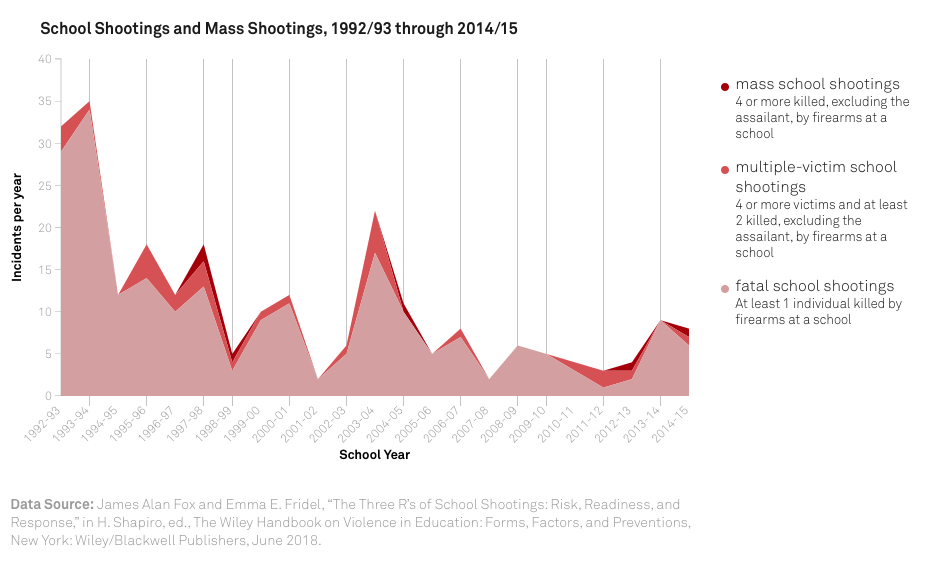
First, as I noted recently on SacredCowChips, the supposed escalation in mass shootings at schools is a myth. Northeastern University provides this summary of the research quoted in my post, including the chart on the long-term decline in school shootings shown above. In light of these statistics, the lead researcher, James Alan Fox, believes that most school security measures are counter-productive, including proposals to arm teachers. I do not fully agree, but be that as it may, it is astonishing that the media and large swaths of the public have accepted as fact the myth of a school shooting epidemic.

The ignorance of would-be gun controllers about guns themselves is legendary. Few of them can actually define an “assault weapon” yet are convinced that they must be banned. The cosmetic addition of certain features to a standard semi-automatic rifle apparently makes these guns too “scary”. And there is little understanding that standard rifles sold today, which fire one shot at a time, are semi-automatic weapons! Rifles, by the way, are involved in only a small fraction of gun homicides, so the focus on “assault weapons” is misplaced. Given this level of ignorance, it’s all too easy to dismiss the gun control crowd as unworthy of a real debate over gun regulation.

Of course, the crux of the debate revolves around constitutional rights. While many of those in favor of stricter gun regulation disavow any desire to repeal the Second Amendment or to actually confiscate guns, there is a significant contingent among them harboring that as an end-goal. Their ideal is politically laughable because it would never get a two-thirds vote of each house of Congress, let alone ratification by 3/4 of the states.

The Second Amendment is described by its foes as outdated and dangerous. I submit, however, that the right to defend oneself against predators, human or otherwise, is a natural right and not subject to obsolescence. The Second Amendment was also intended as protection against tyranny by government, and it serves as protection against a tyranny of any majority or rogue minority. Gun-rights critics argue that the founders of our country did not anticipate the powerful weapons available today, and that they would never have intended citizens to be armed with them. The claim is dubious because the founders certainly would have believed that citizens should have the freedom to arm themselves at least in proportion to the arms used by potential predators (please forgive the use of the term “assault weapons” at the link).

Frankly, I do not expect government tanks to roll down my street on a mission to confiscate guns. Instead, the first step would be a strongly-suggested voluntary sacrifice of weapons. Later, perhaps actual confiscations would be attempted via small detachments of authorities or perhaps by marauding, black-shirted proxies. But confiscations won’t happen as long as a serious threat of reprisal exists, with reasonably powerful weapons, and that is a credit to the Second Amendment.

There are serious misconceptions (not to mention plentiful media propaganda) about the likelihood that stricter gun laws can reduce gun homicides, or that they could have prevented the mass shooting tragedies that have occurred. Some of those shootings are better viewed as failures of law enforcement — examples are the lack of official follow-up on prior tips about the shooter in Parkland, FL, the failure of the school’s resource officer to engage the shooter, the failure of the FBI to detain a shooter prior to an attack at the Pulse nightclub in Orlando, and in still other cases, the failure of background checks to identify individuals as ineligible to purchase guns. There is little doubt that proper enforcement of existing law and protocol would have prevented a number of mass shootings. The focus should be on improving the existing system before expecting responsible citizens to happily consent to further erosion of their natural and constitutional rights.

Strict gun regulation would certainly infringe on liberty, leaving private citizens defenseless in exchange for tenuous assertions of social benefits. Defensive gun uses (DGUs) are thought to far outstrip gun homicides (seven posts touching on that subject are at this link). If guns could be effectively outlawed in the U.S., other instruments of homicide would replace guns because so much killing is driven by the drug war, gang activity, and other social dysfunctions. The same is true of suicides. If you recognize the futility of the war on drugs, you shouldn’t expect much success from a war on guns. Criminals will acquire guns whether they are illegal or not, so the ability to defend oneself with equal force is critical. There is a lively debate over the empirical research on the efficacy of stricter gun laws, but it’s always good to be skeptical when it comes to government prohibitions. Control advocates often cite Australia as an example of successful firearms control, but the country’s gun ban and buy-back program was ineffective in reducing gun homicides (also see here).

Finally, it’s appalling to see the depths to which certain radical enemies of gun ownership will sink in attempting to cast blame on their opponents for mass shootings. In fact, they have blamed not just the NRA, but all gun owners for the Parkland shooting and gun homicides generally. But the NRA represents responsible, law-abiding gun owners and promotes safe and responsible gun use. Roughly 47% of adults in the U.S. have guns in their homes, and they own guns for self-defense or sporting purposes. Attempts to shame them into supporting curtailments on their liberties is obnoxious and rather foolish because it is so unlikely to be fruitful approach. Successful codification always hinges on consensus, which just doesn’t exist with respect to gun law in the U.S.

The media have fawned over the students who have participated in the March For Our Lives campaign. The childrens’ ignorance of constitutional principles, and guns of course, is noteworthy, but their exploitation by powerful political and economic forces is pathetic. The significance of their numbers has been exaggerated as well: reports show the crowd size at the march in Washington, DC was about a quarter of what the organizers claimed. And the anti-gun students have failed to convince many of their peers, according to a poll conducted by USA Today/Ipsos. Perhaps as the spotlight fades, more of these student protestors will have occasion to study the U.S. Constitution and the natural rights it protects against government overreach. No matter how the kids feel now, I’m certain that many of them will be responsible gun owners someday.

Suicides Happen, Guns or Not

20 Monday Jun 2016

Posted by Nuetzel in Gun Rights

≈ Leave a comment

Tags

British Coal-Gas Story, Don B. Kates, Gary Mauser, Gun Rights, Guns and Suicide, Harvard, Impulsive Suicide, International Suicide Rates, Mises Institute, Mises Wire, OECD Suicide Comparison, Passion Suicide, Premeditated Suicide, Ryan McMaken, Teenage Suicide

heads

Gun-rights deniers often assert that access to guns increases the suicide rate, a question recently addressed by Ryan McMaken on the Mises Wire blog. He shows conclusively that suicide rates across countries are not related to gun laws. While gun ownership in the U.S. is extensive, and most gun deaths in the U.S. are suicides, the U.S. suicide rate is in the middle of the pack for OECD countries. Most of those countries have more restrictive gun laws. In fact, the U.S. suicide rate is lower than in Austria, Finland, France, Belgium, and Japan. Gun ownership rates are extremely low in Austria, France, and Japan. Therefore, suicide rates appear to be unrelated to legal gun ownership and the restrictiveness of gun laws. These facts, and simple logic, suggest that an individual in a state of extreme desperation has alternative means of taking their own life.

The most nuanced argument that guns encourage suicides is based on a dichotomy of premeditated suicides versus suicides of impulsivity or passion. Most impulsive suicides, according to this view, are carried out with faster, less painful and more reliable methods, which would include the use of guns. That’s based in part on interviews with suicide survivors and the mental health records of non-survivors. However, it would not be surprising to learn that survivors actually had less intent to begin with; a comparison is impossible because we can’t ask the non-survivors. And whether a mental health record, or the absence of one, is always  a reliable guide to the degree of impulsivity is open to question. So while there are differences in the mental health records of firearm suicide victims versus those who have used less reliable methods, the conclusions seem to rest on fairly unreliable measures of impulsivity or on survivor-only samples. Researchers don’t have much choice in the matter, but drawing conclusions based only on survivors is prone to severe bias.

McMaken shows that guns account for most suicides only among those of age 55 and above, a group that is likely to be the least impulsive. Teenagers might be expected to be the most impulsive, but they tend to have lowest rates of suicide by firearms. However, a teen might not have ready access to a gun even if one is in the home. The teenage suicide rate is even less related to gun ownership across countries. New Zealand, Ireland, Finland and Canada come in much higher than the U.S. on this sad measure, and Australia, Japan, Switzerland, Belgium and Sweden are above the U.S.

At the previous link, the “British coal-gas story” is told to argue that cutting off a common means of suicide will lead to a permanent reduction in suicides. In this case, a changeover from coal gas for heating and cooking to natural gas is alleged to have led to a permanent decrease in total suicides in Great Britain in the 1960s, as death by “sticking your head in the oven” was no longer very reliable. However, other research has found compensatory increases in other forms of suicide, so the coal-gas lesson is suspect.

A Harvard study (circa 2007) by criminologists Don B. Kates and Gary Mauser focused on the ties between guns, murder and suicide; they concluded that suicide does not bear a relationship to gun possession. The authors examined cross-country and within-country data:

“There is simply no relationship evident between the extent of suicide and the extent of gun ownership. People do not commit suicide because they have guns available. In the absence of fire‐ arms, people who are inclined to commit suicide kill themselves some other way.”

Suicide is a manifestation of despair so deep that the victim simply cannot get on with life. Guns have nothing to do with that anguish. It may be true that failed attempts often lead to a renewal of spirit, but survivors still have a high rate of suicidal recidivism. Moreover, the question of the depth of the original intent for survivors is open to question. Those choosing guns for suicide might think it’s the best alternative, but clearly other alternatives will be chosen when guns are unavailable. The claim that access to guns makes people more vulnerable to taking their own lives is not supported by the data.

Anti-Gun Babes Up In Arms

17 Friday Jun 2016

Posted by Nuetzel in Gun Control, Gun Rights

≈ 1 Comment

Tags

ACLU, Alexander Hamilton, Andrew Napolitano, Applied Economics, Assault Weapons, Background checks, Defensive Gun Uses, DGUs, Due Process, Eugene Volokh, Fully-Automatic Guns, Glenn Reynolds, Gun Blame, Gun-Free Zones, Individual Right to Bear Arms, James B. Jacobs, Killing Zones, Mass Shootings, Mizzou, Ninth Amendment, Ordinary Constitutional Law, Pink Pistols, Pulse Nightclub, Rolling Stone Magazine, Second Amendment, Semi-Automatic Guns, Soopermexican, Terror Watch List, Trey Gowdy, Unenumerated Rights, Well-Regulated Militia

image

Passion for various forms of gun control was inflamed by the tragic murder of 49 patrons (with 53 injured) at the Pulse nightclub in Orlando, Florida in the early hours of last Sunday morning. A man with ties to radical Islam was the perpetrator, but that’s not convenient to the left’s narrative, so scapegoats for the massacre run the gamut from guns to transgender bathroom laws to Christian “intolerance”, as opposed to the intolerance of a bat-shit crazy Islamic extremist. The Soopermexican notes the following:

“It’s really amazing how liberals [sic] are finding a way to blame Christians for the actions of the Orlando terrorist, who was, 1) gay, 2) Muslim, 3) Democrat, and 4) racist. … But then that’s what they did that time when a crazed liberal gay activist tried to shoot up the Family Research Council. Remember that? He literally said he wanted to kill everyone and then ‘smear Chick-Fil-A in the victim’s faces.’“

In case there’s any misunderstanding, I include that quote NOT to denigrate gays, Muslims, or Democrats, but to emphasize the absurdity of blaming Christians for the Orlando shootings. To get a sense of the infectious silliness going around in leftist circles over the slaughter, read this account of a vigil for the Pulse victims held in Columbia, MO by several student organizations near the main campus of the University of Missouri, at which Latino activists scolded the gay activist crowd for being “too white” and for paying insufficient attention to racial issues. Of course, it’s true that many of the Orlando victims were Latino, but after all, the vigil was for them, too, not just the white victims.

The left despises private gun ownership, or perhaps private anything except for their own privileges. Gun-blame feels so compassionate to them, and in this case, it conveniently avoids any mention of the killer’s ethnicity and radical ideology. Agitators say that “assault weapons” must be banned, but they are generally unable to articulate a precise definition. More thorough background checks are another favorite “solution”, but that’s based on an article of faith that such checks would be effective. Without proof that background checks actually work, and there is none, it still seems like a good idea to the “do something” crowd. Then, there are those whose real agenda is to ban guns outright, despite the fact that gun bans are counterproductive and infringe on the rights of law-abiding citizens.

Most of those who wish to ban assault weapons think they are referring to guns that fire repeatedly when the trigger is pulled. In other words, they believe that assault weapons are fully automatic weapons. But fully automatic weapons have been banned in the U.S. since 1934! Semi-automatic weapons require the trigger to be pulled to fire each bullet but load the next bullet automatically. James B. Jacobs of the NYU School of Law gives a fairly detailed description of the distinction between so-called assault weapons and other firearms, which essentially comes down to appearance:

“‘Assault weapons’ are semiautomatic firearms designed to look like military rifles. They are not military rifles—sometimes called assault rifles24—such as the U.S. Army’s M-16 … that can be fired in automatic or semiautomatic mode, or Russia’s AK-47, Germany’s HK G36 assault rifle, and Belgium’s FN Fal assault rifle. In contrast to assault rifles, these semiautomatic look-alikes do not fire automatically. Functionally, they are identical to most other semiautomatics. … Practically all modern rifles, pistols, and shotguns are semiautomatics; non-semiautomatic long guns include bolt action, slide action, and breach loaders; non-semiautomatic pistols are called revolvers.“

Jacobs discusses the futility of a ban on assault weapons and offers accounts of some historical assault weapon bans that were ineffective. Those outcomes were due in part to the flimsy distinction between assault weapons and other guns, as well as the fact that assault weapons are used in a relatively small percentage of gun crimes and in few mass shootings (also see here). This is corroborated by a recent paper appearing in the journal Applied Economics in which the authors report:

“… common state and federal gun laws that outlaw assault weapons are unrelated to the likelihood of an assault weapon being used during a public shooting event. Moreover, results show that the use of assault weapons is not related to more victims or fatalities than other types of guns. However, the use of hand guns, shot guns and high-capacity magazines is directly related to the number of victims and fatalities in a public shooting event. Finally, the gunman’s reported mental illness is often associated with an increase in the number of victims and fatalities.“

Another contention made by ill-informed opponents of gun rights is that mass shootings are never stopped by citizens with guns. That is simply not true, but it is good propaganda because foiled shooting attempts tend to receive much less notice than actual mass shootings. This article by Eugene Volokh provides a list of confirmed incidents in which a mass shooting was averted by a citizen carrying a gun. This situation has its counterpart in the left’s denial that defensive gun uses (DGUs) occur more frequently than gun crimes. DGUs are difficult to count because they often go unreported and may not even require the firing of a shot.

Another mistake is the continued advocacy for “gun-free zones” (such as the Pulse nightclub) within which even guards are not allowed to carry firearms. Andrew Napolitano rightly labels these “killing zones”.

More stringent background checks are another favorite solution of gun-rights opponents. However, actual background checks have done nothing to stop the most vicious mass shootings that have occurred over the past few years. This is another testament to the naiveté of relying on government to protect you, in this case, a government information system. Sheldon Richman has explained the futility of background checks thusly:

“… people with criminal intent will find ways to buy guns that do not require a check. Proponents of background checks seem to think that a government decree will dry up the black market. But why would it? Sales will go on beyond the government’s ability to monitor them. Out of sight, out of government control. … Thus the case against mandating ‘universal’ background checks withstands scrutiny. This measure would not keep criminally minded people from acquiring guns, but it would give a false sense of security to the public by promising something they cannot deliver.“

Advocates of assault weapon bans and wider background checks are inclined to characterize gun rights supporters as paranoid. As Volokh explained last year, however, there is strong reason to believe that the pro-gun lobby has correctly assessed the motives among the opposition as more extreme. Volokh notes that an ineffectual ban, like the 1994-2004 assault weapon ban and many other gun bans internationally, cannot outweigh the interests of society in protecting a basic liberty.

And as to basic liberties, Rolling Stone offers a wonderful illustration of the left’s disregard for individual rights and constitutional protections in an angry missive to gun rights supporters: “4 Pro-Gun Arguments We’re Sick of Hearing“. The author not only holds the Second Amendment in distain: vogue left-think has it that the entire Constitution is tainted because the framers were unable to agree on abolition 230 years ago (at a time when slave ownership was commonplace among the aristocracy). The fact that many of the founders were sympathetic to abolition makes little difference to these critics. They say the Constitution is not a legitimate framework for governance, despite its extremely liberal point of view on issues of individual rights. Apparently,  Rolling Stone would be just fine with abrogating the free speech rights of gun advocates.

Over the past 20 years or so, case law has increasingly viewed the Second Amendment as “ordinary constitutional law“, meaning that it protects individuals’ right to bear arms. The “well-regulated militia” limitation written into the Second Amendment is no longer accepted by the courts and most legal scholars as a limitation on individual rights. The militias it references were state militias raised from the civilian population, and the armaments they used were generally owned by the same civilians. In any case, there is no time limitation imposed on gun ownership by the Second via that clause. An earlier discussion of these issues was provided by Eugene Volokh in “The Commonplace Second Amendment“.

All this is quite apart from the Ninth Amendment, which states that nothing in the Constitution should be interpreted as limiting rights that are unenumerated. That would include self-defense, and ownership of a gun for that purpose is well advised. The Wikipedia entry on the Ninth Amendment says:

“One of the arguments the Federalists gave against the addition of a Bill of Rights, during the debates about ratification of the Constitution, was that a listing of rights could problematically enlarge the powers specified in Article One, Section 8 of the new Constitution by implication. For example, in Federalist 84, Alexander Hamilton asked, ‘Why declare that things shall not be done which there is no power to do?’“

In other words, we do not derive our rights from government or the majoritarian passions of the moment.

Finally, the debate in Congress this week has centered on whether individuals on the FBI’s Terrorist Watch List should be denied the right to purchase a gun. That might seem like a no-brainier, but it raises legitimate concerns about civil liberties. There are about 700,000 people on that list (some reports put the number much higher), many of them U.S. citizens; some of them are there by mistake. Individuals on the list have not been convicted of a crime and are therefore entitled to due process under the Fifth and Fourteenth Amendments. Watch Rep. Trey Gowdy’s passionate defense of due process to a DHS official this past week. When the ACLU and congressional republicans agree on the tyrannical nature of a restriction like this, you just can’t dismiss it out-of-hand. Such a change in the law cannot be justified without a fast and effective process giving citizens on the list a right of challenge.

The left is bereft of competence on the matter of guns, gun rights and the Constitution generally. They consistently demonstrate a dismissive view of individual liberties, whether that involves guns, religion, property, speech or due process. The tragedy in Orlando deserves more than ill-informed, knee-jerk conclusions. The most productive approach to terror risks involves individuals able to protect themselves and help watch out for others. That’s consistent with the position of the gay gun-rights group Pink Pistols. More power to them!


Gagging On Campaign Finance Reform

10 Wednesday Feb 2016

Posted by Nuetzel in Big Government, Campaign Finance

≈ Leave a comment

Tags

Bernie Sanders, Bipartisan Campaign Reform Act, Buckley v. Valeo, Bundler Disclosure, Campaign Contributions, Campaign Finance, Citizens United, Eigene Volokh, Elena Kagan, Federal Election Commission, First Amendment Protections, Hillary Clinton, Ilya Shapiro, Influence Spending, Jacob Sullum, Jeb Bush, Jeffrey Milyo, Jonathan Adler, Legislative Dysfunction, McCain-Feingold, McCutcheon v. FEC, Michael McConnell, Press Clause, rent-seeking behavior, Speechnow.org v. FEC, Spending Limits

campaign-finance-reform

Campaign finance is an area of internal conflict for some libertarians. On one hand, they do not believe in restrictions of any kind on freedom of expression. That implies no limits on what an individual can spend in support of a political cause, by themselves or in association with others, and whether it merely promotes a point of view or supports a political candidate. At the same time, libertarians are strongly opposed to rent-seeking activity, or efforts to use government power to promote private interests. Political spending is seen by many as an avenue for rent seeking, which suggests to them a need for limits on campaign contributions.

In fact, full-throated support of free speech and opposition to campaign limits do not stand in conflict. The reasons are: 1) such limits are an assault on free speech; 2) campaign contributions represent “small change” in the larger scheme of rent-seeking pursuits; 3) contributions seldom represent direct efforts to influence policy; and 4) imposed limits have a detrimental effect on the ability of elected officials to do their jobs.

Speech

Free speech, long interpreted by the courts more broadly as free expression, is protected by the First Amendment to the U.S. Constitution. This includes political expression, but traditionally it included campaign contributions as well, the latter being an obvious mechanism by which one can express views. However, the Supreme Court has upheld statutory limits on individual contributions to specific campaigns, as well as disclosure rules, on the grounds that they prevent corruption (Buckley v. Valeo and more recently McCutcheon v. Federal Election Commission(FEC)). I view the contribution limits as a contravention of the First Amendment, denying an enumerated right on the grounds that it “might” lead to corruption. If preventing corruption is the sole rationale for these limits, then government itself should be sharply limited, as it most certainly leads to graft and corruption at the expense of relatively powerless taxpayers.

Citizens United

A well-known Supreme Court case decided in 2010 involved independent political speech, as opposed to expression of political preference revealed by campaign spending. This was Citizens United v FEC, in which the Court ruled that political speech cannot be restricted on any basis other than corruption. As described by Ilya Shapiro, the case is widely misunderstood. One point of interest here is that the case related to speech by an organization rather than an individual. The Court ruled that a corporation (a nonprofit in the case) could not be prevented from airing a film critical of Hillary Clinton, striking down provisions of the Bipartisan Campaign Reform Act of 1990 (McCain-Feingold) under the First Amendment.

The Citizens United decision was NOT about campaign contributions. As an interesting aside, in a search of cartoons related to campaign finance, a great many imply that the Supreme Court abolished such limits in Citizens United. It did not. Even given some level of disaffection, it is hard to account for the near-complete lack of understanding about the case.

More informed critics of the decision bemoan that fact that it allows speech by corporations (and unions and other associations) to go unlimited, though they don’t seem to mind the absence of limits on political speech by media corporations. (See Eugene Volokh’s view in the Brown Daily Herald and Michael McConnell’s reinterpretation of Citizen’s United as a Press Clause case in the Yale Law Journal.) The critics also fail to recognize that corporations are associations of individuals, who are otherwise subject to no restrictions on independent speech or on what they can spend to speak independent of any political candidate (as established in Speechnow.org v. FEC in 2010). The technical treatment of a corporation as a “person”, which many find objectionable, is beside the point. Only by distorting the meaning of the First Amendment can any limitation be placed on the freedom of individuals to speak in association with others.

Jacob Sullum covers the confused legal thinking of leading Democrats Hillary Clinton and Bernie Sanders on campaign finance reform, and on Citizens United in particular. Jeb Bush is no better. Most of the opposition to the decision centers around the notion of “balancing” speech, but Sullum offers a piece of wisdom from a 1996 quote of future Supreme Court Justice Elena Kagan: “the government may not restrict the speech of some to enhance the speech of others.”

Corporate Campaign Spending

Another point raised by Ilya Shapiro is that corporate spending growth has neither accelerated nor decelerated in the wake of Citizens United. Moreover, restrictions on direct campaign contributions are still in place. However, campaign contributions are a relatively small percentage of corporate “influence spending”, averaging roughly 10% of the total between 2007 and 2012 for 200 large “politically active” corporations. Thus, direct campaign contributions are unlikely to be the primary avenue for rent-seeking activity. They might help buy “access” to politicians, but they may not be especially effective in influencing policy. These points are supported by University of Missouri economist Jeffrey Milyo in “Politics Ain’t Broke, So Reforms Won’t Fix It“. Milyo marshals empirical evidence that should make us skeptical of campaign finance reform efforts.

Incapacitated Legislators

Jonathan Adler of Case Western emphasizes the legislative dysfunction created by campaign finance reforms. McCain-Feingold places limits on funds candidates can receive from their political parties and other sources, forcing them to spend a large proportion of their time on fundraising (and placing incumbents at a distinct advantage). If there is a shred of sincerity in the populist insistence that members of Congress be subject to tighter term limits, or that Congress is woefully unproductive, then full repeal of these limitations should be a priority.

Visibility Versus Effectiveness

The chief advantage of combatting corruption through regulating campaign finance is that it is a visible target. However, it is a target too rich with free speech implications. Disclosure requirements are one thing (through arguments can be made against infringements on the privacy of contributors as well). Limiting forms of expression outright is draconian, and reformers are unlikely to be satisfied until campaigns are funded entirely by taxpayers. Attacking “corruption” via limits on campaign contributions presumes a need to protect both contributor and recipient from their own guilt. Even if contributions help gain better access to an elected representative, it does not imply that the representative will act on motives counter to the perceived public merits of an issue. Moreover, the argument that limits on direct contributions to candidates “keep money out of politics” is flawed. Limits simply change the distribution of political spending, increasing the reliance on bundlers and organizations like Super PACs, and shifting the tables in favor of incumbents.

There are far better ways to combat corruption among legislators and others in government, some with more severe drawbacks than others. Term limits are one possibility, but would deny voters of legitimate choices. Another option is to allow candidates to have unrestricted access to campaign funds through central organizations, rather than forcing them to rely on independent Super PACs, which cannot always be relied upon to craft a candidate’s preferred messages. Immediate disclosure of contributors and amounts would help to bring more transparency to the campaign finance process. Stiffer disclosure requirements for “bundlers” would also help. Perhaps elected executives could be prohibited from appointing bundlers to positions of authority, though a precise definition of “bundler” might become contentious. There are other reform possibilities related to limiting permissible lobbying activity.

The libertarian’s dilemma with respect to campaign finance is easily resolved once the focus is placed squarely on protecting individual rights. In the end, the best defense of individual rights and against corruption in government is to limit government. It’s wise to place strong reigns on an institution that operates by virtue of coercive authority. The danger was well-acknowledged by the limits on government power enshrined in the Constitution.

Follow Sacred Cow Chips on WordPress.com

Recent Posts

  • Immigration and Merit As Fiscal Propositions
  • Tariff “Dividend” From An Indigent State
  • Almost Looks Like the Fed Has a 3% Inflation Target
  • Government Malpractice Breeds Health Care Havoc
  • A Tax On Imports Takes a Toll on Exports

Archives

  • December 2025
  • November 2025
  • October 2025
  • September 2025
  • August 2025
  • July 2025
  • June 2025
  • May 2025
  • April 2025
  • March 2025
  • February 2025
  • January 2025
  • December 2024
  • November 2024
  • October 2024
  • September 2024
  • August 2024
  • July 2024
  • June 2024
  • May 2024
  • April 2024
  • March 2024
  • February 2024
  • January 2024
  • December 2023
  • November 2023
  • August 2023
  • July 2023
  • June 2023
  • May 2023
  • April 2023
  • March 2023
  • February 2023
  • January 2023
  • December 2022
  • November 2022
  • October 2022
  • September 2022
  • August 2022
  • July 2022
  • June 2022
  • May 2022
  • April 2022
  • March 2022
  • February 2022
  • January 2022
  • December 2021
  • November 2021
  • October 2021
  • September 2021
  • August 2021
  • July 2021
  • June 2021
  • May 2021
  • April 2021
  • March 2021
  • February 2021
  • January 2021
  • December 2020
  • November 2020
  • October 2020
  • September 2020
  • August 2020
  • July 2020
  • June 2020
  • May 2020
  • April 2020
  • March 2020
  • February 2020
  • January 2020
  • December 2019
  • November 2019
  • October 2019
  • September 2019
  • August 2019
  • July 2019
  • June 2019
  • May 2019
  • April 2019
  • March 2019
  • February 2019
  • January 2019
  • December 2018
  • November 2018
  • October 2018
  • September 2018
  • August 2018
  • July 2018
  • June 2018
  • May 2018
  • April 2018
  • March 2018
  • February 2018
  • January 2018
  • December 2017
  • November 2017
  • October 2017
  • September 2017
  • August 2017
  • July 2017
  • June 2017
  • May 2017
  • April 2017
  • March 2017
  • February 2017
  • January 2017
  • December 2016
  • November 2016
  • October 2016
  • September 2016
  • August 2016
  • July 2016
  • June 2016
  • May 2016
  • April 2016
  • March 2016
  • February 2016
  • January 2016
  • December 2015
  • November 2015
  • October 2015
  • September 2015
  • August 2015
  • July 2015
  • June 2015
  • May 2015
  • April 2015
  • March 2015
  • February 2015
  • January 2015
  • December 2014
  • November 2014
  • October 2014
  • September 2014
  • August 2014
  • July 2014
  • June 2014
  • May 2014
  • April 2014
  • March 2014

Blogs I Follow

  • Passive Income Kickstart
  • OnlyFinance.net
  • TLC Cholesterol
  • Nintil
  • kendunning.net
  • DCWhispers.com
  • Hoong-Wai in the UK
  • Marginal REVOLUTION
  • Stlouis
  • Watts Up With That?
  • Aussie Nationalist Blog
  • American Elephants
  • The View from Alexandria
  • The Gymnasium
  • A Force for Good
  • Notes On Liberty
  • troymo
  • SUNDAY BLOG Stephanie Sievers
  • Miss Lou Acquiring Lore
  • Your Well Wisher Program
  • Objectivism In Depth
  • RobotEnomics
  • Orderstatistic
  • Paradigm Library
  • Scattered Showers and Quicksand

Blog at WordPress.com.

Passive Income Kickstart

OnlyFinance.net

TLC Cholesterol

Nintil

To estimate, compare, distinguish, discuss, and trace to its principal sources everything

kendunning.net

The Future is Ours to Create

DCWhispers.com

Hoong-Wai in the UK

A Commonwealth immigrant's perspective on the UK's public arena.

Marginal REVOLUTION

Small Steps Toward A Much Better World

Stlouis

Watts Up With That?

The world's most viewed site on global warming and climate change

Aussie Nationalist Blog

Commentary from a Paleoconservative and Nationalist perspective

American Elephants

Defending Life, Liberty and the Pursuit of Happiness

The View from Alexandria

In advanced civilizations the period loosely called Alexandrian is usually associated with flexible morals, perfunctory religion, populist standards and cosmopolitan tastes, feminism, exotic cults, and the rapid turnover of high and low fads---in short, a falling away (which is all that decadence means) from the strictness of traditional rules, embodied in character and inforced from within. -- Jacques Barzun

The Gymnasium

A place for reason, politics, economics, and faith steeped in the classical liberal tradition

A Force for Good

How economics, morality, and markets combine

Notes On Liberty

Spontaneous thoughts on a humble creed

troymo

SUNDAY BLOG Stephanie Sievers

Escaping the everyday life with photographs from my travels

Miss Lou Acquiring Lore

Gallery of Life...

Your Well Wisher Program

Attempt to solve commonly known problems…

Objectivism In Depth

Exploring Ayn Rand's revolutionary philosophy.

RobotEnomics

(A)n (I)ntelligent Future

Orderstatistic

Economics, chess and anything else on my mind.

Paradigm Library

OODA Looping

Scattered Showers and Quicksand

Musings on science, investing, finance, economics, politics, and probably fly fishing.

  • Subscribe Subscribed
    • Sacred Cow Chips
    • Join 128 other subscribers
    • Already have a WordPress.com account? Log in now.
    • Sacred Cow Chips
    • Subscribe Subscribed
    • Sign up
    • Log in
    • Report this content
    • View site in Reader
    • Manage subscriptions
    • Collapse this bar
 

Loading Comments...