• About

Sacred Cow Chips

Sacred Cow Chips

Category Archives: Uncategorized

Divesting of Human Well Being

04 Tuesday Nov 2014

Posted by Nuetzel in Uncategorized

≈ 2 Comments

Tags

American University, Benjamin Zycher, College Endowments, Divestment, Energy, Fossil fuels, Harvard, Julia Morriss, Political Correctness

guilt-ridden

The movement to be “politically correct” among college endowments and other funds has included a push to divest of assets in industries that extract, refine or distribute fossil fuels. A bright student at American University named Julia Morriss penned this opinion piece on divestment in the university’s student newspaper. She says:

“As you read this on your iPhone, eat an organic avocado grown in California and buy a plane ticket home for winter break, I urge you to think about what a world without fossil fuel use would mean. Energy is embedded in virtually everything we do and consume, from life-saving drugs to our clothing. …This would be a different story if a viable option to fossil fuels existed that could handle all the world’s needs. But sadly we are not there yet.

And this isn’t just about getting to keep your iPhone. Lower-income households spend almost a quarter of their income on energy. Cutting out fossil fuels would cause energy prices to soar, punishing the poor the most.”

Harvard’s President sensibly voiced his opposition to fossil fuel divestment in a recent statement. Here is a well-articulated condemnation of the divestment movement from Benjamin Zycher entitled “The Breathless Hypocrisy Driving Energy ‘Divestment’“. He says this:

“So if investment in fossil-fuel sectors engenders some sort of moral quandary, does the same principle apply to investment in industries that use energy? After all, they are responsible for the very existence of the energy producers; will the divestment campaign expand to agriculture, manufacturing, transportation, retailing, the household sector, and all the rest?”

Read the whole thing, as they say.

Dislike Campaign Spending, Don’t Restrict It

03 Monday Nov 2014

Posted by Nuetzel in Uncategorized

≈ Leave a comment

Tags

Campaign Spending, First Amendment, Freedom of Speach, Halloween, Institute For Justice

money_in_politics

Here is interesting perspective from the Institute For Justice on an issue that is often blown out of proportion: money in politics. The graphic above from IJ tells the story. From the IJ post:

“Americans spend more money on Halloween candy, parties and costumes than was spent by all federal candidates, PACs and party committees combined in the last presidential election cycle.”

This comparison is a striking contrast to the rhetoric of totalitarians who wish to cast aside First Amendment rights by restricting political spending. Yes, campaign ads can be tiresome, but they usually convey information, and the loudest complaints seem to come from factions who simply don’t like what their opposition is saying. From IJ Attorney Paul Stevens:

“… campaign spending is nothing to be afraid of. This money is spent persuading American voters about the most important issues of the day. In a democracy with more than 200 million voting-age citizens, the amount Americans spend on campaigns is neither scary nor unreasonable.“

Obamacare Shills Try Heroic Measures

01 Saturday Nov 2014

Posted by Nuetzel in Uncategorized

≈ 1 Comment

Tags

ACA, Business Week, CHIP, Cronyism, Death Spiral, Employer Sponsored Plans, Forbes, Government Failure, Health Care Exchanges, Mandates, Medicaid, Obamacare, USA Today, Welfare Programs

obama-health-care

Die-hard Obamacare supporters are in full denial over the lousy results of the health care plan in its first year. They’re tone deaf, living a delusion. This piece from Forbes.com notes that the Affordable Care Act (ACA) has been an abject failure thus far on six of seven major counts, and even the one “success” is terribly blemished. Close to 90% of the increase in the number of insured is due to expansion in the Medicaid and state Children’s Health Insurance Program roles. Both of those welfare programs predate the ACA and certainly could have been expanded without Obamacare and its collateral damage to existing health plans and the health care industry. In fact, according to Business Week, less than half of physicians now accept Medicaid, so it’s not always easy for those “newly insured” individuals to gain access to actual care.

In fact, Medicaid patients are not the only ones with access problems. This USA Today article linked by Forbes notes that physicians are limiting the number of Obamacare exchange-covered patients they’ll accept. After the disastrous unraveling of the “if-you-like-your-plan-you-can-keep-it” fiction, it was revealed that many of the policies foisted upon the “previously-insured-but-no-longer” group through Obamacare exchanges offered severely limited provider networks. If you liked your doctor, you might well have lost your doctor.

For the majority who do not qualify for taxpayer subsidies under Obamacare, the health insurance premia on policies acquired on the exchanges have risen drastically. This problem is covered in the Forbes article. Far less expensive short-term plans are being offered by insurers as an alternative to Obamacare, but they are only renewable if the insured remains healthy. It is precisely these kinds of circumstances that might devolve into a death spiral for Obamacare: an increasingly sick risk pool and universal rating may lead to accelerating premium hikes for the exchange policies.

So, prospects for improvement under the ACA are quite bleak. We’ve seen a botched rollout of the Obamacare website, the chief enrollment vehicle, which is still problematic; a wrecked individual market with policies cancelled and replaced by coverage with limited provider networks; a medical device industry battered by new taxes; a negative impact on full-time employment as firms reduce hours to avoid coverage requirements; expanded welfare programs with a concomitant burden on taxpayers; increased emergency room utilization; physicians opting out due to inadequate reimbursement and high compliance costs; healthy individuals opting out and sick individuals opting in; higher premia with more increases on the way and the prospect of an insurance death spiral; and we’ve seen arbitrary exemptions carved out for various cronies of the Obama administration all along the way. Oh, and we’ve seen lies, delays, and every effort to back-load costs and front-load benefits, an implementation governed by political considerations rather than improving health care. The next shoe to drop is likely to be widespread cancellation of employer-sponsored coverage as the ACA coverage mandate hits employers in 2015.

Desperate propaganda continues to flow, but that can’t change the fact that Obamacare is terrible policy with results to prove it. Here is government failure.

We Need Trolleys Like We Need Excuses For New Taxes

30 Thursday Oct 2014

Posted by Nuetzel in Uncategorized

≈ 1 Comment

Tags

Coyote Blog, Delmar Trolley, Federal Grants, Forest Park, Judy Garland, Resource Costs, Streetcars, The Atlantic, The Show Me Institute, Transit Taxes, Trolleys

lite-rail

Streetcars and trolleys seem to evoke romantic notions, but they are a gigantic waste of resources. They are costly to build relative to alternatives by about an order of magnitude. After construction, the revenue they produce generally pays only a fraction of ongoing operating costs, contributing nothing to the original capital costs. It’s a loser all the way around. The “economic development” mantra is a fallacy. Relative to what alternative? Assertions of “environmental benefits” are even more bogus, as if pouring resources valued in the millions down the hole to build a new civic toy did not have negative environmental implications. Waste is waste.

Here is a recent article in The Atlantic that covers the poor performance of many new streetcar and trolley systems. They defend the rail concept, provided that it is dedicated and not competing with auto, bike, bus and pedestrian traffic for lanes. This problem has been encountered by a number streetcar systems, including one in Washington, DC. Coyote Blog has some additional thoughts on the DC line and the urbanist streetcar obsession in general:

“What we see over and over again is that by consuming 10-100x more resources per passenger, rail systems starve other parts of the transit system of money and eventually lead to less, rather than more, total ridership (even in Portland, by the way).”

A trolley project is underway in St. Louis that is typical of other systems in terms of waste. It would link a popular district called the University City Loop with Forest Park. Nostalgic images of Judy Garland riding the trolley to the World’s Fair in the park must dance in the heads of supporters. Clang, Clang, Clang! Here is a short piece on the Delmar Trolley:

“The total construction cost will reach close to $45 million — almost $20 million per mile of track. … taxpayers will finance most of the project’s construction and operational costs. … The plan’s proponents have not presented any kind of cost-benefit analysis to the public. ”

Ah, but a $25 million federal grant was approved for the project back in 2012, and that’s just a free lunch for locals, right? How many local planners around the country think in those terms? Short answer: too many!

Taleb’s Crock Pot: Whip Statistical Theory and Rhetoric To a Fine Agitprop

29 Wednesday Oct 2014

Posted by Nuetzel in Uncategorized

≈ Leave a comment

Tags

Biofortified, Black Swans, David Tribe, DebunkingDenialism, Emil Karlsson, Fat Tails, GMO Pundit, GMOs, Luddites, Nassim Taleb, NeuroLogica, Precautionary Principle, The Motley Fool

scary-crockpot

Nassim Taleb, a well-known statistical theorist, and two coauthors (a physicist and a philosopher) have written a working paper in which they purport to show that GMO’s should be banned worldwide lest we flirt with complete ruination, quite possibly the end of humanity. The paper may come to represent sacred writ to anti-GMO activists, as it seems to imply that their position is supported by statistical theory. Ultimately, the paper merely uses statistical theory in the service of rhetoric. It relies on a series of ill-defined dichotomies that the authors use to classify genetic plant engineering into the most “ruinous” category of processes. Among other things, GE is categorized by the authors as a “top-down” technology, it creates global risks and systemic risks, it involves interconnected factors, it is irreversible, its outcomes can be characterized by a probability distribution with “fat tails,” its true risks are “unknowable,” and (worst of all?) it is “human-made,” as opposed to a natural process devoid of human intervention. Perhaps the last condition is meant only to classify processes into the so-called “precautionary approach” to policy assessment, rather than “standard risk management,” but it may reveal something significant about the predisposition of the authors toward human technological endeavors.

The statistical theory presented by the authors is fine, as far as it goes. I have admired some of Taleb’s earlier work, such as Fooled By Randomness, which sought to demonstrate the irrationality of assigning likelihood or even meaning to chance events. Taleb achieved real stardom following the publication of The Black Swan, which warned of severe “outlier” events so rare that they cannot be predicted or even assigned probabilities by humans. The true risks are “unknowable.” Applied work involving “fat-tailed” distributions of possible outcomes, which characterize a wide range of phenomena, is typically supported by prior experience or data, but that is not possible with “ruinous” black swans. Perhaps “extremely long- and fat-tailed” is more descriptive of distributions giving rise to black swans, but of course the extreme outcomes might not be observable ex post.

Taleb, et al, contend that development and cultivation of GMOs carry risks of a black swan ecocide. “Significant” risks? Wait, that involves statistical precision… and data! “Excessive” risks? That implies measurability of one sort or another, not to mention a coherent tradeoff of some kind. “Any” risk of a certain qualitative nature (as defined by the “precautionary approach,” with possible ruin on any time scale)? Of course, the authors are not biologists, agronomists, or geneticists (neither am I), but they claim to have sufficient knowledge to make this judgment:

“Ecologically, in addition to intentional cultivation, GMOs have the propensity to spread uncontrollably, and thus their risks cannot be localized. The cross-breeding of wild-type plants with genetically modified ones prevents their disentangling, leading to irreversible system-wide effects with unknown downsides.” [emphasis added]

The article contains a comparison of GMOs to nuclear energy risks, which seems intended to defuse criticism that the authors are simply Luddites. They express guarded optimism that nuclear power-generating risks are “local” in nature, and that problems associated with long-term storage of nuclear wastes are manageable. Clearly, however, those risks are just as “unknowable” as those associated with GMOs. We might add to the list of dangerous human endeavors all research and development of artificial intelligence. After all, a complete ban on AI research would prevent the coming singularity, when we’ll otherwise be lorded over by ruthless, self-serving machines! On a less sarcastic note, I do not discount the possibility of a singularity, but we have the luxury of some time to develop AI in a cautious way, just as we have time to minimize risks in the continuing development and application of GE.

Here is a subset of the many assertions made by Taleb, et al in support of their view:

  • GMOs have the propensity to spread uncontrollably.
  • Healthwise, the modification of crops “impacts” everyone.
  • GMO risks are associated with “fragility” (essentially increasing costs).
  • GMOs imply monocultures.
  • GMOs are qualitatively dissimilar to selectively-bred crop varieties.
  • Selective breeding does not remove crops from their evolutionary context.
  • GMOs remove crops from their evolutionary context.
  • The ecological implications of releasing modified organisms into the wild are not tested empirically before release.
  • The health effects of GMOs have not been tested sufficiently.
  • Incremental varieties of GMOs cause the risk of ecocide to increase.

All of these points are debatable to one extent or another. For example, the common assertion that GMOs promote monocultures reflects a common confusion over GMOs versus adequate crop rotation in mechanized farming. The authors exploit this confusion by linking monocultures and GMOs to reduced genetic diversity (apparently within single crops) and assert that this makes crops more vulnerable to blight, though it is hard to see why this is a foregone conclusion regarding the effects of introducing desirable traits.

More fundamentally, Taleb, et al give short shrift to the idea that there is a risk-reward tradeoff in the use of GMOs, that there are potential benefits and risks of GMO alternatives, and the fact that GMOs do not, in fact, suspend evolutionary processes. If a mutation embodied in a GMO also confers an evolutionary advantage, chances are the mutation will be propagated. If not, the mutation will tend to vanish. This is a safety mechanism provided by nature. Of course, anti-GMO activists seek to conjure images of mad geneticists whipping up monster “Audrey” GMOs with evolutionary advantages, but that is not the character of biotechnology.

Taleb, et al, also wish to equate GMOs with Monsanto. The fact that they are so eager to invoke the company’s name in a negative context within an ostensibly academic paper is a giveaway that the paper is agenda-driven. Monsanto and GMOs are not synonymous, and it is highly misleading to conflate the technology with a single company.

The authors attempt to upstage critics with the choice of the adjective “non-naive” to describe their use of the precautionary principle to guide their policy prescription:

“… it is essential to distinguish the PP so that it is neither used naively to justify any act of caution, nor dismissed by those who wish to court risks for themselves or others. The PP is intended to make decisions that ensure survival when statistical evidence is limited—because it has not had time to show up —by focusing on the adverse effects of ‘absence of evidence.’”

So, they excuse themselves from bringing anything empirical to bear on the issue of GMO risks because, they contend, “unknowability” is the very nature of the risk/ruin problem, despite the fact that evidence supporting GMO safety does exist, in scads!

Here are a few other sources who have commented on the article:

This post on the NeuroLogica blog questions Taleb’s understanding of biology and genetic engineering. The author, Steven Novella, also notes that Taleb, et al, do not assess the risk of alternatives:

“Growing enough food for 7 billion people has consequences, in terms of land use, fertilizer, pesticides, and displacing natural ecosystems. GMO as a technology can potentially add to our efficiency. Banning GMO means relying more heavily on other technologies that may have even more risks.”

In addition, Novella says:

“… Taleb’s arguments to still come down to hyping the risk of unforeseen consequences due to the inherent limits of scientific knowledge. I don’t agree, however, that GMOs have the potential for global ruin. This is still largely based on a naive belief that transgenes are inherently risky, when there is no scientific reason to believe that they are. …  He failed to make a compelling argument that his principle of zero risk should apply to GMO.”

The Motley Fool, generally an admirer of Taleb’s previous work, also believes that he is off-base in the case of GMOs.

David Tribe at the GMO Pundit refutes a couple of assertions made by Taleb, et al. about natural variation and the “track record” of nature as an evaluator of risk.

And at DebunkingDenialism, Emil Karlsson is particularly galled, as he should be, by the comparison the paper makes of the risks of Russian Roulette to GMOs. He writes that Taleb and his coauthors fail to understand basic biology:

“In the end, the authors have clearly demonstrated that they do not care about biology, medicine or rational risk analysis. They have negligible knowledge of molecular biology, plant breeding and genetic engineering. It does not matter how much knowledge they have of statistics. If your model is based on flawed premises, then the application and conclusion of that model is going to be flawed. Garage in, garbage out.”

Taleb, et al have adorned their paper with statistical theory, and they are certainly correct that “unknowable” risks may be ruinous. But their case against GMOs ignores the substantial body of known evidence on GMO safety. They bring absolutely no evidence to bear to the contrary. Their arguments mislead by relying on false premises and arbitrary classifications. Unfortunately, that won’t stop reverent anti-GE crusaders from heralding Taleb’s “proof” that GMOs are ruinous and must be banned.

Labeling Exemptions Subvert Law’s Phobic Intent

26 Sunday Oct 2014

Posted by Nuetzel in Uncategorized

≈ Leave a comment

Tags

AAAS, Colorado, Commerce Clause, Compliance Costs, Denver Post, Farmer's Daughter, GMO food, GMO labeling law, Oregon, Oregonian, sworn statement, Unintended Consequences, Vermont

Sierra Exif JPEG

Predictably, Vermont’s new GMO labeling law is proving to be another classic failure of big government, as noted by The Farmer’s Daughter. Her post provides some of the gory details, including specific exceptions written into the drafted rules and “sworn statement” exemptions, both of which mean it will be of much less value to the public as a informational mechanism.

“The statement requires the signer to swear the food was not made from genetically engineered seeds and it was not co-mingled with any other GMO food. As you can imagine, such a system creates an odd set of regulations. On the one hand, a farmer has to keep all the GMO and GMO-free food separate, fill out these statements for each product, hope that nothing got mixed up, and risk perjury if it did. Alternatively, the grocery store has to keep the food separate, keep track of which sworn statement goes with which product (will they keep them in the display?), and hope that customers don’t mix up the products in the display.”

Obviously, the law will impose substantial compliance costs on farmers and grocers, and it will create barriers to trade across Vermont’s state lines that might ultimately meet a challenge under the Commerce Clause.

Meanwhile, debates over GMO labeling rage in a few other states, such as Oregon and Colorado, with measures on their ballots this November. The American Association for the Advancement of Science (publisher of Science magazine) is opposed to the Oregon’s initiative, as is the Oregonian newspaper, which published this editorial:

“Choice, in fact, is one reason to support the status quo, which provides organic and voluntarily labeled non-GE products for anyone who cares to buy them, usually at a higher price. The poor are protected, meanwhile, because, as the Washington report notes, ‘Volunteer labeling concentrates the costs on the target group able and willing to pay more for GMO-free products’ while ‘mandatory labeling imposes costs on everyone and not just those that desire GMO-free goods.’”

Here’s the Denver Post’s opinion on the Colorado measure:

“Colorado’s sugar beet growers could be seriously undermined. They grow genetically modified beets, so sugar from them would have GMO labels. Yet the beet growers argue that the end product is indistinguishable from other sugar because the GMO protein in the beets is removed in processing.

The same is true of vegetable oils from corn or canola seed that come from GMO plants.“

Does THC Hold a Cure For Cancer?

23 Thursday Oct 2014

Posted by Nuetzel in Uncategorized

≈ Leave a comment

Tags

Alzheimer's, Cancer, Cannabinoids, Classical Values, Curing Cancer, National Cancer Institute

Cancer

Cancer research is proceeding along a number of promising avenues, but there is an apparent gulf between the promise of one class of potential cures and the emphasis it receives in terms of publicity and funding: cannabinoids. Contrary to what some might suspect, when I say that cannabinoids show promise, it is not grounded in pseudoscientific balderdash, a topic on which I posted last night! Indeed, there is a brief but solid history of research showing the potential of cannabinoids in fighting cancer, as shown at this page on the National Cancer Institute website. The Classical Values blog has a post with quotes from the site; and CV bemoans the lack of attention devoted by the media to this type of research.

Unfortunately, until more effort is devoted to studying the effects of cannabinoids on cancer in humans, including optimization of its delivery, those cancer victims with an awareness of the research will be consigned to using covert and undoubtedly less effective means of ingestion, and many others will go uninformed. A disclaimer: it should go without saying that cancer victims should not undertake experiments with cannabinoids to the exclusion of other treatments recommended by personal physicians or specialists.

Cannabinoids may hold promise in treating other prominent disorders. Again at Classical Values, this post discusses their potential usefulness in preventing and treating Alzheimer’s disease, quoting a study conducted at the University of South Florida.

Precautionary Genocide

22 Wednesday Oct 2014

Posted by Nuetzel in Uncategorized

≈ 3 Comments

Tags

Biotechnology, conspiracy theories, Farmer's Daughter, food purists, GMOs, natural healing, Precautionary Principle, Pseudoscience, Skeptical Libertarian

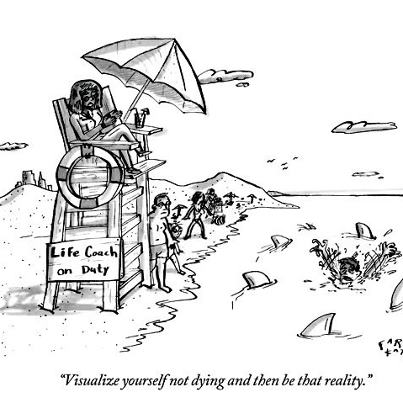
LifeCoachCartoon

The claims of radical food purists, promoters of natural healing, medical skeptics and conspiracy theorists carry a high cost. For an articulate delineation of some major varieties of this sort of hogwash, take a look at “‘What’s The Harm’: The Body Count of Pseudoscience” at The Skeptical Libertarian blog:

“The answer is that the cost of misinformation is too large to ignore. It is real. It is devastating. It is counted in billions of dollars wasted on junk cures, in billions spent on treating preventable diseases. It is measured in lifetimes shortened, bodies crippled, eyes blinded, and children lost.

The costs of medical conspiracy theories and baseless fear-mongering are immense and ghastly. Millions upon millions of people are hurt and killed because [of] them every year. It is a veritable holocaust of ignorance. But it is a holocaust that is still happening, year after year, extinguishing countless of lives that could have been saved by good science, free markets, and sound policy.”

The bogus scientific claims are often simply examples of the precautionary principle gone berserk. Medical and biotechnology that has been proven safe and effective is rejected at the urging of activists whose goals are political, or snake oil salesmen whose goals are pecuniary, while innocents are put at risk. The author(s) of the post linked above cover several areas of pseudoscience worthy of condemnation. Read the whole thing, as they say.

One special topic mentioned in the post is scaremongering related to GMOs, which have demonstrated potential to enhance agricultural productivity and nutrition. That such anti-GMO nonsense can gain any traction with the public and policymakers is a tribute to effective promotion of bad science disguised as legitimate research. The Farmer’s Daughter USA blog has a couple of recent posts on GMO safety worth reading: “Just Ignore Those 2,000+ Studies Showing GMOs are Safe!” and “1 Trillion Meals Later: The GMO Safety Debate Is Over“. From the latter:

“Anti-GMO activists always refer to “scientific” studies done on animals eating genetically modified food with horrid results as proof that biotech isn’t safe. Yet, we have never encountered similar side effects or results in animal agriculture. Unlike the claims of tumors in rats, inflamed pig stomachs, or infertile sheep, animal agriculture has not encountered these problems while feeding their animals GMO feed.

Never.“

Enabling Disparate Impact Seekers

21 Tuesday Oct 2014

Posted by Nuetzel in Uncategorized

≈ Leave a comment

Tags

ABA, Disparate impact, Inclusive Community Project, Investors Business Daily, Racial Discrimination, Section 8 Housing, Supreme Count

State Gobbles Man

The cause of racial unity is not well-served by abusive application of the “disparate impact” doctrine. A dispute has reached the U.S. Supreme Court over tax credits for Section 8 (low income) housing in the Dallas area, which are dispensed by the Texas Department of Housing. The Inclusive Community Project (ICP) alleges that too many permits are issued in low-income areas, leading to segregation of minorities. Of course, housing prices may limit the feasibility of Section 8 housing in higher-income communities, so the result is a natural consequence of reasonable decision-making. The case is of  broad importance, however, as discussed in this IBD opinion.

Established business and social practices based on sound principles may have, as a by-product, a disproportionate or disparate impact on disadvantaged minorities. For example, if a minority population has less savings, on average, than non-minorities, they will tend to require higher loan-to-value ratios when applying to lenders for similar mortgage amounts. They are therefore more likely to have their applications declined or priced less favorably. This obviously differs from outright discrimination against the minority, and it should not rise to a cause of action against a lender who merely attempts to protect investors from excessive risk or to comply with regulations against excessive risk-taking. From the IBD opinion piece:

“‘The risk of disparate-impact lawsuits, in the absence of guidance from the court, pressures the residential mortgage lending industry to arrive at particular outcomes and end numbers to avoid such lawsuits,’ the American Bankers Association wrote the high bench in a joint amicus brief. …

Such pressure can force lenders to water down underwriting standards and take on more risk, since ‘down-payment requirements, debt-to-income requirements, loan-to-value requirements, and other neutral, risk-based underwriting requirements can all affect various racial and ethnic groups differently,’ ABA added.”

Policy goals should be at least compatible. Whether or not the plight of disadvantaged populations justifies some form of redistributive “justice,” there is no reasonable excuse for undermining prudent business practices that are otherwise free of any intent to discriminate against minorities. And in any case, a less efficient economy diminishes society’s capacity to redress such ills. Indeed, it’s more likely to aggravate them and allow disharmony to fester.

Truthy’s In The Eye of The Beholder

20 Monday Oct 2014

Posted by Nuetzel in Uncategorized

≈ Leave a comment

Tags

Ajit Pai, Civil Liberty, Free Speech, Government Spying, NSF, Snooping, Social Media, Steven Colbert, Truthy, Twitter

Snoop on Civil Libs

Over the top: The federal government, through the NSF, is funding the development of a tool  to “mitigate the diffusion of false and misleading ideas, detect hate speech and subversive propaganda, and assist in the preservation of open debate.” Oh really? Should anyone find this reassuring? FCC Commissioner Ajit Pai condemns this initiative in the Washington Post. The project’s name is “Truthy,” a term credited to Steven Colbert, who otherwise seems to have nothing to do with it. Pai sums up the project nicely:

“Hmm. A government-funded initiative is going to ‘assist in the preservation of open debate’ by monitoring social media for ‘subversive propaganda’ and combating what it considers to be ‘the diffusion of false and misleading ideas’? The concept seems to have come straight out of a George Orwell novel.

The NSF has already poured nearly $1 million into Truthy. To what end? Why is the federal government spending so much money on the study of your Twitter habits?

Some possible hints as to Truthy’s real motives emerge in a 2012 paper by the project’s leaders, in which they wrote ominously of a ‘highly-active, densely-interconnected constituency of right-leaning users using [Twitter] to further their political views.’”

Does anyone of good faith on the Left actually think this is a good idea? And make no mistake: technology of this sort can be reversed. If anyone on the Left thinks it’s a good idea, are they willing to live with the consequences if things don’t go their way, say, if their avowed enemies take power? Have some more Pai:

“To those who wish to shape the nation’s political dialogue, social media is dangerous. No longer can a cadre of elite gatekeepers pick and choose the ideas to which Americans will be exposed. But today’s democratization of political speech is a good thing. It brings into the arena countless Americans whose voices previously might have received inadequate or slanted exposure.

The federal government has no business spending your hard-earned money on a project to monitor political speech on Twitter. How should it instead have reacted when funding for Truthy was proposed? The proper response wouldn’t have required anywhere near 140 characters. It could have been, and should have been, #absolutelynot.“

← Older posts
Newer posts →
Follow Sacred Cow Chips on WordPress.com

Recent Posts

  • A Warsh Policy Scenario At the Federal Reserve
  • The Coexistence of Labor and AI-Augmented Capital
  • The Case Against Interest On Reserves
  • Immigration and Merit As Fiscal Propositions
  • Tariff “Dividend” From An Indigent State

Archives

  • February 2026
  • January 2026
  • December 2025
  • November 2025
  • October 2025
  • September 2025
  • August 2025
  • July 2025
  • June 2025
  • May 2025
  • April 2025
  • March 2025
  • February 2025
  • January 2025
  • December 2024
  • November 2024
  • October 2024
  • September 2024
  • August 2024
  • July 2024
  • June 2024
  • May 2024
  • April 2024
  • March 2024
  • February 2024
  • January 2024
  • December 2023
  • November 2023
  • August 2023
  • July 2023
  • June 2023
  • May 2023
  • April 2023
  • March 2023
  • February 2023
  • January 2023
  • December 2022
  • November 2022
  • October 2022
  • September 2022
  • August 2022
  • July 2022
  • June 2022
  • May 2022
  • April 2022
  • March 2022
  • February 2022
  • January 2022
  • December 2021
  • November 2021
  • October 2021
  • September 2021
  • August 2021
  • July 2021
  • June 2021
  • May 2021
  • April 2021
  • March 2021
  • February 2021
  • January 2021
  • December 2020
  • November 2020
  • October 2020
  • September 2020
  • August 2020
  • July 2020
  • June 2020
  • May 2020
  • April 2020
  • March 2020
  • February 2020
  • January 2020
  • December 2019
  • November 2019
  • October 2019
  • September 2019
  • August 2019
  • July 2019
  • June 2019
  • May 2019
  • April 2019
  • March 2019
  • February 2019
  • January 2019
  • December 2018
  • November 2018
  • October 2018
  • September 2018
  • August 2018
  • July 2018
  • June 2018
  • May 2018
  • April 2018
  • March 2018
  • February 2018
  • January 2018
  • December 2017
  • November 2017
  • October 2017
  • September 2017
  • August 2017
  • July 2017
  • June 2017
  • May 2017
  • April 2017
  • March 2017
  • February 2017
  • January 2017
  • December 2016
  • November 2016
  • October 2016
  • September 2016
  • August 2016
  • July 2016
  • June 2016
  • May 2016
  • April 2016
  • March 2016
  • February 2016
  • January 2016
  • December 2015
  • November 2015
  • October 2015
  • September 2015
  • August 2015
  • July 2015
  • June 2015
  • May 2015
  • April 2015
  • March 2015
  • February 2015
  • January 2015
  • December 2014
  • November 2014
  • October 2014
  • September 2014
  • August 2014
  • July 2014
  • June 2014
  • May 2014
  • April 2014
  • March 2014

Blogs I Follow

  • Passive Income Kickstart
  • OnlyFinance.net
  • TLC Cholesterol
  • Nintil
  • kendunning.net
  • DCWhispers.com
  • Hoong-Wai in the UK
  • Marginal REVOLUTION
  • Stlouis
  • Watts Up With That?
  • American Elephants
  • The View from Alexandria
  • The Gymnasium
  • A Force for Good
  • Notes On Liberty
  • troymo
  • SUNDAY BLOG Stephanie Sievers
  • Miss Lou Acquiring Lore
  • Your Well Wisher Program
  • Objectivism In Depth
  • RobotEnomics
  • Orderstatistic
  • Paradigm Library
  • Scattered Showers and Quicksand
  • Jam Review

Blog at WordPress.com.

Passive Income Kickstart

OnlyFinance.net

TLC Cholesterol

Nintil

To estimate, compare, distinguish, discuss, and trace to its principal sources everything

kendunning.net

The Future is Ours to Create

DCWhispers.com

Hoong-Wai in the UK

A Commonwealth immigrant's perspective on the UK's public arena.

Marginal REVOLUTION

Small Steps Toward A Much Better World

Stlouis

Watts Up With That?

The world's most viewed site on global warming and climate change

American Elephants

Defending Life, Liberty and the Pursuit of Happiness

The View from Alexandria

In advanced civilizations the period loosely called Alexandrian is usually associated with flexible morals, perfunctory religion, populist standards and cosmopolitan tastes, feminism, exotic cults, and the rapid turnover of high and low fads---in short, a falling away (which is all that decadence means) from the strictness of traditional rules, embodied in character and inforced from within. -- Jacques Barzun

The Gymnasium

A place for reason, politics, economics, and faith steeped in the classical liberal tradition

A Force for Good

How economics, morality, and markets combine

Notes On Liberty

Spontaneous thoughts on a humble creed

troymo

SUNDAY BLOG Stephanie Sievers

Escaping the everyday life with photographs from my travels

Miss Lou Acquiring Lore

Gallery of Life...

Your Well Wisher Program

Attempt to solve commonly known problems…

Objectivism In Depth

Exploring Ayn Rand's revolutionary philosophy.

RobotEnomics

(A)n (I)ntelligent Future

Orderstatistic

Economics, chess and anything else on my mind.

Paradigm Library

OODA Looping

Scattered Showers and Quicksand

Musings on science, investing, finance, economics, politics, and probably fly fishing.

Jam Review

"If you get confused, listen to the music play."

  • Subscribe Subscribed
    • Sacred Cow Chips
    • Join 128 other subscribers
    • Already have a WordPress.com account? Log in now.
    • Sacred Cow Chips
    • Subscribe Subscribed
    • Sign up
    • Log in
    • Report this content
    • View site in Reader
    • Manage subscriptions
    • Collapse this bar
 

Loading Comments...