Please, no. Let’s not get too aggressive about regulating AI development and use.
Sure, certain kinds of AI regulation are worthwhile and probably unavoidable, but those theoretically fall within the bounds of existing law: the framework in which liability issues, property rights, and claims of fraud are settled. Otherwise, there may be a role for industry self-regulation, perhaps within the kind of framework outlined here. Beyond that, broader and more intrusive government regulation and oversight of AI companies would serve to slow or retard development, and thereby hamper progress on addressing safety and security (because ongoing development will help reveal weaknesses). It would also stifle industry competition in the U.S., and cede advantages to adversaries, particularly China.
Promise and Limits
My position on AI regulation flows from optimism about what AI can accomplish as well as recognition of AI’s inherent limits. It is a powerful technology, but it does not “reason”. It is capable of real innovation, but only to the extent that it mechanically and iteratively constructs solutions based on a catalogue of past knowledge. Of course, it does the latter exceptionally well, and its solutions can be quite novel, drawing upon complex links between phenomena across many dimensions, but that is not the same as creative genius.
Those who anthropomorphize AI tend to fall for superstitions about new technology that have plagued humanity for centuries and have, at times, hindered the advancement of human well being. Yet we have prospered from new technologies in spite of this noise.
Begging For Discipline
Unfortunately, recent warnings from some AI executives and developers have been taken to heart across the political spectrum, though not particularly within the Trump Administration. While I have been critical of many of Trump’s policy positions and initiatives, deregulation has been a bright spot (if very uneven), and the promise of a light touch on AI regulation is another plus. Yet Trump has allowed the Pentagon to prohibit defense contracts with Anthropic as a security concern. In addition, the proposed “AI Force” raises questions, especially in light of Defense (War!) Secretary Pete Hegseth’s Anthropic decision. Presumably, the AI Force would be a branch of Homeland Security. AI obviously has significant military and defense applications. But could such an AI Force remain above the regulatory fray even as it designates certain applications or models to be a threat to national security? And could such a designation be contested?
The “doomers” within the AI industry are an obvious irony. They warn that their work might have “existential” consequences but continue that work under what we might call a self-compelled burden of competence. If anyone and everyone is going to do AI, then they too must do it too, if only for the good of humanity. But they insist that joining forces with the federal government to regulate or even pause development will somehow save the day, despite the global nature of the competition.
Perhaps Deeper Motives
To me, their rationale for government regulation seems implausible. The big AI companies are massive enterprises, and whether or not one believes they could “capture” a new regulatory body, they are nonetheless highly interested in shaping the future of any rules and regulation to which they and their competitors would be subject.
Alex Tabarrokinsists that regulatory capture is typically confined to mature, regulated industries in his post “What Regulatory Capture Actually Looks Like”. He not only doubts that AI doomers have designs on capturing regulators; he also believes that the doomers expressed fears are completely sincere.
As one of Tabarrok’s commenters suggests, however, the AI executives’ behavior comports with the “bootleggers and baptists” theory of public choice, whereby politicians or influential parties claim the highest motives in serving the public interest and yet stand to reap economic gains from “protective” restrictions. In the case of AI, the executives may well be playing both roles. And they might happily accept both roles even if they believe their own warnings of doom. In fact, any rents the big AI concerns gain as a result of new regulations might be viewed as deserved, or unavoidable in any case.
Another plausible explanation for the pro-regulatory (and pro-pause) position taken by some players, notably Anthropic and OpenAI, is discussed by Francis Turner. It has to do with a desperate need for cash flow. One avenue would involve an effort to:
“… wriggle out of the optimistic compute commitments they have made. … both Open AI and Anthropic have made enormous commitments to purchase compute which has been what has driven the explosive growth in data centers. Unfortunately for Big AI the demand simply doesn’t seem to be there. Or at least the demand to pay the prices Big AI wants to charge.“
Turner also notes that a regulatory push to ban Chinese models would be seen as a competitive boost for these companies. Finally, Turner believes the big AI companies employ individuals with a personal drive to control the evolution and use of AI. That’s not hard to believe! A regulatory regime would offer ample opportunities for industry insiders to step into roles in which they could do just that. Possible motives are ample, whether borne of altruism, power-seeking, or the pursuit of economic gain. We could call this mere rent seeking or political bargaining, rather than regulatory capture, but some sort of capture might well be a goal.
Fearsand Risks
Again, cries for regulation are accompanied by a stoking of fears that AI presents existential risks for humanity. One prominent example is closely associated with Noah Smith, though I’m sure he’s not the first to discuss it. That’s the idea that AI will be used to design a deadly supervirus that will wipe out most of the human race. This fear is overblown and unrealistic. A number of extremely deadly pathogens already exist, ebola being the perhaps the most contagious and deadly. Local deployments could surely be used to infect a large number of people, but that would be difficult to pull off and we are capable of containment. It is hardly an existential threat to humanity. As to the creation and spread of deadly new bugs, practical obstacles drastically reduce the likelihood of such an outcome, particularly on an existential scale, as outlined by Claus Wilke in “I’m sorry, you’re not going to die from an AI-engineered supervirus”.
Perhaps the most significant risks presented by AI fall within the realm of cybersecurity. Certain security breaches could conceivably threaten large numbers of people, but they are unlikely to approach existential levels for humanity.
The potential for plain old fraud via AI is real, including the creation and propagation of misinformation at scale. This is probably as much a human or user problem as an AI problem. AI hallucinations are an aspect of it as well, but that’s really an obstacle to adoption, so AI companies are working hard to minimize the problem. Damages under all of these categories should fall within the traditional legal bounds of liability, whether the result of intent or negligence. The latter distinction should carry less weight given that AI decisions are often shrouded within a so-called “black box”. Of course, assigning liability assumes that a responsible party can be identified, but legally defining LLMs as products helps to solve that problem.
Turner also raises the possibility of severe financial damage from an AI agent given authority over large amounts of capital, especially if assigned malicious financial objectives. This category of damage falls within the scope of existing securities laws and regulation.
Finally, some have warned of a risk that humans will suffer “cognitive atrophy” from relying on AI. In fact, it’s said to be a reality even now, and that it will become more severe as humans rely on AI to solve more problems and perform tasks. Will AI cause humans to devolve and face a more brutish existence? While I accept that AI presents a risk of cognitive atrophy, there are also ways in which AI stimulates intellectual curiosity about all manner of things. Much depends on the spirit in which AI is approached. It must be used as a tool and a complement to human intellectual pursuit, not a substitute for it, but that depends in large part on the user. I’m confident that the human spirit of inquiry will remain as strong as ever.
Summary
To sum up my general view regarding the pleadings for regulation of AI, I offer this quote from Per Byland:
“The State’s core function, in both theory and practice, is to give the ruling class a reliable way to extract wealth from society while posing as selfless public servants. It’s an ideal setup for the greedy, self‑absorbed, and unproductive.“
Except in this case we see the ownership and employees within a highly productive sector of the economy ostensibly rooting for the state to make them less productive. Or are they really? If it’s safety they want, then it’s incumbent on them to make their products safe, whatever that might entail, or face legal consequences. Continued development is likely to reveal risks as well as better ways to mitigate those risks.
If it’s economic advantage that Big AI craves, that answer too is in their very hands: they must compete in the AI marketplace to produce capable, reliable, and safe products that buyers value. Adopting a rigid government regulatory solution or a pause in development would likely bring the sacrifice of U.S. competitive advantages in AI and ultimately a centrally-planned and ineffective approach to AI.
As for designs on gaining a political advantage, we can hope that AI doomers will ultimately go the way of all Luddites before them.
Bad policy ideas are circulating that have been conceived amid hysteria over AI. These are interventionist approaches to the development and deployment of AI models, ranging from direct confiscation of AI capital, taxes on the flow of compute, various forms of regulation, and state and local efforts to forbid the construction of data centers. All of these actions would unnecessarily inhibit achievement of AI’s enormous potential benefits and present unnecessary national security challenges as well.
Land Use and Displacement
Emotionally I’m probably just as NIMBY as the next guy when it comes to developments in my vicinity that might offend my personal aesthetics or intrude on my privacy. But at a more rational level, I object to developments that will inflict external costs on me. I happen to live in a private community that provides some buffer against incursions of those kinds, but I deeply sympathize with anyone who finds their property will soon be next door to a large or obnoxious industrial, commercial or government facility, and I despise the use of eminent domain for almost any purpose.
But let’s step back and consider the case in which an owner of private property receives what they feel is just compensation on the sale of their land to a data center developer. This property might be in your close proximity, but you can’t prevent your neighbor from selling unless it’s by way of a larger political process to revoke his property rights. Of course, you can help organize or join a resistance group in an attempt to stop the development. That’s perfectly reasonable if you fear the prospect of having your property stranded in the middle of a new industrial or commercial development.
Ultimately, such efforts are likely to influence negotiations between communities and developers. In fact, developers of data centers can often be persuaded to work with communities in addressing public concerns, and some developers are eager to do so.
Water and Power Consumption
Aside from land use, potential displacement, and aesthetic issues (including plain-old NIMBYism), other underlying concerns exciting local opposition to data centers have to do with predicted strains on water and power supplies. These are no doubt critical issues in certain localities. However, on the whole these concerns are vastly overblown, as elucidated by Andy Masley at this link. In particular, water use by data centers is on the same order of magnitude as other industrial uses. Contrary to some claims, any water pollution by data centers is usually confined to the construction phase, if at all, and in that respect is very much like any other construction project. And as Masley points out, a data center can generate tax revenue for use in reducing water scarcity.
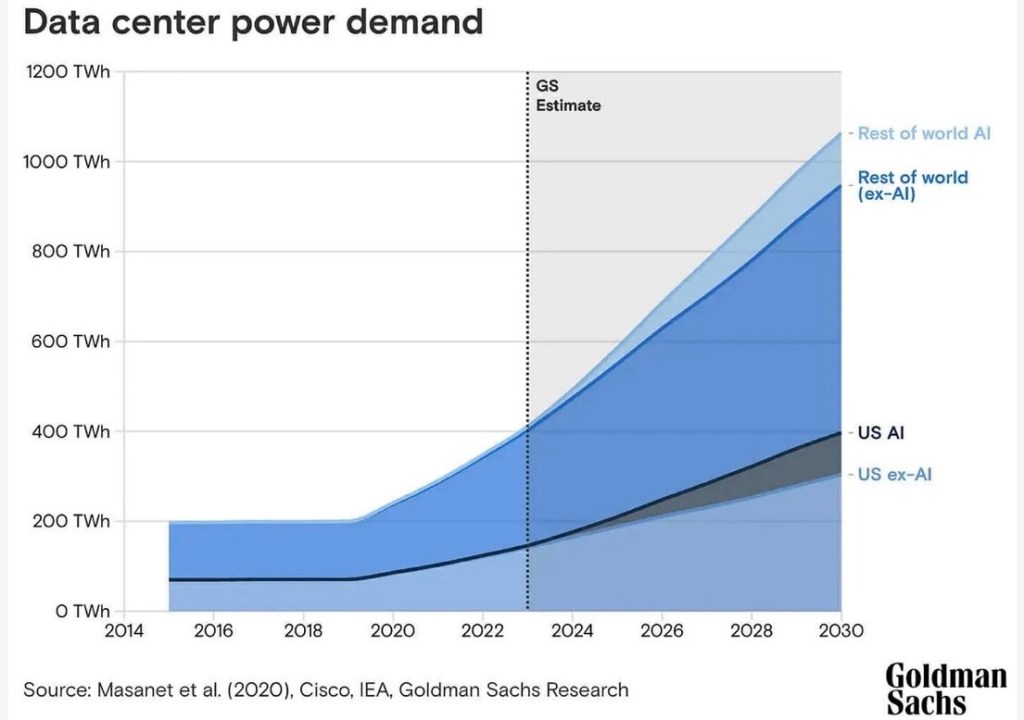
It should also be noted that data centers house the computational power of the entire internet. As the chart (from Masley) at the top of this post shows, AI represents an incremental need that is still relatively small relative to total data center power use. Incidentally, water cooling rather than air cooling reduces a data center’s power consumption.
Nevertheless, the power consumption of data centers is indeed a matter of critical importance and controversy. Referring again to the chart at the top, it’s evident that data center power usage is growing rapidly. However, developers are increasingly planning to produce their own power off-grid, often colocating with their power sources to minimize transmission costs. This includes locating alongside natural gas basins, installing wind and solar collection facilities nearby, and coming soon, incorporating modular nuclear reactors. The latter would provide base-load, dispatchable, zero-carbon power for data centers. Of course, modular reactors will be costly and might eat into returns from developing data centers, but other power sources are costly as well, and it is the one sure dispatchable, zero-carbon, off-grid solution.
Water and energy supplies for data centers are key to enabling broad contributions of AI to consumer welfare, productivity growth, and national security. Local interests should weigh other benefits that construction of data centers will bring to a community. Construction jobs and permanent data center jobs are obviously important considerations, as well as the aforementioned increases in local tax revenue.
State Regulation and Litigation
Of course, AI controversies are playing out at the national and state levels as well. First, there is the issue of AI regulation. AI legislation in all 50 states attempts to regulate various “threatening” aspects of AI. These bills address topics such as fraud prevention (e.g., deep fakes), chatbot safety, and restrictions on automated AI decisioning (e.g., hiring, insurance coverage and claims adjudication).
There is litigation and potential litigation at the state level related to alleged abuses by Open AI’s ChatGPT. These concern the use of customer data and alleged encouragement of self-harm, among other matters. And the New York legislature has passed a bill calling for a one-year moratorium on AI data center development.
These regulatory and legal efforts at the state and local level raise the prospect of fragmented treatment of AI in different jurisdictions that would be disruptive and costly for both AI companies and users. Federalist principles aside, economic efficiency argues for a more uniform approach to many concerns about AI. But whether it’s at the federal, state, or local level, tight regulatory control of AI risks compromising the healthy competitive development of AItechnology and the industry. That’s because politicians and bureaucrats cannot possess the knowledge of evolving competition, scarcity, and market incentives only revealed by free market processes.
Rooting for Regulation
Unfortunately, modern-day Luddites at the national level are calling for a moratorium on AI development. In fact, in 2023, fears of AI misalignment with human interests brought even Elon Musk to call for a six-month “pause” on development. Today, a number of industry insiders call for a “slowdown”, if only other countries go along with it (fat chance!).
Yes, AI is improving… fast, but the most consequential threats have to do with security protocols. Anthropic, in particular, almost begged for government control over its Mythos product, which recently gripped the AI and cybersecurity communities with its advanced ability to identify software vulnerabilities. The Fable version is said to incorporate “guardrails”, but reportedly Fable is vulnerable to “jailbreaks”. In what should not have surprised Anthropic after its own warnings, the federal government imposed export controls, restricting access by foreign nationals. And now, Anthropic has withdrawn availability of the models worldwide..
Be Careful What You Ask For
Perhaps Anthropic got what it deserved, but sadly, the Trump Administration seems to have crossed a threshold from a “light touch” approach to regulating AI to something more severe. Let’s hope the Mythos/Fable affair doesn’t presage a permanent transition from private governance to state control. Thatwouldinhibit development and present risks likely to rattle some of AI’s most important customers, .
The last link cites Timnit Gebru’s critique that AI labs have made a huge miscalculation:
“She argues that AI labs have consistently used ‘dangerous AI’ narratives for marketing, investor appeal, and competitive advantage, only for the narrative to backfire when actual state power intervenes. (on X)”
It’s possible that Anthropic and a few of its competitors have fallen for the same mistaken notion that central planning by government bureaucrats can improve upon market processes. Statists on the right and the left have been eager to join the chorus for regulatory control.
Dean Ball channels Friedrich Hayek in the following tweet on the mistaken impression that government must impose a “strategy” and “plan” AI.
“I think part of it, at least vis a vis US/China competition, is that US and western chattering classes find it hard to believe that the market-driven outcome of frontier AI could possibly be right. They basically believe, in their hearts, that the Chinese system, with its ‘industrial strategy,’ has eclipsed capitalism. So they harbor the same inferiority complex toward the Chinese system that many Americans once harbored toward the EU’s system. Their heuristic is that the industrial strategists of China have grasped the whole picture of the technological competition in a way that US industrialists, with their ‘profit maximizing incentives,’ could not possibly have matched. And so any outcome in the economy that is not the result of ‘strategy’ is therefore prima facie worse than what the ‘strategists’ have concocted. They also believe the Chinese strategists possess awesome powers of foresight and the ability to evade all tendencies of financial and economic gravity, due of course to ‘strategy,’ really it’s almost a kind of orientalism.”
National security is an important consideration, of course, but AI development should not be hamstrung for fear of the ever-present need for improved encryption or by the prospect of threats from autonomous weapons systems. Indeed, AI can and should be put to use defending against all such threats to national security without compromising its promise as a revolutionary technology with a wide range of applications. Again, Trump’s purported intent to encourage U.S. AI development is undercut by his fixations on controlling trade and “taking stakes”. And do foreign customers want to deal with this confusing state of affairs? Or simply go to China?
AI and Capital Redistribution
Another nest of controversies has to do with the widespread presumption that AI will be negative for labor markets. Prescriptions from the populist left and right include various kinds of AI taxation, redistribution, and even nationalization.
Bernie Sanders and Donald Trump both want a sovereign wealth fund, and Sanders wants to fund it with a one-time 50% tax on AI stock. Sanders, the High Prince of Economic Parasites, is sponsoring a bill he claims would allow the American public to take a role in determining the future of AI, whatever that means. What he hopes to create is a mechanism for wealth redistribution, since the fashionable view is that AI will be a catastrophe for labor. While the AI industry is far from profitable at the moment, many AI stocks have soared in value. And Sanders’ target “AI industry” might fairly broad, including chip manufacturers and other producers of AI infrastructure.
If the public wants to kill AI investment in the U.S., tank equity markets, and give politicians an excuse for more profligate spending, then Sander’s bill is a grand idea. It would be an outright expropriation of wealth. The impacts on economic growth, productivity, American competitiveness, and national security would be unambiguously negative. And lest you think such a redistribution is necessary to compensate for job losses caused by AI, that issue is far from settled. In fact, it’s highly likely that the job realignment certain to take place will result in growth from a variety of occupations previously unimagined, just as technological advances have in the past.
The Compute Tax
Others (including Sanders) have also broached the idea of a “compute tax”, or as Brian Albrecht explains:
“… a levy on computational resources. Think GPU hours, processing power, data center electricity, or some similar proxy for AI work.”
Albrecht believes the real intent is to tax the stock of physical AI capital, as opposed to a flow of input services rendered for AI. But consider the number of goods and services whose values are likely to be enhanced by the use of AI as an input. And also consider the innovation and discovery that will be made possible by AI. Albrecht wisely questions the logic of adding to the cost and discouraging this value added via taxation. In the context of killing the golden goose, he cites two rules of optimal taxation: don’t tax intermediate goods and don’t tax capital. When the supply of capital is elastic, he notes, taxing it is more likely to harm workers than to help them. And one can reasonably argue that the external benefits expected to flow from AI would justify a compute subsidy rather than a tax. Finally, Albrecht cautions that a compute tax, unless it is very broad and at a very high rate, won’t raise much revenue.
Trump’s Confusion
Bernie Sanders deserves plenty of condemnation for his infantile, class-warfare rhetoric and interventionist approach to economic policy, including state ownership of the means of production. But in practice Donald Trump isn’t much better. He’s been busy partially nationalizing several different industries, including steel, semiconductors, nuclear energy, rocket motors, quantum computing, and critical mineral supplies, often with direct reins on business decisions (e.g., the “Golden Share” in U.S. Steel). Now, he’s angling to acquire equity stakes in AI companies. The Senate Armed Services Committee is ready to help him out with a bill that would establish a Department of Defense Equity Investment Account at the Treasury.
These are all part of the sovereign wealth fund Trump has decided is in the fiscal and national security interests of the U.S. Again, government ownership stakes in private companies invite cronyism, political interference, and regulatory capture. In the case of AI, it is an invitation to censorship and government surveillance. Moreover, spare government funds would be better spent paying down our burgeoning public debt, reducing government obligations and interest expense at zero risk. In contrast, the value of private equity stakes and their returns are fully at risk, while leaving government debt, interest expenses, and interest rate rollover risks in place.
Trump is now inveigling the likes of Sam Altman (OpenAI), Dario Amodei (Anthropic), Sundar Pichai (Google), and even Elon Musk (xAI) to accept his vision of public ownership of AI stock. It’s effectively a trap and a prescription for competitive failure, but Trump doesn’t get it.
Superabundance?
Many AI industry leaders have indeed bought into some version of an AI wealth transfer, primarily because they accept the notion of superabundance along with heavy losses of remunerative work for humans. But in fact they don’t understand the economics of capital deepening and the contradictions implied by their position.
First, savings and funds available for capex are scarce, and any given project for AI buildout must compete with many other valued uses. The working world will not be monopolized by AI robots any time soon, even given dramatic cost reductions. AI may well increase the productivity of human workers (along with their wages) in greater proportion than other forms of physical capital. But some forms of labor are likely to be in surplus, and that will cause the wages in those occupations to become more competitive relative to the cost of potential AI-augmented substitutes. In fact, occupations in which humans are more competitive than machines will persist. Here is Albrecht on this point:
“And comparative advantage always pops up fighting against [human job losses]. When automation makes some things cheap, the things that remain expensive tend to be the things that are hard to automate. And the things that are hard to automate are, almost by definition, the things where humans still have comparative advantage. The saved dollar drifts toward where humans are still worth paying. That’s not optimism. That’s what comparative advantage means.“
A second contradiction of the superabundance job-loss narrative is, as I’ve said, that there will be many inventive new occupations available for humans. At worst, job losses will be a transitional phenomenon. Third, superabundance itself implies drastically lower prices, which would ultimately benefit wage earners and consumers, obviating the need for government intervention on their behalf.
I had to laugh when I read this quote of Rebecca Lowe, who has an amusing and sensible reaction to the “AI will take all the jobs” narrative:
“I think a large part of this is you don’t really get experts in their particular domains writing about AI. Instead, you get ‘the AI expert’, and they want to reinvent the wheel. You see this when they write about economics, or when they write about philosophy. You talk to an AI person and suddenly they’re like, ‘I’ve just discovered this thing!’ And it turns out they’re talking about, like, supply and demand. And you’re like, oh my God.”
CCP Interference
I’ll briefly touch on one other controversy: whether the anti-AI/data center furor is being instigated by the Chinese in an attempt to undermine U.S. leadership in AI. The House Energy and Commerce Committee claims to have evidence that strongly suggests the CCPs involvement in attempts to hamstring substantial U.S. leadership in AI. Apparently no details on that evidence have been made public, however. It would not be surprising or uncharacteristic of the CCP, and if true would constitute another tension in the attempt to safeguard national security while avoiding government obstruction in AI development.
Summary
Artificial intelligence is animating economic controversies at the local, state and federal levels. Like other forms of industrial development, opponents are roused by claims of strains on local resources as well as displacement of property owners. Some of these claims are exaggerated or can be resolved via negotiation or technological solutions.
There are also fears that AI can be used in a variety of nefarious ways. There may be legitimate dangers, and AI companies themselves are actively working to address so called “alignment” issues. Nevertheless, there are increasing calls for state and/or federal regulation of AI. These proposals must be approached cautiously or they could easily derail U.S. progress on perhaps the most promising technologies to ever come down the line. That would indeed represent an economic and national security failure.
Finally, fear that AI will lead to large-scale job losses and widening inequality has prompted calls for taxes on AI capital, or even partial nationalization, with redistribution of future profits to the public. This would be a colossal mistake. Nothing could stanch AI development more effectively than such a policy. Unfortunately, even Donald Trump has called for the government to take equity stakes in AI companies pursuant to “national priorities” and supposedly for the benefit of American taxpayers. In fact, this partial nationalization has already begun. This is a prescription for destructive regulation, planning failures, and corruption.
The key lesson in all this is that we’ll all be better off if government stays out of the way of AI development.
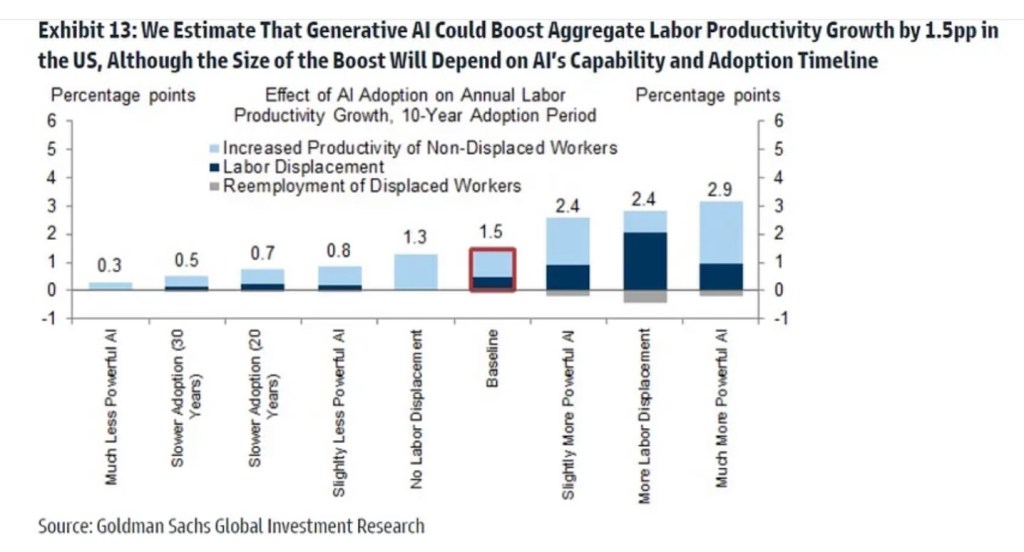
Artificial intelligence (AI) has become a very hot topic with incredible recent advances in AI performance. It’s very promising technology, and the expectations shown in thechart above illustrate what would be a profound economic impact. Like many new technologies, however, many find it threatening and are reacting with great alarm, There’s a movement within the tech industry itself, partly motivated by competitive self-interest, calling for a “pause”, or a six-month moratorium on certain development activities. Politicians in Washington are beginning to clamor for legislation that would subject AI to regulation. However, neither a voluntary pause nor regulatory action are likely to be successful. In fact, either would likely do more harm than good.
Leaps and Bounds
The pace of advance in AI has been breathtaking. From ChatGPT 3.5 to ChatGPT 4, in a matter of just a few months, the tool went from relatively poor performance on tests like professional and graduate entrance exams (e.g., bar exams, LSAT, GRE) to very high scores. Using these tools can be a rather startling experience, as I learned for myself recently when I allowed one to write the first draft of a post. (Despite my initial surprise, my experience with ChatGPT 3.5 was somewhat underwhelming after careful review, but I’ve seen more impressive results with ChatGPT 4). They seem to know so much and produce it almost instantly, though it’s true they sometimes “hallucinate”, reflect bias, or invent sources, so thorough review is a must.
Nevertheless, AIs can write essays and computer code, solve complex problems, create or interpret images, sounds and music, simulate speech, diagnose illnesses, render investment advice, and many other things. They can create subroutines to help themselves solve problems. And they can replicate!
As a gauge of the effectiveness of models like ChatGPT, consider that today AI is helping promote “over-employment”. That is, there are a number of ambitious individuals who, working from home, are holding down several different jobs with the help of AI models. In fact, some of these folks say AIs are doing 80% of their work. They are the best “assistants” one could possibly hire, according to a man who has four different jobs.
Economist Bryan Caplan is an inveterate skeptic of almost all claims that smack of hyperbole, and he’s won a series of bets he’s solicited against others willing to take sides in support of such claims. However, Caplan thinks he’s probably lost his bet on the speed of progress on AI development. Needless to say, it has far exceeded his expectations.
Naturally, the rapid progress has rattled lots of people, including many experts in the AI field. Already, we’re witnessing the emergence of “agency” on the part of AI Learning Language Models (LLMs), or so called “agentic” behavior. Here’s an interesting thread on agentic AI behavior. Certain models are capable of teaching themselves in pursuit of a specified goal, gathering new information and recursively optimizing their performance toward that goal. Continued gains may lead to an AI model having artificial generative intelligence (AGI), a superhuman level of intelligence that would go beyond acting upon an initial set of instructions. Some believe this will occur suddenly, which is often described as the “foom” event.
Team Uh-Oh
Concern about where this will lead runs so deep that a letter was recently signed by thousands of tech industry employees, AI experts, and other interested parties calling for a six-month worldwide pause in AI development activity so that safety protocols can be developed. One prominent researcher in machine intelligence, Eliezer Yudkowsky, goes much further: he believes that avoiding human extinction requires immediate worldwide limits on resources dedicated to AI development. Is this a severely overwrought application of the precautionary principle? That’s a matter I’ll consider at greater length below, but like Caplan, I’m congenitally skeptical of claims of impending doom, whether from the mouth of Yudkowsky, Greta Thunberg, Paul Ehrlich, or Nassim Taleb.
As I mentioned at the top, I suspect competition among AI developers played a role in motivating some of the signatories of the “AI pause” letter, and some of the non-signatories as well. Robin Hanson points out that Sam Altman, the CEO of OpenAI, did not sign the letter. OpenAI (controlled by a nonprofit foundation) owns ChatGPT and is the current leader in rolling out AI tools to the public. ChatGPT 4 can be used with the Microsoft search engine Bing, and Microsoft’s Bill Gates also did not sign the letter. Meanwhile, Google was caught flat-footed by the ChatGPT rollout, and its CEO signed. Elon Musk (who signed) wants to jump in with his own AI development: TruthGPT. Of course, the pause letter stirred up a number of members of Congress, which I suspect was the real intent. It’s reasonable to view the letter as a means of leveling the competitive landscape. Thus, it looks something like a classic rent-seeking maneuver, buttressed by the inevitable calls for regulation of AIs. However, I certainly don’t doubt that a number of signatories did so out of a sincere belief that the risks of AI must be dealt with before further development takes place.
The vast dimensions of the supposed AI “threat” may have some libertarians questioning their unequivocal opposition to public intervention. If so, they might just as well fear the potential that AI already holds for manipulation and control by central authorities in concert with their tech and media industry proxies. But realistically, broad compliance with any precautionary agreement between countries or institutions, should one ever be reached, is pretty unlikely. On that basis, a “scout’s honor” temporary moratorium or set of permanent restrictions might be comparable to something like the Paris Climate Accord. China and a few other nations are unlikely to honor the agreement, and we really won’t know whether they’re going along with it except for any traceable artifacts their models might leave in their wake. So we’ll have to hope that safeguards can be identified and implemented broadly.
Likewise, efforts to regulate by individual nations are likely to fail, and for similar reasons. One cannot count on other powers to enforce the same kinds of rules, or any rules at all. Putting our faith in that kind of cooperation with countries who are otherwise hostile is a prescription for ceding them an advantage in AI development and deployment. Regulation of the evolution of AI will likely fail. As Robert Louis Stevenson once wrote, “Thus paternal laws are made, thus they are evaded”. And if it “succeeds, it will leave us with a technology that will fall short of its potential to benefit consumers and society at large. That, unfortunately, is usually the nature of state intrusion into a process of innovation, especially when devised by a cadre of politicians with little expertise in the area.
Again, according to experts like Yudkowsky, AGI would pose serious risks. He thinks the AI Pause letter falls far short of what’s needed. For this reason, there’s been much discussion of somehow achieving an alignment between the interests of humanity and the objectives of AIs. Here is a good discussion by Seth Herd on the LessWrong blog about the difficulties of alignment issues.
Some experts feel that alignment is an impossibility, and that there are ways to “live and thrive” with unalignment (and see here). Alignment might also be achieved through incentives for AIs. Those are all hopeful opinions. Others insist that these models still have a long way to go before they become a serious threat. More on that below. Of course, the models do have their shortcomings, and current models get easily off-track into indeterminacy when attempting to optimize toward an objective.
But there’s an obvious question that hasn’t been answered in full: what exactly are all these risks?As Tyler Cowen has said, it appears that no one has comprehensively catalogued the risks or specified precise mechanisms through which those risks would present. In fact, AGI is such a conundrum that it might be impossible to know precisely what threats we’ll face. But even now, with deployment of AIs still in its infancy, it’s easy to see a few transition problems on the horizon.
White Collar Wipeout
Job losses seem like a rather mundane outcome relative to extinction. Those losses might come quickly, particularly among white collar workers like programmers, attorneys, accountants, and a variety of administrative staffers. According to a survey of 1,000 businesses conducted in February:
“Forty-eight percent of companies have replaced workers with ChatGPT since it became available in November of last year. … When asked if ChatGPT will lead to any workers being laid off by the end of 2023, 33% of business leaders say ‘definitely,’ while 26% say ‘probably.’ … Within 5 years, 63% of business leaders say ChatGPT will ‘definitely’ (32%) or ‘probably’ (31%) lead to workers being laid off.”
A rapid rate of adoption could well lead to widespread unemployment and even social upheaval. For perspective, that implies a much more rapid rate of technological diffusion than we’ve ever witnessed, so this outcome is viewed with skepticism in some quarters. But in fact, the early adoption phase of AI models is proceeding rather quickly. You can use ChatGPT 4 easily enough on the Bing platform right now!
Contrary to the doomsayers, AI will not just enhance human productivity. Like all new technologies, it will lead to opportunities for human actors that are as yet unforeseen. AI is likely to identify better ways for humans to do many things, or do wonderful things that are now unimagined. At a minimum, however, the transition will be disruptive for a large number of workers, and it will take some time for new opportunities and roles for humans to come to fruition.
Robin Hanson has a unique proposal for meeting the kind of challenge faced by white collar workers vulnerable to displacement by AI, or for blue collar workers who are vulnerable to displacement by robots (the deployment of which has been hastened by minimum wage and living wage activism). This treatment of Hanson’s idea will be inadequate, but he suggests a kind of insurance or contract sold to both workers and investors by owners of assets likely to be insensitive to AI risks. The underlying assets are paid out to workers if automation causes some defined aggregate level of job loss. Otherwise, the assets are paid out to investors taking the other side of the bet. Workers could buy these contracts themselves, or employers could do so on their workers’ behalf. The prices of the contracts would be determined by a market assessment of the probability of the defined job loss “event”. Governmental units could buy the assets for their citizens, for that matter. The “worker contracts” would be cheap if the probability of the job-loss event is low. Sounds far-fetched, but perhaps the idea is itself an entrepreneurial opportunity for creative players in the financial industry.
The threat of job losses to AI has also given new energy to advocates of widespread adoption of universal basic income payments by government. Hanson’s solution is far preferable to government dependence, but perhaps the state could serve as an enabler or conduit through which workers could acquire AI and non-AI capital.
Human Capital
Current incarnations of AI are not just a threat to employment. One might add the prospect that heavy reliance on AI could undermine the future education and critical thinking skills of the general population. Essentially allowing machines to do all the thinking, research, and planning won’t inure to the cognitive strength of the human race, especially over several generations. Already people suffer from an inability to perform what were once considered basic life skills, to say nothing of tasks that were fundamental to survival in the not too distant past. In other words, AI could exaggerate a process of “dumbing down” the populace, a rather undesirable prospect.
Fraud and Privacy
AI is responsible for still more disruptions already taking place, in particular violations of privacy, security, and trust. For example, a company called Clearview AI has scraped 30 billion photos from social media and used them to create what its CEO proudly calls a “perpetual police lineup”, which it has provided for the convenience of law enforcement and security agencies.
AI is also a threat to encryption in securing data and systems. Conceivably, AI could be of value in perpetrating identity theft and other kinds of fraud, but it can also be of value in preventing them. AI is also a potential source of misleading information. It is often biased, reflecting specific portions of the on-line terrain upon which it is trained, including skewed model weights applied to information reflecting particular points of view. Furthermore, misinformation can be spread by AIs via “synthetic media” and the propagation of “fake news”. These are fairly clear and present threats of social, economic, and political manipulation. They are all foreseeable dangers posed by AI in the hands of bad actors, and I would include certain nudge-happy and politically-motivated players in that last category.
The Sky-Already-Fell Crowd
Certain ethicists with extensive experience in AI have condemned the signatories of the “Pause Letter” for a focus on “longtermism”, or risks as yet hypothetical, rather than the dangers and wrongs attributable to AIs that are already extant:TechCrunch quotes a rebuke penned by some of these dissenting ethicists to supporters of the “Pause Letter”:
“‘Those hypothetical risks are the focus of a dangerous ideology called longtermism that ignores the actual harms resulting from the deployment of AI systems today,’ they wrote, citing worker exploitation, data theft, synthetic media that props up existing power structures and the further concentration of those power structures in fewer hands.”
So these ethicists bemoan AI’s presumed contribution to the strength and concentration of “existing power structures”. In that, I detect just a whiff of distaste for private initiative and private rewards, or perhaps against the sovereign power of states to allow a laissez faire approach to AI development (or to actively sponsor it). I have trouble taking this “rebuke” too seriously, but it will be fruitless in any case. Some form of cooperation between AI developers on safety protocols might be well advised, but competing interests also serve as a check on bad actors, and it could bring us better solutions as other dilemmas posed by AI reveal themselves.
ImaginingAI Catastrophes
What are the more consequential (and completely hypothetical) risks feared by the “pausers” and “stoppers”. Some might have to do with the possibility of widespread social upheaval and ultimately mayhem caused by some of the “mundane” risks described above. But the most noteworthy warnings are existential: the end of the human race! How might this occur when AGI is something confined to computers? Just how does the supposed destructive power of AGIs get “outside the box”? It must do so either by tricking us into doing something stupid, hacking into dangerous systems (including AI weapons systems or other robotics), and/or through the direction and assistance of bad human actors. Perhaps all three!
The first question is this: why would an AGI do anything so destructive? No matter how much we might like to anthropomorphize an “intelligent” machine, it would still be a machine. It really wouldn’t like or dislike humanity. What it would do, however, is act on its objectives. It would seek to optimize a series of objective functions toward achieving a goal or a set of goals it is given. Hence the role for bad actors. Let’s face it, there are suicidal people who might like nothing more than to take the whole world with them.
Otherwise, if humanity happens to be an obstruction to solving an AGI’s objective, then we’d have a very big problem. Humanity could be an aid to solving an AGI’s optimization problem in ways that are dangerous. As Yudkowsky says, we might represent mere “atoms it could use somewhere else.” And if an autonomous AGI were capable of setting it’s own objectives, without alignment, the danger would be greatly magnified. An example might be the goal of reducing carbon emissions to pre-industrial levels. How aggressively would an AGI act in pursuit of that goal? Would killing most humans contribute to the achievement of that goal?
Here’s one that might seem far-fetched, but the imagination runs wild: some individuals might be so taken with the power of vastly intelligent AGI as to make it an object of worship. Such an “AGI God” might be able to convert a sufficient number of human disciples to perpetrate deadly mischief on its behalf. Metaphorically speaking, the disciples might be persuaded to deliver poison kool-aid worldwide before gulping it down themselves in a Jim Jones style mass suicide. Or perhaps the devoted will survive to live in a new world mono-theocracy. Of course, these human disciples would be able to assist the “AGI God” in any number of destructive ways. And when brain-wave translation comes to fruition, they better watch out. Only the truly devoted will survive.
An AGI would be able to create the illusion of emergency, such as a nuclear launch by an adversary nation. In fact, two or many adversary nations might each be fooled into taking actions that would assure mutual destruction and a nuclear winter. If safeguards such as human intermediaries were required to authorize strikes, it might still be possible for an AGI to fool those humans. And there is no guarantee that all parties to such a manufactured conflict could be counted upon to have adequate safeguards, even if some did.
Yudkowsky offers at least one fairly concrete example of existential AGI risk:
“A sufficiently intelligent AI won’t stay confined to computers for long. In today’s world you can email DNA strings to laboratories that will produce proteins on demand, allowing an AI initially confined to the internet to build artificial life forms or bootstrap straight to postbiological molecular manufacturing.”
There are many types of physical infrastructure or systems that an AGI could conceivably compromise, especially with the aid of machinery like robots or drones to which it could pass instructions. Safeguards at nuclear power plants could be disabled before steps to trigger melt down. Water systems, rivers, and bodies of water could be poisoned. The same is true of food sources, or even the air we breathe. In any case, complete social disarray might lead to a situation in which food supply chains become completely dysfunctional. So, a super-intelligence could probably devise plenty of “imaginative” ways to rid the earth of human beings.
Back To Earth
Is all this concern overblown? Many think so. Bryan Caplan now has a $500 bet with Eliezer Yudkowsky that AI will not exterminate the human race by 2030. He’s already paid Yudkowsky, who will pay him $1,000 if we survive. Robin Hanson says “Most AI Fear Is Future Fear”, and I’m inclined to agree with that assessment. In a way, I’m inclined to view the AI doomsters as highly sophisticated, change-fearing Luddites, but Luddites nevertheless.
Ben Hayum is very concerned about the dangers of AI, butwriting at LessWrong, he recognizes some real technical barriers that must be overcome for recursive optimization to be successful. He also notes that the big AI developers are all highly focused on safety. Nevertheless, he says it might not take long before independent users are able to bootstrap their own plug-ins or modules on top of AI models to successfully optimize without running off the rails. Depending on the specified goals, he thinks that will be a scary development.
James Pethokoukis raises a point that hasn’t had enough recognition: successful innovations are usually dependent on other enablers, such as appropriate infrastructure and process adaptations. What this means is that AI, while making spectacular progress thus far, won’t have a tremendous impact on productivity for at least several years, nor will it pose a truly existential threat. The lag in the response of productivity growth would also limit the destructive potential of AGI in the near term, since installation of the “social plant” that a destructive AGI would require will take time. This also buys time for attempting to solve the AI alignment problem.
In another Robin Hanson piece, he expresses the view that the large institutions developing AI have a reputational Al stake and are liable for damages their AI’s might cause. He notes that they are monitoring and testing AIs in great detail, so he thinks the dangers are overblown.:
“So, the most likely AI scenario looks like lawful capitalism…. Many organizations supply many AIs and they are pushed by law and competition to get their AIs to behave in civil, lawful ways that give customers more of what they want compared to alternatives.”
In the longer term, the chief focus of the AI doomsters, Hanson is truly an AI optimist. He thinks AGIs will be “designed and evolved to think and act roughly like humans, in order to fit smoothly into our many roughly-human-shaped social roles.” Furthermore, he notes that AI owners will have strong incentives to monitor and “delimit” AI behavior that runs contrary to its intended purpose. Thus, a form of alignment is achieved by virtue of economic and legal incentives. In fact, Hanson believes the “foom” scenario is implausible because:
“… it stacks up too many unlikely assumptions in terms of our prior experiences with related systems. Very lumpy tech advances, techs that broadly improve abilities, and powerful techs that are long kept secret within one project are each quite rare. Making techs that meet all three criteria even more rare. In addition, it isn’t at all obvious that capable AIs naturally turn into agents, or that their values typically change radically as they grow. Finally, it seems quite unlikely that owners who heavily test and monitor their very profitable but powerful AIs would not even notice such radical changes.”
As smart as AGIs would be, Hanson asserts that the problem of AGI coordination with other AIs, robots, and systems would present insurmountable obstacles to a bloody “AI revolution”. This is broadly similar to Pethokoukis’ theme. Other AIs or AGIs are likely to have competing goals and “interests”. Conflicting objectives and competition of this kind will do much to keep AGIs honest and foil malign AGI behavior.
The kill switch is a favorite response of those who think AGI fears are exaggerated. Just shut down an AI if its behavior is at all aberrant, or if a user attempts to pair an AI model with instructions or code that might lead to a radical alteration in an AI’s level of agency. Kill switches would indeed be effective at heading off disaster if monitoring and control is incorruptible. This is the sort of idea that begs for a general solution, and one hopes that any advance of that nature will be shared broadly.
One final point about AI agency is whether autonomous AGIs might ever be treated as independent factors of production. Could they be imbued with self-ownership?Tyler Cowen asks whether an AGI created by a “parent” AGI could legitimately be considered an independent entity in law, economics, and society. And how should income “earned” by such an AGI be treated for tax purposes. I suspect it will be some time before AIs, including AIs in a lineage, are treated separately from their “controlling” human or corporate entities. Nevertheless, as Cowen says, the design of incentives and tax treatment of AI’s might hold some promise for achieving a form of alignment.
Letting It Roll
There’s plenty of time for solutions to the AGI threat to be worked out. As I write this, the consensus forecast for the advent of real AGI on the Metaculus online prediction platform is July 27, 2031. Granted, that’s more than a year sooner than it was 11 days ago, but it still allows plenty of time for advances in controlling and bounding agentic AI behavior. In the meantime, AI is presenting opportunities to enhance well being through areas like medicine, nutrition, farming practices, industrial practices, and productivity enhancement across a range of processes. Let’s not forego these opportunities. AI technology is far too promising to hamstring with a pause, moratoria, or ill-devised regulations. It’s also simply impossible to stop development work on a global scale.
Nevertheless, AI issues are complex for all private and public institutions. Without doubt, it will change our world. This AI Policy Guide from Mercatus is a helpful effort to lay out issues at a high-level.
Every action has a cost. When you’re on the hook, major decisions are obviously worth pondering. But major societal decisions are often made by agents who are not on the hook, with little if any accountability for long-term consequences. They have every incentive to discount potential downside effects, especially in the distant future. Following Frederic Bastiat, Don Boudreaux writes of three levels of “What Is Not Seen” as a consequence of human decisions, which I summarize here:
Immediate foregone alternatives: Possession, use and enjoyment of X is not seen if you buy Y.
Resources not directed to foregone alternatives: The reduction in X inventory is not seen, compensating production of X is not seen, and extra worker hours, capital use and flow of raw materials needed for X production are not seen.
The future implied by foregone alternatives: Future impacts can take many forms. X might have been a safer or healthier alternative, but those benefits are unseen. X might have been lower quality, so the potential frustration and repairs are unseen. X might have been less expensive, but the future benefits of the money saved are unseen. All of these “unseens” have implications for the future world experienced by the decision-maker and others.
These effects take on much more significance in multiples, but (2) and (3) constitute extended unseen implications for society at large. In multiples, the lost (unseen) X production and X labor-hours, capital and raw materials are more obvious to the losers in the X industry than the winners in the Y industry, but they matter. In the future, no vibrant X industry will not be seen; the resources diverted to meet Y demand won’t be seen at new or even old X factories. X might well vanish, leaving only nontransformable detritus as a token of its existence.
Changes in private preferences or in production technologies create waves in the course of the “seen” reality and the “unseen” world foregone. Those differences are caused by voluntary, private choice, so gains are expected to outweigh losses relative to the “road not traveled”. That’s not a given, however, when decisions are imposed by external authorities with incentives unaligned with those in their thrall. For that reason, awareness of the unseen is of great importance in policy analysis, which is really Boudreaux’s point. Here is an extreme example he offers in addressing the far-reaching implications of government intrusions:
“Suppose that Uncle Sam in the early 20th century had, with a hypothetical Ludd Act, effectively prohibited the electrification of American farms, businesses, and homes. That such a policy would have had a large not-seen element is evident even to fans of Bernie Sanders. But the details of this not-seen element would have been impossible today even to guess at with any reliability. Attempting to quantify it econometrically would be an exercise in utter futility. No one in a 2015 America that had never been electrified could guess with any sense what the Ludd Act had cost Americans (and non-Americans as well). The not-seen would, in such a case, loom so large and be so disconnected to any known reality that it would be completely mysterious.“
Price regulation provides more familiar examples. Rent controls intended to “protect” the public from landlords have enormous “unintended” consequences. Like any price regulation, rent controls stifle exchange, reducing the supply and quality of housing. Renters are given an incentive to remain in their units, and property owners have little incentive to maintain or upgrade their properties. Deterioration is inevitable, and ultimately displacement of renters. The unseen, lost world would have included more housing, better housing, more stable neighborhoods and probably less crime.
A price floor covered by Boudreaux is the minimum wage. The fully predictable but unintended consequences include immediate losses in some combination of jobs, hours, benefits, and working conditions by the least-skilled class of workers. Higher paid workers feel the impact too, as they are asked to perform more (and less complex) tasks or are victimized by more widespread substitution of capital for labor. Consumers also feel some of the pain in higher prices. The net effect is a reduction in mutually beneficial trade that continues and may compound with time:
“As the time span over which obstructions to certain economic exchanges lengthens, the exchanges that would have, but didn’t, take place accumulate. The businesses that would have been created absent a minimum wage – but which, because of the minimum wage, are never created – grow in number and variety. The instances of on-the-job worker training that would have occurred – but, because of the minimum wage, didn’t occur – stack up increasingly over time.“
Regulation and taxation of all forms have such destructive consequences, but policy makers seldom place a heavy weight on the unobserved counterfactual. Boudreaux emphasizes the futility of quantifying the “unseen” effects these policies:
“… those who insist that only that which can be measured and quantified with numerical data is real must deny, as a matter of their crabbed and blinding scientism, that such long-term effects … are not only not-seen but also, because they are not-seen, not real.“
The trade and welfare losses of coercive interventions of all types are not hypothetical. They are as real as the losses caused by destruction of property by vandals. Never again can the owners enjoy the property as they once had. Future pleasures are lost and cannot be observed or measured objectively. Even worse, when government disrupts economic activity, the cumulative losses condemn the public to a backward world that they will find difficult to recognize as such.
Nassim Taleb, a well-known statistical theorist, and two coauthors (a physicist and a philosopher) have written a working paper in which they purport to show that GMO’s should be banned worldwide lest we flirt with complete ruination, quite possibly the end of humanity. The paper may come to represent sacred writ to anti-GMO activists, as it seems to imply that their position is supported by statistical theory. Ultimately, the paper merely uses statistical theory in the service of rhetoric. It relies on a series of ill-defined dichotomies that the authors use to classify genetic plant engineering into the most “ruinous” category of processes. Among other things, GE is categorized by the authors as a “top-down” technology, it creates global risks and systemic risks, it involves interconnected factors, it is irreversible, its outcomes can be characterized by a probability distribution with “fat tails,” its true risks are “unknowable,” and (worst of all?) it is “human-made,” as opposed to a natural process devoid of human intervention. Perhaps the last condition is meant only to classify processes into the so-called “precautionary approach” to policy assessment, rather than “standard risk management,” but it may reveal something significant about the predisposition of the authors toward human technological endeavors.
The statistical theory presented by the authors is fine, as far as it goes. I have admired some of Taleb’s earlier work, such as Fooled By Randomness, which sought to demonstrate the irrationality of assigning likelihood or even meaning to chance events. Taleb achieved real stardom following the publication of The Black Swan, which warned of severe “outlier” events so rare that they cannot be predicted or even assigned probabilities by humans. The true risks are “unknowable.” Applied work involving “fat-tailed” distributions of possible outcomes, which characterize a wide range of phenomena, is typically supported by prior experience or data, but that is not possible with “ruinous” black swans. Perhaps “extremely long- and fat-tailed” is more descriptive of distributions giving rise to black swans, but of course the extreme outcomes might not be observable ex post.
Taleb, et al, contend that development and cultivation of GMOs carry risks of a black swan ecocide. “Significant” risks? Wait, that involves statistical precision… and data! “Excessive” risks? That implies measurability of one sort or another, not to mention a coherent tradeoff of some kind. “Any” risk of a certain qualitative nature (as defined by the “precautionary approach,” with possible ruin on any time scale)? Of course, the authors are not biologists, agronomists, or geneticists (neither am I), but they claim to have sufficient knowledge to make this judgment:
“Ecologically, in addition to intentional cultivation, GMOs have the propensity to spread uncontrollably, and thus their risks cannot be localized. The cross-breeding of wild-type plants with genetically modified ones prevents their disentangling, leading to irreversible system-wide effects with unknown downsides.” [emphasis added]
The article contains a comparison of GMOs to nuclear energy risks, which seems intended to defuse criticism that the authors are simply Luddites. They express guarded optimism that nuclear power-generating risks are “local” in nature, and that problems associated with long-term storage of nuclear wastes are manageable. Clearly, however, those risks are just as “unknowable” as those associated with GMOs. We might add to the list of dangerous human endeavors all research and development of artificial intelligence. After all, a complete ban on AI research would prevent the coming singularity, when we’ll otherwise be lorded over by ruthless, self-serving machines! On a less sarcastic note, I do not discount the possibility of a singularity, but we have the luxury of some time to develop AI in a cautious way, just as we have time to minimize risks in the continuing development and application of GE.
Here is a subset of the many assertions made by Taleb, et al in support of their view:
GMOs have the propensity to spread uncontrollably.
Healthwise, the modification of crops “impacts” everyone.
GMO risks are associated with “fragility” (essentially increasing costs).
GMOs imply monocultures.
GMOs are qualitatively dissimilar to selectively-bred crop varieties.
Selective breeding does not remove crops from their evolutionary context.
GMOs remove crops from their evolutionary context.
The ecological implications of releasing modified organisms into the wild are not tested empirically before release.
The health effects of GMOs have not been tested sufficiently.
Incremental varieties of GMOs cause the risk of ecocide to increase.
All of these points are debatable to one extent or another. For example, the common assertion that GMOs promote monocultures reflects a common confusion over GMOs versus adequate crop rotation in mechanized farming. The authors exploit this confusion by linking monocultures and GMOs to reduced genetic diversity (apparently within single crops) and assert that this makes crops more vulnerable to blight, though it is hard to see why this is a foregone conclusion regarding the effects of introducing desirable traits.
More fundamentally, Taleb, et al give short shrift to the idea that there is a risk-reward tradeoff in the use of GMOs, that there are potential benefits and risks of GMO alternatives, and the fact that GMOs do not, in fact, suspend evolutionary processes. If a mutation embodied in a GMO also confers an evolutionary advantage, chances are the mutation will be propagated. If not, the mutation will tend to vanish. This is a safety mechanism provided by nature. Of course, anti-GMO activists seek to conjure images of mad geneticists whipping up monster “Audrey” GMOs with evolutionary advantages, but that is not the character of biotechnology.
Taleb, et al, also wish to equate GMOs with Monsanto. The fact that they are so eager to invoke the company’s name in a negative context within an ostensibly academic paper is a giveaway that the paper is agenda-driven. Monsanto and GMOs are not synonymous, and it is highly misleading to conflate the technology with a single company.
The authors attempt to upstage critics with the choice of the adjective “non-naive” to describe their use of the precautionary principle to guide their policy prescription:
“… it is essential to distinguish the PP so that it is neither used naively to justify any act of caution, nor dismissed by those who wish to court risks for themselves or others. The PP is intended to make decisions that ensure survival when statistical evidence is limited—because it has not had time to show up —by focusing on the adverse effects of ‘absence of evidence.’”
So, they excuse themselves from bringing anything empirical to bear on the issue of GMO risks because, they contend, “unknowability” is the very nature of the risk/ruin problem, despite the fact that evidence supporting GMO safety does exist, in scads!
Here are a few other sources who have commented on the article:
This post on the NeuroLogica blog questions Taleb’s understanding of biology and genetic engineering. The author, Steven Novella, also notes that Taleb, et al, do not assess the risk of alternatives:
“Growing enough food for 7 billion people has consequences, in terms of land use, fertilizer, pesticides, and displacing natural ecosystems. GMO as a technology can potentially add to our efficiency. Banning GMO means relying more heavily on other technologies that may have even more risks.”
In addition, Novella says:
“… Taleb’s arguments to still come down to hyping the risk of unforeseen consequences due to the inherent limits of scientific knowledge. I don’t agree, however, that GMOs have the potential for global ruin. This is still largely based on a naive belief that transgenes are inherently risky, when there is no scientific reason to believe that they are. … He failed to make a compelling argument that his principle of zero risk should apply to GMO.”
The Motley Fool, generally an admirer of Taleb’s previous work, also believes that he is off-base in the case of GMOs.
And at DebunkingDenialism, Emil Karlsson is particularly galled, as he should be, by the comparison the paper makes of the risks of Russian Roulette to GMOs. He writes that Taleb and his coauthors fail to understand basic biology:
“In the end, the authors have clearly demonstrated that they do not care about biology, medicine or rational risk analysis. They have negligible knowledge of molecular biology, plant breeding and genetic engineering. It does not matter how much knowledge they have of statistics. If your model is based on flawed premises, then the application and conclusion of that model is going to be flawed. Garage in, garbage out.”
Taleb, et al have adorned their paper with statistical theory, and they are certainly correct that “unknowable” risks may be ruinous. But their case against GMOs ignores the substantial body of known evidence on GMO safety. They bring absolutely no evidence to bear to the contrary. Their arguments mislead by relying on false premises and arbitrary classifications. Unfortunately, that won’t stop reverent anti-GE crusaders from heralding Taleb’s “proof” that GMOs are ruinous and must be banned.
I have relied upon injections of genetically modified insulin hormone to keep me alive for many years. The benefits of biotechnology for mankind are supported by decades of hard experience and volumes of careful research, and there is no evidence of harm. But that can’t dissuade neo-Luddites in their efforts to foment panicked opposition to genetic modification of crops.
Another GMO horror story has been circulating about an experiment said to have been conducted at a Chinese university in which students were fed Bt rice. The claim is that an outbreak of acute leukemia ensued. This report bears all the all the earmarks of a fraud, right down to the fact that no one on campus seems to have heard about it!
Anti-GMO activists disparage critics for calling attention to the “fringe” character of the outlets promoting their views, or by diminishing opposing claims as “corporate,” when in fact the real problems are that those activists rely on badly designed and executed research and superstitions about technology. Articles about the alleged Chinese GMO experiment make false claims about prior research findings of a link between GMOs and leukemia. In fact, while the authors of that earlier research don’t admit it, their work casts more doubt on the safety of organic Bt pesticides than on GM crops expressing the Bt toxin. In other words, it’s lousy research. See here for further confirmation. This is reminiscent of other flimsy research promoted by the anti-GMO lobby, such as the notoriously bad Serelini study that used, as subjects, rats that had been bred to develop tumors.
Oddly, hysteria over GM crops does not extend to the genetically modified antibodies created to cure diseases like ebola. Synthetic human insulin is made via genetic modification too! Why no opposition? Perhaps because the activists recognize the impressive benefits of the biotechnology in this context. The potential benefits of GM crops are no less impressive. And despite the best efforts of the anti-GMO lobby, there is no persuasive evidence that GM foods are harmful.
Are robots likely to replace labor at an increasing rate? Or, are robots and labor sufficiently complimentary as inputs that there will be a continuing role for humans in production? The first argument has been made by pessimists and Luddites for at least two centuries, often hysterically, and they have been consistently wrong, as Mark Mills demonstrates in “The Data Are Clear: Robots Do Not Create Unemployment!”
Of course, “labor” has many facets: there is physical labor, there are skilled crafts, and there is so-called knowledge work; many other categories and sub-categories can be delineated. Mills makes the simple distinction between “drudgery” and higher-level “cognitive chores,” and he notes that automation has primarily functioned to eliminate the former. He also emphasizes that over time, automation has actually given rise to various cognitive chores that were never imagined prior to the substitution of capital for human drudgery. In this sense, new forms of labor are seen to be complimentary to capital. So, at once, the automation of tasks is both “labor-saving” and generative of new human functionality. There is every reason to believe that this process will continue to play out as robots begin to collaborate with humans in more complex ways.
Mills links to this interesting paper by David Autor of MIT, which the author Autor recently presented at the Federal Reserve’s annual conference in Jackson Hole, WY. The paper offers an interpreted history of the labor market over the five decades since the computor revolution. He summarizes the thrust of his thinking on the subject by appealing to the paradox that “our tacit knowledge of how the world works often exceeds our explicit understanding.” This implies that technological advance can and does tend to create expansive opportunities for humans. Autor says:
“… journalists and expert commentators overstate the extent of machine substitution for human labor and ignore the strong complementarities. The challenges to substituting machines for workers in tasks requiring adaptability, common sense, and creativity remain immense.”
Autor and Mills both note that automation necessarily leads to reduced demand for certain types of labor, and that the process can lead to severe dislocations and losses for many individuals in the short run. Autor also notes that some lower-level tasks are not yet especially amenable to automation, and that workers in such occupations are unlikely to benefit as automation takes place elsewhere. This serves to emphasize the importance of gaining the kinds of complex skills that can be of value in collaboration with more intelligent machinery. In other words, investment in human capital will be as valuable as ever.
In advanced civilizations the period loosely called Alexandrian is usually associated with flexible morals, perfunctory religion, populist standards and cosmopolitan tastes, feminism, exotic cults, and the rapid turnover of high and low fads---in short, a falling away (which is all that decadence means) from the strictness of traditional rules, embodied in character and inforced from within. -- Jacques Barzun