Gender Gap Claptrap

Tags

, ,

Image

The gender wage gap disappears after controlling for voluntary choices made by women and men regarding occupation, emphasis on family time and duties and/or personal preferences. These decisions often have sociological roots, but they are private decisions in the first instance and not amenable to engineering via regulatory action. For example, controlling for just one factor, marital status, accounts for 75% of the gender difference in average wages. In the post linked above, Mark Perry at Carpe Diem thoroughly debunks the wage gap myth.

It is already illegal to pay equally-situated men and women different salaries. Yet it is just too difficult for some politicians to resist using the difference in average wages as an excuse for regulating private employment decisions and wages. The pernicious effects of this kind of legislation are discussed in ‘Paycheck Fairness’ Will Lead to Fewer Paychecks, Less Fairness. It’s particularly interesting that the “Paycheck Fairness Act” would expose private employers to class action lawsuits over wage differences. Needless to say, trial lawyers are enthused.

The Tragic Obamacare Adventure

Tags

, ,

Image

Obamacare: Some high-risk individuals have gained cheaper health coverage under the ACA. Some previously uninsured individuals will now have coverage. But as a consequence, direct harm has been caused to other individuals, and the financial costs have been massive. Just take a look here. The positive outcomes could have been accomplished with much less strife, but that’s another post. Here, I’m merely taking inventory of the abject failure that is Obamacare:

28 delays and extensions: Obama has done more to repeal Obamacare than the GOP could have hoped to accomplish themselves, (but these actions are of questionable legality). That’s the good news.

Only 14% Of Obamacare Exchange Sign-Ups Are Previously Uninsured Enrollees.

The Administration conducted a wholly dishonest campaign to “sell” the law to the public (“if you like your plan you can keep it”), and the dishonest PR spin continues.

Waived mandates for the President’s cronies.

Roughly 5M lose their individual coverage.

Big premiums hikes (30% in CA, and often higher elsewhere), with strong likelihood of more increases for next year due to adverse selection on the exchanges.

Networks under Obamacare have been thinned in an attempt to reduce costs. Will you really keep your doctor?

Full-time positions become part-time positions (this is likely to resume as the now-delayed employer mandate approaches).

Web site failures impose private costs of untold hours on would-be applicants.

Massive implementation costs, including an often demented ad campaign on the taxpayer dime.

Massive subsidies inflate the federal deficit.

A panoply of new taxes.

Prosperity Exposed

Tags

, ,

Image

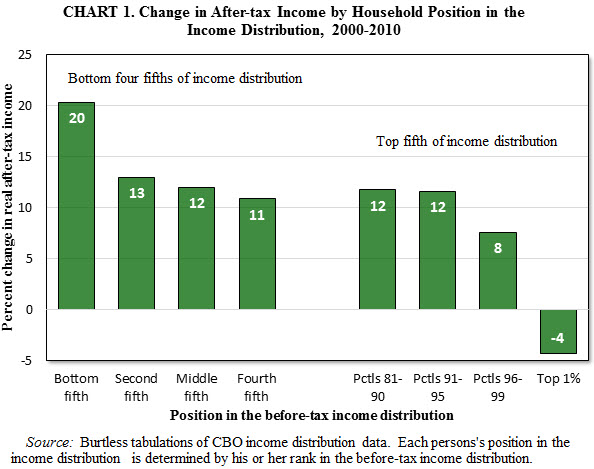
This Brookings research by Gary Burtless reveals lessons about changes in incomes in the U.S. that may be surprising to some. These changes relate to quintiles of the distribution, NOT to migration of individuals across quintiles. The data do not show stagnation in the middle and lower end of the income distribution. Non-cash sources of income have grown rapidly relative to total income. The changes show that income at the top is quite volatile, and income at the low end has been insulated from shocks by transfer payments. 

Redistributionists should love this data in many ways, but I suspect this information will be passed over by the left to avoid diluting their message that more redistribution is needed to achieve social justice…  always more.

Is Invention Self-Breeding?

Tags

,

Image

The Next Age of Invention, by Joel Mokyr in City Journal, is a nice antidote to the many neo-Luddite doomsayers lurking within the social sciences. Some highlights (for me) were his discussion of some of the ways in which national income accounting understates the benefits of new technologies, reasons why we might be poised for dramatic advances, the trend toward (and variety of) potential “small” innovations, and technological “bite-back” and how it spurs additional improvements. Last but not least, this article was fun for me because Mokyr takes on my former thesis advisor! He does not discuss the mechanisms by which the benefits of future innovations will be diffused, which is somewhat controversial, but I have no doubt that they will be diffused widely with time. 

The Mortgage Interest Deduction Delusion

Tags

, ,

Image

The home mortgage interest deduction does not encourage home ownership and it disproportionately benefits high-income taxpayers. A study of the MI deduction’s various impacts in National Affairs demonstrates the extent to which its benefits are skewed to high-earners, wealthy suburbs, the coasts and other areas with high real estate prices. The study also discusses the perverse incentives created by the deduction.

If you think the MI deduction helps you personally, remember that it almost certainly inflated the price you paid for your home and the amount you had to finance, and it likely has caused the income tax rate you pay to be higher than it would be in its absence. There is little or nothing to recommend the deduction as policy. Even the ostensible goal of a federally-directed increase in home ownership is of questionable value. Reform of the tax code will be politically charged, and this provision will have its share of staunch defenders. The authors discuss various alternatives and approaches to reform that could ease the transition away from the deduction.

India’s Biomarker IDs

Tags

, , ,

Image

India’s biomarker-ID payments system and aid plan is pathbreaking in some ways, but I find it a bit scary. Some say national IDs are a necessary part of living in a modern society. Reluctantly, I’ll say maybe. Do they facilitate tyranny? Perhaps they could, but they certainly aren’t a necessary condition. Does the amount of personal information linked to an ID, including biomarkers or even biometric data, create additional danger to personal freedom? Quite possibly. Do the benefits of a system like India’s, which by many accounts are very high for the least fortunate, outweigh such concerns? Hmm, not so sure.

Individual privacy is of extremely high value. I believe it guarantees at least some degree of personal liberty. I appreciate the security concerns we have in the post 9/11 world, and I am sure that the vast majority of employees at agencies like NSA are honorable people who would not use information for any purpose not truly in the public interest. However, the trust we can place in granting extra-constitutional powers to government agencies is only as strong as the trust we have in current and future government regimes. In this light, allowing the government to warehouse the personal information of citizens is a major concern. To argue that government access to this information is necessary in a modern society strikes me as specious. Instead, that “need” indicates that government has grown beyond its appropriate role. A modern society will advance more effectively by relying on markets in which individuals can trade personal information as necessary under private contracts. Moreover, the security value of having the government warehouse personal information on a large scale has never been demonstrated.

Thanks to Tyler Cowen at Marginal Revolution.