• About

Sacred Cow Chips

Sacred Cow Chips

Tag Archives: Christopher Rufo

Dubious Scorecards of Violence By Ideology

02 Thursday Oct 2025

Posted by Nuetzel in Political Violence, Terrorism

≈ Leave a comment

Tags

Alex Nowraste, Amber Duke, Anti-Defamation League, Antifa, Assassination Culture, Black Lives Matter, Brian Thompson, Charlie Kirk, Christopher Rufo, David Harsanyi, George Floyd, Global Terrorism Database, ideological Violence, Islamic Violence, Leftwing Violence, Luigi Mangione, Matt Margolis, National Institute of Justice, Network Contagion Research Institute, Oklahoma City Bombing, Pulse Nightclub, Rightwing Violence, Ryan James Girdusky, The CATO Institute, Timothy McVeigh, Twin Towers Attack, Waukesha, Zizians

There have been many claims about the relative frequency of violent terrorist acts committed by the left and right sides of the political spectrum. Leftists like to focus on fatalities because they believe the data favor them as less violent. Broader measures of violence tell a different story. However, the comparisons are terribly flawed owing to the difficulty of 1) knowing that ideology was definitely the motive in a particular case; and 2) classifying the ideology of a violent actor. Law enforcement statistics are obviously subject to those kinds of classification problems, and so are most studies that purport to measure ideological violence accurately. In short, the comparisons are a mess.

Ideological Homicide

The following are counts of total ideologically-motivated homicides since 1990 according to a 2024 DOJ National Institute of Justice report. Excluding the 9/11/2021 Twin Towers attack, there were 520 total fatalities; 227 were attributed to the far right and 42 to the far left. That report is now available only as an archive on the Wayback Machine. The on-line PDF disappeared just after Charlie Kirk’s murder in September, which seems a little too coincidental. Nevertheless, as we’ll see, the report’s findings were absurd.

Matt Margolis reviews a recent CATO study by Alex Nowrasteh on politically-motivated violence. Here are the totals by year:
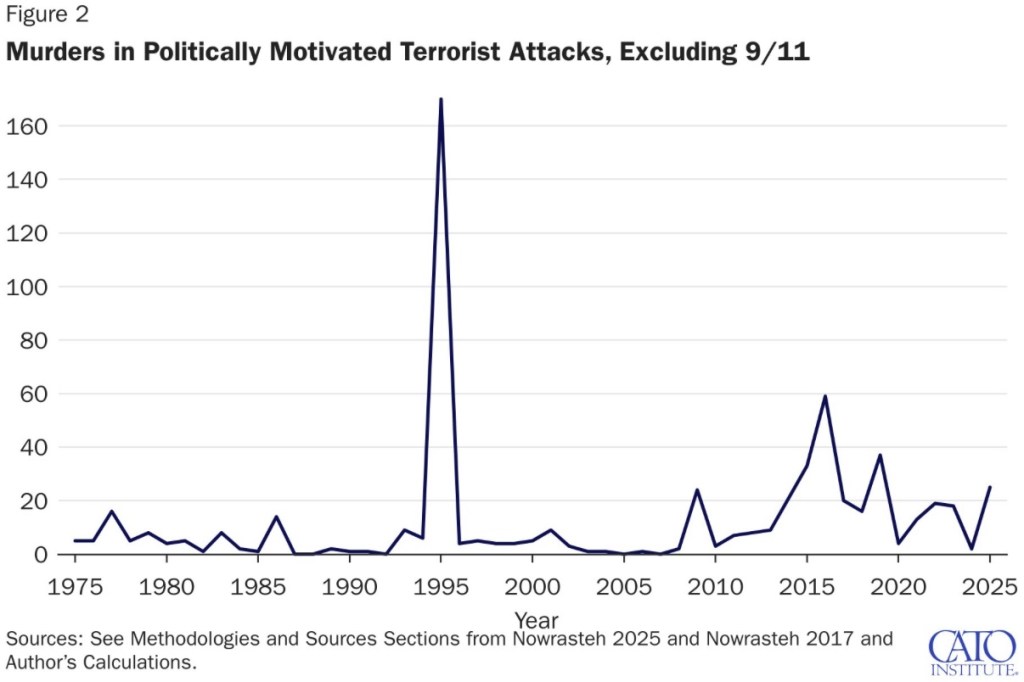
Margolis discusses a couple of major (and questionable) decisions made by the author or his sources:

—The Oklahoma City bombing in 1995 (168 deaths) was committed by Timothy McVeigh, an individual of ambiguous “anti-government” political persuasion who supported abortion rights. Those deaths were attributed to the right.

—The 2020 riots following George Floyd’s death resulted in 19 deaths. Of course, Antifa (which we’re confidently told doesn’t exist) and Black Lives Matter (BLM) were heavily involved, so this was clearly leftist violence. Those deaths aren’t counted,

These two adjustments alone would swing the attribution of deaths to a majority of leftist killers. Margolis then credits Amber Duke for identifying several additional misclassifications that occurred between 2015 and 9/10/2025 (the day prior to Kirk’s murder), during which there were 57 “politically-inspired” killers. She documents nine cases (26 fatalities and a number of serious injuries) of questionable political attribution. Several of these cases involved motives that are arguably nonpolitical, including severe psychological disorders, and at least one killer could have been motivated by a desire to promote a leftist politician (Tim Walz). I would probably accept a couple of these incidents as right-adjacent if not right-wing motivated, but the point is that ambiguities frequently compromise these ideological classifications.

Duke notes the head-scratching exclusion of a couple of incidents attributable to leftist passions: the BLM-affiliated Waukesha killer who plowed into a Christmas parade in his truck, killing six; a killing perpetrated by multiple BLM protestors; and a bomber at an IVF clinic that killed one person. Again, in the nine cases identified by Duke, the perps were either questionably classified ideologically or not classified at all. Correcting all of these errors swings the tally to 20 left-wing and 19 right-wing killers from 2015-9/10/2025.

Oddly, Duke takes no issue with the non-classification of the Pulse Nightclub shooting in 2016 (treated separately as Islamic terror). The killer was said to have had “issues” with gays, but apparently he was gay! And there were reports that he was motivated by opposition to U.S. foreign policy, which usually codes as left.

The ADL Weighs In

Duke also directs us to a critique by Ryan James Girdusky of some agitprop produced by the Anti-Defamation League (ADL). Of course, the ADL has a left-wing bias that comes through loud and clear in this report. As Duke summarizes,

“… they lump white nationalist inter-gang killings, domestic violence, and other non-ideologically motivated murders into its ‘right-wing political violence’ category.“

And here is David Harsanyi:

“The [ADL] list includes murders that occurred during attempted prison escapes, sex crimes, robberies, and family squabbles, none of which have anything to do with furthering the tenets of white supremacy or any cause. In one of the incidents, the police have yet to find a motive for the homicide.“

In case you still harbor any doubt about the ADL’s bias, their report actually excludes six deaths connected with the Zizians, a murderous trans cult. They also ascribe no political motive for Luigi Mangioni’s assassination of United Health Care CEO Brian Thompson because:

“… hostility towards the healthcare system or health insurance companies is not in itself an ideology and because a good portion of the anger on Mangione’s part may have stemmed from purely personal reasons .…”

The list, however, includes “right-wing” murders that occurred during attempted prison escapes, sex crimes, robberies, and family squabbles, none of which had anything to do with furthering the tenets of white supremacy or any cause. In one of these incidents, the police have yet to find a motive for the homicide.

Harsanyi offers further criticism of the FBI’s classifications and the Global Terrorism Database. Of the latter, he notes:

“It counted the Las Vegas mass shooter who murdered 59 people in 2017 as a right-wing ‘anti-government extremist.’ In truth, we have no clue what the shooter’s motivations were, unless the GTD has inside information from the FBI. Of the 32 other incidents the organization labeled right-wing terrorism that year, 12 were merely ‘suspected’ of being on the Right (mostly because they had white skin).“

More Systemic Misclassification

The CATO and ADL reports, as well as government statistics, are uniform in treating violence by Islamic extremists as a category apart from violence on the left and right. The Islamist category dominates the data on terrorist homicides due to 9/11 (87% of terrorist fatalities since 1975; excluding 9/11, Islamist attacks account for 23%). Separate treatment is based on alleged religious motives behind these acts. However, Islamic causes have garnered increasing support from the Left in the years since 9/11 and the War in Iraq. That became more palpable during the Obama years. It has culminated in a surge of aggressive anti-Zionism and support for not just a Palestinian state, but one extending from the river to the sea, which is code for genocide in Israel. Apparently, Hamas’ murderous raid into Israel on 10/7/2023 was a major touch point for this activism.

At present, there isn’t much ambiguity surrounding the leftist-Islamic alignment, despite what should seem like obvious points of tension. These include Islamic subjugation of women and harsh treatment of homosexuals. But in the West, leftists identify with the presumed victimhood status of Islamic populations. Certain cases of violence by Islamic actors in the U.S. can reasonably be counted now as leftist terror attacks. However, the reports aren’t tallied that way, which helps to foster the impression that the right instigates a larger share of violent and homicidal attacks.

Also problematic: “anti-government” actors have almost always been classified as right-wing. This is highly misleading. Both left-and right-wing anti-government violence tend to vary with which side is in power.

Non-Lethal But Could Be Lethal

Despite its severe shortcomings, the CATO report at least gives lip service to non-lethal violence … or what, for the grace of God, might have turned out to be non-lethal. This encompasses foiled efforts to harm, injuries of all sorts, arson, smashed windows, stolen merchandise, other property damage, and even threats to individuals or institutions, which tend to inflict emotional distress and other costs. Too much commentary hints at praise for the left’s “restraint” in perpetrating non-lethal violence! Protests accompanied by riots are described as “mostly peaceful”.

There is no question about the recent surge in left-wing violence, especially in 2025. Over the past few years, there have been several assassination attempts against high-profile individuals on the right, including Donald Trump and Charlie Kirk. Trans activists have perpetrated other killings. There have been multiple attacks on ICE agents and other law enforcement officers. We’ve witnessed persecution, intimidation, and attacks against Jews on college campuses and elsewhere. Riots have erupted in Portland, LA, New York, Atlanta, and other cities. The trend is not new, but the levels of unrest have been disquieting.

They Say, “Don’t Overreact”

Another factor is prosecutorial leniency. Violent leftist actions tend to be concentrated in urban areas where prosecutors are likely to share the actors’ ideology and give them a pass. This does nothing to discourage destructive behavior. As a civil libertarian, however, Nowrasteh warns in his CATO report:

“The big fear from politically motivated terrorism is that the pursuit of justice will overreach, result in new laws and policies that overreact to the small threat, and end up killing far more people while diminishing all our freedoms.“

I too have strong libertarian leanings, but the balance of risks should favor action to protect individuals and their property from threats of violent action, maintain public order, while not prejudging the intent of disturbances as “peaceful”.

Views on Violence

Official statistics and other reports on political violence by the left and right are unreliable. They tend to overstate right-wing inspired violence and understate left-wing inspired violence. The recent swing toward leftist acts of terror has been difficult to hide, however.

I’ll close by noting that the mainstream right and left seem to have considerably different attitudes toward politically-motivated violence. In my observation, when some fringe right-wing maniac, white supremacist, or militia group perpetrates violence (or so much as stages a public demonstration), the mainstream right tends to react with revulsion. When fringe leftists do the same, the mainstream left tends to rationalize and even support the uglies.

The Network Contagion Research Institute (NCRI) has noted the rise of “assassination culture”. Surveys show that violence against political opposition has more support from the left than the right. Social media has become a breeding ground upon which these sentiments can turn into action. From the last link:

“NCRI’s analysis, based on troves of social media data, reveals how fringe internet culture has helped build what the group calls ‘permission structures’ for violence. These are social environments—online or offline—where violent acts are no longer condemned but tacitly accepted, if not outright encouraged.“

This is what Christopher Rufo calls the “left-wing terror memeplex”, and it’s often less tacit than right out loud! It’s almost enough to make a sham of the explicit exceptions to protected speech defined by the First Amendment.
White Racialism, Identity Politics, and Crippling DEI

09 Thursday Nov 2023

Posted by Nuetzel in DEI, Identity Politics

≈ 1 Comment

Tags

Anti-discrimination law, Christopher Rufo, Colorblind Society, Comparative advantage, DEI, Diversity, Equity, George Floyd, Hobbesian, Identity Politics, Inclusion, Jim Crow Laws, Protected Classes, Racial Preferences, Racialism, racism, rent seeking, Segregation, Slavery, Social Constructs, Structural Racism, Tribalism, Tyler Cowen, Victimhood, Victor Davis Hanson, White Racialism, Zero-Sum Thinking

I’ve taken an extended hiatus from blogging while moving to a different part of the country. I haven’t posted here in over 10 weeks, but a new post appears below. I’m still tying-up loose ends from the move, but I’ll be trying to get back to posting more regularly … trying!

~~~~~~~~~~~~~~~~~~~~~~~~~~~~~~~~~~~~~~~

Absurd ideas about race and identity politics come from extreme elements on both the Left and the Right. Some leftists insist that race has no natural basis — that it’s simply a “social construct”. On the Right, a “racialist” contingent is promoting the “celebration of whiteness” and embracing racial preferences for whites. Treated as alternative pathways, I’d take “social construct”. It’s nonsense, of course, but the beautiful irony is that it provides a basis for stripping away from our institutions the entire diversity, equity, and inclusion (DEI) straightjacket. It’s almost as if those promoting race as a social construct wish to build a “colorblind” society. On the other hand, I suppose some think they can have their DEI cake along with a side of free choice to identify as anything they want: black, white, or furry.

Who Are the Racists?

People of good faith don’t harbor or act on racist tendencies. The mere recognition of racial/ethnic/cultural differences is not evidence of racism and does not preclude the treatment of all with fairness and due respect. It’s possible to respect, value, or fall in love with someone outside one’s own racial, ethnic, or cultural group of origin, even while holding a general affinity for one’s own group, as nearly everyone does.

But a few real racists are sprinkled across all races, ethnicities, cultures, and the full political spectrum. The “popular” racist stereotype as white male has been kept alive by the lingering echos of slavery in America, which ended nearly 16 decades ago, and the long hangover that included Jim Crow laws and segregation. Today, however, “white society” or “whiteness” is hardly the sole domain of prejudice.

Is Racialism Different?

Now, a few whites are promoting the celebration of “white identity” as a counterbalance to identity politics among non-whites. Ostensibly, this “white racialism” might be similar to celebrations of identity often practiced by minorities, which are also forms of racialism. Should white racialism be viewed as less savory than racialism practiced by racial minorities?

For most Caucasians, “being white” does not have much salience relative to other affiliations defining identity. That’s why white racialism seems odd to me. Sure, when forced to check a box, whites will check “Caucasian”, but “white identity” seems overly broad. There are too many distinct cultures and subcultures that dominate self-identity, such as national ancestry, religion, and cultural membership.

The same could be said for many other racial categories, but minority status and historical events (e.g., American slavery) help explain why broad categories often form cohesive identity groups. And, as Christopher Rufo notes in his great discussion of the racialist viewpoint, broad categories tend to be the most closely associated with racialism:

“Yes, left-wing racialism is indeed now deeply embedded in America’s institutions, and the demographic balance of the country has shifted in recent decades. And yes, the basic racial classification system in the United States broadly delineates continental origin—Europe, Africa, Latin America, Asia—in a way that is not arbitrary or meaningless. Terms such as ‘white,’ ‘black,’ ‘Latino,’ and ‘Asian,’ while often obscuring important variations within such groupings, have become the lingua franca and are useful shorthand descriptors for many purposes.”

There are individuals from all groups or “classes”, including whites, who react critically to aggressive expressions of identity by members of other classes. Perhaps that’s excusable, depending on the degree of zealotry on either part. The line between pride in race/ancestry/culture and fractious racialism might be hard to discern in some cases, but the chief distinction is rooted in explicit, demeaning and/or envious comparisons to “out-groups”. This might be damaging enough, but from there it can be a very short step into outright racism.

A preoccupation with the historic disadvantages of one’s race can be disempowering to an individual and destructive in a social sense. I believe the white racialist phenomenon belongs in that category. The presumed “disadvantages” of whiteness are very contemporary, however, rooted in policies dating back only to the widespread adoption of racial preferences for non-white “protected classes” and DEI.

Preferences For All

Imagine the racialist policies now practiced widely in government, industry, and academia — particularly racial preferences on behalf of protected classes — but now applied on behalf of heretofore unprotected classes as well. For example, what if some proportion of jobs, admissions, or other coveted placements were set aside for whites? If whites represent 50% of the population, then 50% of hires or admissions would be reserved for whites.

Some might assume that this treatment is already implied by existing racial preferences, but that’s not the case. In the wake of George Floyd’s death, just 6% of new hires among S&P companies were white, according to Bloomberg News.

Nevertheless, such a white racialist turnabout would be a colossal mistake. Adding strict limits to the application of existing preferences might be a good thing, but white racial preferences would buttress the entire system of racial preferences as an institution and add more rigidity to the operation of labor markets. From an economic viewpoint, it would be just as pernicious as racial preferences generally.

Racial preferences of any kind freeze labor markets and impair the allocation of human resources to their most-valued uses. In fact, placing one individual into a position on any basis other than their qualifications implies that two individuals must be placed into positions in which they lack comparative advantage relative to each other. Little by little, that means lost output and upward price pressure. It is a mechanism that short circuits gains from trade, shriveling the benefits that the most and least talented confer on society at large. Extending preferences to whites would only serve to further institutionalize this damaging practice.

Adherence to numerical preferences is to pretend that people can be treated less as individuals and more like interchangeable parts… except with respect to their value as “class members”. Racial preferences are presumed to be a remedy for so-called structural racism, as opposed to racism by individuals. But they involve classification and favor the so-called “oppressed” at the expense of designated “oppressors”. The latter, almost without exception, had no role oppressive regimes of the past. Favoritism of this kind necessarily means reverse discrimination and fails to match individuals to roles in an optimal fashion.

Whether publicly or privately imposed, racial preferences often undermine those they are purported to help by placing individuals into positions for which they may not be competitive. This can sabotage an individual’s long-term success. It goes without saying that preferences build resentment among the “unprotected”, which goes to the impetus for “white racialism”. Indeed, preferences are not always popular with protected classes either. That’s because they interfere with merit-based decision-making and are perceived to stigmatize those presumed to benefit.

The Fixed Pie Is a Lie

Racialism reflects zero-sum thinking, a hallmark of DEI initiatives. Tyler Cowen quoted the abstract of a recent NBER working paper that found:

“… a more zero-sum mindset is strongly associated with more support for government redistribution, race- and gender-based affirmative action, and more restrictive immigration policies.”

Zero-sum thinking is fundamental to rent-seeking behavior, which is motivated by either malevolent greed or perceptions of victimhood. Victimhood and rent seeking is at the heart of calls for DEI, to say nothing of more radical proposals like reparation payments. White racialism attempts to get in on the action by positing that whites are oppressed under the current institutional dominance of DEI. But the misguided presumption that every identity group should have their own preferences or quotas broadens the emphasis on redressing perceived harms and redistributing rewards — zero-sum activities.

These zero-sum efforts waste energy and resources, harming our ability to produce things that enhance well being. Ultimately, they are actually negative-sum activities, and they also breed hatred.

Race is obviously determined by genetics, but I’d be happy to pretend it’s a mere social construct if that would help get us to a “colorblind” society.

Conclusion

There’s a huge irony in the racialism exercised by both traditional and “white racialist” DEI advocates: it neglects the most fundamental and just application of diversity: equality of opportunity. This principle incorporates the concept of diversity without sacrificing economic efficiency. We’ve largely abandoned it in favor of equality of outcomes via racial preferences, even at a time when society has become enlightened with respect to racial differences. In doing so, we’ve unintentionally chosen another form of explicit racial victimization.

To close, here’s a good summary of the dangers of racialism and identity politics offered by Victor Davis Hanson:

“Anytime one ethnic, racial, or religious group refuses to surrender its prime identity in exchange for a shared sense of self, other tribes for their own survival will do the same.

All then rebrand their superficial appearance as essential not incidental to whom they are.

And like nuclear proliferation that sees other nations go nuclear once a neighboring power gains the bomb, so too the tribalism of one group inevitably leads only to more tribalism of others. The result is endless Hobbesian strife.”

And that’s how white racialism fits right in with the pernicious politics of identity. When you can, vote for the elimination, or at least reform, of DEI policies and practices, not for a reinforcement of identity politics.

Ubiquitous Guilt: EEOC Disparate Impact Liability

22 Thursday Sep 2022

Posted by Nuetzel in Discrimination, Regulation

≈ 3 Comments

Tags

Antonin Scalia, Automation, Bias, Business Necessity, Chevron Deference, Christopher Rufo, Civil Rights Act, Credit Checks, Criminal Background Checks, DEI, discrimination, Disparate impact, Due Process, EEOC, Employment Practices, Equal Protection, Four-Fifths Rule, Gail Heriot, Griggs v. Duke Power Co., Major Questions Doctrine, Non-Delegation Doctrine, Protected Groups, Separation of Powers, Stakeholder Capitalism, Strength Tests, Title VII, Warren Burger, Written Job Tests

A key part of the Civil Rights Act of 1964 was Title VII, which dealt with employment discrimination. Title VII applied only to intentional discrimination, but it didn’t take long for the Equal Employment Opportunity Commission (EEOC), the agency charged with administering Title VII, to find ways to expand the scope of its enforcement mandate under the law. The EEOC eventually managed to convince virtually all parties, including employers, employees, job applicants, attorneys, and even the courts, that the law prohibited employment practices having disparate impacts on groups protected from actual discrimination under the law. Predictably, this warped reinterpretation created severe distortions to the efficiency and fairness of labor market outcomes .

Another Rogue Agency

On the EEOC’s complete and erroneous reimagining of Title VII, Gail Heriot’s “Title VII Disparate Impact Liability Makes Almost Everything Presumptively Illegal” is a must read. Heriot is a Professor at the University of San Diego School of Law and is a member of the U.S. Commission on Civil Rights. This post attempts to summarize most of the important points in Heriot’s paper, so if you don’t have time for Heriot’s paper, read on. All errors are mine, of course!

Heriot provides an incredible case study on the dangers of regulatory overreach. She first discusses the EEOC’s blatant usurpation of Congressional power:

“It is hardly surprising that EEOC officials would undertake to publish answers to the questions they were hearing repeatedly…. But publishing such ‘guidances’ also had the potential to spin out of control. The temptation would always be to use them to establish what the EEOC staff wanted the law to be rather than what it was. Instead of interpreting Title VII in good faith, guidances would soon become quasi-legislation—disguised as interpretation, but in reality imposing new duties on employers not found in Title VII itself.

None of this should be surprising. It is in the nature of bureaucracy. It naturally seeks to expand its powers, often beginning by occupying niches that are otherwise unoccupied. Over time, a little power often becomes a lot of power. What is surprising is how upfront EEOC officials were about their tactics in accumulating that power.”

Having gone this far, one might be tempted to ask the EEOC what limiting principle they actually apply to determine whether various employment and hiring practices are permissible. Are level of education, industry experience, and tests of physical and cognitive faculties verboten? The answer that is there is no consistent, limiting principle. Instead, Heriot says the EEOC “picks its battles” (see below). She also describes the EEOC’s adoption of a so-called “four-fifths rule”, which is about as arbitrary as it gets. It means the EEOC will challenge an employment practice only if it leads to a selection of any protected group at a rate less than 80% of the most-selected group. That is, the “disparate impact” must be less than 20% to rule out a challenge. This rule appears nowhere in Title VII.

Job Qualifications? You’re Guilty!

Unfortunately, as Heriot takes pains to demonstrate, it’s virtually impossible to identify a hiring guideline or method of employee assessment that does not have a disparate impact. The examples she provides on pp. 34 – 37 of her paper, and on p. 40, are convincing. Furthermore, the EEOC’s “four-fifths” rule hardly narrows the potential for challenge at all.

“Selection rates of less than four-fifths relative to the group with the highest rate are extremely common. Just as everything or nearly everything has a disparate impact, everything or nearly everything has a selection rate that fails the ‘four fifths rule’ for some race, color, religion, sex, or national origin group.”

So the EEOC is allowed to operate with tremendous discretion. Again, Heriot says the agency “picks its battles”, focusing on challenges to screening tools like “written tests, physical strength and endurance tests, criminal background tests [sic], high school diploma requirements, personal credit histories, residency requirements, and a few others.”

This regulatory environment encourages employers to keep job requirements vague, sometimes to the point at which potential applicants might not be sure what the job qualifications really are, or exactly what the job function entails. One upshot is that this makes it harder to detect and prove actual discrimination, and it often leads to more arbitrary decisions by hiring managers, which may, in fact, involve real discrimination, including nepotism and/or cronyism.

Unbiased Intent Doesn’t Matter

Heriot points to a disastrous decision by the Supreme Court that, perhaps unintentionally, helped legitimize the concept of disparate impact as legal doctrine, and as a valid cause of action by plaintiffs against employers. In Griggs v. Duke Power Co. (1971), the Court rejected the premise that an employer’s innocence with respect to their intent to discriminate was an inadequate defense of an employment practice that had adverse consequences to a protected group. Heriot quotes the opinion of Chief Justice Warren Burger:

“… good intent or absence of discriminatory intent does not redeem…. Congress directed the thrust of the Act to the consequences of employment practices, not simply the motivation.”

It’s as if the Court convinced itself that adverse consequences prove actual discrimination, even when there is no intent to discriminate. The Court also emphasized that it’s decision was based on “general deference” to the EEOC! And this was years before the unfortunate Chevron Doctrine (judicial deference to administrative agencies on interpretation of law) was formally established by the Court. Heriot and others assert that the decision in Griggs would have astonished the authors of Title VII.

Heriot also discusses changes in the treatment of “business necessity” as a defense against complaints of disparate impact. It is generally the employer’s burden to show the “necessity” of a challenged hiring practice. “Necessity” was the subject of several Supreme Court decisions in the 1970s and 1980s, but the Court stopped short of requiring an employer to show that a practice was “essential”. In one case, the court shifted some of the burden back onto the plaintiff to show that a practiced lacked necessity. In 1990, there was concern in the Bush Administration and Congress that the difficulty of proving business necessity would eventually lead to the adoption of racial quotas by employers in order to prevent EEOC challenges, though the authors of Title VII had staunchly opposed quotas. While the original hope was that the Civil Rights Act of 1991 would resolve questions about “business necessity” and the burden of proof, it did not. Instead, it can be said that it legitimized disparate impact liability, with conditions. The standard for proving necessity, based on Court decisions, evolved to become more strict with time. There are cases in which courts seem to have left the EEOC to define “business necessity”, as if the EEOC would be in a better position to do that than the business itself!

Inviting Discrimination

Heriot devotes part of her paper to the perverse effects of disparate impact. When employers are faced with prohibitions or the threat of action against a certain practice, whether it be tests of aptitude, strength, or screening on criminal or credit records, they may abandon those devices and opt instead for “informal” proxies. The use of proxies, however, often leads to instances of actual discrimination, whether born of conscious or unconscious bias on the part of hiring managers.

Heriot provides a number of examples of the proxy phenomenon, some of which have been confirmed by empirical research. For example, an employer interviewing candidates for a job that requires math proficiency might reasonably use a test of math skill as a key criterion. If such a test is prohibited, the hiring manager might be tempted to hire an Asian candidate, since Asians have a reputation for good math skills. Similarly, an applicant of West European ancestry might be favored for a position requiring excellent grammar skills, absent the ability to explicitly test grammatical skill. Candidates for a job requiring a certain level of physical strength could be evaluated by various tests of strength, but barring that, a hiring manager might be inclined to hire based on gender.

When criminal background checks are prohibited, employers might be tempted to use proxies such as gender and race as a substitute. Likewise, if it’s forbidden to check a candidate’s credit record to gauge reliability, other proxies might lead to discrimination against members of protected classes. Needless to say, these kinds of outcomes are precisely the opposite of what the EEOC hopes to achieve.

As Heriot further notes, the outcomes can be much systematic and destructive than a bit of one-off discrimination in hiring, promotion, pay raises, or task assignment. These may inflict damage reaching well beyond having the wrong people gaining favorable labor market outcomes. For example, an employer might choose to relocate operations to a “safer” or more affluent community, barring an ability to perform criminal background or credit checks. Or businesses might decide to substitute capital for labor, given the interference in their attempts to identify the best job candidates. The difficulty in screening also creates an incentive to automate, just as premature automation is becoming more common with rising wage floors imposed by government.

Killing Jobs and Competition

Like many forms of regulation, however, large firms in less competitive industries are usually better positioned to survive EEOC scrutiny than smaller firms in competitive markets. Indeed, we often see large market players embrace regulation because it gives them a competitive advantage over smaller rivals. In this case, we see large firms adopting their own diversity, equity, and inclusion (DEI) goals. This is not solely related to the threat of EEOC challenges, however. Private lawsuits alleging discrimination or disparate impact are also a concern, as is pleasing activists inside and outside the company. Nevertheless, as Christopher Rufo reveals, there is growing push-back against the corporate DEI regime. Let’s hope it continues to gain traction.

Unconstitutional Executive Discretion

Heriot also dedicates part of her paper to constitutional issues related to the EEOC’s broad discretion in the application of disparate impact to employment practices. For one thing, disparate impact is a direct source of discrimination: when members of “protected groups” are awarded opportunities based on the possibility of disparate statistical outcomes, it means the majority candidates are denied those opportunities, no matter their qualifications. This is outright discrimination, and it’s instigation by a federal agency constitutes an explicit denial of equal protection under the law.

It should be no surprise that many consider disparate impact actions against employers to be denials of due process. Furthermore, when a federal agency like the EEOC exercises broad discretion, the so-called non-delegation doctrine should come into play. That is, the EEOC makes judgements on matters that are not necessarily authorized Congress. Thus, there are legitimate questions as to whether the EEOC’s discretion is a violation of the separation of powers. Granted, the courts have long deferred to administrative agencies in the interpretation of enabling statutes, but the Supreme Court has taken a new tack under Chief Justice Roberts. In some recent decisions, the Court has relied on a new “major questions” doctrine to place certain limits on executive discretion.

Conclusion

Hiring? Creating jobs? Better not get picky about checking your applicants’ skills and backgrounds or you risk liability for contributing to the statistical malaise of one, or of many, protected groups. That’s how it is under “disparate impact” rules imposed by the EEOC. The success of your business be damned!

Gail Heriot’s excellent paper details the way in which the EEOC transformed the meaning of its enabling legislation, expanding its reign over employment practices across the nation. She demonstrates the breadth of disparate impact rules with examples showing that virtually any attempt at systematic screening of job applicants can be held to be illegal. Your intent to hire the most qualified candidate without bias doesn’t matter, under an insane Supreme Court decision that buttressed the EEOC’s authority. As Heriot says, “… everything is presumptively illegal”. She also describes how disparate impact liability leads to employment decisions based on proxy criteria, which often lead to actual (even if unintended) discrimination. Further unintended consequences are the possibility of larger job losses in minority communities and less competition in product and labor markets. Finally, Heriot delineates several constitutional violations inherent in broad EEOC discretion and the enforcement of disparate impact.

One day a court challenge to the EEOC and disparate impact liability might rise to the level of the Supreme Court. Justice Antonin Scalia expected it, but it still hasn’t come before the Court. It should! Another way to do battle against the EEOC’s scourge is to challenge corporations who cow-tow to activists and to the EEOC with their own DEI initiatives. This manifestation of stakeholder capitalism is a cancer on the wealth and productivity of the U.S. economy, resting side-by-side with disparate impact liability.

Follow Sacred Cow Chips on WordPress.com

Recent Posts

  • Immigration and Merit As Fiscal Propositions
  • Tariff “Dividend” From An Indigent State
  • Almost Looks Like the Fed Has a 3% Inflation Target
  • Government Malpractice Breeds Health Care Havoc
  • A Tax On Imports Takes a Toll on Exports

Archives

  • December 2025
  • November 2025
  • October 2025
  • September 2025
  • August 2025
  • July 2025
  • June 2025
  • May 2025
  • April 2025
  • March 2025
  • February 2025
  • January 2025
  • December 2024
  • November 2024
  • October 2024
  • September 2024
  • August 2024
  • July 2024
  • June 2024
  • May 2024
  • April 2024
  • March 2024
  • February 2024
  • January 2024
  • December 2023
  • November 2023
  • August 2023
  • July 2023
  • June 2023
  • May 2023
  • April 2023
  • March 2023
  • February 2023
  • January 2023
  • December 2022
  • November 2022
  • October 2022
  • September 2022
  • August 2022
  • July 2022
  • June 2022
  • May 2022
  • April 2022
  • March 2022
  • February 2022
  • January 2022
  • December 2021
  • November 2021
  • October 2021
  • September 2021
  • August 2021
  • July 2021
  • June 2021
  • May 2021
  • April 2021
  • March 2021
  • February 2021
  • January 2021
  • December 2020
  • November 2020
  • October 2020
  • September 2020
  • August 2020
  • July 2020
  • June 2020
  • May 2020
  • April 2020
  • March 2020
  • February 2020
  • January 2020
  • December 2019
  • November 2019
  • October 2019
  • September 2019
  • August 2019
  • July 2019
  • June 2019
  • May 2019
  • April 2019
  • March 2019
  • February 2019
  • January 2019
  • December 2018
  • November 2018
  • October 2018
  • September 2018
  • August 2018
  • July 2018
  • June 2018
  • May 2018
  • April 2018
  • March 2018
  • February 2018
  • January 2018
  • December 2017
  • November 2017
  • October 2017
  • September 2017
  • August 2017
  • July 2017
  • June 2017
  • May 2017
  • April 2017
  • March 2017
  • February 2017
  • January 2017
  • December 2016
  • November 2016
  • October 2016
  • September 2016
  • August 2016
  • July 2016
  • June 2016
  • May 2016
  • April 2016
  • March 2016
  • February 2016
  • January 2016
  • December 2015
  • November 2015
  • October 2015
  • September 2015
  • August 2015
  • July 2015
  • June 2015
  • May 2015
  • April 2015
  • March 2015
  • February 2015
  • January 2015
  • December 2014
  • November 2014
  • October 2014
  • September 2014
  • August 2014
  • July 2014
  • June 2014
  • May 2014
  • April 2014
  • March 2014

Blogs I Follow

  • Passive Income Kickstart
  • OnlyFinance.net
  • TLC Cholesterol
  • Nintil
  • kendunning.net
  • DCWhispers.com
  • Hoong-Wai in the UK
  • Marginal REVOLUTION
  • Stlouis
  • Watts Up With That?
  • Aussie Nationalist Blog
  • American Elephants
  • The View from Alexandria
  • The Gymnasium
  • A Force for Good
  • Notes On Liberty
  • troymo
  • SUNDAY BLOG Stephanie Sievers
  • Miss Lou Acquiring Lore
  • Your Well Wisher Program
  • Objectivism In Depth
  • RobotEnomics
  • Orderstatistic
  • Paradigm Library
  • Scattered Showers and Quicksand

Blog at WordPress.com.

Passive Income Kickstart

OnlyFinance.net

TLC Cholesterol

Nintil

To estimate, compare, distinguish, discuss, and trace to its principal sources everything

kendunning.net

The Future is Ours to Create

DCWhispers.com

Hoong-Wai in the UK

A Commonwealth immigrant's perspective on the UK's public arena.

Marginal REVOLUTION

Small Steps Toward A Much Better World

Stlouis

Watts Up With That?

The world's most viewed site on global warming and climate change

Aussie Nationalist Blog

Commentary from a Paleoconservative and Nationalist perspective

American Elephants

Defending Life, Liberty and the Pursuit of Happiness

The View from Alexandria

In advanced civilizations the period loosely called Alexandrian is usually associated with flexible morals, perfunctory religion, populist standards and cosmopolitan tastes, feminism, exotic cults, and the rapid turnover of high and low fads---in short, a falling away (which is all that decadence means) from the strictness of traditional rules, embodied in character and inforced from within. -- Jacques Barzun

The Gymnasium

A place for reason, politics, economics, and faith steeped in the classical liberal tradition

A Force for Good

How economics, morality, and markets combine

Notes On Liberty

Spontaneous thoughts on a humble creed

troymo

SUNDAY BLOG Stephanie Sievers

Escaping the everyday life with photographs from my travels

Miss Lou Acquiring Lore

Gallery of Life...

Your Well Wisher Program

Attempt to solve commonly known problems…

Objectivism In Depth

Exploring Ayn Rand's revolutionary philosophy.

RobotEnomics

(A)n (I)ntelligent Future

Orderstatistic

Economics, chess and anything else on my mind.

Paradigm Library

OODA Looping

Scattered Showers and Quicksand

Musings on science, investing, finance, economics, politics, and probably fly fishing.

  • Subscribe Subscribed
    • Sacred Cow Chips
    • Join 128 other subscribers
    • Already have a WordPress.com account? Log in now.
    • Sacred Cow Chips
    • Subscribe Subscribed
    • Sign up
    • Log in
    • Report this content
    • View site in Reader
    • Manage subscriptions
    • Collapse this bar
 

Loading Comments...